Prowl by Colleen Coble Summary, Characters and Themes
Prowl by Colleen Coble is a suspense novel set around The Sanctuary Wildlife Preserve in Alabama, where dangerous animals and even more dangerous people share the same fenced-in world. Paradise Alden, the preserve’s veterinarian, is trying to start over—launching a small-town clinic, settling into a new life with her boyfriend Blake Lawson, and chasing answers about family she never knew she had.
But when a worker is found dead inside a tiger enclosure, it’s clear the preserve is being watched and manipulated. As threats mount and old secrets surface, Paradise and Blake must untangle who wants her gone—and why. It’s the 2nd book in the Sanctuary series.
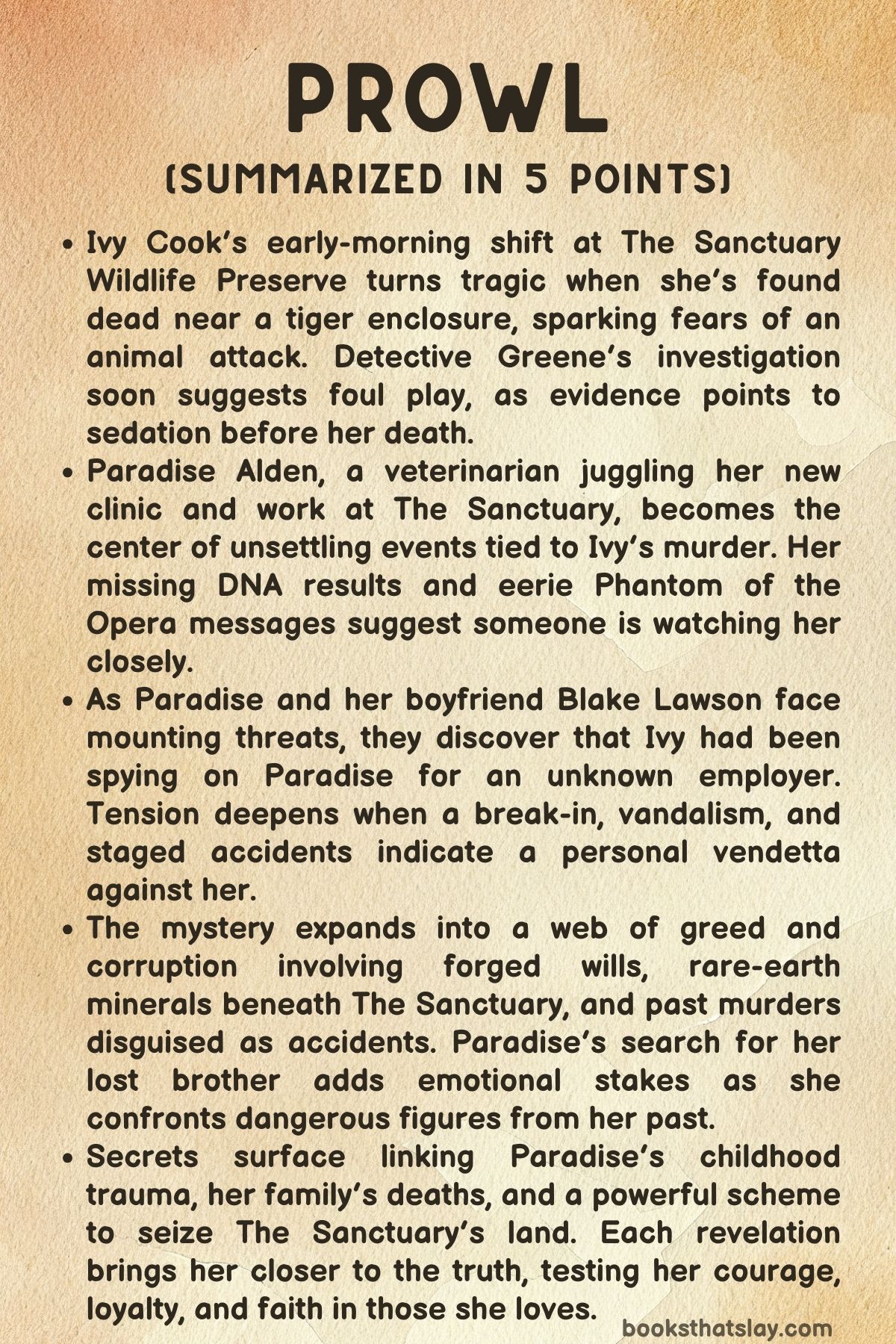
Summary
Before sunrise at The Sanctuary Wildlife Preserve, Ivy Cook goes about her grim routine of feeding the predators. She hates the smell, the danger, and the constant awareness that one mistake could get her killed.
Still, she needs the job because she owes money from gambling. She also has a second reason for being there: she’s been paid by an anonymous person to gather information about the preserve’s veterinarian, Paradise Alden, and report back quickly so she can disappear.
While feeding the big cats, Ivy reaches the tiger area and approaches Raj, a tiger kept separated because he’s unpredictable. As she steps inside the outer perimeter, she realizes something is wrong—the inner gate is already open.
Raj moves toward her with calm focus. Ivy backs away, scrambling for the exit gate, when a sharp sting hits her neck.
Her limbs weaken and her thoughts blur. She understands, too late, that someone has already decided how this morning ends.
Elsewhere, Paradise is in her element. She treats a newly arrived black jaguar named Midnight for an abscessed tooth, working smoothly with her vet tech, Warren Gibson.
After the procedure, she heads into town for the first day at her own clinic, Pawsome Pets, in Nova Cambridge. A cheerful surprise awaits her: her boyfriend, Blake Lawson, and his mother, Jenna Anderson, have organized a small celebration with Jenna’s young sons, Isaac and Levi.
Paradise is welcomed warmly by townspeople, and for a few hours her life feels stable.
That calm shatters when trouble at the preserve pulls everyone back. Blake notices the utility vehicle near the tiger area and sees signs the feeding routine has been interrupted.
Ivy’s car is still on site, but she is missing. Blake begins feeding the predators himself, his worry rising with every enclosure he reaches.
When he arrives at Raj’s habitat, the tiger stares toward a corner. Blake follows the animal’s gaze and finds Ivy’s body inside the inner enclosure, blood everywhere.
The inner gate swings slightly, and drag marks suggest she was pulled in. Blake calls for help, locks Raj away, and waits for authorities.
Paradise, driving toward The Sanctuary, sees emergency vehicles racing in the same direction and fears the worst for Jenna’s boys. When she arrives, she finds Jenna and the children safe, but the scene around the predator enclosures is tense.
Detective Creed Greene takes charge, and his manner is sharp and suspicious, especially toward Blake. Forensic tech Nora Craft arrives to process evidence.
Blake explains what he found, but Greene’s attention lingers on the fact that Blake has access to tranquilizers and dart equipment used at the preserve.
As the investigation begins, Paradise faces another unsettling mystery. She has been waiting for DNA test results that might reveal a brother she didn’t know existed.
She receives an email saying the results are ready, but the attachment is gone. Customer service confirms the report appears to have existed and then vanished.
Soon after, she learns the company has no record of her samples being received at all and offers a free retest. Paradise can’t shake the feeling that someone deliberately interfered.
Then the harassment starts. Paradise receives a call that plays music from The Phantom of the Opera.
She finds a note hidden in her bedsheets quoting ominous lines from the show. When she checks her security camera footage, she sees a hooded figure climbing the stairs at night, unlocking her apartment door, and entering.
The intruder leaves no obvious damage—only the message that Paradise is being watched. Blake upgrades her security with new locks, more cameras, and motion lights, and insists she needs a way to protect herself.
The threats become more personal and more dangerous. Paradise finds animal feces placed on the driver’s seat of her car.
Greene returns with a major update: Ivy’s death was staged. Ivy had Telazol in her bloodstream and a puncture wound consistent with a dart.
Someone sedated her and arranged the scene to suggest she was killed by a tiger. Instead of focusing on unknown suspects, Greene presses harder on Blake, demanding access to the tranquilizer supply and equipment.
Paradise, furious at Greene’s behavior and accusations, pushes back and threatens to file a complaint.
Blake takes Paradise to a shooting range to teach her firearm safety. Paradise is uneasy about the idea of aiming at anyone, but she learns the basics and practices carefully.
The lesson gives her a sense of control—until the next attack proves just how far the stalker will go. Driving home at night with rescued kittens in a carrier, Paradise’s car speakers suddenly blast Phantom music from a USB drive she didn’t plug in.
She realizes someone planted it while her car was parked at The Sanctuary. Moments later she hears a rattle inside the car: a rattlesnake is loose in the cabin.
Paradise escapes and injures her shoulder in the process. Blake arrives and confirms it’s an eastern diamondback.
The snake slips away, but the message is clear—someone is willing to kill her indirectly and make it look like an accident.
Determined to find answers, Paradise visits Ivy’s grandmother, Karen Cook, who admits Ivy had been paid to gather information about Paradise. Karen believes the employer was “someone from your past” curious about Paradise’s return and urges her to list people from her teen years.
Paradise and Blake begin combing through old connections, old yearbooks, and faint memories, trying to identify who might be behind the pressure campaign.
A major break comes from drone footage collected by a local teen, Mason Taylor. Reviewing the files, Paradise and Blake spot a hooded figure near the big cat habitats and, on night footage from the evening before Ivy’s death, see someone on a bicycle unlocking the tiger enclosure gates and leaving one ajar.
The drone captures the person’s face: Lloyd Adams, Paradise’s former foster father. They decide to go through Police Chief Jane Dixon rather than Greene and make copies to protect the evidence.
As Paradise’s old life rises to the surface, so does a new danger connected to the land itself. Soil tests reveal rare earth elements under The Sanctuary’s property—worth millions, but likely requiring the park to be sold or relocated.
An investigator named Nicole Iverson even appears and offers fifteen million dollars on behalf of an unnamed buyer. Blake refuses, but the offer confirms that outside forces now know what lies beneath the preserve.
At the same time, a separate threat grows: questions about ownership. The Sanctuary was bought from Mary Steerforth after her husband Allen died years earlier in what was officially labeled an accident.
Mary has long believed Allen was forced off the road and then framed as a drug user. Paradise and Blake discover troubling details—an injection mark on Allen’s body, an incomplete police report, and signs that someone tampered with evidence.
Mary’s nephew Dean, known for past meth dealing, seems obsessed with locating a will that could undo the sale and reclaim the property.
Break-ins and intimidation continue. Blake’s apartment is burglarized, and camera footage suggests Dean.
Paradise and Blake find Dean’s old white truck hidden under a tarp and uncover paint traces that could link it to Allen’s crash. Forensic checks strengthen their suspicion that Allen was murdered.
Then the will appears—found hidden in a barn’s hayloft—and it leaves everything to Dean. If it is real, Jenna could lose The Sanctuary.
If it is fake, someone is using it as leverage to force the family off the land. Elowen, Dean’s ex, finally confesses privately that the will is forged and that Dean forged it.
She also reveals Dean admitted to killing Allen by injection and tried to pressure her into forging signatures before. Elowen is terrified of testifying, but her confession clarifies the stakes: Dean is willing to ruin lives to get the property back.
Meanwhile, Paradise’s DNA search finally connects her to a close family match: Drew Bartley, a detective from Atlanta who believes they share the same mother. Drew arrives with proof and an urgency that goes beyond curiosity—his biological father died shortly before Paradise’s adoptive parents were murdered, and he suspects the cases may be linked.
Paradise gives him old items from the attic to help, hoping this connection might also explain why someone is desperate to stop her from learning the truth.
The stalker escalates from threats to kidnapping. During an outing, Jenna’s son Levi disappears.
A note demands they search a specific area and warns that next time they won’t find him. Levi is discovered bound and gagged, alive but traumatized.
The police produce a composite sketch that resembles Adams, and Jane later arrests Adams, finding a vial of Telazol in his room. Adams admits Ivy tried to blackmail him for money and says he killed her.
Yet Paradise and Blake believe he was working for someone else—someone smarter and more invested.
Paradise pushes to uncover the larger conspiracy. A crucial clue emerges: Adams’s cousin is Roger Dillard, Abby’s father and a longtime local figure.
Paradise’s memories begin to sharpen, including a childhood music box connected to Phantom themes and flashes of the night her parents were murdered. When Paradise confronts Mary Steerforth for answers, she finds Mary badly injured under her house.
Mary whispers apologies and says “they had to have both properties.” Before Paradise can get help, she is attacked from behind and taken.
Blake tracks Paradise using a locator app and arrives to find Mary dead and Paradise gone. The signal moves offshore.
Paradise wakes bound on an airboat in swamp wetlands with Dean Steerforth. Dean admits the will is forged and says he struck Mary with a crowbar to stop her from calling Jane.
He reveals the motive: the rare earth deposit is richest on The Sanctuary’s land, and the deal requires access through the preserve. Roger Dillard owns the other property needed and is involved.
Dean plans to dump Paradise where animals will destroy evidence.
Blake forces Roger to take him into the delta on an airboat, but Roger turns on him, pulling a gun and revealing he arranged Paradise’s abduction to protect the fortune. Blake manages to outsmart Roger, disarm him, and leave him stranded.
He continues alone, following Paradise’s signal.
In the swamp, Paradise works one hand free and manages to draw her pistol. When she hears another airboat approaching, she faces Dean.
In the standoff that follows, she shoots him in the chest. Dean falls into the water and disappears.
Blake arrives moments later, and the two reunite, shaken but alive.
Afterward, police search the wetlands. Roger vanishes; only part of him is found, and authorities believe an alligator killed him while he fled.
Adams takes a plea deal and tells police what he knows, and investigators conclude Roger’s desperation and greed drove the plot. Paradise struggles with the reality that she killed Dean in self-defense, but Blake stays close, helping her steady herself.
Drew remains in contact, determined to keep digging into their shared history and the older murders. With the immediate threats stopped, Paradise and Blake turn toward rebuilding and protecting The Sanctuary’s future, now aware that some secrets have been answered—and others are finally within reach.
Characters
Paradise Alden
Paradise Alden stands at the emotional and moral center of Prowl, embodying both compassion and courage in the face of escalating danger. As a veterinarian, she is deeply empathetic, not just toward animals but also toward the people around her.
Her nurturing nature contrasts sharply with the malevolence that surrounds The Sanctuary Wildlife Preserve. Beneath her composed exterior lies a woman burdened by trauma—haunted memories of her parents’ murder, the mystery of her adoption, and the unknown identity of her brother.
Paradise’s development across the novel charts her evolution from quiet determination to active defiance. The threats against her—from the Phantom-themed torment to the venomous manipulations of those around her—push her toward reclaiming her agency.
Her moral compass remains unwavering even when forced to confront violence, as seen when she kills Dean in self-defense and grapples with the psychological aftermath. Through Paradise, Colleen Coble explores themes of identity, inherited pain, and moral strength, portraying a heroine whose compassion does not preclude power.
Blake Lawson
Blake Lawson represents steadiness, loyalty, and the embodiment of quiet heroism. As both Paradise’s protector and romantic partner, he navigates a world that constantly tests his integrity.
His background as the caretaker of The Sanctuary and his sense of responsibility toward his family highlight his grounded nature. Blake’s love for Paradise deepens his character—his protective instincts occasionally border on overbearing, but they stem from genuine fear of losing her.
His confrontation with corruption, his conflict with Detective Greene, and his efforts to preserve the preserve’s legacy all reinforce his role as the moral and emotional anchor of the story. Blake’s bravery is pragmatic rather than theatrical—he fights not for glory, but to safeguard what he loves.
His relationship with Paradise matures through shared trials, revealing a partnership built on respect, faith, and resilience rather than mere romance.
Ivy Cook
Ivy Cook serves as both a catalyst and a cautionary figure in Prowl. Her death ignites the mystery that drives the narrative, but her life—marked by desperation, debt, and deceit—reflects the destructive power of moral compromise.
Ivy’s decision to infiltrate The Sanctuary and extract information about Paradise positions her as both victim and perpetrator. Her vulnerability, born from financial ruin and manipulation, humanizes her even as she participates in wrongdoing.
The discovery that she was murdered rather than killed by a tiger underscores the calculated cruelty of those exploiting her. Ivy’s tragic arc reinforces one of the novel’s recurring messages: that greed and desperation often make people pawns in larger, more sinister games.
Through her, the story gains emotional texture and moral complexity, reminding readers that even flawed individuals can evoke sympathy and regret.
Detective Creed Greene
Detective Creed Greene epitomizes institutional corruption and the abuse of power. From his first appearance, Greene exudes intimidation, chauvinism, and a willingness to manipulate justice for personal gain.
His treatment of Paradise—marked by condescension and harassment—reveals not only his moral decay but also his complicity in the broader web of deceit surrounding The Sanctuary. Greene’s character functions as a thematic counterweight to Paradise’s integrity; he embodies the rot within systems meant to protect.
By exposing his corruption and misconduct, Coble uses him to critique authority figures who exploit their position. Greene’s eventual downfall, though not the primary focus, reinforces the story’s moral structure: justice, even when delayed, finds its way through persistence and courage.
Jenna Anderson
Jenna Anderson, Blake’s mother, brings warmth and moral grounding to the turbulent events of Prowl. A widowed mother raising two young sons, she symbolizes family, resilience, and faith amid chaos.
Her home becomes a refuge for Paradise, not only physically but emotionally, as she represents the stability that Paradise has long sought. Jenna’s dilemmas—especially regarding the ownership of The Sanctuary and the ethical conflict of keeping property that may not be rightfully theirs—add depth to her character.
She is neither naïve nor passive; rather, she faces moral uncertainty with humility and grace. Her relationship with her sons, Isaac and Levi, infuses the narrative with hope and innocence, counterbalancing the pervasive darkness of deceit and greed.
Dean Steerforth
Dean Steerforth personifies the destructive potential of greed and moral corruption. His background—tainted by drug use, fraud, and violence—culminates in his central role as the antagonist whose actions threaten both lives and legacies.
Dean’s pursuit of The Sanctuary’s land for its rare-earth deposits exposes his ruthless opportunism, while his willingness to forge wills, commit murder, and conspire with others like Roger Dillard underscores his amorality. Yet, Coble does not portray him as purely monstrous; his self-justifications and moments of fear suggest a man shaped by bitterness and failure.
Dean’s death in the swamp, delivered poetically by the woman he sought to destroy, completes his tragic descent—a warning about the price of corruption and unchecked ambition.
Roger Dillard
Roger Dillard represents a subtler form of evil—one cloaked in civility and community standing. His outward persona as a respected ranch owner conceals a decaying moral center driven by greed and terminal desperation.
Roger’s manipulation of others, his collusion in Ivy’s murder, and his orchestration of Paradise’s abduction all stem from his alliance with powerful mining interests and his failing health. He views exploitation as survival, turning morality into a negotiable currency.
Roger’s death—symbolically consumed by the swamp and its alligators—serves as poetic justice, illustrating how nature itself reclaims those who betray it. Through him, Coble expands the novel’s critique of greed, showing how even established figures of respectability can become agents of destruction when driven by fear and avarice.
Mary Steerforth
Mary Steerforth is one of the most tragic figures in the novel, trapped between loyalty, fear, and guilt. As Allen’s widow and Dean’s aunt, she occupies a morally ambiguous space, aware of crimes yet too paralyzed to act decisively.
Her affection for Paradise and her conflicted relationship with Dean create an emotional tension that culminates in her violent death. Mary’s decline mirrors the decay of the moral fabric surrounding The Sanctuary.
In her final moments, her confession—“they had to have both properties”—exposes the greed that underpinned every betrayal. Through Mary, Coble portrays how silence and complicity can be as destructive as direct malice, transforming her from bystander to victim of the very evil she enabled.
Hezekiah “Hez” Lawson
Hez Lawson, Blake’s cousin, serves as the intellectual backbone of the investigative thread in Prowl. His expertise, resourcefulness, and analytical thinking help unravel the legal and scientific dimensions of the mystery.
Hez operates as a voice of reason and calm amidst emotional upheaval, representing rationality and loyalty. His role in uncovering the forgery, analyzing evidence, and exposing deceit makes him indispensable to the preservation of justice.
Yet beyond intellect, Hez’s integrity distinguishes him; he acts out of principle rather than profit. His engagement to Savannah adds a note of normalcy and hope, suggesting that honesty and love can thrive even when surrounded by duplicity.
Drew Bartley
Drew Bartley arrives as the long-lost brother whose presence ties together Paradise’s past and present. His introduction expands the novel’s emotional and thematic scope from mystery into legacy.
As an Atlanta police detective, Drew mirrors Paradise’s moral strength and sense of justice, yet he carries his own burdens—chiefly the unresolved mystery of his father’s death. His search for truth parallels Paradise’s own, binding them not just by blood but by shared loss.
Drew’s revelation about their parents’ intertwined histories intensifies the narrative’s emotional stakes, turning the investigation into a personal quest for closure. His arrival also signifies healing and renewal—a possibility of family restored after generations of loss and violence.
Themes
Greed and Moral Corruption
Throughout Prowl, greed operates as the most destructive force, eroding integrity and driving individuals to betrayal, violence, and deceit. The Sanctuary Wildlife Preserve—initially conceived as a haven for endangered creatures—becomes a battleground for human avarice, where the lure of rare earth deposits beneath the land transforms people into predators themselves.
Dean Steerforth’s obsession with wealth encapsulates this descent. His willingness to forge a will, commit murder, and conspire with others to seize control of the property reveals how greed corrupts not only morality but also human empathy.
Roger Dillard’s participation, motivated by illness and the fear of dying without securing financial stability, deepens this moral decay; he justifies exploitation and violence under the guise of necessity. Even Ivy Cook’s decision to spy for money reflects how desperation linked to debt can lure someone into compromising ethics.
The novel presents greed not merely as a personal failing but as a societal disease that preys upon weakness and fear, contrasting the natural balance of The Sanctuary with the chaotic appetites of humanity. The story underscores that once financial gain becomes more valuable than human life or conscience, destruction is inevitable.
Paradise Alden and Blake Lawson stand as moral counterpoints—struggling to preserve integrity amid deceit—showing that redemption lies not in acquiring wealth but in defending what is genuine, compassionate, and just.
The Persistence of the Past
The past in Prowl acts as a living force that refuses to remain buried, shaping every aspect of the present. Paradise’s childhood trauma—the murder of her parents, the music box, and the haunting memory of a man entering her room—creates psychological scars that dictate her fears and choices.
Her search for familial truth through DNA testing is not simply curiosity but a desperate attempt to reclaim the self that was stolen by trauma and secrecy. Each revelation connects back to long-concealed events involving deceit, adoption, and murder, showing how the weight of unacknowledged history poisons generations.
The reemergence of figures like Lloyd Adams and Roger Dillard bridges the divide between past and present crimes, proving that unpunished evil festers until confronted. The book portrays memory not as static recollection but as a force demanding justice, constantly resurfacing through physical evidence—like the monkey music box—or emotional triggers such as scent and sound.
Paradise’s eventual confrontation with her memories signifies not only the solving of external mysteries but also the liberation from internal imprisonment. The narrative suggests that healing requires courage to face the shadows of memory, not to erase them but to understand their influence and reclaim agency.
The Fragility of Trust and Betrayal
Trust in Prowl is portrayed as a fragile thread easily severed by deceit and fear. The characters live in a world where appearances deceive—law enforcement officers abuse power, family members hide fatal secrets, and partners struggle to balance love with suspicion.
Detective Creed Greene’s manipulative behavior undermines the very institution meant to protect justice, while Ivy’s betrayal through espionage poisons any sense of workplace safety. Paradise’s journey illustrates the difficulty of trusting after betrayal; her guarded nature stems from repeated violations of safety, from childhood abuse to adult manipulation.
Blake’s consistent loyalty contrasts sharply with the duplicity surrounding them, demonstrating that trust requires vulnerability—something Paradise must painfully relearn. Yet even Blake faces moments of doubt, especially when the investigation turns against him, highlighting how quickly suspicion corrodes relationships under pressure.
The novel’s treatment of betrayal operates on both personal and systemic levels: individuals betray each other for gain, and institutions betray citizens through corruption. The eventual restoration of trust between Paradise and Blake, achieved through mutual honesty and shared danger, suggests that faith in others is not naïve but essential for survival.
The book ultimately portrays trust as a choice made in defiance of fear, a fragile but necessary foundation for love and justice.
The Struggle Between Civilization and Instinct
The Sanctuary, with its cages and predators, serves as a metaphorical reflection of humanity’s own battle between civility and primal instinct. The predators—tigers, hyenas, jaguars—mirror the violence, greed, and territoriality in the human characters.
Ivy’s death in the tiger enclosure blurs the line between animal savagery and human cruelty, suggesting that it is not nature but human corruption that breeds true danger. Paradise and Blake’s work with animals requires both compassion and control, a delicate balance between respecting instinct and maintaining order.
This mirrors their emotional world, where passion, fear, and survival instincts often clash with rational thought. Roger and Dean represent the regression toward base instinct, acting out of greed and dominance rather than conscience.
In contrast, Paradise embodies the effort to rise above these impulses, her veterinary care symbolizing humanity’s potential for empathy and stewardship. The recurring imagery of cages—both literal and psychological—underscores how even those who believe themselves civilized remain imprisoned by fear, desire, or guilt.
Prowl questions whether civilization is a veneer masking instinct or a deliberate moral choice that must be reaffirmed through compassion and restraint.
Identity and the Search for Belonging
At its heart, Prowl is a story about identity—how it is shaped, hidden, and reclaimed. Paradise’s adoption, her unknown brother, and the mysterious erasure of her DNA records signify a life defined by displacement and concealment.
Her yearning to understand her origins reflects a universal human need for belonging and self-knowledge. The discovery of her biological brother Drew Bartley offers not just familial connection but emotional validation, affirming that her fragmented past still holds meaning.
Yet identity in the novel is also tied to deception: forged wills, false investigations, and assumed roles distort truth, forcing characters to navigate a landscape where authenticity is rare. The Sanctuary becomes a symbolic refuge for lost and endangered beings—both animal and human—where each creature, like Paradise herself, seeks a place of safety and recognition.
Through her confrontation with the truth about her family, the lies surrounding her adoption, and the revelation of those exploiting her history, Paradise reconstructs her identity not through ancestry but through moral clarity. Belonging, the novel asserts, is not inherited but chosen—found in the people and values one protects, not in the blood that binds them.
Justice and Redemption
The pursuit of justice in Prowl extends beyond legal investigation to moral reckoning. Paradise, Blake, and their allies face a justice system compromised by corruption and greed, forcing them to seek truth through personal courage rather than institutional reliability.
Detective Greene’s misconduct exemplifies how authority can distort justice when driven by bias and power. In contrast, Paradise’s insistence on confronting danger, even when the law fails her, transforms her from victim to moral agent.
Her act of killing Dean, though traumatic, is portrayed not as vengeance but as tragic necessity—a confrontation with evil that reclaims her right to survive. The novel presents redemption as a process of truth-telling and accountability: for Ivy, whose betrayal ends in death; for Adams, whose confession exposes deeper rot; and for Paradise, whose endurance redeems a legacy of silence.
Justice, therefore, is not merely the punishment of the guilty but the restoration of moral order and self-respect. The ending, where Paradise and Blake plan to rebuild The Sanctuary, symbolizes renewal—proof that even amid devastation, righteousness can be reclaimed, and life can emerge from ruin.