The Crown of Moonlight Summary, Characters and Themes
The Crown of Moonlight by Martina Boone is a fantasy novel set in a war-scarred Highlands landscape where ancient rules still decide who gets to live, rule, and remember. Flora Domhnall is holding her clan together while armies close in and old bloodlines become dangerous again.
When she meets Chyr, a wounded Siorai Rider bound by brutal oaths, her quiet fight to protect Dunhaelic turns into something larger: a clash of crowns, bargains, and gods. The story blends survival, political pressure, forbidden magic tied to the land, and a relationship shaped by distrust, desire, and consequences.
Summary
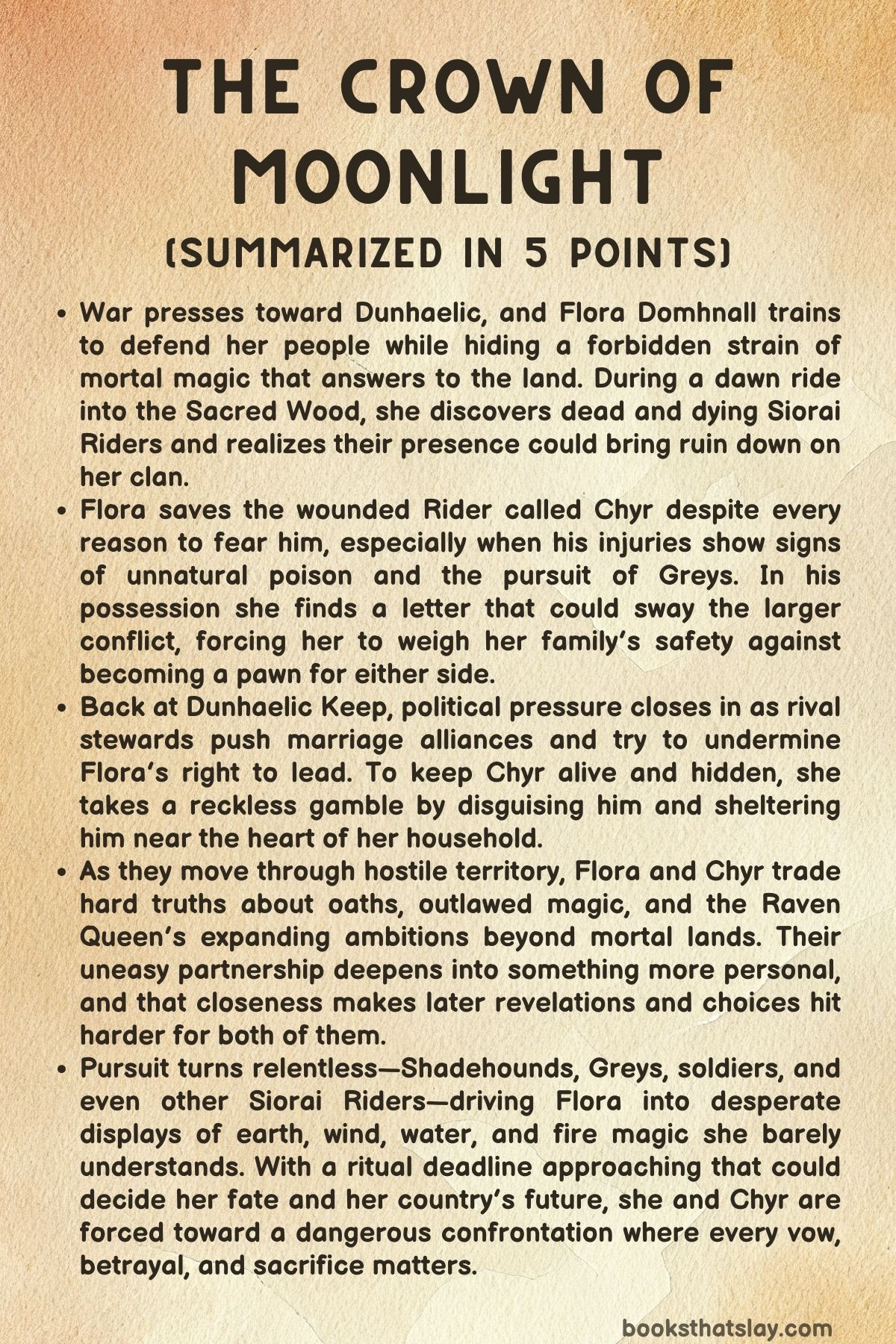
War edges toward Dunhaelic, and Flora Domhnall starts her days training her stallion, Ari, and preparing her people for the worst. One icy dawn she rides farther than usual, crossing into the Sacred Wood along a forgotten military road.
The forest is wrong—no birds, no small animals, only silence—and Ari reacts as if something unseen is watching. Flora follows the signs and finds a horrifying scene: a mare collapsed near a ridge, two men beside her, one arranged like a prepared corpse and another bound across the saddle, bleeding and barely alive.
The air carries a sickly sweetness that reminds Flora of bodies twisted by corrupted magic. She feels power thick in the clearing and realizes these men are not human.
They are Siorai, immortal Riders whose deaths could bring retaliation down on her land.
As Flora searches, the living Rider steps from the shadows. He is tall, wounded, and armed, with a presence that makes the hair on her arms rise.
Flora hides her fear by using her secret mortal magic—illegal since the old queens were murdered—to turn her dagger into the illusion of her father’s sword. The Rider warns her that the illusion will not save her if she forces a fight.
He calls himself Chyr and makes it clear he is running out of strength. His companions, Oran and Tuirse, are dead from wounds that refuse to heal.
Chyr asks for supplies, a fresh horse, and silence. Flora refuses his payment and accuses his kind of breaking old agreements and leaving human dead to rot during their wars.
Still, she cannot ignore a dying man at her feet. When Chyr collapses, she treats him instead of ending him.
While binding his chest, Flora finds a wax-sealed letter in his pocket. It is addressed to the rebel king and written by General Seoras Mora.
The message condemns failures at Culodur, warns that someone trusted—Lord Sean—may have blundered or betrayed them, and hints that reinforcements and hired soldiers will soon reshape the campaign. Flora understands instantly that this paper could change the war and, if anyone suspects Dunhaelic touched it, her people could be crushed by either side.
When Chyr wakes and finds his ring, sword, and the letter missing, he assumes she stole them. He attacks her in panic and anger, but Flora draws power from the earth and from strange blue-crystal rings taken from the dead Riders.
The ground bucks and shakes, throwing Chyr off. She forces him to listen, returns his things, and orders him off her land.
Yet Chyr sees what she did—raw land-magic and the presence of Shadehounds, shadow-creatures that behave like her silent guards—and he realizes Flora is far more than a stubborn mortal woman.
Flora brings Chyr to a hidden shelter near Dunhaelic and hides him in an abandoned cottage. Back at the keep, the pressure on her tightens.
Her father and brothers are gone, the clan is exhausted, and opportunists arrive to claim what they can. Stewards from lesser branches of the Domhnall family bring demands dressed up as concern.
One of them, Dughall—who tormented Flora when they were young—pushes a marriage proposal meant to take control of Dunhaelic through her. Flora rejects him, standing her ground as chief, but she knows she may not be able to refuse forever if the clan needs allies.
Flora’s nurse and housekeeper, Catriona, discovers the truth about the wounded Siorai and demands Flora kill him before he brings ruin. Flora refuses.
Mercy, she believes, is the one choice the war has not stolen from her yet. With soldiers of the Raven Queen moving closer, Flora risks everything by smuggling Chyr into the keep disguised as a mute female companion for her grieving, unstable mother.
Chyr, too weak to escape, accepts the humiliation because he has no other way to live.
As Flora continues treating him, Chyr reveals pieces of what is really happening. He belongs to a brotherhood of Riders sworn to divine law, yet he is trapped by oathbands that burn whenever he even considers defying the king he serves.
The Raven Queen, Vheara, has returned from long banishment and is mining celestial iron—metal that can kill immortals—and turning it into weapons and poison. The blackened streaks in Chyr’s wound come from that source.
Flora realizes the suffering of her homeland is only one front in a wider conquest.
When the danger at Dunhaelic peaks, Flora and Chyr flee together and take shelter in a hidden cavern. Away from eyes and duty, the tension between them breaks.
Flora, facing a future where she may be forced into marriage for politics, decides to claim one choice for herself. They spend a night together that leaves both of them changed—physically, emotionally, and magically.
Flora wakes stronger, feeling how his power and her earth-magic have begun to answer each other. Yet she insists it cannot continue.
Her people come first.
On the road, Flora learns the truth she suspects but does not want: Chyr is not only a Rider. He is the rebel king himself—Teàrlach Solas—hiding behind half-truths and oaths.
The revelation hits like a betrayal. To Flora, it means she gave trust and intimacy to the son and heir of the very tyranny that destroyed her bloodline.
She rides in cold fury, and when danger strikes at an enemy outpost, she fights beside him anyway. Together they kill soldiers, face Greys and Ravenhounds, and Flora discovers new edges to her magic—wind, rain, and control over forces she never dared test.
Chyr’s fellow Riders—Ronan, Lorcan, and Daire—catch their trail and pursue Flora, believing she is a threat to their king. Flora escapes into bogland, pushing her power to the limit, but Chyr follows even when the ground tries to swallow horse and rider.
Flora cannot let him die there, no matter what he is, and she spends the last of her strength to save him from the black water.
The conflict grows into a desperate mission across sea and coast. They sail in small boats under fog and magic while the queen’s ships hunt them.
Cannons and grapeshot tear the air. Working with Niall, Daire, Lorcan, and Sean, Flora learns to shape wind and water with precision, forcing enemy vessels onto rocks and raising waves that break longboats apart.
Each victory costs her, because she feels lives end when her magic turns lethal, but there is no time to stop. Flora is racing a rule older than the war itself: the Compact requires a Maiden to claim the final crown before moonset on the Night of Rebirth—or die at sunrise.
On Muilean, they ride under rune-made silence toward the Loch of Rebirth and the Altar of the Moon. Enemy forces mass around the site, including Greys and elite soldiers wearing amulets that swallow magic.
Chyr presses Flora to choose a Rider as consort to complete the rite. He begs her to choose him, then kill him afterward if that is the only way to free her from his oaths and keep her safe.
Flora refuses to bargain with his life, even as she admits she loves him.
At the altar, their plan collapses. The gateway that should open to Tirnaeve is sealed.
Flora steps forward anyway, willing to attempt the sacrifice alone. The Duke of Cumarann—the Butcher—reveals himself and drives a blade through her chest.
Flora tears herself free, answers with her own transformed weapon, and brings him down as Shadehounds leap in. Bleeding, she offers her blood to the altar and swears herself to Alba Scoria and the old powers, demanding they accept her without the usual terms.
Chaos erupts among the Riders as oaths collide, but Flora does not stop. Moon-cool power floods her, easing the wound, and the Crown of Moonlight settles onto her.
In the midst of signal fires rising across Muilean, Flora stands crowned at last—alive, claimed by duty and magic—while Chyr vows love even as the chains of his oaths tighten around what the two of them might become.
Characters
Flora Domhnall
Flora Domhnall, the protagonist of The Crown of Moonlight, stands as a compelling embodiment of courage, compassion, and defiance amid the ruins of war. She begins as a young woman burdened by loss—her father and brothers gone, her clan on the brink of destruction—but she refuses to yield to despair.
Her morning rides, initially acts of discipline and control, reveal her restlessness and inner strength. Flora’s defining trait is her fierce sense of duty to Dunhaelic and its people, which drives her to make perilous choices, such as rescuing and hiding the wounded Ever, Chyr.
This act of mercy, though politically reckless, captures her moral conviction that humanity must not mirror the cruelty of its oppressors.
Her secret connection to magic deepens her complexity; she carries the power of her Cailleach ancestry, symbolizing both heritage and forbidden strength in a world that punishes such gifts. Throughout the narrative, Flora grows from a dutiful daughter into a leader capable of commanding elemental forces and moral authority alike.
Her relationship with Chyr challenges her beliefs about loyalty and love, forcing her to reconcile personal desire with the weight of leadership. She emerges as both a protector and a queenly figure, willing to sacrifice herself for her people and her land.
By the novel’s end, her transformation from reluctant heir to the bearer of the Crown of Moonlight signifies her ascension into sovereignty—rooted in empathy, tempered by pain, and defined by resolve.
Chyr (Cóirneach / Teàrlach Solas)
Chyr, or Cóirneach, represents the tragic duality of honour and bondage that defines much of The Crown of Moonlight. An Ever Rider of immense power, he is bound by magical oaths to a corrupt king and haunted by the failure of his comrades.
His wounds—both physical and spiritual—reflect a man caught between duty and conscience. From his first encounter with Flora, he struggles between silencing her to protect his secret and admiring her courage and compassion.
His gradual vulnerability reveals an enduring humanity beneath his immortal composure, and his respect for Flora becomes admiration, then love.
As the story unfolds, the revelation of his true identity as Teàrlach Solas, the rebel king, transforms him into a figure of moral paradox. He embodies both the enemy and the ally, the tyrant’s heir and the saviour striving to undo his father’s sins.
His relationship with Flora becomes the crucible in which he tests his freedom, as her defiance forces him to question the oaths that bind him. Chyr’s tragedy lies in his awareness that every act of rebellion exacts a price—his life, his love, or his soul.
By the climax, he stands not only as a warrior but as a man seeking redemption through sacrifice, his devotion to Flora merging with his desire to restore balance to a broken world.
Catriona
Catriona, Flora’s nurse and housekeeper, is the embodiment of maternal wisdom hardened by survival. Her character provides moral grounding amid chaos, representing the voice of caution, tradition, and realism.
She understands the brutal calculus of war and continually reminds Flora of the costs of compassion in a time of siege. Her insistence that the wounded Ever should be killed is not cruelty but fear—fear of the devastation his presence could bring upon Dunhaelic.
Yet her loyalty to Flora never wavers; even as she disapproves of her choices, she aids in hiding Chyr and preparing for the clan’s survival.
Through Catriona, the novel explores generational conflict: the tension between the old ways of endurance and the new path of empathy and resistance that Flora chooses. Catriona’s presence grounds the supernatural and romantic threads of the story in the realities of human frailty and loss.
She represents the endurance of the common people—the silent strength that sustains kingdoms even as kings and queens rise and fall.
The Raven Queen (Vheara)
The Raven Queen, Vheara, stands as the dark mirror of Flora—a woman of immense power consumed by vengeance and ambition. Banished for centuries and now returned to wage war upon both mortal and immortal realms, she personifies the corruption of magic and the hunger for domination.
Her mining of celestial iron, a weapon that poisons and kills immortals, symbolizes her willingness to defy natural law to achieve absolute control. Though she appears distant for much of the novel, her influence permeates every event: the Greys twisted by her magic, the armies that march in her name, and the terror that shapes the moral choices of others.
In contrast to Flora, whose magic restores and protects, the Raven Queen’s power destroys and enslaves. She is not merely a villain but a representation of what happens when grief and pride eclipse compassion.
Her shadow defines the moral stakes of the novel—forcing Flora and Chyr to confront what kind of rulers they wish to become and what sacrifices true sovereignty demands.
Dughall
Dughall, the opportunistic steward and would-be suitor, embodies the corrosive greed and cruelty that thrive in wartime. His ambition to unite the clans through marriage to Flora masks his desire for power and control.
Through him, the novel explores the insidious dangers within humanity itself—those who exploit chaos for personal gain. Dughall’s presence in Dunhaelic contrasts starkly with Chyr’s wounded nobility; he is wholly mortal, yet more monstrous in intent than the Ever enemies.
His arrogance and manipulation deepen Flora’s isolation and reinforce her determination to lead without submission.
Ronan, Lorcan, Daire, Sean, and Niall
The Ever Riders surrounding Chyr form a chorus of loyalty, conflict, and sacrifice that illuminate different facets of his struggle. Ronan, disciplined and steady, represents the old honour of the Anvar’thaine; Lorcan and Daire, masters of water and illusion, embody the versatility and weariness of warriors who have fought too long.
Sean, whose divided loyalties lead to violence, personifies the tragic consequences of oaths and pride, while Niall’s youth and vulnerability highlight the fading idealism of their cause. Together, they show the fractured brotherhood of those bound by divine duty but burdened by mortal suffering.
Their interactions with Flora bring tension and occasional respect, forcing her to navigate a world where trust is both a gift and a weapon.
The Duke of Cumarann, “The Butcher”
The Duke of Cumarann, known as the Butcher, serves as the physical embodiment of tyranny and brutality. His cruelty is infamous, and his battlefield presence radiates the same terror that the Raven Queen’s magic inspires.
When he stabs Flora during the final ritual, he becomes the agent of her transformation—a destroyer whose violence unwittingly crowns a queen. His character, though less explored internally, functions as the dark instrument through which the novel’s themes of sacrifice, rebirth, and justice reach their climax.
Themes
Power, Legitimacy, and the Cost of Rule
War tightening around Dunhaelic forces Flora into leadership before she has the comfort of preparation, and that pressure reshapes what “rightful rule” means in The Crown of Moonlight. She is not simply protecting land; she is protecting the idea that her clan still has a future worth defending, even when soldiers, Greys, and political opportunists treat that future like a prize to be seized.
Her authority is challenged in two directions at once. Outside, the Raven Queen’s forces make power feel purely military: whoever has iron, cannons, and corrupted magic dictates what happens next.
Inside, the stewards from lesser branches try to convert crisis into leverage, using marriage proposals and veiled threats as a way to control succession without drawing a sword. Flora’s refusal to be traded as an alliance token becomes a political stance, not only a personal one.
She insists that leadership must answer to responsibility, not entitlement, and her choices repeatedly show that rule is measured by what she is willing to carry—risk, blame, and moral consequences.
The coronation stakes intensify this theme by making legitimacy bodily and immediate. The Compact’s demand that the Maiden must gain the Crown of Moonlight before moonset or die at sunrise turns governance into a timed ordeal that cannot be postponed for strategy meetings or safer conditions.
Flora’s final movement toward the altar, especially once the doorway is sealed and help from Tirnaeve is not coming, frames sovereignty as something earned through sacrifice rather than inherited through blood or proclaimed by ceremony. Even victory is not clean: she takes lives at sea and on land, and the narrative shows that power secured in wartime always includes grief, exhaustion, and fear of what that power might require next.
The theme lands hardest when Flora becomes queen through blood and will while beacons flare across Muilean—not as a pageant, but as a signal that her rule begins in the same moment her vulnerability is most visible.
Magic as Identity, Crime, and Survival
Flora’s magic is not presented as a decorative gift; it is a dangerous fact about who she is, how she is hunted, and what she must hide to keep others alive. Early on, her “illegal mortal magic” surfaces under duress, and that illegality matters because it turns self-defense into a potential death sentence if the wrong authority notices.
Her relationship to power is therefore shaped by secrecy and restraint. She can call on earth and weather, calm a collapsing mare, sense the pull of enchanted rings, and later shape air and water into battlefield tools, but every use invites exposure.
That makes magic a kind of double life: it is her edge against Greys and soldiers, and also the reason her home could be punished or destroyed if she is labeled a threat. The book shows how oppression can force the gifted into living like fugitives even before they commit any political act.
Magic also functions as a language of lineage and belonging. Flora’s strength is tied to land and to a heritage that others tried to erase, and the story repeatedly hints that the past is not past at all—outlawed queens, stolen thrones, and centuries-old crimes still dictate who is permitted to wield power now.
Chyr’s world offers a mirrored version of that identity trap. He has magic, training, and sacred tools, yet his power is constrained by oathbands that burn when he even thinks of defiance.
In his case, magic is not freedom; it is a mechanism of control embedded into his body. The result is a theme where magic becomes both proof of self and proof of captivity.
One character hides power to avoid execution; the other has power but cannot choose how to use it without pain and punishment.
As the conflict escalates, magic becomes survival technology rather than mysticism. Flora’s abilities grow from small acts—stabilizing an animal, concealing movement—into large-scale tactics: fog, wind walls against grapeshot, waves that split ships, rain that smothers beacons, mud traps that break pursuit.
The narrative makes the physical toll explicit: fatigue, weakness, the risk of losing control, and the emotional shock of feeling lives end when her force destroys vessels. By the time she reaches the altar, magic has become inseparable from her endurance and her willingness to pay for outcomes she did not choose.
It is not “special”; it is necessary, and necessity is never gentle.
Oaths, Coercion, and Moral Injury
Chyr’s oathbands establish a world where loyalty is not merely expected but enforced through pain and magical consequence, and that turns every decision into a fight between conscience and compulsion. He is bound to a corrupt ruler descended from an older tyrant, and the binding is not metaphorical.
The oaths do not allow him the comfort of ambiguity: even a thought of disobedience can trigger burning, and refusal can mean exile or worse. This creates a theme about coercion that reaches beyond Chyr.
The Raven Queen’s use of corrupted magic, Greys, and celestial iron weapons shows a political order built on forced compliance and fear. The Butcher’s presence near the altar and the amulets that consume magic underline that coercion can be engineered into objects and systems, not only threatened by people.
Moral injury grows out of this coercion. Chyr is not portrayed as simply “conflicted”; the story shows how being compelled to serve wrongdoing fractures a person’s sense of self.
His admiration for Flora’s courage is sharpened by the fact that she can choose her defiance, while he must calculate what his bindings will permit. When he urges Flora to choose him as consort and then kill him, it is not melodrama—it is a desperate attempt to escape being used as a weapon against her later.
He recognizes that the oaths might force him to harm the person he loves, and the knowledge itself becomes a wound. The theme intensifies when Sean invokes other oaths and blocks Chyr’s impulse to bleed into the consort’s cup, turning a sacred moment into a struggle over which set of bindings has authority.
It is a reminder that in this world, ideals like “justice” and “duty” are easily turned into chains.
For Flora, coercion takes different forms but leaves similar scars. She is pressured into marriage for alliance, threatened by internal rivals, and hunted by external forces that would punish her people for her choices.
When she refuses to kill Chyr despite recognizing the danger, her mercy is not naive; it is a decision to reject the logic of coercion that governs her enemies. Yet the narrative does not pretend mercy is free.
Every compassionate act becomes another liability, and that tension creates a portrait of moral injury on the “good” side too: she must kill in combat, she must gamble with lives, and she must endure betrayal without letting betrayal rewrite her character. Oaths and coercion thus operate as a theme about what war does to ethics—how it narrows options until even decency feels like a risk.
Trust, Betrayal, and the Price of Knowing the Truth
Trust in The Crown of Moonlight is never built in a safe environment; it forms under threat, pain, and incomplete information. Flora’s first contact with Chyr begins with fear and the possibility of violence, yet she treats his wound instead of exploiting it.
That choice creates a fragile bridge that is constantly tested by practical reality: he is an Ever Rider, her land could be punished for his presence, and she is hiding illegal magic that could doom her clan if revealed. Their early exchanges—names offered cautiously, help given with conditions, anger mixed with respect—show trust as a calculated risk rather than an emotional surrender.
Each gesture is weighed against consequences: who might see, who might retaliate, what could be demanded later in return.
Betrayal enters not as a single twist but as a process of revelation. Flora reads a letter that can shift a war, and simply knowing what it contains threatens her neutrality and safety.
The story treats information itself as dangerous property: possessing it makes her a target; using it could save her people; refusing to use it could be a form of integrity that costs lives. Chyr’s reaction when he wakes to missing items, his assumption that she stole them, and his later ambush show how mistrust becomes almost automatic when survival depends on controlling threats quickly.
When he later apologizes and tries to rebuild an understanding, it is not a clean reset—his violence has already changed the terms, and so has Flora’s discovery of her own power.
The most devastating fracture comes when Flora realizes Chyr is the rebel king. The earlier intimacy in the cave is not dismissed as meaningless; instead, the betrayal stings because what felt like an earned closeness now appears entangled with hidden identity and political consequence.
The story is careful about why this hurts: it is not only romantic deception, but the sense that her autonomy was compromised by ignorance. Flora’s anger frames knowledge as a form of consent—if she did not know who he was, she could not fully choose the risks she was taking with her body, her heart, and her clan’s future.
Chyr’s inability to deny it outright, because of oath constraints, deepens the cruelty of it: even his honesty is rationed by bindings. Trust becomes a theme about what people owe each other in crisis, what silence counts as, and how quickly love can be made to feel like conquest when truth arrives late.
Mercy Versus Necessity in Wartime
Flora’s repeated refusals to kill Chyr when it would be strategically “clean” establish a moral line she will not cross, even while siege preparations and enemy patrols suggest that softness could mean extinction. Her mercy is not passive.
It requires action—bandaging wounds, hiding bodies, moving an enemy through her land, risking discovery, and standing against Catriona’s insistence that killing him would protect everyone. That argument is persuasive in wartime logic, and the story treats it as such.
Catriona is not written as foolish; she is written as someone who has learned, through grief and experience, that danger ignored becomes tragedy. Flora’s refusal therefore becomes a principled choice that must survive constant pressure, not a simple preference for kindness.
As the conflict escalates, the narrative forces Flora into acts that contradict the comfort of mercy. She kills soldiers in a hidden outpost, she participates in ambushes, and she uses weather and sea to destroy vessels, feeling lives end through the force she directs.
This is where the theme gains weight: mercy does not spare her from violence; it only shapes the reasons and boundaries around it. The story suggests that wartime ethics are often about selection rather than purity—who must die, who can be spared, and what kinds of harm can be refused even when harm is unavoidable.
Flora heals injuries obsessively because poisoned blades and corrupted magic change the stakes; her mercy becomes preventive, a way to deny the enemy the advantage of slow death. At the same time, she learns that saving people can demand terrifying power and swift killing.
The contradiction is the point.
The altar sequence distills the theme into a single crisis. Flora moves forward even when the gate is sealed, offering sacrifice without a consort, effectively choosing her people’s survival over her own life.
When the Butcher stabs her, she responds with lethal force and then uses her own blood to bind herself to Alba Scoria and the gods. Mercy here is not a blanket refusal to kill; it is the refusal to become the kind of ruler who treats life as disposable.
Even her enemies’ cruelty does not earn them control over her moral identity. The book keeps asking whether compassion can exist without being naive, and its answer is hard-edged: compassion can be deliberate, fierce, and costly, especially when it must coexist with necessity.
Love, Autonomy, and Consent Under Unequal Power
The romance between Flora and Chyr is charged not only by attraction but by the political and supernatural imbalance between them. Flora has heard stories of Ever enthrallment and addiction, and she cannot afford to be naive about what an immortal might do to a mortal woman.
That fear shapes her interpretations of intimacy: every moment of closeness carries an underlying question about whether she is fully in control of herself. The narrative confronts this directly when Flora asks about Ever wine and compulsion, and Chyr’s offense becomes meaningful because he insists on her freedom rather than claiming a right to her.
His refusal to compel her is not presented as a romantic flourish; it is presented as a moral boundary that matters precisely because the world expects the powerful to take what they want.
Flora’s autonomy is also threatened by her own society. The expectation that she must marry for alliance turns desire into a scarce personal territory.
When she chooses to spend a night with Chyr, it reads as an assertion of agency in a life shaped by obligation. She is not surrendering to romance; she is claiming a decision that belongs to her body and her heart, even if the future will demand sacrifice.
That choice becomes more complicated when his identity as the rebel king emerges. What she experienced as a private decision becomes politically loaded, and that shift is part of the theme: in wartime, even love is drafted into strategy, reputation, and propaganda, whether the lovers want it or not.
The story also explores consent as something threatened by secrecy and constraint. Chyr’s half-truths are not only personal failures; they create conditions where Flora cannot fully assess risk.
Meanwhile, Chyr’s own ability to consent to his role is compromised by oathbands; he is trapped in obligations that can override desire and morality. Their intimacy therefore sits on a battlefield of competing forces: attraction, affection, fear, duty, and coercion.
The theme is not “love conquers all.” It is closer to “love must survive realities that can weaponize it.”
By the end, when Chyr vows love regardless of what his oaths force him to do, the promise is both tender and unsettling, because it acknowledges that the greatest threat to their bond is not lack of feeling—it is the machinery of power that can turn love into leverage and choice into illusion.