The Devil in Oxford Summary, Characters and Themes
The Devil in Oxford by Jess Armstrong is a 1920s mystery set in wintry Oxford, following Ruby Vaughn: an undefeated fencer with a knack for antiquities and a habit of getting into trouble. Ruby arrives for a bookseller’s gathering and expects a few quiet days among rare volumes and collectors.
Instead, a public exhibition ends in horror, rumors of curses flare, and Oxford’s museums and reading rooms become hunting grounds for a stolen occult book and a very human criminal scheme. With her guarded healer ex, a frightened friend, and unhelpful police in her orbit, Ruby investigates before more people vanish.
Summary
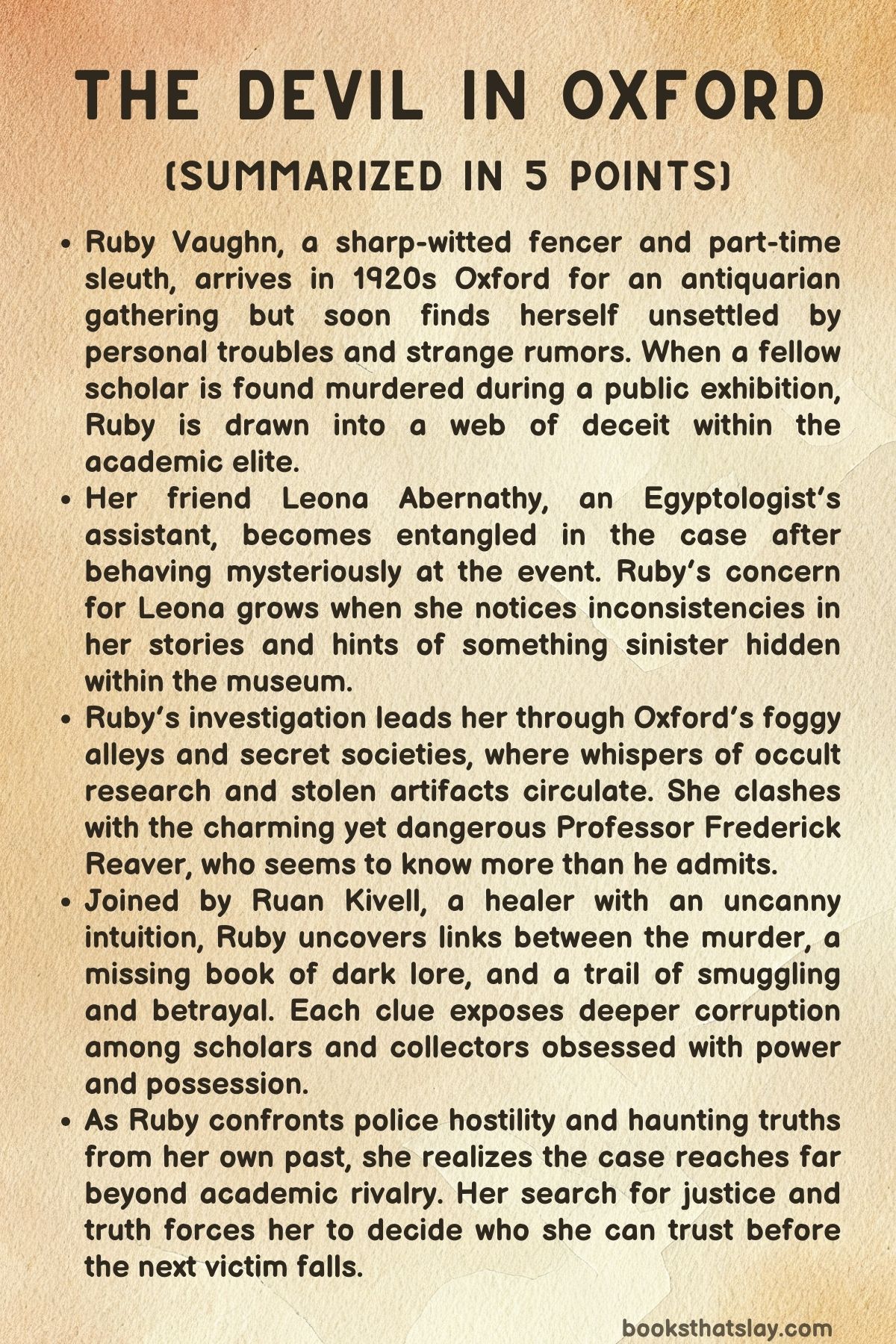
Ruby Vaughn comes to Oxford in December 1922 for Mr. Owen’s annual antiquarian event. She tries to distract herself with fencing at the Artemis Club, but her focus is shot: she has fresh scrapes from recent danger, a messy break with Ruan Kivell, and anxiety about her solicitor, Hari Anand, who keeps trying to reach her.
Ruby also confesses to her friend Leona Abernathy that someone new has appeared claiming to be Ruby’s dead mother, a claim that drags old grief back to the surface. Leona comforts her, yet acts strangely guarded, and mentions—almost too late—that she now works closely with an Egyptologist at the Ashmolean Museum, Professor Frederick Reaver.
That night, Ruby attends a party hosted by Emmanuel Laurent, a professor with political ambitions and a taste for collecting. Oxford gossip circles around Julius Harker, the showman owner of a curiosity museum, who has been missing ahead of a promised exhibition of a “Napoleonic cache” of Egyptian items.
Ruby is uneasy about the whole affair, but the next day Mr. Owen reveals he has tickets, and Ruby agrees to go.
Harker’s Curiosity Museum is packed and stifling. Ruby can’t find Owen in the crowd, and the building’s themed wings funnel people toward a curtained stage where the cache is meant to be revealed.
Outside for air, Ruby runs into Reaver, who surprises her with his charm, confidence, and sharp interest in her. Back inside, Ruby spots Leona looking panicked and out of place, as if she’s hunting for someone.
Leona admits she came because Harker has not arrived, and she fears Reaver will see her there. Reaver does see her, corners her with quiet control, and leads her away just before the exhibition begins.
A nervous man named Mueller, Harker’s business partner, takes the stage in Harker’s absence. When the curtain is pulled back, the displayed artifacts seem anticlimactic—until screams erupt.
Inside a large stone funerary box lies Julius Harker’s body, jammed into the space with blood pooled at his head. His hands are injured as if he fought the lid from within, raising the terrifying possibility he was shut inside alive.
Ruby suspects his tongue has been cut out.
In the chaos, Ruby is grabbed and pulled down from the dais by Ruan Kivell, the Cornish folk healer she once loved—arriving in Oxford because of a drunken letter she sent. Their reunion is tense and unfinished, but the police lock down the museum, and Ruby realizes Leona and Reaver are missing from the scene.
Later, Mr. Owen insists Ruan stay at Ruby’s Oxford townhouse for safety.
Before dawn, Leona shows up at Ruby’s kitchen in torn clothes, shaking and filthy, offering a confusing story about being trapped in a storeroom. She claims Mueller has been arrested for Harker’s death and demands Ruby help clear him, blurting that she “cannot let him suffer” before cutting herself off.
Ruby and Ruan notice Leona is hiding something. Outside, a huge black dog watches from the lane, and Ruan calls it a bad sign.
Ruby goes to the Ashmolean to patch things up with Leona and agrees to look into Mueller’s arrest. On her way out, she sees a newspaper screaming about a revived mummy’s curse, complete with Ruby’s name, turning the murder into public spectacle.
Reaver offers her an umbrella and, while walking with her, warns her to stop meddling. He also hints Harker had a history of theft and enemies.
Ruby ignores the warning and visits the police station, lying that she is Mueller’s niece to gain access. Mueller insists he is innocent.
He says Harker had been arranging a valuable sale and that the wrong buyer might kill to keep him quiet. He also confirms the long-standing rivalry between Harker and Reaver.
Ruby is thrown out by Inspector Beecham, who despises her independence and threatens her with jail.
Determined to find her own answers, Ruby returns at night with Ruan to break into Harker’s museum. They search offices and drawers, finding letters, ledgers, and a protective stone charm Ruan calls a milpreve.
The building feels wrong in a way Ruby can’t name, and she leaves with documents to study.
Events turn uglier fast. Ruby learns Mueller is dead and that items have been stolen from the museum, including Harker’s missing tongue.
Ruan finds evidence suggesting the “artifacts” may have been used to hide cocaine shipments. Ruby steals a police file and discovers a decade-old scandal: Harker once stole a rare occult book, The Radix Maleficarum, from the Bodleian Library, a crime that helped destroy his Oxford standing.
Ruby tries to involve Leona, who has museum access, but Leona becomes visibly rattled by the book’s name. Leona sends Ruby to Jonathan Treadway at the natural history museum with a cryptic note.
Treadway burns it immediately and warns Ruby that powerful people are involved and Leona is in danger. Ruan reveals that, years ago, Treadway was suspected of the Radix theft, but Harker took the blame—suggesting loyalty, scandal, and leverage.
Then Leona vanishes. Ruby goes to Leona’s home and finds it ransacked.
Leona’s roommate Annabelle is stabbed and fading. Ruan performs emergency surgery on the floor and keeps her alive, and Ruby hides Annabelle at her townhouse rather than risk compromised authorities.
Ruby confronts Reaver, who reacts coldly to Leona’s disappearance and again pushes Ruby to stop. A colleague, Mary, reveals Leona and Reaver have been arguing and shows Ruby a half-burned message: someone “wants the Radix.” Mary also mentions Leona searching for “Saqqara scrolls,” but the museum doesn’t list any such item, hinting at a cover story.
Using Annabelle’s Bodleian reading card, Ruby sneaks into the library to find the Radix—only to learn it is missing again and was last signed out ten years earlier under Ruan Kivell’s name. Ruby reels, unsure whether Ruan is being framed or has kept secrets from her.
At the same time, Hari presses Ruby to meet the woman claiming to be her mother, warning that the impostor knows intimate details and could ruin her.
Hari then uncovers another shock: Ruby’s wartime memories—once dismissed as delusions—match real people and real injuries, suggesting she was used for something covert and then threatened into silence. He even spots a scarred aviator in Oxford, tied to those memories, and suspects government involvement.
On Christmas Eve, Ruan disappears. A witness reports him collapsing after speaking with a well-dressed man and being taken away in a car.
Annabelle, half-conscious, adds that Leona was taken with a syringe and that two men were involved. Ruby resorts to a desperate plan: she loosens the bonds of the captive Inspector Beecham, follows him when he slips free, and trails him to a riverfront operation where crates are being loaded onto a canal boat.
Ruby finds bricks that look like cocaine and a torn page from her own notebook—proof she’s being pulled into someone else’s plot. A gun presses to her injured temple: Reaver has caught her.
Before Ruby can be used as leverage, the canal boat explodes, destroying the shipment. Reaver drags Ruby away, furious and frantic, and forces an exchange at Emmanuel Laurent’s home.
There, the truth breaks open: Laurent is the criminal mastermind. He killed Harker for stealing his cocaine, cut out his tongue, and kidnapped Leona and Ruan with syringes to recover The Radix Maleficarum.
Laurent boasts about control and influence, but Ruby draws Hari’s pistol and shoots him in the shoulder, ending his threat. Reaver restrains Laurent as a scarred aviator arrives—an intelligence “captain” who confirms the government has been tracking Laurent and used Jack Price, the young constable, as an informant.
Ruby finds Leona and Ruan upstairs, alive but bound. Ruby and Ruan finally speak plainly about what they feel, and she frees him.
The next day, the papers claim Laurent died of a heart attack, smoothing the scandal away. Ruby meets Reaver and Leona at the closed Ashmolean, where they admit the Radix’s original has been hidden and a forgery was used as bait.
Ruby insists the real book must return to the Bodleian, and they agree to do it quietly. Ruby reconciles with Leona, then leaves Oxford.
Weeks later, back in Exeter, Ruby receives a telegram from Hari: he has news about the impostor and Ruby’s mother, and he needs her in London—sending Ruby toward her next danger.
Characters
Ruby Vaughn
Ruby Vaughn is the indomitable heart of The Devil in Oxford, a woman defined by courage, intelligence, and restlessness. A fencer of great skill and a keen antiquarian sleuth, she embodies the dual spirit of refinement and rebellion.
Her stubborn independence and sharp wit make her both admirable and difficult to contain in a world still dominated by rigid expectations for women in 1920s England. Beneath her strength, however, lies deep trauma—haunted by the loss of her mother, the scars of war, and her own ambiguous past tied to espionage and deceit.
Ruby’s relationships—with Leona, Ruan, and Hari—reveal her vulnerability and craving for trust, even as she hides behind defiance and irony. Her investigative zeal is driven as much by moral conviction as by a subconscious need to impose order on a chaotic past.
By the novel’s end, Ruby emerges not merely as a detective but as a survivor who confronts her ghosts while still daring to seek the truth, no matter how painful.
Leona Abernathy
Leona Abernathy, Ruby’s fencing partner and former wartime friend, is a study in contradictions—poised yet tormented, loyal yet secretive. Her role in The Devil in Oxford weaves between ally and suspect, protector and victim.
Raised partly in Egypt and fluent in ancient languages, Leona bridges the world of scholarship and moral ambiguity. Her association with both Julius Harker and Frederick Reaver draws her into a dangerous underworld of smuggling, occult artifacts, and espionage.
Leona’s guilt and evasiveness stem from divided loyalties: she seeks to do good by repatriating stolen antiquities, yet her complicity in secret deals haunts her. The novel paints her as emotionally fragile yet fiercely principled, her friendship with Ruby tinged with affection, jealousy, and an unspoken bond of shared pain.
Her eventual reconciliation with Ruby, and her efforts to right the wrongs of the past, confirm her as a tragic yet redemptive figure—one who risks everything for truth and loyalty.
Ruan Kivell
Ruan Kivell, the Cornish healer and Ruby’s turbulent lover, represents the mystical undercurrent that runs through The Devil in Oxford. A man of intuition and pain, Ruan bridges the rational and the supernatural, capable of sensing thoughts and omens yet grounded in physical healing.
His rugged compassion contrasts Ruby’s intellectual boldness; he is her moral anchor even when suspicion falls upon him. The revelation of his connection to the stolen book The Radix Maleficarum adds depth to his mystery—he becomes both suspect and savior.
Through his quiet endurance and emotional sincerity, Ruan embodies redemption in a world of deceit. His love for Ruby, rekindled through danger and near death, reaffirms the novel’s central theme: that truth and love demand vulnerability as much as courage.
Frederick Reaver
Professor Frederick Reaver, the magnetic Egyptologist, is one of the novel’s most morally ambiguous figures. In The Devil in Oxford, he oscillates between charm and menace, intellect and obsession.
His rivalry with Julius Harker and his domineering relationship with Leona paint him as a man consumed by ambition and possession. Yet beneath his arrogance lies a soldier’s pragmatism and a scholar’s devotion to discovery.
Reaver’s connection to government secrets and covert operations complicates his image—he becomes both a tool of empire and a reluctant agent of justice. By the novel’s conclusion, Reaver’s actions reveal a surprising sense of honor: he protects Leona, aids in unmasking the true criminal, and restores the stolen artifact.
His complexity makes him neither villain nor hero but a reflection of the moral grayness of postwar academia and empire.
Julius Harker
Julius Harker’s shadow looms large over The Devil in Oxford, even though he dies early in the story. A disgraced scholar, collector, and scandal-ridden figure, Harker symbolizes the dangerous allure of forbidden knowledge.
His theft of The Radix Maleficarum, involvement in occult research, and defiance of Oxford’s elite mark him as both visionary and transgressor. Through testimonies and revelations, he emerges as a man undone by ambition and secrecy—someone who sought truth in the occult and paid for it with his life.
His gruesome death inside the funerary box transforms him into a martyr of curiosity, his silence—literally enforced by the removal of his tongue—an emblem of the cost of knowledge in a world that punishes dissent.
Emmanuel Laurent
Emmanuel Laurent serves as the true devil of The Devil in Oxford—a charismatic politician and anthropologist whose cultivated demeanor conceals ruthless corruption. His private museum and scholarly façade mask a criminal enterprise built on smuggling antiquities and cocaine.
Laurent’s manipulation of others, including Harker, Reaver, and Leona, reveals his mastery of deception and control. He represents the corruption of intellect by greed, a man who cloaks vice in the language of culture.
Even in his downfall, Laurent remains chillingly composed, embodying the book’s exploration of moral decay beneath Oxford’s veneer of civility. His exposure and death mark not just the resolution of the mystery but the moral reckoning of the world Ruby inhabits.
Hari Anand
Hari Anand, Ruby’s loyal solicitor and confidant, stands as a figure of rationality and compassion amid chaos. In The Devil in Oxford, he provides both legal aid and emotional support, balancing Ruby’s recklessness with pragmatic wisdom.
His Indian heritage and Oxford education position him as an outsider navigating class and racial prejudice with quiet dignity. Hari’s belief in Ruby’s sanity and innocence, even when others doubt her, highlights his moral clarity and deep affection for her.
His discovery of governmental involvement in the case and his persistence in uncovering the truth demonstrate courage equal to Ruby’s own. By the end, Hari’s continued role as messenger and protector ensures that Ruby’s next adventure—linked to her mother’s mystery—will not be faced alone.
Mr. Owen
Mr. Owen, Ruby’s employer and mentor, embodies the stable foundation of scholarship in The Devil in Oxford. A bookseller and antiquarian, he represents the intellectual integrity that contrasts with the corruption of Oxford’s elite.
His calm demeanor and paternal guidance offer Ruby a rare sense of belonging and moral grounding. While he often cautions her against rashness, he ultimately supports her independence, recognizing that her instincts serve justice as much as curiosity.
Mr. Owen’s bookshop becomes both sanctuary and symbol—a place where truth is preserved amid a world of deception.
Mary
Mary, Leona’s diligent colleague at the Ashmolean, plays a quieter but essential role in The Devil in Oxford. Through her observations and fragments of knowledge, she helps Ruby piece together the connections between Leona, Reaver, and Harker.
Mary’s practicality and understated intelligence make her a grounding presence in the museum’s shadowy intrigue. Though secondary, her courage in sharing information with Ruby despite risks underscores the novel’s recurring theme of ordinary people standing against hidden powers.
Annabelle
Annabelle, Leona’s young roommate, serves as both victim and witness in The Devil in Oxford. Her brutal attack and near-fatal injuries highlight the stakes of the conspiracy Ruby uncovers.
Through her suffering, the narrative exposes the vulnerability of innocents caught in webs of deceit. Yet Annabelle’s survival—and her haunting recollections of the assailants—provide crucial clues that propel Ruby toward the truth.
She represents the collateral damage of obsession and secrecy, a reminder of the human cost beneath the intellectual and political drama.
Themes
Identity and Self-Discovery
In The Devil in Oxford, the theme of identity serves as both a personal struggle and an intellectual puzzle that drives Ruby Vaughn’s journey. Her entire investigation unfolds against the backdrop of uncertainty about who she truly is—both in her social position and in her own mind.
Ruby, a war veteran and a woman of intelligence in a rigidly patriarchal society, constantly grapples with how others define her versus who she knows herself to be. Her fencing prowess and defiant independence mark her as someone unwilling to conform to post-war expectations of femininity, yet beneath that confidence lies a fractured self haunted by the ghost of her mother and the trauma of the war.
The imposter claiming to be her dead mother becomes a literal manifestation of Ruby’s internal turmoil, forcing her to confront her buried past and the possibility that her history may not be what she believes.
Jess Armstrong uses the motif of doubles and impostors—mirrored identities, hidden motives, and secret lives—to question how truth and selfhood can be manipulated. Each major character wrestles with hidden selves: Leona’s moral compromises, Reaver’s dual roles as scholar and spy, and Harker’s split identity as archaeologist and criminal.
Ruby’s own assumed roles—detective, niece, and thief of police files—reflect how identity in Oxford’s world is fluid, crafted for survival. The final revelation that government agents have monitored Ruby, suspecting her of espionage, underscores how identity can be not only self-fashioned but politically controlled.
By the end, Ruby begins to reclaim authorship of her life, understanding that her identity cannot be dictated by others’ stories, reputations, or lies—it must be written on her own terms.
Corruption and the Abuse of Power
Power in The Devil in Oxford operates beneath layers of civility and scholarship, hidden under the veneer of academic prestige and British respectability. The institutions that should preserve truth—the university, the museum, and the police—are steeped in deceit, exploitation, and greed.
Armstrong presents Oxford not merely as a setting but as a microcosm of systemic corruption, where antiquarian respectability conceals smuggling, forgery, and murder. Figures like Emmanuel Laurent and Frederick Reaver embody the seductive and destructive nature of power.
Laurent uses his academic influence to mask criminal operations, while Reaver manipulates authority to control others emotionally and professionally.
The novel also examines gendered power dynamics. Ruby’s independence provokes scorn from male counterparts like Inspector Beecham, who wields institutional power to humiliate and silence her.
The museum’s male scholars, ostensibly protectors of knowledge, exploit both women and artifacts to maintain authority. Even the theft of The Radix Maleficarum symbolizes how knowledge itself can be weaponized—stolen, hidden, or destroyed to maintain dominance.
Armstrong’s portrayal of British Intelligence and government secrecy adds another layer, suggesting that corruption extends far beyond Oxford’s walls. The state’s quiet manipulation of lives, deaths, and reputations exposes how national interest excuses moral decay.
Through Ruby’s resistance to these structures, Armstrong constructs a narrative of moral rebellion. The novel’s resolution—where Ruby exposes truth but must remain silent for political convenience—reveals the tragic persistence of power’s corruption.
Justice exists only in fragments, and truth is often buried to preserve appearances. Armstrong’s critique is subtle but unflinching: when institutions prize control over integrity, even the pursuit of knowledge becomes an act of violence.
Gender, Freedom, and Social Constraint
The social fabric of The Devil in Oxford is tightly bound by expectations of class and gender, and Ruby Vaughn’s defiance of these norms drives much of the narrative tension. As a woman who fought in the Great War, Ruby inhabits a liminal space—neither accepted among men nor comfortable within the domestic sphere society assigns her.
Her fencing at the Artemis Club, a women-only space, represents more than sport; it becomes an assertion of autonomy, a physical and intellectual challenge to patriarchal limitation. Her every investigation, confrontation, and disguise challenges a world that expects female obedience.
Armstrong situates Ruby’s struggle within a broader critique of the post-war social order. The novel’s 1920s Oxford is depicted as a city rebuilding itself through male ambition while suppressing female intellect and agency.
Leona Abernathy, brilliant yet trapped in the shadow of her employer, demonstrates how women’s achievements are often erased or appropriated. Ruby’s encounters with men—from the condescending Inspector Beecham to the manipulative Reaver—underscore the costs of defiance.
Yet Armstrong does not frame Ruby as an icon of unblemished liberation; her recklessness and emotional vulnerability reveal the personal toll of resisting constraint.
This theme also extends to the idea of intellectual freedom. The women in the novel—Ruby, Leona, and even the unseen impostor—seek truth in a world that treats knowledge as male property.
The Bodleian Library, with its restricted access, becomes a symbolic battlefield. When Ruby uses a stolen reading card to enter, she claims her right to knowledge denied by social hierarchies.
Armstrong suggests that freedom for women in such a world can never be granted; it must be taken, often at great risk. Ruby’s persistence in investigating Harker’s murder despite threats and intimidation stands as a testament to endurance and moral courage.
The conclusion, with Ruby choosing yet again to pursue new mysteries, affirms that her fight for self-determination is far from over.
The Legacy of War and Psychological Trauma
Beneath the mystery and intrigue of The Devil in Oxford runs a deep current of post-war disillusionment. Set in the aftermath of the Great War, the novel portrays a generation haunted by violence and secrecy.
Ruby’s sharp wit and competence mask unresolved trauma—memories of battlefields, lost comrades, and suppressed experiences of wartime espionage. The scarred aviator and her fragmented recollections of a hidden mission suggest that the war never truly ended for her; it merely transformed into a quieter battlefield of memory and guilt.
The return of the “imposter” mother mirrors the ghostly persistence of the past, showing how personal trauma and historical catastrophe merge.
Armstrong uses this psychological dimension to explore the moral ambiguity of survival. Characters like Ruan Kivell, with his psychic sensitivity, embody the war’s spiritual damage—a blurring of the natural and supernatural as coping mechanisms for grief.
The prevalence of drugs, smuggling, and secret intelligence work reflects a world numbed by trauma and desperate for control. Oxford itself, a city of learning, becomes a haunted landscape where relics of ancient civilizations mingle with the buried horrors of modern warfare.
Through Ruby’s journey, Armstrong presents trauma not merely as memory but as a shaping force of identity and morality. Ruby’s refusal to accept official explanations—of murder, espionage, or her own history—stems from the war’s lesson that truth is often the first casualty.
Her need to uncover what truly happened, both in Oxford and in her past, becomes a quest for psychological restoration. Yet the ending’s ambiguity, with Ruby preparing for another confrontation with her hidden past, suggests that healing remains uncertain.
The war’s legacy, like the shadowed relics of the Radix Maleficarum, lingers in every mind it touched.
Knowledge, Mystery, and Forbidden Truth
The pursuit of knowledge in The Devil in Oxford is both a noble endeavor and a dangerous temptation. The book’s scholars, collectors, and detectives are united by curiosity, yet their quests repeatedly border on obsession.
The stolen Radix Maleficarum epitomizes forbidden knowledge—its connection to witchcraft and power evoking the perils of intellectual transgression. Armstrong transforms academic inquiry into moral suspense: who deserves to know the truth, and at what cost?
Harker’s murder arises from the misuse of scholarship, where discovery becomes greed, and truth becomes contraband.
Ruby’s role as an antiquarian investigator places her in constant tension with this theme. She reveres knowledge yet understands its capacity to destroy.
Her decision to steal police files, break into the museum, and read restricted materials blurs the line between enlightenment and violation. Armstrong constructs knowledge as a form of possession—of artifacts, secrets, and even people.
Reaver’s and Laurent’s competing ambitions reveal how easily intellectual pursuit can morph into domination. The novel’s repeated image of sealed boxes—funerary coffins, locked desks, forbidden rooms—symbolizes both the human hunger for revelation and the danger of uncovering what should remain buried.
In the end, the restoration of the Radix Maleficarum to the Bodleian represents a fragile moral balance. Ruby insists on truth over concealment, even as others argue for silence to preserve peace.
Armstrong’s closing scenes suggest that knowledge must be reclaimed, not hidden, even when it exposes corruption. The act of bringing the lost book home mirrors Ruby’s own reclamation of self—a belief that confronting darkness, however painful, is the only path toward light.