The Forest of Missing Girls Summary, Characters and Themes
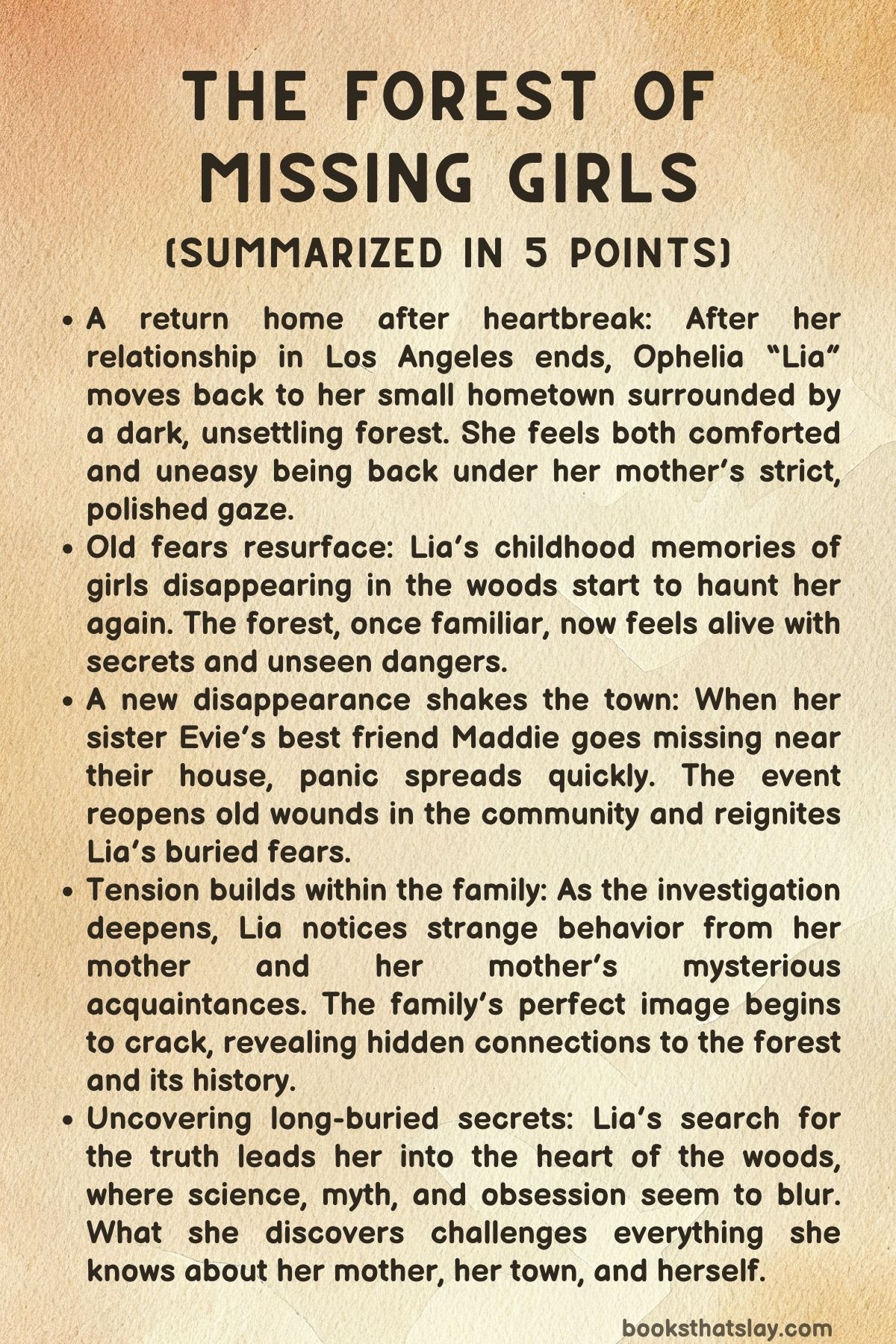
The Forest of Missing Girls by Nichelle Giraldes is a dark, modern thriller set in a town where the woods feel too close and too knowing. When Ophelia “Lia” returns home after a breakup, she expects to regroup, not to step back into a place marked by a long history of vanished girls.
Her polished mother and quiet household routines hide old rules and older fears, and the forest at the edge of their property seems to remember everything. As another teen disappears, Lia is forced to confront what her family has been protecting—and what the town has been losing.
Summary
Fresh off a breakup in Los Angeles, Ophelia “Lia” drives back to the wooded town where she grew up. She leaves behind her ex’s spotless apartment and the version of herself she tried to shape into someone “easy” to keep.
Home is warm and familiar on the surface, but the forest surrounding the house makes her skin prickle, especially at night. Inside, her mother, Elizabeth, is as controlled and immaculate as ever, her father affectionate but distant, and her younger sister, Evie, glued to her phone.
Lia slips into old habits quickly, yet she can’t ignore how the place still tightens around her.
The town’s past hangs over the family. Years earlier, girls began disappearing in and near the forest, including Krista McNeil, a fifteen-year-old who never made it home.
After Krista vanished, Lia stopped wandering among the trees the way she used to. Now, settling back in, she tries to focus on remote work and the practical task of unpacking her car, but the woods keep calling attention to themselves.
One afternoon, the family dogs drift toward the tree line. Poppy stiffens and growls, staring into the dark between trunks.
When Lia realizes Daisy has wandered farther in, she follows, forcing herself a few steps into the forest despite the fear crawling up her spine.
Near the ground, Lia finds a gold charm bracelet with dangling letter charms that read “JELK.” She pockets it, uneasy about why something so personal would be there. Back at the house, she shows it to her mother.
Elizabeth barely reacts, suggesting it probably belongs to someone who dropped it on a walk and praising Lia for bringing it back. The calm response feels too rehearsed, as if the forest routinely returns lost objects and no one asks what else it might take.
Soon after, Evie’s best friend, Maddie, comes over. With Lia still feeling out of place in her own home, she watches Evie and Maddie fall into their familiar rhythm.
One evening, while Lia stays inside, Evie and Maddie sit outside near the firepit close to the woods. Evie steps inside briefly to clear dishes.
When she returns, Maddie is gone.
Panic spreads fast. Evie and Lia search the porch, yard, and house, calling Maddie’s name.
They find Maddie’s phone abandoned outside, glowing inside a blanket on a chair, as if she simply stood up and left without it. Lia treats it like evidence and stops Evie from touching it.
Their mother returns to a house lit up with frantic movement and immediately takes control: calls are made, questions asked, a plan formed. Police arrive that night.
Flashlights sweep the tree line, but the woods offer nothing back.
By morning, Elizabeth is already at the kitchen table with a laptop and legal pad, organizing a larger community search as if she’s done it before. Lia joins a group that includes Kate Montgomery, a pregnant woman who claims she knows Elizabeth from a gala.
People comb through brush and leaf litter in lines, placing bright markers, searching for a sign that can turn fear into fact. Hours pass with no trace.
Lia notices her mother speaking privately with Kate, their whispers clipped and urgent, and Kate’s face flashes with guilt when Lia comes near.
As days drag on, the town fills with posters, news segments, and worried neighbors cycling through the house. Evie can’t sleep; Lia can’t stop listening for noises outside the glass doors.
In brief, unsettling glimpses, another viewpoint appears: “missing girls” waking in the woods, then later in a stark room with machines, watched over by two women—one called Mother and another called Jane. The girl’s memories are foggy, her body feels wrong, as if it has been changed.
Mother insists she is safe, but safety comes with rules about scars, silence, and obedience.
Lia tries to reclaim some normalcy by leaving the house for coffee and running into Kiera, an old acquaintance who invites her to a small movie night. Talking with someone outside the family feels like air in her lungs.
But even as Lia shares the basics—her breakup, her return, the shock of Maddie’s disappearance—she keeps her mother’s strange calm and the forest’s pull locked behind her teeth.
The story also reveals Elizabeth’s earlier life, rooted in the influence of an older woman who calls herself Mother. This Mother speaks of the forest as something holy that “heals,” and of creating a “family” through a dark kind of caretaking.
Elizabeth has been part of that world longer than Lia ever guessed.
When Elizabeth and Lia’s father leave town, Elizabeth warns Lia and Evie to stay out of the woods. The warning lands like a dare.
Evie, convinced their mother is hiding something, pushes Lia to investigate. They enter the forest with bright pink tape to mark their path, trying to keep logic between themselves and fear.
But the woods refuse to behave. Their markers appear where they shouldn’t.
Smoke rises in the distance and then disappears. The trail seems to rearrange itself.
Evie vanishes for a moment and reappears across a clearing as if the space blinked. They find a perfectly round clearing and a tree carved with the name “Mary.” The forest feels less like a place and more like a decision being made around them.
They only escape when two women they recognize, Lydia and Kate, find them near a maintained running trail and drive them home. The sisters are rattled, and Evie later studies maps, realizing the location they ended up in makes no sense.
Something in the woods bends distance, direction, and certainty.
The nightmare becomes real when Lia is taken to a hidden basement laboratory. There, hospital-like machines surround a body on a table.
A doctor—Dr. Wolston—reveals a young woman assembled from parts of multiple missing girls. Lia recognizes Maddie’s hair and skin, and the underlying structure of Chloe Brookfield, another girl who vanished years earlier.
The “girl” on the table, called Emma, is not one person but a project built piece by piece. Dr. Wolston speaks casually about taking what she needs next, and her attention turns toward Evie.
Upstairs, Lia finds her mother and Evie unconscious on the couch under watch. Jane arrives furious, and the house fills with tension and old loyalties colliding.
In the chaos, Elizabeth signals she is awake, and Lia realizes Kate is not simply an outsider—Kate also understands what is happening and is waiting for the right moment.
Elizabeth and Jane prepare dinner under Dr. Wolston’s gun, hiding a plan in plain sight. Elizabeth slips belladonna into the red wine Dr. Wolston prefers, trying to ensure only the doctor drinks it.
But to avoid suspicion, Elizabeth also drinks enough to endanger herself. As the poison takes hold, Dr. Wolston begins to choke, and the room breaks into panic.
Dr. Wolston claims she can save Elizabeth if Lia hands over the gun. Lia refuses.
When the moment comes, Lia shoots Dr. Wolston and kills her.
They scramble for an antidote, but Elizabeth fades. Desperate, Jane and Lia take her into the forest, following a path that seems to open for them.
In a round clearing under the new moon, they bury Dr. Wolston. The ground hums with warmth, and Elizabeth inhales as if the forest itself has restarted her body.
They return home with Evie still unconscious and later decide to keep the full truth from her, because her memory is fractured and the cost of knowing feels too high.
In the aftermath, Lia and Elizabeth leave Maddie’s bones at a trailhead so police can identify her and her family can finally bury her. They carve Dr. Wolston’s name beneath “Mary,” marking a private grave the town will never understand.
Then they face the final problem: Emma, the unfinished girl in the basement. Rather than abandon what has been done to so many girls, they decide to complete her.
On the next new moon, with the forest’s strange energy rising again, Emma wakes.
Characters
Ophelia “Lia”
Ophelia, often called Lia, stands as the emotional center of The Forest of Missing Girls. Her journey from Los Angeles back to her childhood home represents a descent into both personal reckoning and the haunting legacy of her family and the woods surrounding them.
Lia is a woman fractured by self-doubt, emerging from a failed relationship that magnified her insecurities about worth, beauty, and belonging. Her return home forces her to confront not just her mother’s cold perfectionism but the deeper, more sinister history woven into the town’s disappearances.
Throughout the narrative, Lia evolves from passive and self-blaming to brave and decisive, particularly when she uncovers the truth behind Dr. Wolston’s grotesque experiments. Her courage is not merely physical but moral—she faces horrifying revelations about her family’s complicity and still chooses to protect her sister.
Lia’s internal conflict between fear and responsibility defines her character, and by the end, she becomes a figure of resilience and reclamation, symbolizing the strength of women who survive the cruelty of control and silence.
Elizabeth
Elizabeth, Lia’s mother, is one of the most complex figures in The Forest of Missing Girls, embodying both the façade of composure and the burden of inherited monstrosity. Outwardly, she appears as the epitome of order—elegant, exacting, emotionally distant.
Yet beneath that poise lies a history bound to the forest and to Dr. Wolston, the “Mother” who molded her into both victim and accomplice. Elizabeth’s obsession with perfection is revealed not as vanity but as survival, a discipline born from the conditioning of a woman who was raised in a cult-like environment of female creation and control.
Her relationship with Lia is fraught with unspoken expectations, but her final actions—poisoning Dr. Wolston, sacrificing herself to save her daughters, and ultimately being revived by the forest—redefine her as a tragic savior. Elizabeth’s duality represents the generational trauma passed from woman to woman: shaped by oppression, yet fighting, however imperfectly, to end it.
Evie
Evie, the youngest daughter, represents innocence and the vulnerability of youth caught in the shadows of family secrets. At the beginning, she appears as a typical teenager—attached to her phone, blunt in her opinions, and emotionally detached from the adult concerns around her.
However, when her best friend Maddie disappears, Evie’s composure unravels, revealing deep fear and intuition about the malevolent forces surrounding the woods. Her relationship with Lia is a mix of dependence and resentment, mirroring the complexities of sisterhood shaped by trauma.
Evie becomes the embodiment of what Lia and Elizabeth fight to protect—the hope of a life not consumed by the sins of the past. Although she remains unaware of the full truth at the novel’s end, her innocence becomes both her shield and the symbol of renewal for the family’s fractured line.
Dr. Wolston (“Mother”)
Dr. Wolston, referred to ominously as “Mother,” is the novel’s embodiment of perverse creation and control. A scientist and manipulator, she distorts the nurturing role of motherhood into something monstrous—building new “daughters” from the bodies of missing girls.
To her, life and identity are materials to be engineered, stripped of humanity and turned into an experiment of perfection. Her relationship with Elizabeth reveals the cyclical nature of abuse and dominance, where the victim becomes the enforcer under the guise of care.
Dr. Wolston’s belief that the forest is holy and that she serves as its caretaker elevates her from a mere villain to a kind of dark priestess, blurring the line between science and mysticism. Her death by Elizabeth’s poisoned wine and Ophelia’s gunshot marks not just the end of her reign, but a metaphorical breaking of the mother-daughter chain of control that haunted generations.
Jane
Jane is a fascinating secondary figure who bridges the worlds of obedience and rebellion. Once one of Dr. Wolston’s “daughters,” she represents what Elizabeth could have become had she chosen submission over conscience.
While initially complicit, Jane’s growing awareness of the horrors around her—and her eventual alliance with Elizabeth and Ophelia—demonstrates her struggle for redemption. She is pragmatic, emotionally hardened, yet deeply wounded, carrying both loyalty and regret.
Her role in helping save Elizabeth and in burying Dr. Wolston shows her final act of defiance, reclaiming agency in a world that stripped it from her.
Kate Montgomery
Kate’s character operates as both a mystery and a mirror. Outwardly friendly and well-integrated into the community, she conceals her deeper ties to the “family” of women linked to Dr. Wolston.
Her interactions with both Elizabeth and Lia reveal a woman torn between fear and complicity, someone who has survived by balancing loyalty with quiet subversion. Kate’s awareness during the climactic confrontation—signaled by her silent communication with Ophelia—positions her as an unlikely ally, though one who remains morally ambiguous.
She represents the quiet survivors of systemic control: those who endure within darkness without fully escaping it.
Maddie
Maddie, Evie’s best friend, becomes one of the tragic “missing girls,” her disappearance triggering the story’s unraveling. Though her on-page presence is brief, she embodies innocence and trust betrayed.
The later revelation that her body was used as a component in Dr. Wolston’s grotesque experiment transforms her from a mere victim to a haunting reminder of lost autonomy and stolen girlhood. Maddie’s fate anchors the emotional weight of the narrative, forcing Lia and Evie to confront not only external evil but their own guilt for survival.
Themes
Identity and Self-Perception
The exploration of identity in The Forest of Missing Girls centers on Lia’s struggle to understand who she is outside the expectations of others—her ex-boyfriend, her mother, and even her hometown. The story opens with Lia’s quiet realization that she has molded herself into the woman Tom wanted, one whose worth was defined by his attention and the aesthetics of his life in Los Angeles.
Her return home forces her to confront how long she has lived through borrowed identities—her mother’s version of perfection, society’s version of desirability, and a man’s version of companionship. Each of these identities is fragile, constructed to please, rather than to express her authentic self.
As Lia re-enters the forested home of her childhood, she experiences the eerie familiarity of being “Ophelia” again—a name that feels heavy and unwanted. This return to her full name symbolizes a re-emergence of the self she has long suppressed.
The forest becomes a mirror to her internal fragmentation: vast, dark, and filled with echoes of the past. The missing girls represent parts of herself that have been lost to fear, shame, and conformity.
In the shocking revelation of Dr. Wolston’s experiments—girls literally disassembled and reconstructed—the novel externalizes Lia’s inner turmoil. The grotesque reconstruction of bodies parallels how women are socially engineered, forced to become pleasing composites of ideals.
By the end, when Lia participates in restoring “Emma,” she is reclaiming agency over creation, shifting from object to subject, from a woman defined by others to one who defines herself. Her evolution is not one of simple empowerment but of painful recognition that identity is both inherited and chosen, fragile yet self-forged through survival.
Motherhood and Control
Motherhood in The Forest of Missing Girls is presented as both nurturing and oppressive, a duality that shapes every relationship in the novel. Elizabeth, Lia’s mother, embodies perfection to the point of suffocation.
Her insistence on control—over her home, her daughters, and her image—stems from her own traumatic past under the influence of “Mother,” Dr. Wolston, who perverted motherhood into an act of possession. Through Elizabeth’s lineage, motherhood is not simply about protection but about creation and domination, about shaping others according to one’s design.
The cyclical nature of this control reveals how maternal love, when infected by fear and inherited trauma, becomes manipulation disguised as care.
The generational repetition of “Mother’s” ideology—creating girls from others, reassembling them into new beings—reflects an obsession with perfecting what nature provides. Elizabeth’s polished existence mirrors her creator’s pathological need to refine the flawed.
Yet her eventual rebellion—poisoning Dr. Wolston and sacrificing herself—shows a desperate attempt to reclaim motherhood as an act of love rather than control. She finally embodies the lesson she once spoke but never lived: that sisters must protect one another.
Lia, who has long felt diminished by her mother’s expectations, witnesses her mother’s humanity for the first time in her self-destructive defiance.
This theme also extends to Lia’s relationship with Evie. Initially resentful of her younger sister, Lia rediscovers the depth of maternal instinct within herself as she fights to save her.
The novel questions whether true motherhood lies in creation, protection, or sacrifice—and whether those instincts can coexist without destroying the self. In the end, motherhood becomes an inheritance of both love and burden, an unbroken thread of care that resists even death.
The Forest and the Unknown
The forest is not merely a backdrop in The Forest of Missing Girls; it is a sentient force that shapes the novel’s psychological atmosphere and moral questions. It stands as a threshold between the known and the forbidden, between civilization’s order and nature’s raw truth.
To Lia, the forest evokes fear and memory—it is where girls vanish, where innocence dissolves into silence, and where the line between human and monstrous becomes indistinguishable. Yet it is also the only place that holds the potential for rebirth.
The forest’s hum, its strange ability to distort space and time, represents an ancient and almost spiritual intelligence that transcends human comprehension.
The disappearances within its depths are both literal and symbolic. The girls who go missing become lost voices of a community unwilling to face its darkness.
Each disappearance is absorbed by the woods, as if the forest swallows guilt and memory itself. For Elizabeth and Dr. Wolston, the forest becomes a site of transformation and control, a secret world where they can reconstruct bodies away from society’s judgment.
For Lia, however, it becomes a site of reckoning. Entering the forest means confronting the inherited secrets that bind her family and facing the monstrous legacy of human ambition that masquerades as science and motherhood.
By the end, the forest becomes a paradoxical sanctuary—both a graveyard and a womb. It consumes and restores, punishes and forgives.
When Elizabeth is resurrected within its clearing, the forest transcends horror to embody a mysterious moral balance. It holds the capacity to destroy and to heal, much like the human will that has tried to control it.
In its shadows, the novel’s deepest truth emerges: that the unknown within nature mirrors the unknown within ourselves, and that some forms of salvation require walking through darkness rather than fleeing from it.
Female Disappearance and the Erasure of Women
Throughout The Forest of Missing Girls, the recurring motif of vanishing girls serves as a haunting reflection on how society erases women—physically, emotionally, and symbolically. Each missing girl becomes both a tragedy and an echo of a broader silence, representing how women’s pain is often absorbed and forgotten by the collective consciousness.
The town’s uneasy familiarity with these disappearances exposes a community conditioned to normalize loss. These vanishings are treated as distant tragedies until they touch the central family, revealing how selective empathy and denial sustain systemic neglect.
The literal dismemberment of girls under Dr. Wolston’s experiments transforms this theme into a visceral metaphor. The girls’ bodies are taken apart and recombined to create an imagined perfection, mirroring how women are fragmented by social expectations.
Beauty, obedience, and usefulness become components to be assembled rather than qualities of a whole person. The reconstructed girl, “Emma,” is the ultimate symbol of female erasure—built from many but belonging to none, her individuality replaced by the illusion of flawlessness.
For Lia, the investigation into these disappearances forces her to recognize that her own life has been a quieter form of disappearance. She has faded into roles and expectations that rendered her invisible.
By confronting the literal erasure of others, she begins to reclaim her own presence. The act of leaving Maddie’s remains for discovery and choosing to complete Emma is both a mourning and a reclamation—acknowledging the violence done to women while asserting that their stories will not remain buried.
The novel’s haunting close, with Emma awakening beneath the new moon, suggests that the cycle of loss and return is never fully broken but transformed into resilience—a whispered promise that what was erased will find its voice again.