The Forget-Me-Not Library Summary, Characters and Themes
The Forget-Me-Not Library by Heather Webber is a small-town novel with a touch of everyday magic, set in an Alabama place that seems to “catch” people when they’re drifting. When Juliet Nightingale’s car dies on a stormy road, she ends up in Forget-Me-Not and is welcomed into a family still mending its own fractures.
As Juliet tries to live with grief and missing memories, the town’s library, its mysterious director, and a black cat rumored to guide readers toward what they need all quietly nudge people toward truth, repair, and new beginnings.
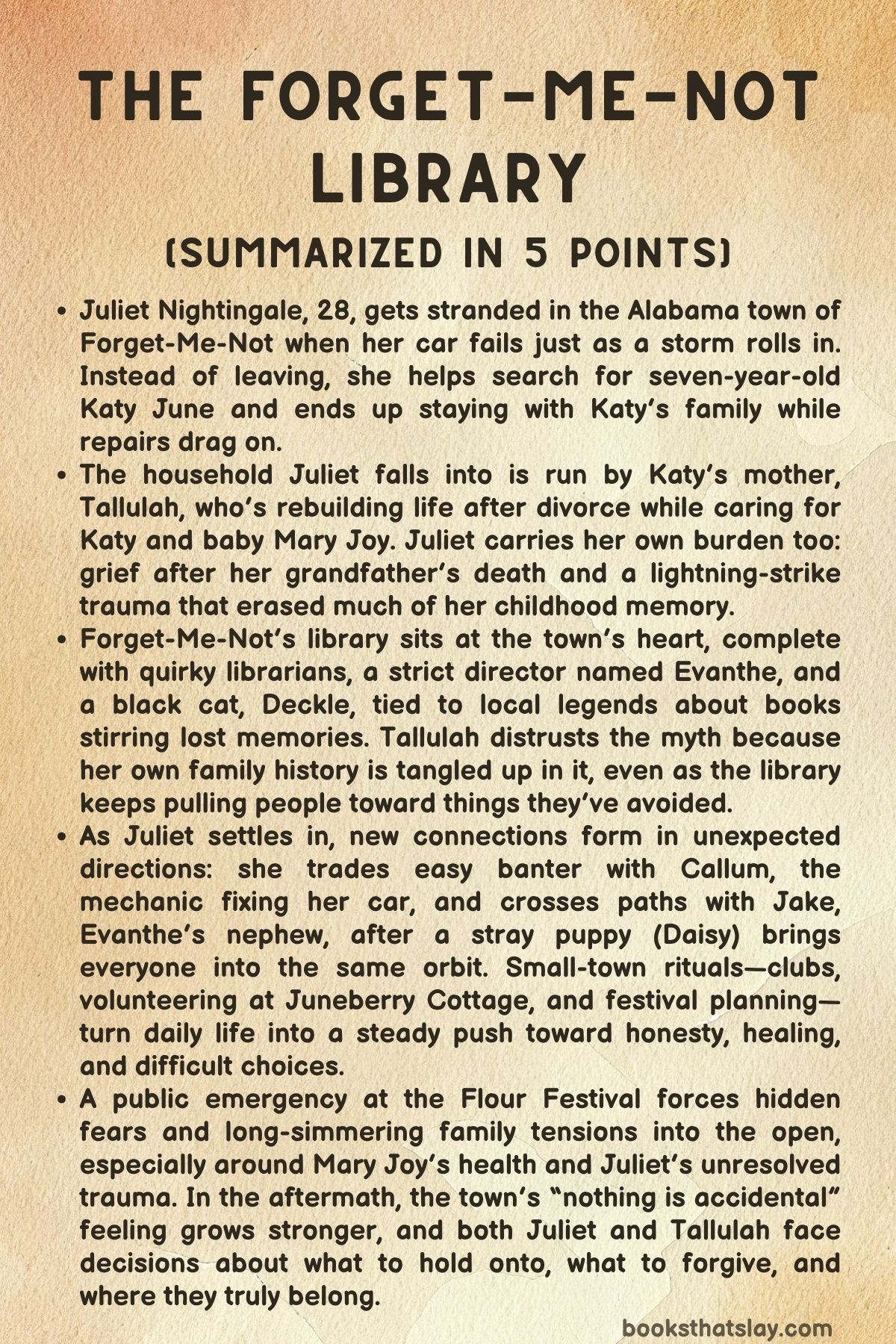
Summary
Juliet Nightingale is driving alone through the South on her way to Memphis when a detour and gathering storm push her onto unfamiliar roads. Her car sputters, coughs up blue smoke, and finally gives out near a small Alabama town called Forget-Me-Not.
While she sits trying to figure out what to do next, an elderly man, Tennyson Greenlee, approaches her in a panic: his seven-year-old granddaughter, Katy June, is missing. Juliet wants to keep moving before the weather turns, but something in Tenn’s fear makes her stay and help search.
A local woman, Maeve Hearnshaw, quickly takes charge of the situation. She calls her grandson Callum, who runs the town repair shop, to tow Juliet’s broken car.
Maeve also tells Juliet, in a way that feels half like a warning and half like comfort, that Forget-Me-Not has a reputation for being a stopping place for people who’ve lost their way. Juliet brushes that off, but she can’t deny she’s already stuck: the car needs parts that won’t arrive right away.
Juliet joins the search and finds Katy asleep in a tree, clutching a book. Katy is bright, imaginative, and oddly perceptive.
She talks to Juliet like they’re already friends, and Juliet carefully helps her climb down. When Tenn and Maeve arrive, the relief is immediate, and the family insists Juliet come to dinner.
That night, Juliet is invited to stay in Tenn’s house until her car is fixed. She expects to be a temporary guest, but the warmth of the household unsettles her in a good way.
The story also follows Tallulah Mayfield, Tenn’s granddaughter and Katy’s mother. Tallulah works at the Forget-Me-Not Library, a beloved town hub with its own legend: a black cat named Deckle is said to guide visitors to books that restore lost memories.
Tallulah resents the story because her own mother once chased that promise of recovered memory and adventure, and eventually left. Now Tallulah is divorced, raising Katy and baby Mary Joy, and trying to rebuild a steady life in her hometown.
At the library, Tallulah works with two older librarians, Nettie Getchell and Isabel Espinoza, who treat gossip as a community service and offer advice whether it’s requested or not. A man named Jake arrives and gets a small cut, and the librarians fuss over him while Tallulah tries not to notice how charming he is.
She soon learns Jake is the nephew of Evanthe Kilburn, the library’s intimidating director and a long-estranged figure in Tallulah’s family circle.
Back at Tenn’s house, Juliet settles into a cozy attic room. Alone at night, she faces what she has been avoiding: three months earlier, she survived a lightning strike that killed her beloved grandfather.
The trauma left her with a burn scar, deep grief, and large holes in her childhood memories. Her road trip was supposed to help her feel like herself again, but she’s mostly been running.
Katy’s easy trust and Tenn’s gentle presence make it harder to keep fleeing.
Juliet’s role in the household grows quickly. When Tenn hurts his back, Juliet steps in without hesitation, calming the chaos and getting him help.
The situation becomes even more chaotic when a muddy stray puppy bursts into the house, as if it has decided it lives there now. Tallulah tries to keep order while quietly realizing that Juliet, the unexpected guest, has become part of their daily rhythm.
Juliet begins seeing signs that her memory may be shifting. A phone call with her sister Amy confirms that a vivid “dream” Juliet had was actually a real childhood moment.
In town, Juliet meets Callum again and again, and their teasing conversations slide into real attraction. When she brings the “lost dog” flyer to the library, it becomes clear the puppy belongs to Jake, who had been researching puppy care.
Jake loses his lodging because Evanthe has strict rules, and the town rapidly rearranges itself to take him in, with Vera Ingleby offering a converted garage apartment and plenty of questions.
As Juliet becomes more embedded in Forget-Me-Not, people keep hinting that her arrival wasn’t random. Evanthe’s attention sharpens when she hears about the blue smoke from Juliet’s car, as if it means something specific.
Tallulah finally explains the local belief: the town draws in people who are unmoored and helps them heal through connection. Juliet doesn’t fully know what to think, but she can’t deny that being here eases something inside her.
Juliet also starts volunteering at Juneberry Cottage, a hospice respite home in town, where she meets residents and learns their stories. She agrees to a date with Callum after some nudging from locals, then nearly cancels out of fear she’s only playing along with a fantasy.
When she’s honest with Callum, he answers with honesty of his own, and they decide to take a real chance on each other.
Tallulah faces her own fragile hopes. She grows closer to Jake, then discovers he planned to leave town soon once his housing situation elsewhere is finalized.
The thought of another goodbye hits hard, especially with Katy already carrying sadness about her father, Scott, and the ways he disappoints her.
The turning point comes during the Flour Festival, when Juliet’s mother and sister visit. Dark skies and open space trigger Juliet’s anxiety, and her fear spikes just as a crisis erupts: baby Mary Joy shows signs of a severe allergic reaction after being given frosting that likely contains egg whites.
Juliet recognizes the danger immediately, calls 911, and tries to act, but panic shakes her body. Jake steps in with calm medical competence, administers an EpiPen from another parent, and helps stabilize Mary Joy until the ambulance arrives.
Juliet later learns she had a major panic attack layered on top of the emergency.
That night, Tallulah confronts Scott, furious that he ignored instructions about food. Scott admits he had planned to take a job overseas, but the near-tragedy forces him to face how absent he’s been.
He decides to move back and be present, and Tallulah—hurt but practical—agrees to try again for the girls’ sake, while making it clear this is his last chance.
Juliet, shaken, decides she needs therapy again and prepares to leave with her family. Before she goes, she visits Renny, a man at Juneberry who has been carrying a long love story and a long silence.
When Juliet accidentally finds a torn photograph, she realizes Renny’s lost love, Walt, was her grandfather. Renny confirms it and shares proof: the other half of the photo, an inscription in a book, and robin feathers her grandfather once gave him.
Juliet understands that her trip led her here not only for her own healing, but to reconnect two lives that mattered to the man she loved most.
Even with that clarity, Juliet still tries to drive away. Then she stops, overwhelmed by the thought of leaving the town and Callum, and makes a wild decision: she sabotages her own car so she can’t go.
Callum finds her mid-act, stunned, then relieved when she admits she’s choosing to stay and find support locally. They commit to each other with laughter and urgency.
Time moves forward. Tallulah returns to the library with new energy, planning to pursue further education and shape a future that feels like hers.
Deckle’s odd insistence on a particular cookbook finally prompts Tallulah into a recovered memory involving her grandmother June, a coffee tin, and a necklace that has been safeguarded for years. Tallulah confronts Evanthe and learns Evanthe has been keeping the tin safe, waiting for the right moment to return it.
Inside are recipes and a necklace engraved with a message about following the direction that leads you home.
Nearly a year and a half later, the community gathers at Christmas in the Library House. Tallulah lives there with Jake and the girls, and Jake has chosen to stay for good.
Mary Joy’s allergies are confirmed, Scott is involved and closer, and the town has settled into a new balance. Juliet and Callum arrive with news of their own: Callum has proposed.
At a wedding in the library—Evanthe marrying Jed, with Deckle carried down the aisle—another traveler with car trouble appears, and the town’s gentle pattern begins again, ready to guide one more lost person toward the life they didn’t know they needed.
Characters
Juliet Nightingale
Juliet is the story’s emotional lens: a capable, sharp-eyed young woman whose life has been cracked open by trauma and grief. After surviving a lightning strike that killed her grandfather and erased much of her childhood, she moves through the world with a strange combination of competence and disorientation—she can problem-solve in the moment, yet feels unmoored from her own history.
Her instinct to help Tennyson search for Katy June, even when she wants to flee the storm, reveals her core nature: she’s compassionate, steady under practical pressure, and unable to ignore someone else’s fear. At the same time, Juliet’s internal conflict is relentless—she carries guilt for surviving, shame over panic responses she can’t control, and a deep hunger to feel “whole” again through memory.
Forget-Me-Not becomes a mirror that reflects who she is beneath the amnesia: someone who finds purpose in caretaking, connection, and quiet bravery, whether she’s coaxing a child out of a tree, noticing the early signs of anaphylaxis, or admitting she needs therapy instead of pretending she’s fine. Her romantic pull toward Callum is less about rescue and more about being seen without explanation; with him, she can be both fragile and strong.
Juliet’s final choice—to stop running and claim a life where healing is supported—shows her transformation from a woman driven by loss to someone willing to build a future alongside it.
Tallulah Mayfield
Tallulah embodies the tension between staying and leaving, between family duty and personal longing. As a divorced mother working at the town library, she projects competence and control because her world demands it—two children, an aging grandfather figure in the home, a fragile co-parenting situation, and a job tied to a place that carries old wounds.
Her skepticism toward the library’s magic is deeply personal: she resents the idea that books and “restored memories” can rewrite fate, because her own mother was pulled away by that very myth, leaving Tallulah with abandonment as a formative injury. This is why she bristles at mystery and rules—she’s had too many people vanish, emotionally or literally, and she believes safety comes from structure.
Yet Tallulah’s arc is a gradual softening into trust: she allows Juliet into the household, allows Katy to skip camp for healing, and eventually allows love with Jake even when it risks another goodbye. The crisis at the Flour Festival exposes Tallulah’s fiercest trait—maternal protectiveness that becomes rage when her children are endangered—and it also pushes her to renegotiate power with Scott.
By the end, Tallulah is not “fixed” by magic; she chooses growth through education, partnership, and reclaimed family history, proving that healing in Forget-Me-Not is not passive enchantment but active courage.
Tennyson Greenlee
Tennyson, often called Tenn and functioning as Papaw, is the town’s gentle gravity. He presents as an elderly man with a mix of frailty and stubborn independence, but his true role is emotional anchoring: he holds space for others to fall apart without judgment.
His immediate willingness to trust Juliet, invite her into the family, and treat her as if she belongs reveals a man who understands that strangers can be kin when circumstances demand it. Tennyson’s physical limitations—back pain, routines, the need for help—quietly invert the usual “patriarch” dynamic; he isn’t powerful by force, but by steadiness, tenderness, and the way he models community care.
His belief in the town’s purpose, and in the idea that people arrive for reasons, makes him a bridge between the mundane and the mystical. Most importantly, Tennyson’s love for Katy June and Mary Joy is unwavering and practical, expressed through daily presence rather than speeches, and that presence creates the safe household where Juliet’s healing can begin.
Katy June
Katy June is a child written with unusual emotional intelligence, but she never feels like a prop; she functions as a truth-teller whose simplicity cuts through adult denial. Her imagination and love of books aren’t just charming traits—they’re coping tools, a way of making sense of a family shaped by divorce, shifting routines, and a mother who is often stretched thin.
Katy’s first big scene—found asleep in a tree clutching a book—captures her essence: she seeks refuge in stories and in elevated places where she can watch life from a safer distance. She bonds with Juliet quickly because Juliet treats her as a full person, not a problem to manage, and Katy responds with trust, insight, and a longing to keep Juliet close.
Her reluctance about camp canoeing reveals grief in a child’s language: certain activities become landmines because they belong to a version of family that no longer exists. Katy’s birthday party, with its carefully crafted rituals and meaningful gifts, shows how much she needs continuity and chosen symbols of stability.
Even when she’s playful, Katy is emotionally perceptive, and her connection to Juliet becomes one of the story’s most healing relationships—an intergenerational friendship where both give comfort and both receive it.
Mary Joy Mayfield
Mary Joy is the youngest, but she catalyzes one of the story’s most defining turning points. As a baby, she represents the future Tallulah is trying to protect and build, and her vulnerability forces the adults around her to reveal their true capacities.
The allergic reaction at the Flour Festival strips away social niceties and exposes competence, panic, guilt, and love in real time: Juliet’s sharp recognition, Jake’s calm action, Tallulah’s rage and fear, and Scott’s reckoning all orbit Mary Joy’s tiny body. After the crisis, Mary Joy’s ongoing allergies become a daily discipline that reshapes the household—label-checking, vigilance, and a constant awareness that love sometimes looks like relentless caution.
In the time jump, her confirmed allergies also quietly symbolize the story’s theme: some conditions don’t disappear, but families can adapt, learn, and become safer together.
Maeve Hearnshaw
Maeve is the town’s practical mystic—someone who moves with ease between casseroles and prophecy. She first appears as a helpful local who makes a phone call, arranges a tow, and offers hospitality, but beneath that is a steady conviction that Forget-Me-Not “collects” the lost.
Maeve’s warmth is not invasive; it’s strategic in the best way, nudging people toward the places and conversations that will change them. She functions as an informal caretaker to many—supporting Tennyson, mentoring through Juneberry Cottage, and gently pressing Juliet to consider belonging rather than merely passing through.
Maeve also models emotional intelligence: she sees the shape of grief in Juliet’s behavior and speaks about it without melodrama, offering interpretation—the meaning of the blue smoke—when Juliet is ready to hear it. Maeve’s power is that she never demands belief; she simply behaves as if people are worth saving, and that assumption becomes contagious.
Callum Hearnshaw
Callum is the grounded romantic lead: steady, teasing, and quietly dependable, with a temperament that balances Juliet’s anxiety rather than inflaming it. As the mechanic repairing Juliet’s car, he occupies a symbolic role from the start—he’s the person who could “send her away,” yet he’s also a person who makes staying feel safe.
His flirtation is playful but not shallow; it carries attentiveness, and he consistently shows up in moments that matter, from reassurance at Juneberry to support after the hospital scare. Callum’s reaction to Juliet canceling their date reveals an important trait: he won’t accept being treated like a performance, and he pushes for honesty without punishing vulnerability.
He is willing to “take the risk” of her complicated emotional landscape, which is exactly what Juliet needs—someone who doesn’t require her to be cured before she’s lovable. In the end, Callum becomes a choice Juliet makes actively, not a prize she wins, reinforcing the story’s idea that real repair is mutual and intentional.
Jake Kilburn
Jake is introduced as charming and intriguing, but his depth is revealed through competence and restraint. The library cut-finger scene positions him as someone who draws attention without seeking it, and the dog situation—being evicted over Daisy—shows that he values care over convenience.
His defining moment is the emergency with Mary Joy: Jake becomes the calm center, taking action with clinical confidence while others tremble or spiral. Learning he is a radiologist who works remotely reframes his earlier “mystery” as privacy rather than deception; he isn’t hiding a dark secret so much as protecting his autonomy.
Jake’s emotional arc centers on commitment: he initially has an exit plan and a time limit, and Tallulah’s devastation at that realization mirrors her history of abandonment. Jake’s choice to turn back, confess what he wants, and stay is not just romantic—it’s reparative, directly answering Tallulah’s deepest fear.
He represents a love that returns, not a love that disappears when life gets complicated.
Evanthe Kilburn
Evanthe is the story’s most controlled adult, and that control reads as both strength and wound. As the library director, she enforces rules with a severity that borders on coldness, yet her contradictions—such as the pet-free library that still houses Deckle—suggest that her rigidity is performative, a way to keep the world predictable.
Her distance from Tallulah is layered: part estrangement, part guilt, part protective secrecy. Evanthe’s relationship to memory is especially charged; she exists at the intersection of the library’s myth and its real consequences, and she carries the burden of what the “magic” cost certain families.
Her long-kept coffee tin, locked away for eighteen years, reveals a different Evanthe than the one who scolds and evicts: someone who can keep faith with a promise for nearly two decades, waiting until Tallulah is ready. Even her brief appearance at the birthday party signals slow thawing—she cannot yet stay and be fully present, but she can show up, speak hard truths, and leave a gift.
By the end, her marriage to Jed suggests she has finally allowed herself a softer life, one where love is not a breach in the walls but a doorway home.
Nettie Getchell
Nettie is one of the library’s lively engines: comedic, nosy, and deeply invested in other people’s happiness. Her fussing over Jake’s cut finger and her enthusiasm for gossip could be read as meddling, but in context it functions as community caretaking—an insistence that no one stays isolated for long.
Nettie’s social energy helps integrate outsiders like Juliet, and her invitations and club culture create spaces where healing can happen without looking like therapy. She represents a kind of small-town affection that can feel overwhelming to newcomers, yet it’s also what prevents grief from becoming total solitude.
Isabel Espinoza
Isabel mirrors Nettie’s meddling warmth but carries her own flavor—bolder, more teasing, and quick to interrupt moments with humor, like the catcall that breaks Juliet and Callum’s near-kiss. Isabel’s role is to keep the town’s emotional tone from tipping into sentimentality; she punctures intensity at strategic times, reminding everyone that life continues even when hearts are racing.
Like Nettie, she helps maintain the library as a social hearth, a place where awkwardness, attraction, and vulnerability are all allowed to coexist.
Vera Ingleby
Vera is the friendly interrogator: generous with cookies and hospitality, yet hungry for details, romances, and backstories. She embodies the town’s surveillance-as-care model—people watch because they want to help, even when their curiosity is too much.
Her eagerness to house Jake in her converted garage apartment shows her practical kindness, and her delight in “figuring him out” adds levity while also reinforcing the theme that outsiders are quickly woven into the community fabric. Vera’s home becomes a temporary nest for Juliet’s family during the hospital aftermath, underscoring that her nosiness is paired with real support when it counts.
Georgia
Georgia functions as a connector between people and places, especially through the house that awakens Juliet’s sense of memory and belonging. Her pragmatic description of the damaged-yet-solid property frames Forget-Me-Not’s philosophy in architectural form: what matters is the foundation, and everything else can be repaired with time, help, and commitment.
Georgia also carries news that shapes Tallulah’s future, and she seems to understand that homes in this town are more than listings—they’re invitations. Through her, the story suggests that “where you live” can be an emotional decision, not just a logistical one.
Renny
Renny is one of the narrative’s quiet heartbreaks and, ultimately, one of its most profound releases. Initially, he appears as someone connected to Juneberry and the town’s older layers, but his significance expands when Juliet discovers his link to her grandfather.
Renny represents a love that was real yet unclaimed, preserved in fragments—torn photographs, handwritten inscriptions, and saved robin feathers. His long-held grief is dignified rather than bitter; he has lived with absence without letting it harden him into cruelty.
When the truth surfaces, Renny becomes a bridge for Juliet’s healing: he returns her history in a way that is tender and surprising, and he reframes her grandfather not just as the man she lost, but as a man who loved deeply and complicatedly. Renny’s willingness to encourage Juliet toward therapy and support, even if it means she leaves, shows love without possession—a thematic counterpoint to abandonment.
Ronald Whitman Stephens
Juliet’s grandfather, revealed as Ronald Whitman Stephens and also connected to Renny’s “Walt,” is the story’s spiritual center even after death. He shaped Juliet’s inner world through affection, rituals, and small wisdoms, which is why losing him also meant losing her sense of self.
The lightning strike makes him a symbol of sudden tragedy—how life can split into “before” and “after” without warning—and his absence becomes the space Juliet keeps trying to fill with motion and searching. The later discovery of his love for Renny complicates him in a humanizing way: he wasn’t only a family figure, he was a person with desires, regrets, and a life that exceeded what Juliet knew.
This revelation doesn’t diminish him; it enlarges him, and it gives Juliet something precious—proof that love persisted in his life, and that her memories can be restored not just by magic, but by truth.
Scott
Scott begins as the absent father whose unreliability hurts Katy and creates constant tension for Tallulah. His failure to show up, his broken promises, and his casual mishandling of Mary Joy’s allergy boundaries position him as a threat—not malicious, but dangerously careless.
The emergency forces an overdue reckoning: Scott’s guilt becomes a pivot point where he is confronted with the real cost of half-parenting. His confession about an overseas job and then his decision to stay and move back to Alabama is his attempt at redemption, but Tallulah’s skepticism is crucial—she understands that dramatic promises can fade once guilt cools.
Scott’s arc is therefore conditional and realistic: he is offered a last chance, not instant forgiveness, and the story treats fatherhood as something he must earn through consistency rather than declarations.
Amy
Amy, Juliet’s sister, acts as both grounding voice and emotional mirror. Her humor and appetite at the festival contrast Juliet’s rising panic, which makes Juliet’s internal struggle more visible without needing exposition.
Amy also functions as a keeper of family truth—confirming that Juliet’s resurfacing dream is a real memory and therefore giving Juliet permission to hope. She represents the life Juliet left behind and the support system Juliet needs to integrate healing rather than chase it alone.
Amy’s presence highlights that rediscovery is not only solitary; it often requires someone else to say, “Yes, that happened, and you are still you.”
Mr. Daniels
Mr. Daniels is a small but potent embodiment of community tenderness. His gift to Katy—a cutting from Papaw’s oak tree meant to become a new “Bill”—is not just sweet; it’s a ritual of continuity, an adult recognizing a child’s need for a living symbol she can trust.
He participates in the town’s collective parenting, stepping in with a gesture that says, “You are not alone, and your heart deserves something steady.” Characters like Mr. Daniels are how Forget-Me-Not becomes believable: the town heals not through speeches, but through quiet acts that accumulate into safety.
Deckle
Deckle, the library’s black cat with golden eyes, is the story’s most overtly mystical figure and its most elegant metaphor for memory. Deckle behaves like a guide rather than a pet—appearing at thresholds, leaving clues, and repeatedly nudging people toward the exact book or object that will unlock what they’re avoiding.
To Tallulah, Deckle is a provocation because he represents the myth that stole her mother; to Juliet, he becomes a strange reassurance that her life isn’t random. The paw prints and the “impossible” appearances are less about proving magic and more about externalizing an internal process: healing often arrives as insistence, as something that keeps tapping your shoulder until you finally look.
Deckle’s presence keeps the library from being merely a workplace; it becomes a living archive where grief, love, and identity can be recovered.
Daisy
Daisy, the muddy stray puppy, is chaos in the best way—an intrusion that forces people into care, humor, and shared responsibility. Her arrival triggers domestic upheaval, instantly turning Juliet from guest to participant, and she becomes an emotional bridge between characters who might otherwise stay guarded.
Daisy also deepens Jake’s characterization: his bond with her shows softness and a willingness to be inconvenienced for love. For Katy, Daisy is a lesson in letting go—loving something while knowing it may not remain yours—and that makes Daisy a gentle rehearsal for the larger fear of losing Jake.
The fact that Daisy ultimately stays as part of the household future reinforces the story’s promise that not every attachment ends in abandonment.
Jed
Jed’s presence is most visible at the end, but his importance is thematic: he represents Evanthe’s choice to stop living purely in duty and to accept intimacy. If Evanthe’s life has been defined by containment, then marrying Jed is a public declaration of openness.
The wedding in the library, with Deckle as part of the ceremony, fuses the town’s practical community with its mythic heart and signals that even the most guarded person can choose belonging.
Dale
Dale appears largely through backstory, yet he serves as proof that Forget-Me-Not has a pattern: people arrive stranded, and their lives redirect. His earlier connection to Evanthe and his influence on Jake’s decision to come to town show how stories ripple through families.
Dale functions like an echo—an earlier version of the same “lost, then found” trajectory Jake is about to complete.
Bitsy Krebbs
Bitsy is a ghost in the architecture, tied to the house that sparks Juliet’s familiarity and longing. Her story—illness, departure, death, and a neglected home—turns the property into a symbol of interrupted lives and deferred care.
The damage to the house is not only physical; it represents what happens when no one is left to tend the place where a life once unfolded. That is why Juliet’s reaction is so intense: the house feels like a container for displaced identity, and Bitsy’s absence makes space for Juliet’s possible future.
June
June, remembered through Tallulah’s recovered memory and tied to the hidden coffee tin, represents legacy that was temporarily withheld but never abandoned. Her act of entrusting something precious to Evanthe suggests a deep belief in timing—that Tallulah would come back to herself when she was ready.
June’s presence emphasizes that family inheritance isn’t only property or genetics; it’s recipes, objects, sayings, and the invisible threads of love that persist even through years of silence.
Themes
Healing and Rediscovery of the Self
In The Forget-Me-Not Library, the process of healing—both emotional and psychological—forms the backbone of the story. Juliet Nightingale arrives in Forget-Me-Not not just by circumstance but by destiny, seeking restoration after trauma and memory loss.
Her car’s breakdown acts as a symbolic rupture, halting her external journey and redirecting her toward an internal one. Through her interactions with the townspeople, especially Maeve, Tallulah, and Katy, she begins confronting the grief she has long suppressed.
The community itself becomes a mirror for her pain and a conduit for recovery. The town’s rhythm of kindness, the comforting domesticity of shared meals, and the steady companionship of people who genuinely care help Juliet reconnect with herself.
Forget-Me-Not represents a liminal space where those burdened by sorrow or guilt find solace not through grand revelations but through small acts of compassion and connection. The book demonstrates that healing is not about erasing the past but about accepting it, even when fractured.
The restoration of Juliet’s memories parallels her emotional mending—what begins as fear of remembrance transforms into gratitude for rediscovery. Heather Webber’s narrative reminds readers that healing rarely happens in isolation; it requires the grounding presence of others and the courage to stop running.
The magic of Forget-Me-Not does not lie in supernatural elements but in its ability to nurture broken souls until they can find strength again, symbolizing the universal longing for belonging and renewal.
Memory and the Power of Remembrance
Memory serves as a powerful emotional current throughout The Forget-Me-Not Library, shaping both individual identity and communal bonds. Juliet’s amnesia following her grandfather’s death makes her relationship with memory deeply personal; she becomes a living embodiment of loss, searching for pieces of her history.
Forget-Me-Not itself is steeped in remembrance, from its name to its mythic origins involving love, loss, and recollection. The library, with its mysterious cat Deckle, reinforces the notion that stories and books are vessels of memory, capable of restoring what time or trauma has taken.
Tallulah’s resistance to this idea—her resentment of the library’s legends—reveals how painful remembering can be when memories are tied to abandonment and grief. Yet, over time, she learns that memory is not an enemy but an anchor, holding her to the people and values that truly matter.
The rediscovery of the coffee tin filled with recipes and her grandmother’s message reaffirms that remembering is not just looking backward; it’s carrying love forward. Juliet’s reconnection with her grandfather’s past and Renny’s revelation about his long-lost relationship bring memory full circle, showing that remembrance heals what silence distorts.
Through intertwined personal histories, Webber explores how memory defines who we are, how we love, and how we ultimately find peace. Forget-Me-Not becomes a sanctuary for remembrance—where lost stories are found, forgotten pain is honored, and the act of remembering becomes the truest form of homecoming.
Community and Belonging
The heart of The Forget-Me-Not Library lies in its portrayal of community as both refuge and transformation. Forget-Me-Not is more than a setting—it is a living entity shaped by kindness, gossip, and the unspoken understanding that everyone there carries wounds.
Each resident, from the nosy yet well-meaning Vera to the steadfast Maeve, contributes to a social fabric that embraces newcomers like Juliet without question. Their involvement in one another’s lives is not invasive but restorative, offering structure and affection to those adrift.
The town’s gatherings—the Flour Festival, the book clubs, and family dinners—act as communal rituals reaffirming that connection is the antidote to isolation. Through Tallulah, the narrative also shows that belonging is not always effortless; her guardedness stems from betrayal and disappointment, yet the steady presence of others slowly rebuilds her trust.
Jake’s arrival and his eventual decision to stay underscore that belonging often requires a choice—to remain, to invest, to care. Even the library, symbolic of collective memory and wisdom, thrives on shared participation, uniting the eccentric and the broken in a single space of acceptance.
By the end, both Juliet and Tallulah realize that home is not found but made, and that community, in its simplest form, is an act of love. Webber’s depiction of Forget-Me-Not reflects an ideal yet attainable vision of togetherness—a reminder that human connection, sustained through empathy and constancy, can heal what solitude cannot.
Love and Emotional Renewal
Love in The Forget-Me-Not Library transcends the conventional bounds of romance, encompassing familial affection, friendship, and the quiet devotion found in care and understanding. Juliet’s budding relationship with Callum emerges not from grand passion but from mutual tenderness and shared vulnerability.
Their connection mirrors her gradual opening to life again after trauma. Tallulah’s love story with Jake, on the other hand, is one of rediscovery—proof that trust and affection can bloom even after disillusionment.
Romantic love here is restorative, not escapist; it coexists with the love between parents and children, friends, and even between humans and the past. The enduring bond between Juliet and her late grandfather drives much of her emotional evolution.
His presence lingers through dreams, memories, and symbols such as the robin and the oak, illustrating that love continues to guide even after death. Tallulah’s familial love—her protectiveness over Katy and Mary Joy—anchors her amid uncertainty, reinforcing that love is as much responsibility as it is feeling.
Webber’s portrayal of love emphasizes quiet constancy over intensity, healing over possession. It is not love that saves her characters but their willingness to be saved by love—to allow themselves to be seen, forgiven, and held.
The book suggests that love’s truest form is acceptance: of self, of others, and of the imperfections that make connection meaningful. In Forget-Me-Not, every relationship—romantic, familial, or platonic—serves as a testament to love’s capacity to rebuild what loss once fractured.
Destiny and the Mystique of Place
The concept of destiny and the idea that certain places hold unseen power form one of the most enchanting undercurrents in The Forget-Me-Not Library. Forget-Me-Not itself functions as a character—mysterious, compassionate, and guiding.
The town’s legend, that it attracts those who have lost their way, imbues it with a sense of purpose beyond geography. Juliet’s accidental detour and car failure are portrayed as acts of fate rather than coincidence, as if the town called her there to heal and rediscover herself.
The symbolism of the “blue smoke” from her car encapsulates the merging of the mystical and the emotional—it is grief made visible, an outward manifestation of inner turmoil. Deckle, the enigmatic black cat, serves as the town’s emissary of destiny, guiding people toward moments of clarity and reconciliation.
For Tallulah, destiny unfolds not as a predetermined script but as the gentle realization that she is where she is meant to be. Through these converging arcs, Webber suggests that destiny is not an external force dictating outcomes but an internal awakening—the recognition of meaning in what once felt accidental.
The mystical aura of Forget-Me-Not exists not to replace reason but to affirm faith in the unseen patterns that shape human lives. By the novel’s end, the idea of destiny becomes deeply human: it is the instinct that leads Juliet to stay, Tallulah to open her heart, and the townspeople to keep believing that every lost soul who arrives is meant to find their way home.