The House Saphir Summary, Characters and Themes
The House Saphir by Merissa Meyer is a gothic-leaning fantasy mystery set in a city that runs on superstition, relics, and rumor. Mallory Fontaine survives by selling fear: she leads midnight tours through an abandoned mansion tied to the legend of a nobleman who murdered his wives.
Mallory insists it’s all performance—until the dead start answering back and real monsters step out of the dark. When a reclusive count hires Mallory and her sister to remove a violent spirit from his family château, the sisters enter a home where lies don’t stay harmless for long, and where the past still wants a body.
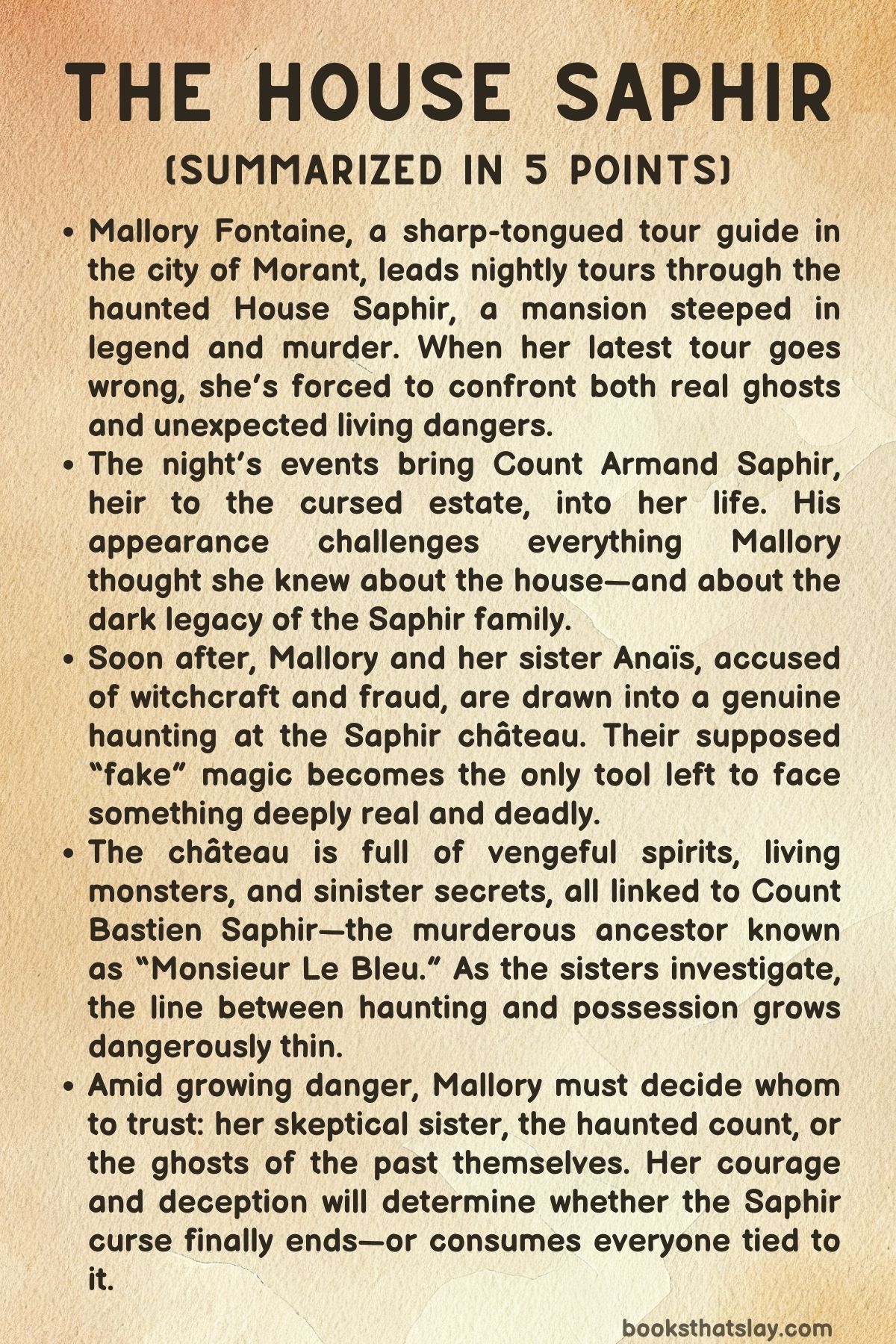
Summary
Mallory Fontaine waits under a streetlamp in Morant, a dagger hidden in her boot, ready to guide another paid night tour through the abandoned House Saphir. The mansion’s name draws customers who want to hear about Count Bastien Saphir—“Monsieur Le Bleu”—a nobleman blamed for murdering multiple wives.
Two clients arrive first: Louis Dumas, rich and smug, and Sophia, quiet and marked with a Tyrr initiate tattoo. They say a fortune teller urged them to come—Mallory’s sister, Anaïs—and Louis boasts he bought a so-called god-relic feather from her.
A third guest is late, but Mallory opens the gate and begins the show.
Inside the grounds, she narrates the family history, the famous wine, and how Bastien built the mansion to impress society. Louis scoffs at being guided by a woman, but Mallory refuses to be pushed around.
She lights lanterns and candles, moving them through dusty rooms and grand spaces meant for parties long ago. In the dining room, she reveals a portrait of Le Bleu—and sees a ghost no one else can: Triphine Maeng, Bastien’s first wife.
Triphine comments sharply on everything, annoyed to be ignored, while Mallory keeps her face steady so the guests won’t realize anything is real.
Mallory adds details meant to horrify: Triphine’s sudden decline after giving birth, the rushed burial without proper rites, and the convenient lack of witnesses. Upstairs, a heavy thump suggests something else is in the house.
Then the late guest appears in a mirror and nearly causes panic. Mallory reacts on instinct, throwing him down before realizing he’s just a man who missed the entrance.
His name is Axel Badeaux, and his bright blue eyes unsettle her—Triphine says he looks like the Saphirs.
Mallory continues, showing sketches she’s made of the wives and leading them down into a hidden corridor and the wine cellar. There she describes Triphine’s death in gruesome detail and displays a ring as a prop, then pivots into selling souvenirs.
Axel presses her with pointed questions about the Fontaine sisters and rumors of witchcraft. Mallory denies everything and pushes the tour onward, building to the final “haunting” with hidden tricks: a sudden flare of fire, a slamming door, and a figure on the stairs that is really a mannequin dressed as Triphine.
The audience turns on her. Louis and Sophia reveal themselves as investigators and accuse Mallory of fraud, trespass, counterfeit goods, and fake fortunes.
Mallory is shackled—until Axel challenges them with a question only Triphine could answer. Mallory asks the ghost what she held in her last portrait.
Triphine answers: her newborn son. Axel accepts the proof and reveals his real name—Count Armand Saphir, heir to the estate—and grants Mallory permission to be in the house.
The investigators leave, warning they will return.
Mallory recovers hidden money and argues with Armand over a real sapphire ring she’s found. Before the dispute can settle, something crashes upstairs.
Triphine admits she’s frightened: a large creature has moved in. Mallory climbs the stairs with her dagger, Armand following, and they face a wolf-headed monster—a voirloup.
Armand is bitten while shielding her. Mallory stabs the creature and knocks it down the stairs, but it returns, and their tricks fail.
In desperation, Armand throws Mallory’s real silver coins at the beast; the metal burns it from within. They escape through a window into the vines, only to find the voirloup blocking the lawn.
Two strangers appear—Fitcher and Constantino—armed with strange tools and calm confidence. Constantino’s arrow hits true, and the voirloup vanishes, leaving a glass figurine behind.
Fitcher warns that dark magic clings to the property and will attract more threats. They give Mallory a shimmering contact card for “Fitcher’s Troupe,” telling her to write her need and entrust it to the four winds.
When they disappear, Armand wakes and decides Mallory must have used magic. Mallory can’t fully deny it anymore.
The next morning, Mallory and Anaïs face eviction; their rent is ten weeks overdue, and Mallory’s coins are gone. Armand arrives at their shop and makes an offer: his family château in Comorre is haunted by Monsieur Le Bleu, and the disturbances have become violent.
He wants the “renowned” Fontaine witches to remove the spirit. Mallory tries to refuse, but the threat of arrest and the promise of payment force her hand.
She quotes an outrageous fee; Armand agrees, leaving a jeweled medallion as collateral and insisting they start immediately.
On the road to Comorre, Triphine unexpectedly appears among the luggage, shocked she’s left Morant at all. At the château, more dead wives watch from an upper window—Lucienne and Béatrice among them—while the housekeeper Yvette doubts the sisters’ claims.
The household is strained and scared. During an awkward dinner, Mallory sees the ghosts mocking the living from the far end of the table.
Armand explains how “accidents” have maimed staff and driven workers away. Later, Mallory glimpses Le Bleu in a reflection, as if the house itself is watching her.
That night, a maid named Julie asks for a fortune reading, wearing a massive sapphire ring and admitting she secretly married last week. Anaïs performs their usual scripted comfort, but the cards feel wrong to Mallory.
The fear becomes real when a lou carcolh—huge, snail-like, with tentacles—crawls from the wardrobe and attacks. Salt drives it off, and Mallory scratches fake runes into the slime to keep up appearances.
Mallory attempts to summon Fitcher’s Troupe by releasing their card to the wind, but a salamander of glass turns real long enough to burn her message to ash. Soon after, Julie is found murdered and displayed on antlers, a sword through her chest, her ring stolen, her finger removed.
Words for “Trust” and “Betrayal” are carved into her skin—marks tied to Bastien’s past crimes. Evidence begins pointing toward Armand, and Mallory’s unease grows when she discovers Julie’s ring hidden in his rooms.
Using a risky ritual, the sisters briefly bring Julie back to speak; Julie confirms her “lord husband” was Armand and says he killed her.
Mallory prepares to flee, but Armand confronts her in a storm, his manner dark and threatening. Before the situation resolves, Fitcher and Constantino arrive in chaos as the château attacks them with shifting floors and living corridors.
Driven into the cellar, they find a ritual chamber staged with the murdered wives’ bodies and wedding rings. Bastien appears, bargaining for Mallory’s death in exchange for Anaïs’s life.
Mallory stalls, then realizes the ghosts can harm him. The wives rise in fury, forcing Bastien back.
A larger plan forms around the five rings and a binding tied to the house. In the chapel, Gabrielle Savoy—Bastien’s fourth wife, long thought escaped—reveals herself and leads a ritual, but Anaïs is suddenly possessed and kills Gabrielle with Bastien’s sword.
Outside, Bastien explains how he spread his influence through tainted tea, then uses blood-magic at the fountain to rebuild a mortal body for himself. With a body, he no longer needs possession, and Mallory sees a narrow opening: trap him in the house and burn the anchor of his power.
Mallory and Armand flood the château with fortified wine as fuel and begin the binding. Bastien counters with illusions and force, shutting exits and turning the building into a weapon.
Mallory shatters a salamander figurine to release real fire, igniting the wine and setting the château ablaze. On the roof, the house tries to kill them; Armand falls, badly injured.
Bastien offers Mallory survival if she frees him, but she refuses. Guided by the wives’ spirits and Gabrielle’s last instruction, Mallory speaks the spell and discovers her own hidden nature—she transforms into a bird mid-fall and survives.
The burning finishes what the ritual started. Bastien’s spirit is extinguished in blue flame, and the dead wives finally fade into peace, all but Triphine, who chooses to remain.
Later, back in Morant, Mallory and Armand rebuild the estate into a controlled haunted attraction and a small apothecary, turning scandal into stability. Anaïs travels with Fitcher’s Troupe, and Mallory—now openly accepted as something real—begins a new life with Armand, engaged with a cheap glass “sapphire” that still means exactly what she wants it to mean.
Characters
Mallory Fontaine
Mallory Fontaine is the daring and resourceful protagonist of The House Saphir, a woman who straddles the worlds of deception and the supernatural. At first glance, she appears to be a con artist—conducting fraudulent ghost tours and selling counterfeit relics—but beneath her schemes lies sharp intelligence, courage, and a strong moral compass twisted by necessity.
Life has not been kind to Mallory; poverty and suspicion have forced her to survive through cunning rather than privilege. Yet her apparent cynicism conceals deep compassion and a longing for legitimacy.
Her interactions with ghosts, especially Triphine Maeng, reveal that she possesses a genuine connection to the supernatural, even if she resists acknowledging it. Over time, Mallory evolves from a pragmatic skeptic into a true witch, learning to harness both magic and trust.
Her relationship with Count Armand Saphir adds another dimension to her character: she is drawn to him despite his dark family legacy, finding in him a mirror of her own haunted self. By the novel’s end, Mallory’s wit and bravery transform her from a discredited fraud into a savior who binds evil, restores peace, and secures her place as a rightful heir to both magic and love.
Anaïs Fontaine
Anaïs Fontaine, Mallory’s older sister, contrasts her sibling in temperament and belief. Where Mallory is fiery and impulsive, Anaïs is serene, deliberate, and deeply intuitive.
She acts as the anchor of the Fontaine sisters, providing both the stability and the intellect that Mallory often lacks. Though she outwardly participates in their fortune-telling scams, Anaïs’s understanding of ritual and energy suggests that she may harbor a latent or moral magic of her own.
Her bond with Mallory oscillates between exasperation and fierce loyalty; she often scolds Mallory’s recklessness but follows her into danger out of love. Anaïs’s eventual possession by Bastien Saphir is a devastating twist that reveals her inner vulnerability—her mind and spirit are strong, yet her empathy leaves her open to corruption.
Still, Anaïs plays a crucial role in the story’s moral resolution: through her suffering and survival, she represents the enduring strength of sisterhood and the peril of tampering with powers beyond understanding.
Count Armand Saphir
Count Armand Saphir stands as both heir and victim to the cursed Saphir lineage. With his piercing blue eyes and tortured demeanor, Armand embodies the gothic ideal of the reluctant aristocrat burdened by ancestral sin.
He seeks to restore his family’s reputation and cleanse his home of Bastien’s haunting, yet he cannot fully escape the taint of his bloodline. His relationship with Mallory begins with suspicion but grows into mutual respect and affection as they face the horrors of the château together.
Armand’s transformation throughout the novel—from the skeptical employer to the wounded protector and eventual romantic partner—illustrates his redemption. He is not merely a romantic foil but also a reflection of Mallory’s journey: both are trapped between lies and truth, the past and the possibility of rebirth.
When he risks everything to aid in the final ritual and later rebuilds the estate with Mallory, Armand becomes a symbol of healing, proof that love and legacy can coexist even amid the ruins of horror.
Bastien Saphir (Monsieur Le Bleu)
Bastien Saphir, known in legend as Monsieur Le Bleu, is the specter that embodies the generational rot of House Saphir. Once a man of charm and influence, he descended into madness and murder, killing his wives in grotesque rituals that intertwine lust, possession, and power.
In death, Bastien transcends mere villainy to become a manifestation of corruption—his ghost feeds on fear, bloodlines, and guilt. His haunting of both Armand and the château transforms the physical space into a living organism of torment, one that traps all within its influence.
Bastien’s cruelty extends beyond his murders; he manipulates Mallory and Anaïs through psychological warfare, exploiting their insecurities and their bond. His ultimate defeat through Mallory’s fire and faith marks not just the end of his terror but the symbolic destruction of patriarchal tyranny that has cursed generations.
Even in ruin, Bastien’s presence lingers as a cautionary echo of the darkness inherited through unchecked desire and pride.
Triphine Maeng
Triphine Maeng, Bastien’s first wife, is the ghost who transcends tragedy to become one of the story’s most memorable spirits. Initially sardonic and bitter, she evolves into an unlikely ally for Mallory.
Bound to the mansion and weary from centuries of neglect, Triphine’s sharp humor and blunt observations offer both levity and wisdom amid the terror. Unlike many literary ghosts, she retains her individuality and agency, guiding Mallory through deception and danger.
Her connection to the physical and emotional history of the house gives her insight into the nature of its curse. Triphine’s decision to remain with Mallory after the other spirits ascend underscores her affection and loyalty—she finds in Mallory the acknowledgment and friendship denied to her in life.
Through her, the novel gives voice to women erased by history and abuse, transforming her from a victim into a guardian of truth.
Fitcher and Constantino
Fitcher and Constantino, members of the mysterious monster-hunting group Fitcher’s Troupe, serve as the pragmatic counterparts to the Fontaine sisters’ uncertain magic. Fitcher, calm and analytical, provides a grounding presence, while Constantino, more impulsive and fierce, embodies the group’s militant resolve.
Their arrival marks a turning point in the novel, introducing an external world of organized supernatural combat. They do not simply function as saviors; instead, they expand the moral scope of the story, showing that the fight against darkness extends beyond the cursed château.
Their respect for Mallory’s courage and ingenuity signifies her acceptance into the legitimate world of magic and sorcery. In the end, their friendship and alliance with the sisters promise a future where knowledge, skill, and compassion coexist against evil.
Julie
Julie begins as a naïve maid and becomes one of the most tragic figures in The House Saphir. Her youthful idealism and secret marriage to Armand expose the intersection of innocence and corruption at the heart of the château’s curse.
Julie’s death—displayed grotesquely as one of Bastien’s ritual victims—marks the narrative’s descent into true horror, blurring the boundary between human crime and supernatural malice. Even after death, Julie’s spirit embodies both vengeance and sorrow, forcing Mallory to confront the truth about trust, betrayal, and love’s vulnerability.
Her posthumous testimony not only unravels the mystery but also serves as a moral reckoning for all characters entangled in deceit. Julie’s suffering anchors the novel’s gothic intensity, reminding readers that beauty and purity often become casualties in the battle against inherited evil.
Yvette
Yvette, the pragmatic and judgmental housekeeper, provides a human counterpoint to the novel’s magical chaos. Devout in her faith and skeptical of witchcraft, she represents the social voice of morality and superstition within the household.
Her disdain for the Fontaine sisters arises not from malice but from fear—of sin, of the unknown, and of her own helplessness in a haunted estate. Over time, however, Yvette’s stoicism softens as she witnesses Mallory’s courage and compassion.
By the story’s conclusion, she becomes an unlikely ally and even a partner in rebuilding the estate’s new life, helping to transform House Saphir from a symbol of death into one of renewal.
Themes
Gender, Power, and Autonomy
Within The House Saphir, gender dynamics shape nearly every conflict, exposing how control and perception are used as tools of dominance. Mallory Fontaine’s role as a tour guide—a woman earning her living by retelling the legend of a murderous nobleman—directly challenges the patriarchal expectations of her world.
Her defiance against men like Louis Dumas, who doubts her competence purely because she is female, underscores a recurring struggle for autonomy in a society that prizes female obedience and appearance over intellect and courage. The contrast between Mallory’s pragmatic independence and the historical oppression faced by Count Bastien Saphir’s wives illustrates a generational echo of subjugation.
These women, silenced in life and rendered ornamental in death, become literal ghosts whose voices have been suppressed by both their murderer and societal norms. Mallory’s interactions with their spirits reveal how women’s stories, when reclaimed, become acts of rebellion.
Moreover, even the living women—Anaïs with her fortune-telling, Yvette’s rigid religiosity, and Julie’s tragic naïveté—embody different responses to a system that confines them. Through these interwoven arcs, the novel constructs a lineage of female resistance where survival, wit, and agency replace passivity.
Power is not granted but seized, and the ghosts’ eventual liberation mirrors Mallory’s own assertion of identity—not merely as a “fake witch,” but as a woman who commands her destiny and transforms performance into truth.
The Haunting of Guilt and Inherited Sin
The haunting in The House Saphir extends far beyond restless spirits; it is a manifestation of collective guilt, both personal and ancestral. The Saphir family’s curse, originating from Bastien’s atrocities, symbolizes how moral corruption seeps through generations, tainting even those who seek redemption.
Count Armand’s torment is not only by ghosts but by the weight of his bloodline—his physical resemblance to Bastien, the inherited wealth built on murder, and the creeping madness that threatens to repeat history. The château itself becomes a living representation of guilt, responding to human emotion with violent physicality: cracking walls, bleeding doors, and illusions of suffering that echo the crimes committed within.
Mallory’s role as an outsider is crucial in unraveling this cycle, as she refuses to accept inherited sin as immutable fate. However, she too becomes entangled—her lies, her fraudulent séances, and her opportunistic deceptions blur the boundary between survival and complicity.
The theme culminates in the final confrontation, where Mallory recognizes that absolution cannot come from escape but from acknowledgment and sacrifice. By confronting Bastien and binding his soul, she symbolically cleanses not just the house but the moral debt carried by everyone connected to it.
The haunting thus transforms from supernatural spectacle into a meditation on memory, shame, and the courage required to face one’s lineage without becoming enslaved to it.
The Performance of Truth and the Illusion of Belief
Throughout The House Saphir, truth operates as a fragile construct, shaped by deception, performance, and faith. Mallory’s livelihood depends on illusion—fake relics, staged hauntings, and scripted séances—yet her fraudulent craft paradoxically leads her closer to genuine magic.
Her entire identity is an act, but within that act lies authenticity; she provides people with the comfort or fear they secretly crave. The story questions what it means to “believe” in a world where truth is fluid and subjective.
The investigators’ exposure of her tricks early in the book highlights the tension between rationality and wonder, between debunking the supernatural and acknowledging that some mysteries transcend logic. The contrast between Anaïs’s cynicism and Mallory’s gradual awakening to real magic underscores the porous line between fabrication and revelation.
Even Armand’s skepticism collapses under the weight of undeniable horror, forcing him to confront that faith sometimes begins where evidence ends. By the conclusion, when Mallory wields authentic sorcery to destroy Bastien, the narrative suggests that belief itself has creative power—the ability to turn illusion into truth.
Her journey from fraud to witch is less a shift in capability than in conviction, redefining truth not as the absence of lies but as the courage to act as though meaning exists, even in chaos.
Love, Trust, and Betrayal
The emotional center of The House Saphir lies in its relentless examination of love as both salvation and danger. From Bastien’s perverse “love” for his wives—an obsession rooted in possession and cruelty—to Mallory’s evolving bond with Armand, the novel exposes how trust can become the most lethal vulnerability.
The recurring motif of rings, especially those engraved with words like “Trust” and “Betrayal,” transforms the idea of marriage into a binding curse, where vows are weapons disguised as promises. Mallory’s distrust of affection stems from survival; deception has protected her more reliably than sincerity ever could.
Yet, in her relationship with Armand, love becomes a crucible for moral testing. Their intimacy grows amidst lies, suspicion, and fear, forcing Mallory to distinguish genuine care from manipulation.
Julie’s murder, committed by her husband, becomes a grim echo of this dilemma—a warning that love without equality turns fatal. The novel ultimately portrays trust as an act of bravery rather than naivety.
When Mallory risks everything to believe in her power, in Armand, and even in the ghosts she once exploited, love transcends romantic sentiment and becomes resistance itself. The final image of her wearing a cheap ring—a symbol stripped of pretense—affirms that authentic connection lies not in wealth or ceremony but in the shared act of survival and choice.
The Conflict Between Rationality and the Supernatural
The House Saphir constructs an atmosphere where reason and the supernatural exist in perpetual tension, reflecting humanity’s struggle to reconcile intellect with instinct. Characters like Louis Garneau and Sophia Blaise embody institutional rationality, enforcing order through law and skepticism, while the Fontaine sisters operate within the ambiguous space of folklore and intuition.
The setting—a decaying mansion filled with mechanical traps, genuine ghosts, and ancient magic—acts as a liminal ground where science and superstition blur indistinguishably. Even Armand’s reliance on medicines and logical explanations collapses in the face of Bastien’s resurrection.
The book uses this tension to question the limits of human understanding: what happens when logic no longer explains survival? Mallory’s evolution is framed as a surrender not to ignorance but to experience—an acknowledgment that some realities defy categorization.
Her acceptance of true magic does not erase her pragmatism; it enriches it, creating a worldview where faith and intellect coexist. The novel’s resolution, where a calculated ritual binds an ethereal evil, embodies this synthesis.
Knowledge alone cannot save them, nor can blind faith; only the combination of wit, observation, and belief restores balance. In this harmony between skepticism and the unknown, the story finds its final equilibrium—an acknowledgment that the supernatural is not the enemy of reason, but its necessary counterpart.