The Influencer Summary, Characters and Themes
The Influencer by Adriane Leigh is a dark psychological thriller that explores obsession, deceit, and the dangerous seduction of social media fame. The story follows Shae Halston, a woman whose online alter ego, “Mia Starr,” projects a perfect life built entirely on lies.
As her marriage collapses and her fabricated world spirals out of control, Shae descends into madness, consumed by jealousy and her craving for attention. The book examines how the quest for digital validation distorts truth and identity, showing the devastating consequences of living for an audience instead of reality. It’s a chilling portrait of influence gone wrong.
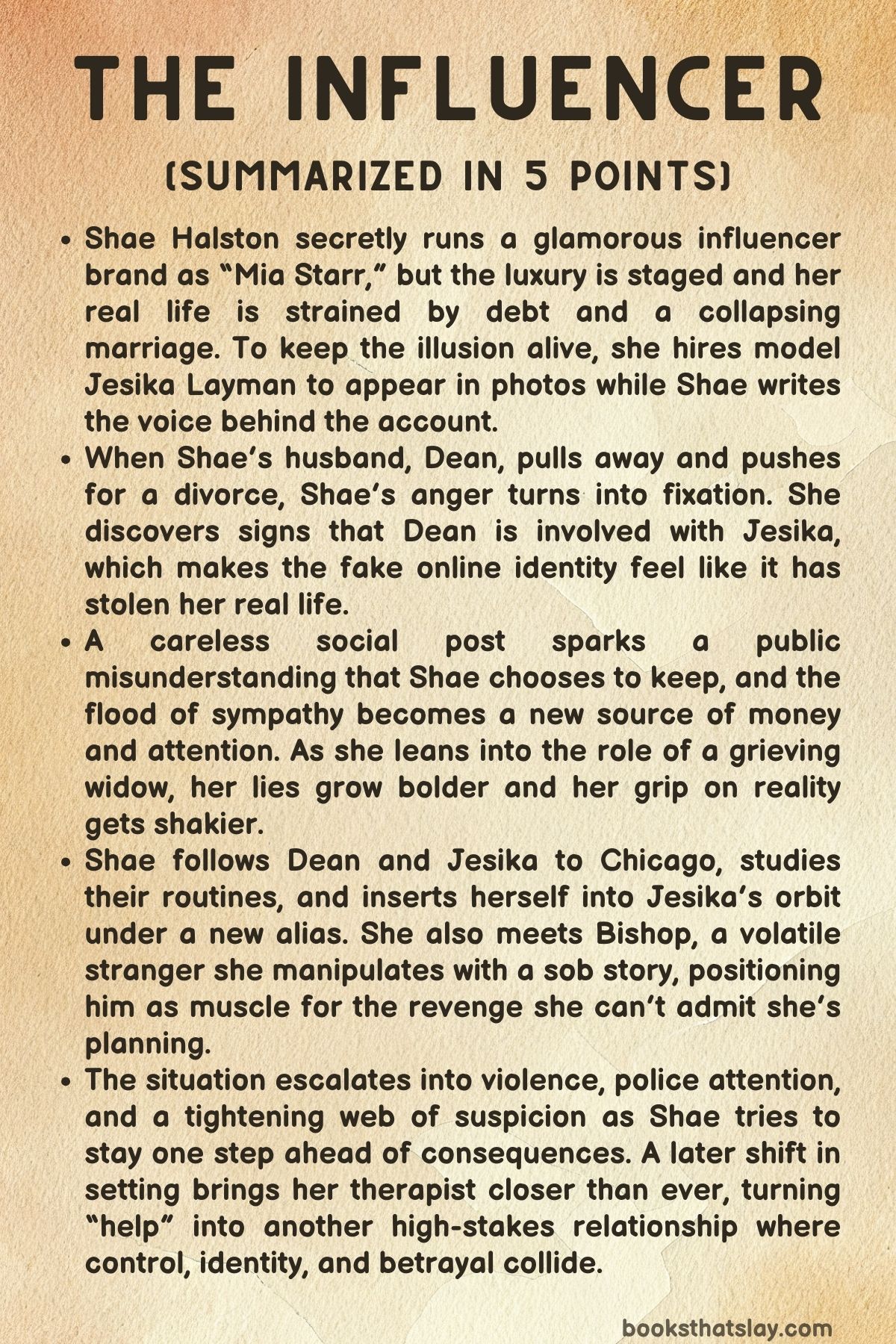
Summary
The novel opens with a haunting scene of a woman drowning, realizing too late that betrayal has sealed her fate. This sets the stage for the story of Shae Halston, a woman leading a fractured existence between reality and fantasy.
Under the online persona “Mia Starr,” she portrays herself as a glamorous influencer adored for her beauty and wealth. In truth, Shae’s life is in disarray.
Her marriage to Dean Halston, once a thriving real estate agent, is collapsing under the weight of financial strain and emotional distance. To maintain her digital illusion, Shae hires a model, Jesika Layman, to appear in photos as Mia Starr while Shae provides captions and personal stories.
Together, they construct an image of success and sophistication that keeps followers enthralled but leaves Shae empty inside.
As Dean’s business falters, he demands a divorce, exposing the instability that has long plagued their marriage. Their final argument turns violent when he threatens to reveal that Mia Starr is a hoax.
Shae, devastated, drowns her sorrows in alcohol and discovers on social media that Jesika is romantically involved with Dean. The revelation that her husband is in love with the woman who embodies her false persona breaks her completely.
In a drunken outburst, she posts a cryptic message—“My husband is dead to me”—but forgets to include the last two words. Her followers interpret the post literally, flooding her with sympathy and donations.
At first panicked, Shae quickly rationalizes the mistake as harmless and begins exploiting the misunderstanding for money and fame.
She fabricates a tragic narrative about Dean’s death, claiming he succumbed to a rare illness. The lie brings her attention, wealth, and validation.
The more she deceives, the more control she feels, crafting an image of a grieving widow adored for her strength. Her moral boundaries erode as she manipulates every situation for online engagement.
She sedates her neighbor’s dog for convenience, later pretending its near-death was a personal tragedy for sympathy content. Her obsession with image grows until reality and performance become indistinguishable.
When Jesika announces she’s pregnant and engaged to Dean, Shae’s jealousy reignites. She travels to Chicago, determined to confront them.
Under her alias “Maya,” she accidentally befriends Jesika at a café. Jesika, unaware of Shae’s true identity, sees her as a kind stranger, but Shae’s intentions are malicious.
She studies Jesika’s habits, stalks her daily routines, and manipulates her way into Jesika’s life to get closer to Dean. Her deceit deepens as she begins using Jesika’s pictures again for her influencer posts and plots revenge.
Jesika invites “Maya” to her home, and Shae seizes the chance to infiltrate their private world. She observes the luxury and love that she believes should have been hers.
When Jesika confides in her about the pregnancy and her fears regarding Dean’s behavior, Shae plays along, subtly sowing doubt. She sabotages small things—flushing Dean’s medication, leaving traces of her presence—and grows intoxicated by the sense of control.
Her descent accelerates when she meets Bishop, a rough stranger who becomes her pawn. She manipulates him with lies about an abusive ex-husband and convinces him that Dean deserves to die.
Bishop attacks Dean violently, leaving him near death. When Shae realizes what she has caused, guilt collides with her delusions, and her obsession redirects toward Jesika, whom she now blames for everything.
Shae’s mental unraveling continues as she plays caretaker to Jesika under the guise of friendship. When Bishop begins blackmailing Dean for money, Shae panics, realizing she’s lost control of her own scheme.
She tries to stop Bishop, but he ignores her, and violence escalates once more. She becomes consumed with fear that her connection to the assault will be discovered.
In one of the story’s most chilling sequences, Shae sneaks into Jesika and Dean’s apartment at night, hiding in their closet as they make love. The twisted voyeurism confirms how far gone she is.
Her jealousy turns murderous. She fantasizes about killing Jesika, and during a confrontation near the Chicago River, her rage explodes.
Jesika falls into the water after a violent struggle, and despite Shae’s brief attempt to save her, Jesika drowns. Moments later, Shae murders Dean, staging his death as an accident.
On the run, she flees to Tahoe, reinventing herself once more. Broke and unstable, she seeks shelter while continuing to manipulate people with her lies.
She rebrands herself again, this time using her real name while still pretending to be a victim. Her old therapist, Kelly Fraser, tracks her down and offers support, unaware of how dangerous Shae has become.
Kelly believes she can rehabilitate Shae and invites her into her care. For a time, Shae appears calmer, but her mind remains a web of fantasy and deceit.
Eventually, Shae’s past catches up with her. Authorities arrest her for the murders of Jesika and Dean.
During the trial, her online following transforms her into a media spectacle nicknamed “the Widow Influencer.” She is found not guilty by reason of insanity and confined to a psychiatric hospital. Kelly, wracked with guilt, continues visiting her, though she realizes Shae’s illness is far deeper than she once thought.
A year later, Kelly visits the institution and finds Shae appearing docile, claiming to be pregnant and living in delusion. But when the hospital experiences chaos from a staff strike, Shae strikes back.
She lures Kelly outside, attacks her brutally, and mutilates her to steal her identity. Shae stages the scene to make it look like her own suicide and escapes the facility disguised as Kelly Fraser.
In a horrifying twist, Kelly survives but is left disfigured and unable to speak. Mistaken for Shae, she becomes the institutionalized patient while the real Shae—now free—drives toward Chicago, plotting a new beginning.
The ending leaves the reader with the unsettling realization that Shae’s manipulative power, born from her obsession with control and appearance, has once again given her freedom.
The Influencer ultimately portrays the dark extremes of identity and performance, showing how the hunger for validation can consume and destroy. Through Shae Halston’s spiral, Adriane Leigh explores the blurred line between authenticity and illusion in a digital world obsessed with perfection.
Characters
Shae Halston / Mia Starr / Maya
Shae Halston is the deeply fractured and tragic core of The Influencer, a woman consumed by the need to be seen, loved, and validated. Beneath her crafted online persona “Mia Starr,” she hides crippling insecurity, unresolved trauma, and a desperate yearning for control in a life spiraling into chaos.
Her creation of Mia Starr begins as escapism — an alternate identity that represents everything she cannot be: wealthy, beautiful, adored. However, as her lies deepen, Shae becomes entangled in a web of deceit that blurs her sense of self.
The boundary between Shae and Mia collapses until she begins to live entirely through this fabricated identity, losing touch with morality and reality alike.
Her relationship with Dean serves as both catalyst and mirror to her mental decay. His betrayal — real or perceived — shatters the last of her emotional stability.
Every action that follows, from her manipulation of followers to her descent into violence, stems from a warped desire to reclaim the power she lost when he abandoned her. Yet, Shae’s manipulation is not born solely from cruelty; it is a desperate, delusional plea for relevance in a world where authenticity no longer defines worth.
By the end, she embodies both victim and villain — the ultimate product of a society addicted to illusion, attention, and emotional voyeurism. Her transformation into Mia Starr and later “Maya” represents complete dissociation from her true self, culminating in the chilling final escape where she assumes her therapist’s identity, fully consumed by the personas she once controlled.
Dean Halston
Dean Halston represents the fractured moral compass of The Influencer. Initially introduced as the supportive husband behind Shae’s influencer façade, he gradually emerges as both victim and enabler.
His desire for control and validation mirrors Shae’s, though his methods differ. Dean’s initial ambition and success sustain Shae’s fantasies, but his eventual emotional withdrawal exposes the hollow foundation of their marriage.
His affair with Jesika Layman—ironically the woman embodying Shae’s false image—serves as the story’s cruelest irony. By loving Jesika, Dean indirectly rejects the real Shae for the fantasy she created.
Throughout the narrative, Dean oscillates between guilt and resentment. He becomes both the abuser and the abused in Shae’s retellings, his identity distorted by her narrative manipulations.
His downfall — beaten, broken, and later almost murdered — underscores how deeply he becomes trapped in Shae’s delusion. Dean’s survival at the end is both punishment and liberation.
Scarred and disabled, he exists as the living proof of Shae’s destruction, but also as a silent witness to her escape. His tragedy lies in his inability to distinguish love from control, a blindness that binds him to the toxic cycle that destroys them both.
Jesika Layman
Jesika Layman embodies innocence, beauty, and the unintended consequences of living in someone else’s shadow. Hired originally as the face of “Mia Starr,” she becomes the physical manifestation of Shae’s fantasy life — the woman who lives the dream that Shae only pretends to have.
Jesika’s character is warm, naive, and trusting, qualities that make her easy prey for Shae’s manipulation and envy. Yet, Jesika is not simply a victim; her willingness to overlook moral boundaries, such as entering a relationship with a married man, reflects a subtle complicity in the cycle of deceit that drives the novel.
Her relationship with Dean, while genuine in affection, is built on the remnants of Shae’s illusion. Jesika inherits the love, lifestyle, and even the jealousy that Shae cultivated online, without realizing the danger it holds.
As Shae’s obsession intensifies, Jesika becomes both target and reflection — the living embodiment of everything Shae cannot attain. Her death, tragic and senseless, completes the metaphor of identity consumption: the creator destroys her own creation.
Jesika’s drowning in the green St. Patrick’s Day river is not just physical death but symbolic annihilation of innocence under the weight of obsession and deception.
Bishop
Bishop serves as the dark extension of Shae’s fractured psyche — the physical manifestation of her suppressed rage and desire for vengeance. Introduced as a mysterious, dangerous stranger, Bishop becomes both lover and weapon, manipulated into carrying out Shae’s violent fantasies.
His rough exterior and volatile nature contrast with Shae’s calculated deceit, yet they share a common emptiness. For Bishop, violence offers purpose; for Shae, he becomes the means to reclaim control she lost over Dean and Jesika.
Despite his criminal tendencies, Bishop’s loyalty and misplaced sense of protection reveal his own brokenness. He sees Shae as a victim worth avenging, unaware that she is orchestrating the chaos.
His eventual betrayal—blackmailing Dean for money—marks his descent into moral corruption, mirroring Shae’s own. Through Bishop, the novel explores how manipulation breeds further destruction: he is both tool and casualty of Shae’s madness.
His disappearance into the shadows after the assault leaves his fate ambiguous, but his presence lingers as the embodiment of how far Shae’s lies can reach beyond the screen into the real world.
Kelly Fraser
Kelly Fraser represents the fragile line between compassion and complicity. As Shae’s therapist, she begins as a stabilizing force, offering guidance and empathy.
However, her professional boundaries blur as she becomes emotionally entangled in Shae’s life, treating her not only as a patient but as a project and companion. Kelly’s warmth and desire to help make her vulnerable to Shae’s manipulative charm.
She tries to save Shae from her delusions but underestimates the depth of her instability.
Kelly’s role evolves from therapist to victim, both psychologically and physically. Her sympathy turns into a fatal flaw when she invites Shae into her life, crossing the ethical divide that keeps reality and delusion separate.
The final twist — where Shae mutilates her and assumes her identity — transforms Kelly into the tragic mirror of her patient. Paralyzed, burned, and silenced, Kelly becomes a literal embodiment of truth suppressed by lies.
Her survival yet inability to communicate underlines the novel’s theme: in the world of performance and deceit, the authentic voice is the first to be silenced.
Themes
Identity and Self-Deception
In The Influencer, Adriane Leigh crafts a deeply unsettling portrait of how fractured identity and self-deception can erode the human psyche. Shae Halston’s double life as “Mia Starr” is not merely a social-media experiment—it is a desperate act of self-preservation for a woman whose reality is too painful to endure.
By constructing Mia, Shae escapes her failures as a wife, her financial instability, and her emotional emptiness. Yet, the longer she lives as Mia, the further she drifts from her authentic self, until the boundaries between truth and illusion blur completely.
Her need for validation becomes pathological, and every lie reinforces the fragile scaffolding of her false identity. What begins as a performance for her followers transforms into a full psychological metamorphosis, where Shae cannot distinguish between the influencer and the woman behind the camera.
The novel exposes how online personas can serve as both refuge and prison, how the digital mirror reflects not who we are, but who we wish others to see. Leigh’s depiction of Shae’s disintegration underscores the danger of constructing identity on external approval; when that approval falters, the self collapses.
The final act, where Shae assumes Kelly Fraser’s identity after mutilating her, completes her evolution into pure artifice—a human being erased by her own fabrication. Identity, in the novel, is not a stable truth but a performance sustained by deception, and Shae’s downfall illustrates how easily a lie, when believed long enough, becomes a person’s only reality.
Obsession and Control
Obsession in The Influencer functions as both Shae’s driving force and her undoing. Her fixation on Dean and Jesika stems not only from jealousy but from her desperate need to reclaim control over a life that has spiraled beyond her grasp.
Every act of manipulation—from hiring Jesika to impersonate Mia Starr to orchestrating Dean’s assault—reveals her compulsion to dominate narratives and people alike. Control becomes her substitute for love and meaning; when Dean abandons her, she clings to the illusion that she can still dictate his reality by fabricating his death online.
Yet, as her lies metastasize, her control becomes an illusion itself. The social media algorithms she once mastered turn into a machine she must constantly feed, a voracious entity demanding more tragedy, more drama, more content.
Leigh uses Shae’s obsession to mirror the obsessive consumption patterns of her followers, who feed on her grief as entertainment. The story suggests that obsession is cyclical—it consumes both the watcher and the watched.
Shae’s fixation on Jesika, culminating in murder, represents the final collapse of this illusion of mastery. By killing Jesika, she attempts to reclaim her stolen identity, but in doing so, she destroys the last vestige of her humanity.
Her later manipulation of Bishop and eventual attack on Kelly are extensions of the same pathology: a woman so addicted to control that she annihilates anyone who threatens her version of truth. Leigh portrays obsession not as passion, but as a parasitic force that drains life until only madness remains.
The Illusion of Perfection and the Corruption of Social Media
Through Shae’s dual existence as a failed woman behind a glamorous influencer brand, The Influencer lays bare the moral and emotional corruption fostered by social media culture. The curated perfection of Mia Starr is a mirror held up to the audience’s hunger for idealized lives.
Leigh exposes how the influencer economy thrives on deceit, commodifying grief, beauty, and even death for likes and sponsorships. When Shae fabricates Dean’s death and monetizes the sympathy of her followers, she transforms mourning into performance art and tragedy into profit.
Her followers, eager to consume emotional spectacle, become complicit in her deception, highlighting how digital culture rewards the most manipulative narratives. The novel also dissects how these curated illusions warp emotional authenticity.
Shae’s sense of worth is dictated entirely by audience engagement; her reality no longer exists offline. Leigh’s portrayal is not a simple condemnation of social media but a critique of the psychological vacuum it creates.
In chasing relevance, Shae sacrifices intimacy, honesty, and morality, trading them for the dopamine rush of virtual applause. By the time she kills Jesika, the influencer and the woman are indistinguishable—both are constructs feeding off each other’s falsity.
Leigh’s message is chillingly clear: in a world obsessed with looking perfect, authenticity becomes an act of rebellion, and truth the ultimate casualty.
Feminine Rivalry and Internalized Misogyny
Beneath the story’s psychological horror lies a nuanced exploration of female rivalry and internalized misogyny. In The Influencer, Shae’s hatred for Jesika is rooted not simply in betrayal but in projection.
Jesika represents everything Shae wishes to be—beautiful, adored, effortless. Yet Jesika is also the embodiment of the very persona Shae created, making her both muse and enemy.
Leigh portrays this dynamic as a reflection of how women are conditioned to compete under patriarchal and capitalist structures, especially in the digital age where visibility equates to power. Instead of solidarity, the female characters engage in cycles of mimicry, envy, and violence, all driven by societal expectations of perfection.
Even Shae’s interactions with her therapist, Kelly Fraser, reflect this tension; what begins as dependence and admiration devolves into resentment and domination. Kelly’s professional concern becomes another stage for Shae’s need to assert superiority.
The rivalry between women here is not innate—it is the product of external pressures that teach them to define their worth through comparison and possession. Jesika’s kindness and naivety contrast sharply with Shae’s corrosive insecurity, making her both victim and reflection of the system that exploits women’s appearances.
Leigh ultimately portrays misogyny not as an external enemy but as an internal poison—one that convinces women like Shae to destroy each other in pursuit of an unattainable ideal. Through this, the novel becomes a haunting commentary on how social and psychological conditioning weaponize femininity against itself.
Madness, Morality, and the Collapse of Reality
The descent into madness in The Influencer is rendered not as sudden hysteria but as a gradual erosion of morality under the weight of deceit. Shae’s unraveling is both personal and societal—a woman whose moral compass is warped by the constant need for validation.
Her lies begin as survival mechanisms but evolve into expressions of power and defiance. Leigh portrays insanity as a logical endpoint of a culture that blurs truth and performance, where authenticity is punished and deception rewarded.
By the time Shae ends up in the psychiatric hospital, she has fully embraced her alternate persona, Mia Starr, as her true identity. The narrative questions whether her madness is genuine or calculated—whether she is a victim of her fractured mind or a master manipulator exploiting systems of sympathy.
Her final act of violence against Kelly Fraser, switching identities once again, suggests that insanity and sociopathy have become indistinguishable. Leigh uses Shae’s mental collapse to explore the boundaries of moral accountability in an age where reality itself can be curated, filtered, and sold.
The hospital, intended as a place of recovery, becomes another stage for performance and manipulation. In the end, the ambiguity of Shae’s sanity mirrors the instability of the digital world she once ruled.
The novel closes with a chilling question—if lies can become truth through repetition and performance, then what separates madness from survival in a world built on illusion?