The Lady on Esplanade Summary, Characters and Themes
The Lady on Esplanade by Karen White is a gothic mystery set in the atmospheric and rain-soaked streets of New Orleans. Blending family secrets, lost love, and supernatural forces, the story follows Nola Trenholm as she grapples with both the living and the dead while restoring an old Creole cottage.
Haunted by memories, unresolved grief, and ghostly presences, Nola becomes entangled in a decades-old mystery linked to her friend Beau Ryan’s family. The book combines eerie hauntings with emotional revelations, examining how the past refuses to rest and how confronting it becomes the only way forward. It’s the 3rd book in the Royal Street series by the author.
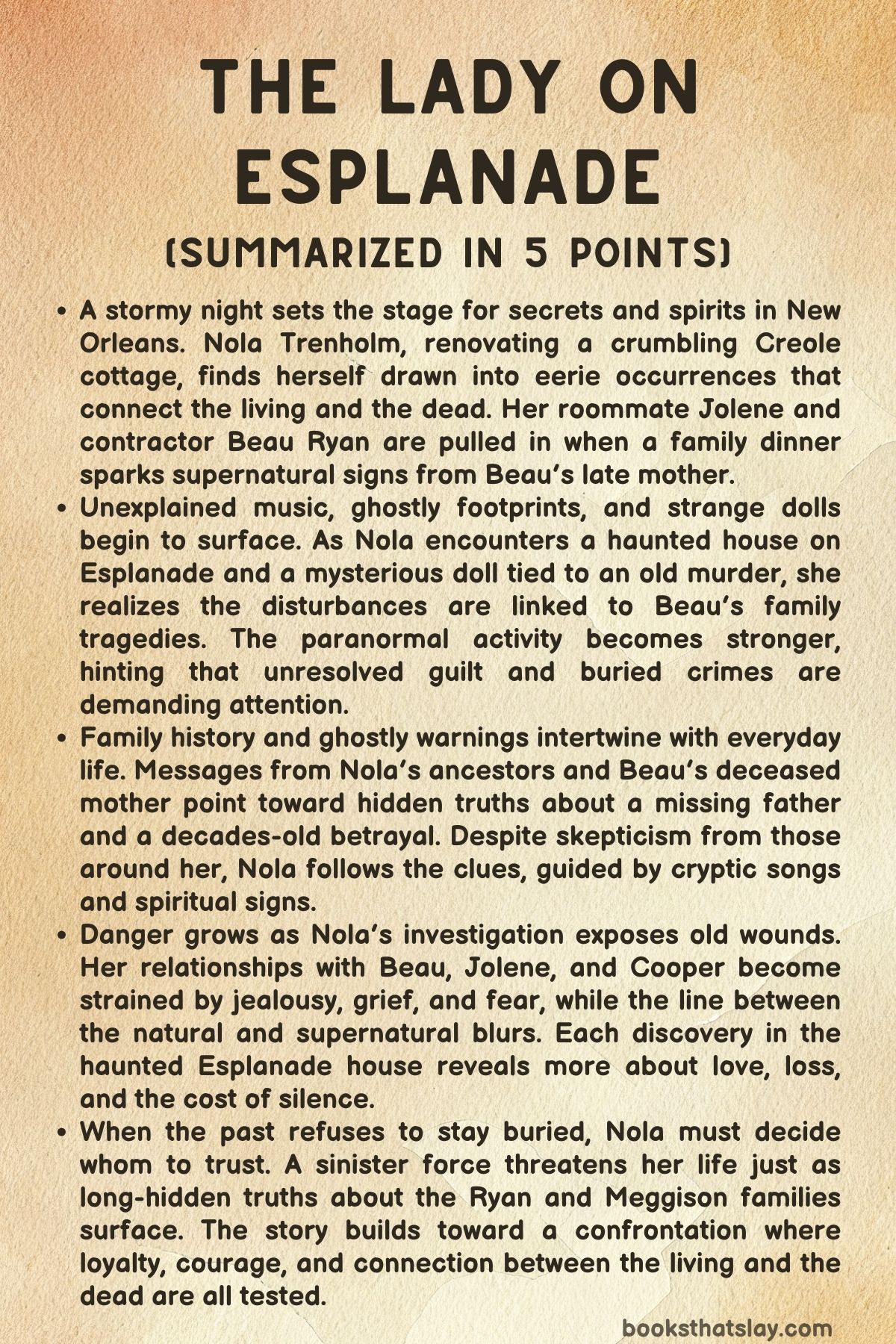
Summary
In the flood-drenched heart of New Orleans, Nola Trenholm and her vivacious roommate Jolene prepare for dinner despite torrential rain. Nola, a determined renovator working on a decaying Creole cottage, reluctantly joins her friend for an evening out with Beau Ryan, a contractor she admires but keeps at arm’s length.
The dinner at Commander’s Palace brings together friends and family, but beneath the celebration lies tension. During the meal, strange static fills the air, and wet footprints appear out of nowhere—signs that Nola recognizes as paranormal.
When a ghostly presence interrupts a marriage proposal, Nola realizes Beau’s deceased mother, Adele Ryan, still lingers and is trying to send a message.
The next morning, Nola wakes to unsettling music—Adele’s favorite song—playing on her phone. Jolene’s unusual behavior and obsessive engagement party planning add to Nola’s unease.
Then her half-sister Sarah calls, claiming their dead great-grandmother has phoned with a cryptic message about “Buddy,” Beau’s missing father, and a warning to seek out a fortune teller named Madame Zoe. The supernatural disturbances intensify, forcing Nola to accept that the past is pushing toward revelation.
When Nola visits a property on Esplanade with Cooper Ravenel, a friend from Charleston, they find an eerie old house filled with whispers of history. As they explore, Nola discovers an antique perfume bottle and a hidden compartment containing a haunting Madame Alexander doll.
Soon after, wet footprints appear again, and Adele’s presence seems to follow them. Jolene later reports news of human bones found at Charity Hospital, hinting that Adele’s death may have been more sinister than anyone realized.
Hauntings escalate. The same Adele song begins to play at impossible moments, and Beau’s mother’s spirit becomes more insistent.
At Café Degas, Beau and Nola confront the idea that multiple spirits may inhabit the Esplanade house—among them a barefoot child and an angry woman tied to Cooper. When a vase shatters on its own, they realize these entities can harm the living.
Beau refuses to engage with spirits, but Nola pushes him to confront the truth about his family’s past.
Nola’s renovation project soon suffers water damage, pulling Beau, Jolene, and others into chaotic repairs. Amid the wreckage, the cursed doll appears again, and all their phones ring with Adele’s voice singing “Hello.” Jolene insists Adele’s ghost is demanding closure, but Beau remains in denial.
When they later dine with Beau’s grandmother Mimi and Adele’s old friend Camille LeBlanc, Nola senses danger beneath polite conversation. Camille confesses to sending Buddy off alone to find his missing daughter Sunny—decisions that indirectly led to Adele’s disappearance.
When the doll reappears at the Ryans’ home, it brings with it a gold hoop earring belonging to Madame Zoe, signaling Adele’s plea for Beau to visit the fortune teller.
Reluctantly, Beau agrees to see Zoe after Nola convinces him that Adele’s spirit won’t rest otherwise. Before that, they visit Honey and Joan, elderly sisters who once owned the Esplanade house, and learn the doll originally belonged to their niece, Lynda, who vanished years ago.
Their parrot becomes violently agitated at the sight of the doll, confirming its dark energy. Soon after, Nola and Cooper explore the house again, and their relationship rekindles briefly before turning terrifying—a malevolent presence manifests, causing a car crash that leaves Nola hospitalized.
While recovering, Nola learns shocking details: Adele’s remains have been found beneath Charity Hospital. Her death wasn’t accidental—she was strangled, and her diamond stolen.
Mimi confirms Adele’s spirit is torn between anger and protection, and the cursed doll acts as both warning and messenger. Cooper’s reappearance at the hospital only complicates things, as Nola senses a jealous ghost attached to him.
Despite danger, Nola and Sarah—her psychic sister—vow to uncover the truth about Adele, Buddy, and the tangled Ryan family history.
When Nola later finds synthetic blond hair and Youth-Dew perfume traces, she realizes the blood evidence once thought to belong to a murdered woman might have been Mark’s—the father of the missing child, Lynda. Determined to uncover the truth, she enlists Camille to drive her to the Esplanade house.
There, Nola finds the doll again, this time with the words “FIND THE STONES” written in dust and a hidden key labeled “Guidry Moving and Storage” inside the doll’s head. She pieces together the clues: a storage unit may conceal a body, and the killer is closer than anyone believes.
The revelation comes too late. Camille, pretending to help, drugs Nola with medicated soup and tries to extract information about the hidden rings and stones linked to Adele’s murder.
As Nola fades, she realizes Camille and her husband Henry were responsible for Adele’s death. Camille plans to stage Nola’s “accidental” fall, but spirits intervene—Adele and Nola’s mother appear to protect her.
Nola manages to send Beau a single emoji as a distress signal. Beau and Felicity arrive in time to confront Camille, who admits everything before falling to her own death down the stairs.
Even after Camille’s demise, one last dark force—Mark’s enraged spirit—attacks, pulling Nola toward the underworld. Only by repeating the mantra “We’re stronger together” and invoking unity with Beau and Felicity can she banish the evil.
The trapped spirits of Sybil, Patrick, and Mark finally find peace, vanishing into the light. Nola collapses as help arrives.
In the aftermath, truth surfaces. Honey confesses she helped her sister Jessica hide Mark’s body after he murdered Sybil and attacked Lynda.
Jessica fled with Lynda to protect her. The “missing” father, Buddy, was struck by Henry during Adele’s murder attempt and vanished, leaving his fate uncertain.
Adele’s death is confirmed as murder, but her spirit finally rests.
Weeks later, Nola, now healing, returns to her cottage with Jolene. Beau reappears with Adele’s restored ring, meant for his partner Sam, and closure begins to take shape.
But Madame Zoe returns, warning Nola and Sarah that their connection to the stones—and to Buddy’s disappearance—isn’t over. As Nola starts her new life, her car radio suddenly blasts another old song, reminding her that peace in New Orleans never lasts long, and some ghosts are never truly gone.
Characters
Nola Trenholm
Nola is the heart of The Lady on Esplanade, a woman whose intellect and sensitivity bridge the natural and supernatural worlds. Living in New Orleans, she is both pragmatic and intuitive—her profession in renovation symbolizes her inner desire to rebuild and heal from the wreckage of her past.
Haunted by the presence of spirits and guided by a moral compass that values truth, she becomes the conduit through which the mysteries of the dead are revealed. Her relationships—particularly with Beau and Jolene—test her emotional resilience and her instinct to nurture others, even when it endangers her.
Nola’s courage grows throughout the narrative; she evolves from a hesitant observer of the paranormal to an active protector who confronts malevolent forces and human deceit alike. Her capacity for empathy, especially toward lost souls like Adele and Sybil, defines her as the moral center of the story and the true heir to the spiritual legacies surrounding her.
Jolene
Jolene is Nola’s vivacious roommate, a character who balances humor and heartbreak with compelling contradictions. Outwardly flamboyant and socially radiant, she conceals layers of insecurity and pain, particularly surrounding her unrequited feelings for Jaxson.
Her compulsive need for control—evident in her obsession with party planning—serves as a coping mechanism for deeper emotional wounds. Jolene’s Southern charm and fierce loyalty make her both comic relief and emotional ballast in moments of chaos.
When paranormal phenomena disrupt their lives, Jolene’s reactions range from skepticism to fear, revealing her pragmatic side. However, her affection for Nola anchors her in the narrative as more than a sidekick; she represents friendship’s power to endure even when tested by betrayal, love, and supernatural turmoil.
Beau Ryan
Beau is a complex figure defined by guilt, grief, and a reluctant sensitivity to the otherworldly. His charm and strength mask a deep vulnerability rooted in his mother Adele’s tragic death and his father Buddy’s disappearance.
Though outwardly rational, Beau’s connection to spirits—especially Adele’s lingering presence—forces him to reconcile his disbelief with experiences that defy logic. His dynamic with Nola is laced with unspoken tension: he admires her courage but fears emotional intimacy because it mirrors the unpredictability of the ghosts that haunt them both.
As the story unfolds, Beau becomes a man caught between redemption and repression, learning that acknowledgment of pain—both his own and his family’s—is the only path to peace. His evolution culminates in confronting the truth about Adele’s murder and the weight of family secrets, transforming him from skeptic to believer and from broken son to protector.
Adele Ryan
Adele’s spirit dominates the novel’s spectral landscape. In life, she was a loving but conflicted mother trapped by guilt and deception; in death, she becomes a guardian spirit whose lingering presence drives the story’s central mystery.
Her spectral appearances—accompanied by water, music, and wet footprints—embody both warning and guidance. Adele’s determination to reveal the truth about her murder and protect Beau from repeating past mistakes shows her enduring maternal love.
She is also a symbol of feminine strength suppressed by betrayal and silenced by violence. Through Nola’s sensitivity, Adele’s fragmented voice gains expression, and her quest for closure binds the living and the dead in a shared act of reckoning.
Cooper Ravenel
Cooper serves as both a romantic foil and a moral mirror for Nola. His charm and ease mask layers of regret tied to his past—most notably, his comatose fiancée, Lilly, whose lingering spiritual energy complicates his relationship with Nola.
Cooper’s encounters with the supernatural test his composure, forcing him to confront his guilt and the boundaries between affection and obsession. He represents the danger of emotional avoidance: by refusing to process loss, he inadvertently invites the past to invade his present.
Over time, Cooper learns to let go of the ghosts—literal and emotional—that bind him, symbolizing the human struggle to reconcile love, remorse, and renewal.
Camille LeBlanc
Camille is the novel’s most deceptive presence, cloaking malice beneath refinement. As Adele’s best friend and Beau’s godmother, she initially appears as a grieving confidante, but her duplicity is gradually exposed.
Camille embodies the destructive side of jealousy and control; her manipulation of Henry and involvement in Adele’s murder reveal the darkness beneath her genteel exterior. Her poisoning of Nola and attempted cover-up mark her descent into villainy, and her eventual downfall—both literal and moral—serves as poetic justice.
Camille’s character is a chilling study of how love twisted by envy becomes lethal, and her actions catalyze the story’s climactic confrontation between truth and deception.
Sarah Trenholm
Sarah, Nola’s half sister, brings a younger, more impulsive energy to the narrative. Sensitive to the paranormal yet uncertain of her abilities, she mirrors Nola’s early doubts and becomes her emotional and spiritual counterpart.
Her psychic sensitivity deepens the link between the Trenholm family and the supernatural legacy of New Orleans. Sarah’s growth lies in her gradual acceptance of her intuitive gifts and her role in helping Nola unravel the mysteries surrounding Adele’s death and Mark’s crimes.
Her courage and compassion highlight the story’s theme of familial connection transcending both life and death.
Mimi Ryan
Mimi, Beau’s grandmother, represents endurance, tradition, and the haunting weight of generational grief. A matriarch grounded in faith and memory, she bridges the old South’s elegance with its shadows of repression and secrecy.
Her knowledge of family history—tempered by denial and love—makes her both a source of wisdom and a keeper of silence. Mimi’s collapse upon touching the cursed doll signifies the psychic toll of generations burdened by unspoken truths.
Her eventual acceptance of the paranormal realities surrounding her family marks a quiet redemption, as she moves from passive remembrance to active reconciliation with the past.
Honey Meggison
Honey is one of the novel’s most morally ambiguous figures. Her decision to help Jessica and Lynda escape after Mark’s death blurs the line between justice and complicity.
A product of trauma and Southern loyalty, Honey acts from a fierce instinct to protect, even when her actions conceal crimes. Her revelation of the truth to Nola provides crucial closure, revealing that survival often demands moral compromise.
Honey’s calm, almost resigned demeanor contrasts with the chaos around her, making her a haunting reminder that secrets preserved in the name of love can shape generations.
Mark
Mark’s presence looms like a curse throughout The Lady on Esplanade. Though dead for most of the novel, his influence permeates every haunting.
Violent, controlling, and consumed by pride, Mark represents the corrupting force of patriarchal power and emotional dominance. His spirit manifests as darkness and decay—a physical and moral rot infecting the living.
Through Nola and Beau’s confrontation with his ghost, the novel portrays evil not as otherworldly but as deeply human, born of cruelty and selfishness. His final release into light, prompted by forgiveness and confrontation, transforms his narrative from vengeance to reluctant absolution.
Themes
Grief, Loss, and Healing
In The Lady on Esplanade, grief permeates every aspect of the narrative, binding the characters across generations and blurring the line between the living and the dead. Nola, Beau, Jolene, and the others navigate a landscape shaped by both literal and emotional storms.
The haunting presence of Adele Ryan is more than a ghostly phenomenon—it represents the unresolved pain that lingers when closure is denied. Each supernatural occurrence reflects a psychological manifestation of the characters’ inability to let go.
Nola’s encounters with Adele’s spirit mirror her own struggle to confront personal trauma and familial estrangement, while Beau’s refusal to communicate with his mother’s spirit symbolizes a fear of emotional vulnerability. The discovery of hidden truths—bodies buried, crimes concealed, love unspoken—demonstrates how grief becomes corrosive when truth is suppressed.
The novel situates loss within the setting of New Orleans, a city whose cyclical flooding and decay metaphorically echo the persistence of sorrow beneath beauty. Healing, in this world, requires acknowledgment of both the spectral and the human past.
The process of reconciliation—between family members, lovers, and even the living and the dead—illustrates that grief cannot be exorcised; it must be faced and understood. The spirits that inhabit the story serve not to terrify, but to compel remembrance.
By confronting pain, the characters reclaim agency over their histories, suggesting that true healing arises not from forgetting but from recognizing the depth of loss and learning to coexist with its echoes.
Family Secrets and the Burden of the Past
The narrative unfolds as a labyrinth of concealed family histories, where every revelation exposes another layer of deception. The Ryan family’s secrets—Adele’s murder, Buddy’s disappearance, Camille’s betrayal—form the novel’s emotional backbone.
These hidden truths show how silence and shame corrode generations. The haunted doll, the recurring footprints, and the mysterious messages are not random supernatural events but symbols of suppressed memory demanding exposure.
Through Nola’s investigative persistence, the novel underscores the destructive power of withholding truth within families. Each character’s identity is shaped by what has been hidden from them: Nola’s fractured relationship with her half-sister, Beau’s lifelong uncertainty about his father, and Jolene’s guarded emotions all stem from inherited secrecy.
Karen White constructs the Ryan family’s history as a mirror of New Orleans itself—beautiful, decaying, and layered with forgotten stories. The eventual uncovering of the truth about Mark’s crimes and Honey’s concealment of his death reframes morality; the novel questions whether protecting loved ones justifies perpetuating lies.
The revelation that Camille, a figure of maternal warmth, is complicit in murder emphasizes that evil often hides behind facades of affection. Ultimately, The Lady on Esplanade portrays family secrets as both curse and catalyst.
They destroy trust but also ignite the search for truth, compelling characters to redefine loyalty and justice. Only through uncovering the hidden can they escape the cyclical burden of the past.
The Supernatural as a Reflection of Human Emotion
The spectral elements in the story function not merely as plot devices but as emotional expressions of guilt, love, and unresolved conflict. Spirits in The Lady on Esplanade are drawn to emotional energy—grief, anger, longing—and act as metaphors for the psychic weight of memory.
Adele’s lingering presence reflects the love she bears for her son and her desperation to reveal the truth of her death. The haunting of the Esplanade house, with its flickering lights and eerie footprints, externalizes the turmoil simmering beneath the characters’ relationships.
The supernatural world is not antagonistic but intertwined with human morality; it holds the living accountable for their actions. The recurring use of Adele’s songs, such as “Rolling in the Deep,” fuses the paranormal with the emotional, transforming modern technology into a conduit for spiritual communication.
The presence of Sybil, Patrick, and Mark’s malevolent ghost demonstrates that every unresolved human act—violence, betrayal, neglect—creates a lingering resonance. By grounding ghostly occurrences in emotional truth, Karen White constructs a supernatural framework that validates empathy and redemption.
The coexistence of ghosts and humans challenges the notion of finality in death; instead, it portrays love and guilt as forces capable of transcending mortality. The spectral, in this sense, becomes a narrative language through which trauma speaks when words fail.
The Search for Identity and Belonging
At its heart, The Lady on Esplanade explores how identity is constructed through history, family, and emotional inheritance. Nola’s renovation of the decaying Creole cottage symbolizes her effort to rebuild her fractured sense of self.
Each wall she restores and each artifact she uncovers becomes an act of reclaiming belonging in a city haunted by its own past. Her half sister Sarah’s psychic connection and Jolene’s complex loyalty underscore the tension between chosen and inherited identities.
Beau’s struggle with his family’s legacy—his mother’s mysterious death, his father’s disappearance, his own fear of emotional connection—mirrors Nola’s journey toward self-understanding. The novel situates identity within the duality of New Orleans: a place where history never fully recedes, and where personal and collective memory constantly intersect.
The recurring motif of renovation and restoration reflects an inner rebuilding process; the characters are not only uncovering physical remnants but also reconstructing who they are in relation to their pasts. Nola’s interactions with spirits and the living alike challenge her to define herself beyond victimhood or rescuer.
By the end, identity emerges as fluid and layered—a composition of memories, choices, and reconciliations. Belonging, the novel suggests, is not found in bloodlines alone but in the courage to confront truth, accept imperfection, and recognize connection as the thread linking all human experience, both living and dead.
Betrayal and Redemption
Betrayal threads through every relationship in the novel, shaping both tragedy and transformation. Camille’s deceit and Henry’s violence embody betrayal in its most literal sense, but subtler forms appear throughout—friends concealing truths, lovers withholding feelings, and family members protecting one another through harmful lies.
The symbolism of “Rolling in the Deep” underscores how betrayal reverberates emotionally, echoing through generations like a haunting refrain. Yet betrayal in The Lady on Esplanade is not merely destructive; it acts as a crucible through which redemption becomes possible.
Characters must confront the consequences of their deceit to find forgiveness and peace. Beau’s eventual decision to face his mother’s spirit and uncover the truth about her death exemplifies this transformation.
Nola’s forgiveness toward Honey, despite her complicity in covering up Mark’s murder, represents moral maturity and empathy born of suffering. Redemption, in the novel, is achieved not through punishment but through truth-telling and reconciliation.
Even the restless spirits find release only when the living acknowledge wrongdoing. The novel suggests that betrayal is an inevitable part of human connection, but redemption remains possible through courage, honesty, and compassion.
By intertwining emotional and supernatural reckonings, Karen White transforms betrayal from a source of despair into an opportunity for spiritual and emotional renewal.