The Last Ember Summary, Characters and Themes
The Last Ember by Lily Berlin Dodd is a fantasy-adventure set in soot-stained Porttown, where class divides are sharp and government “secrets” are enforced with fear. On her twelfth birthday, brilliant academy student Evangeline “Eva” Alexander claims an odd silver object that should not exist, while Dusty St. Ichabod, a workhouse orphan with ties to the Thieves’ Union, is pushed into a mission that turns personal fast.
What begins as a theft spirals into a chase beyond the city, a dangerous creature waking from legend, and a ruthless official determined to use it to end a war on his own terms.
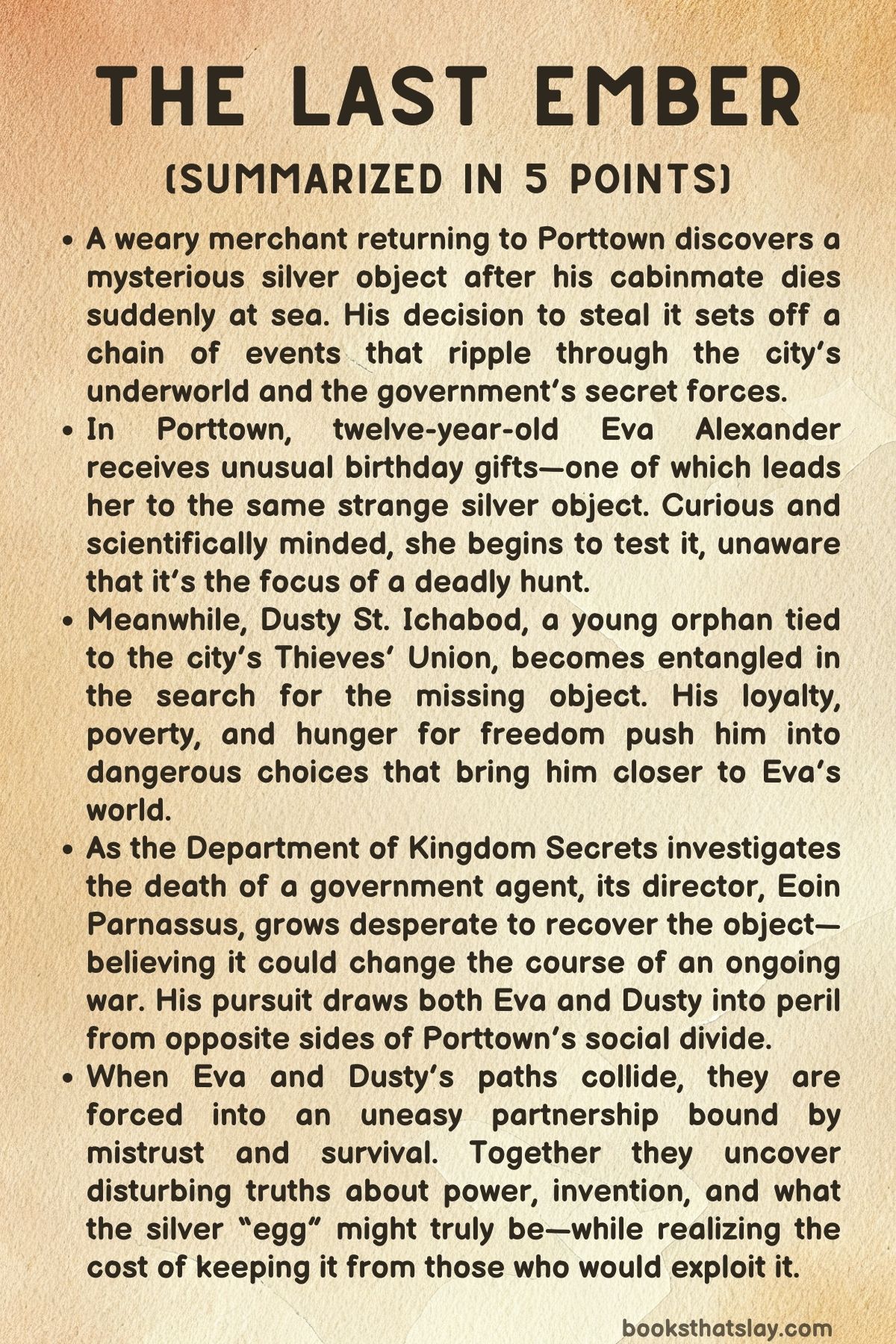
Summary
A fine-goods merchant limps back to Porttown after failing to sell luxury wares in the Northern Isles. In his cramped cabin, his quiet cabinmate—neatly dressed, wearing a leather hat—suddenly chokes and dies.
The merchant does not call for help. Instead, he searches the dead man’s luggage, telling himself he is “protecting valuables.” He finds identical gray suits, journals and papers in unfamiliar languages, and a small wooden case stamped with the Seal of Porttown.
Inside sits a brilliant silver, egg-shaped object that feels strangely soft. Remembering the man ate chocolates before bed, the merchant decides the sweets are poisoned and throws them away.
Panicked by what the papers might reveal, he tosses the journals and documents into the sea as well, wiping out any written trail. He plans to sell the silver object to jeweler Early Bronsworth once the ship docks.
On October first, Evangeline “Eva” Alexander wakes at the Young Ladies’ Royal Academy for Science and Mathematics. It is her twelfth birthday, and her roommate Myrnie has already opened her mail.
Eva receives a bright dress from her stylish stepmother, a voucher from her father for any item in Bronsworth’s top jewelry department, and perfume plus a sharp-edged letter from her mother, Imogen, who lives in the Northern Isles performing as a lady clown while chasing rumors of an image-recording device. Myrnie gives Eva a treasured book by Dr. Benedicta Frogg about “cryptoecology,” arguing that legendary creatures may be real.
Across town in the Shambles, thirteen-year-old Dusty St. Ichabod wakes in the workhouse dormitory at St. Ichabod’s already thinking about conscription and death. When a little boy wets the bed in fear, Dusty takes the blame.
The warden, Wakey-Wakey, demands Dusty roll up his sleeves for punishment, exposing a fresh tattoo: the Mark of Thieves, five fish in a circle, proof Dusty has recently been inducted into Porttown’s Thieves’ Union. Wakey-Wakey does not recognize it, but assumes Dusty must have escaped and committed crimes to get it.
He beats Dusty and assigns humiliating extra labor, including late milk deliveries to the girls’ academy.
Dusty arrives at the academy breakfast in stained work clothes, and Eva notices the “milk boy,” including a patch of gray hair. Afterward, Eva and Myrnie go to Bronsworth’s store to use Eva’s voucher.
Bronsworth tries to steer her toward expensive pieces, but Eva’s attention locks onto a plain box in his cluttered office. Inside is the same silver, egg-shaped object.
Eva insists it must be “rubibium” based on its look and demands it as her choice. She even orders Bronsworth to tell her father she chose a tiara instead.
Bronsworth, sweating and uneasy, lets her take it while privately admitting he barely understands what it is.
That night, Eva and Myrnie experiment. The object does not behave like a normal metal.
When heated, it does not melt; it gives off a sharp bang and develops a hair-thin crack while remaining intact. Myrnie consults Dr. Frogg’s book and suggests a frightening possibility: the object could be an aerimander egg, silver-shelled and fireproof, meant to hatch only under extreme heat.
The crack could be the first sign of waking. They decide to keep it cool, never touch it bare-handed, and bring it to Dr. Frogg.
Elsewhere, Dusty receives a sardine tin used as a citywide signal: an all-hands meeting has been called. At the Lurid Ferret, thieves crowd in as leaders explain that a government agent aboard the SS Leanne was killed by poisoned chocolate, and a stolen silver oval is missing.
The Department of Kingdom Secrets is hunting it, and the Thieves’ Union has been ordered to find it first for their queen. Dusty learns the object was sold at Bronsworth’s to a girl at the academy—Eva.
Because Dusty has access as the punished milk delivery boy, he is tasked with retrieving it.
Director Eoin Parnassus of the Department of Kingdom Secrets moves quickly. He arrives at the academy demanding to see Eva, calling it national security.
Eva senses danger, hides the object in a box labeled for “monthly things,” and lies that she threw it away. Parnassus searches but recoils from the box and leaves without checking it.
Eva now understands the object is not just rare; it is wanted.
Eva and Myrnie forge permission to leave the city and reach Dr. Frogg in the Meadow District. Before they can escape, Dusty breaks into Eva’s room masked and desperate.
In the struggle, Eva touches the egg with her bare hand—and it fuses to her skin, burning her. The dorm begins to wake as pounding starts at the door.
Dusty realizes he cannot take the egg without taking Eva. He blocks the door with furniture, breaks the window, and drags Eva down the fire escape.
They flee Porttown in a bread truck, chased by the threat of guards and Parnassus. Eva refuses to raise an alarm, revealing she fears Parnassus more than a thief.
Dusty heads for the Lockwood Forest, following marks that lead to the Thieves’ Queen. In the wet woods they argue constantly—Eva offended by his roughness, Dusty mocking her privilege—yet each needs the other.
Eva wants Dr. Frogg; Dusty needs the egg delivered.
At the Lockwood Inn, Dusty is drugged by soup and wakes to find Eva gone. A stable worker explains the truth: Eva exploited Dusty’s inability to read, bribed help, and rode away toward the Meadow District.
Dusty, injured and low on money, rents a slow pony named Gourd, leaving his prized knife as collateral. A storm erupts.
Eva rides hard until lightning forces her to shelter. Later, making a small fire, she accidentally warms the egg too much; its cracks glow, smoke leaks out, and her horse bolts.
Eva smothers the heat and continues on foot, terrified by the movement she glimpsed inside.
Myrnie escapes Porttown to follow Eva and reaches the Lockwood Inn battered and bleeding after a bicycle crash. She meets Calder “Cal” Ore, Dusty’s older partner—returned from the war traumatized, missing an arm, now wearing a bronze prosthesis.
Cal claims he is sworn to protect innocents and joins Myrnie, both believing Eva is headed to Dr. Frogg.
Eva reaches Dr. Frogg’s strange property, marked by rare creatures, and convinces her to help. Dr. Frogg confirms it is an aerimander egg and applies a bitterroot salve that will detach it after hours.
Eva spends the night uneasy, noticing signs that Dr. Frogg is bitter and discredited. Before dawn, Dr. Frogg peels the egg off Eva’s hand, leaving pale scars.
Then she declares she will hatch it for her own vindication. She throws it into the fire, threatens Eva, and attacks her.
Dusty arrives in time, smashes a window, and intervenes.
Despite the rescue, power shifts back to Porttown. Eva is locked in her home, treated as unstable, while Parnassus claims control of the situation.
He visits Eva, intimidates her, and reveals Dusty is in custody, facing charges that could justify execution. Underground beneath City Hall, Dusty endures cold confinement and Parnassus’s manipulations.
Parnassus explains Cal’s “deal”: safety and a better arm in exchange for betrayal. Dusty refuses to cooperate, and Parnassus threatens torture and death.
Eva, convinced the aerimander—whom she calls Rubi—still lives, writes a plan to go underground and free Dusty and Rubi. On the day she is sent to a strict seaside school, she uses homemade “Bonbon” explosives to escape and drop into marked manholes.
Below, Dusty is strapped to a chair as interrogation begins. Cal appears carrying a sedated Rubi and forces Dusty’s release by threatening to remove the syringe and wake the creature.
The moment breaks when Parnassus strikes from behind, killing Cal and reclaiming Rubi.
Eva arrives in time to grab the syringe as it clatters free. Rubi wakes in panic.
A young agent draws a pistol; Rubi attacks, and a blast of white-hot light fills the chamber. When it clears, Cal is dead, the agent is reduced to ash, and Rubi is gone.
Eva frees Dusty, and they escape through a melted opening into a city thrown into alarms and smoke. At the wharf, Eva insists she must find Rubi.
Dusty, wrecked by Cal’s betrayal and death, turns away and leaves.
Dusty returns briefly to St. Ichabod’s to warn the boys to use the Union token Cal left behind for food and medicine, then disappears before he can be caught again. Weeks later, Eva endures the bleak routine at Byrdhaven, still believing Rubi is hiding rather than dead.
During Solitude in the library, something strikes her window—a rock fired by a slingshot—signaling that someone on the outside has found her again.
Characters
Evangeline “Eva” Alexander
Eva Alexander, the twelve-year-old prodigy at the Royal Academy for Science and Mathematics, stands as the intellectual and emotional heart of The Last Ember. Her inquisitive mind, fueled by an unrelenting curiosity and a passion for scientific truth, defines her journey from a sheltered scholar to a courageous adventurer.
Though privileged by birth, Eva possesses a rare blend of analytical brilliance and moral conviction that sets her apart from her peers. Her divided family—an ambitious father, an eccentric performing mother, and a vain stepmother—shapes her into someone constantly seeking stability and truth amid chaos.
Her relationship with the mysterious silver egg, later revealed as Rubi, symbolizes both scientific curiosity and empathy; where others see a weapon or a curiosity, Eva recognizes a living being deserving of care. Throughout the novel, she matures from a rule-abiding student into a daring girl who risks everything to challenge power, rescue her friend Dusty, and protect Rubi.
Eva’s courage, compassion, and intellect merge into the portrait of a young scientist who refuses to let logic suppress humanity.
Dusty St. Ichabod
Dusty St. Ichabod’s character embodies resilience born from deprivation. A thirteen-year-old orphan from Porttown’s brutal workhouse, Dusty’s life is shaped by hardship, loss, and an instinct for survival.
Branded with the Mark of Thieves and bound to a dangerous underworld, Dusty is hardened by circumstance yet not devoid of conscience. His compassion surfaces when he protects younger orphans, endures punishment in silence, and hesitates to harm even when survival demands it.
Despite his rough edges, his loyalty and instinctive kindness distinguish him from the world of greed and exploitation surrounding him. Dusty’s partnership with Eva—first as kidnapper and later as ally—reveals his capacity for trust, guilt, and redemption.
His relationship with Cal, a mentor and betrayer, exposes Dusty’s yearning for belonging and his struggle against betrayal and authority. Through Dusty, The Last Ember portrays the human cost of poverty and the innate strength of a child who learns to choose morality over necessity.
Eoin Parnassus
Director Eoin Parnassus of the Department of Kingdom Secrets serves as the novel’s embodiment of institutional cruelty and moral corruption. Cold, calculating, and convinced of his own righteousness, Parnassus views science and war as inseparable tools of control.
His obsessive pursuit of the aerimander egg—under the guise of national security—reveals a man consumed by power and blind to consequence. Parnassus’s manipulations, from murdering agents to torturing children, expose his detachment from human empathy.
His interactions with Eva and Dusty demonstrate a chilling paternalism; he treats their intelligence as a threat to his authority. Beneath his controlled demeanor lies a fragile ego, terrified of losing dominance in a world shifting toward rebellion and truth.
Parnassus’s descent into violence and paranoia mirrors the broader decay of the Kingdom’s moral order, making him not just an antagonist, but a warning about intellect stripped of conscience.
Myrnabelle “Myrnie” Wilshins
Myrnie serves as the emotional counterbalance to Eva’s logic. Her warmth, loyalty, and unpolished honesty ground Eva’s brilliance in friendship and humanity.
Though less academically gifted, Myrnie’s courage and emotional intelligence often surpass her friend’s scientific detachment. She embodies devotion and practicality, acting decisively when danger arises—writing letters, escaping into the woods, and risking her life to find Eva.
Her steadfast belief in Eva’s goodness and her quick compassion for Dusty reveal her as the moral compass among the trio. Through Myrnie, The Last Ember emphasizes that intellect alone is insufficient for survival or moral victory; heart and empathy are just as essential.
Calder “Cal” Ore
Cal is a haunting figure of loyalty fractured by guilt. Once Dusty’s mentor and savior, he returns from the war physically mutilated and spiritually scarred.
His bronze prosthetic arm becomes a symbol of both survival and enslavement—a constant reminder of how the government manipulates the broken and desperate. Torn between allegiance to the Thieves’ Union and coerced service to Parnassus, Cal’s inner conflict leads to tragic consequences.
His final act of rebellion—sacrificing himself to save Dusty—redeems his earlier betrayal and highlights the moral decay of a system that exploits even its heroes. Through Cal, the novel examines trauma, coercion, and the thin line between betrayal and survival.
Dr. Benedicta Frogg
Dr. Frogg, once a respected scientist and now a bitter recluse, represents the destructive side of unbridled ambition. Her obsession with proving the existence of legendary creatures leads her to madness and cruelty.
Initially a figure of eccentric intellect, she quickly becomes an unsettling mirror of Parnassus—another scientist corrupted by obsession, though driven by pride rather than politics. Her interactions with Eva reveal a chilling inversion of mentorship: where Eva seeks truth for understanding, Frogg seeks it for vindication.
Her willingness to harm a child to validate her theories shows the ethical collapse that occurs when discovery outweighs empathy. Frogg’s violent end reinforces the theme that knowledge without compassion breeds monstrosity.
Imogen Alexander
Imogen, Eva’s estranged mother, exists largely through her letters, yet her presence deeply influences Eva’s development. As a performer and dreamer chasing rumored inventions, Imogen embodies artistic imagination and freedom in contrast to the rigid science of Porttown.
Her manipulative yet affectionate messages reveal a woman torn between love and self-absorption. Through her, Eva inherits both wonder and restlessness, as well as a conflicted view of what it means to pursue truth.
Imogen represents the emotional and creative lineage that fuels Eva’s courage to challenge authority and follow her convictions.
Early Bronsworth
Early Bronsworth, the jeweler who unwittingly becomes the middleman in the smuggling of the aerimander egg, is a study in moral cowardice. His greed and fear of authority define his every decision.
Though not overtly villainous, Bronsworth’s complicity in deceit and exploitation exemplifies the everyday corruption that sustains oppressive systems. He stands as a cautionary figure—a man too timid to be evil, yet too self-serving to be good.
Themes
Greed and Moral Compromise
Greed in The Last Ember is not limited to material desire but evolves into a moral infection that distorts the motives of nearly every major character. The merchant’s choice to rob the dead man’s trunk instead of alerting the authorities establishes the moral foundation of the novel—one where personal gain trumps conscience.
His rationalizations that he is “protecting” valuables or that he will donate a token amount later reveal how easily morality is redefined when greed is involved. This same thread persists through Porttown’s corrupt economy, from Bronsworth’s willingness to sell what he doesn’t understand to the Thieves’ Union’s formalized structure of crime.
In this world, greed operates as an accepted social mechanism rather than a sin; it drives progress, trade, and even the pursuit of scientific discovery. Eva’s own curiosity borders on a kind of intellectual greed—her hunger for knowledge blinds her to danger and pulls her deeper into moral gray zones.
By the time Director Parnassus seeks the aerimander egg as a weapon, greed transforms into an institutional force capable of annihilation. The novel suggests that moral decay is rarely born from necessity but rather from a subtle self-convincing that each theft, lie, or manipulation serves a higher purpose.
The world of Porttown functions on this principle: every act of self-interest is dressed as duty, science, or justice. Through its chain of betrayals, the book exposes how greed, once justified, becomes indistinguishable from survival—and how survival, in turn, becomes an excuse for cruelty.
Class Divide and Exploitation
The novel constructs Porttown as a miniature empire where every character’s fate is determined by class. Dusty’s life in St. Ichabod’s workhouse exposes the mechanical brutality of poverty: boys are beaten, humiliated, and prepared for labor or war as though they are disposable parts in an industrial engine.
His tattoo, the Mark of Thieves, is both a sign of rebellion and a sentence of belonging to a system that exploits his desperation. The upper world of Hillplace and the Royal Academy, in contrast, represents privilege disguised as meritocracy.
Eva and Myrnie study science, yet the environment shields them from the social rot that makes their education possible—the milk they drink, the servants who deliver it, the wars fought for their comfort. When Dusty and Eva’s paths cross, the story forces these two worlds into collision, showing how rigid hierarchies crumble only under crisis.
Their uneasy partnership through the forest challenges the entrenched assumptions each holds about the other: Dusty learns intellect is not confined to the rich, and Eva realizes poverty breeds its own form of courage and ingenuity. Even the Thieves’ Union mirrors the power structures it opposes; its “Queen” and hierarchical codes replicate the same corruption as the Kingdom’s institutions.
Through this mirroring, the novel argues that exploitation is not merely an outcome of inequality but a cultural constant—replicated across classes because it offers a sense of control in an otherwise uncertain world.
Knowledge and Power
Knowledge in The Last Ember functions as both liberation and domination. Eva’s fascination with the silver object begins as a pursuit of discovery but evolves into an ethical dilemma: understanding the unknown also grants the power to harm.
Her scientific curiosity mirrors Parnassus’s political ambition—both seek mastery over nature and truth, but their motivations diverge. Eva wants comprehension; Parnassus wants control.
The book portrays knowledge as a volatile substance that transforms depending on who wields it. Dr. Frogg embodies the madness of intellectual isolation—her obsession with reclaiming academic recognition drives her to violence and cruelty.
The Kingdom’s Department of Secrets turns information into weaponry, reducing knowledge to a tool of conquest. Even Dusty, who cannot read, becomes central to the novel’s exploration of epistemic injustice: his ignorance is imposed by social design, yet his intuition and survival skills often outmatch formal education.
The dynamic between Eva and Dusty highlights how unequal access to learning reinforces power structures. However, when they combine intelligence and instinct, they momentarily transcend their imposed limitations.
Ultimately, the novel presents knowledge as a living entity—like the aerimander itself—capable of nurturing or destroying depending on whether it is treated with curiosity or greed.
War and the Machinery of Control
The ongoing colonial war in the Free Territories shadows every event in the novel, shaping its politics and its people’s psychology. Although distant from the frontlines, Porttown operates under the logic of perpetual warfare—discipline, surveillance, and sacrifice define civic life.
The workhouse prepares children for death, while propaganda normalizes violence as duty. Parnassus personifies the bureaucratic cruelty that sustains such a system; his Department of Secrets embodies the weaponization of information and fear.
The missing “weapon” is less a singular object than a symbol of this machinery—something beautiful, misunderstood, and devastating when mishandled. Through the aerimander egg, the novel interrogates the human urge to dominate nature as an extension of the desire to dominate other nations.
The Kingdom’s moral decay mirrors the cost of endless war: empathy eroded, truth suppressed, and power justified by paranoia. Even Cal’s bronze arm—an emblem of state-sponsored survival—illustrates how war reshapes the body into an instrument of service.
The narrative’s tension between Eva’s innocence and Parnassus’s fanaticism reveals that the true danger of warfare lies not in battle itself but in the transformation of moral thought it produces. In a world defined by conflict, peace becomes unthinkable, and the machinery of control perpetuates itself by manufacturing threats.
Transformation and Identity
Transformation operates as both a literal and symbolic force throughout the novel. Characters are remade by circumstance, deception, and the pursuit of survival.
Dusty begins as a boy bound by poverty but grows into a figure capable of moral choice, confronting the same system that created him. Eva’s journey from a sheltered scholar to a fugitive mirrors a coming-of-age that strips away illusions about authority, family, and truth.
The aerimander egg becomes the ultimate metaphor for identity’s instability—a living entity capable of immense power once it awakens, reflecting the latent potential in both children. Its fusion to Eva’s hand signifies not just a physical bond but a transformation of her inner self; knowledge and responsibility become inseparable.
Cal’s prosthetic arm and Parnassus’s emotional disfigurement further emphasize that transformation can be both creative and destructive. Every major character carries the mark of change as both scar and salvation.
By the end, identity in The Last Ember is not a fixed construct but an evolving state shaped by moral choices, by what one refuses as much as by what one accepts. The novel closes on uncertainty—Eva planning another escape—underscoring that transformation never ends but only moves into new forms, like an ember that refuses to die out.