The Last Wish of Bristol Keats Summary, Characters and Themes
The Last Wish of Bristol Keats by Mary E. Pearson is a richly imagined fantasy novel that blends elements of love, destiny, and redemption across mortal and magical worlds. The story follows Bristol Keats, a young woman torn between the world she was born into and the enchanted realm of Elphame.
Caught in a war between kingdoms and dark powers, she confronts her family’s haunted past—her mother’s corruption, her father’s imprisonment, and her own transformation. Pearson’s narrative explores forgiveness, sacrifice, and the enduring strength of second chances, leading to a conclusion that bridges the mystical and the human, the past and the present. It’s the 2nd book in the The Courting of Bristol Keats series.
Summary
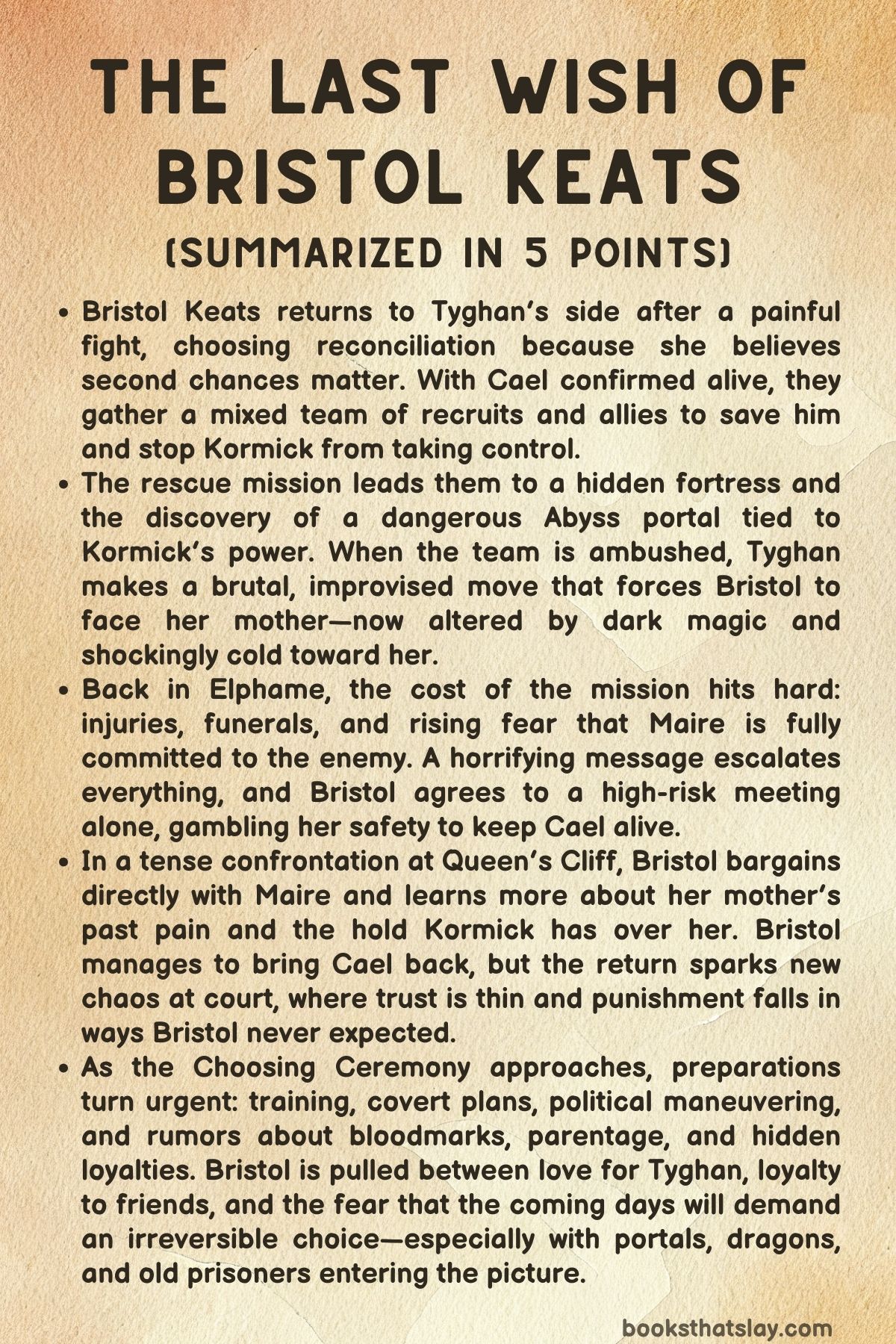
Bristol Keats awakens in her room, now cleansed of the argument she had with Tyghan, though the emotional wounds linger. The sprites, sensing her sorrow, fill her windowsill with rose petals.
Despite her grief, Bristol prepares to rejoin Tyghan and their team in a daring mission to rescue Cael, long presumed dead. Her thoughts turn to her family—her father, Logan Keats, a master of disguise, and her mother, Maire, who has fallen under a dark spell.
Tyghan has rescinded his order to kill Maire, deciding instead to capture her. Bristol accepts this compromise, understanding that her father can survive on his own.
When Tyghan appears, they reconcile, and she tells him that second chances matter more than first ones. Together, they leave for the rescue.
At dawn, the mission begins. Tyghan, now healed, surprises the others by joining the group led by Kasta.
Their goal is to locate Cael and prevent the power-hungry Kormick from taking control. Bristol and her companions, including Olivia and Julia, prepare to face the dangers ahead.
They mount their flying horses and soar invisibly toward the border of Danu, where they locate a mysterious Abyss portal radiating demonic energy. When Bristol touches it, the portal burns her hand, marking her connection to its power.
Tyghan heals her injury, and they resolve to use this discovery to stop Kormick during the upcoming Choosing Ceremony.
The group reaches Queen’s Cliff, a fortress that now serves as Cael’s prison. Moving stealthily through a deadly forest, they nearly lose Sashka to a sand trap but save her with magic.
Kasta leads a small squad to switch Cael with an enchanted hare, while the rest stand guard. The plan collapses when the team is ambushed.
Hollis is captured, and Kasta’s squad is pinned down. Quin rushes to Tyghan, urging him to use “Keats” as a last resort.
Tyghan pretends to take Bristol hostage, dragging her before Maire—her mother transformed into a horned, radiant being. Maire, cold and detached, mocks her daughter.
To make the threat real, Bristol presses herself against Tyghan’s blade, drawing blood. The sight breaks Maire’s composure, and she commands her soldiers to stand down before vanishing, leaving five minutes for the team to flee.
Back in the city, the survivors regroup in Winterwood Hall. Kasta reports the ambush, and Tyghan, haunted by his actions, confides in Eris about his guilt.
The council refuses to lift the death order on Maire, and Bristol comforts the wounded, trying to hold everyone together. Later that night, she breaks down in Tyghan’s arms, mourning the loss of her mother’s humanity.
Elsewhere, Bristol’s sisters, Cat and Harper, pack their family home, still hoping Bristol will return. Their father, Kierus (Logan Keats), hides in the forest, determined to find Maire.
He is captured by Melizan, a knight loyal to Danu, who takes him prisoner.
Days later, peace is shattered when a package arrives at the palace containing Glennis’s severed head and a note from Maire demanding that Bristol meet her alone. Despite Tyghan’s protests, Bristol insists on going.
At the border, her friends urge her to flee, but she rides alone to Queen’s Cliff to confront her mother. Meanwhile, Tyghan confronts Kierus in prison, accusing him of betrayal.
Though bitter, Tyghan secretly reduces Kierus’s sentence out of respect for Bristol.
Bristol meets Maire in the mist. Her mother shifts between cruelty and vulnerability, revealing fragments of her tortured past.
She tells Bristol of her childhood slavery, the loss of her hand, and how Kormick saved her, offering power and revenge. Bristol challenges her mother’s loyalty, arguing that Kormick’s help only created another prison.
When Bristol reveals her father’s location, Maire softens but insists Bristol must leave Elphame. She opens a portal to send her away, but Bristol refuses, lacking her timemark—the charm that keeps her anchored in time.
Instead, she bargains for Cael’s release, offering to leave the realm peacefully. Maire agrees, and Bristol returns with Cael, who quickly turns on her.
Julia and the others intervene, subduing him and bringing him to the palace.
At court, Cael lashes out and orders executions before fainting. Tyghan declares himself interim king until the Choosing Ceremony and confines Cael.
Meanwhile, Kasta betrays Tyghan’s mercy, turning Kierus to stone despite orders to spare him. Bristol and her friends grieve Glennis’s death and celebrate small moments of respite before Tyghan confronts Bristol about the truth of her bargain with Maire.
Preparations for a royal wedding begin—Melizan and Cosette’s binding ceremony. Amidst the festivities, Bristol learns more about her lineage when Willow, a fairy, reveals she once saved Logan Keats as a baby.
Reuben, another figure from her past, confesses to helping her father escape to the mortal world. These revelations deepen Bristol’s understanding of her family’s tangled history.
Meanwhile, tensions rise in Elphame. At the council meeting, powerful lords demand Bristol’s control, fearing her growing power.
Tyghan defends her, violently rejecting their authority. Later, Bristol discovers her father turned to stone on Judge’s Walk.
Furious, she forces Kasta to reveal how to reverse the curse. Using the instructions, she accidentally releases Pengary, an ancient prisoner who transforms into a dragon and escapes.
Determined, she continues until she frees her father.
The final battle erupts as Kormick’s army advances. Dragons—Pengary among them—join the fight on Bristol’s side.
Tyghan and Kierus fight together, finally reconciling before Kierus is mortally wounded by Kormick. Bristol confronts her mother at the Abyss as Kormick demands she reopen the portal.
Maire hesitates, torn between love and duty. When Kormick attacks, Maire sacrifices herself by dragging Bristol onto the Stone of Destiny.
The Stone declares Bristol Queen of Elphame. Kormick kills Kierus before fleeing, and Maire is struck down by an arrow.
Consumed by rage and grief, Bristol transforms into a dragon and kills Kormick, ending the war.
In the aftermath, Bristol grieves deeply for her parents and decides to return home, naming Julia as steward of Elphame. When she tries to leave, she learns her timemark has been stolen, severing her bond to the realm.
Furious, she blames Tyghan and departs through a new portal, demanding that she be considered dead.
She emerges in her old world thirty years later. Her sister Harper, now middle-aged, welcomes her, but Cat is gone.
Bristol builds a new life, running a café and raising her son, Rían—Tyghan’s child. Years later, when Harper discovers a hidden timemark, Bristol sends a message to Tyghan.
In Elphame, he has abandoned his throne and lives as a farmer. When he receives her summons, he returns.
Their reunion is emotional and tender. Tyghan meets Rían, realizing he is his son.
After confronting years of loss and love, Bristol and Tyghan reconcile and rebuild their bond.
A year later, they are married and live peacefully with Rían and their newborn daughter, Catarina. Surrounded by family and friends, Bristol reflects that every hardship led her here.
Through love, forgiveness, and the courage to begin again, she finally fulfills her last wish—to build a life that bridges both worlds.
Characters
Bristol Keats
Bristol Keats, the central figure of The Last Wish of Bristol Keats, embodies resilience, moral courage, and the emotional duality of love and loss. Her character evolves from a conflicted young woman torn between duty and personal grief into a decisive leader whose choices determine the fate of two worlds.
Her relationships—with her father, Logan (Kierus), her mother, Maire, and her lover, Tyghan—serve as mirrors reflecting her inner struggles between forgiveness and vengeance. Bristol’s compassion drives her, but her courage defines her: she faces betrayal, trauma, and supernatural transformations, yet remains anchored by a belief in redemption and second chances.
Her eventual transformation into a dragon symbolizes both transcendence and the weight of sacrifice—she becomes what she fears most to protect others. Even when crowned Queen of Elphame, Bristol’s humanity persists through her empathy and vulnerability.
Her final decision to leave Elphame and return to the mortal world, despite heartbreak and exile, illustrates the full circle of her growth: from a reluctant hero to a self-realized woman who chooses peace over power.
Tyghan
Tyghan represents the archetype of the warrior-king burdened by both love and leadership. Once Bristol’s adversary, then her ally and lover, his journey is one of redemption and self-discovery.
Through his military prowess and strategic mind, Tyghan projects authority, yet his personal life reveals a man constantly torn between duty and emotion. His love for Bristol exposes his vulnerability, softening his hardened exterior and grounding his morality in compassion rather than conquest.
The guilt he bears—over orders, sacrifices, and political manipulations—deepens his complexity. His moments of tenderness with Bristol, especially his respect for her autonomy and pain, contrast with the ruthlessness demanded by the throne.
Tyghan’s ultimate act of humility—abandoning kingship for a simple life as a farmer—completes his redemption arc. By the story’s end, when he reunites with Bristol and their son, his transformation from ruler to family man stands as a testament to the novel’s theme of second chances and the enduring power of love over ambition.
Maire (Leanna Keats)
Maire’s character is the most tragic and multifaceted in The Last Wish of Bristol Keats. Once a loving mother named Leanna, she becomes a corrupted and conflicted sorceress under the name Maire.
Her descent into darkness, driven by trauma, abuse, and the seductive promise of power, turns her into both a villain and a victim. Her alignment with Kormick and the Fomorian forces stems not from innate cruelty but from years of neglect and suffering that twist her sense of justice.
Despite her monstrous transformation, traces of her former self emerge—especially in her encounters with Bristol, where maternal instinct battles with magical corruption. The moment she spares Bristol’s life and defies Kormick is her redemption, proving that love can survive even in the darkest hearts.
Her death, pierced by an elven arrow, brings a devastating conclusion to her arc—a woman reclaimed too late by humanity but immortalized through her daughter’s forgiveness.
Kierus (Logan Keats)
Kierus, Bristol’s father, stands as a figure of paradox—both a master of disguise and a man struggling to face his true identity. His life, divided between deception and survival, reflects the broader theme of fragmented identity that runs throughout the novel.
Though he abandons his family, his actions are often guided by love and guilt rather than malice. His reunion with Bristol exposes the tension between secrecy and truth, as well as his enduring love for Maire despite her transformation.
Kierus’s artistic talent—culminating in his final painting, Tempest #44—serves as his confessional, revealing both his regret and his longing for reconciliation. His death at Kormick’s hands in Maire’s arms is both symbolic and redemptive: the artist dies in the embrace of the woman he never stopped loving, leaving behind a legacy of creation, sacrifice, and forgiveness.
Cael
Cael embodies the corrupting influence of power and privilege. Once a prince full of promise, he devolves into a figure of arrogance, instability, and moral decay.
His imprisonment, manipulation, and later paranoia expose the fragility beneath his royal veneer. Yet his downfall is not entirely self-inflicted—he is also a product of Elphame’s political rot and generational trauma.
Cael’s rivalry with Tyghan and his volatile relationship with Bristol highlight his inability to see beyond entitlement, even as he faces ruin. His survival after captivity and forced submission to Tyghan’s rule bring no redemption, only resignation.
Through Cael, Pearson critiques the cyclical nature of power—how authority, when untethered from empathy, breeds isolation and madness.
Kasta
Kasta is a soldier forged by loyalty and pain, whose moral ambiguity makes her one of the story’s most compelling secondary figures. As Tyghan’s first officer and one-time lover of Kierus, she bridges the human and political conflicts of The Last Wish of Bristol Keats.
Her sense of justice is warped by grief and bitterness, culminating in her cruel decision to imprison Kierus eternally despite Tyghan’s mercy. Yet her actions stem not from pure malice but from a belief that justice demands personal sacrifice.
Kasta’s loneliness and suppressed emotions make her both formidable and tragic. In her final scenes—drinking alone, mocking the world’s fleeting joy—she embodies the consequences of vengeance unchecked by forgiveness.
Eris
Eris functions as both mentor and mystery, guiding Tyghan through politics and personal turmoil while hiding truths of his own. His quiet wisdom and cryptic demeanor conceal deep emotional wounds, particularly in his strained relationship with Dahlia and his possible paternity of Tyghan.
As a symbol of fading idealism, Eris represents the old guard of Elphame—those who have seen too much and loved too little. His loyalty never wavers, but his restraint costs him emotional fulfillment.
His grief over Dahlia’s death humanizes him, revealing that even the wisest are not immune to regret. Through Eris, Pearson explores the burden of knowledge and the loneliness of those who lead from the shadows.
Dahlia
High Witch Dahlia stands as a figure of intellectual and emotional complexity—a woman bound by her power and her secrets. Her authority as a witch masks her deep personal vulnerabilities, particularly her unspoken love for Eris.
Dahlia’s manipulations, often perceived as cold, are in fact acts of protection for the fragile balance of Elphame. Her final confession of love before death redeems her in the reader’s eyes, transforming her from a political player into a tragic romantic.
Dahlia’s death is more than personal loss—it marks the end of an era, the silencing of reason in a world descending into chaos.
Julia, Rose, Avery, Hollis, and Sashka
Bristol’s friends—Julia, Rose, Avery, Hollis, and Sashka—serve as emotional anchors and moral mirrors throughout the novel. Each brings a unique strength: Julia’s compassion, Rose’s practicality, Avery’s bravery, Hollis’s humor, and Sashka’s quiet resilience.
Together, they represent the power of chosen family and the bonds that sustain Bristol through war and loss. Their unwavering loyalty, even when faced with death or betrayal, contrasts sharply with the political duplicity surrounding the main court.
Through them, Pearson reinforces the theme that love—in all its forms—is the true magic capable of mending even the most fractured souls.
Themes
Love, Redemption, and Second Chances
Love in The Last Wish of Bristol Keats is not portrayed as a flawless or idealized emotion but as a resilient, often bruised force that drives characters toward redemption. The bond between Bristol and Tyghan encapsulates this theme with raw intensity.
Their relationship begins under the weight of betrayal and mistrust yet evolves into something transformative. Bristol’s decision to return to Tyghan—despite their painful past—symbolizes the belief that forgiveness is not about erasing wounds but embracing the possibility of renewal.
Their love becomes a sanctuary in a world ruled by power struggles, curses, and betrayal. It is through love that both characters rediscover their humanity.
Tyghan’s willingness to risk his title and defy political decrees for Bristol’s safety underscores how love can challenge systems of control. Beyond romance, the novel expands this theme to parental and filial love.
Bristol’s fractured relationship with her mother, Maire, and her father, Kierus, embodies love corrupted by power and guilt. Maire’s final act—saving Bristol at the cost of her own life—reveals a buried tenderness that survives even through transformation into darkness.
Similarly, Kierus’s flawed devotion and repeated failures illustrate that love does not always redeem but can still inspire acts of courage. Ultimately, Pearson uses love as both weapon and remedy.
It demands pain before peace, forgiveness before fulfillment, and endurance before closure. The novel’s closing reunion between Bristol and Tyghan, after years of loss and separation, validates love’s cyclical nature—it may falter under time and grief but reemerges with a quiet, hard-earned grace.
Identity, Legacy, and the Search for Self
Bristol Keats’s journey is fundamentally one of self-discovery amid chaos, deception, and inheritance. Her life is divided between mortal and fae worlds, forcing her to confront questions of belonging and authenticity.
Throughout the story, she oscillates between daughter, lover, soldier, and queen—each role demanding a different mask. Yet, every transformation pushes her closer to understanding that identity is not determined by lineage or prophecy but by choice.
Her parentage—born of a human father and a fae mother enslaved by her own power—binds her to two realms in conflict. The revelation of her heritage and her eventual transformation into a dragon (an avydra) serves as both literal and symbolic manifestations of her fractured identity.
The dragon form, feared and revered, becomes the ultimate expression of her acceptance: she embodies both destruction and creation. Kierus’s artistry, Maire’s rage, and Tyghan’s moral conflicts all mirror Bristol’s internal struggle to define who she is without being consumed by the legacies of others.
Pearson crafts identity not as a static inheritance but as a continuous act of reclamation. Bristol’s reign as Queen of Elphame, though short-lived, signifies this evolution.
She no longer fights to belong; instead, she chooses her own destiny—returning to the mortal world and embracing an ordinary life with her son. Her identity becomes whole not through power but through peace.
The novel thus portrays selfhood as an ever-shifting construct, where acceptance of one’s contradictions becomes the truest form of strength.
Power, Corruption, and Moral Responsibility
Power in The Last Wish of Bristol Keats operates as both temptation and curse. It manifests through magic, monarchy, and bloodlines, ensnaring nearly every character.
Tyghan’s leadership is constantly tested between duty and compassion, while Maire’s descent into Fomorian allegiance demonstrates how trauma can distort strength into tyranny. The story interrogates the price of control: whether the authority to rule, the ability to heal, or the command over life and death, each form of power exacts a toll on the bearer.
Bristol’s arc, from reluctant warrior to sovereign, explores this moral tension most poignantly. Her resistance to exploit her magical gifts contrasts sharply with Kormick’s hunger for domination.
Pearson refuses to present clear heroes or villains; rather, she exposes how intentions—no matter how noble—can be corrupted by fear and grief. Maire’s justification for her actions, rooted in her childhood suffering and subjugation, humanizes her tyranny while revealing how cycles of oppression perpetuate through the abused becoming abuser.
Similarly, Tyghan’s hidden manipulations—such as the false execution order for Kierus—blur the line between justice and vengeance. The ultimate battle for Elphame is less about territory and more about moral inheritance: who deserves to rule and at what cost.
By the end, Bristol’s abdication signifies the novel’s rejection of absolute power. True leadership, Pearson suggests, lies not in control but in conscience—the courage to relinquish power for the sake of humanity.
Family, Forgiveness, and the Burden of Legacy
Family functions in this narrative as both foundation and fracture. The Keats family, scattered across realms and identities, embodies the consequences of generational pain.
Bristol’s reunion with her parents is marked not by joy but by grief and reckoning. Maire’s transformation into a horned fae monarch represents the corruption of maternal love under the weight of abuse and ambition.
Kierus’s failures as a husband and father stem from his inability to reconcile his artistic sensitivity with his cowardice. Yet both parents, in their final acts, seek redemption through sacrifice.
Pearson portrays forgiveness not as absolution but as recognition of shared fragility. Bristol’s grief for her parents at the joint funeral is not forgiveness in words but in understanding—the realization that love, even when broken, remains.
The novel also reflects on surrogate families: Tyghan’s soldiers, Bristol’s squad of friends, and Harper’s care in the mortal world all redefine family as chosen, not inherited. These bonds sustain Bristol when blood ties collapse.
The burden of legacy—of inheriting her parents’ mistakes and debts—becomes a crucible through which she redefines family values. By protecting her child from the same cycle of violence and secrecy, Bristol symbolically heals generations of hurt.
Through this lens, Pearson’s depiction of family transcends sentimentality; it becomes a meditation on survival, reconciliation, and the power of empathy to reclaim what history has broken.
Transformation, Mortality, and the Passage of Time
Transformation in The Last Wish of Bristol Keats functions as the novel’s spiritual axis. It governs the characters’ evolution and the metaphysical rules of Elphame.
Bristol’s metamorphosis—emotional, magical, and temporal—mirrors the inevitability of change. From the moment she leaves the mortal world to her return decades later, time acts as both thief and teacher.
Her discovery that thirty years have passed in her world underscores the novel’s meditation on mortality. Pearson uses temporal dislocation to illustrate how growth often requires loss.
Bristol’s realization that her sister Cat has died while Harper has aged becomes a painful confrontation with impermanence. Even her magical powers, which once symbolized vitality, begin to feel like burdens of endurance rather than gifts.
The transformations of others—Maire into a horned queen, Kierus into stone, Tyghan from king to farmer—reinforce the notion that survival demands adaptation. Yet the final chapters suggest transformation can also be redemptive.
Bristol’s acceptance of ordinary life, her motherhood, and her reunion with Tyghan reveal that the truest form of immortality lies in continuity—through love, memory, and creation. The passage of time does not erase suffering but reframes it as part of the human (and fae) experience.
Pearson closes the story with serenity rather than triumph, affirming that transformation is not a punishment but a passage toward meaning, where even loss becomes a form of renewal.