The Memory Gardener Summary, Characters and Themes
The Memory Gardener by Meg Donohue is a beautifully crafted story about loss, memory, and renewal, told through the eyes of Lucy, a landscape designer who returns to her hometown of Bantom Bay after sensing her late mother’s presence. Drawn back by a mix of nostalgia and unfinished emotions, Lucy discovers an abandoned garden at the Oceanview Home, an assisted living estate filled with residents haunted by grief and fading memories.
As she revives the gardens, Lucy also awakens buried emotions, family secrets, and the healing power of remembering. The novel explores how beauty, scent, and memory can restore not just landscapes, but lives.
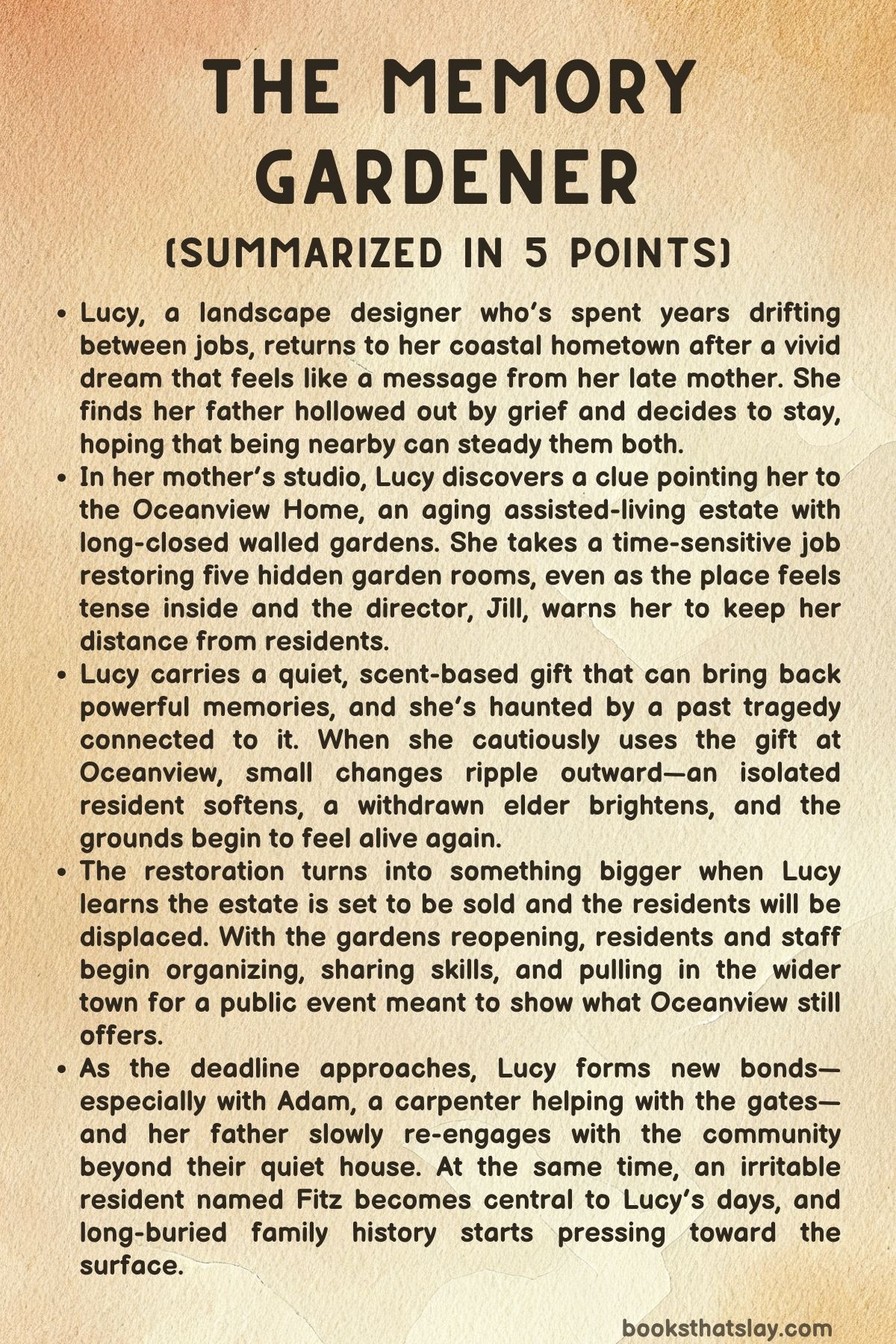
Summary
Lucy, a landscape designer who has spent years drifting from job to job, is pulled back to her coastal hometown of Bantom Bay by a vivid dream of her late mother. Haunted by the scent of her mother’s perfume, she decides to return home, bringing her dog, Gully, along.
There, she finds her father changed—withdrawn, thin, and living in quiet sorrow since her mother’s death. Determined to help him, Lucy decides to stay in Bantom Bay and look for local work.
In her mother’s old art studio, Lucy finds traces of her mother’s life: unfinished paintings, the smell of oil and flowers, and a calendar with one curious note circled—“The Oceanview Home.” Investigating, she discovers the Oceanview Home is an aging estate turned assisted living facility that needs a gardener for a special project. Intrigued and feeling a strange connection to the place, she applies for the job and is quickly hired by Donovan Pike, the current owner, under the watchful supervision of Jill Li, the director.
Upon arrival, Lucy finds the property both grand and decaying, its once-lush gardens overtaken by weeds. The estate’s history is rooted in generosity—founded by Agatha Pike as a sanctuary for widows—but it has since declined.
The residents live quietly, disconnected, and surrounded by the melancholy they call “the Gloom.” Among them is Fitz, a cantankerous old man recovering from a stroke; Marjorie Swenson, a lively woman clinging to better days; Cynthia, her fading friend; and Vikram Neel, a once-famous pastry chef who has lost the will to eat or live.
Lucy begins restoring the gardens, rediscovering her childhood gift—an inherited ability to evoke memories through the scents of plants. Though warned by her late mother that this gift can have consequences, Lucy tentatively uses it to help residents.
The first is Adele, a lonely widow who inhales lavender and is transported to a joyful memory of her honeymoon. Then Vikram, revived by the fragrance of viburnum, recalls his signature cake recipe and regains his appetite.
These moments bring the residents back to life, even if briefly, stirring emotions and awakening long-buried parts of themselves.
Despite Jill’s early warnings not to interfere with the residents, Lucy’s compassion overrides the rules. She feels her mother’s spirit guiding her, especially when she realizes her mother may have visited Oceanview before her death.
Yet her past still haunts her—especially the memory of Jack Harris, her high school sweetheart who died after she used her gift to bring back a painful memory from his past. The guilt of that tragedy lingers, shadowing her every act of kindness.
While uncovering the hidden gardens, Lucy meets Adam Lewis, a carpenter hired to restore the broken gates. Adam is a widower raising his quiet daughter, Sophie, who hasn’t spoken since her mother’s death.
As Lucy and Adam work together, Sophie forms a bond with Gully and begins to open up. Their growing friendship sparks something deeper between Lucy and Adam, both of whom are still healing from loss.
When Jill reveals that Donovan plans to sell the Oceanview Home to developers who will turn it into a luxury hotel, Lucy is devastated. She realizes Donovan only wanted the gardens restored to increase the property’s value.
The residents will soon lose their home. Determined to honor her mother’s spirit and the residents’ love for Oceanview, Lucy joins Cynthia and Marjorie in organizing a secret spring party—a final celebration to rally the community and prove the home’s worth.
With help from residents, staff, and Adam’s family, they plan an event that will draw public attention and support.
Meanwhile, Lucy’s relationship with her father begins to heal. Together they revisit her mother’s studio, and her father reveals that her mother’s true joy came not from painting, but from teaching and sharing creativity.
Inspired, Lucy donates her mother’s art supplies to the community center, where her father starts volunteering, rekindling his sense of purpose. In the studio, Lucy notices that her mother’s last unfinished painting depicts the Oceanview Home’s meadow, proving she had been there before she died—likely trying to reconcile the family’s long-standing wounds.
As preparations for the spring party intensify, tragedy strikes when Cynthia passes away. The loss strengthens Lucy’s resolve to continue her work and bring joy back to the home.
The residents, united by the cause, fill the gardens with music, food, and laughter on the day of the event. When Donovan arrives, furious that the home has been used for a public gathering, Jill confronts him with petitions, financial projections, and proof that Oceanview can survive with renewed community support.
The heartfelt success of the party—and the residents’ determination—soften Donovan, who begins to reconsider selling.
During the event, Lucy’s father arrives, and a stunning truth surfaces: Fitz, the gruff resident who has become one of Lucy’s unexpected allies, is actually her grandfather. The long estrangement between Fitz and Lucy’s father, Gregory, stemmed from Fitz’s disapproval of Gregory’s marriage to Lucy’s mother.
Fitz had feared Gregory would be abandoned like he was by his own wife. Lucy’s mother, Nell, had visited Fitz shortly before her death, hoping to reunite the family.
Through Lucy’s presence, that reconciliation finally happens. Father and son forgive each other, bridging years of silence and resentment.
In a quiet moment, Lucy helps Sophie confront her own grief through scent—the aroma of sage unlocks Sophie’s memory of her mother, prompting her to speak again for the first time. The moment of healing ripples through Adam and Lucy, bringing their growing bond into light.
Moved by the beauty and spirit of the gardens, Donovan cancels the sale. Instead, he decides to preserve Oceanview as a living home for the residents, supported by new programs and community involvement.
The estate’s energy shifts—once a place of decline, it becomes one of renewal and belonging.
Months later, Lucy has made Bantom Bay her permanent home. The Oceanview Home thrives, filled with laughter, creativity, and life.
Lucy continues her work as its full-time gardener, guiding new residents through gardens that bloom with both memory and hope. Her father teaches classes at the community center, Fitz spends his days on the terrace playing chess, and Adam and Sophie have become part of her world.
Surrounded by family, love, and purpose, Lucy realizes that memory—like a garden—needs tending, patience, and faith to flourish.
The Memory Gardener closes with Lucy embracing her new beginning, her mother’s spirit lingering in every petal and every fragrance, reminding her that even in loss, something beautiful can grow.
Characters
Lucy
Lucy, the protagonist of The Memory Gardener, is a woman bound by grief, guilt, and the fragile hope of renewal. Her connection to the natural world is both mystical and deeply emotional—her ability to evoke memories through the scents of flowers is not simply a supernatural talent but a metaphor for the way she bridges the past and present.
Haunted by the tragic death of Jack Harris, which she believes her gift caused, Lucy has spent years wandering from one landscaping job to another, unable to put down roots. Her return to Bantom Bay and the Oceanview Home marks her journey toward healing and belonging.
Through her work, Lucy learns that creation and care—whether for a garden, a home, or a person—can be acts of redemption. Her empathy toward the residents, her growing relationship with Adam and Sophie, and her reconciliation with her father and grandfather all demonstrate her evolution from guilt-ridden isolation to integrated, purposeful love.
Gregory
Lucy’s father, Gregory, is a man consumed by silence and self-denial after the death of his wife, Nell. His home mirrors his emotional state—immaculate yet lifeless, lacking warmth or nourishment.
Initially, he appears resigned to solitude, estranged from neighbors and friends, but his interactions with Lucy gradually thaw his detachment. Gregory’s eventual revelation that Fitz is his estranged father and his acknowledgment of the truth about Nell’s past bring him full circle.
He begins to mend what grief and pride once broke, taking active steps toward community involvement and reconnection. Gregory’s transformation underscores the novel’s theme that healing often requires both remembering and forgiving.
Nell
Though deceased when The Memory Gardener begins, Nell’s presence pervades every corner of the narrative. Her scent—gardenia, sandalwood, linseed oil—acts as a spiritual thread drawing Lucy back to Bantom Bay.
Nell’s artistic and empathic nature is reflected in Lucy’s own. Her belief in the emotional power of art and memory shaped her daughter’s relationship with beauty and healing.
However, Nell’s life was also marked by regret: her marriage to Gregory severed his bond with his father, Fitz, and she carried guilt believing her influence caused that rupture. Even in death, she catalyzes reconnection—her unfinished painting leads Lucy to Oceanview and eventually reconciles the family she once unintentionally divided.
Fitz
Fitz, Lucy’s grandfather, is a man of contradictions—curmudgeonly and prideful, yet vulnerable beneath his brusque exterior. Living at Oceanview Home after a stroke, he hides from others, tormented by memory loss and regret.
His encounters with Lucy, whom he initially mistakes for his late wife Millie, stir dormant feelings of love and remorse. Fitz’s harshness masks a lifetime of fear—fear of abandonment, of being wrong, of facing the consequences of estranged relationships.
His eventual recognition of Lucy as his granddaughter and reconciliation with Gregory marks one of the book’s most powerful emotional resolutions. Fitz embodies the novel’s exploration of how memory—though painful—can restore identity and connection when faced with courage.
Donovan Pike
Donovan represents the conflict between heritage and commerce. As the heir to the Oceanview Home, he feels burdened by its financial failure and haunted by his father’s mismanagement.
Initially, he sees the estate as a liability to be sold rather than a legacy to be preserved. His pragmatic coldness contrasts sharply with Lucy’s emotional attachment to the gardens.
However, as the gardens revive and the residents rediscover joy, Donovan’s perspective shifts. By the novel’s end, he abandons the sale and recommits to sustaining the home.
His transformation illustrates how memory, community, and compassion can outweigh profit and self-interest.
Jill Li
Jill begins as a pragmatic and somewhat antagonistic figure—a director focused on rules and efficiency. Her suspicion of Lucy’s unorthodox methods masks deeper insecurities about control and failure.
Over time, Jill’s rigidity softens as she witnesses the positive effects of Lucy’s work on the residents. When she confesses that Oceanview is being sold, she acts not as an adversary but as an ally, aligning herself with Lucy and the residents in their effort to save the home.
Jill’s evolution from gatekeeper to guardian highlights the possibility of redemption through honesty and shared purpose.
Adam Lewis
Adam enters Lucy’s life as a craftsman tasked with restoring the garden gates, but he soon becomes a mirror for her own loss and resilience. A widower raising his selectively mute daughter, Sophie, Adam represents quiet endurance.
His craftsmanship parallels Lucy’s gardening—both heal through creation and care. His relationship with Lucy unfolds slowly, grounded in shared grief and the courage to love again.
Adam’s eventual restoration of both the gates and his ability to find “soul” in homes again parallels Lucy’s emotional rebirth. Through him, the novel underscores the restorative power of empathy and partnership.
Sophie
Sophie, Adam’s young daughter, is a tender symbol of innocence wounded by loss. Her silence after her mother’s death reflects an inner fracture that words cannot bridge.
Through her bond with Lucy and Gully, and ultimately through the scent of grey musk sage, Sophie reconnects with her memories and begins to speak again. Her recovery is one of the novel’s most touching arcs—demonstrating how remembrance, when approached with love, can be healing rather than painful.
Marjorie Swenson
Marjorie is the heart of the Oceanview residents—a spirited, optimistic woman who refuses to let age or adversity dampen her determination. She spearheads the movement to save the home and restores vitality to the community.
Her compassion toward Cynthia, Fitz, and Lucy makes her a unifying force. Through Marjorie, The Memory Gardener portrays how leadership and hope can flourish in unexpected places, turning frailty into strength.
Cynthia
Cynthia’s struggle with cognitive decline is depicted with sensitivity, her moments of lucidity brought forth by the scent of honeysuckle. Once a confident law student, she rediscovers her assertiveness and becomes instrumental in organizing the campaign to save Oceanview.
Her reawakening through memory reflects one of the novel’s central ideas—that recalling the past can reinvigorate the self, even in the face of decay.
Vikram Neel
Vikram, a once-renowned pastry chef ravaged by arthritis and depression, is another of Oceanview’s wounded souls. His rediscovery of passion through Lucy’s floral scents—particularly the memory of creating his chai spice cake—rekindles his sense of worth.
Vikram’s transformation underscores the novel’s recurring motif of sensory memory as a bridge to joy and purpose.
Adele Abrams
Adele’s melancholy and physical frailty lift when Lucy helps her relive her honeymoon in Provence through lavender. Her awakening embodies the beauty of small miracles that ripple through Oceanview, turning despair into vitality.
Adele’s rediscovered zest for life amplifies the theme that beauty and memory can be medicine for the heart.
Gully
Gully, Lucy’s loyal dog, functions as more than a companion; he is a grounding presence, bridging human solitude with unconditional affection. He comforts the elderly, soothes Sophie, and offers Lucy wordless support through her emotional journey.
Gully symbolizes constancy in a story defined by change and loss.
Themes
Grief that lives in the senses
Lucy’s return to Bantom Bay is driven less by logic than by a sensory summons: the precise blend of gardenia, sandalwood, and linseed oil that signals her mother’s presence. Grief in The Memory Gardener is not abstract sadness; it is an atmosphere that settles into rooms, routines, and bodies.
Lucy’s father becomes a portrait of mourning expressed through avoidance—an immaculate house that feels staged, a nearly empty refrigerator, food pushed around a plate, social invitations declined until absence becomes a habit. The novel shows how grief can narrow a person’s world without any dramatic announcement, turning daily life into something that must be endured rather than lived.
Lucy’s own grief is complicated because her mother’s gift and her mother’s work were both forms of emotional influence. Lucy stands in her mother’s studio surrounded by materials that still feel “alive,” but the very liveliness of the space sharpens the loss, because it suggests a presence that should be there and isn’t.
At Oceanview, grief is communal and varied: residents mourn spouses, health, independence, and the slow erosion of memory; staff mourn stability and the quiet pride of a home they want to protect. The “Gloom” becomes a shared language for what happens when grief isn’t processed, when people retreat into isolation and an institution gradually stops expecting joy.
Small shifts—a window opened, tables returned to the terrace, baking smells replacing antiseptic—signal that grief can loosen its grip when the environment invites connection. The story also acknowledges grief’s unpredictability: laughter in a dining room can feel like comfort to one person and an assault to another, as it does for Fitz.
Grief here is personal, physical, and social, shaped by what people allow themselves to feel and what they refuse to touch.
Memory as a force that can heal or harm
The central mechanism of scent-triggered memory in The Memory Gardener treats remembrance as something active, not passive. Lucy’s gift creates immediate emotional shifts by pulling people into vivid scenes that restore parts of themselves they thought were gone.
Adele’s lavender memory doesn’t merely entertain her; it returns her to a version of herself capable of desire, movement, and conversation, which changes how she inhabits her body in the present. Vikram’s encounter with viburnum restores the pride and sensory pleasure of his craft, making appetite and purpose possible again.
Cynthia’s honeysuckle moment does something even more radical: it restores her sense of authority and agency, allowing her to speak and organize rather than simply decline quietly. These outcomes suggest that memory can function like a bridge back to identity, especially for people whose current circumstances have reduced them to patients, residents, or “cases.” At the same time, the novel refuses to portray memory as safely therapeutic.
Lucy’s history with Jack demonstrates that bringing a buried experience to the surface can destabilize someone already near an edge. What Lucy intends as help becomes a catalyst that intensifies Jack’s fear and shame, and her long-held guilt shows how the consequences of memory can echo for years.
Fitz’s hostility adds another dimension: memory is also a threat because it demands emotional reckoning. He rejects anything that might soften him, because softness would require him to revisit regrets he has kept sealed.
The story keeps asking what it means to return someone to a truth they avoided. Is it kindness, intrusion, or both?
By making memory so immediate and embodied, the novel highlights its moral weight: remembrance can restore dignity and connection, but it can also expose raw nerves, reopen wounds, and change a life in ways the “helper” cannot fully control.
The ethics of influence and the burden of unintended consequences
Lucy’s gift and her mother’s emotion-shaping paintings raise a difficult question: what happens when one person has the power to alter another person’s inner state? The Memory Gardener treats that power as morally serious, not cute or purely magical.
Lucy carries a warning she once heard—every action has a consequence—and the narrative proves that warning through Jack’s death and the shame that follows. Her fear is not only that she harmed him; it is that she crossed a boundary by deciding, on his behalf, what he should face.
This anxiety shapes how she approaches Oceanview. At first, she is careful, offering “gifts” through plantings without explicitly directing residents into memories.
But the results are so striking that the temptation to help becomes stronger than her caution, especially when she sees people trapped in depression, loneliness, or cognitive decline. The story complicates this by showing how institutional power also manipulates outcomes.
Donovan’s plan to sell Oceanview and use the restored gardens to increase property value is another kind of influence—financial and strategic rather than sensory—yet it affects residents’ lives just as deeply. Jill’s initial restrictions on Lucy’s contact with residents reveal a fear of liability and disruption, but also a desire to control emotional currents inside a fragile community.
When Lucy helps Adele and Vikram, her actions blur the line between caregiving and interference, between compassionate risk and ego-driven rescue. The novel does not resolve this theme with a simple rule; instead, it evaluates intention alongside consent, context, and accountability.
Lucy’s best moments occur when she remains present after the “gift,” helping people integrate what they felt rather than treating memory like a quick fix. Her worst fear is that she will repeat the Jack pattern: act from certainty, trigger something she cannot contain, and then be left with irreversible fallout.
By keeping that fear alive even as positive transformations occur, the story insists that real help requires humility, boundaries, and a willingness to face outcomes rather than disappear from them.
Place, roots, and the decision to stop running
Lucy’s decade of constant movement as a landscape designer isn’t framed as adventurous freedom; it reads as a strategy for avoiding attachment. Coming home forces her to confront what she has been refusing: a father sinking into solitude, a town full of people who remember her, and a history she has tried to outpace.
In The Memory Gardener, place is not merely scenery; it is a container for unresolved relationships. The smell of coastal air, familiar storefronts, and the repurposed Seadrift Gallery trigger both nostalgia and dread, suggesting that “home” can hold comfort and threat at the same time.
Lucy’s choice to stay is presented as unexpectedly decisive, as if she is surprised by her own readiness to stop fleeing. Oceanview becomes a second test of rootedness.
The job has a hard deadline and a transactional premise, yet Lucy begins to treat it as a living community rather than a project. She forms routines, notices individual needs, and allows herself to be known.
That shift matters because her previous life was built around leaving before the emotional bill arrived. Staying in Bantom Bay means living with consequences, both painful and healing.
The theme extends to other characters: Adam is rooted by responsibility to Sophie even when grief has drained his inspiration; Fitz is rooted in Oceanview partly because it once allowed dogs and partly because it gives him structure, even as he resents it; Lucy’s father begins to re-enter community life through practical work at the community center, rediscovering purpose through contribution. The threat of the home’s closure raises the stakes of rootedness by showing that stability is not guaranteed.
People can be forced to leave even when leaving harms them. In response, characters choose to build ties quickly and deliberately—friendships, projects, shared plans—because belonging is treated as something created through action.
Rootedness here is not sentimental; it is a commitment to remain present, to be accountable, and to build a life that cannot be packed into a car and driven away.
Aging, dignity, and the human need to be seen
Oceanview’s residents are not portrayed as background figures or inspirational props; they are shown as people negotiating loss of function, shifts in identity, and the social invisibility that often comes with age. The “Gloom” is partly a mood and partly a consequence of systems: neglected grounds, closed gardens, reduced expectations, and a clinical interior that smells of antiseptic rather than life.
The Memory Gardener suggests that dignity is tied to choice, access, and sensory richness. When residents are kept inside, monitored, and managed primarily through rules, their days flatten into compliance.
When the terrace opens and the gardens become accessible again, residents regain not only pleasure but agency. Marjorie and Cynthia reclaim the role of hosts and organizers; Adele becomes more than someone moved from place to place; Vikram’s culinary identity reappears when he is invited to remember the craft he loved rather than pressured to “just eat.” Fitz is especially important because he resists sentimental treatment.
He is prickly, proud, and often unkind, which makes his gradual softening feel earned rather than forced. His relationship with Gully allows a form of connection that does not require performance or polite conversation.
Isobel’s care shows how dignity can be maintained through small acts—food offered without humiliation, companionship offered without pressure, patience without condescension. The novel also portrays the staff’s precariousness.
Jill and others are not villains; they are people trying to balance safety, budgets, and residents’ quality of life while facing job insecurity. The looming sale exposes how easily elders can become collateral in financial decisions, displaced because they are seen as occupants of valuable real estate rather than individuals with histories and attachments.
By focusing on sensory experience—birds, waves, baking smells, flowers, sun—this theme argues that dignity is not only medical care. It is the right to live in a world that still feels vivid, relational, and meaningful, even when the body and mind are changing.
Renewal through care, craft, and shared work
Restoration in The Memory Gardener operates on multiple levels: physical spaces are repaired, but so are relationships, habits, and self-perceptions. The gardens begin as a “sunken jungle,” closed off by rotting gates and ivy-covered walls, mirroring the emotional shutdown inside the home.
As Lucy clears paths and reveals hidden entrances, people begin moving again—first literally, then emotionally. The novel connects beauty with responsibility: restoring a space is not cosmetic; it changes what a community believes is possible.
When residents see visible progress, they begin to imagine gatherings, tables on the terrace, and traditions returning. This is not presented as a miracle that happens overnight; it is built through labor, planning, coordination, and the messy reality of people showing up.
The public spring party becomes the clearest expression of renewal as collective action. Cynthia’s moment of clarity leads to organizing; clipboards, tickets, publicity, and budgeting turn hope into a strategy.
Katie modernizes outreach, Jill takes risks despite professional consequences, and residents shift from passive recipients of decisions to active participants in their own future. The theme also includes private renewal.
Lucy’s father starts with a crooked bulletin board and moves toward teaching a workshop, rediscovering competence and usefulness after months of retreat. Adam regains his sense that homes have “souls,” suggesting that craft can return when grief is given room and companionship.
Sophie’s drawing of a dream garden shows renewal as imagination: the ability to picture a future rather than only mourn the past. The novel insists that renewal is not denial of loss.
Memorials still happen, grief still surfaces, and some memories hurt. Renewal is portrayed as a choice repeated daily: tending plants, preparing food, building structures, making calls, welcoming visitors, and apologizing when one has caused harm.
The restored gardens matter because they become proof that care changes outcomes. They also become a counterargument to the idea that decline is inevitable.
With attention, resources, and community will, a place—and the people within it—can return to life.
Family legacy, secrecy, and reconciliation across generations
The story’s emotional engine is not only Lucy’s grief for her mother but the way family history sits half-spoken in the rooms she returns to. Her father’s silence, his reluctance to discuss certain names, and the town’s hints about “something awful” create a sense that Lucy has grown up around gaps.
The Memory Gardener treats secrecy as a form of protection that often becomes its own harm. Lucy’s father believes withholding information may spare pain, yet his withdrawal leaves Lucy alone with assumptions and self-blame.
The eventual revelation that Fitz is Lucy’s grandfather reframes earlier tension: Fitz’s fixation on Lucy’s resemblance to Millie is not just confusion; it signals unresolved family memory pressing against the present. Fitz’s estrangement from Gregory reveals how fear can shape a family’s trajectory.
His ultimatum—meant to prevent abandonment—produces abandonment by pushing his son away. That dynamic echoes Lucy’s own pattern of leaving before she can be left.
The theme suggests that emotional inheritance is real: not in a mystical sense, but in how coping strategies get passed down as “normal.” Nell’s role becomes especially poignant. Her attempt to reconcile Fitz and Gregory before her death shows that love sometimes expresses itself as repair work, an effort to close distances that others have accepted.
Her unfinished painting of the Oceanview view functions like a final message without words: she was there, she saw what was at stake, and she wanted something for her family that she did not have time to complete. Reconciliation arrives through direct conversation and acknowledgement rather than grand gestures.
Fitz apologizes, Gregory admits the long shadow of regret, and Lucy becomes a bridge between them while also asserting her own story. The novel does not pretend that decades of hurt vanish instantly; instead, it shows how reconciliation begins with presence—sitting together, speaking plainly, and allowing vulnerability that pride once blocked.
By connecting Lucy’s personal healing to this family repair, the story suggests that moving forward often requires addressing what came before, not to punish anyone, but to stop repeating the same protective damage in new forms.
Belonging versus profit and the struggle over what has value
The sale of Oceanview introduces a sharp conflict between human needs and market logic. Donovan’s rationale is practical—financial failure, inherited mismanagement, and pressure to make the property viable—but the consequences are intimate: residents uprooted, staff displaced, and a community treated as an obstacle to a lucrative transformation.
The Memory Gardener highlights how easily “value” becomes defined by what can be monetized. The planned boutique hotel, golf course, and luxury positioning frame the estate’s beauty as an asset for outsiders rather than a lifeline for people who already live there.
The irony is that the same gardens that nurture residents also become a tool for increasing sale price. Lucy’s labor, intended as care and renewal, is almost used to finalize displacement.
This creates a moral tension that fuels the residents’ response. Their strategy is not to beg for sentimentality but to demonstrate viability: ticket sales, a new waitlist, publicity, and a budget plan.
They meet the market’s language with evidence while still defending a different kind of worth—continuity, safety, friendship, and dignity. Donovan’s shift after experiencing the renewed gardens suggests that even practical people can be moved when they encounter the lived reality behind spreadsheets.
His childhood memories reawaken a sense of responsibility that had been reduced to liability management. The novel also complicates villainy.
Donovan is not purely cruel; he is overwhelmed by inheritance and risk. Jill is not purely obstructive; she is exhausted by systems that punish compassion.
The developers remain mostly offstage, which keeps the focus on the broader issue: decisions that reshape communities are often made without genuine contact with the people affected. By ending with Oceanview thriving and experimenting with new models—memberships, limited events—the novel suggests that preserving belonging may require creative adaptation.
The core argument is that a place can be both financially sustainable and ethically grounded, but only if people refuse to let profit be the only measure of what matters.