The Midnight Book Club Summary, Characters and Themes
The Midnight Book Club by Emily W. Andersen is a contemporary literary novel that blends quiet magic with personal rediscovery. It follows Aurelia, a grieving woman who inherits her late aunt’s London bookshop and soon discovers that, at midnight, its shelves come alive with characters from classic literature.
As she navigates loss, loneliness, and the pressures of rebuilding her life, Aurelia finds companionship among the fictional visitors who appear each night — and inspiration to write again. The story explores how books can shape our identities, how grief transforms creativity, and how imagination can offer both refuge and renewal.
Summary
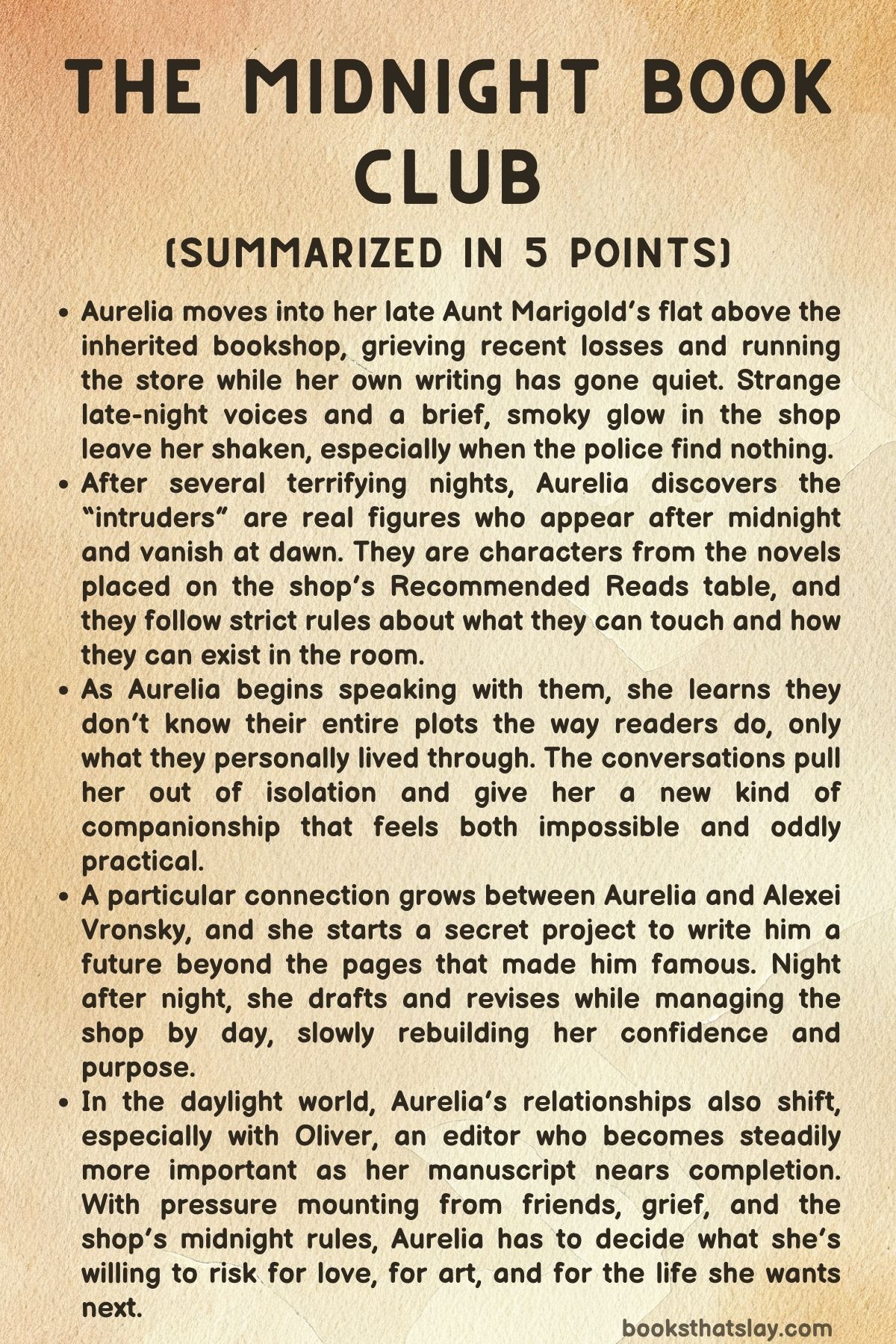
After a year shadowed by grief, Aurelia moves into her late Aunt Marigold’s flat above the bookshop she has inherited. Still raw from the recent deaths of both her mother and aunt, she tries to manage the shop alone while struggling with creative stagnation.
Her sleep is soon interrupted by strange noises from the shop below — voices holding calm, old-fashioned conversations, even mentioning “Pemberley.” When she investigates, the shop is empty, though faint lights and mist linger. Embarrassed after calling the police, Aurelia begins to question her own senses.
The disturbances continue, each time more vivid. On one occasion, she glimpses figures in Regency clothing before they vanish, leaving only a trace of smoke.
The police find nothing but note an unexplained haze. As the nights repeat this eerie pattern, Aurelia wonders whether she is hallucinating or if her aunt’s shop hides something extraordinary.
Her sister Antonia and father both dismiss the idea of hauntings, but Aurelia senses that her aunt may have left more behind than just a business.
One night, determined to uncover the truth, Aurelia witnesses a full gathering of people in historical attire conversing cheerfully among the shelves. When one man’s hand turns to swirling letters as it passes through a book, she realizes these are not intruders but something else entirely.
The visitors see her, and though frightened, Aurelia soon learns their secret: they are characters who step out of books at midnight.
Among them is Sergeant Cuff from The Moonstone, who gently explains that her Aunt Marigold knew them well. They cannot touch anything not born of fiction, and they always return to their stories at dawn.
Each night’s gathering depends on the books displayed on the shop’s “Recommended Reads” table. That night, characters from Anna Karenina, Little Women, and Sense and Sensibility also appear — including Count Alexei Vronsky, Laurie Laurence, and the Dashwood sisters.
Realizing Marigold curated that table with purpose, Aurelia begins to feel the shop’s enchantment is a legacy meant for her.
Aurelia’s days continue as normal — dealing with customers, her cat Fezz, and her skeptical friends — but her nights become a world of conversation, wit, and wonder. She grows particularly attached to Vronsky, who is curious about the modern world and surprised to learn he exists in a story over a century old.
Their nightly exchanges become the heart of her renewed creativity, and she starts writing again for the first time since her mother’s death.
Outside her secret life, Aurelia reluctantly goes on a date with Oliver Pearce, a publishing professional, arranged by her friend David. The meeting is awkward but ends with an unexpected kiss, leaving her conflicted.
Yet, her thoughts keep returning to the bookshop’s midnight visitors — and especially to Vronsky, who feels increasingly real. When she and Vronsky begin discussing what his life might be like after the end of Anna Karenina, an idea sparks: together, they could write his continuation.
Over several weeks, Aurelia and Vronsky collaborate on this imagined sequel, exploring the idea that he survived and found a new purpose. The partnership reignites Aurelia’s passion for storytelling.
She types while he dictates, editing during the day and returning to him each night. The process helps her process grief and rediscover her identity as both writer and dreamer.
By Christmas, she shares parts of the draft with her literary visitors, who cheer her efforts and call her their storyteller.
When she visits her family for the holidays, Aurelia realizes how much she misses the midnight world she’s built. Her sister notices her brighter spirit, unaware of the source.
Returning to London, Aurelia throws herself back into writing. The manuscript nears completion, and her connection with Vronsky deepens, though they can never touch.
Their conversations move from art and literature to longing and purpose, blurring the line between fiction and emotion.
Encouraged by her friends, Aurelia decides to publish the story. James, her friend’s partner, insists she let Oliver handle it professionally.
Nervous but determined, she meets Oliver and hands him the manuscript, explaining that it reimagines Vronsky’s life after tragedy. Oliver agrees to edit it and becomes intrigued not only by the story but by Aurelia’s passion.
Their friendship rekindles, filled with lunches, editing sessions, and growing affection neither quite names. Still, Aurelia hesitates, afraid of mixing her magical secret with real intimacy.
Her nights remain devoted to the shop. The characters encourage her, with Elinor Dashwood and Marmee urging her to embrace love in life as she has in fiction.
When Oliver’s feelings become undeniable, Aurelia realizes her fear of being “too much” — a wound from past relationships — has kept her from happiness. Inspired by the advice of her fictional friends, she rewrites the story’s ending, giving Vronsky a future filled with love.
Naming his new partner Vivienne, after a grave she once saw, Aurelia creates for him the peace she wishes for herself.
When she delivers the new draft to Oliver, she confesses that she added the romance because it felt true. Oliver recognizes the name from their shared walk in Highgate Cemetery and senses her vulnerability.
This time, he doesn’t hold back. Their second kiss confirms what both have been denying.
From then on, Aurelia balances her two worlds: a thriving shop, a loving relationship, and a book about to be published.
As launch day nears, Vronsky grows restless, sensing that the story’s completion means his time in Aurelia’s world is ending. He asks her to promise never to display Anna Karenina again, ensuring he can stay in the life they’ve written for him.
When the dawn comes, he fades for the last time, leaving Aurelia both heartbroken and fulfilled. She replaces Anna Karenina on the Recommended Reads table with her own book — a gesture of continuation rather than closure.
At midnight, the mist rises once more. Familiar figures appear, joined by two newcomers: Prince Yashvin and Vivienne, now characters from Aurelia’s own story.
They tell her Vronsky lives happily in Paris, painting, walking by the Seine, and deeply in love. Hearing this, Aurelia feels peace.
Through writing, she has not only rewritten Vronsky’s fate but also transformed her own — finding in imagination the courage to live, love, and hope again.
Characters
Aurelia
Aurelia is the emotional and narrative center of The Midnight Book Club, introduced at a point of collapse and transition: newly bereaved, physically exhausted, and living inside the inheritance that has swallowed her old life. Her grief is not decorative background; it actively shapes her perceptions, her sleep, her irritability, and her sense of identity, which has narrowed from “writer and daughter” to “caretaker of a shop and a pile of losses.” The strange midnight gatherings arrive at the exact moment she is most likely to doubt her own mind, which makes her early fear feel doubly intimate—she isn’t only scared of intruders or ghosts, she’s scared that she might be breaking.
What makes Aurelia compelling is how quickly she shifts from avoidance to agency: once she realizes the phenomenon is real, she stops being merely a frightened witness and becomes a participant, then a hostess, and finally a creator who uses the shop’s magic as a lever to restart her stalled voice.
Her relationships reveal the different versions of herself she’s trying to reconcile. With Antonia, she is the guarded sister who performs “fine” to avoid worry; with David, she is both protected and pushed, sometimes resentful of his intrusions but also quietly dependent on his insistence that she keep living.
With Oliver, she becomes a person forced back into the risk of the real world, where there are consequences, misunderstandings, and no tidy page-bound rules. Most importantly, her bond with Vronsky becomes a mirror for her own fear of happiness: she can imagine an altered future for him before she can imagine one for herself, and the moment she recognizes she has still denied him “real” love is the moment she admits she has been bargaining for “happy enough” in her own life too.
By the end, Aurelia’s growth is not simply romantic or professional; it is existential—she reclaims authorship over her days, her shop, and the story she tells herself about what she deserves after loss.
Aunt Marigold
Marigold is the architect of the bookshop’s secret and a lingering presence that feels both maternal and mischievous. Even though she is absent in the living timeline, her personality continues to act on the plot through the careful mechanism of the Recommended Reads table, the boundaries of the magic, and the fact that she has clearly prepared the visiting characters to expect Aurelia.
Marigold’s defining trait is her practicality braided with wonder: she may not have been theatrical about the supernatural, but she was strategic enough to manage it, contain it, and quietly curate it into a sustainable ritual. That combination makes her feel like the shop itself took human form in her—grounded, hospitable, stubbornly old-fashioned in the best sense, but also capable of holding the impossible without collapsing.
Her role is also emotional. Marigold is part of Aurelia’s grief stack—another cancer loss, another goodbye—yet she remains a source of comfort because her choices reveal faith in Aurelia’s future.
Leaving the shop to Aurelia is not only inheritance; it is a vote of confidence that Aurelia can carry a legacy without being trapped by it. The hidden tea with a warning note captures Marigold’s intimacy perfectly: she is still “there,” teasing and caring at once, nudging Aurelia toward laughter and then, unavoidably, toward tears.
In that way, Marigold represents a model of how love survives death in this story: through objects, rituals, and the quiet structures people build for those who come after.
Antonia
Antonia functions as Aurelia’s long-distance anchor and her most consistent source of ordinary reality. Living in Paris and speaking with Aurelia across calls, she is close enough to detect when something is wrong but far enough that Aurelia can keep performing competence.
Antonia’s humor—like the “literate burglars” joke—shows how she uses lightness to manage fear, and her repeated concern that Aurelia is overwhelmed signals a protective instinct that comes from shared family trauma. She believes the simplest explanation first, not because she is dismissive, but because she is trying to keep her sister safe from spiraling.
At the same time, Antonia’s presence highlights Aurelia’s isolation. Aurelia lies to her about a writing group because Antonia represents the kind of loving scrutiny Aurelia is not ready to withstand; admitting the truth would mean admitting how strange, fragile, and changed she feels.
Antonia is therefore both comfort and pressure—proof of family continuity, but also a reminder that Aurelia cannot stay hidden in the shop forever. When the family gathers later, Antonia’s attentiveness makes it clear that Aurelia’s healing is not meant to be solitary; the story wants Aurelia to return to a wider circle, even if she does so carrying secrets.
David
David is the catalyst friend: affectionate, meddling, and relentless in his determination to keep Aurelia from shrinking into isolation. He pushes the first date, pushes social plans, and even pushes Aurelia to consider publishing—not because he lacks empathy, but because he sees how grief has turned Aurelia’s life into a single locked room above a shop.
His care often arrives as irritation because it ignores Aurelia’s need for control, yet that is precisely his function: he challenges the illusion that Aurelia can heal purely by retreating.
David’s behavior also exposes Aurelia’s ambivalence about being “saved.” She resents his matchmaking, but she also confides in him and eventually tells him she’s writing again, which shows she trusts him with the version of herself she wants back. Even when he is drunk and confrontational, his accusation that she is being consumed is not entirely wrong; he becomes the voice of the outside world, demanding she make room for living people alongside literary ones.
By the end, his role has been vindicated not because he “fixed” her, but because he refused to let her disappear.
Oliver Pearce
Oliver begins as an awkward idea—a date arranged by others—yet he evolves into Aurelia’s most significant real-world counterpart to the midnight enchantment. His early stiffness and ambition, especially his comments about digital futures, position him as everything Aurelia is defensive about: strategic, modern, professionally driven, and seemingly dismissive of the tactile intimacy of print.
That initial friction is important because it prevents their relationship from feeling like escapism; Oliver is not an extension of Aurelia’s comfort zone, he is the uncomfortable reminder that the world is changing and she must decide what she stands for.
As Oliver re-enters Aurelia’s life as an editor, he becomes associated with craft, rigor, and trust. Aurelia hands him her only copy, which is a symbolic surrender of control from someone who has been clinging to control as a grief response.
Oliver’s steadiness—showing up often, working through pages, bringing food, bringing his dog—contrasts with the untouchable visitors who vanish at dawn. He is present in daylight, in mess, in conflict, and that is why he matters: he is love with consequences.
Their miscommunication after the midnight kiss reveals Aurelia’s fear-based narrative that she is “too much,” and Oliver’s hurt shows he is not a fantasy helper but a person who can be wounded. The bookmark he keeps, moved from jacket to jacket, quietly reframes him as more romantic and emotionally consistent than Aurelia assumed, and it forces her to recognize how thoroughly she has been pre-writing rejection into her own life.
Ultimately, Oliver represents the kind of intimacy Aurelia cannot control the way she controls the page—an intimacy she must choose anyway.
James
James is a pragmatic gatekeeper to the publishing world and a foil to Aurelia’s vulnerability. He refuses to read the work himself and funnels her toward Oliver, which can look dismissive on the surface but functions narratively as a shove toward the exact relationship Aurelia is trying to avoid.
James also represents the professional machinery Aurelia is anxious about: editors, market reception, the public act of claiming authorship. Through him, the story acknowledges that magic alone does not produce a book in the real world; people, networks, and industry decisions still matter.
His insistence that Oliver is the right editor is less about romance and more about forcing Aurelia to treat her work seriously enough to put it in competent hands.
Mark
Mark is the bridge between Marigold’s era and Aurelia’s ownership of the shop. As an older regular who once loved Marigold, he carries the shop’s emotional history without being haunted by it.
His conversations with Aurelia are important because he validates the shop as something “special” to many people while still encouraging Aurelia to make it her own. That affirmation helps Aurelia move from stewardship to authorship in a broader sense—she can honor Marigold without living as a substitute for her.
Mark’s tenderness toward Marigold also shows that love in this novel is not limited to the young or the new; it’s threaded through the shop’s community, reinforcing the bookshop as a living organism sustained by relationships.
Kali
Kali functions as Aurelia’s truth-telling friend and the clearest voice against shame. She is practical in a different way than David: where David pushes action, Kali pushes insight.
Her encouragement about publishing and her own professional pivot into guided museum tours frame reinvention as normal rather than desperate, which matters for Aurelia, who fears that changing course means betraying the past. Kali is also the one Aurelia confides in when the Oliver situation unravels, and Kali’s pushback against “too much” directly attacks the wound left by Brendan.
In doing so, Kali becomes a counter-author of Aurelia’s self-concept, offering a kinder narrative and demanding Aurelia live by it.
Brendan
Brendan appears primarily as an echo, but he is one of the most psychologically influential figures in Aurelia’s romantic arc. His parting cruelty—framed in Aurelia’s mind as confirmation that she is excessive and unlovable in grief—becomes a script she keeps applying to Oliver even when evidence contradicts it.
Brendan’s function is to show how a single relationship can leave behind a belief that outlives the relationship itself. Aurelia’s journey with Oliver is therefore also a journey of unlearning Brendan, and the story treats that unlearning as an active choice rather than a passive fading.
Fezz
Fezz is more than a pet; he is a tonal stabilizer and a quiet validator of the magic. His presence turns fear into domesticity—Aurelia trips over him, feeds him, worries about him—and that normalcy keeps the story from drifting into pure surrealism.
When Fezz interacts with the visitors and releases small puffs of word-mist from contact with their clothing, he becomes a kind of litmus test: the phenomenon is not only in Aurelia’s head, and it has rules that extend beyond her perception. Fezz also provides companionship in the loneliest hours, reinforcing that Aurelia’s bravery is often achieved with one small, warm creature nearby.
Mrs. Smith
Mrs. Smith is an early embodiment of the shop’s ordinary demands and Aurelia’s insecurity about replacing Marigold. Her impatience and brisk purchasing style make her seem minor, but her momentary expectation that Marigold will be at the counter lands sharply: it shows Aurelia that the community still sees the shop through Marigold’s face.
Mrs. Smith’s presence therefore intensifies Aurelia’s pressure to perform competence while she is privately unraveling. She also underscores a recurring theme: books are intimate, but customers can still be transactional, and Aurelia has to navigate both worlds.
Alfie
Alfie, Mrs. Smith’s corgi, adds warmth and texture to the shop’s daytime life, but he also deepens the sense of routine that Aurelia is trying to maintain. He represents the small, unmagical details that continue even when Aurelia’s nights become extraordinary.
In a story about characters made of words, a dog in a bookshop is a grounding reminder of bodies, habits, and simple comforts.
Biscuit
Biscuit, Oliver’s dog, quietly assists Oliver’s integration into Aurelia’s world. Where Oliver can sometimes feel “professional” and external, Biscuit makes him human and domestic; the dog’s presence in the shop normalizes Oliver being there and softens the intensity of their editing sessions.
Biscuit also parallels Fezz in function: both animals stand at the border between Aurelia’s private life and her public space, helping make intimacy feel possible in a place that has become loaded with grief and secrecy.
Sergeant Cuff
Sergeant Cuff, drawn from The Moonstone, becomes the most authoritative interpreter of the midnight phenomenon. His detective identity makes him uniquely suited to explain rules, observe patterns, and speak with calm certainty when Aurelia is panicking.
He brings order to wonder, and his insistence that they are not ghosts reframes the magic as something stranger and more literary: beings who can step out of narrative constraints but are still bound by the logic of print. Cuff’s limitation—knowing only what he personally experienced—adds poignancy, because it makes him both real and incomplete, a person whose world is larger than the page but not omniscient about it.
Cuff also serves as a moral center for the book club. His presence encourages Aurelia to treat the visitors as people rather than spectacles, which is essential if the story is going to explore empathy across realities.
He is the one who helps Aurelia understand the stakes of survival, the meaning of dawn, and the idea that the shop’s magic is not random but curated. In a novel full of emotion, Cuff supplies clarity.
Count Alexei Vronsky
Vronsky is the most complex of the visiting characters because he operates simultaneously as a person, a symbol, and a creative partner. His initial appearance—unable to touch Aurelia, constrained by rules, yet intensely present—establishes the story’s central tension between intimacy and distance.
Aurelia’s fascination with him is not simply romantic; it is bound up with authorship, fate, and the ache of unfinished lives. Vronsky’s shock at the twenty-first century, and his relief that pleasures like books and theatre still exist, makes him feel both displaced and enduring, a man trying to locate himself in a time that has outlived his world.
What gives Vronsky depth is his insistence on duty and identity even when offered escape. When Aurelia suggests the train could divert, he refuses, not out of stubbornness but because his selfhood is built on responsibility to his men and home.
That refusal grounds him morally and prevents the rewrite from becoming a simple rescue fantasy. As Aurelia and Vronsky write together, he becomes a collaborator who is both grateful and discerning; he wants a better ending, but he also wants it to be true to what he could plausibly choose.
His inability to be touched turns their bond into something exquisitely verbal—handshakes mimed, affection carried through conversation, longing structured by the limits of ink. When Aurelia realizes she has denied him love in her first version, the correction is not only for him; it is Aurelia admitting that survival without joy is not enough.
Vronsky’s final departure is therefore both triumphant and heartbreaking: he leaves because he finally has a future, and that future exists precisely because Aurelia learned how to give it.
Laurie (Theodore Laurence)
Laurie, from Little Women, brings warmth, teasing energy, and a youthful social ease that contrasts with Aurelia’s guardedness. He quickly positions Aurelia as hostess, which is a subtle act of empowerment: it invites her to belong rather than observe.
His playful presence helps transform the midnight gatherings from frightening intrusions into community, making the “club” feel like a club rather than a haunting. Laurie’s role also reinforces the theme that characters have inner lives beyond their most famous plot points; he is not trapped in a single arc, but arrives as a fully social being with curiosity and charm.
Marmee
Marmee functions as the club’s emotional caretaker, offering Aurelia the kind of gentle praise and moral encouragement Aurelia has been starved of since her mother’s death. When Marmee compares Aurelia to Jo, it lands as both recognition and blessing: Aurelia is not only running a shop, she is reclaiming her writer-self.
Marmee’s presence also emphasizes that the book club is not merely entertainment; it becomes a space of healing, where Aurelia can receive affirmation from figures who embody tenderness and steadiness. In a story about loss, Marmee represents the possibility of being mothered again, even briefly, through literature.
Elinor Dashwood
Elinor, from Sense and Sensibility, is a mirror for Aurelia’s habit of restraint. She represents composure, careful consideration, and the tendency to carry heavy emotion privately while still fulfilling obligations.
Her conversations with Aurelia about literature and the idea that characters have memories and tastes beyond what was written articulate one of the novel’s key philosophies: stories are not cages, and emotional truth is not limited to what is recorded. Elinor also plays a crucial role when she confronts Aurelia about settling for “happy enough.” Coming from a character famous for endurance and self-control, that critique gains weight, pushing Aurelia to recognize the difference between dignity and self-denial.
Marianne Dashwood
Marianne embodies openness and intensity, the emotional counterpoint to Elinor and, in many ways, to Aurelia’s numbness. Her presence adds immediacy to the club, and her physical near-contact with Fezz that releases word-mist makes her a vivid demonstration of the visitors’ strange materiality.
Marianne’s confrontation of Aurelia about building barriers against love is consistent with Marianne’s worldview: feeling deeply is not a flaw to be managed but a truth to be honored. She pressures Aurelia toward risk, which is exactly what Aurelia needs if she is going to move from surviving grief to living beyond it.
Rachel
Rachel, from The Moonstone, contributes to the club’s grounding in mystery and consequence. Her inclusion alongside Sergeant Cuff keeps The Moonstone present as more than a favorite title; it becomes part of the club’s identity, linking the shop’s secret to a tradition of hidden truths.
Rachel’s support in confronting Aurelia about her emotional avoidance suggests she is not only a participant but a stakeholder in the club’s integrity. She represents the idea that personal happiness, like solving a mystery, requires facing what you would rather keep buried.
Count Levin
Levin is discussed rather than present, but his role as a reference point is telling. Aurelia describes him as shy, kind-hearted, and devoted, which reveals what Aurelia values at that stage: steadiness, sincerity, and the quieter form of love that contrasts with Vronsky’s stormy legacy.
Vronsky’s limited knowledge of Levin also reinforces the novel’s rule that characters do not possess the reader’s omniscience, and it highlights the strange sadness of existing inside a partial account. Levin therefore functions as both a thematic tool and an implied challenge: the story is asking what it means that some lives get recorded in detail while others become footnotes in someone else’s narrative.
Kitty
Kitty, like Levin, exists mainly as part of Aurelia and Vronsky’s conversation, but her symbolic function is clear. She represents the life path Vronsky did not take: a love that matures into stability, a relationship that survives the social pressures and personal storms that consumed Vronsky’s original arc.
When Aurelia speaks of Kitty’s devotion, it underlines Aurelia’s longing for love that does not punish vulnerability. Even unseen, Kitty helps define what “a better ending” might emotionally require.
Sergey Ivanovich
Sergey Ivanovich appears as part of Vronsky’s remembered platform scene, and his presence reinforces the boundary of Vronsky’s knowledge: Vronsky remembers what he experienced up to the train’s departure, and then the world becomes blank. Sergey Ivanovich, as someone Vronsky speaks with in that moment, becomes a marker of narrative cutoff—the last tether to what the original record contains before Aurelia begins to imagine what could follow.
Prince Yashvin
Prince Yashvin enters late through Aurelia’s published sequel, and his arrival is proof that Aurelia’s authorship has become real inside the shop’s magic. His presence is not merely a cameo; it is a structural confirmation that Aurelia can now create beings who stand beside the classics on equal metaphysical footing.
Yashvin also helps validate Vronsky’s happiness from an outside perspective within the new narrative world, serving as a social witness who can speak about Vronsky’s life in Paris. Through him, the story underscores that a rewritten future gains solidity when it is shared and inhabited by others, not only by the one person being “saved.”
Vivienne
Vivienne is Aurelia’s most intimate act of creation: a romantic partner designed not as a consolation prize, but as a corrective to the emotional evasion Aurelia recognizes in herself and in her first draft. The fact that Vivienne’s name comes from a real gravestone Aurelia noticed with Oliver links Vivienne to mortality and memory, blending the living world and the literary world in a single choice.
Vivienne matters because she arrives as a stranger to Aurelia, which proves the experiment worked; Aurelia did not simply script a puppet, she authored a reality that has its own autonomy within the shop’s rules.
Vivienne’s characterization, as described by others, is deliberately stabilizing: she calms Vronsky, matches him, and makes happiness feel sustainable rather than explosive. In that sense, Vivienne is also a narrative statement about what love should be after devastation—not another consuming fire, but a steady warmth.
Her marriage to Vronsky and their life in Paris serve as the story’s emotional proof that Aurelia’s reinvention is not pretend. When Vivienne confirms Vronsky is alive and happy, she is also confirming Aurelia’s deepest need: that endings can be rewritten without erasing truth, and that love can be built not in spite of loss, but after it.
Themes
Grief and Healing
Aurelia’s journey in The Midnight Book Club begins within the shadow of compounded loss—the deaths of her mother and Aunt Marigold leave her isolated, burdened, and uncertain about her future. Grief saturates her daily life, dictating her inability to sleep, write, or find meaning in ordinary routines.
The inherited bookshop becomes both a sanctuary and a haunting reminder of the women she has lost. Her encounters with the mysterious midnight visitors initially mirror her fractured state of mind, as she questions her own sanity.
Yet, as the novel progresses, these supernatural events act as a bridge toward recovery. Through engaging with the book characters, she begins to reengage with life, literature, and creativity.
Writing—once an act suffocated by sorrow—becomes her path to renewal. The process of coauthoring with Vronsky reflects the reconstruction of her identity after loss; she learns to transform pain into creation rather than paralysis.
The theme of healing is portrayed not as a sudden revelation but as a gradual reclamation of purpose. The story underscores that grief doesn’t vanish—it reshapes, becoming a quiet undercurrent that informs growth.
By the end, Aurelia’s acceptance of both love and art signifies emotional recovery grounded in remembrance rather than erasure. The voices that once terrified her turn into companions guiding her back to herself, illustrating that healing often emerges through connection, creativity, and the courage to reimagine one’s story.
The Power of Literature and Imagination
Books in The Midnight Book Club function as portals—literal and emotional. The novel celebrates reading as an act that transcends time, death, and physical boundaries.
The arrival of literary characters from works like Anna Karenina, Little Women, and The Moonstone transforms the bookshop into a threshold between fiction and reality, blurring the line between imagination and life. This phenomenon reflects the idea that literature lives through readers; every act of reading resurrects characters, giving them renewed agency beyond the author’s intent.
Aurelia’s conversations with these figures highlight how stories evolve with each reader’s interpretation. Vronsky, in particular, embodies the enduring dialogue between reader and text—his unfinished story becomes a metaphor for how literature remains open-ended, inviting continuous reinvention.
Through her collaboration with Vronsky, Aurelia steps into the role of both reader and author, proving that imagination can reconfigure not only narratives but also personal destiny. The shop’s midnight gatherings symbolize how books preserve emotional truth across centuries, uniting human experience in empathy and wonder.
Andersen uses this theme to argue that fiction is not escapism but engagement—a way to confront life, grief, and love with renewed understanding. Ultimately, the novel affirms that imagination is an act of survival and that storytelling, when shared, becomes an enduring conversation between the living and the written.
Creativity and Rebirth
At the heart of The Midnight Book Club lies Aurelia’s creative rebirth. When the story opens, her identity as a writer is suspended; she is paralyzed by loss, unable to produce words.
Her creative stagnation mirrors her emotional numbness. The midnight phenomenon reignites her artistry by giving her a partner in creation—Vronsky, a figure from literature who embodies unfinished narrative potential.
Through their collaboration, writing transforms from a solitary act into a form of communion. As Aurelia drafts, edits, and rewrites, she rediscovers her voice, learning that creativity is inseparable from vulnerability.
The act of giving Vronsky a new future becomes symbolic of reclaiming her own. Her progression from observer to creator—from someone haunted by words to someone who commands them—marks her evolution.
The novel equates creation with courage: the willingness to imagine, to err, and to begin again. When Aurelia rewrites Vronsky’s ending to include love, she metaphorically rewrites her own, stepping into emotional openness.
By publishing the book under her name, she asserts authorship over her life and work, proving that rebirth arises not from forgetting pain but from transforming it into expression. Andersen positions artistic creation as a form of resurrection, suggesting that imagination grants life not just to characters but to those who dare to write them anew.
Love and Human Connection
Romantic and platonic relationships in The Midnight Book Club underscore the necessity of connection as a counterforce to loneliness. Aurelia’s early interactions—with her sister Antonia, her friend David, and her cautious date with Oliver—reveal her discomfort with intimacy after repeated loss.
Her initial encounters with Vronsky provide emotional companionship in a space where physical touch is impossible, symbolizing her guardedness. This inability to connect physically mirrors her emotional distance from the living.
Over time, as her trust in both Vronsky and Oliver deepens, she learns that love is not a threat to independence but a form of sustenance. Oliver’s steady affection contrasts with her spectral relationships, grounding her in the tangible world.
The evolution from Vronsky’s imagined affection to Oliver’s real one reflects Aurelia’s shift from grief’s dreamlike isolation to the risks of genuine attachment. Even friendships play a crucial role—David’s meddling, Kali’s frank advice, and Marmee’s fictional mentorship all push Aurelia toward openness.
Love in this novel is not idealized; it is messy, uncertain, and restorative. Andersen presents connection as an act of bravery, especially for someone accustomed to absence.
By the end, Aurelia’s embrace of both romantic and communal love illustrates that healing culminates not in solitude but in shared existence—between writer and reader, lover and beloved, living and remembered.
Legacy and Continuity
Legacy functions as a quiet but persistent theme in The Midnight Book Club, linking generations, stories, and acts of creation. Aurelia’s inheritance of Marigold’s bookshop symbolizes the transmission of both tangible space and intangible wisdom.
Through the shop, Marigold’s life continues, and through Aurelia’s writing, so does her influence. The “Recommended Reads” table operates as a living memorial—its curated titles invite literary spirits, but also embody Marigold’s philosophy of connection through stories.
The bookshop thus becomes a site where memory takes physical form, allowing the past to converse with the present. Similarly, Aurelia’s mother’s love for literature shapes her choices, suggesting that legacies are not merely possessions but emotional and creative inheritances.
When Aurelia publishes her book and witnesses characters from her own story appear at midnight, the cycle completes: she becomes the source of future legacies. Her creation breathes life into new beings who, like her predecessors, will carry her imagination forward.
Andersen’s portrayal of legacy moves beyond ancestry—it encompasses literature’s eternal life. Each story births another, every reader reanimates the past, and every act of authorship ensures continuity.
The novel closes on a sense of perpetuity: love, art, and memory do not end; they transform, multiply, and live on in those who dare to read and write anew.