The Night Guests Summary, Characters and Themes
The Night Guests by Marina Scott is a gothic historical novel set in 1903 Omaha, where grief, social downfall, and the hunger for belief collide. Nina Wilson, once part of a respected family, now lives in a crumbling mansion with a mother who cannot accept her husband’s death.
After a séance awakens strange events, Nina seeks help from a charismatic medium, Leroy Marshall, hoping to restore her mother’s sanity and save their home. Instead, Nina is drawn into a world of staged spiritualism, buried wrongdoing, and forces in the house that feel older than any human lie.
Summary
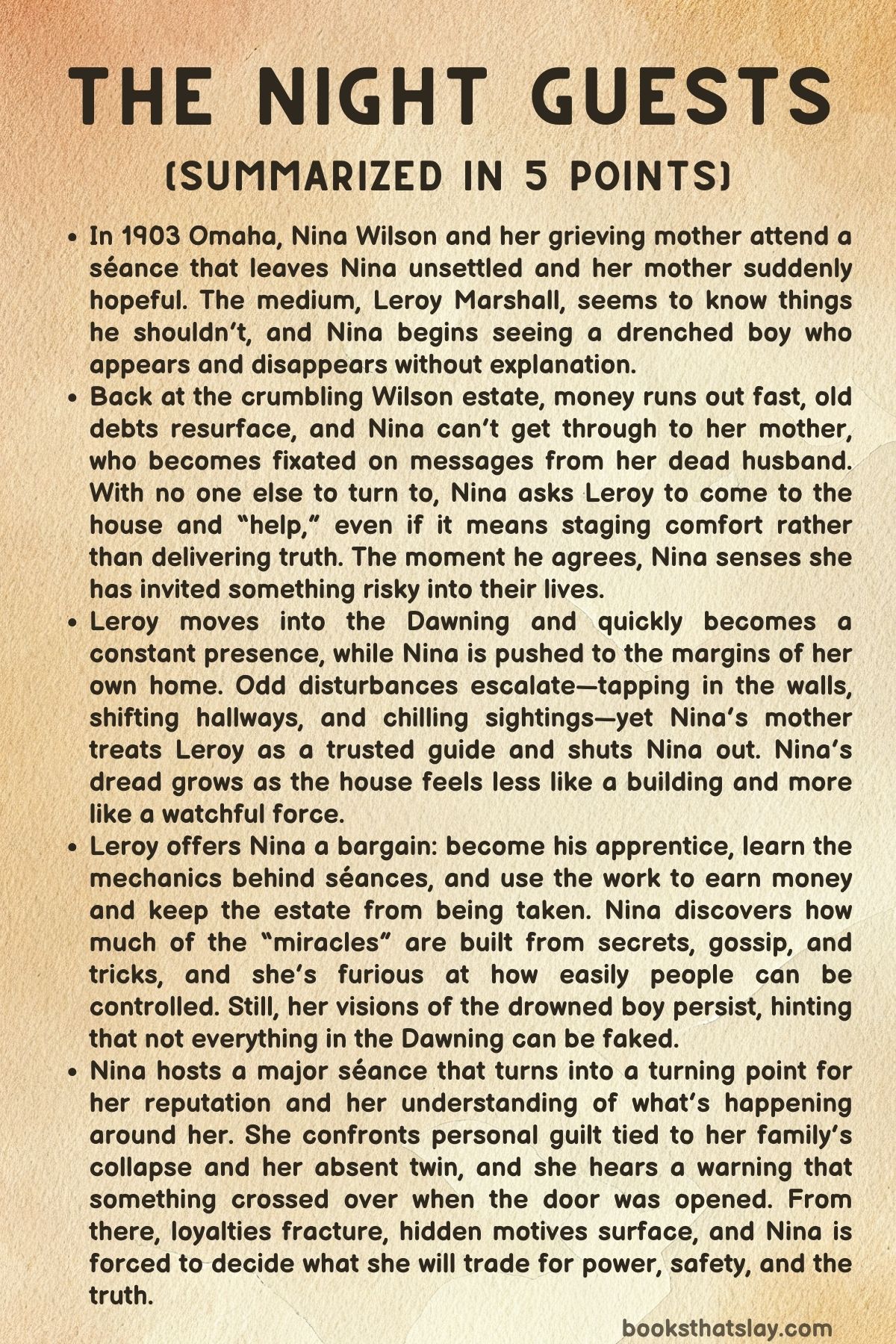
Nina Wilson attends a séance with her mother, Elise, hoping it might ease the numbness that has settled over their household since Robert “Bert” Wilson died. The Wilson name used to carry weight in Omaha, but Bert’s gambling and debts wrecked their standing, leaving Nina and Elise surrounded by quiet mockery from people who once called them friends.
The séance is led by Leroy Marshall, a young, commanding medium whose confidence unsettles Nina even before the candles are lit. He invites guests to bring sealed letters for the dead, and as he “receives” messages, the room reacts—knocks, drafts, extinguished light.
Nina sees something worse: the brief image of a soaked boy who disappears and leaves a puddle on the floor. When Leroy claims Bert is present and reading Elise’s nightly letters, Elise faints, and the gathering collapses into panic.
The next day Elise behaves like a different woman—playing piano again, smiling, speaking as if Bert is close enough to touch. Her renewed energy should be a relief, but it quickly turns into fixation.
Elise writes letters to her dead husband every night and walks to the cemetery to burn them, insisting the ritual matters. With the family’s money gone and bills piling up, Nina tries to pawn heirloom silver to pay the doctor and keep the remaining servant, Tilda, employed.
Instead, a pawnbroker’s note informs Nina that her father’s old debt still hangs over them, and the amount is staggering. Nina returns home humiliated, frightened, and more trapped than ever, writing to her twin brother Amos—confined far away and already a wound she can’t heal.
When Nina confronts Elise about their finances, Elise responds with calm certainty that Bert will provide from beyond the grave. Nina’s anger brings no change, only accusations that she lacks faith.
Tilda suggests the one person who might reach Elise is Leroy Marshall. Nina doesn’t trust him, but she fears her mother’s mind is sliding somewhere she can’t follow.
She goes to the home where Leroy is staying and begs him to come to their estate, the Dawning, even offering jewelry as payment. Leroy refuses her trinkets yet agrees to come immediately, speaking as if a different price will be collected later.
On the ride to the Dawning, Nina hears the same child’s voice again, whispering, “Return what’s mine,” and the warning settles in her bones.
The Dawning is isolated and decaying, an old symbol of Wilson pride now sagging into neglect. Leroy studies it like a man memorizing a map.
When he meets Elise, Nina is shut out, left in the hallway while Elise allows Leroy into her bedroom alone. The next morning Elise claims Leroy left late and that Bert’s presence remained with her for hours.
Nina tries to challenge the story, but her protest is interrupted by terror: the drowned boy’s face appears outside the dining-room window and slams against the glass as if trying to break through. Then he is gone, leaving no crack, no mark—only Nina’s shaking certainty that what she saw was real.
Instead of sending Leroy away, Elise invites him to stay. She insists Nina is the one who needs help, not her, and frames Leroy’s presence as a kind of treatment.
Nina resists, arguing they cannot afford a guest, but she yields when Elise finally shows a flicker of warmth and asks her to accept this “for us.” Leroy takes Amos’s old room, and Nina feels as if the house has been invaded twice—by a stranger and by her family’s unresolved past. Nights become secretive as Elise and Leroy retreat to Bert’s study, locking Nina out while laughter returns to rooms that should not be laughing.
The Dawning begins to behave strangely. Nina senses hallways changing length, doors shifting, and tapping in ceilings like a child bouncing a ball.
Tilda grows afraid and speaks as if the dead are moving inside the walls. Elise spends money they do not have to host elaborate meals, sacrificing jewelry to keep appearances.
Nina learns about nearby land once owned by the Rasks, a family touched by drowning, and she feels a pull toward their abandoned farm. She also catches a glimpse of an intruder in the study—yet he vanishes in a way that makes Nina doubt he was entirely human.
When Nina threatens to involve the police, Leroy talks her down with practical arguments and an unsettling calm, leaving Nina unsure whether he protects her or protects himself.
After a confrontation, Leroy offers Nina a bargain: she becomes his apprentice, and together they host séances for money. He insists Nina has genuine sensitivity, pointing to her visions and the house’s shifting.
Nina dislikes him, distrusts him, and still agrees—because she sees no other way to pay taxes, keep the Dawning, and stop Elise from disappearing into her obsession. Leroy trains Nina in stagecraft: hidden knocks, managed drafts, careful timing, and the use of a secret record of Omaha families’ scandals known among mediums.
Nina is repulsed by the cruelty of it, then tempted by the power it grants. She begins to understand how easily grief can be guided, how readily respectable people will pay to hear what they want.
As Nina’s work with Leroy expands, the boundary between trick and truth keeps breaking. She visits the Rask farm and senses a heavy sorrow.
She discovers her father’s papers and learns he profited from deals that crushed vulnerable settlers, including the Rasks. The drowned boy’s message—“Return what’s mine”—stops sounding like nonsense and starts sounding like a demand for justice.
When Elise’s condition worsens into dangerous behavior, Nina finally arranges medical care and watches her mother taken away, devastated and relieved in the same breath.
Nina hosts a major séance at the Dawning, using the record of secrets to stun their guests with “messages” that feel impossibly specific. The performance succeeds until the moment it stops being a performance.
Amos appears—not alive, not a trick, but the spirit of Nina’s twin, marked by the truth of his death. He tells Nina her letters and a personal object helped him cross, and he warns her that opening the door has allowed something else through, something that wants to be sent back.
Nina collapses under the weight of guilt and fear, and Leroy, focused on success and profit, tries to pull her closer with comfort that turns into seduction.
Afterward, spirits appear at the worst moments, exposing hidden crimes and detonating Nina’s control. Violence erupts when their associate, James, returns with demands and threats, and Tilda kills him in the chaos.
Nina’s trust in Leroy fractures further when she realizes his intimacy with Tilda and learns they intended to frighten the Wilson women away and seize the property. The Dawning responds to Nina’s fury as if it shares her anger: the house turns predatory, and Tilda is crushed and consumed by the very walls that once sheltered her.
Alone and unraveling, Nina lives with the echoes of what the Dawning has done. She eventually discovers the simple truth behind the drowned boy’s demand: he wants a small toy returned, a piece of his life that was stolen along with his family’s land.
Nina brings the toy back to the ruined farm, offers it to the boy’s spirit, and the air finally feels lighter. When James reappears alive and attacks Nina, the Dawning protects its remaining mistress in a final, monstrous act, swallowing him into a portrait.
Nina chooses what comes next. She keeps the record of secrets as leverage against Omaha’s powerful men, turns the Dawning into shelter for girls rescued from brothels, and resumes séances—this time calling up Leroy’s ghost night after night, binding herself to a life where the living and the dead answer to her.
Characters
Nina Wilson
Nina Wilson stands as the heart of The Night Guests, a woman whose evolution from grief to power mirrors the novel’s interplay between illusion and truth. Initially, Nina is defined by duty and despair—trapped in the decaying grandeur of the Dawning and burdened by her mother’s instability and her family’s ruined name.
Her skepticism toward spiritualism sets her apart in an era fascinated by séances, yet it also becomes the very path through which she finds agency. Nina’s desperation to save her mother draws her into Leroy Marshall’s orbit, where her rationality is slowly eroded by forces—both supernatural and psychological—that surround her.
Throughout the narrative, Nina wrestles with guilt over her father’s sins, her brother’s death, and her own complicity in sustaining illusions. As she learns the art of deception from Leroy, her transformation from victim to manipulator blurs moral boundaries.
By the end, Nina claims mastery over death itself, hosting séances not for profit but for purpose, turning the Dawning into a sanctuary. Her final acceptance of power—wielded through both human cunning and spiritual command—cements her as a tragic heroine who redefines control in a haunted world.
Leroy Marshall
Leroy Marshall embodies the seductive intersection of charisma, deceit, and genuine otherworldly knowledge. A self-made spiritualist, he thrives on performance and psychological manipulation, using charm as his greatest weapon.
His origins in crime and hardship lend him a predatory intelligence—he reads people’s pain and converts it into spectacle. For Nina, Leroy is both corrupter and catalyst: he draws out her latent strength even as he exploits her vulnerability.
His relationship with Elise Wilson reveals his skill in exploiting grief, yet there are hints of sincerity beneath his cynicism. He recognizes something authentic in Nina’s visions, a power beyond his staged illusions, and this recognition unsettles him.
Despite his professed disbelief, he is drawn to forces he cannot explain. Leroy’s downfall—his betrayal of Nina, his complicity in Tilda’s schemes, and ultimately his violent death—serves as poetic justice.
Yet his ghostly return in the novel’s final letter suggests that his hold over Nina endures, a lingering reminder that manipulation and belief can become indistinguishable.
Elise Wilson
Elise Wilson, Nina’s mother, is a portrait of grief transfigured into obsession. Once a graceful matron of Omaha society, Elise’s descent into delusion following her husband’s death exposes the fragility of Victorian womanhood under emotional collapse.
Her unwavering faith in her husband’s continued presence reflects both deep love and dangerous dependency. Through Elise, The Night Guests explores the spiritualist movement’s grip on the bereaved, showing how women, silenced by social decorum, turned to séances for agency and comfort.
Her interactions with Leroy reveal her hunger for connection, but they also expose her as a vessel through which deception takes hold. Elise’s fragility contrasts with Nina’s eventual strength; where Elise is consumed by longing, Nina learns to wield it.
Her institutionalization marks not just the end of her influence, but also a symbolic passing of control from one generation of women to another.
Tilda
Tilda serves as both servant and silent witness to the Wilson family’s decay. Initially portrayed as loyal and pragmatic, her belief in the supernatural gives her a layered complexity.
Tilda bridges the divide between skepticism and faith, reflecting the servant class’s unique position in turn-of-the-century households—intimately aware of their masters’ secrets yet powerless to change them. Her devotion to Elise and later to Leroy reveals her need for belonging and her vulnerability to manipulation.
When her relationship with Leroy is exposed, her loyalty fractures into jealousy and cruelty, culminating in her violent death at the hands of the Dawning itself. Symbolically, Tilda represents corrupted faith—a believer whose trust becomes her undoing.
Her end reinforces the novel’s recurring theme: that belief, once twisted by deceit, can consume the believer entirely.
Amos Wilson
Though Amos appears briefly in life and longer in death, his presence anchors the emotional and supernatural dimensions of the story. As Nina’s twin, he mirrors her internal struggle—his suicide a haunting reflection of the family’s moral and emotional decay.
Amos’s ghost is both guide and warning, urging Nina toward redemption even as his appearance opens the door for darker entities. His story of illness, shame, and self-destruction captures the period’s taboos around mental health and moral “disease.” Through Amos, the novel equates haunting with memory and guilt; his forgiveness allows Nina to confront not only her past but also the lingering corruption that binds her family to the Rask tragedy.
Amos’s spectral presence becomes a form of conscience—a reminder that truth and peace can coexist only when the dead are acknowledged and released.
Oliver “Ollie” Rask
Oliver Rask’s ghost is the novel’s most tragic and symbolic figure. The drowned boy haunting the Dawning embodies the legacy of greed and exploitation that taints the Wilson name.
His repeated plea, “Return what’s mine,” encapsulates both a literal and moral demand for restitution. Oliver’s spirit transcends the role of a mere apparition; he becomes a catalyst for Nina’s awakening, transforming her from a passive mourner into an active redeemer.
His story exposes her father’s moral corruption and connects the family’s downfall to the sins of class and capitalism. When Nina finally returns the toy soldier—his lost possession—Oliver’s release represents the restoration of balance between worlds.
He is the novel’s purest ghost, a child wronged by human greed but ultimately guiding the living toward justice.
James
James functions as a shadowy counterpart to Leroy, representing ambition stripped of charisma. Initially posing as an accomplice in Leroy’s deceptions, he is driven by greed and opportunism.
His intrusion into the Dawning, his violence toward Nina, and his obsession with the Blue Book reveal a man governed by power and possession. James’s reappearance after his presumed death turns him into a grotesque echo of the living—a man consumed by his own malice.
His ultimate demise at the hands of the Dawning underscores the house’s role as moral arbiter, punishing those who exploit grief for gain. James’s greed contrasts sharply with Nina’s transformation, making him a cautionary figure whose humanity dissolves long before his physical end.
Themes
Grief and the Desperation for Connection
In The Night Guests, grief functions as both the emotional foundation and the moral undoing of the Wilson family. Marina Scott portrays how loss corrodes the boundary between the living and the dead, and how the yearning to bridge that divide drives her characters toward ruin and revelation alike.
Elise Wilson’s mourning over her husband’s death manifests as a dependence on séances and letters to the beyond, transforming her from a grieving widow into someone unmoored from reality. Her belief that her husband’s spirit reads her letters becomes an emotional narcotic, offering solace while tightening the grip of delusion.
Nina, in contrast, channels her grief through responsibility and denial. Her attempts to sustain the household and protect her mother are driven by guilt over her father’s death and her twin brother Amos’s institutionalization.
Scott uses their contrasting responses to expose the destructive potential of unprocessed grief. What begins as mourning evolves into obsession, blurring perception and enabling manipulation by figures like Leroy Marshall.
The novel suggests that grief, when left unacknowledged, becomes a haunting of its own kind—psychological, not spectral. The Dawning, their decaying estate, mirrors this internal collapse, its physical degradation aligning with the corrosion of memory and faith.
The theme reveals that grief is not a passive wound but an active force, capable of remaking identities, distorting truths, and summoning ghosts that may be more psychological than supernatural.
Exploitation and the Illusion of Faith
Scott exposes a society where spiritualism becomes an industry, and belief is commodified under the guise of comfort. Leroy Marshall embodies this moral corruption—his séances and charm offer solace to the bereaved but mask a calculated manipulation of pain for profit.
Yet he is not merely a villain; he personifies the moral ambiguity of faith itself. Through him, the novel asks whether comfort obtained through deception is less valid than faith grounded in truth.
The séance scenes highlight the tension between genuine yearning for transcendence and the performative spectacle that feeds on that yearning. Nina’s reluctant apprenticeship under Leroy extends this exploration, as she learns the techniques of illusion—the secret knocks, the floating lights, the emotional scripts—and gradually recognizes that spiritual authority can be built entirely from deceit.
However, her eventual transformation from victim to participant complicates the theme: by mastering the art of illusion, Nina gains autonomy, using the same tools of deception once used against her. The narrative therefore blurs moral lines, portraying exploitation not just as an act committed by the powerful but as a cycle that entraps all who participate in it.
Faith in The Night Guests becomes indistinguishable from fraud, and belief itself becomes a dangerous currency traded between grief and survival.
Female Autonomy and Social Constraint
Set against the backdrop of 1903 Omaha, the novel situates its female characters within the rigid expectations of propriety and dependence. Nina’s journey represents a rebellion against these constraints, though it emerges through morally fraught means.
Her initial role as caretaker to her mother and guardian of the family’s decaying name places her in the conventional posture of duty and silence. But as the story progresses, her growing defiance—first against social scorn, then against Leroy’s dominance—marks a transition from subservience to self-determination.
Her embrace of the séance trade, though rooted in deceit, becomes a paradoxical act of liberation. In mastering the art of illusion, she claims control over her narrative, wealth, and reputation in a society that offers women little agency.
Elise’s trajectory serves as the cautionary counterpoint: her dependence on a dead husband and on male intermediaries like Leroy underscores how patriarchal structures persist even after death. By the novel’s conclusion, Nina reclaims the Dawning and turns it into a refuge for women, signaling a reclamation of both space and power.
Scott presents autonomy as born not from purity but from survival, shaped in the crucible of deceit, madness, and grief. The female body and mind become battlegrounds for control—by men, by ghosts, and by the expectations of respectability—and Nina’s victory lies in asserting ownership over all three.
Guilt, Redemption, and Inherited Sin
The Wilson family’s downfall is not merely personal but moral, rooted in past wrongdoing that reverberates across generations. The discovery that Nina’s father defrauded the Rask family links the supernatural hauntings to tangible injustices, grounding the ghost story in the ethics of exploitation.
Oliver Rask’s ghost, demanding “Return what’s mine,” functions as the embodiment of historical guilt—a call for reparation from the wronged dead. Nina’s haunting is thus not only psychological but ancestral; she must confront her family’s sins to restore balance.
Her eventual act of returning the toy soldier and the Rask deed symbolizes an acknowledgment of culpability and an attempt at redemption. Scott frames guilt as a corrosive force that erodes the boundary between morality and madness, suggesting that denial perpetuates haunting while confession restores peace.
Even Leroy and Tilda’s deaths can be read as moral reckonings, their greed consumed by the very darkness they manipulated. By contrast, Nina’s survival depends on acceptance of guilt and her willingness to transform it into moral action.
Redemption in The Night Guests emerges not from divine forgiveness but from human acknowledgment—the courage to confront the ghosts created by one’s own hands.
The House as a Living Conscience
The Dawning stands at the center of The Night Guests not merely as a setting but as a sentient presence reflecting the spiritual and emotional decay of its inhabitants. Its shifting walls, whispering halls, and morphing portraits externalize the characters’ inner torment.
As Elise’s delusions deepen and Nina’s guilt intensifies, the house responds—crosses turn upside down, hallways stretch, and the wallpaper itself becomes predatory. Scott constructs the Dawning as a physical embodiment of memory and repression, a structure that absorbs and manifests the family’s sins.
When it ultimately devours Tilda and defends Nina, the house transcends metaphor, becoming both avenger and confessor. It acts according to a moral logic absent in the human world, punishing deceit and rewarding atonement.
Yet it also represents inheritance: the burdens passed down through generations that one must confront or be consumed by. By the novel’s end, when Nina restores the estate and fills it with rescued women, the Dawning is reborn as a sanctuary rather than a tomb.
The transformation of the house mirrors Nina’s own reclamation of self—an evolution from haunted victim to sovereign keeper of her own ghosts. Through this dynamic, Scott turns architecture into psychology, making the house the truest witness to human corruption, endurance, and renewal.