The Cross by Steve Cavanagh Summary, Characters and Themes
The Cross by Steve Cavanagh is a fast-paced legal thriller that plunges readers into the dangerous life of Eddie Flynn, a former con artist turned defense attorney. Set in New York, the story explores the murky intersection of justice, corruption, and survival.
Flynn is drawn into a deadly web involving the NYPD, organized crime, and a shadowy assassination unit known as the Morgue Squad. When a courtroom case against a corrupt detective leads to murder, cover-ups, and revenge, Flynn’s skills as both a lawyer and a hustler are pushed to their limits. Cavanagh’s sharp prose and relentless pacing make this an electrifying tale of law, loyalty, and deception.
Summary
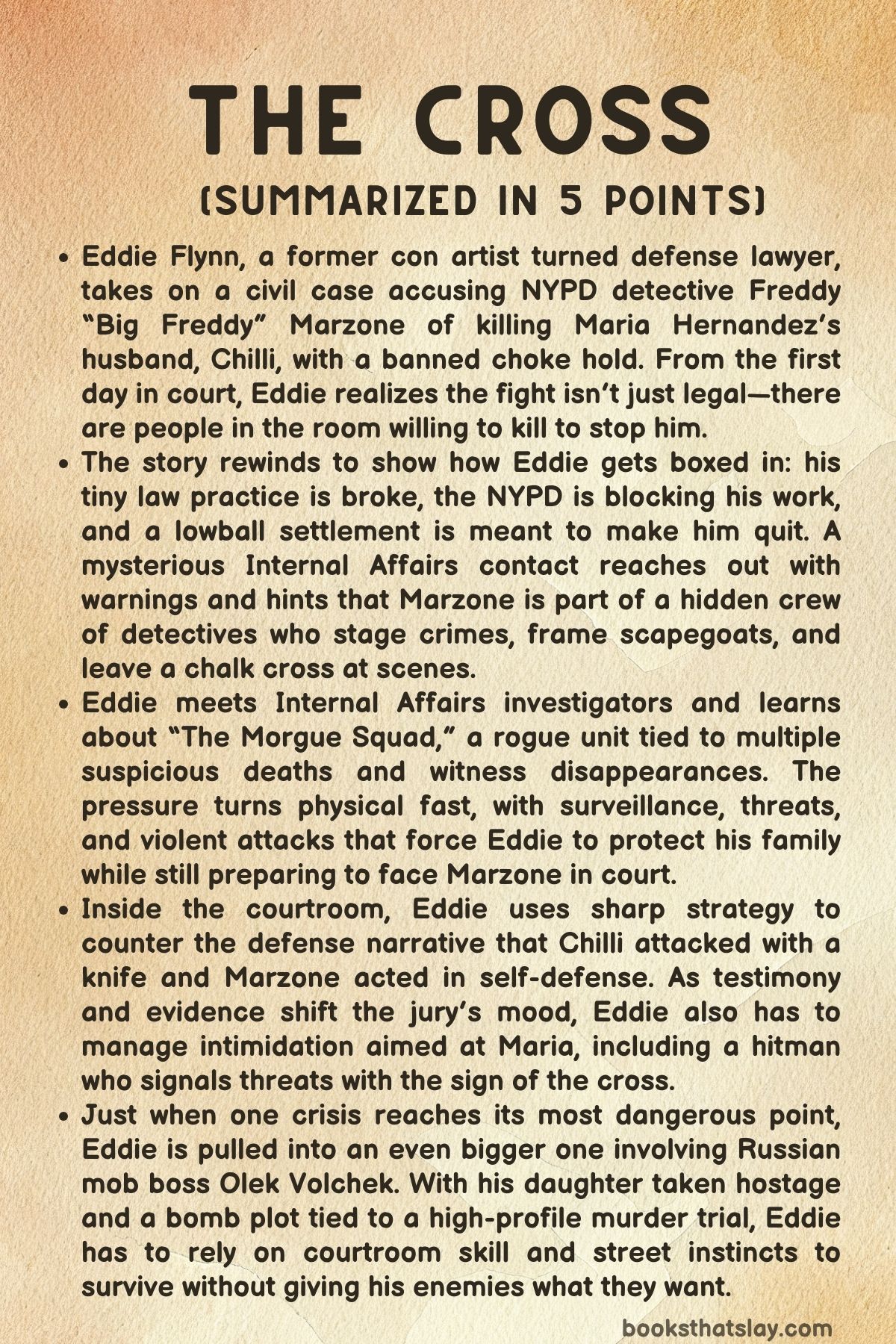
Eddie Flynn, a once-notorious con artist turned defense attorney, faces his most dangerous challenge yet when he takes on a civil case against NYPD detective Freddy “Big Freddy” Marzone. The case centers on the killing of Chilli Hernandez, a reformed ex-gang member who was allegedly murdered by Marzone during an arrest.
Chilli’s widow, Maria, is grieving and pregnant, and Eddie sees the case as both a moral duty and the last hope to save his struggling law firm. But as the trial begins, Eddie realizes the courtroom is not the only battleground—someone in the gallery is watching him, making the sign of the cross, a silent threat that signals death.
Twenty-four hours earlier, Eddie’s partner Jack Halloran tries to convince him to abandon the lawsuit after the defense offers a pitiful $2,500 settlement. Jack, a compulsive gambler, wants quick money to pay debts, but Eddie refuses to back down, even though the firm is broke.
Their stand against the NYPD has made them pariahs, and clients are scarce. That night, Eddie is lured into a dangerous meeting with Internal Affairs, where he meets Detective Elizabeth McAllister and her superior, Albert Frost.
Frost warns him that the department is riddled with corruption and that Marzone leads a secret faction of homicide detectives called “The Morgue Squad.” The group kills for profit and covers up the crimes with staged evidence, marking every scene with a chalk cross.
Before Eddie can process the implications, Frost is assassinated by a sniper during their meeting on the East River Ferry. Chaos erupts as gunfire kills another agent, and Eddie barely escapes by diving into the freezing river.
Pursued by gunmen, he calls his wife Christine to flee with their daughter and contacts Jack for help. When Jack arrives, Marzone’s partner, Detective Roark, ambushes Eddie in the car, threatening to kill him unless he drops the case.
Eddie cleverly provokes Roark into choking him in front of a traffic camera, capturing crucial evidence of the attack.
Later, McAllister provides Eddie with Frost’s investigative files, confirming the existence of the Morgue Squad and their ties to multiple murders disguised as justified police shootings. Each death bears the cross symbol.
McAllister admits that Frost used Eddie as bait to expose the squad. Despite the risks, Eddie vows to continue, determined to bring Marzone to justice.
As the trial progresses, Eddie battles both legal opponents and invisible enemies. Maria testifies about her husband’s violent death, facing hostile cross-examinations that question her credibility and Chilli’s past.
Eddie’s expert witness exposes Marzone’s chokehold as an illegal maneuver, but the defense undermines his testimony by revealing personal scandals. Meanwhile, McAllister retrieves Frost’s hidden camera footage that captures the truth: Chilli was unarmed, compliant, and killed without cause.
Marzone planted the knife afterward. Unfortunately, the video cannot be used in court without authentication, and Frost’s death renders it inadmissible.
Eddie’s situation worsens when a hitman known as Zippo threatens Maria, tracing a cross on her dress as a chilling warning. Eddie realizes the only way to protect her is to manipulate the trial itself.
Using his old con artist instincts, he blackmails Vinnie Federof, Marzone’s flashy defense lawyer, after discovering that Vinnie’s bribe money was accidentally given to a juror’s fiancé—a scandal that could destroy the case. Eddie forces Vinnie to cooperate and return his clients.
He then pressures the city attorney, Alfred Boles, into a massive settlement by showing him the murder video privately, arguing that the city’s failure to stop Marzone makes them liable. The city agrees to a $10 million settlement, with half held in trust for Maria’s unborn child and a public statement to clear Chilli’s name.
Outside the courthouse, Marzone and his corrupt squad flee but are obliterated in a car explosion. Maria collapses, going into premature labor, and nearby police find another body marked with a cross—Zippo’s calling card.
The killer has begun erasing witnesses to tie up loose ends.
That night, Vinnie hides in terror, knowing he’s next. McAllister sets up a SWAT ambush at his house, but when Zippo arrives demanding Frost’s memory card, Vinnie draws his gun, and a violent shootout ensues.
Zippo is killed, but not before damaging the camera. McAllister retrieves it, planning to expose the truth, unaware that Eddie secretly destroys the memory card to protect Maria from reliving her husband’s murder.
Maria gives birth to a healthy son, Chilli Jr., while Eddie’s law firm finds new success overturning wrongful convictions tied to the Morgue Squad. Yet, beneath the victories, danger lingers.
Sometime later, Eddie’s fragile peace shatters. He is kidnapped by Russian mob boss Olek Volchek and his lieutenant Arturas.
Volchek reveals that Eddie’s partner Jack has been murdered and that his severed head now serves as a warning. The Russians have kidnapped Eddie’s ten-year-old daughter, Amy, and demand that he act as Volchek’s defense lawyer in an ongoing murder trial.
The plan is horrifying: Eddie must smuggle a bomb into the courthouse and detonate it under the witness stand to silence a key witness, Little Benny, who is set to testify against Volchek.
Bound by fear for Amy’s life, Eddie pretends to cooperate. Using his street smarts, he steals Arturas’s wallet during a scuffle, hoping it might help him later.
Dressed in a tailored suit rigged with explosives, Eddie infiltrates the courthouse under the guise of legal privilege, bypassing security through his personal connections. Inside, he quickly assesses the situation and begins to devise a counter-con.
As the trial unfolds, Eddie identifies weak points in the prosecution. The prosecutor, Miriam Sullivan, relies heavily on a handwriting expert, Dr. Goldstein, to link Volchek to a murder note.
Using charm and cunning, Eddie publicly discredits Goldstein by exposing his outdated and pseudoscientific beliefs. The courtroom turns against the expert, giving Eddie a temporary upper hand.
However, his small victory is undercut when he notices that a jury consultant, Arnold Novoselic, is a professional lip-reader who may have understood his whispered comments about the bomb. Eddie realizes the FBI and prosecution might already know the truth.
With only hours left before the bomb’s deadline and his daughter’s life in peril, Eddie faces an impossible race against time. The clock is ticking, and the next move he makes will determine not only the fate of his family but whether he can outsmart both the law and the underworld that seeks to control him.
Characters
Eddie Flynn
Eddie Flynn is the engine of The Cross, a man whose two lives—former con artist and present-day lawyer—merge into a single survival skillset. He treats the courtroom like a street hustle: reading tells, anticipating pressure points, and turning other people’s rules into traps.
What makes Eddie compelling isn’t just cleverness, but the line he constantly walks between principle and pragmatism. He wants justice for Maria and Chilli, yet he’s willing to bargain with predators, manipulate optics, and even destroy evidence when he believes mercy matters more than truth on paper.
The story keeps forcing Eddie into “no clean choices” situations, and his character is defined by how he keeps choosing a third option: not pure heroism, not surrender, but an improvised path that saves lives now and pays moral costs later.
Freddy “Big Freddy” Marzone
Freddy Marzone represents institutional violence with a human face—massive, calm, and terrifyingly ordinary in his certainty. He isn’t just a bad cop; he’s the kind of operator who relies on the system’s habits to protect him: procedural loopholes, departmental solidarity, and the public’s default trust in law enforcement.
Marzone’s menace is amplified by how little he needs to perform it—he doesn’t rant or posture, he simply exists as an immovable force who expects the world to bend. His leadership of the Morgue Squad also frames him as a strategist, not a brawler: a man who understands that the real power is not in killing, but in controlling the story after the killing.
Maria Hernandez
Maria Hernandez is the emotional core of the early courtroom narrative, carrying grief and pregnancy in the same breath. She is not written as naïve; she understands the danger and the imbalance of power, but she still shows up, still testifies, still insists her husband’s life meant more than his criminal record.
Maria’s vulnerability—especially with the hitman’s invasive “blessing” gesture—doesn’t reduce her to a symbol; it sharpens her humanity and raises the stakes beyond Eddie’s professional survival. By the end, Maria becomes the reason Eddie makes choices that aren’t about winning, but about protecting a future, even if that means burying the ugliest truths where they can’t reach her.
Chilli Hernandez
Chilli is present mostly through memory, reputation, and footage, which becomes its own kind of trial: who gets to define a dead man. He is portrayed as someone attempting a genuine reformation after prison, but his past is repeatedly weaponized to justify his death and to make the public comfortable with it.
The crucial tragedy is that Chilli’s compliance is real—hands up, trying to do the right thing—yet the system is already positioned to interpret any movement as threat. His death becomes evidence of how quickly a person can be turned into a “patsy” when powerful people need a scapegoat, and how justice can be strangled just as surely as a man can be.
Jack Halloran
Jack Halloran is Eddie’s mirror image: where Eddie uses hustle to protect others, Jack is always one step from using it to escape his own consequences. His gambler’s mentality—folding when things get scary, chasing a fast win elsewhere—creates constant friction with Eddie’s stubborn commitment to the Hernandez case.
Yet Jack is also loyal in the ways that matter, showing up in the stakeouts and the escapes, proving he isn’t just a liability. His later fate under Volchek turns him into a cautionary tale about what happens when fear, addiction, and coercion collide: Jack becomes proof that not everyone can endure the same pressure Eddie survives, and his death is designed to break Eddie by showing the cost of failing.
Vinnie Federof
Vinnie Federof is flamboyance as camouflage, a defense attorney who performs confidence to hide how compromised he is. He’s opportunistic and slippery, but not fearless; when the power balance shifts, he becomes pliable, even desperate.
Vinnie’s defining trait is self-preservation, and the story uses him to show how corruption spreads through “respectable” channels: the suits who don’t personally kill anyone but keep the machinery moving. His panic later, when the violence he helped enable comes for him, exposes the hollowness of his swagger and underscores a core theme of The Cross: proximity to monsters does not grant immunity from them.
Detective Elizabeth McAllister
Elizabeth McAllister is a disciplined, sharp-edged conscience inside the system, someone who believes rules matter precisely because she has seen how easily they’re ignored. Her closed-window habit is more than a quirk; it reveals a mind trained by trauma to anticipate the worst, and it also signals how violence leaves lasting routines behind.
McAllister’s role is complicated: she helps Eddie, but she also admits she used him as bait, showing that even “good” actors can justify ethically gray tactics when confronting entrenched corruption. She stands for persistence and procedure, but the narrative repeatedly tests whether procedure can survive in a world where evidence is killed along with witnesses.
Albert Frost
Albert Frost embodies the lonely cost of integrity inside a compromised institution. He brings truth, but also manipulation—inviting Eddie into a meeting that is effectively a trap meant to flush out the Morgue Squad.
His insistence that it’s “too late” reflects both realism and resignation: he knows how these units operate and how quickly they eliminate risk. Frost’s assassination is a turning point because it proves the threat is not theoretical; it is immediate, precise, and willing to kill in public spaces.
He becomes a martyr figure, but also a warning about how even Internal Affairs can be outgunned when corruption is organized like a cartel.
Detective Roark
Roark is the enforcer personality within the Morgue Squad’s structure: hands-on, aggressive, and comfortable applying violence up close. His chokehold threat against Eddie is intimate domination, meant to remind Eddie that the law is just paper when someone has a forearm and a badge.
Roark also illustrates how corruption is maintained through fear and spectacle—he doesn’t just warn Eddie, he demonstrates capacity. In the footage of Chilli’s arrest, Roark’s behavior shows how quickly escalation can be manufactured, turning compliance into “resistance” through provocation, making the eventual killing feel pre-scripted.
Alfred Boles
Alfred Boles is the institutional defense of denial, a city attorney whose job is to shrink tragedy into liability exposure. He argues policy over reality, leaning on the idea that the NYPD “trains against” chokeholds, as if training automatically prevents abuse.
Yet Boles is also pragmatic; when confronted with undeniable footage and a new liability angle, he pivots to settlement. That flexibility makes him a realistic character: he isn’t personally invested in Marzone’s innocence, only in minimizing damage to the city.
In The Cross, Boles represents how justice can become a negotiation, and how truth often matters only when it becomes expensive to ignore.
Deputy Commissioner Johnson
Johnson personifies polished authority and carefully worded evasion. His testimony about discipline—especially the admission that even proven chokehold cases rarely lead to firing—exposes the gap between official policy and lived practice.
He isn’t shown committing violence, but he is part of the pipeline that enables it by protecting reputations and minimizing consequences. Johnson’s function in the narrative is to make corruption look bureaucratic: not always a conspiracy in a dark room, but a repeated administrative choice to treat brutality as manageable fallout.
John Patrick
John Patrick is a truth-teller with baggage, and that baggage becomes the weapon used against him. His technical clarity about how Marzone’s described hold becomes an illegal choke gives Eddie a clean factual platform, but his past misconduct allows the defense to reframe him as biased and untrustworthy.
This character illustrates a recurring legal theme: credibility is often treated as binary, and a flawed messenger can be used to poison an accurate message. Patrick’s presence forces the reader to confront how courtrooms don’t simply evaluate what happened; they evaluate who is “allowed” to say it.
Christine Flynn
Christine is Eddie’s anchor to ordinary life, and the story uses her sparingly to emphasize what Eddie stands to lose beyond pride or money. Her role is protective and practical—taking their daughter to safety when warned—showing a family dynamic built on trust in Eddie’s instincts even when those instincts come from a criminal past.
Christine also represents the quiet burden carried by loved ones of high-risk people: she doesn’t choose Eddie’s enemies, but she lives with the consequences of them.
Amy Flynn
Amy becomes the ultimate leverage point against Eddie, shifting the story from professional danger into parental terror. Her kidnapping is designed to collapse Eddie’s moral options: he can’t gamble with his own life the way he sometimes does, because the cost is now a child’s suffering.
Amy’s presence in the narrative is less about her personality and more about her function as Eddie’s unbreakable boundary—proof that even a master improviser can be cornered when the threat targets someone innocent and unreachable.
Jiang
Jiang is a small but vivid reminder that Eddie’s world straddles formal law and street-level logistics. As a Chinatown process server, he sits in the ecosystem where legal paperwork meets informal networks, making him credible as someone who can arrange handoffs and verify deception.
His video proof is important not just as a plot device, but as a character statement: Jiang is competent, observant, and not easily played, which forces Eddie to adapt rather than dominate every situation.
Harry Lam
Harry Lam’s restaurant functions as a crossroads for the story’s under-the-table dealings, and Harry is implied as a facilitator of spaces where people can meet, exchange, and vanish into the city. He isn’t deeply developed in the summary, but his inclusion adds texture: the legal battle is not confined to courtrooms; it spills into neighborhoods where information is traded like currency.
Olek Volchek
Olek Volchek is control dressed as elegance, a mob boss whose violence is calculated, not impulsive. He doesn’t merely threaten Eddie; he engineers a closed system of choices where every exit is poisoned—bomb, hostage, deadline, and proof of what happens when someone fails.
Volchek’s cruelty is theatrical, using Jack’s severed head and the torture of Jack’s sister as narrative weapons, meant to colonize Eddie’s imagination with fear. In The Cross, Volchek represents a different kind of corruption than the Morgue Squad: not institutional rot, but criminal power that mimics corporate management—assigning tasks, measuring compliance, and punishing underperformance.
Arturas
Arturas is the operational face of Volchek’s coercion, a lieutenant who blends menace with procedure. Strapping a bomb to Eddie’s back and calmly explaining timelines makes him more frightening than a simple brute, because it suggests routine: he has done this before.
Arturas also becomes the kind of opponent Eddie understands best—someone with pockets, habits, and exploitable complacencies—hence the pickpocketed wallet, a small act that signals Eddie’s refusal to be purely victim. Arturas is not the mastermind, but he is the mechanism, and mechanisms are often harder to reason with than people.
Little Benny
Little Benny is the pressure valve of Volchek’s trial: a gunman turned cooperating witness whose testimony could collapse the mob boss’s freedom. He’s important less as a personality and more as a target, the human linchpin whose survival determines whether law can reach Volchek.
Benny’s existence highlights a cruel irony—witnesses are simultaneously protected by the state and hunted by power, and their bodies become battlegrounds for competing systems of control.
Mario Geraldo
Mario Geraldo is the dead man at the center of Volchek’s case, and like Chilli, he becomes a story fought over by others. His role underscores how murder trials often treat victims as evidence rather than people.
The difference is that Geraldo’s death is leveraged upward—used to trap a kingpin—while Chilli’s death is leveraged downward—used to protect killers. That contrast deepens the book’s fixation on whose lives are granted meaning in court.
Miriam Sullivan
Miriam Sullivan is a prosecutor under siege by both the defense and the hidden realities of the courtroom. She is presented as prepared and ambitious, intending to build a clean narrative around a star witness and expert testimony.
Eddie’s dismantling of her expert humiliates her publicly, but her quick consultation with a lip-reader suggests competence and adaptability—she may be outplayed in one moment, but she isn’t oblivious. Miriam represents the state’s imperfect attempt at order: determined, but vulnerable to showmanship, misinformation, and the unseen coercions that swirl around high-profile cases.
Dr. Irving Goldstein
Dr. Irving Goldstein is the fragility of expert authority. He enters as a technical weapon—handwriting analysis meant to sound objective—and collapses when his own intellectual history contradicts his present certainty.
His past work tying handwriting to sexual deviance becomes a credibility sinkhole, turning him from scientist to spectacle. Goldstein’s character function is to show how “expertise” can be both powerful and brittle, and how court truth can hinge on whether an expert seems respectable rather than whether their methods are reliable.
Barry
Barry, the courthouse security guard, is a small but critical character because he embodies the everyday trust that Eddie’s reputation buys him. Waving Eddie through because of familiarity and a known habit (the medal setting off alarms) shows how systems are often bypassed not through hacking, but through relationships and routine.
Barry isn’t corrupt in intent; he’s simply human, and that humanity becomes a vulnerability Volchek exploits.
Arnold Novoselic
Arnold Novoselic, the professional lip-reader, introduces a chilling twist: even whispers can be evidence, and even secrecy can be observed. His presence turns Eddie’s private calculations into potential exposure, tightening the noose around Eddie’s already shrinking time.
Arnold represents a modern courtroom’s expanded surveillance—truth doesn’t only come from the witness stand anymore; it can come from watching the watchers, from reading what was never meant to be spoken aloud.
Chilli Jr.
Chilli Jr. symbolizes what remains after the violence and bargaining: a living future that cannot consent to the story built around him. His birth transforms the settlement from a legal victory into a moral commitment, and it helps explain Eddie’s later choice to destroy the memory card.
In The Cross, Chilli Jr. is the clearest argument the narrative makes for mercy over evidence: the idea that some truths, while legally valuable, can be emotionally fatal to the people forced to carry them.
Themes
Justice under siege by institutional power
In The Cross by Steve Cavanagh, the legal system is presented as a battleground where truth is not simply argued but physically suppressed. Eddie Flynn’s courtroom work is never separate from survival, because the opposition is not only a defense attorney and a city representative but a police machine that can sabotage careers, manipulate evidence, and eliminate witnesses.
The civil case over Chilli Hernandez’s death shows how “justice” can be reshaped by procedure and reputation: the city leans on technical defenses, character assassination, and the assumption that official narratives deserve default trust. Maria’s grief and pregnancy highlight how those seeking accountability often enter the system already disadvantaged—emotionally, financially, and socially—while the state has endless resources and public credibility.
The chokehold issue underscores a deeper problem: rules can exist on paper while enforcement quietly fails in practice, and that gap becomes a hiding place for violence. Eddie’s strategy is not only legal brilliance; it is a recognition that formal justice is sometimes blocked by gatekeeping, intimidation, and selective accountability.
Even when powerful evidence exists, like the recorded killing, it cannot automatically be used, because legitimacy depends on chain-of-custody, authorization, and testimony—structures that can be weaponized when insiders are dead or compromised. The result is a grim portrait of justice as something that must be fought for in a hostile environment, where the system’s safeguards are vulnerable to those who understand how to bend them.
Corruption as an organized ecosystem
Corruption in The Cross by Steve Cavanagh is not portrayed as a few bad individuals but as a coordinated ecosystem with its own rules, symbols, and methods of self-preservation. The Morgue Squad operates like a closed network that blends official authority with criminal tactics: murders are committed for hire, scapegoats are framed, and evidence is staged to fit a prewritten story.
The chalk cross becomes a signature that signals ownership and control—less a clue left behind by accident and more a mark that says, “We were here, and we can do this again.” What makes the corruption especially dangerous is its ability to merge violence with legitimacy. Officers can stop someone under color of law, control the scene, create the “facts” later cited in reports, and rely on institutional reflexes that protect the badge.
Witnesses dying “mysteriously” shows how the ecosystem extends beyond the moment of the crime into aftermath management. Even Internal Affairs, supposedly a corrective mechanism, is forced into risky tactics that treat Eddie as bait, implying that official oversight is outmatched and desperate.
The story suggests that corruption survives because it is not just about personal greed but about collective protection: each member’s safety depends on silence, and the institution’s reputation depends on denying patterns. When those patterns threaten exposure, the ecosystem responds the way an organized criminal enterprise would—through intimidation, blackmail, and murder—except it has the added advantage of uniforms, credentials, and systemic hesitation to believe the worst about law enforcement.
Fear as a tool of control
Violence in The Cross by Steve Cavanagh is not random; it is communication. The hitman’s sign of the cross in the courtroom gallery is a message that reaches beyond Eddie into the entire room: the trial is being watched, and consequences will not wait outside the courthouse.
Threats are delivered with precision—Roark’s chokehold warning, Zippo drawing a cross on Maria’s dress, the stalking on the ferry—each designed to narrow choices until “cooperation” feels like the only rational option. Fear becomes a method of shaping decisions, forcing Eddie to consider not just winning but who might die if he does.
The most chilling aspect is that fear targets the vulnerable and the intimate. Maria’s pregnancy is exploited as a pressure point; Eddie’s family becomes a lever; even the courtroom, supposedly a safe civic space, turns into a stage for intimidation.
Later, the Russian mob escalates the same principle to an extreme: Eddie is compelled by the threat to his daughter and the display of Jack’s severed head, which turns fear into certainty. This shows how coercion works when the perpetrator can prove capability and intent.
The story also illustrates how fear spreads through networks: it is not only the person threatened who changes behavior, but everyone around them—partners, witnesses, even attorneys. Under constant danger, morality becomes complicated because choices are made under duress, and “right” actions carry immediate lethal risk.
Fear, then, is not just an emotion; it is a weapon that reorganizes priorities, compresses time, and forces compromises that would otherwise be unthinkable.
Moral compromise and the cost of protecting the innocent
Eddie Flynn’s choices in The Cross by Steve Cavanagh repeatedly hinge on the difference between what is legally correct, what is morally pure, and what is necessary to protect people who cannot withstand further harm. He negotiates with corrupt actors, uses leverage that borders on blackmail, and makes deals that would look ugly in isolation—but each move is framed as harm reduction in a world where clean options are scarce.
The civil settlement and the demands Eddie makes are not just about money; they are about dignity, public narrative, and a future for Maria’s child, including exoneration and reopening a linked investigation. Yet the most morally loaded moment comes when Eddie destroys the memory card to spare Maria from ever watching Chilli die.
That act can be read two ways at once: it protects a grieving widow from trauma, and it also removes evidence that could serve broader accountability. The story forces a question: when justice requires exposing brutality in full detail, who bears the emotional cost of that exposure?
Eddie’s decision suggests that protecting an individual’s humanity can conflict with the public need for proof. Similarly, bargaining with Zippo to manage timing and survival demonstrates how moral compromise can become a short-term shield against immediate violence.
The narrative doesn’t romanticize these choices; it highlights the residue they leave behind, especially as consequences keep coming. Eddie’s skills as a former con artist make him effective, but they also place him in a constant ethical negotiation with himself—using manipulation for “good” while knowing manipulation is still manipulation.
Moral compromise here is not a single fall from grace; it is a repeated calculation made in crisis, where saving the innocent can demand actions that never feel fully righteous.
Identity, reinvention, and the weaponization of past skills
The protagonist’s background in The Cross by Steve Cavanagh turns identity into a practical tool rather than a static label. Eddie Flynn is not simply “ex–con artist turned lawyer”; he is someone whose previous life never stops being relevant, because his courtroom tactics and survival instincts rely on the same abilities: reading people, controlling narratives, misdirecting attention, and exploiting assumptions.
His bluff through courthouse security, the pickpocketing, the psychological traps set during cross-examinations, and the ability to improvise under pressure all show reinvention as something active, not symbolic. The story argues that redemption is not about erasing the past but repurposing it.
Eddie’s skill set was shaped by an environment where rules were flexible and danger was immediate; the legal world pretends to be orderly, but the events around the Morgue Squad and Volchek reveal that the courthouse can become just another arena for power plays. Eddie’s identity therefore sits on a line: the traits that once enabled wrongdoing now enable resistance against greater wrongdoing.
At the same time, the narrative suggests reinvention has limits, because the past can be used against you. The Russians choose Eddie specifically because his familiarity with courthouse routines gives him privileged access; his reputation becomes a security vulnerability.
In other words, the very trust he has built as a lawyer becomes the opening through which coercion enters. The tension is that Eddie’s identity is both armor and target.
His ability to transform experience into advantage is what keeps him alive, but it also ensures he is constantly pulled back into situations where ethics and survival collide, making reinvention a continuing process rather than a completed journey.