A Christmas Carol Summary, Characters and Themes
A Christmas Carol by Charles Dickens is a short novel about change—how a person who has spent years shutting out others can still choose a different way to live. Ebenezer Scrooge is rich, sharp-tongued, and proud of caring about nothing but business.
On Christmas Eve, he is confronted by a warning from beyond the grave and then guided through scenes from his own life, his present surroundings, and a future that shows what his choices lead to. The story uses these visits to push Scrooge to face what he has avoided: loneliness, regret, and responsibility—and to discover what generosity can look like in everyday actions.
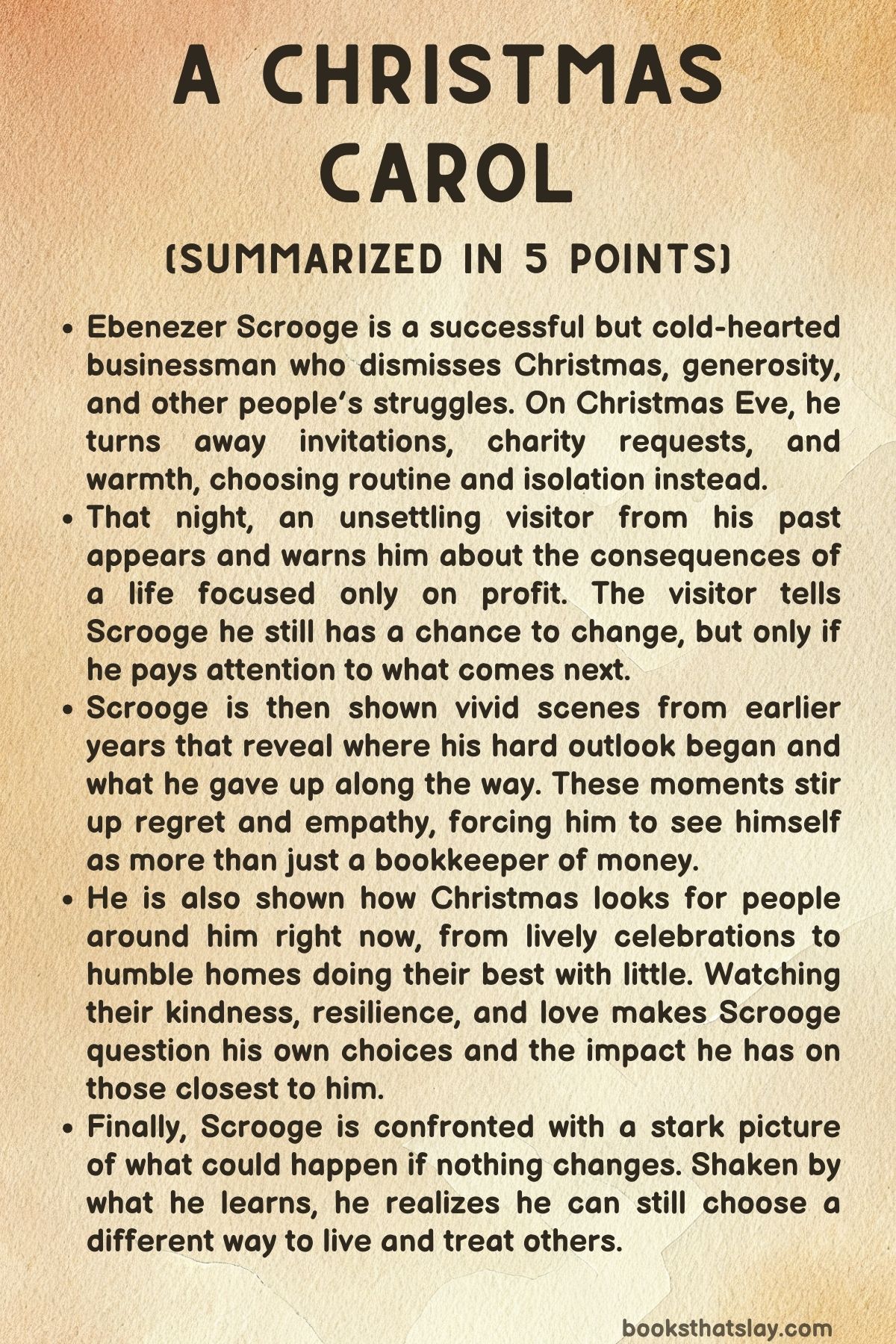
Summary
Ebenezer Scrooge runs a London counting-house under the sign “Scrooge and Marley,” even though Jacob Marley, his business partner, has been dead for seven years. Scrooge is the kind of man who treats warmth as waste.
He keeps his office cold, begrudges coal for the fire, and speaks to people as if kindness is a trick. His clerk, Bob Cratchit, works in a cramped little space with barely any heat, copying letters while Scrooge watches expenses like a hawk.
On Christmas Eve, Scrooge’s nephew, Fred, arrives full of good cheer. He wishes Scrooge a merry Christmas and invites him to dinner the next day.
Scrooge rejects the greeting and the invitation, declaring Christmas a foolish nuisance. Fred leaves without bitterness, offering friendly wishes anyway, and even extends goodwill toward Bob.
Not long after, two gentlemen visit the office to collect donations for the poor. They explain that many people have little to eat or warm themselves with.
Scrooge refuses. He argues that prisons and workhouses exist for those in need and speaks as if poverty is someone else’s problem.
The collectors leave, disappointed but polite.
As the workday ends, Scrooge grudgingly grants Bob Christmas Day off, complaining that it is like paying wages for nothing. He demands Bob arrive early the following morning.
Scrooge then eats alone, returns to his gloomy rooms in a largely empty building once connected to Marley, and locks himself in for the night.
At his door, Scrooge notices something unsettling: the knocker seems to show Marley’s face. He dismisses it as imagination, but the unease follows him inside.
After settling near a small fire with a thin meal, he hears strange sounds. A bell begins to swing on its own, and then every bell in the house seems to ring.
From below comes the noise of a heavy chain dragged across stone, moving closer.
Marley’s ghost appears, entering through a locked door. He looks as he did in life, but now he is transparent and bound in a long chain made of items tied to business and money—cash-boxes, keys, ledgers, and documents.
Scrooge tries to explain the sight away as indigestion or nerves, but Marley forces him to pay attention, rattling the chain and speaking with grim urgency.
Marley tells Scrooge that after death he is condemned to roam the world, unable to take part in it, because he failed to use his life for anything beyond profit. He explains that his chain was forged link by link through selfish choices, and warns Scrooge that Scrooge is forging his own chain in the same way—already heavy, already dragging.
Marley says he has come to offer Scrooge one chance to avoid the same fate. Three spirits will visit: the first at one o’clock the next night, the second the following night at the same hour, and the third on the next night after midnight has passed.
Marley then opens the window and shows Scrooge the street outside filled with wandering spirits, each burdened by chains and sorrow. They lament that they can see suffering and need, yet have lost the power to help.
Scrooge is shaken. He closes the window, stares at the still-locked door, and collapses into bed without even undressing.
Later, Scrooge wakes in darkness and hears the church bells mark the passing time. Confused by the hour, he worries he may have slept through a whole day, but the fog and cold outside suggest it is still night.
Remembering Marley’s warning, he forces himself to stay awake until one. As the clock strikes the hour, a bright light appears in the room, and his bed curtains are drawn aside by a strange hand.
A spirit stands before him, looking like both a child and an old man, dressed in white, with a strong light shining from its head. It introduces itself as the Ghost of Christmas Past and says it has come for Scrooge’s benefit.
The spirit takes Scrooge by the arm and leads him out through the wall, arriving in a snowy countryside scene that Scrooge recognizes immediately.
The spirit shows him his childhood: a lonely boy left at school during the holidays, reading by a weak fire while others go home to their families. Scrooge watches his younger self with tears and admits he wishes he had treated a carol-singing boy more kindly the previous night.
The scene shifts to another Christmas at the same school, when Scrooge’s sister Fan arrives, joyful to bring him home. She tells him their father has changed and that Scrooge will not have to return to the school.
Scrooge learns, with a sting of guilt and tenderness, that Fan later died and that her child is Fred—the nephew he keeps pushing away.
The spirit then shows Scrooge as a young apprentice, working for a generous employer named Fezziwig. On Christmas Eve, Fezziwig closes up shop and turns the workplace into a party.
There is music, food, dancing, laughter, and a sense that work can be made lighter by simple kindness. Scrooge is moved more than he expects.
When the spirit remarks that Fezziwig spent little to create this joy, Scrooge insists it mattered because a boss has the power to make life easier or harder for employees through small choices. He blurts out that he wishes he could say something to Bob Cratchit at that very moment.
The spirit’s final lessons are harder. Scrooge sees himself older, sitting with a young woman named Belle.
She ends their engagement because Scrooge has changed—his attention and affection have been replaced by his hunger for money and security. She releases him gently, even kindly, but it leaves a wound.
The spirit then shows Belle years later, now married with children. Her husband mentions seeing Scrooge alone in his office, with Marley near death.
Scrooge cannot bear the sight of his own isolation. Desperate, he begs the spirit to stop.
When the spirit refuses, Scrooge struggles with it and forces a cap over its head, trying to shut out its light. Even then, the light leaks out around the edges.
Exhausted, Scrooge falls into sleep.
He wakes again, aware that one o’clock is near. He sits up, alert, watching for the next visitor.
When the hour arrives, the room begins to glow with a warm, ruddy light. A voice calls him into the adjoining room.
Scrooge steps inside and finds it transformed into a rich Christmas scene—greenery, bright berries, and an overflowing feast piled high. A large, cheerful spirit sits among it all, holding a glowing torch, and introduces itself as the Ghost of Christmas Present.
Scrooge asks to be taught, and the spirit invites him to touch its robe. Instantly the room changes, and they are out in the city streets on Christmas morning.
People bustle along, shops are partly open, snow is scraped from doorways, and there is a general lift in the air. They watch families carry their meals to bakers to be cooked, and the spirit sprinkles drops from its torch over the food and gatherings.
When tempers threaten to flare, the drops seem to restore good humor. The spirit explains that this is part of what it carries: the ability to encourage kindness, especially where people share what little they have.
The spirit then takes Scrooge to the Cratchit home. The house is small and the meal is modest, but the family prepares it with care and excitement.
Bob arrives with Tiny Tim, his frail young son who walks with a crutch and an iron frame. The family gathers around their dinner, grateful and animated.
After the meal, they celebrate with pudding and a warm drink. In the middle of their happiness, Tiny Tim offers a blessing for everyone.
Scrooge asks the spirit directly whether Tiny Tim will live. The spirit shows him an image of an empty place by the fire and an unused crutch—unless the future changes.
The spirit repeats Scrooge’s own earlier words about “surplus population,” turning Scrooge’s cruelty back toward him. Scrooge is stricken, feeling shame rather than superiority.
The spirit then shows Scrooge more scenes of Christmas: miners on a bleak moor singing together, men at a lonely lighthouse sharing a fire and exchanging good wishes, sailors aboard a ship humming tunes and remembering home. Finally, they visit Fred’s house, warm with company and laughter.
Fred and his friends joke about Scrooge’s bitterness, but Fred remains sincere in his concern. He says he pities Scrooge and will keep inviting him, because Scrooge’s wealth cannot buy him the comfort of belonging.
The group plays games and makes music. Though Scrooge is unseen, he is pleased and wants to stay.
As midnight approaches, the spirit visibly ages. Before it departs, it reveals two miserable children clinging to its robe, named Ignorance and Want.
The spirit warns Scrooge that both are dangerous and that Ignorance is especially to be feared. The clock strikes twelve, and the Ghost of Christmas Present disappears.
A third spirit arrives: a silent, hooded figure, the Ghost of Christmas Yet to Come. It does not speak, only points.
Scrooge follows, terrified by its quiet authority. They appear among businessmen who discuss a recent death with cold indifference.
They joke about attending the funeral only if there is something to gain, and speak as if the dead man’s passing is nothing more than an item of gossip.
The spirit leads Scrooge to a rough part of town and into a junk shop run by Old Joe. People arrive to sell stolen goods taken from the dead man’s room: linens, small valuables, silver, even bed-curtains.
They laugh as they bargain, mocking the dead man’s loneliness and the fact that no one cared enough to keep watch. Scrooge is horrified.
The spirit shows a dark room where the dead body lies on a bed, neglected and covered. Scrooge cannot bring himself to look at the face.
Desperate, he begs to see someone who feels sorrow about this death. The spirit shows a struggling couple who learn the creditor is dead and feel relief, believing their debt may no longer be pressed.
Scrooge realizes the dead man’s harshness brought no mourning—only release.
He begs again, asking to see tenderness linked to death. The spirit takes him back to the Cratchit home, now quiet with grief.
Tiny Tim is gone. Bob returns from the churchyard and breaks down, then tries to steady himself for the sake of his family.
The Cratchits comfort one another and speak about visiting Tim’s grave. Their sorrow is real, and their love makes the loss heavier.
Scrooge finally demands to know the name of the dead man. The spirit leads him to a churchyard and points to a neglected grave.
Scrooge reads the name on the stone: EBENEZER SCROOGE. The truth lands all at once—these scenes have been showing the end of his own life, with no friends, no mourners, and no kindness left behind.
Scrooge clutches the spirit’s robe and begs for a chance to change, promising he will honor Christmas in his heart and live differently.
At that moment, the spirit shrinks and changes, and Scrooge finds himself gripping a bedpost. He wakes in his own room, overflowing with relief and joy, because it is still Christmas Day and he has time to act.
He throws open the window, calls to a boy outside, and sends him to buy the largest turkey he can find, arranging for it to be delivered to the Cratchits anonymously.
Scrooge dresses in his best clothes and goes out into the streets, greeting people warmly and laughing with a freedom that surprises even him. He seeks out one of the charity collectors from the day before, apologizes, and privately promises a large donation.
He goes to church, takes pleasure in the ordinary bustle of the holiday, and then heads to Fred’s house. Nervous at the door, he finally knocks and is welcomed inside with astonishment and delight.
He joins the celebration as a participant, not a critic.
The next morning, Scrooge arrives at his counting-house early and waits for Bob Cratchit. When Bob comes in late, Scrooge pretends to scold him, then reveals the truth: Bob’s salary will be raised, and Scrooge will help Bob’s family.
He follows through, becoming a source of support rather than pressure. Tiny Tim does not die.
Scrooge, once proud of his cold distance from others, becomes known for warmth and generosity, keeping the spirit of Christmas as a daily practice rather than a once-a-year event.
Characters
Ebenezer Scrooge
Ebenezer Scrooge begins as a man who has trained himself to treat warmth—emotional, social, and even literal warmth—as a kind of weakness. His miserliness is not just about money; it is a worldview that measures life in transactions and refuses to recognize mutual responsibility.
He takes pride in isolation because distance protects him from feeling, and feeling would require change. What makes him compelling is that his cruelty is shown as something practiced and reinforced over time rather than an inborn trait: he has repeatedly chosen profit over people until it becomes habit, identity, and armor.
The visits from the spirits work because they do not simply shame him; they confront him with the human cost of his choices and with the loneliness of the future his choices create. By the end, Scrooge’s transformation is not portrayed as a sudden personality swap but as the return of capacities he once had—tenderness, regret, generosity, and the desire to belong—now redirected into consistent action, as he tries to repair what he can while there is still time.
Jacob Marley
Jacob Marley functions as the moral warning made personal, and his power lies in the fact that he is not an abstract messenger but Scrooge’s mirror. In life he shared the same narrow devotion to business, and in death he embodies the consequences of a life lived without human connection.
His chain—built from the tools and symbols of commerce—turns greed into something visible and heavy, suggesting that what seemed “practical” in life becomes a kind of spiritual imprisonment afterward. Marley is also significant because he shows a hint of remorse and concern that Scrooge has not yet learned; he returns not to punish Scrooge but to prevent him from repeating the same fate.
That mixture of terror and compassion makes Marley more than a scare tactic: he represents the possibility that awareness can arrive too late, and therefore the urgency of change while life still offers choices.
Fred
Fred, Scrooge’s nephew, is the story’s steady counterpoint to bitterness, because his goodness is not naïve or fragile—it is resilient. He recognizes Scrooge’s coldness clearly, yet he refuses to let cynicism be the final word between them.
His repeated invitation is not only a seasonal gesture; it is an ongoing offer of belonging, a door that remains open even when it is repeatedly shut in his face. Fred’s laughter and holiday games matter because they model joy as a communal act rather than a private indulgence, and they reveal how Scrooge’s rejection harms himself most of all by cutting him off from ordinary human warmth.
Fred’s role becomes especially meaningful at the end, when Scrooge’s nervous knock at Fred’s door shows that transformation requires humility, and Fred’s immediate welcome proves that reconciliation can be swift when love has been patiently maintained.
Bob Cratchit
Bob Cratchit represents the dignity of the working poor, and Dickens shapes him as someone who refuses to let hardship erase tenderness. He is overworked and underpaid, yet he does not become cruel in response; instead, he preserves gentleness in his home and tries to create a celebratory world for his family with what little he has.
Bob’s politeness toward Scrooge is not presented as cowardice so much as the precarious reality of dependence, which makes his Christmas toast to Scrooge complex: it is part forced gratitude, part hope, and part habit of making peace for the sake of the family’s happiness. When the future shows Bob in grief, the emotional force comes from how deeply he loves and how carefully he has tried to be a good father despite limited power.
By choosing to raise Bob’s salary and support his family, Scrooge is not simply “being nice”—he is correcting a daily injustice that he previously treated as normal.
Tiny Tim
Tiny Tim is the story’s most concentrated symbol of vulnerable innocence, but he is not written as merely pitiable. His voice and presence give the Cratchit household a spiritual brightness, and his repeated blessing carries a quiet authority that contrasts with Scrooge’s earlier contempt for the poor.
Tim’s frailty makes the stakes of Scrooge’s choices immediate: indifference is no longer theoretical when it is attached to a child whose future depends on whether people with resources decide to care. At the same time, Tim’s role is also about how communities interpret suffering—his family does not romanticize poverty, but they fight to keep love and gratitude alive within it.
The vision of Tim’s death functions as the sharpest moral lever, not because tragedy is used for shock alone, but because it reveals how preventable grief can be when compassion becomes action rather than sentiment.
Mrs. Cratchit
Mrs. Cratchit brings a fierce realism that keeps the story from becoming a soft-focus celebration of hardship. She works hard, stretches little resources into a feast, and protects her family’s pride; her energy is practical and emotional at once.
Her bitterness toward Scrooge is one of the most honest reactions in the book, because she names what polite society often tries to smooth over: that cruelty dressed as “business” leaves real people hungry, exhausted, and scared. Yet she also participates in the family’s rituals of warmth—serving, laughing, sharing—showing that anger at injustice and love at home can coexist.
Through her, acknowledges that forgiveness and generosity are not owed to oppressors, and that Bob’s courtesy to Scrooge costs the family something even on Christmas.
Peter Cratchit
Peter Cratchit illustrates the thin line between childhood and adult responsibility. He is young enough to join in the excitement of the day, yet old enough to feel the pressure of earning and advancement, which appears in the family’s talk of his possible new job.
His pride—shown in his participation in the meal and the family’s hopes for him—signals how strongly the Cratchits invest in the future despite poverty. Peter’s presence matters because it frames the Cratchit children not as ornaments to evoke sympathy, but as individuals being shaped by circumstance, ambition, and love.
In that sense, the story uses Peter to show how economic cruelty ripples forward: it does not only threaten the sick; it narrows options for the growing.
Martha Cratchit
Martha Cratchit embodies the quiet sacrifices that keep a poor household afloat in A Christmas Carol. Her late arrival from work indicates that even on Christmas she cannot fully escape labor, and yet she enters the celebration with warmth, adding to the family’s sense of togetherness.
Martha’s character shows how responsibility can be taken on early, especially by older children, and how family joy often depends on invisible effort. She also reinforces the Cratchits’ emotional strength: despite fatigue, she participates in the rituals of the day, suggesting that happiness is not the absence of hardship but a deliberate practice of care and presence.
Belinda Cratchit
Belinda Cratchit is portrayed as capable and helpful, and her importance in A Christmas Carol lies in what she contributes to the atmosphere of home. She participates actively in preparing the meal and seems to carry both competence and excitement, reflecting how the children share responsibility rather than merely receiving care.
Belinda’s role helps make the Cratchit household feel like a functioning community: everyone has a part, and the shared work becomes part of the celebration. Through her, A Christmas Carol emphasizes that dignity is created in small acts—preparing sauce, setting things right, showing up for one another—even when money is scarce.
Fezziwig
Fezziwig represents the moral alternative to Scrooge’s model of business: he proves that authority can be humane. His Christmas party is not framed as extraordinary wealth on display; it is framed as leadership expressed through generosity and attention to workers as people.
The crucial point is that his kindness is inexpensive but transformative, because it turns labor into something less dehumanizing. This is why Scrooge responds so strongly—Fezziwig reveals that Scrooge’s harshness was never necessary, only chosen.
Fezziwig’s character gives the story one of its clearest arguments: employers shape the emotional weather of their workplaces, and small mercies can change lives as surely as large gifts.
Belle
Belle is the clearest portrait of what Scrooge sacrifices before the ghosts begin their work. She is not simply a lost romance; she is a moral witness who recognizes that Scrooge’s love has been displaced by obsession with wealth.
Her decision to end the engagement is painful but firm, suggesting that affection cannot survive when it is consistently deprioritized. Belle’s later happiness—marriage and children—does not exist to punish Scrooge so much as to show him an alternate life he could have built, one grounded in connection rather than accumulation.
Belle’s scenes are devastating because they reveal that Scrooge’s loneliness is not accidental; it is the predictable outcome of repeatedly choosing money as the safest form of attachment.
Fan
Fan, Scrooge’s sister, appears briefly, but her impact is structural: she anchors Scrooge’s capacity for love in his past. Her joyful rescue of young Scrooge from school shows that he was once someone worth loving and capable of being loved, which undermines the idea that he has “always been” cold.
Fan’s death as an adult adds a layer of loss that helps explain Scrooge’s emotional retreat without excusing it; grief can harden people, but it can also invite tenderness, and Scrooge has chosen hardening. Fan is also the link to Fred, turning Fred’s warmth into a continuation of family love that Scrooge has been rejecting.
Through Fan, the story suggests that Scrooge’s redemption is, in part, a return to family feeling that existed before greed eclipsed it.
Want
Want, the other child revealed with Ignorance, embodies deprivation as a living, haunting presence. Like Ignorance, Want is a societal creation, suggesting that poverty is not fate but produced by human choices and systems.
Want’s appearance at the climax of the Present’s visit reframes all the festive scenes: joy exists, but it sits beside hunger, cold, and insecurity, and celebration does not erase injustice. The Spirit’s warning forces Scrooge—and the reader—to confront the idea that neglecting Want is not only morally wrong but socially explosive, because suffering will not remain hidden.
Want is the clearest reminder that charity is not a decorative virtue; it is a necessary response to real human need.
Old Joe
Old Joe, the junk dealer, represents the ugliest form of opportunism, not because he is uniquely evil but because he is the logical endpoint of a world where people are valued only for what can be taken from them. His shop becomes the place where death is reduced to inventory, and the casual laughter over stolen items shows how quickly dignity disappears when a person has lived without earning human regard.
Old Joe’s scene is horrifying precisely because it is transactional, mirroring the way Scrooge himself treated human beings as costs and inconveniences. Old Joe, ultimately is a grim reflection: when society worships profit without compassion, even death becomes a marketplace.
Themes
Redemption and Moral Transformation
Ebenezer Scrooge’s journey in A Christmas Carol centers on the possibility of personal change, even for someone who has spent years rejecting compassion. At the beginning, Scrooge is defined by isolation, bitterness, and an unshakable belief that wealth matters more than human connection.
His refusal to contribute to charity, his cold treatment of Bob Cratchit, and his contempt for Christmas all show a man who has built his identity around control and emotional distance. The arrival of Marley’s ghost introduces the idea that a life focused only on profit carries consequences beyond death.
Marley’s chains, formed from symbols of business and greed, represent the moral weight of choices made without kindness.
The spirits who visit Scrooge do not simply frighten him into behaving better; they confront him with the emotional truth of his own life. The Ghost of Christmas Past forces him to see how loneliness shaped him and how his pursuit of money cost him love and belonging.
The Ghost of Christmas Present reveals the warmth and strength of families like the Cratchits, showing Scrooge what generosity can create even in poverty. The final spirit’s vision of his unmourned death makes clear that a life without care for others leads to emptiness.
Redemption in A Christmas Carol is not portrayed as abstract forgiveness but as active responsibility. Scrooge’s change becomes real only when it results in action—supporting the Cratchits, reconnecting with his nephew, and opening himself to community.
Dickens presents transformation as something earned through empathy, humility, and the decision to live differently while there is still time.
Social Responsibility and the Treatment of the Poor
The world of A Christmas Carol reflects a society sharply divided between wealth and hardship. Dickens uses Scrooge’s attitudes to expose how easily the comfortable can dismiss the suffering of others.
Scrooge’s insistence that prisons and workhouses are enough for the poor shows a mindset that treats poverty as a personal failure rather than a social reality. His cruel remark about “surplus population” reveals the danger of reducing human lives to numbers and economic burden.
Through the Ghost of Christmas Present, Dickens offers a direct contrast between Scrooge’s selfishness and the dignity of those who struggle. The Cratchit family’s Christmas is modest, yet filled with affection, cooperation, and gratitude.
Their joy does not erase their hardship, but it demonstrates that poverty does not diminish humanity. Tiny Tim becomes the emotional center of this theme, representing vulnerable lives that depend on the choices of those with power.
When Scrooge learns that Tim may die, the issue becomes personal, forcing him to confront what his indifference truly costs.
Dickens also broadens the theme beyond one household. The spirit’s travels show miners, sailors, and lonely workers finding comfort in shared celebration, suggesting that human solidarity matters everywhere.
The warning embodied by Ignorance and Want makes the social critique unmistakable: neglecting education, compassion, and basic needs creates a future of suffering and unrest.
Memory, Regret, and the Emotional Power of the Past
Scrooge’s confrontation with memory is one of the most emotionally intense elements of A Christmas Carol. The Ghost of Christmas Past does not show random scenes; it forces Scrooge to face the roots of who he became.
His childhood loneliness at school reveals that his harshness did not appear without cause. He was once a neglected boy, desperate for warmth and companionship.
This does not excuse his cruelty, but it explains how pain can harden into bitterness when left unresolved.
The visions also remind Scrooge of lost innocence and missed opportunities. Seeing Fan, his sister, brings forward the tenderness he once knew, while also connecting him to his nephew, the living reminder of family he has rejected.
The joyful celebration hosted by Fezziwig shows Scrooge an alternative model of adulthood—one where leadership includes kindness and where small acts can shape the lives of others. Scrooge realizes that power can be used to uplift rather than exploit.
The most painful memory is Belle’s departure. Her decision to leave reflects how greed replaced love in Scrooge’s life.
The regret here is not only romantic; it represents the moment Scrooge chose wealth over human connection. Watching Belle’s later happiness intensifies his awareness of what he sacrificed for money.
Community, Connection, and the Spirit of Christmas
The celebration of Christmas is not mainly about tradition or religion, but about community and shared humanity. Scrooge’s greatest flaw is not simply greed, but separation.
He lives alone, eats alone, and treats relationships as inconveniences. Christmas functions as a symbol of what he rejects: warmth, generosity, forgiveness, and belonging.
The Ghost of Christmas Present highlights how connection sustains people even in difficult circumstances. The Cratchits’ home is physically small and financially strained, yet emotionally rich.
Their love for one another gives them strength. Fred’s household also represents this theme, as his friends laugh, play, and even speak kindly of Scrooge despite his hostility.
Fred’s continued invitations show patience and hope, suggesting that community is built not only on shared joy but also on the willingness to keep extending care.
Dickens also shows connection across social boundaries. The spirit’s visits to miners, lighthouse keepers, and sailors emphasize that the desire for companionship and comfort is universal.
Christmas becomes the one time when people are more open to generosity and goodwill, reminding society of values that should exist all year.