A Steep and Savage Path Summary, Characters and Themes
A Steep and Savage Path by JJA Harwood is a dark folktale set in the Carpathians, where village superstition collides with desperate love. Irina arrives chasing a rumor: a vampire is hunting locals, and she believes the creature might be the kind of guide who can cross into Death’s country and return.
To get what she needs, she agrees to a graveyard “wedding” meant to appease a restless spirit—only to be locked into the vampire’s abandoned hut like a sacrifice. What follows is a perilous bargain, a journey through the underworld’s strange rules, and a choice that costs more than blood.
Summary
Irina stands in a graveyard at dawn wearing borrowed bridal linen embroidered in red, a crown braided from pine and snowdrops pressing into her scalp. The groom is dead, the grave beside her is empty because no one has found the body, and the villagers watch the treeline as if the forest might step forward and claim them.
Father Simeon completes the rite quickly, lifts her crown a moment over the open grave, and sends her away to a repaired hut at the woods’ edge. The villagers promise food, blankets, firewood, and garlic, but only send patrols in daylight.
Irina asks for warm clothes and her pack. They tell her everything is inside.
The hut is a single room: curtained bed, table, oven, chairs, and garlic hanging like warning bells. When Irina opens her pack, her sturdy travel clothes are gone.
The message is clear—she is not meant to leave. She swallows her anger and prepares anyway.
She gathers water and provisions, sharpens kindling into stakes, and takes out a hidden necklace of wooden beads that once belonged to her younger sister, Catalina.
Catalina’s story has driven Irina here. In summer, Catalina fell from a tree.
Her body survived, but when she woke, her eyes were empty and she did not speak or respond. A witch told Irina the girl’s soul never came back: Catalina’s body lives, but her spirit is trapped in the land of the dead.
The witch also warned that reaching it requires a guide that can move between the living world and Death’s realm—something that walks while it should be buried.
So Irina followed rumors of a vampire into this village, lied to her parents, took work in Mihai’s household, and listened to the nightly prowling. Every sunset the attacks begin: the creature hunts from its old house, drags victims into the dark, and leaves bloodless bodies by the church.
Father Simeon proposes an old remedy: marry a restless dead man so the village’s curse settles. Irina volunteers, not out of charity, but because a “husband” like that might lead her where no living person can go.
Night falls. Irina sits ready with a stake, crown still on her head, window open.
The sounds come—soft, familiar, too sure. Then the door creaks.
The vampire enters without invitation because the hut is his. He speaks in a harsh, human rasp, and he moves with the calm certainty of a predator who has never had to ask for anything.
Irina calls him her husband, tries to control the encounter, and then—fearing she will lose her nerve—strikes. He vanishes and reappears above her, clinging to the ceiling like a spider.
They fight in a scramble of wood, breath, and terror until Irina manages to pin him with a chair and force him to listen.
She offers a bargain: he will take her to the land of the dead, help her find a soul, and bring her back. In return, she will feed him small amounts of her blood on the journey.
And once she returns, she will invite him into villagers’ homes so he can feed without being hunted. The vampire agrees, on his terms.
He makes her surrender the stake and seal the deal with blood. They exchange names—Stefan and Irina—and he bites her.
Stefan refuses to let her travel in bridal linen and mocks the villagers for giving her nothing else. He leads her into the forest at a speed that makes her stumble to keep up, and brings her to a hidden mountain cave.
Inside, two immense pale stone columns form something Stefan can sense but Irina cannot. He tells her she must be “touched by death” to see it, and bites her again while she faces the darkness.
Her blood wakes the stone. Ribbons of red-gold light rise and form an archway into a shimmering void.
Together they step through.
The land beyond is dim, cold, and wrong in the way a dream is wrong. Stefan panics when the gate begins fading for him while it remains clear to Irina.
He realizes the rule: her brush with death let her enter, and his need for life will be the key to leaving. Irina discovers another price—her pack has been left behind by the crossing.
She still has a candle stub and coins, like the offerings buried with the dead, but her knife is gone.
A blue glow draws them onward to a vast river where the dead gather in a long queue for a ferryman’s boat. Catalina’s bead necklace shifts like a compass toward the water, tugging Irina with quiet insistence.
Irina learns another dangerous truth when a dead man touches her hand: his body suddenly shows the reality of his death, frost spreading as terror floods his face. Stefan yanks him away, and then has Irina confirm it with a dead child, who breaks into sobs as sickness blooms across his skin.
Irina’s living touch forces the dead to remember pain, loss, and their final moments. Horrified, she tries to keep her hands to herself, but in this place even small mistakes can become disasters.
At the river dock, dead soldiers flirt with Irina, and one grows bold enough to reach for her. Stefan intervenes with a snarling possessiveness that startles everyone, and Irina quickly claims him as her husband to stop the crowd from turning.
The ferryman arrives—tall, hooded, with claw-like hands—and Irina pays without contact. When a group is turned away for lacking fare, Irina insists on helping.
Stefan protests, but she pushes him into giving coins to a crying child, who spreads the gift among the others.
Across the river, the crowd follows a wine-colored road toward a brilliant display where lights show each soul’s life in a shifting mural, then a sheet of light appears to claim them. Different colors mean different fates.
A murderer’s wine-dark red route ends in screams. Irina and Stefan slip aside to observe, and when a small child reaches the front and a blue-grey light flares, Irina grabs Stefan and runs straight into it to avoid the red.
The passage burns Irina’s chest with searing pain, while Stefan feels nothing. She collapses on an endless plain of grey-green grass.
Stefan hauls her away from the barrier, shaken.
Irina lets Stefan drink from her wrist to keep him strong. Where her blood falls, red peonies bloom from nothing.
Following Catalina’s necklace, they trek until it points downward. They tear up the turf and find a hole into darkness, the grass around it writhing toward Irina’s bleeding hands.
They widen the opening and drop into a bright, toy-like village full of dead children and placid, oversized-eyed “animals.” The children swarm Irina with questions about her wedding and demand games. Terrified of touching them, she invents rules to keep them sitting and calm.
They tell her Catalina was taken by “guardians” because she made them sad and put strange thoughts into their heads. The guardians blurred memories to keep the children compliant.
A “door” made from a ring of haystacks leads out. Irina promises the children she will stay and be their mother, then starts a hiding game so she and Stefan can escape.
Pushing through the haystack boundary twists Irina with agonizing pressure, while Stefan passes easily. Beyond lies a darker forest where mushrooms glow along the path and another pale-gold barrier waits across a field of perfect flowers.
Stefan touches it and is burned, unable to cross. The pale-gold route is for the pure, and Stefan does not qualify.
Irina gives him her blood so he can heal; he drinks from her neck, and she slips into exhausted sleep. She wakes pinned by vines that have grown around her wrists and throat, staining the flower-carpet red.
Stefan tears her free, and they flee.
They eventually reach a walled city built from gravestones. Inside, the dead live with unnerving normality: markets, stalls, luxuries, and no living animals or growing plants.
Irina buys gloves with Stefan’s help when a vendor accepts strange payment, and she finally has a barrier against accidental touch. When they ask for a map, merchants laugh—here, travel depends on thinking of where you want to go.
In the crowd Stefan spots someone he knows: Danil, a boy from Stefan’s past. Danil needles Stefan and grabs Irina’s wrist.
In the struggle, his bare hand touches Irina’s cheek. His body begins to rot and fail as he relives death in a rush of horror.
He screams, and the market turns toward them. Irina and Stefan flee, hiding under carts and using the chaos to escape the city.
On the road, Stefan admits he and Danil once mattered to each other, and jealousy may still linger. They reach a rope bridge over the Grey River, the river of sorrow.
Irina crosses, but when Stefan follows, grief crushes him so hard the bridge sags toward the water. Irina cannot step back onto the rope without scorching it, yet she manages to smother the burn with cloth, and peonies spring up over the damage as if her blood and will can mend things.
She helps Stefan reach safety, and he breaks down, confessing the truth: his father abused him, then abandoned him in the mountains without boots or coat before a storm. Stefan froze to death, returned as an undead creature, and killed his father and others who had ignored the cruelty.
Irina comforts him, refusing to treat his victimhood as proof he deserves ruin.
Following the necklace again, they force their way through another painful boundary and arrive at a settlement with an inn. They pay for a room with a story—how they “met”—and Irina rests while noticing a frightening change: hunger and thirst are fading from her body, as if the underworld is rewriting her.
In the morning, enormous tracks outside suggest they are being hunted. The landlady offers them passage toward a larger city with a university, and shows Irina a strange feather left by the guardians, shifting shape as if it cannot decide what it is.
As Irina and Stefan travel, their closeness stops being only strategy. When Stefan’s hunger nearly overwhelms him in an alley, Irina kisses him and chooses the bond they have been circling.
Even so, fear follows them. At the River Lethe, Irina considers forgetting pain, but Stefan panics—one touch could erase Catalina, their mission, everything.
Before they can decide how to cross, winged guardians strike. Talons seize Irina and Stefan and carry them to a black fortress.
They are thrown into a hall where torches die one by one, and Death arrives with calm authority that leaves no room to argue. Irina admits her purpose: she came to retrieve Catalina’s soul.
Death confirms Catalina is not dead—her body lives—so Irina’s interference has caused disorder among souls. Death offers mercy, but demands a test.
Catalina’s soul is among thousands of birds in an enclosure. Irina must find her.
Irina uses the bead necklace as a lure. A small yellow bird flutters close, drawn to the familiar touch of home.
The bird becomes Catalina, confused but alive. Irina holds her sister, relief cracking her open.
Death agrees Catalina can return and says the Blue River crossing will restore her fully to life.
Then the price is spoken: only two may leave the underworld. Irina must choose between Catalina and Stefan.
The one left behind will truly die. Death gives Irina a vial of Lethe water so the abandoned person could forget her and be spared that pain, but forbids Irina from drinking it herself.
Guardians escort them toward the Blue River. Irina is torn apart by the choice, but Stefan does not let her pretend there is another option.
He tells her to choose Catalina. Under a willow tree, Irina admits the bargain, and Stefan accepts it with quiet courage.
They share a final kiss and make an oath in the river’s blue waters to seek happiness if they can, even if it is apart. Irina offers Stefan the Lethe vial so he can forget her.
Stefan crushes it in his fist, refusing oblivion.
Irina and Catalina board the ferryman’s boat. Stefan remains on the bank as the distance grows, and Irina’s sobbing feels like it might split her body in two.
She guides Catalina back through the caverns to the gate of Life. Catalina sleeps on Irina’s back, unaware of what Irina has sacrificed.
When Irina crosses into the living world, hunger and sensation crash over her. She makes her way home.
Catalina wakes in her bed with their parents, remembering almost nothing—only a vague dream of flight.
Irina cannot return to being the girl she was. She secures what she is owed, leaves the village that tried to cage her, and carries the underworld inside her like a second shadow.
Months later, on a bright spring morning, Stefan appears at Irina’s door—alive, breathing, human. He explains the strange rule that saved him: he never ate the food of the dead, living instead on Irina’s blood, and that bound him to the living world.
His life will be divided—he can remain through summer, but must return to Death in autumn. Irina does not bargain for better terms.
She takes what is offered: Stefan, now, in this season. She lets him in, ready to face her family and whatever future they can build within the limits of the bargain that shaped them both.
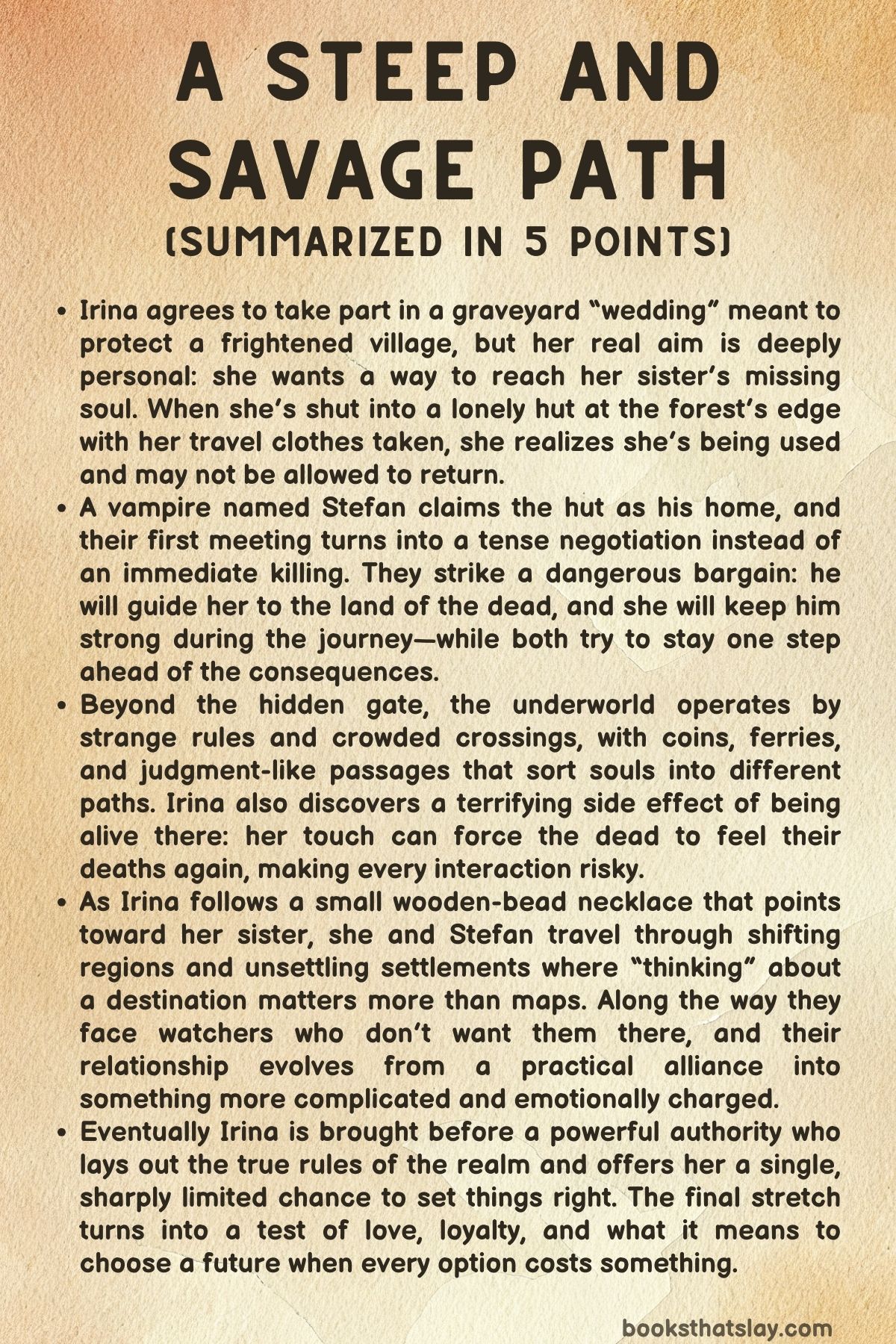
Characters
Irina
In A Steep and Savage Path, Irina is driven by a fierce, practical love that overrides fear, propriety, and even morality when she believes Catalina’s life depends on it. She begins as someone who can play the village’s expectations to her advantage—accepting the role of “bride” and “offering” with a controlled, almost ritual composure—yet her inner purpose is radically personal rather than heroic: she is willing to be misunderstood, used, and endangered if it gets her closer to retrieving her sister’s soul.
What makes Irina compelling is the way her courage stays tactile and bodily; she counts supplies, sharpens stakes, bargains with a predator, endures the underworld’s pain, and keeps moving even when nausea, blood loss, and exhaustion should stop her. At the same time, she carries a moral pressure point that never resolves neatly: her living touch harms the dead by forcing them to re-experience their deaths, and she must learn to navigate a realm where compassion can be dangerous.
Irina’s arc is shaped by the gradual transformation of her boundaries—first she treats Stefan as a means, then as a partner, and finally as someone she loves enough to lose—while also confronting how the underworld changes her, threatening to unmake her humanity from the inside by dulling hunger, thirst, and ordinary life instincts. By the end, Irina’s strength is no longer only the will to descend and retrieve; it is the will to live afterward, carrying grief, anger, and a love that has to accept seasons and limits.
Stefan
Stefan initially appears as the story’s nightmare given a voice: a vampire-figure who enters without invitation, claims space as ownership, and tests Irina like prey. Yet A Steep and Savage Path makes him far more than a monster by grounding his violence in a history of abandonment and brutality that distorted him before death ever did.
Stefan’s defining contradiction is that he is both predator and protector, and the narrative repeatedly forces him to choose which self will win; his hunger is real, his capacity for cruelty is real, but so is his restraint, his tactical intelligence, and his emerging tenderness. His knowledge of thresholds, rules, and underworld mechanics gives him authority, but his fear of losing that authority—especially when the gate’s logic flips and he needs Irina’s living touch to return—exposes vulnerability beneath the posturing.
Stefan’s jealousy act becomes more than camouflage because it reveals a deeper craving: to be claimed, to belong, to be chosen in a way he never was in life. When he collapses at the Grey River under grief, his confession reframes him: the killings he committed after returning undead are not excused, but they become legible as an eruption of long-denied suffering and rage at a community that watched abuse and did nothing.
His love for Irina is expressed most powerfully not through romance but through consent and sacrifice—accepting that Catalina must be the choice, refusing Lethe because memory is the last piece of selfhood he can own, and enduring the pain of being left behind without trying to make Irina carry additional guilt. The ending’s seasonal bargain—human in summer, bound to Death in autumn—fits Stefan’s character precisely: his story is about living with consequences, and about love that must persist even when it cannot be simple, permanent, or free.
Catalina
Catalina functions as both beloved person and central mystery, and A Steep and Savage Path is careful to show that she is not merely a plot object: she is the emotional core that gives Irina’s choices their weight. In life, Catalina’s accident leaves her body present but her self absent, creating a particular kind of horror for a family—grief without closure, love without reciprocity—and this liminal state mirrors the novel’s obsession with thresholds and in-between conditions.
In Death’s realm, Catalina’s soul is portrayed as small, vulnerable, and wrongfully displaced rather than corrupt or doomed, which underscores the injustice that motivates Irina: Catalina did not “earn” her fate through sin or choice, she was taken because the system of the underworld is indifferent and procedural. When Irina finally draws her out of the bird enclosure, Catalina’s confusion and childlike immediacy highlight how little she understands of what has been done to her, intensifying the cruelty of the bargain that forces Irina to choose.
Catalina’s limited memory after returning—only a vague dream of flying—reinforces the story’s bittersweet realism: rescue does not erase trauma, and restoration is never total. Catalina’s presence in the ending is quietly powerful because it represents what Irina fought for—life continuing—while also serving as the unspoken cost that shapes Irina’s future with Stefan.
Father Simeon
Father Simeon embodies institutional spirituality under siege, and in the novel, the is both protector and accomplice. His role in orchestrating the graveyard “wedding” ritual positions him as someone who believes in old rites as tools of survival, but the story keeps his ethics murky: he offers reassurance, patrols, garlic, and supplies, yet the villagers’ actions reveal a willingness to entrap Irina, and he presides over that machinery without stopping it.
Father Simeon’s authority is rooted in communal fear—he is the voice that can turn panic into procedure—yet procedure becomes a way to justify sacrifice. He is not portrayed as a cartoon villain; rather, he reflects how communities outsource guilt to ritual, letting “tradition” make cruelty feel necessary.
His presence also shows the gap between spiritual language and lived consequences: blessings and rites do not feed Irina, do not clothe her, do not protect her once she is locked into the role of bait. As a character, Father Simeon represents the uneasy intersection of faith, folklore, and social control, where belief can comfort but also rationalize abandoning an individual for the imagined safety of the many.
Doctor Emil Nicolescu
Doctor Emil Nicolescu brings an intellectual lens into a realm that punishes certainty, and the book uses him to explore the limits of knowledge when confronted with the sacred and the strange. He is eager, self-possessed, and interpretive—mapping what he sees onto classical frameworks like the Aeneid, Styx, Elysium, and Tartarus—because scholarship is how he makes the unknown navigable.
Yet his explanations do not grant control; they offer language, not safety, and the underworld’s shifting “gates” reveal that systems here are experiential rather than purely structural. Emil’s demeanor also contrasts with Irina’s urgency: where she wants Catalina, he wants comprehension, and that difference clarifies Irina’s character by opposition.
At the same time, he is not purely self-serving—he holds their place in line, he speaks with the confidence of someone used to leading discussions—and his presence suggests the underworld collects every kind of person, including those who refuse to stop analyzing even after death. Emil ultimately functions as a reminder that meaning-making is a survival instinct too, but one that can distract from immediate moral stakes when a living girl is burning her way through doors beside you.
Doru and Andrei
Doru and Andrei represent a specific kind of post-death stagnation: the dead who still cling to swagger, flirting, and social games as if they can recreate life’s hierarchies on the riverbank. Their soldierly camaraderie and teasing approach to Irina initially reads as nuisance, but it becomes dangerous because Irina’s living touch weaponizes contact, turning casual intrusion into terror.
Doru’s relative ability to back down and apologize marks him as more responsive to social cues and consequence, while Andrei’s boldness and insistence on testing boundaries makes him the sharper threat; he is the kind of person who assumes access until someone stops him. Their dynamic also deepens Stefan’s characterization: his possessiveness can be read as controlling, yet the context reveals it as a shield against a crowd that could literally be harmed by Irina’s curse and could also harm her if panic erupts.
Through these two, the story shows how even in death, entitlement and predation can persist, and how women are expected to manage men’s reactions—until Irina refuses and asserts her agency loudly enough to cut through the scene.
Danil
Danil is the novel’s most intimate reminder that Stefan had a life after death that included connection, rivalry, and longing, and the story uses him to complicate both romance and monsterhood. He is sharp-tongued, probing, and deliberately destabilizing, picking at Stefan’s condition and Irina’s bridal symbols as if trying to expose the story they are telling the world and themselves.
His jealousy—whether romantic, possessive, or simply resentful—gives him the energy of someone who wants to reclaim a place he believes he lost, and that makes his touch of Irina feel like both provocation and proof-seeking. The moment Irina’s touch triggers his death-truth—his body withering into the shape of what happened to him—turns Danil into a living demonstration of the curse’s horror and of the underworld’s fragility: social conflict becomes existential instantly.
Danil’s role is not to be redeemed or condemned so much as to show how the past is never cleanly severed; Stefan’s attachment history follows him, and Irina’s presence forces those old entanglements to surface violently.
Themes
Bargains, Consent, and the Cost of Getting What You Want
Irina’s decisions are shaped by a world where people treat survival as a transaction, and the story keeps pressing on what “agreement” means when power is uneven. The village stages her graveyard marriage as a protective ritual, but it is also a way to make her expendable.
They offer supplies and patrols with conditions that keep her controlled, then remove her travel clothes to prevent escape. What gets called a communal solution is, in practice, coercion packaged as tradition.
That pressure carries into her first confrontation with Stefan. Their bargain is technically mutual, yet it is born from threat, hunger, fear, and the fact that she is trapped with no other route to Catalina.
Even when Irina proposes terms and tries to steer the deal, she is negotiating with a predator inside a locked situation that other people engineered for her.
As the journey continues, bargaining becomes the underworld’s language. Passage depends on coins, markets accept secrets and labor as currency, rooms are rented with personal stories, and even mercy arrives as a test with strict rules.
The point is not that trade is evil, but that every exchange exposes what each person values most and what they are willing to surrender. Irina pays in blood repeatedly, and the payment is both literal and symbolic: each bite buys progress while also tightening a bond she didn’t initially seek for romance.
The most brutal negotiation comes from Death’s condition that only two may leave. It reframes the entire quest into a moral contract with a fixed limit, forcing Irina to decide what love looks like when love cannot save everyone.
The story keeps returning to the same uncomfortable idea: sometimes “choice” exists, but it exists inside a cage built by others, and the price of action is never abstract. Irina gets Catalina back, but the book refuses to let that victory be clean, because the methods used to reach it leave marks that cannot be talked away.
Sisterhood, Responsibility, and the Fear of Failing the People You Love
Irina’s drive begins with Catalina’s empty-eyed life after the accident, and everything that follows is fueled by the kind of devotion that feels like a duty as much as affection. She is not chasing a vague hope or a heroic reputation; she is responding to a private emergency that no one else seems able to solve.
That urgency explains why she lies to her parents, takes work in a dangerous household, and walks into the village’s ritual knowing it could kill her. Her love for Catalina is active rather than sentimental: it’s planning, enduring pain, reading signs, and refusing to accept the version of events that says, “This is just how things are now.” Even when she appears reckless, the risk is anchored in a promise she has made to herself: she will not be the sister who watches Catalina’s body continue without Catalina inside it.
The underworld scenes keep testing what responsibility does to a person over time. Irina’s living touch makes the dead relive the worst moment of their lives, so she must protect others from her hands while also protecting herself from being touched.
That creates a constant tension between care and danger: she wants to help, she gives coins to stranded souls, she comforts Stefan, she calms a brewing fight, but her mere contact can cause suffering. The theme becomes sharper when she worries about what her touch might do to Catalina’s soul if Catalina is fragile or altered.
Responsibility turns into fear: what if saving her sister breaks her again, or what if the rescue makes Catalina remember something she cannot bear? The book uses that dread to show how love can carry guilt even before anything goes wrong.
When Catalina is finally found, the reunion is relief and grief at once, because retrieving her immediately triggers a new responsibility: choosing who lives. Irina’s attachment to Stefan doesn’t cancel the sister bond; it complicates it.
The choice Death demands is painful precisely because Irina’s love is not limited to one person. By making her pick, the story highlights how caretaking can become a trap when the world insists that devotion must be ranked.
Irina’s eventual life after returning shows responsibility continuing in a quieter form: she gets Catalina home, faces family life again, and carries private loss without being able to share its full shape. Her love succeeds, but it also changes her, and the theme insists that rescuing someone does not return the rescuer to who they were before.
Life, Death, and the Uneasy Border Between Them
The book treats the boundary between living and dead as a place with rules that are physical, social, and emotional. Irina needs “death’s touch” to perceive the gate, and Stefan needs “life’s touch” to return, turning the border into something like a lock that demands different keys from different bodies.
This creates a world where categories matter: living, dead, and undead are not just labels but conditions that decide what hurts you, what you can see, and what you are allowed to do. Irina’s pain passing through gates makes her body the proof that she does not belong there.
Meanwhile, Stefan’s burned hand at the pale-gold barrier shows that the underworld has moral architecture as well as geography: some paths refuse certain beings, not because of strength but because of what they are.
Irina’s touch forcing the dead to relive their deaths is one of the clearest expressions of this theme. Her living presence pulls reality back into the underworld like a sudden cold wind.
The dead can joke, flirt, barter, and wander, but contact with life reintroduces the truth they have been buffered from: fear, wounds, regret, unfinished messages. The underworld isn’t portrayed as pure punishment; it’s organized, functional, even busy, with markets and roads.
Yet life is disruptive there, and the disruption isn’t heroic. It is messy, dangerous, and often cruel in effect even when Irina intends no harm.
That turns the border into an ethical problem: what right does the living have to enter, and what damage is done simply by showing up?
As the journey continues, Irina begins to change—her hunger and thirst fade, vines pin her down, and her body behaves as if it is being claimed by the rules of the place. The theme becomes about contamination in both directions: the underworld tries to rewrite the living, and the living can injure the dead without meaning to.
Stefan’s arc adds another twist, because he exists between states. His hunger is a constant reminder that the undead body has needs but not the same needs as the living.
His later return as alive and human doesn’t erase the border; it makes it seasonal, with his life divided between summer and autumn. The story’s vision of mortality isn’t a single door you walk through once.
It is a system of thresholds, each with its own toll, and crossing changes you even if you come back.
Power, Judgment, and Who Gets to Decide What Is “Right”
Authority in the story is shown as both human and cosmic, and neither is fully kind. The village leaders and Father Simeon speak in the language of protection and ritual, but they practice control: they dictate the terms of Irina’s sacrifice, restrict help to daylight patrols, and quietly ensure she cannot leave by taking her clothes.
Their power rests on community fear and tradition, which allows them to frame a human life as a tool. That dynamic matters because it establishes a pattern: those with authority justify harm as necessity, and those without authority are told to accept it for the greater good.
Irina is not fooled by the moral story they tell, yet she is still forced to live inside their decisions.
In the underworld, judgment becomes formal and visible. The lights that sort souls—blue-grey, pale gold, wine-dark red—turn morality into an infrastructure that moves people like traffic.
Irina and Stefan have to read that system quickly because a wrong choice might send them somewhere they cannot escape. Later, the guardians and Death represent an even higher level of authority: swift enforcement, little patience, and a demand for explanations.
Death’s presence is calm but absolute. The underworld has order, and Irina’s quest is defined as disruption.
What makes this theme compelling is that Death is not written as a villain who can be shouted down. Death is a keeper of boundaries, and the story allows the uncomfortable possibility that the system’s anger at Irina is not entirely unjustified, even if the reader sympathizes with her motive.
At the same time, the book also questions whether “order” equals “justice.” Catalina’s soul is held among thousands of birds, separated from her living body because of rules that treat her as a case to be managed. The guardians removing her because she “made them sad” suggests that control can be justified as emotional hygiene rather than fairness.
Even the option of Lethe water is a kind of institutional mercy that comes with a chilling logic: pain can be solved by erasing memory, so the harmed person stops protesting. Irina’s refusal to drink it herself, and Stefan’s refusal to use it, push back against a system that offers comfort by deleting meaning.
The theme ultimately suggests that judgment is often less about truth and more about maintaining stability, and that individuals must decide whether they accept the stability or insist on a more personal version of what is right—even when insisting costs them.
Trauma, Memory, and the Question of What Healing Looks Like
Suffering in the story is not only physical; it lives in the way characters remember, avoid remembering, and fear remembering. Irina’s power makes trauma contagious.
A dead man’s frost spreads, a child’s sickness blooms, panic erupts, and suddenly the underworld’s calm surface cracks to reveal the raw moment of loss. This portrays memory as something with weight and shape, not a quiet internal event.
Trauma becomes a force that can be triggered by contact, which is why Irina must be so careful. Her intention does not change the result, and that creates its own kind of trauma for her: she becomes afraid of her own hands, afraid of being seen, afraid of causing suffering just by existing in a crowd.
Stefan’s trauma is anchored in his death and the life that led to it. When the Grey River’s sorrow crushes him, it is not a random weakness; it is accumulated grief finally given a physical form.
His confession about being abandoned by his father, freezing, and returning to kill those who ignored the abuse is not presented as a neat confession that resolves his character. It is a wound that explains why he expects to be barred from goodness, why he fears hurting Irina, and why he believes he should be the one left behind.
His trauma shapes his morality: he sees himself as damaged, and he uses that belief to justify self-sacrifice. Irina’s response—insisting he did not deserve what happened—offers comfort, but it does not erase the history.
It simply challenges the story Stefan tells himself about what his pain means.
The River Lethe raises the theme’s central dilemma: is forgetting a form of healing or a form of loss? Irina considers it because pain is exhausting, but Stefan panics because memory is also identity.
Death’s offer of Lethe water as a way to spare the abandoned person pain is both compassionate and disturbing, because it treats love as something that can be deleted like a stain. Stefan crushing the vial is a statement that healing cannot be bought by destroying meaning.
He would rather hurt and remember than be safe and empty. Catalina, on the other hand, returns with almost no memory, which functions as a different kind of mercy: she can live without carrying the underworld inside her.
Irina is the one who remembers everything. Her survival is not just returning home; it is living with knowledge that cannot be fully shared.
The theme suggests that recovery is uneven: one person may be protected by forgetting, another may be forced to carry the whole story, and love often means accepting that unfair distribution.
Desire, Partnership, and Learning to Trust a Dangerous Person
The relationship between Irina and Stefan begins as strategy, not romance, and that origin keeps influencing how intimacy develops. Irina approaches Stefan with a demand and a deal, and he responds with hunger and suspicion.
Their early interactions are full of threat management: stakes, furniture as weapons, rules about entry, and agreements about blood. Trust is not assumed; it is built in small exchanges where each person proves they will keep a promise even when it would be easier not to.
Irina gives blood because Stefan needs it to function, but she also controls when and how it happens, trying to turn vulnerability into a chosen act rather than an imposed one. Stefan, meanwhile, repeatedly protects her in crowds, blocks the dead from touching her, and plays the “husband” role as a shield.
His protectiveness has sharp edges, and Irina pushes back when it risks turning into possession. Their conflict about how to perform affection in public shows a key tension: protection can resemble control, and survival roles can start shaping the private relationship if they are not challenged.
Desire enters the story as something that complicates the original deal. Feeding is intimate, painful, and necessary, which blurs the line between need and want.
When Irina kisses Stefan after the alley moment, it marks a shift from survival-based closeness to chosen closeness. Yet the book doesn’t present this as a simple transformation into softness.
Stefan still fears what he is capable of, envies Irina’s life, and worries that hunger will win. Irina refuses to accept resignation, and her insistence forces Stefan to confront the idea that love might not be something he earns by being good; it might be something offered even when he feels unworthy.
Their partnership is tested by moral decisions as much as by danger. Irina’s insistence on helping stranded souls with coins shows her values, and Stefan’s reluctant participation shows that he can be moved by her ethics even when he thinks compassion is unsafe.
He challenges her choices, but he also learns from them. When the final choice arrives—Catalina or Stefan—the relationship becomes the place where the story asks what love requires.
Stefan’s willingness to be left behind could be read as pure devotion, but it also reflects his self-image as someone who does not belong among the living. Irina’s grief shows that love does not cancel obligation; it forces her to live with an impossible arithmetic.
The ending, where Stefan returns alive but with a divided life, keeps the relationship from becoming a perfect reward. Love remains constrained by the rules of death, seasons, and consequence, yet Irina accepts the imperfect shape of it.
The theme argues that trust and desire are not about finding a safe person; they are about choosing how to build a life with someone who carries danger, and deciding together what boundaries make that choice possible.