Bluebird Gold Summary, Characters and Themes
Bluebird Gold by Devney Perry is a romantic suspense novel set in the quiet, snow-covered town of Dalton, Montana. After the death of her father, Ike Poe, Ilsa returns to the cabin where she spent childhood summers, hoping to settle his affairs and find some sense of closure.
Instead, she discovers unsettling clues, rumors of hidden treasure, and signs that her father’s death may not have been accidental. As fear and mystery grow around Cotters Lake, Ilsa finds unexpected support in Sheriff Cosi Raynes, and together they face secrets buried deep in the town’s past.
Summary
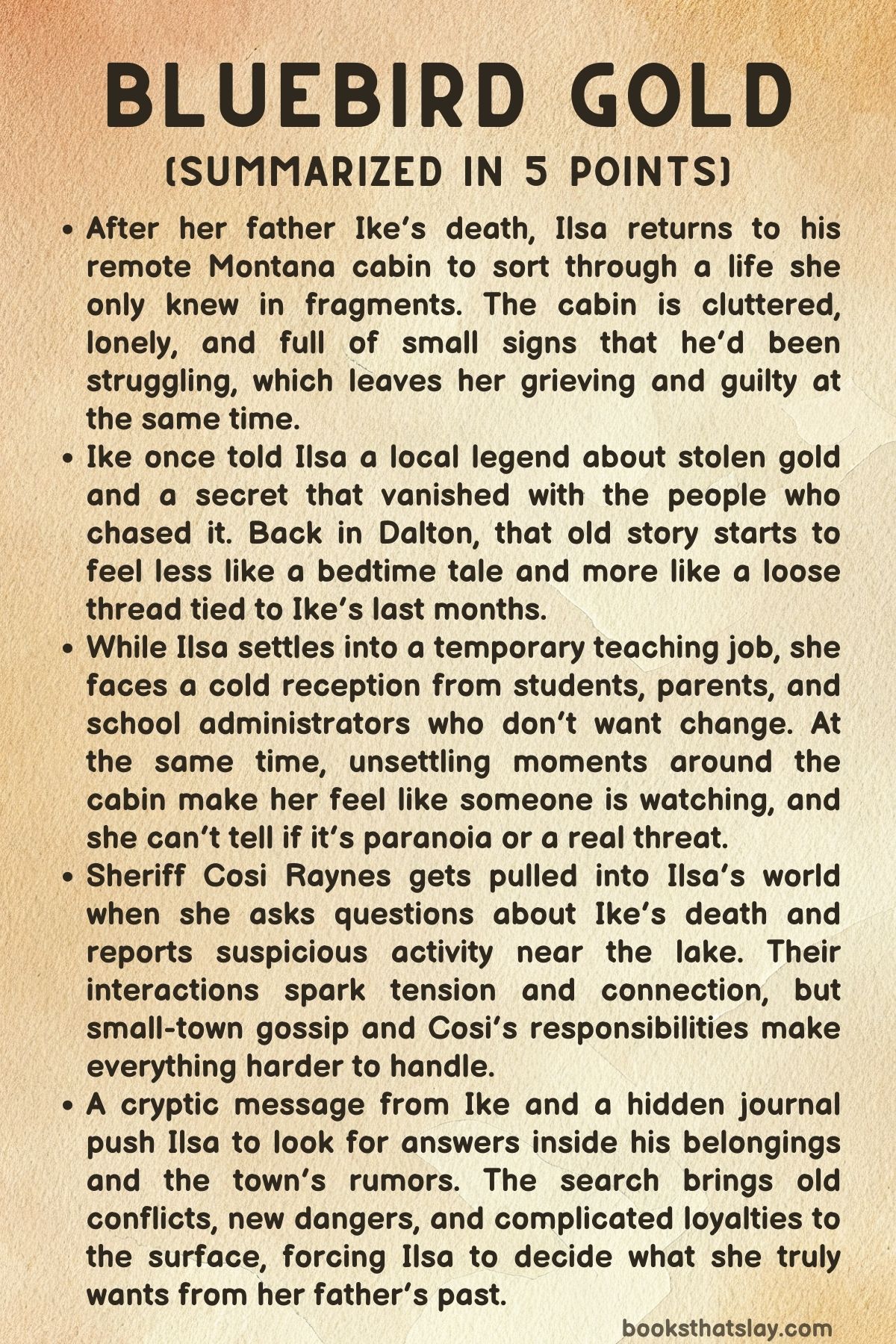
Ilsa Poe returns to Montana in January 1983 after learning of her father Ike’s death. She comes back to the small cabin on Cotters Lake, a place filled with memories of summers spent fishing, cooking, and listening to her father’s stories.
The cabin now feels cramped, cluttered, and lonely, and Ilsa is overwhelmed by the task of cleaning it out before selling it in the spring. She is also taking a temporary job teaching math at Dalton High School, hoping work will keep her grounded while she grieves.
As she sorts through boxes, Ilsa finds troubling signs that her father had been living poorly. Empty cans, piles of clutter, and handwritten notes suggest a man struggling alone.
She feels guilt for not visiting when he asked her to come the previous summer. Her only steady connection is Troy, a longtime friend from Arizona, but even their conversations leave her feeling distant, especially as Troy builds a life with his girlfriend.
One night, Ilsa is startled when she sees a figure in a dark ski mask watching her through the kitchen window. She calls the sheriff’s office, and Sheriff Cosi Raynes arrives to investigate.
Despite searching, he finds no evidence beyond Ilsa’s own footprints and his deputy’s tracks. Ilsa is frustrated, certain she saw someone, while Cosi tries to reassure her without escalating fear.
At school, Ilsa faces hostility from students and pressure from the administration. A senior boy insults her openly, parents complain about grades, and the principal offers little support.
Cosi appears at the school because his teenage son, Spencer, has failed a math test. Ilsa refuses to give Spencer special treatment, and the interaction leaves tension between her and the sheriff, though an undeniable pull begins to form.
Back at the cabin, Ilsa continues cleaning, desperate to understand her father’s final months. She receives an envelope from an older stranger named Jerry, who claims Ike’s death was not an accident.
Inside is a cryptic note from Ike: “FIND THE ATLAS AND THE KEY” and “THE TRUTH IS BENEATH A TAP DANCE.” The message breaks through Ilsa’s numbness, and she finally allows herself to grieve fully.
Ilsa presses Cosi for details about the investigation into Ike’s drowning. Cosi explains that Ike went fishing alone, was later found in the lake, and the evidence supported an accidental fall and drowning.
Ilsa remains uneasy, especially after learning her father had been acting strangely before his death, making arrangements and sending letters.
A blizzard traps Ilsa at the cabin for days. During this isolation, she remembers something her mother mentions: Ilsa once took tap lessons as a toddler and practiced inside the cabin.
Following the clue, Ilsa pries up a floorboard and discovers a hidden journal filled with Ike’s handwriting, clippings, and strange references. Almost immediately, she senses she is being watched again, spotting the masked figure outside before it vanishes.
Cosi responds once more, pushing through dangerous roads to reach her. Still, he finds no clear proof of an intruder.
Ilsa begins to fear that someone is searching for something Ike left behind. The town whispers about old legends, including a long-lost stash of gold from the mining era, rumored to be hidden near Garrack.
Seeking answers, Ilsa visits Trick and Sully’s, the town’s only bar. The bartender, Patrick “Trick” Dougan, recognizes her as Ike’s daughter and shares stories about Ike, who was nicknamed “Bluebird.” Trick speaks of Ike’s paranoia, his obsession with rumors of hidden gold, and his relationship with a woman named Donnie, whose death deeply affected him.
That night, Ilsa encounters Jackie, a violent outsider, and Cosi steps in to stop trouble before it escalates. The incident pulls Ilsa and Cosi closer, and soon their growing attraction becomes impossible to ignore.
Ilsa knows getting involved with the sheriff is risky, especially since she teaches his son, but emotion overrides caution.
Soon after, Ilsa’s cabin is attacked. She returns to find it ransacked, furniture destroyed, clothes and bedding cut apart, and her father’s home violated.
Even the tires on the vehicles are slashed, leaving her stranded. Overwhelmed, Ilsa breaks down, and Cosi insists she stay at his house for safety.
Living under the same roof intensifies their bond. Cosi’s mother, Linda, is wary, and town gossip spreads quickly.
Ilsa struggles with feeling like an outsider, but Spencer grows comfortable with her presence, and a fragile sense of family begins to form.
Ilsa continues chasing Ike’s clues. The journal contains a reference to “Box 286,” leading her to a post office box once belonging to Donnie.
Inside, Ilsa finds accumulated mail and, most importantly, an atlas. Though unmarked, it confirms Ike’s message was real and that he left a trail behind.
The mystery darkens when Ilsa suddenly becomes violently ill and collapses. Doctors determine she has been poisoned, and tests reveal her water was laced with ricin.
Evidence points toward Trick, whose fingerprints are found on the jar. Trick disappears, and Cosi becomes consumed with finding him.
Ilsa survives, but the attack leaves lasting fear. Her mother arrives from Arizona, and Spencer learns painful truths about his absent mother, Gwen, who has resurfaced.
Gwen reveals she found Ilsa unconscious and may have saved her life, complicating Spencer’s emotions.
Weeks later, Cosi spots Trick fleeing in a truck and gives chase. Cornered, Trick confesses his obsession with Ike’s talk of lost gold and admits he confronted Ike harshly the day he died.
In panic, Trick drives onto the frozen lake, trying to escape, but the ice breaks beneath him, and he dies as the lake swallows the truck.
In the aftermath, Ilsa and Cosi scatter Ike’s ashes on the island. Ilsa sees Jerry again, and Cosi realizes he is George Dougan, Trick’s great-uncle, suggesting the Dougan family had been tied to Ike’s secrets all along.
Ilsa chooses to keep the cabin rather than sell it. Though many of Ike’s papers were ruined, Spencer recreates a map from memory, determined to finish what Ike started.
Together, Ilsa, Cosi, and Spencer begin rebuilding their lives.
Seven years later, Ilsa is now Ilsa Raynes, returning to Cotters Lake with her daughters. During renovations, Cosi discovers hidden cans beneath the cabin floor.
Inside are gold nuggets. Ike Poe had found the legendary lost gold and concealed it, leaving clues so Ilsa could one day uncover the truth.
Characters
Ilsa Poe (Ilsa Raynes)
Ilsa is the emotional center of Bluebird Gold, a woman pulled back to Montana by grief, unfinished business, and the uneasy sense that her father’s death left behind more questions than closure. Her return to Ike’s cabin is not just a physical homecoming but a confrontation with abandonment, guilt, and the childhood she never fully understood.
Ilsa’s personality is shaped by restraint and self-reliance—she insists on handling everything alone, even when fear and loneliness overwhelm her. As the story progresses, she transforms from someone merely surviving loss into someone brave enough to seek truth, accept love, and build a future that honors the past rather than being trapped inside it.
Sheriff Cosi Raynes
Cosi is both protector and puzzle-solver, a man grounded in duty but deeply affected by the emotional storms around him. As sheriff, he initially approaches Ike Poe’s death with professional certainty, believing it was an accident, yet Ilsa’s persistence and the strange events at Cotters Lake slowly crack that confidence.
Cosi is also defined by his role as a father, balancing law enforcement with raising Spencer under the shadow of abandonment from Gwen. His growing relationship with Ilsa reveals his longing for connection and stability, even as it risks gossip and professional fallout.
Cosi’s arc is about learning that some truths require more than procedure—they require belief, empathy, and personal courage.
Ike Poe
Ike is the haunting presence behind everything in Bluebird Gold, a father whose love was steady but whose life became increasingly secretive and isolated. Through his letters, journals, and the remnants of his cabin, Ike emerges as a man shaped by Montana’s harsh beauty and by the heartbreak of losing his family when Ilsa’s mother left.
He clung to stories, legends, and the possibility of hidden treasure as both comfort and obsession. Ike’s death may appear accidental, but his cryptic clues suggest he was trying to protect Ilsa or prepare her for something he couldn’t fully explain.
Ultimately, Ike represents legacy—how love and mystery can survive long after a person is gone.
Patrick “Trick” Dougan
Trick is one of the most unsettling characters in the novel because he stands at the intersection of charm and danger. As a bartender, he appears friendly, familiar, and woven into Dalton’s small-town fabric, yet beneath that surface lies obsession and resentment.
Ike’s stories about lost gold ignite something dark in Trick, twisting curiosity into fixation. His actions escalate from gossip to violence, culminating in betrayal, poisoning, and destruction.
Trick embodies the corrosive power of greed, showing how legend and longing can rot into desperation when someone believes they deserve what was never theirs.
Spencer Raynes
Spencer is more than a teenager caught in the background—he becomes a quiet emotional anchor in the story. At first, he seems like a typical high school boy focused on basketball and doing the bare minimum in school, but his loyalty and protectiveness quickly surface.
Spencer’s relationship with Ilsa grows naturally, built on trust and shared vulnerability, and he becomes part of the fragile family unit forming around her and Cosi. His ability to recreate the atlas map from memory symbolizes hope and continuation, proving that healing can come through the next generation.
Troy
Troy represents Ilsa’s past life and the emotional safety she once relied on, even when it was incomplete. As her longtime friend, he offers comfort, consistency, and help, but his growing commitment to Lori highlights how time has moved forward without Ilsa.
Troy is not cruel, but his presence forces Ilsa to confront her fear of being left behind and her uncertainty about belonging anywhere. He functions as a reminder that some relationships are meant to support a season of life, not define its future.
Linda Raynes
Linda is a sharp-edged but deeply concerned maternal figure, embodying the protective instincts of an older generation in a small town. Her tension with Spencer and her initial discomfort with Ilsa reflect her fear of disruption in her son’s household.
Yet beneath her sternness is care, shown through her presence, cooking, and unwillingness to abandon family when crisis strikes. Linda represents the complicated love of someone who struggles to express tenderness but still shows up when it matters.
Gwen
Gwen is one of the most emotionally complicated characters in Bluebird Gold, defined by absence, regret, and late attempts at redemption. As Spencer’s mother, she represents an old wound in Cosi’s life, having left without explanation and returned only through letters and distant watching.
Her desire to reconnect is tangled with guilt and fear, and her involvement in Ilsa’s poisoning incident places her in a morally uncertain space—both suspicious and strangely instrumental in saving Ilsa’s life. Gwen’s character explores the lasting impact of abandonment and the fragile possibility of second chances.
Jerry (George Dougan)
The man Ilsa knows as Jerry is a shadow figure, moving through the story like a whisper of unfinished truth. His warning that Ike’s death was no accident plants the seed of doubt that drives much of the mystery.
Later revealed as George Dougan, Trick’s great-uncle, he becomes a symbol of hidden identities and buried history. George’s role suggests that in Dalton, secrets are generational, and even old men carry the weight of what their families have done.
Donnie
Donnie’s presence is mostly felt through absence, yet her impact on Ike’s final years is profound. As Ike’s girlfriend, she brought him companionship, and her death appears to have triggered his paranoia, urgency, and preparations before drowning.
Donnie represents the tenderness Ike still had in his later life, and her connection to the post office box and the hidden clues ties her to the mystery that survives her.
Paul Johnson
Paul serves as a surface-level antagonist in the school setting, embodying teenage hostility and the town’s resistance to outsiders. His disrespect toward Ilsa fuels gossip and tension, making him an easy suspect when vandalism occurs.
However, his eventual clearing reinforces one of the novel’s themes: the obvious answer is often wrong, and fear can distort perception.
Pamela
Pamela is the steady, observant presence in the sheriff’s office, offering Cosi both administrative support and blunt emotional insight. She functions as a voice of reason, reminding him that small-town gossip can wound deeply and that his choices affect Ilsa in ways he may underestimate.
Pamela adds warmth and realism to the law enforcement side of the story.
Principal Harlan
Harlan represents institutional pressure and the harsh expectations placed on Ilsa as an outsider teacher. Rather than supporting her, he prioritizes appeasing parents and maintaining appearances.
His character highlights how small communities can enforce conformity and how quickly judgment spreads when someone doesn’t fit neatly into local norms.
Florence (Ilsa’s Mother)
Florence is shaped by her decision to leave Montana, a choice that fractured Ike and defined Ilsa’s childhood. Her resentment toward Ilsa returning reveals unresolved guilt and discomfort with the past.
Yet when Ilsa is poisoned, Florence arrives, proving that her love for her daughter remains despite distance and tension. Florence represents the complicated bond between mother and daughter, strained by history but not erased by it.
Robert Aaron
Robert is a peripheral but important figure because he is the last known person to see Ike alive. His involvement underscores the uncertainty surrounding Ike’s drowning and the way ordinary neighbors become part of tragedy in a small town.
He also reflects how suspicion can easily fall on those closest to an event.
Jackie
Jackie is a flashpoint of violence, an outsider whose aggression disrupts Dalton’s fragile calm. His confrontation with Ilsa and Cosi shows the danger lurking beyond the town’s quiet surface.
Jackie’s character reinforces the sense that Ilsa is vulnerable not only to mystery but to very real physical threats.
Deputy Larry
Larry represents flawed authority, quick to dismiss Ilsa’s fears and worsen her isolation through skepticism. His inability to find evidence and his careless assumptions reflect how easily women’s fear can be minimized, especially when they are outsiders.
Larry’s presence adds frustration and tension to the investigation.
Themes
Grief, Absence, and the Weight of Unsaid Goodbyes
Loss in Bluebird Gold is not presented as a single moment but as something that lingers in physical spaces, unfinished conversations, and delayed returns. Ilsa’s grief is complicated because it arrives alongside regret.
She is not only mourning her father’s death, but also mourning the relationship they failed to fully repair. The cabin becomes a symbol of that emotional burden, filled with clutter, empty cans, and evidence of loneliness that Ike endured quietly.
Cleaning it is not simply a practical task but an emotional confrontation with how much she did not know. The discovery of Ike’s final letter and his unfinished to-do list sharpens this theme even further, showing how love can remain present even when communication breaks down.
Ike wanted to tell her stories, wanted her to come back, and Ilsa must live with the reality that she did not.
The novel also shows how grief can create doubt. Ilsa cannot accept the simplicity of an accidental drowning because her sorrow demands meaning.
The possibility that Ike’s death was not an accident becomes intertwined with her need to believe that his life mattered enough to leave behind answers. Grief makes her vulnerable, suspicious, and emotionally raw, especially when she feels watched or threatened.
Her father’s absence is everywhere, but so is his voice, guiding her through clues and memories. The emotional power of the story lies in how grief is both pain and motivation, pushing Ilsa toward truth, connection, and eventually healing.
By the end, scattering Ike’s ashes is not only closure but also a continuation of love, showing that even after death, family bonds can still shape the future.
Family Relationships and the Complexity of Belonging
Family in Bluebird Gold is portrayed as complicated, imperfect, and deeply influential. Ilsa’s relationship with her father is filled with warmth from childhood memories, but also with distance created by her mother leaving Montana.
Ike is left crushed, Ilsa is taken away, and the separation becomes a defining wound for them both. Returning after his death forces Ilsa to face how family can be both comfort and pain.
Her mother’s resentment about Montana reflects another layer of fracture, showing how adults carry their own disappointments and pass them down unintentionally.
At the same time, the story highlights the longing for belonging. Ilsa comes back not just to settle an estate, but to understand who her father truly was.
That desire is deeply tied to identity, because knowing Ike means knowing herself. Cosi’s family life mirrors this theme through Spencer and Gwen.
Spencer’s anger and confusion about his absent mother show the emotional cost of abandonment, while Cosi’s steady presence as a father contrasts with Gwen’s instability. The novel suggests that family is not defined only by biology but by who stays, who protects, and who chooses to be present.
As Ilsa becomes part of Cosi and Spencer’s household, the theme expands into the creation of a new family structure. Their bond forms through shared vulnerability and shared responsibility.
By the end, Ilsa is no longer only Ike’s daughter returning to an empty cabin, but a mother and partner building a life forward. Family becomes something rebuilt, not inherited perfectly, but shaped through care, endurance, and commitment.
Secrets, Hidden Truths, and the Need for Answers
The story is driven by secrecy, both personal and communal. Ike’s life is full of things Ilsa never knew: his relationship with Donnie, his paranoia, his hidden journal, and his cryptic messages.
These secrets do not feel like plot devices alone, but reflections of how people hide parts of themselves, even from those they love most. Ike’s clues suggest that he carried fear and knowledge that he could not fully explain.
Ilsa’s search becomes about uncovering not only what happened to him, but who he was beneath the surface.
The town of Dalton also holds secrets. Rumors circulate quickly, and the legend of lost gold hangs over the community like unfinished history.
The idea that something valuable was hidden long ago mirrors the emotional concealment happening in the present. People watch each other, suspect each other, and keep quiet about what they know.
Jerry’s warning that Ike’s death was not an accident shows how truth can exist on the edges, spoken softly, never fully brought into the open.
This theme also reveals how secrecy can become dangerous. Trick’s obsession grows out of whispered stories and half-known clues.
The vandalism, stalking, and eventual poisoning show how hidden motives can erupt violently. Yet the novel also suggests that truth matters, even when it hurts.
Ilsa’s determination to understand Ike’s final days is not only about gold or mystery, but about emotional honesty. In the end, the discovery of the gold beneath the cabin confirms that Ike truly did leave something behind, but the deeper truth is that his love and intentions were always present, waiting to be found.
Obsession, Greed, and the Destructive Power of Wanting More
Greed in Bluebird Gold is not only about money but about fixation. The legend of stolen gold becomes a shadow over the entire story, shaping motivations and feeding fantasies.
Ike’s interest in the lost treasure begins as storytelling, but for others, especially Trick, it becomes something consuming. Trick represents how obsession can distort morality.
What begins as fascination turns into resentment, violence, and ultimately tragedy.
The novel shows how greed often disguises itself as justification. Trick convinces himself that Ike owed something to the town, that Ilsa did not deserve what her father left behind, and that he is entitled to answers.
His actions escalate from harassment to destruction to attempted murder. The poisoning with ricin is the clearest example of how obsession destroys boundaries, turning desire into cruelty.
This theme also connects back to the past. The original legend of vigilantes hiding gold shows how greed corrupts even those who claim righteousness.
The town’s history suggests that people have always been willing to betray each other for wealth. The gold becomes symbolic of temptation, something that pulls out the worst in human nature.
Yet the ending reframes the treasure. When the gold is finally discovered, it is not a triumph of greed but a quiet resolution.
Ike hid it not to enrich strangers, but to leave something meaningful for Ilsa. The real danger was never the gold itself, but what people were willing to do because of it.
The novel ultimately warns that obsession consumes the person who carries it, while love and patience are what truly endure.
Love, Healing, and the Courage to Begin Again
Romance in Bluebird Gold is not presented as simple escape, but as part of healing. Ilsa arrives in Dalton emotionally shattered, isolated, and burdened by guilt.
Her connection with Cosi grows out of shared loneliness and shared responsibility. Both have experienced abandonment in different forms, and both are trying to hold their lives together.
Their relationship is messy, risky, and shaped by the reality of small-town scrutiny, yet it also becomes a source of comfort and stability.
Ilsa’s fear of gossip and judgment reflects how difficult it is to accept happiness when one feels undeserving. She believes she should be alone in her grief, that connection might be reckless.
But Cosi’s presence challenges that belief. He offers protection, warmth, and a sense of home when her father’s cabin is violated and no longer safe.
Love becomes not only passion, but also partnership in survival.
Healing is shown through rebuilding. Ilsa keeps the cabin instead of selling it, choosing to reclaim what was broken.
Spencer becomes part of that healing as well, representing the future and the possibility of family beyond loss. Even Gwen’s return, though painful, becomes part of Spencer’s journey toward closure.
The ending, with Ilsa returning years later as Ilsa Raynes, shows that life continues beyond tragedy. Love does not erase grief, but it creates space for hope.
The cabin, once filled with sorrow and secrets, becomes a place of renewal, where past and future can exist together.
Small-Town Judgment, Community Pressure, and Isolation
Dalton is not just a setting but an emotional force. Life in a small town means privacy is fragile, and everyone is observed.
Ilsa feels this immediately as an outsider, judged as a strict teacher, criticized by parents, and targeted by students. The hostility she faces reflects how communities resist disruption, especially from someone who does not fully belong anymore.
Cosi also warns her that people talk, and this constant awareness shapes her choices. Her relationship with him becomes a source of comfort but also a source of vulnerability because rumors spread quickly.
The principal’s blunt warning shows how reputation can become a form of control. Even when no rules are technically broken, perception matters.
This theme also connects to danger. The stalking, the vandalism, and the masked figure feel intensified because the town is small, surrounded by wilderness, and full of hidden tensions.
Isolation is not only physical at Cotters Lake but social, as Ilsa realizes she cannot easily trust those around her.
Yet the novel also shows the dual nature of community. Dalton can be harsh, but it can also be supportive.
Trick initially offers familiarity, Spencer offers companionship, and eventually the town becomes part of Ilsa’s new life. The story suggests that small-town life magnifies everything: love, suspicion, grief, and hope.
In such a place, survival requires resilience, because community can both wound and heal.