Daggermouth Summary, Characters and Themes
Daggermouth by HM Wolfe is a dystopian political thriller set in a city where power is enforced through ritualized violence, surveillance, and fear. The story centers on New Found Haven, a society divided into rigid social rings, ruled by an authoritarian regime that equates mercy with treason.
At its core, the book examines control, inherited cruelty, resistance, and the cost of survival under tyranny. Through intersecting lives shaped by violence and coercion, the novel explores how systems built on fear fracture both the oppressed and the enforcers, and how defiance can arise from the most unlikely alliances.
Summary
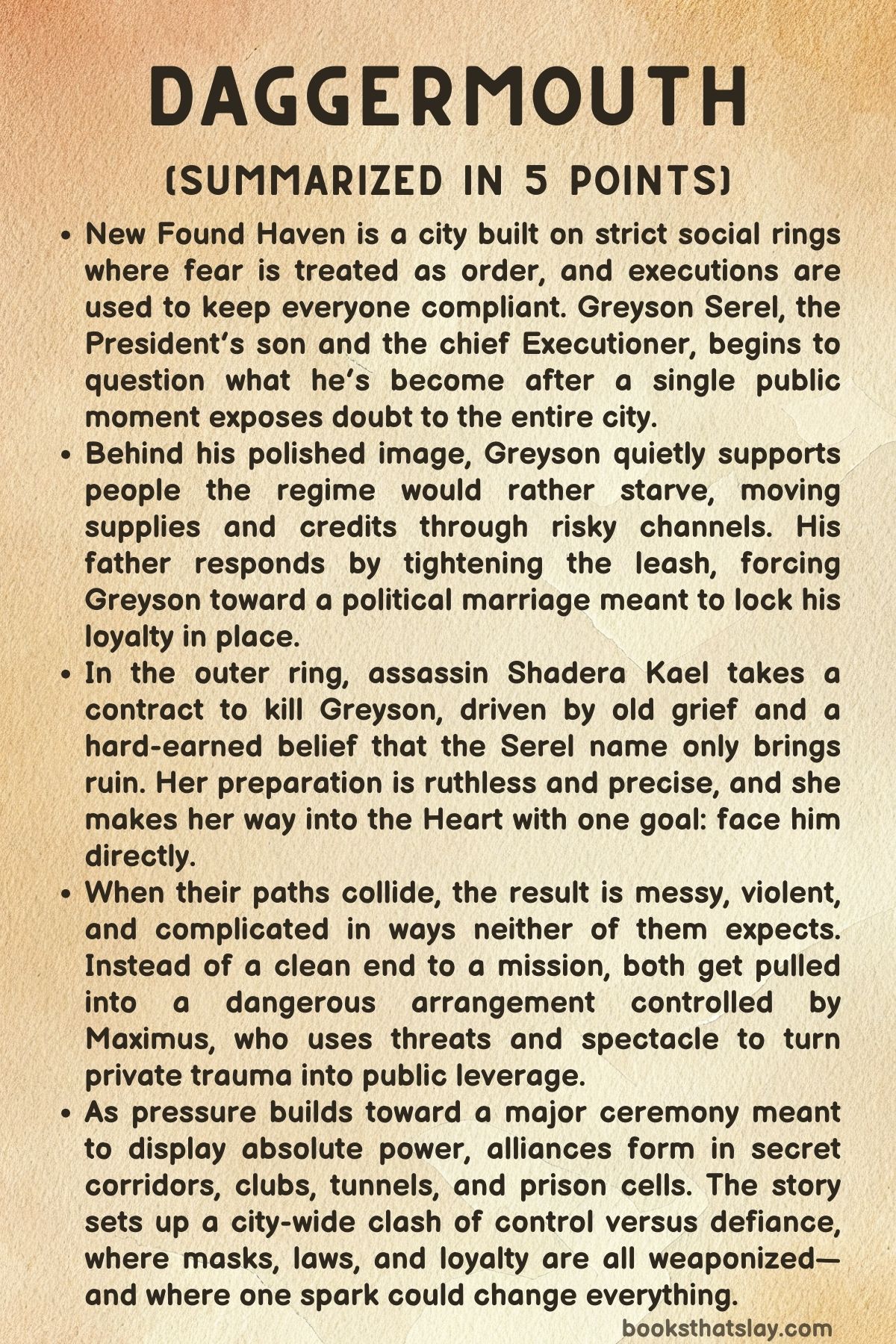
New Found Haven is structured as a city of rings, each one defining a person’s worth, safety, and access to resources. At the center lies the Heart, home to the ruling elite and the seat of absolute power.
Order is maintained through public executions broadcast across the city, reinforcing the idea that obedience is survival. Greyson Serel, the city’s chief Executioner and son of President Maximus Serel, is the public face of this terror.
Trained from childhood to believe that compassion invites collapse, Greyson performs his role with precision, even as doubts quietly erode his certainty.
During a highly publicized execution, Greyson sentences two rebels accused of conspiring against the Heart and violating social boundaries through their relationship. He kills the man without hesitation, but when the woman begs for mercy, Greyson falters.
His pause, witnessed live across the city, is brief yet devastating. A Veyra captain steps in and kills the woman, and the crowd responds with approval.
Greyson understands immediately that his moment of uncertainty has marked him as a liability.
Behind the mask of loyalty, Greyson has been secretly aiding the resistance. Using his authority and access, he smuggles medical supplies and credits into the Cardinal and Boundary rings, hiding contraband beneath patrol vehicles and routing aid through carefully planned channels.
His hatred for the cruelty of the Heart runs deep, especially toward his father, whose rule depends on terror and submission. When Maximus confronts Greyson about the execution, he makes his intentions clear: doubt cannot be allowed.
To bind Greyson more tightly to the regime, Maximus orders him into a Vow marriage with Moraine Daunt, a politically valuable match designed to reinforce obedience.
Far from the Heart, in the Boundary, mercenary Shadera Kael accepts a contract from the Daggermouths, an elite group of assassins. Her target is Greyson Serel.
The payment promised would sustain the Boundary for a year, but the job is also personal. Shadera’s parents were executed during a Veyra raid decades earlier, and she holds the Serel name responsible.
She prepares with discipline and precision, mapping infiltration routes into the Heart and planning to kill Greyson face to face.
Greyson confides his growing despair to Callum Thane, a powerful club owner and his closest ally. He admits that he wanted to believe sparing someone might undo some of the harm he has caused.
Callum warns him that his father is tightening his grip and urges Greyson not to lose what remains of his humanity. Meanwhile, Shadera says goodbye to her lover, Jameson Vine, who begs her to abandon the mission.
She refuses, believing that this act is necessary not only for the city, but for herself.
Shadera infiltrates New Found Haven through maintenance tunnels, surviving ambushes and security systems before emerging inside the Heart. Unseen, she nearly crosses paths with Greyson himself, who is secretly planting contraband beneath patrol vehicles in the same underground garage.
Neither realizes how close they come to each other that night.
The following morning, Greyson carries out another execution, this time of a woman accused of smuggling medicine. Her final words center on mercy, striking Greyson with bitter irony as he kills her for the same act he commits in secret.
Watching from above, Shadera observes him through a scope but decides against a distant kill. She wants him to see her.
On the day of the Vow ceremony, Shadera ambushes Greyson inside the private chamber. The fight is brutal and chaotic.
Greyson proves more formidable than expected, and both are injured. Shadera shoots him, but before she can finish the job, guards storm the room.
Greyson removes his mask in front of her, breaking one of the Heart’s most sacred laws. Shadera is captured, and Greyson collapses from blood loss.
The scandal forces the Serel family into crisis management. A legal loophole transforms disaster into opportunity: if two people see each other unmasked, the punishment can be execution or marriage.
Maximus chooses the latter. Shadera and Greyson are ordered into a public Vow ceremony, intended to display dominance over both the resistance and the assassin who dared challenge the regime.
Both refuse, but Maximus applies pressure through threats. Shadera’s lover is placed under surveillance, and Greyson’s sister Lira becomes leverage.
Shadera is imprisoned and brutalized, her survival turning her into a symbol among the inmates. Greyson, increasingly defiant, confronts his father when Maximus assaults Lira.
He threatens Maximus openly and smuggles Lira out with the help of allies. Left alone with Shadera under surveillance, Greyson’s composure finally breaks.
In the ruins of his controlled life, the two form an uneasy bond. Shadera learns that Greyson never chose his role, and Greyson learns the full truth of Shadera’s past.
Against all logic, they find safety in each other.
As the Vow approaches, resistance forces mobilize. Callum, Jameson, and other leaders coordinate an uprising, unaware that Maximus has anticipated much of their plan.
Inside the Heart, Shadera is beaten nearly to death before being returned to Greyson. He tends to her wounds and vows to kill his father.
On the day of the ceremony, layers of deception collapse. Lira publicly removes her mask, exposing the abuse hidden behind the Heart’s rituals.
Women across the plaza follow her lead, revealing scars and refusing silence. Chaos erupts as loyalties fracture.
Maximus reveals his final trap: many rebel leaders have already been captured, and his own son Brooker has been working as a double agent. Brooker murders Callum in front of Lira, shattering the last illusion of control.
As violence consumes the plaza, Captain Mikel sacrifices himself to save Greyson. In the final moment, Elara Serel, long dismissed as submissive, reveals herself as the architect of Maximus’s downfall.
She executes her husband, ending his reign. With the tyrant dead, the future of New Found Haven remains uncertain, but the myth of fear that sustained it has been broken.
Characters
Greyson Serel
Greyson Serel is the story’s central contradiction: the Heart’s chief Executioner and the President’s son, yet also a covert saboteur of the regime he publicly represents in Daggermouth. His power is real—he can end a life with a single calm motion, command Veyra patrols, and move through the Heart’s sanctums—but it is also a cage engineered by Maximus to make Greyson inseparable from state violence.
Greyson’s defining trait is control: the obsessive sterility of his apartment, the rigid routine at dawn, the way he treats doubt like a contaminant. That control fractures at moments that expose his suppressed humanity—his hesitation on live broadcast, the word “mercy” striking him like a wound, and his private collapse where he destroys his own space because he has no safe place to direct his rage.
The forced Vow turns him into a symbol the regime can weaponize, and his unmasking becomes both rebellion and self-immolation: he violates sacred law not because he’s fearless, but because he’s done being owned by fear. His arc is a slow shift from internal resistance (smuggling supplies, quiet guilt) to open defiance (protecting Lira, threatening Maximus, choosing to stand with Shadera on the platform), culminating in a readiness to sever the idea of “Serel” from his identity—even if it costs him everything.
Shadera Kael
Shadera Kael enters as a mercenary assassin shaped by deprivation, fury, and a life where survival required violence to be faster than thought. Her hatred of the Serel family is not abstract ideology; it is personal history, anchored to the execution of her parents and the city’s long habit of turning grief into obedience.
She is meticulous and mission-driven, yet not purely ruthless—her decision to spare a third attacker in the tunnels hints at a moral line she won’t admit she still has. Shadera’s insistence on killing Greyson “face to face” reveals something deeper than revenge: she wants her suffering witnessed, named, and answered, not erased by a distant shot.
What complicates her is the forced intimacy of captivity; she is dragged from autonomy into a staged marriage that turns her body into political property, and her terror is sharpened by the regime’s sexualized rituals of dominance. Her strongest transformation occurs in the space between brutality and tenderness—accepting help, allowing vulnerability after torture, and recognizing that Greyson’s complicity was also coerced.
By the time she stands on the platform, Shadera is no longer only an instrument of revenge; she becomes a visible indictment of the Heart’s cruelty, her injuries and endurance turning into a language the city can finally read.
President Maximus Serel
Maximus Serel is tyranny rendered intimate: a ruler who understands that public violence works best when it is mirrored by private terror. He treats ideology as a script and family as a tool, training Greyson to equate mercy with collapse while simultaneously ensuring Greyson can never feel clean again.
Maximus’s genius is not strategy alone but psychological architecture—he uses the Vow to fuse scandal into leverage, weaponizes surveillance as omnipresence, and turns the city’s sacred rules (masking, ritual, public spectacle) into mechanisms that force victims to participate in their own humiliation. His cruelty toward Elara and Lira shows that domination is his core appetite, not merely his method; he needs submission performed, repeated, and witnessed.
Even when threatened, he attempts to reassert narrative control by revealing traps, staging betrayals, and making rebels watch the cost of hope. Maximus is also the embodiment of the Heart’s philosophy: if fear is absolute, reality becomes whatever he says it is.
His death matters because it isn’t only political; it is the first time someone denies him the final privilege of deciding what mercy means.
Callum Thane
Callum Thane operates as the rebellion’s velvet blade —a club owner whose influence, networks, and technical reach let him move through the Heart’s seams while looking like part of its glamour. He is Greyson’s closest friend and also, in some ways, his handler: he comforts Greyson’s guilt while pushing him to keep functioning, balancing compassion with the cold arithmetic of planning.
Callum’s greatest strength is coordination—maps, comms, surveillance loops, alliances across rings—and his greatest weakness is the belief that competence can outmaneuver a system designed to crush competence. The revelation that he has been manipulated, that his backdoors are compromised, and that the plan is “too smooth” underscores his tragedy: he knows how to run operations, but he cannot control betrayal embedded inside the story’s bloodlines.
His love for Lira intensifies his urgency until it overrides caution, and his death is not just loss but a message crafted by the regime’s hidden architect. Callum’s end turns him into a martyr of intimacy—killed not in anonymous battle, but in the exact moment he tries to reach the person he loves.
Lira Serel
Lira begins as someone who helps maintain the regime’s image—part of the Heart’s curated narrative—even if she isn’t swinging the sword. Her cracked mask and bruised throat make visible what the Heart normally forces women to hide: that compliance is often manufactured through private violence.
Lira’s evolution is striking because it is intellectual and bodily at once; she recognizes her role in the propaganda machine, then chooses to weaponize that access against the system that raised her. Her defiance on the platform is not impulsive rebellion but a calculated detonation of the Heart’s central myth: that masks equal purity, and hidden suffering equals stability.
By removing her mask publicly, she reframes vulnerability as power and triggers mass imitation, transforming individual courage into collective uprising. Lira’s love for Callum gives her something to lose, but it also gives her a reason to act before the plan’s “optimal timing,” because she refuses to let strategy excuse ritualized assault.
Even after she is shot and dragged away, her impact remains structural—she proves that the Heart’s greatest weakness is visibility.
Elara Serel
Elara is the story’s master of quiet survival, enduring a marriage that functions like a prison while cultivating the one weapon Maximus fails to monitor: underestimation. Publicly, she is the restrained First Lady who absorbs brutality and returns “presentable,” but privately she is patient, observant, and strategically invisible.
Her torment—chained, masked, dislocated—highlights how the regime’s violence is not only punitive but instructional, designed to teach women to disappear inside themselves. Elara’s power is that she learns to use that disappearance as camouflage, letting Maximus believe he has succeeded in erasing her will.
The reveal of her as “Python” reframes her suffering as part of a longer plan rather than a permanent condition, and her execution of Maximus is not portrayed as sudden heroism but as the culmination of endurance turned into precision. By claiming mercy exists “just not for you,” she seizes the regime’s moral vocabulary and redefines it through action, proving that the Heart’s doctrine can be shattered by someone it tried hardest to reduce.
Captain Mikel
Captain Mikel functions as a hinge character, positioned between enforcement and rebellion, suspicion and protection. He initially appears as the Veyra officer who questions Greyson’s movements and reinforces the sense that Greyson is constantly watched, yet his later choices reveal a deeper allegiance that isn’t to Maximus’s cruelty.
Mikel’s relationship to Greyson adds an undercurrent of inherited consequence: Greyson is not just a political asset but personally entangled in Mikel’s hidden truth, which turns many “loyalty” interactions into covert parenting under dictatorship. His betrayal of Maximus is not flamboyant; it is procedural, timed, and costly, suggesting a man who has been planning within constraints for years.
When he steps in front of Greyson and takes the fatal bullet, the act reads as both tactical sacrifice and intimate redemption—choosing, at the end, a life over the system that demanded endless deaths. Mikel embodies the idea that even inside authoritarian machinery, people can become faults in the gears.
Brooker Serel
Brooker is the regime’s most poisonous surprise because he weaponizes the rebellion’s trust from within, turning hope into a trap. His existence as “alive” after a funded death contract reveals how the Heart doesn’t merely crush dissent—it manufactures dissent channels, seeds narratives, and patiently harvests rebel leadership when it becomes convenient.
Brooker’s long-term infiltration suggests a personality comfortable with moral rot; he isn’t driven by fear the way Greyson is, but by alignment with Maximus’s worldview and the thrill of control. The scar from Shadera’s near-kill adds a personal edge to his betrayal, implying that his cruelty is sharpened by grievance and pride as much as ideology.
By killing Callum in front of Lira, Brooker performs the regime’s core lesson: love is a liability, and spectacle is the point. He represents the Heart’s ability to corrupt family into infrastructure.
Moraine Daunt
Moraine Daunt’s role is defined more by what she represents than what she is allowed to choose: a political anchor meant to bind Greyson to the regime through marriage and alliance. The Daunt family’s insistence on enforcing mask law and ritual consequence illustrates how the Heart’s elite maintain power not only through Maximus’s violence but through collective complicity and tradition-as-weapon.
Moraine’s presence in the forced Vow plan exposes how women in the Heart can be both privileged and instrumentalized, valued as symbols that stabilize hierarchy. Even when she is not at the story’s emotional center, she sharpens the stakes by showing that the ruling class has multiple hands on the wheel, and Greyson’s captivity is supported by an entire social machine, not just a single tyrant.
Jaeger Nolin
Jaeger Nolin, leader within the Daggermouth mercenaries, embodies the Boundary’s hardened pragmatism —a man who speaks the language of contracts because ideology is often a luxury for people who aren’t starving. By assigning Shadera the assassination job with a payout that could fund the Boundary for a year, Jaeger frames revolution as logistics: food, medicine, time.
His authority in Wolf’s Head and his willingness to enforce claim through violence reflect a world where respect is survival currency. Later, his reported capture and expected torture show the vulnerability of Boundary leadership when the Heart turns its full attention outward.
Jaeger stands for the uneasy overlap between mercenary culture and resistance: sometimes the same skill set that sells death also becomes the only tool available to fight it.
Jameson Vine
Jameson Vine is the story’s emotional engine from below, driven by love that refuses to stay private. His relationship with Shadera is volatile—argument, intimacy, desperation—because both of them are shaped by violence and have learned to treat tenderness as risk.
Jameson’s plea for Shadera not to go exposes his fear of losing the one person who makes his world feel less doomed, yet his later decision to mobilize teams and lead an extraction proves that his love is not passive. He is also politically awakening; he negotiates with Kestrel Farrow, brings actionable intelligence about drones, and commits to a mission whose stakes extend beyond romance.
Jameson’s resolve is anchored in community promises—especially to grieving families in the Boundary—which elevates him from lover to leader. He represents the type of rebel who becomes dangerous precisely because he has something personal on the line and refuses to let the regime define what that means.
Kestrel Farrow
Kestrel Farrow operates as a strategist and realist, someone who measures resistance in terms of policy shifts, informant incentives, troop movements, and the math of survival. The footage of hangings and her reporting on tightened control show her as a witness who documents atrocity not for despair but for coordination.
Farrow’s caution toward Jameson’s personal motives highlights a central tension in rebellion work: passion fuels courage, but it can also distort judgment. Her role in power-grid access and timing makes her emblematic of the rebellion’s infrastructure layer—people who don’t just fight, but make fighting possible.
When plans fail because codes are rejected and systems are hacked, Farrow’s work underscores how the Heart’s power is not only weapons but information dominance. She is the type of character whose competence threatens the regime, which is why the regime’s counterstrategy targets her channels.
Chapman
Chapman functions as Greyson’s quiet enforcement shield, the kind of operative whose value lies in discretion and immediate action. When Greyson orders him to secure the apartment, move Lira through service tunnels, and use lethal force if necessary, Chapman becomes the physical extension of Greyson’s protective intent—a rare instance where Greyson’s authority is used purely to preserve rather than punish.
Chapman’s presence also emphasizes how fragile safety is in the Heart: survival depends on knowing which corridors are unseen, which rotations can be timed, and which people can be trusted to act without questions. He is not portrayed as a moral philosopher; he is a professional who makes impossible choices look routine, highlighting the story’s theme that under authoritarianism, even “helping” often requires skills learned in violence.
Hawk
Hawk is a connective tissue character, representing the many rebels whose bodies carry the regime’s signature—scars that serve as both trauma and proof. His role in confirming alarms, maintaining tunnel routes, and keeping teams coordinated shows how resistance survives through mundane vigilance, not only dramatic uprisings.
The mention of his Veyra-inflicted scar matters because it signals a life that has already paid an entry fee into rebellion; he is not playing at revolution. Hawk’s presence helps ground the larger operation in the lived realities of the city’s underside, where trust is earned through endurance and competence.
Miranda
Miranda, the maid ordered to clean and reset Elara’s shoulder, embodies the coerced complicity that sustains the Heart . Her task is intimate and violent—restoring Elara’s body to “presentable” form—yet framed as service, reflecting how authoritarian systems recruit ordinary labor into extraordinary cruelty.
Miranda’s role also highlights how power spreads: Maximus doesn’t need to personally perform every act of harm if he can command a household, an institution, and a culture to normalize it. Even without extended perspective, Miranda stands as a reminder that the regime’s brutality is maintained through many hands, some obedient, some terrified, all trapped in the machinery.
Themes
Oppression and Social Division
Daggermouth presents a society where geography becomes a weapon of control. New Found Haven is not merely separated into different rings; it is structured so that privilege, sickness, hunger, and fear remain fixed in place.
The Heart enjoys wealth and safety, while the Cardinal is poisoned and the Boundary is left starving, making inequality feel like an accepted law rather than a moral crime. Maximus maintains this system through executions, surveillance, threats, and public ceremonies that turn cruelty into spectacle.
The punishment of those who love across ring lines shows how deeply the regime fears unity between divided people. By controlling movement, food, medicine, and relationships, the Heart prevents the outer rings from seeing themselves as part of one shared city.
Greyson’s secret smuggling of supplies becomes powerful because it challenges the system at its foundation. His rebellion is not only political but moral: he recognizes that survival should not depend on birth, location, or loyalty to power.
Identity Beyond Reputation
Shadera and Greyson are both introduced through frightening public identities, yet their private selves are far more complicated. Shadera is known as a Daggermouth assassin, feared for violence and precision, but that reputation hides a child who lost her parents and learned to survive in a brutal world.
Greyson is known as the Heart’s Executioner, the masked son of the president, yet beneath that role is someone trapped by his father’s expectations and disgusted by the violence he is forced to perform. Their first judgments of each other are shaped by reputation, grief, and propaganda.
Shadera sees Greyson as a Serel monster, while Greyson sees her as an enemy sent to kill him. As they are forced into proximity, those simple labels begin to collapse.
The story shows that identity can be imposed by family, class, violence, or fear, but it can also be reclaimed through choice. Both characters become most human when they are no longer reduced to what others call them.
Power, Fear, and Control
Maximus rules by making fear feel unavoidable. His power depends not only on weapons and guards, but on the belief that disobedience will always lead to unbearable loss.
He threatens the Boundary, Jameson, Lira, Callum, and anyone connected to Shadera or Greyson because he understands that people can be controlled through the safety of those they love. The forced Vow is a clear example of power disguising itself as law.
Maximus twists legal tradition not to create justice, but to protect his heir and punish resistance at the same time. Masks, ceremonies, public executions, and military violence all serve the same purpose: they make the regime appear permanent.
Yet fear also creates weakness. The more Maximus relies on terror, the more people recognize that his authority has no moral foundation.
His control begins to fail when private resistance becomes public action. The uprising proves that power built on fear can dominate bodies for a time, but it cannot fully command loyalty, truth, or memory.
Resistance and Moral Courage
Resistance in the story takes many forms, and not all of them begin with open battle. Greyson smuggling medicine and food, Mikel secretly protecting the rebellion, Callum weakening security, Lira preparing a broadcast, and Jameson helping people reach safety all show that courage often starts with hidden choices.
These actions matter because the regime depends on silence and isolation. Each character resists from a different position: some from inside the Heart, some from the Boundary, and some from places of personal loss.
Lira’s public call for citizens and women to reclaim power changes private anger into collective action. Mikel’s death protecting Greyson gives moral weight to the rebellion because it shows love standing directly against Maximus’s violence.
Elara’s final revelation as Python also reframes resistance as something patient, strategic, and deeply personal. The ending suggests that rebellion is not only about removing a ruler.
It is about restoring the possibility of mercy, choice, and shared responsibility in a city trained to accept cruelty.