Dungeon Crawler Carl Summary, Characters and Themes
Dungeon Crawler Carl by Matt Dinniman is a fast, funny, brutal survival story set after Earth is hijacked by alien corporations and converted into a televised death game. Carl, an ordinary guy with bad luck and a stubborn streak, survives the apocalypse for the dumbest reason possible: he was outside in the cold, half-dressed, chasing his ex’s cat.
That cat, Princess Donut, becomes his partner—talking, demanding, and unexpectedly powerful. Together they enter a massive dungeon where rules are enforced by an uncaring system, monsters drop loot like slot machines, and popularity can be as important as skill.
Summary
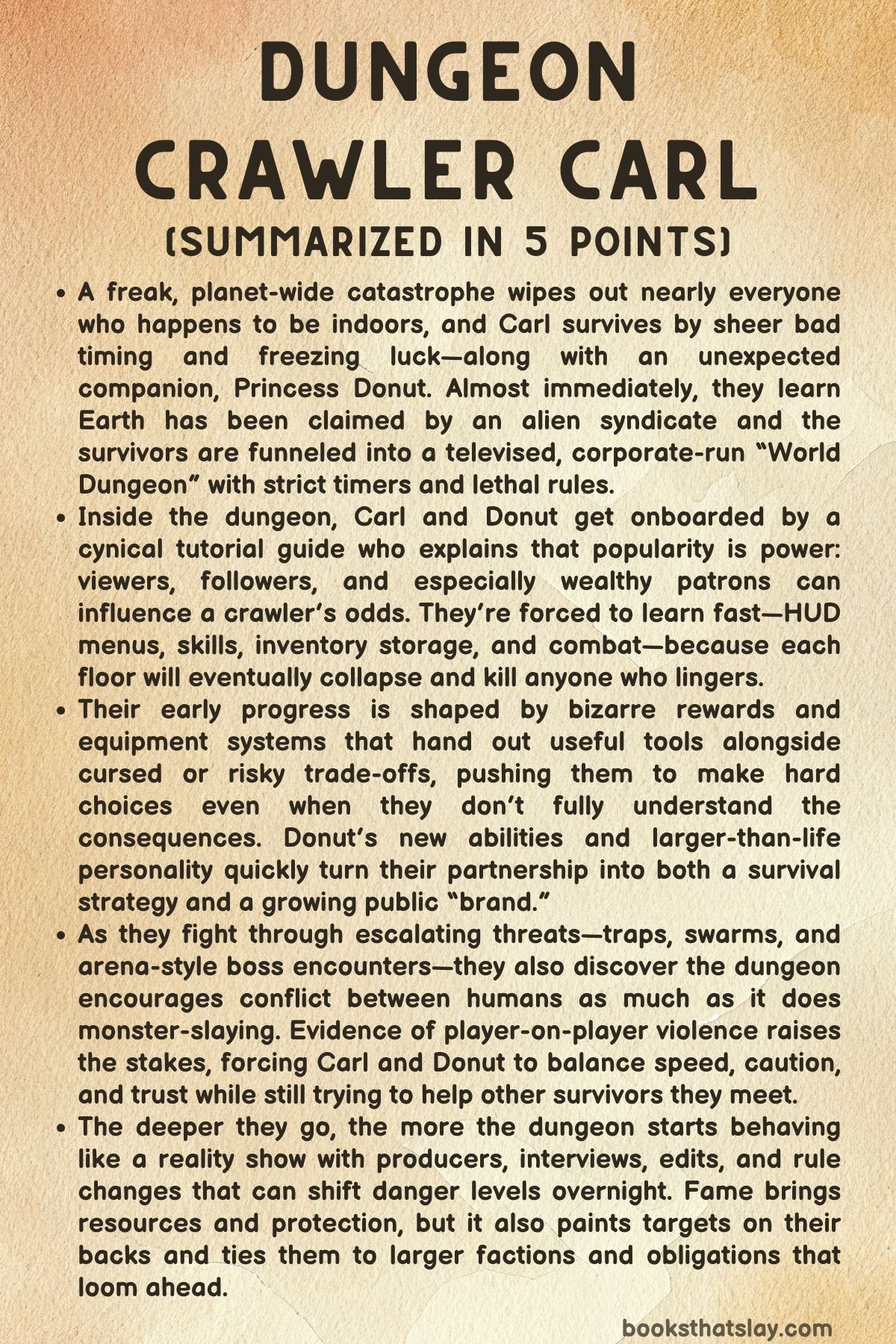
At 2:23 AM on January 3rd, Earth is “transformed” during a winter storm. Anything under a roof is instantly destroyed along with the people inside.
Buildings vanish, vehicles crumble, and most of humanity dies in seconds. Carl survives only because he is outside in freezing weather, wearing almost nothing, trying to rescue Princess Donut, the prized Persian cat left behind by his recently ex-girlfriend, Beatrice.
The moment the world collapses, Carl witnesses horrific evidence of mass death and realizes there’s no safety left on the surface.
A voice speaks inside his head and floating text appears before his eyes, announcing that Earth has been seized by an interstellar Syndicate. The planet’s interior has been crushed and is being mined, and survivors are offered a “chance” to reclaim what was taken by entering a corporate-run game: an 18-level dungeon broadcast across the galaxy as entertainment.
Entrances open briefly, and each deeper level has fewer ways down. Every floor has a collapse timer; anyone left behind dies when the level is reclaimed.
With no shelter and nowhere to go, Carl runs to a bright spotlight marking a dungeon entrance and descends into warmth, knowing the alternative is freezing to death aboveground.
Inside, Carl is registered as a “Crawler,” given a timer showing only days until the first floor collapses, and bombarded with achievement messages that grant loot boxes. Donut is also registered as a crawler, which Carl doesn’t fully understand until he realizes the dungeon recognizes her as a player too.
Carl heads toward a tutorial guild, immediately triggers a trap, and is chased by a crude steam-powered goblin machine packed with enemies. He scrambles through tunnels and reaches a locked guild door, where a rat-like NPC named Mordecai refuses to open it while threats are nearby.
Forced to fight, Carl kills a goblin with his bare hands. Donut slips into the guild during the chaos, and Carl barely makes it inside before the machine thunders past.
The guild is a safe zone. Mordecai explains the basic reality: the dungeon is a product, viewers matter, and money flows through attention.
Fans and “patrons” can send valuable items, meaning charisma and spectacle can become survival tools. Carl learns he cannot choose a class or race until later floors, and that almost no one has ever reached the deepest levels, let alone finished all eighteen.
Mordecai helps Carl unlock his inventory system—an expansive storage space—and teaches him how to read stats, maps, and skills.
Carl opens his loot boxes and equips what he can: potions, weapons, explosives, and enchanted gear, including a toe ring that annoyingly replaces proper footwear but boosts his strength. He also receives a powerful pet-related reward, including a strange biscuit that can transform an animal in unpredictable ways.
Mordecai urges him to use it in the safe zone, where a bad result can’t immediately attack. Before Carl can decide, Donut snatches the biscuit and eats it.
She collapses into a trembling mass as the transformation begins.
When Donut reforms, she can talk—and she is furious about everything, especially being addressed like a normal cat. She insists on the title “Princess Donut,” demands her own loot, and quickly proves she has unusually high stats, especially Charisma.
Mordecai explains she received a special growth pattern that makes her stronger in certain ways as she levels. Donut opens her rewards and, due to her novelty and visibility, receives a legendary item: a jeweled crown with a vulgar name and an even worse hidden consequence.
The crown grants strong benefits and adds a dangerous obligation tied to royalty on a later floor. Once worn, it can’t safely be removed because it will vanish and reappear elsewhere, creating a new rival and leaving Donut without its protection.
Donut equips it instantly anyway, then names their party after herself and makes Carl her bodyguard by party title.
They leave the guild and begin surviving the first floor through constant fights and scavenging. Donut uses magic missiles until her mana runs dry, while Carl brawls with brutal efficiency, aided by enchanted gear and rapid regeneration.
They kill strange creatures, including a lava-spitting llama-like monster, and discover the dungeon’s loot can include anything from food to drugs to bizarre crafting materials. The layout is absurd in places—endless identical doors that lead to the same tiny bathroom—yet lethal in others, filled with rats and insect-like “Scatterers.” Carl’s fighting style shifts toward kicks and stomps, and the system rewards it with skill upgrades that come with unsettling commentary.
They reach a safe room set inside a functional fast-food restaurant, where they can eat, sleep, and clean up. Screens show the countdown to the floor’s collapse and the premiere of the dungeon broadcast, along with the rapidly shrinking number of surviving crawlers.
The scale of death becomes impossible to ignore. After resting, Carl and Donut decide to gain experience by clearing a nearby nest.
Carl uses goblin explosives with mixed success, triggering a violent chain of events that leads them into a locked boss arena.
A neighborhood boss rises from trash: a massive, injured figure called the Hoarder, vomiting cockroaches and crying for help even as she attacks. Donut fires magic while Carl fights brood guardians and tries improvised tactics to restrain the boss.
The fight is messy and ugly, and Carl ultimately kills her with his bare hands despite her pleas. The dungeon rewards them, freezes time to announce victory, and grants loot that includes a map upgrade revealing their local area and a corpse marker.
They later find the corpse and discover a dead crawler murdered by another player. The realization changes everything: other crawlers can kill for loot, and the dungeon environment encourages it.
Carl and Donut become more cautious, balancing monster hunting with fear of armed humans.
As time passes and more survivors cross paths, Carl becomes part of larger group efforts during major encounters, including a high-speed arena boss that turns out to be a rotating formation of pig-like creatures in formal wear. Through teamwork, traps, and improvised engineering, the group kills it, gains levels, and opens the stairwell.
After descending, Carl and Donut are suddenly pulled into a “production” space for an interview on an alien talk show. In front of a roaring nonhuman audience, Donut charms the crowd with ease, turning fear into performance.
Carl plays the reluctant straight man, repeatedly dragged into a catchphrase that becomes broadcast gold.
After filming, the host reveals a more human side and quietly warns them about how the show works: appearance and fan response influence the support they receive, and changing Donut’s form later might hurt their popularity. Profit, not fairness, drives everything.
Carl and Donut return to the dungeon and push onward, seeing how floor transitions reset timers while the overall crawler count continues to crash.
As their fame grows, they are pulled into more broadcasts, including a hostile live show designed to provoke conflict. Carl pushes back, gambling that the production won’t risk killing valuable content.
He uses the moment to help other crawlers escape a deadly situation, humiliating the host on air and earning both cheers and dangerous attention. The show introduces notorious player-killers, Frank and Maggie, and reveals their history, including how their cruelty destroyed their own family.
Carl realizes that one of his traps contributed to their daughter’s injuries, a fact that sits like poison in his mind. The confrontation escalates, and the production rewards the villains with a tracking upgrade that could let them hunt Carl and Donut anywhere, turning fame into a beacon.
Back in a safe room, Carl and Donut continue fighting neighborhood bosses and collecting tools, spells, and upgrades. Donut gains new magic through a mailbox system that delivers rewards tied to her level.
They win a key to a pet menagerie and choose a small, aggressive creature Donut names Mongo. Training it becomes a race against time as they grind fights to reduce its hostility and bond it to the party.
The moment Mongo finally bonds—after Donut risks herself to save it—turns the pet from liability into ally, though experienced voices warn it may still become a deadly problem later.
Near the stairs to the next floor, Carl discovers something worse: contraband corporate items hidden in his inventory history, apparently taken unknowingly from another crawler’s belongings. The implication is clear—powerful entities are involved, and possessing illegal tools can attract attention from forces far beyond the dungeon’s normal rules.
An elderly crawler named Agatha appears alive, refuses help, and hints that unseen watchers already know she’s there before heading down. Carl and Donut prepare to descend to the third floor, armed with loot, rising fame, new enemies, and the understanding that every advantage comes with a cost—and that the dungeon is not only trying to kill them, but also trying to sell their deaths.
Characters
Carl
Carl is introduced as a fundamentally pragmatic survivor—someone who doesn’t start as a chosen hero, but becomes one because he keeps making decisions under pressure and living with the consequences. The sudden annihilation of everyone indoors forces him into an immediate, brutal logic: there is no “normal” to return to, and safety is no longer a place but a moving target inside the dungeon’s rules.
That core practicality becomes his defining trait across the early arc of Dungeon Crawler Carl: he tests systems, reads tooltips, hoards resources, and turns humiliation (being half-naked, being mocked by the interface, being edited by producers) into fuel rather than shame. His violence is not stylized or triumphant; it’s messy, close-range, and often improvised, which makes his morality feel both more grounded and more haunted—he will kill to survive, but he doesn’t become numb to the ugliness of it.
The moment he realizes other crawlers can murder for loot crystallizes his worldview into a harder edge: trust becomes tactical, compassion becomes risky, and his protectiveness toward Donut becomes both emotional anchor and strategic necessity.
Carl’s growth is also inseparable from performance. The dungeon isn’t just a gauntlet; it’s an interstellar show where narrative value translates into loot and patronage.
Carl learns quickly that he’s being shaped by editing, audience expectations, and the producers’ incentives, and he begins pushing back by weaponizing sarcasm, confrontation, and calculated audacity—especially when he needles Prince Maestro on live television. Yet the book repeatedly forces him to confront a darker truth: even when he “wins,” the system can deny him closure (the rage elemental dissolving with “Experience Denied”), and even when he acts for good reasons, collateral damage follows (his dynamite trap indirectly contributing to Yvette’s catastrophic injuries).
That tension—between competence and guilt, defiance and exploitation—gives Carl his emotional complexity. He is not simply adapting to the dungeon; he is learning what kind of person he becomes when survival is content and every choice is monetized.
Princess Donut
Princess Donut begins as a symbol of Carl’s old life—Beatrice’s prized cat, a domestic creature of routines and rules—but the Enhanced Pet Biscuit turns her into something far more dangerous: a sentient, charismatic, status-driven co-protagonist who can literally reshape the team’s destiny with a single impulsive equip. Donut’s personality is immediately clear in her insistence on titles, hierarchy, and presentation; she is terrified, but she refuses to appear weak, and that refusal becomes both comic and strategic.
Her absurdly high Charisma is not just a stat joke—it becomes a narrative engine in Dungeon Crawler Carl, because Donut understands instinctively what Carl has to learn painfully: the dungeon is theater, and attention is power. On Odette’s set, Donut doesn’t merely survive the interview; she dominates it, improvising mythology and charming an alien crowd as if she was made for the spotlight.
The tiara—the Enchanted Crown of the Sepsis Whore—deepens Donut beyond vanity by tying her to consequence. Her immediate decision to equip it shows her impulsiveness and desire for control, but the crown also forces her into an imposed storyline: a future obligation to the Blood Sultanate and a lethal succession requirement.
Donut becomes, in a sense, a character trapped inside a costume she chose too quickly. That conflict—wanting sovereignty while being bound by a system that weaponizes “royalty” as a plot hook—mirrors the dungeon’s broader cruelty.
She also embodies the emotional contradiction of the series: she can be petty, bossy, and insulting, yet her apology to Carl and her admission that she’s terrified reveal a real dependency and sincerity beneath the bluster. Donut’s bond with Mongo further humanizes her; the arc from “hostile, biting creature” to “Royal Steed” reflects Donut’s capacity for loyalty and care when she decides someone is hers, and it also exposes how much she needs companionship to keep fear from taking over.
Beatrice
Beatrice appears only at the edges of the action, but her presence is structural: she represents the pre-dungeon world of control, resentment, and relational imbalance that Carl is already escaping before the apocalypse makes escape mandatory. Her strict rules—like forbidding Carl from cracking the window—signal a dynamic where Carl has been managed rather than partnered, and the breakup context frames his initial emotional state as wounded, angry, and disoriented.
Beatrice functions less as an active antagonist and more as a haunting baseline: the life Carl lost was not purely idyllic, and that matters because it prevents nostalgia from softening the horror. Her absence also sharpens the irony that the one living thing Carl chooses to save from that apartment—Donut—becomes his most consequential relationship afterward.
Beatrice’s role, then, is to underline that Carl’s heroism begins with a small, stubborn decency toward a creature that was never “his,” even when bitterness would have made cruelty easy.
Mordecai
Mordecai is the book’s first sustained embodiment of the dungeon’s institutional cruelty: he is helpful, knowledgeable, and occasionally sympathetic, but he is also bound by rules that force him to prioritize procedure over immediate rescue. His refusal to open the guild door while enemies are nearby establishes the world’s tone—safety exists, but only within rigid constraints designed to create drama and casualties.
As a guide, Mordecai translates the cosmic horror into a user manual: viewers, followers, patrons, loot economies, class selection timing, and the near-mythical nature of reaching deep floors. Yet what makes him more than a tutorial NPC is the flicker of grief and weariness that leaks through, especially when he is found drunk and grieving.
That detail reframes his “rules lawyer” behavior as something closer to survival adaptation: he has lasted by obeying the structure, even when it disgusts him.
Mordecai’s relationship with Carl and Donut is also quietly paternal in a grim way. He teaches them the interface, warns them about offers that “aren’t worth it,” and remains attached as their guide through early floors, but he cannot remove the trap-laden incentives built into the system.
He is a conduit of wisdom who also normalizes the unthinkable—because even compassion must be expressed in the language of mechanics. His connection to Odette hints at a larger backstory and network of former insiders, suggesting Mordecai is not merely an NPC delivering exposition but a person shaped by the same entertainment machine that is now feeding on Carl and Donut.
Tally
Tally, the caretaker NPC in the safe-room fast-food restaurant, represents the dungeon’s most insidious tactic: comfort as manipulation. The meal is “exceptionally good,” the showers work, the beds provide real rest, and the environment mimics an intact slice of Earth normalcy—yet everything is still part of a timed slaughterhouse that will collapse floors and reclaim matter.
Tally’s calm explanations about purchasing persistent personal spaces introduce a new layer of temptation: the dungeon doesn’t just threaten pain; it offers stability, upgrades, and the illusion of home, monetized and gated behind a system designed to extract value from desperation. In Dungeon Crawler Carl, Tally’s function is not to be villainous but to show how a predatory structure can wear a friendly face, making survival feel like consumer choice while time ticks toward collapse.
Lexis
Lexis, the associate producer who meets Carl and Donut in the production trailer, embodies the casual professionalism of exploitation. She is not presented as cackling evil; she’s efficient, upbeat, and transactional, treating Carl and Donut’s terror as a scheduling concern and an interview segment.
That normalcy is the point: Lexis reveals how the entertainment machine runs on people who can compartmentalize cruelty into “production needs.” Lexis represents the mid-level human face of the system—someone close enough to see the contestants as real, but invested enough to keep the show moving regardless.
Odette
Odette is a fascinating contradiction: both manipulator and ally, both performer and pragmatist. Her initial appearance as a crab-taur spectacle in a bug mask highlights the dungeon’s obsession with grotesque aesthetics and manufactured personas, but the reveal—removing the costume to show a human woman who is legless and uses a floating platform—reframes her as someone who has also been shaped, harmed, and repackaged by the industry.
Odette is blunt about motivation: keeping Carl and Donut alive makes her money, which is cynical, but it is also honest in a world where everyone is incentivized to lie. Her warning to Donut not to change race later exposes the cruelty of audience attachment: Donut’s survival odds are linked to remaining “cute,” meaning identity becomes a commodity that can trap a person in a profitable form.
What makes Odette matter is that she offers insider guidance while still participating in the exploitative structure. She is not savior; she is a broker of survival knowledge, and that ambiguity gives her weight.
Her request that Carl tell Mordecai to seek her out suggests a hidden history of mentorship and resistance, or at least a network of people trying to bend the system’s incentives toward keeping certain contestants alive. Odette’s presence expands the story from dungeon tactics into media politics, implying that survival may depend as much on navigating producers and factions as on killing monsters.
Prince Maestro
Prince Maestro is the embodiment of sadistic power dressed as entertainment: an orc host who taunts contestants, threatens real danger as a form of crowd control, and frames cruelty as charisma. His on-stage dominance relies on the assumption that producers will protect the show’s “assets,” which is why Carl’s strategy—provoking him while betting he can’t afford to kill them—works as both defiance and media-savvy counterplay.
Maestro’s menace deepens when he connects himself to ninth-floor politics, boasting of noble lineage and future war leadership in the Skull Clan. That detail makes him more than a TV bully; it links him to the same kind of factional obligation that Donut’s crown imposes, hinting that the ninth floor is a convergence point where performance personas become real political roles.
Maestro also reveals how humiliation is weaponized. The existence of a viral explicit “snick” portraying Carl humiliating Maestro sexually shows that power inside the broadcast can be attacked through narrative and shame rather than swords, and Maestro’s warning to Carl to “learn his place” shows he understands this threat.
He is not merely angry; he is destabilized by losing control of the story.
Admin Zev
Admin Zev enters as an unexpected layer of conscience within the machine—limited, censured, and still complicit. Her apology for booking Maestro’s abusive show and her admission that she was reprimanded for warning them too directly suggest she wants to help, but only within boundaries enforced by the institution.
Zev also provides a critical expansion of the world’s politics: factions, Borant’s sensitivities, and the way publicity spikes can both protect and endanger crawlers. Her role in revealing the “snick” and its likely political fallout demonstrates how the contestants’ survival is entangled with culture wars and propaganda among alien audiences.
Zev’s most important function is to show that the system isn’t monolithic; it contains individuals with motives, fears, and limits. That doesn’t redeem it, but it complicates it, suggesting that Carl and Donut’s best opportunities may come from exploiting fractures between corporate interests, political factions, and personal greed.
Agatha
Agatha represents the most frustrating kind of survivor in a crisis: stubborn, suspicious, and underprepared, yet somehow still alive. Her shopping cart becomes a symbol of both vulnerability and control—she clings to it as her lifeline, but her refusal to adapt (not doing the tutorial, not having an inventory) makes her a liability to herself and others.
Carl’s decision to store her cart in his inventory for tactical reasons exposes the moral messiness of leadership under pressure: he is trying to save a group and execute a plan, but he does it by taking what she perceives as her property, triggering conflict in a moment where unity is essential.
Later, Agatha’s reappearance with contraband implications—Valtay items apparently pulled from her cart—casts her in a more ominous light. Her cryptic warning that “them critters already know I’m here” suggests she may be entangled with forces she barely understands, or that she has a history the dungeon can track.
Agatha is a reminder that not all danger comes from monsters; some comes from human unpredictability, pride, and secrets walking around with a shopping cart.
Brandon
Brandon is defined by practical competence and cooperative instinct. As a maintenance worker, he brings real-world engineering thinking into the dungeon, helping transform scavenged materials into the modular fortress trap, “The Speedbump.” His presence shows how non-combat skills become survival advantages when the dungeon’s challenges are as much mechanical as martial.
Brandon also functions as a stabilizing teammate: he contributes, follows plans, and helps execute under pressure, including delivering decisive force against the tuskling dominatrix with the lightning maul.
Brandon represents a kind of leadership adjacent to Carl’s: he doesn’t dominate the narrative, but he makes success possible through construction, coordination, and competence. He also participates in the story’s cultural questioning—why monsters wear Earth clothing—showing curiosity rather than panic, which signals psychological resilience.
Imani
Imani stands out as a focused, decisive contributor during high-stress combat engineering. She is repeatedly placed in roles that require both strength and precision—positioning wall sections, cranking bolts, stabbing upward through lattice openings when the boss compresses the fortress.
Her function within the group underscores that competence is distributed; Carl may be the focal point, but victory against the “Ball of Swine” is collective execution. Imani represents disciplined courage: the ability to do the necessary physical work without spiraling into fear or ego.
Chris
Chris is presented primarily through action in the trap assembly sequence, working the butterfly bolts and following the practiced routine. That matters because it signals the group has evolved beyond improvisation into rehearsal, which is a key survival shift as the dungeon escalates.
Characters like Chris illustrate how people become components in a plan—both empowering and dehumanizing—mirroring how the show itself reduces individuals to roles.
Yolanda
Yolanda functions as both teammate and emotional barometer. She participates in the construction and bracing, gets injured by flying braces during impact, and is later revived with a potion—an event that foregrounds how fragile the group’s success is and how quickly survival turns into resource expenditure.
Her observation that Agatha hasn’t done the tutorial and lacks an inventory is also a quiet narrative clarification: Yolanda sees the systemic basics, understands risk, and notices who is endangering themselves through ignorance.
Rebecca
Rebecca appears only as a corpse, but she serves as a pivotal psychological character in the story because she marks the point where the dungeon becomes socially predatory. Her death, tagged as caused by another crawler, turns the abstract warning—players can kill each other—into immediate, personal dread.
She becomes a symbol of what happens when fear and greed override solidarity, and her body becomes a grim tutorial that loot can be purchased with human life. Rebecca’s function is to harden Carl and Donut’s threat model: other humans are not automatically allies; they are potential hunters.
Frank Q
Frank Q is a portrait of rationalized monstrosity: he frames murder as strategy and “what must be done” to survive, using family imagery as camouflage. His willingness to ambush groups and gun them down reveals a worldview where other lives are simply resources to convert into gear.
The later “gift” that upgrades tracking so it can find any named crawler anywhere elevates him from local threat to persistent predator, turning him into a long-term narrative pressure on Carl and Donut. Frank’s horror is also that he externalizes blame: he treats the dungeon’s incentives as permission, not temptation, which makes him feel less like a desperate man and more like someone who found his preferred environment.
Maggie My
Maggie My is defined by volatility, cruelty, and a terrifying capacity to turn love into possession. The recap showing her strangling her own daughter while the girl begs is not simply a shocking beat; it establishes Maggie as someone whose survival logic has collapsed into domination and control, where even her child’s autonomy becomes intolerable.
Her attempt to stab Carl onstage—failing only because of the barrier—shows she is impulsive and publicly unhinged, but the smile at the end and the vow to hunt them signals that her violence is also purposeful. Maggie’s menace is psychological as much as physical: she wants vengeance, and the system hands her tools to pursue it.
Yvette
Yvette is the story’s most tragic reflection of coercion. Introduced as Frank and Maggie’s teenage daughter, she is forced into proximity with murder, pressured to shoot a wounded survivor for experience, and punished for maintaining a moral boundary.
Her later catastrophic injury—intersecting with Carl’s dynamite trap—creates a cruel moral knot: Carl’s defensive ingenuity contributes indirectly to the suffering of someone who did not choose the predator path. Yvette’s death at her mother’s hands crystallizes the dungeon’s capacity to twist family into horror, turning survival into a justification for annihilating innocence.
Zhang
Zhang is characterized by competence under extreme pressure and an ability to follow fast, high-stakes instruction. On Prince Maestro’s show, when Carl whispers a rapid plan—abandon the sword, grab the sister and injured companion, run through the monster clash—Zhang executes without hesitation, indicating adaptability and trust in tactical leadership even in a manipulated media trap.
In Dungeon Crawler Carl, Zhang represents the kind of survivor the system hates: someone who can be yanked into staged danger and still find the thin path out through teamwork and speed.
Li Jun
Li Jun mirrors Zhang’s role as part of a coordinated unit, contributing to the escape in the “Death Watch Extreme” hallway. The key detail is not individual flair but synchronized survival: Li Jun’s ability to move decisively with family members and an injured companion shows the human stakes behind the spectacle.
Li Jun underscores that the show’s cruelty often targets bonds—siblings, families, companions—because bonds create drama and because bonds can be used as leverage.
Mongo
Mongo begins as a choice driven by Donut’s emotion and status instincts—she wants the tiny red-tagged creature and names him immediately, even though he is hostile and bites her. What follows is a condensed story of trust engineered through violence: Mongo’s hostility is reduced through coordinated kills, proximity, and a critical rescue moment where Donut saves him from a vespa.
His bond turning official—dot changing color, new title “Royal Steed,” and the reveal that he is effectively a velociraptor—turns Mongo into both asset and looming liability, because his nature implies speed, predation, and attention from enemies. Mongo is also a mirror of Donut: a creature transformed by the dungeon into something sharper and more dangerous than its initial appearance suggests.
In the story, Mongo represents the series’ recurring theme that affection is risky. Loving something makes you protect it, protecting it makes you predictable, and predictability is exploitable—yet the characters keep choosing bonds anyway, because isolation is its own kind of death.
Themes
Survival Without Permission
Carl’s continued existence is an accident of timing, not a reward for preparation, and that frames survival as something that happens outside any moral logic. The transformation doesn’t spare the “good” or punish the “bad”; it eliminates almost everyone who followed ordinary human routines like staying indoors during a storm.
Once the dungeon begins, survival turns into a managed scarcity system where shelter, warmth, time limits, and safe zones become currency. The countdown to floor collapse forces every decision into a pressure cooker, making rest and safety feel like temporary loans rather than rights.
Even small comforts—food in the safe room, showers, a bed—are presented as purchasable upgrades, which makes survival feel like a subscription model layered over trauma. Carl’s body becomes an instrument that must keep functioning: regeneration perks, toe ring buffs, barefoot bonuses, and potions are not “cool gear” so much as an externalized medical system replacing normal life.
The theme keeps returning to a blunt equation: adapt fast or disappear. The dungeon’s design also strips away any illusion of fair pacing.
Enemies scale, rules change mid-run, and mechanics like “Experience Denied” remind Carl that even success can be withheld if it doesn’t serve the operators’ goals. Survival here isn’t about courage alone; it’s about noticing the incentives of the system and staying alive despite those incentives being misaligned with human well-being.
Corporate Ownership of Lives
Earth is treated like an asset that slipped through a paperwork crack, and the consequences of that idea are horrific: people become collateral for a legal and commercial process. The explanation Carl receives—mineral rights, corporate seizure, and a dungeon offered as a “chance” to reclaim matter—turns genocide into a customer service script.
The Borant Corporation doesn’t merely profit from suffering; it packages suffering into an entertainment product with seasons, recaps, interviews, and market features like patronage auctions. The dungeon is structured like a funnel: entrances halve, floors collapse, and survival becomes rarer as spectacle increases, meaning the business model is literally built on attrition.
Even the “help” systems—loot boxes, follower gifts, safe rooms—operate as monetized levers that keep crawlers performing. The theme sharpens when rule changes are announced like patch notes, as if lives are a software environment that can be tuned for engagement.
Carl’s discovery of an ACCOUNTS tab and the deposit fee to cash out royalties shows how even personal branding becomes a revenue stream controlled by the platform. In Dungeon Crawler Carl, exploitation isn’t hidden behind villains twirling mustaches; it is normalized as procedure, contract language, and content strategy.
The most chilling aspect is how quickly everyone is forced to participate. Refusing the system doesn’t restore freedom; it accelerates death.
Compliance becomes the only path to agency, which is the kind of ownership that doesn’t require chains because the environment itself is the cage.
Performance, Fame, and the Loss of Privacy
Carl and Donut don’t just fight to live; they fight while being watched, edited, and sold. The broadcast turns private pain into public content, and it changes what survival even means because visibility becomes both protection and threat.
Odette’s advice makes the logic explicit: entertainment value influences loot and therefore survival odds, so the dungeon rewards those who can perform a version of themselves that audiences want. Donut’s quick mastery of the crowd—crafting a “cat monarchy” story, leaning into charm, understanding the room—shows how persona becomes armor.
Carl’s recurring catchphrase isn’t merely a joke; it becomes a commodity extracted from him and replayed to shape audience expectations. Editing choices reinforce this power: Agatha is removed from highlights, implying that the show can erase people socially even if they’re alive physically.
The “Death Watch Extreme” segment goes further by turning danger into stagecraft controlled by hosts and producers. The theme also includes how fame attracts predation.
More views bring more patrons, but also more enemies, tracking skills, and targeted punishments. The gift of boots that undermine Carl’s barefoot buffs is a cruel example of how the system can disguise sabotage as generosity.
Privacy collapses in layers: the world is gone, the dungeon monitors everything, and even fan-made explicit media becomes political leverage. The result is a life where being seen is unavoidable, and being seen correctly becomes a survival skill.
Identity, Status, and the Arbitrary Nature of Power
The dungeon assigns identities the way a platform assigns usernames, and those labels begin to matter more than past life. Carl becomes “Crawler Carl,” then “Royal Bodyguard,” and each title changes how others treat him and how the system routes rewards.
Donut’s transformation is even more dramatic: she moves from pet to celebrity leader with high Charisma and a stat progression that makes her socially dominant in a way that’s partly earned and partly algorithmic. Her crown locks her into a royal storyline that is both identity and sentence, proving that status can be a trap disguised as prestige.
The “party leader” mechanic also shows how authority can be assigned by numbers rather than wisdom, which creates tension between competence and legitimacy. Carl’s identity is constantly threatened by the show’s framing: catchphrases, edits, and interviews reduce him to a consumable persona.
Meanwhile, figures like Prince Maestro represent institutional identity—noble lineage, faction affiliation, future war leadership—suggesting that even in a death game, hierarchy persists because it is narratively useful. Carl’s refusal to submit to that hierarchy becomes a kind of identity defense: he won’t accept the role of grateful contestant.
Even items shape identity. Barefoot combat buffs encourage him to remain shoeless, which becomes both tactic and aesthetic, while gifted boots become an attempt to push him toward a different, more marketable look.
Underneath all of it is the theme that power is often arbitrary: it comes from loot rolls, audience reactions, faction politics, and legal technicalities. People then have to build a self inside those arbitrary forces without losing their core sense of who they are.
Manipulation Through Rules, Patches, and Information Control
The dungeon operates like a game that can be updated at any moment, except the consequences are physical death. Rule announcements about stairwell mobs no longer disintegrating, changes to enemy balance, and enforcement penalties are presented as administrative tweaks, which highlights how control is maintained through constant recalibration.
Information itself becomes a weapon. Tooltips, hidden skill ratings, minimaps, and guild access determine what a crawler can anticipate, and the system decides when and how that information appears.
Mordecai’s guidance helps, but he is also limited by rules and fear, showing that even allies inside the system are constrained. Odette’s behind-the-scenes truth—that appearance is show business and that keeping them alive makes her money—reveals the deeper layer of manipulation: advice is rarely altruistic, even when it is accurate.
The talk shows demonstrate editorial control as power. Producers choose which footage to highlight, which people to erase, and which conflicts to amplify.
Zev’s warning about not disparaging Borant underscores that speech itself is policed by corporate interest, and even her attempt to help is subject to censure. The contraband Valtay items in Carl’s inventory hint at a shadow economy of influence, suggesting corporations can plant tools and create leverage, then punish or bargain later.
The theme isn’t just “rules exist”; it’s that rules are dynamic, opaque, and designed to keep crawlers reactive. Survival requires not only fighting monsters but also predicting administrative intent, public relations incentives, and political faction consequences.