Every Day I Read Summary, Characters and Themes
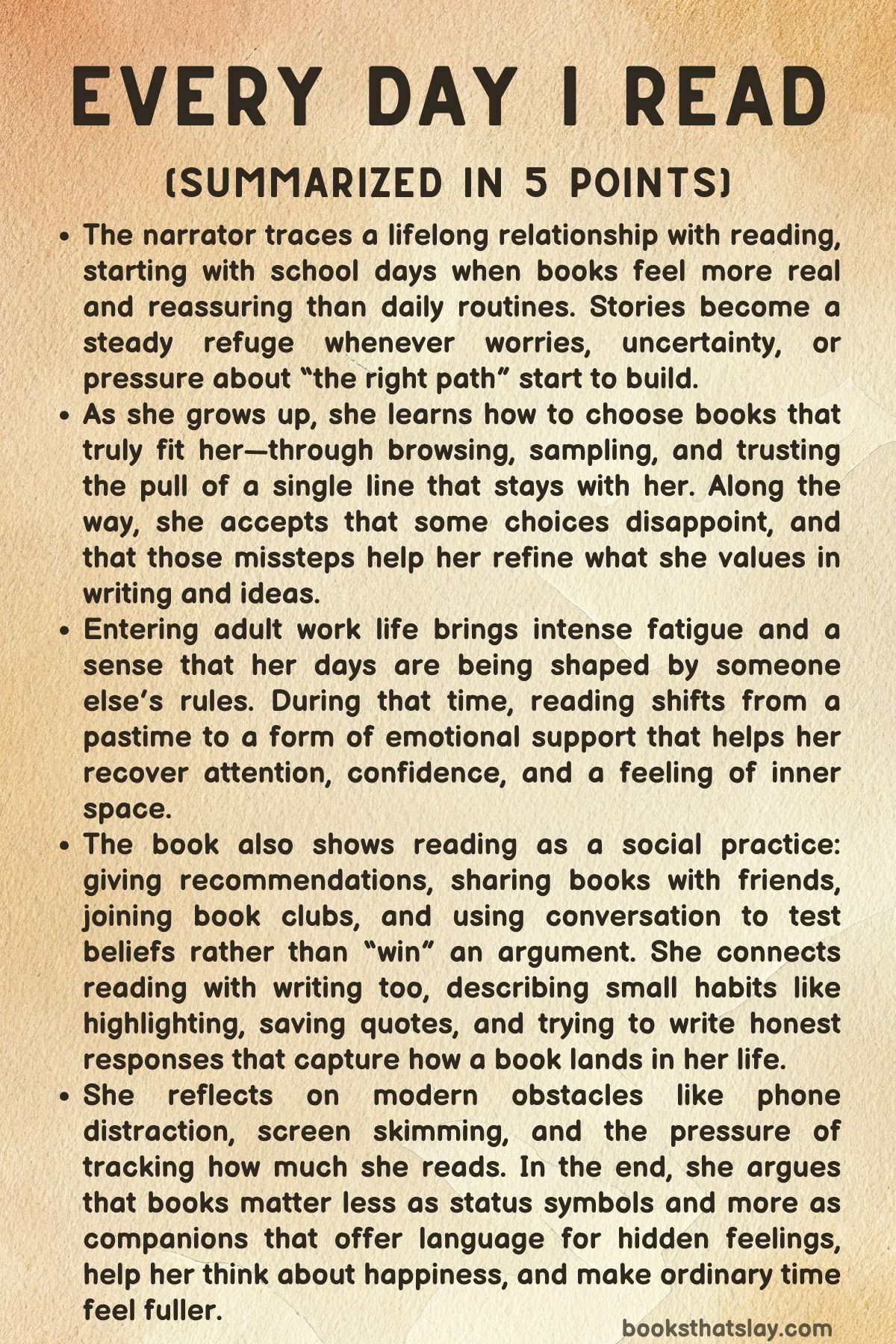
Every Day I Read by Hwang Bo-reum is a reflective nonfiction book about living alongside books—how reading shapes a person’s inner life, choices, and endurance. The narrator looks back on becoming a reader in childhood, then follows that habit into adulthood, where work pressure, anxiety, and distraction test her attention and her sense of self.
Rather than treating reading as a status symbol, she treats it as daily care: a way to steady the mind, borrow courage, and learn how other people survive. The result feels like a friend’s honest reading journal, full of lived moments.
Summary
In Every Day I Read, the narrator begins with her earliest memories of being a reader, when school feels dull compared to the bright world waiting in books. She walks to class talking with friends about what she read the night before, and she counts the hours until she can return to those pages.
Teachers and adults try to steer her toward the “right” behavior and a predictable future, and she nods along, but inside she doesn’t feel convinced. The future looks like something narrow and fixed.
When fears and questions build up, she reaches for stories because they calm her and give her somewhere else to stand.
She explains this reliance through a scene from Edgar Allan Poe’s “A Descent into the Maelström,” where a man survives a deadly whirlpool by noticing which objects resist being pulled down and then clinging to one. The narrator hasn’t faced danger like that, but she recognizes emotional versions of it—times when stress and confusion feel strong enough to drag her under.
For her, books become the object she can hold onto. As she grows older, the attachment doesn’t fade.
She imagines continuing to read as she ages and hopes other readers will recognize the quiet pleasures she loves: finding time to open a book, meeting a sentence that seems to speak directly to her, and sharing that discovery with someone else.
When people ask her what they should read, she doesn’t answer with a single favorite. She tries to learn what the person enjoys first.
If they can’t describe their taste, she recommends starting with a bestseller, not because popularity proves quality, but because widely read books often offer a friendly entry point. She mentions The Courage to Be Disliked, remembering how its conversational style and its message about living fully in the present can energize readers who feel stuck.
Her reading life is shaped early by a tall bookcase at home. As a child, she chooses books almost at random from shelves owned mostly by her parents and older sister, which means she absorbs their interests and preferences before she even has her own.
University changes that. With money from a part-time job, she starts visiting bookstores and choosing for herself.
She discovers that buying books also means making mistakes. Some books have thin ideas dressed up as wisdom; others annoy her with attitudes she can’t accept.
But even disappointing purchases teach her what she values. Over time she develops a method: she checks the table of contents and introduction, reads a few pages, and then listens for her own honest reaction.
Sometimes one sentence is enough to tip her into buying a book. That kind of instinct leads her to Nicolas Bouvier’s The Way of the World, where she is pulled in by the author’s voice and the way he observes people while traveling.
After graduation, her life is swallowed by job hunting. She studies, prepares tests, writes cover letters, attends interviews, and receives rejection after rejection until she finally gets hired by a large company during a period of expansion.
She enters with determination, but office life drains her quickly. Overtime stretches late into the night, and sometimes the long hours feel like performance rather than necessity—staying because everyone stays.
The world narrows until work crowds out everything else. On one subway ride, exhausted beyond what she can admit aloud, she catches herself wishing she could be hospitalized simply to stop.
She compares this period to the myth of Procrustes, forced to fit a shape that injures the spirit even if the body remains whole.
During this time, reading stops being a casual pastime and becomes a form of rescue. She reads intensely on her commute, choosing books instead of staring into tunnels and advertisements, hoping language can restore what work has scraped away.
She becomes especially drawn to essay collections and travel writing, where a voice can feel like company. A passage she remembers from Ryu Shiva about choosing one path and leaving other “roads” for another life presses on her mind.
It makes her wonder whether she is walking down routes she never truly chose, simply because they were available or expected.
She describes meeting friends at a café to write together, and one friend arrives with a stack of small Japanese illustrated novels. The group admires their compact beauty and the care in their design.
The narrator grows fond of short books as comfort reads for days when she feels fragile. She laughs through Lee Kijun’s Um, Excuse Me, recognizing herself in its shy humor.
Later, at a gift exchange, she worries she has chosen badly by bringing a heavy art history book that looks like a burden. Instead, her friends are delighted.
One jokes that carrying it makes her look scholarly, and the narrator feels relieved to see that people often want to know more than their schedules suggest. She also reflects on the satisfaction of finishing long books and the way steady, small goals—just a few pages a day—can move her through something like Harari’s Sapiens.
Because she forgets much of what she reads, she underlines lines and scribbles notes in the margins. She collects quotations like anchors she can return to.
Once she discovers she has read the same Alain de Botton book twice because it was published under different Korean titles, and she annotated both copies as if encountering them for the first time. The realization embarrasses her, but it also comforts her.
Even when details fade, a book can still alter the reader’s temperament and choices, leaving behind changes that don’t require perfect recall.
She keeps a book with her almost everywhere and sees reading and writing as connected habits. Both require effort, not instant reward.
Over time, though, she notices her attention weakening under the pull of her phone. Sitting with a book becomes difficult, and she has to rebuild focus through practical rules: moving distracting apps away, limiting scrolling, and reading in timed bursts—twenty minutes at a stretch—until concentration returns.
She also reflects on how rereading changes classics, and how fiction and poetry remain part of her life even when essays dominate.
Her ideal reading scene is a relaxed holiday, but she admits she often becomes restless when she finally has free time. Instead of waiting for the perfect day, she creates a nightly ritual: reading in bed under a warm lamp.
She also enjoys quiet book bars where people sit near each other in silence, each absorbed in their own pages, sharing a calm atmosphere without conversation.
The narrator is honest about not finishing everything. Some books resist her for years until the timing changes.
She repeatedly fails to enter Umberto Eco’s The Name of the Rose until she makes it past the early stretch; then the story holds her attention and she understands why others praise it. She has a similar experience with Thoreau’s Walden.
At the same time, she refuses to feel guilty about abandoning books that don’t fit her life at a given moment. She believes a difficult book can become the right book later, and forcing it too early only builds resentment.
After a tightly scheduled day, she lies in bed reading and asks herself why she gives so much of her free time to this habit. Is it “useful”?
She remembers Zhuangzi’s idea that even what seems useless can have its own kind of usefulness. She rejects the old belief that being well-read automatically leads to worldly success.
Instead, she names what she wants from books: strength, maturity, steadiness, honesty without being controlled by emotion, continued learning, wisdom, and a better understanding of other people.
A film she watched, Things to Come, gives her a living example of those hopes. She is struck by Nathalie, a middle-aged woman facing betrayal and loss with calm control.
Nathalie often carries a book, and the narrator treats that image as a symbol of steadiness and adaptation. She underlines Montaigne’s line about learning to endure what cannot be avoided and wonders if she could ever live with that kind of composure.
Nathalie becomes proof, in the narrator’s mind, that what a person absorbs through reading can later appear as real support in hard moments.
She then discovers a neighborhood library a short walk from home and becomes a frequent visitor. The library feels small, cozy, and mostly quiet, changing only during school holidays or hot summers when people arrive for air-conditioning.
She loves the sensation of shelves full of possibilities and the freedom to return a book without regret if it disappoints. She mentions Sartre’s Nausea and the character who reads every book in the library alphabetically, an idea she finds overwhelming rather than inspiring.
She prefers Alberto Manguel’s view that a library does not need to be fully consumed to be valuable. She borrows a few books at a time based on mood, sometimes trying unfamiliar genres, sometimes picking up new releases, and sometimes revisiting books she once abandoned.
After finishing books, she collects favorite lines by photographing them or typing them into Evernote. The process is slow and satisfying.
She admits that sometimes she reads partly to find sentences worth keeping. Those sentences can match her anxiety or confusion so precisely that they feel like they were written for her current life.
She builds a set of “comfort quotes,” drawn from thinkers and writers such as Seneca, Goethe, Jeon Tae-il, Einstein, Mark Rowlands, Shin Yeong-bok, Annie Dillard, and Confucius. A single sentence, she concludes, can sometimes outweigh an entire book because it becomes something she can carry into ordinary hours.
She joins book clubs and compares them to the discussion culture around France’s philosophy-focused Baccalauréat that she once saw on television. She thinks Korea’s education culture, shaped by rote learning, can make open debate difficult, but she notices book clubs growing and offering a space where people can speak without fear of having the “wrong” answer.
Her first meeting is awkward: she rehearses comments but speaks clumsily and realizes how hard it is for her to express herself out loud. Over time she learns to value disagreement, because it exposes shallow certainty and forces people to examine their beliefs.
In one club, reading Arendt’s Eichmann in Jerusalem, they argue about whether failing to think critically can itself become a moral problem, and the narrator leaves not with a neat conclusion but with sharper questions about how to live.
Reading also becomes her method for searching for answers, especially about happiness. Aristotle’s claim that happiness is the ultimate human purpose surprises her, and she studies competing ideas: virtue-based happiness, pleasure-based approaches, modern self-help promises, Buddhist detachment, and the Dalai Lama’s emphasis on a peaceful mind.
Daniel Gilbert’s Stumbling on Happiness helps her name different kinds of happiness, and she decides that the kind rooted in looking back with contentment matters most to her. She identifies what currently supports her happiness: evening walks, relationships, meaningful conversations, time alone, and doing well at work.
She is skeptical about digital reading and points to research and commentary suggesting that online reading encourages skimming and shorter attention. Still, she reads digitally every day and tries to choose wisely: screens for lighter material she can move through quickly, paper for denser books that require slower thought.
A physical book imposes limits that help her focus, while a screen demands stronger self-control.
As the book continues, she describes tracking the books she reads each month. What starts as a simple record becomes a source of pressure.
Mid-month, she checks her list and panics if the count looks small. Even though no one else sees it, she feels compelled to hit targets and sometimes chooses thinner books simply to raise the number.
She recognizes the emptiness in this drive, especially after a friend admits he sometimes reads mainly to fill his own list because an empty list makes him feel empty. The narrator begins questioning what she truly wants from reading: not a number, but a steadier self.
She pays attention to book recommendations in the media, but she is more curious about the ordinary books people read and later forget—books that may not transform a life, yet still offer guidance when someone feels stuck. She wants to remember which book helped her on a particular day, because she believes those small rescues matter.
A friend’s confession makes this belief more urgent. The friend shares pain from years of marriage difficulties, cramped living conditions, infertility struggles, and the fear of falling behind others.
The narrator tries to comfort her and realizes that simple reassurance often fails when someone can see only what they lack. She reflects on how people hide their problems and how public images can create the illusion that everyone else is thriving.
Writers matter, she thinks, because they put difficult emotions into words and show that light and darkness can exist together in a single life.
She also describes her habit of reading reviews and essays about books, sometimes spending long stretches on them. Reviews can help her choose what to read, but they can also sway her too easily, so she tries to trust those that include clear summary and quotations rather than exaggerated emotion.
A strong review, she finds, can deepen her interest and sharpen her attention when she reads the book itself.
Her reading eventually leads to writing. She starts a private blog and posts daily after work, watching the number of posts rise.
After a year she worries that her writing might be empty and joins a writing class taught by a book critic. The class reads a book every two weeks and workshops personal writing connected to the reading.
The instructor encourages “reader responses” rather than formal criticism: write what the book stirred, what it clarified, what it disturbed. As the narrator reads with the intention to write, she marks more phrases and pays closer attention.
She admits writing is hard, but she insists the habit matters first—write a few honest sentences, use prompts, set small goals, and keep going.
She becomes attached to fictional characters and carries them in memory long after she forgets plot details. She jokes about labeling friends with character names and describes how certain stories stay with her like quiet companions.
At one point she declutters after reading books about minimalism, boxing up belongings and then facing her bookcase. She sets a personal limit—around 500 books—not as a strict rule but as a reminder to buy less and read more.
Yet the shelves fill again, showing how desire returns, and how her discipline must be renewed.
Not all reading is comforting. She describes struggling through Sue Klebold’s memoir about Columbine, finding it emotionally exhausting but necessary.
Some books, she believes, force a person to face reality rather than hide from it, echoing Kafka’s idea that books should strike the reader awake.
When she hits a summer spell of writer’s block, she turns to books about writing and artists’ lives. She learns about the Japanese illustrator Mizumaru Anzai and is inspired by his insistence on making work he genuinely believes is good.
She encourages reading in alignment with one’s current concerns, whatever they are. She also pushes herself to read beyond her usual interests, discovering that broader reading—such as Peter Drucker—can widen her thinking and alter how she approaches work and life.
She notices despair spreading among friends who fantasize about leaving Korea. She recognizes her own old coping habit of researching Sweden during bleak periods, not because she plans to go, but because imagining a different life offers relief.
Again, books become her store of hope. She builds a personal reserve of sentences she can return to when she feels pressured or deprived, a private “vending machine” of stories and ideas.
She talks about difficult books and how persistence can matter more than immediate understanding. A musician friend begins reading Nietzsche with almost no comprehension but keeps going, and gradually the text becomes clearer.
The narrator adopts this approach: continue reading without demanding full mastery, trusting that repetition can bring understanding later.
Near the end, she describes texting friends and family to ask what they have been reading. The replies vary widely and often reveal what each person is worried about, longing for, or trying to change.
She realizes the question “What have you been reading?” is a gentle way to learn who someone is at that moment. Finally, she imagines a world without books, recalling Fahrenheit 451 and what would vanish if stories and records were destroyed.
For her, losing books would mean losing a vital part of herself, because reading connects her to other minds, comforts her in ordinary suffering, and helps her make meaning out of daily life—one small stretch of time at a time.
Key People
Hwang Bo-reum
In Every Day I Read (Hwang Bo-reum), the narrator is defined less by external drama and more by an inner life that keeps expanding through reading. From middle school onward, books function as her most reliable emotional technology: when school feels rigid, when adulthood feels like a prewritten script, and when anxiety spirals into unanswered questions, she reaches for stories as a stabilizer rather than an escape hatch.
What makes her compelling is her honesty about the double edge of this devotion. Reading is her refuge, but it can also become a measuring stick she uses to judge herself, as seen in her monthly reading lists and the panic of an “empty” record.
Over time, she becomes a careful observer of her own habits—how she chooses books, abandons them without guilt when timing is wrong, rereads without remembering, and rebuilds concentration after digital distraction erodes it. Her growth is not a clean transformation; it’s a long practice of returning to books to recover steadiness, enlarge her understanding of others, and keep a sense of self intact when work, comparison, or modern attention traps threaten to flatten her.
Nathalie
Nathalie, a figure the narrator encounters through film, becomes an ideal of composure under strain. The narrator is struck by how Nathalie faces betrayal and death with calm steadiness and how a book in her hands symbolizes an inner anchor rather than an accessory.
Nathalie matters because she turns the narrator’s hope into an image: the belief that what is absorbed through reading can resurface later as resilience when life tightens. Instead of being a distant role model, Nathalie becomes proof-of-concept for the narrator’s central faith—that books are not only emotions in the moment, but stored strength that can reappear as endurance and adaptation.
Loh Kiwan
Loh Kiwan, a fictional figure the narrator is deeply moved by, shows how her reading crosses the boundary from pastime to lasting empathy. She describes carrying him in her thoughts after finishing the portrayal, which suggests that characters can become moral companions—people who alter how she perceives vulnerability, borders, and belonging.
Loh Kiwan’s presence highlights the narrator’s tendency to form attachments not only to ideas but to human faces inside stories, and it demonstrates her belief that reading expands one’s inner population: the people you have never met can still take up residence in your concern.
Meursault and Gregor Samsa
These remembered names function as emblematic residents of the narrator’s mental world. She holds onto them long enough to jokingly label friends after characters, which shows both intimacy and play: literature becomes a shorthand for temperament, mood, and worldview.
Their role is not to drive plot but to reveal how thoroughly the narrator’s identity is braided with what she reads. They also hint at her attraction to characters who are isolated, estranged, or transformed—figures that echo her own loneliness at times and her sense that modern life can estrange a person from themselves.
Nekhlyudov and Maslova
These two emerge as a scene that echoes even when the narrator closes the book, illustrating her fragment-time reading life—snatching moments before work, after lunch, on commutes, and while waiting. The power of their encounter lies in how it lingers, proving that reading does not require long uninterrupted hours to be profound.
For the narrator, their story represents the way a narrative can keep unfolding internally across ordinary time, turning small pockets of reading into a continuous emotional thread that accompanies her through the day.
Themes
Reading as emotional survival and self-stabilization
School feels like a place where rules and timetables flatten the narrator’s inner life, so the most reliable way to stay psychologically steady is to step into stories. Reading is presented as an everyday coping mechanism rather than a lofty cultural practice: when worry, uncertainty, or unanswered questions swell, a book becomes the quickest route back to composure.
The comparison to Poe’s whirlpool scene makes the point without turning it heroic—books function like something you can grab when you sense yourself starting to spiral. That idea matures with age.
In adolescence it is relief from boredom and anxiety; in adulthood it becomes the difference between being swallowed by exhaustion and keeping a sense of self intact. What matters is not that books “solve” the narrator’s problems, but that they offer enough structure, language, and alternative perspective to prevent emotional free fall.
Even the small details—reading on the commute instead of staring into a tunnel, keeping a book within reach, building a ritual in bed by lamplight—show reading as a stabilizing routine that can be repeated when life becomes noisy or harsh. In Every Day I Read, the narrator’s attachment to reading is not framed as escapism that avoids reality; it is closer to a pressure valve that makes reality bearable.
The comfort is practical: a chapter can fill a difficult hour, a paragraph can interrupt catastrophic thinking, and a single line can give shape to feelings that previously had no name.
Work, conformity, and the fight to keep a private self
The corporate period in the narrator’s early twenties highlights how quickly a person’s life can be narrowed until only performance remains. Job hunting reduces identity to grades, tests, and interview scripts; employment turns time into something owned by the company, including “overtime” done for appearances.
The narrator’s fantasy of being hospitalized signals how the body becomes the last available exit when social expectations and workplace norms feel non-negotiable. The Procrustes image sharpens the theme: the harm is not only tiredness but the pressure to fit a predefined shape, to become the “right” kind of worker even if that requires cutting away parts of one’s inner life.
Reading pushes back against that reduction. It becomes a quiet refusal to let the job be the only narrative that matters.
Essays, travel writing, and reflective books serve as counter-voices that remind the narrator that there are other roads and other definitions of a good life. This theme also shows how compliance can be external while resistance stays internal: the narrator can nod along to adults and managers while privately maintaining an independent mental space through books.
Every Day I Read treats the private self as something fragile under modern routines, and it suggests that protecting it is not a grand rebellion but a daily practice—choosing what enters the mind, making time that belongs to no one else, and returning to language that is not corporate or transactional.
Writing, reader response, and building a voice through reading
The narrator’s private blog and writing class show how reading can become a method for learning to articulate the self. Writing begins as a daily accumulation of posts, then becomes a more demanding practice when the narrator questions quality and seeks guidance.
The instructor’s insistence on “reader responses” rather than formal criticism is crucial: it legitimizes subjective experience as material worth shaping into language. As the narrator starts reading with the intention to write, attention changes—phrases are marked, moments are noticed, emotional reactions are taken seriously.
The theme suggests that writing is not only output but a way of processing life with honesty. It is hard, it requires habit, and it benefits from small goals and prompts, but it offers something reading alone sometimes cannot: a clearer sense of one’s own perspective.
Every Day I Read also implies that writing strengthens reading in return. When you know you might write about a book, you become less passive and more responsive; you notice how a text moves you, irritates you, or alters your thoughts.
This creates a feedback loop where reading and writing together become tools for self-knowledge. The narrator does not romanticize creativity; they acknowledge writer’s block, seek artist biographies for encouragement, and learn from creators who prioritize sincerity over approval.
In that way, writing becomes another form of protecting the inner self—putting personal truth into words before outside voices define it for you.
Facing darkness, moral clarity, and books as confrontations
Not all reading in the book is comforting. The narrator’s experience with Sue Klebold’s memoir and the weight of Columbine forces a confrontation with suffering that cannot be smoothed over.
The decision to keep reading despite emotional pain becomes a statement about maturity: some truths must be faced because refusing them protects comfort at the cost of reality. Kafka’s metaphor of a book as an “axe” captures the idea that reading can hurt in a necessary way, breaking through numbness, denial, or shallow optimism.
This theme deepens the book’s moral dimension. Reading is not only self-care; it is also a practice of not turning away, of learning to see what is difficult without becoming sensational or detached.
The narrator’s interest in discussions about critical thinking and moral responsibility aligns with this: a well-lived life requires the courage to think and to feel in the face of disturbing information. Every Day I Read suggests that confronting darkness through books can widen empathy and strengthen ethical awareness.
It also provides a counterbalance to the productivity theme: a painful book may slow reading down, reduce enjoyment, and offer no easy “takeaway,” yet it can still be among the most valuable experiences because it changes what the reader is willing to acknowledge about the world.
Material spaces of reading and the longing for a book-centered life
Libraries, book bars, small illustrated novels, heavy art books, and the nightly lamp ritual present reading as something embodied and located. The narrator is drawn to places where books are physically present and shared quietly with others.
The neighborhood library offers a feeling of abundance without ownership, and the ability to return a disappointing choice reduces the fear of making the “wrong” decision. That freedom encourages exploration—borrowing by mood, trying new genres, revisiting abandoned titles—making reading feel like an ongoing relationship rather than a test.
The book bar adds another layer: reading alongside strangers creates community without pressure to perform. Silence becomes a shared agreement that attention matters.
The narrator’s affection for compact books on bad days and the pleasure of finishing thick books show that the physical form influences emotional experience: size, weight, and design shape what a reader expects and what kind of comfort they seek. Every Day I Read also addresses accumulation through the decluttering and “500 books” limit.
The narrator respects books as objects but resists turning them into mere possessions. The limit becomes an ethical reminder to read rather than hoard, to choose deliberately rather than shop endlessly.
These spaces and objects reveal a longing for a life oriented around thoughtful time—time that is not fully consumed by work, noise, or endless scrolling, and where the self can breathe.