Mafia and Scars Summary, Characters and Themes
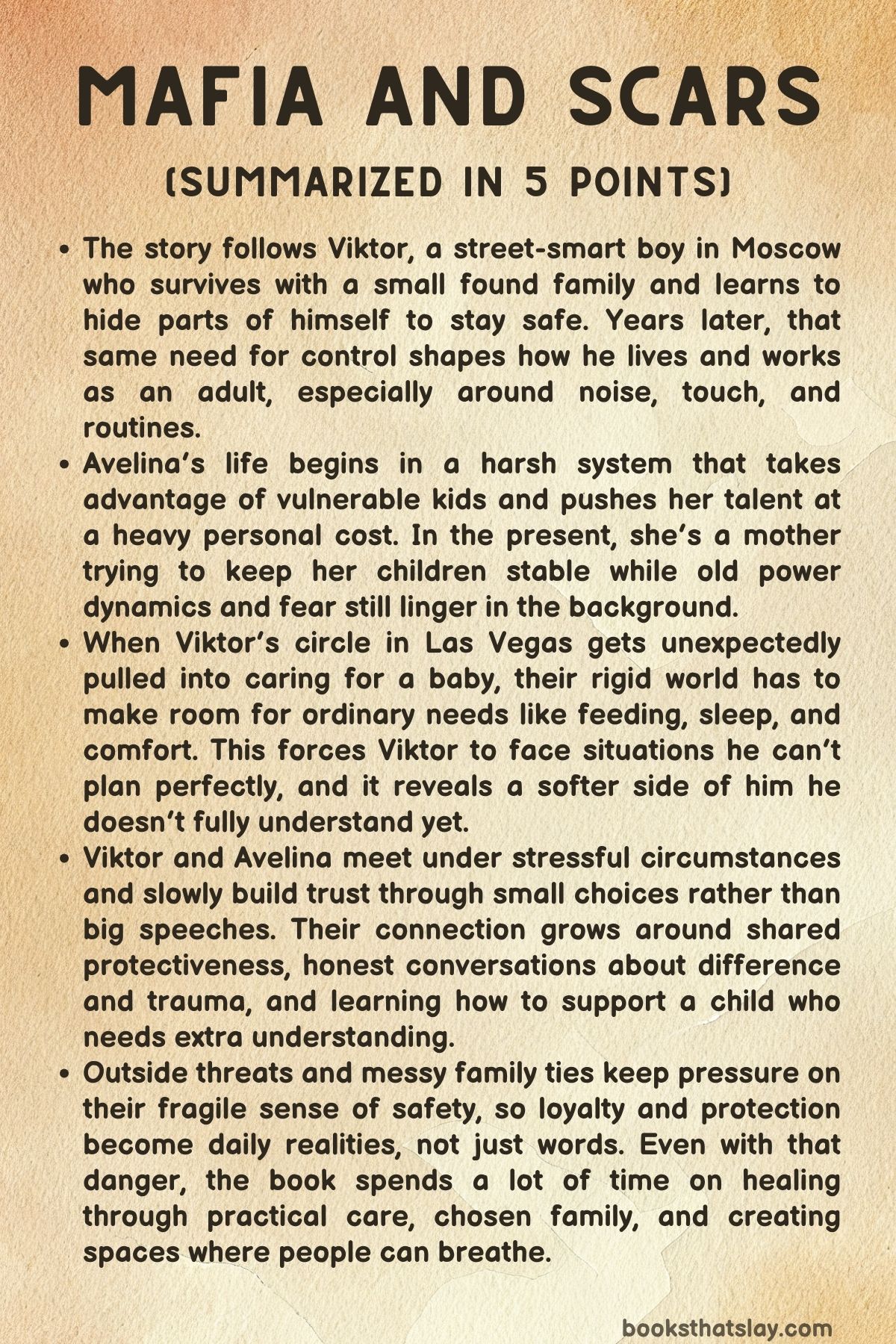
Mafia and Scars by Isa Oliver is a contemporary romantic suspense novel set between Moscow and Las Vegas, centered on two survivors who build a home inside chaos. Viktor grew up on Moscow’s streets and now operates as a disciplined enforcer in a powerful Vegas syndicate, managing sensory overload and social expectations as an autistic man who’s learned to mask for safety.
Avelina is a former elite figure skater marked by institutional abuse and coercion, now a single mother trying to protect her children. When their lives collide because of an abandoned baby and returning threats from Russia, they discover that safety isn’t only a fortress—it’s also care, boundaries, and the choice to stay.
Summary
Viktor’s earliest memories are built on cold, hunger, and rules that keep him alive. As a boy in Moscow, he survives by stealing food and watching patterns—timing, crowds, escape routes.
One day, a ragged but well-dressed boy darts into Viktor’s usual bakery target, snatches a roll, and draws attention that ruins Viktor’s careful routine. Viktor chases him, angry and desperate.
Yet when he catches up, the other boy is shaking with hunger. Viktor breaks his stolen loaf and gives the bigger half away.
The boy is Grigory, and a brief brush of fingers makes Viktor recoil; touch hurts and overwhelms him in a way he can’t explain.
Grigory admits he steals because his father threw him out to “toughen him up.” Viktor, reluctant but unable to leave him outside, offers him a place to sleep for a few nights. He brings Grigory to the small flat he shares with his grandmother, Babulya, and two other boys, Matvey and Nikolai.
The household isn’t gentle, but it’s loyal. They steal and sell what they can, pooling the money to keep food on the table and a roof overhead.
Grigory fits into their rough system quickly, and the group becomes a strange, steady family—one held together by necessity and an unspoken promise to not abandon each other.
By fourteen, Viktor tries to understand his own mind by tracking how “busy” his thoughts are. He experiences his thinking as fast, relentless, and exhausting, often like stark black-and-white images.
He meets Grigory at the library and goes with him on a burglary, watching Grigory move with confidence through broken doors and dark rooms while Viktor keeps watch. They sell what they’ve taken and buy food for the others.
Later, lying on the kitchen floor, Viktor asks Grigory what thinking and dreaming feel like. Grigory describes thoughts that arrive one at a time and dreams filled with color.
Viktor realizes he is different in a way he doesn’t have language for, and the fear of being “wrong” presses in.
That night Viktor breaks into the library, climbs through a damaged window, and searches medical journals until dawn. He finds the word “autism,” reads the clinical descriptions, and sees himself in the pages: aversion to touch, difficulty with eye contact, the internal experience that never shuts off.
The language feels harsh and dangerous. Viktor decides no one can know—not Grigory, not Matvey, not Nikolai, not even Babulya—because he believes difference will make him a liability.
If he is a liability, his family suffers. So he vows silence, turning secrecy into another survival rule.
Avelina’s childhood runs in a parallel track of fear and control. At eleven, in a Moscow orphanage, she’s singled out along with two other girls when three men arrive.
Sister Paraskeva orders the girls to go with them. Avelina senses the lie immediately and refuses, but one of the men—Gennady—hits her and drags her to a car.
The building they take her to is not a home. It’s a place for evaluation, selection, and punishment.
By thirteen, Avelina understands the reality: the men work under government authority, taking girls to be tested, trained, and abused. After weeks of brutal assessments, she’s placed in a strict figure-skating facility.
She’s told she owes the state, that her body belongs to results, and that gratitude is required. Training is relentless, skates are painful, and mistakes are treated as moral failures.
Skating becomes her only moment of relief—movement that briefly gives her space inside her own skin—until Gennady’s presence poisons even that. He humiliates her, threatens her, and teaches her that perfection is never enough and hunger is a tool.
Years later, Avelina wakes in Las Vegas from nightmares that still carry Gennady’s voice. She has two children—Sofia, six, and baby Leon—and she clings to routines that tell her she’s safe.
Her marriage to Geliy has deteriorated into neglect and cruelty. His mother, Olga, needles and judges her.
Geliy’s work is dangerous, his attention unreliable, and Avelina learns to expect abandonment even while she tries to pretend she’s built a stable life.
In present-day Vegas, Viktor lives at Grigory’s heavily guarded compound, nicknamed the Kremlin. Viktor, Grigory, Matvey, and Nikolai have risen from street survival into military service and then into running a powerful criminal operation.
Viktor’s adult life is built on rigid structure: controlled schedules, minimal chaos, and rules that protect his nervous system. He wears black to avoid visual overload.
Unexpected noise and touch can push him into panic, so he tracks his stress in a notebook and uses headphones to block the world when it becomes too much.
One day, irritated by mess on the property, Viktor finds a starving calico cat hiding in the bushes. He takes her inside partly out of practicality and partly because he can’t ignore a creature that fragile.
He names her Queenie. To his surprise, her steady presence becomes calming.
He tolerates her closeness in ways he doesn’t tolerate people. Around the same time, Viktor watches figure-skating videos to self-soothe and becomes fixated on an old, grainy clip of a skater in a Tinkerbell costume.
He replays it repeatedly, captivated by the joy on the ice and the mystery of who she was.
Avelina loses her coaching job in Vegas and accepts a short-term coaching opportunity in Moscow to earn money. She travels with Sofia, leaving Leon with Geliy, though she doesn’t trust him.
On the plane and in Moscow, she cycles through old memories—Geliy’s insults, Olga’s harassment, the sense of being watched. Geliy grows harder to reach, and anxiety builds as Avelina waits for confirmation that Leon is cared for.
Her instincts keep warning her that the past doesn’t stay buried.
Not long after, Viktor is tasked with picking Geliy up in Vegas to repay an old debt—Geliy once saved Viktor’s life. Geliy immediately disrupts Viktor’s careful balance: loud music, aggressive chatter, mocking Viktor’s boundaries, pressing him about dating.
Viktor drops him at a run-down apartment and gives him directions to the Kremlin when Geliy insists on speaking with Grigory. Viktor drives away overstimulated and irritated, already certain Geliy is trouble.
That evening, Geliy arrives at the compound and forces his way into the men’s space, joining a poker game and cheating openly. While the others seethe, Viktor hears noises from Geliy’s luggage and sees a red beam.
He assumes weapon, draws his gun, and rushes forward—only to find a baby strapped into a car seat, playing with a light-up toy. Geliy casually announces it’s his son, Leon, and implies Avelina dumped the child on him.
The room shifts instantly: hardened men faced with a helpless infant, and a situation none of them are built for. Grigory assesses the risk and, after checking who can tolerate it, allows Geliy and Leon to stay.
Avelina returns to Vegas after three exhausting weeks and lands to a message that knocks the air out of her: Geliy has left Leon with someone named Viktor. She doesn’t know who he is, only that her baby is inside an armed fortress with strangers.
She rushes there with Sofia, terrified by guards and walls. Viktor meets her with cold anger and clipped control, taking her keys and parking her car with effortless precision when she fumbles under pressure.
Sofia, unfiltered and bold, calls him out, startling him.
Grigory storms in and accuses Avelina of abandoning her child. Avelina fires back that she traveled for work and Geliy is the one who vanished.
The standoff ends in uneasy compromise: Viktor invites them to dinner. At the table, Avelina’s warmth disarms the men one by one.
Viktor watches her care for Leon with practiced tenderness. He also watches Sofia’s behavior—her sensory responses, her bluntness, her need for certain kinds of comfort—and something in him tightens with recognition.
Avelina plans to leave in the morning, but she collapses at a market stop. Sofia panics, and the hospital becomes a new threat when social workers begin discussing taking the children because Geliy won’t answer calls.
Viktor arrives fast, steady and terrifying in his authority. He declares Avelina and the children will stay with him, effectively blocking the system from splitting them apart.
Doctors insist Avelina needs rest. Viktor forces additional tests, arranges her discharge, and brings the family back to the compound.
Inside the Kremlin, Viktor turns protection into logistics: assigning soldiers to help, managing schedules, insisting on rules. The men struggle with diapers, crying, and the unpredictability of children.
Viktor, overwhelmed by noise and chaos, still refuses to let Avelina lose her kids. In private, he softens in ways that surprise him—baby-talking Queenie, adjusting to Sofia’s presence, trying to build order that doesn’t require shutting people out.
When Babulya arrives unexpectedly and finds Avelina in Viktor’s bed, she erupts in Russian fury and smacks Viktor with a wooden spoon, convinced he’s doing something foolish. Even that chaos has a strange warmth, like the old Moscow flat has echoed forward into this new life.
As Avelina recovers, she and Viktor spend time together at the ice rink. Viktor admits how deeply skating affects him and confesses he doesn’t experience emotions like most people do.
He reveals his autism, the secrecy he built around it, and how he’s begun feeling new things lately—especially around her. Avelina doesn’t treat him like a defect to fix.
She holds his hand, listens, and tells him he doesn’t have to perform another version of himself to be loved. Their closeness turns into a kiss, then a private intimacy that changes the atmosphere between them.
Viktor’s fear spikes after that. The intensity of physical connection scrambles his sense of control.
When Nikolai’s surveillance drones start buzzing loudly over the compound, Viktor snaps under the sensory assault and shoots several down with an RPG. The others are stunned, furious about the cost, but Grigory recognizes it isn’t really about drones.
Pressed in Grigory’s office, Viktor admits he wants Avelina seriously and doesn’t know how to do it without messing up. The solution, absurd and sincere, becomes a “dating training” session where the men coach Viktor through basics: asking questions, making conversation, offering genuine compliments, not forcing himself into a persona.
When Viktor finally lists what he truly likes about Avelina—her intelligence, humor, steadiness—the men go quiet, realizing it’s real.
Viktor tries to ask Avelina out and panics, inviting her to help in the vegetable garden instead. Avelina accepts, delighted, and they work side by side under soft lights, building comfort through shared quiet.
Viktor admits he meant a “real date.” Avelina kisses him and tells him it already was one. They plan dinner on Saturday.
For the dinner, Viktor buys Avelina a sapphire dress, but it’s too tight. The moment triggers her old trauma—body shaming, hunger, control.
Viktor finds her crying and reacts with fierce certainty: Gennady was wrong, and no one gets to reduce her to shame again. Then, trying to fix what he can, he produces a second box containing the same dress in every size, telling her to choose the one that fits and that the rest will be donated.
It’s awkward, excessive, and deeply Viktor: problem-solving as love.
Life at the Kremlin starts to change shape. Sofia brings bright chaos into the men’s rigid world: tea parties, costumes for the pets, blunt declarations about who belongs.
Grigory, to everyone’s shock, participates with careful seriousness. Viktor learns Sofia seeks deep-pressure hugs when overwhelmed.
When Avelina reveals Sofia is autistic, Viktor doesn’t flinch; he recognizes her and understands what that means for her needs. He gives Avelina a children’s book titled All Cats Have Autism, along with supportive tools for Sofia—ear defenders and a weighted blanket—offering practical care without judgment.
Then the past reaches through the walls. Avelina receives an email from Gennady saying he’ll be in the United States.
She sees him on television arriving with a Russian skating team. Panic drives her to the rink at night, and he appears there, having gotten inside despite locked doors.
He tells her they’ve watched her for years and threatens Sofia, demanding the child be delivered into a new program. He implies that Leon and even Viktor could be targets.
Avelina collapses on the ice afterward, terrified and furious.
When Viktor notices something is wrong and pushes for the truth, Avelina tells him everything. Viktor’s response is simple and lethal: if Gennady comes near her or the children again, Viktor will kill him.
But Avelina’s needs go beyond vows. She tells Viktor she doesn’t want to run anymore, yet she also refuses to be kept in the dark.
If they are building a life together, she wants to be included in decisions and safety planning. Viktor agrees, promising she will never face danger alone.
They choose each other fully, not as a rescue fantasy, but as a partnership with boundaries, honesty, and shared responsibility.
The compound grows gentler. Sofia gives Viktor matching pink kitten slippers—one pair for her, an oversized pair for him.
Viktor wears them, threatening his men into silence if they laugh, and keeps them on longer than anyone expects. Wanting to give Sofia something that matches her needs, he builds her a quiet den shaped like a small castle with pillows, a weighted blanket, soft lighting, and carefully arranged stuffed cats.
He also builds Queenie a sheltered window space so she can retreat from noise while still enjoying sunlight. Sofia names her den the “Magic Meow House,” and Avelina is moved by how Viktor anticipates sensory safety, not only physical protection.
Sofia insists on a “family photo” with pets in capes and crowns. Viktor tries to remove himself, claiming he isn’t part of them.
Sofia tells him he belongs because he keeps them safe and makes her mother smile. The words land hard.
Soon after, Viktor secretly learns to ice skate with Matvey’s help. He falls repeatedly and hates the unpredictability, but he keeps going because skating matters to Avelina and Sofia and he wants to share that world with them.
Even as the home strengthens, Viktor doubts himself. He worries he can’t love “correctly,” measuring feelings like numbers and fearing he’ll always come up short.
Avelina confronts his withdrawal and listens as he admits that his internal world, once mostly black-and-white, has begun showing hints of color—especially when he thinks of her. Avelina tells him love isn’t a score.
She points to what he does: consistent care, thoughtfulness, protection, and the willingness to stretch without erasing himself. That steadiness is love.
Sofia eventually asks Viktor to read All Cats Have Autism with her. As they read, Sofia recognizes herself in the pages.
She says she thinks she has autism, and Viktor quietly says he does too. The men overhear and respond without mockery, making the moment feel safe rather than exposed.
Later, Olga visits and insults Avelina and targets Sofia’s autistic traits. Sofia becomes overwhelmed and runs.
Viktor stops Olga firmly, and Avelina refuses to tolerate the contempt. The boundary is clear now: this family does not make room for cruelty.
Viktor’s biggest declaration arrives in his own language. He builds a private ice rink inside the compound, sets up Avelina’s favorite music, and provides freshly sharpened skates.
He skates with her—awkward, determined, present—and tells her this is how he says he loves her. He also meets a neurodevelopmental doctor who explains that his black-and-white thinking can be a stress-filtering response, helping Viktor feel less broken and more understood.
Sofia bluntly tells Viktor he should marry Avelina and be her dad. Viktor admits he wants that but fears his differences will make him fail them.
Sofia repeats what Avelina has taught her: different doesn’t mean broken. Viktor begins planning a proposal.
In the epilogue, Sofia asks to draw rainbows on Viktor’s tattoos with washable markers. Viktor agrees, setting boundaries so it stays tolerable.
Avelina watches, stunned that Viktor allows color and disorder onto what he once treated like armor. Over the next week, Viktor starts wearing a pocket square in a different color each day, moving from red through violet as a controlled way to embrace change.
On the day of violet, Avelina asks why. Viktor explains that color used to overwhelm him, but now he can handle it—and sometimes even like it—because of her and the children.
In the garden, he proposes. Avelina says yes.
Viktor gives her the violet pocket square as a symbol: not of becoming someone else, but of choosing a full spectrum life with the family he’s built.
Characters
Viktor
Viktor is the emotional core of Mafia and Scars because the story tracks how a boy who learned to survive by controlling everything becomes a man who learns that love cannot be controlled, only chosen. His childhood on the streets of Moscow builds him into someone intensely observant, practical, and protective, but it also wires his nervous system for constant threat detection, which shows up later in rigid routines, strict boundaries around touch, and a relentless need for order.
His autism is not presented as a quirk or a tragic label, but as the lens through which he experiences the world: sensations hit harder, noise becomes pain, unpredictability becomes panic, and social expectations feel like rules written in invisible ink. Because he believes difference equals danger, he hides his diagnosis for years, convinced that being “found out” would make him a liability to the people he loves.
In adulthood, his authority and competence in violence and logistics contrast with his vulnerability in intimacy; he can run an operation, survive an ambush, and interrogate threats, yet he struggles to interpret feelings that don’t translate cleanly into numbers, scores, or systems. Avelina and the children shift his inner world from monochrome safety to risky color, and the narrative makes that change tangible: he begins tolerating touch through Queenie, practicing emotional language through “dating training,” and building literal safe spaces for Sofia and Queenie as a way of building emotional safety for himself.
Viktor’s growth is not about becoming less autistic; it is about becoming less ashamed, learning that love can be steady and practical, and realizing that his care is already visible in what he does—showing up, protecting, adapting, and choosing softness without surrendering his boundaries.
Avelina
Avelina’s character is defined by survival under coercion and the long aftershocks of being treated like property. Her early years in the orphanage and the government-controlled selection process create a trauma imprint that follows her into adulthood through nightmares, hypervigilance, and a constant sense of being watched.
Skating is her paradox: it is both the place she is most alive and the place where her body, talent, and obedience were policed, especially through Gennady’s cruelty and the way he weaponized shame to control her. As an adult and a mother, she is warm and capable on the surface, but that warmth is hard-earned rather than naïve—she knows how dangerous “respectable” people can be, and she has learned that safety is not a location, it is a set of protections and choices.
Her relationship with Viktor works because she does not demand he perform emotions in a conventional way; she listens to how he explains himself and meets him where he is, treating his boundaries as real rather than negotiable. At the same time, she refuses to become a passive protected figure inside the compound; her turning point is not simply accepting Viktor’s security but insisting on agency—being included in planning, decisions, and precautions.
Avelina’s arc is ultimately about reclaiming ownership of her life: she stops running in the way trauma taught her to run, not because danger disappears, but because she chooses partnership, insists on respect, and builds a family structure where her children’s needs and her own dignity are nonnegotiable.
Grigory
Grigory functions as Viktor’s anchor, mirror, and gatekeeper of their chosen family, embodying the kind of loyalty that can look harsh until you understand it is rooted in protection. His early introduction as the starving boy Viktor feeds establishes a lifelong bond built on shared survival, and as adults he becomes the leader who has to balance affection with control to keep the entire operation alive.
He is pragmatic, suspicious of outsiders, and quick to interpret risk as betrayal, which is why he initially lashes out at Avelina—his accusation is less about moral judgment and more about threat assessment, because a woman arriving with children can be leverage, chaos, or an entry point for enemies. What makes him compelling is that he can be wrong and still be loyal; once he understands the situation, his leadership shifts toward containment and problem-solving rather than punishment.
He also serves as Viktor’s social translator, pushing Viktor toward emotional honesty in ways that are blunt but protective, as seen in his insistence that Viktor name what he wants and learn how to approach Avelina respectfully. Grigory’s presence keeps the story from becoming only a romance; he represents the machinery of the compound and the reality that love has to exist inside a world of violence, risk, and responsibility.
Matvey
Matvey is the steady ballast of the group, often acting as the practical bridge between intensity and normalcy within the compound’s strange version of domestic life. His history alongside Viktor, Grigory, and Nikolai gives him the same foundational loyalty, but his role tends to be supportive rather than dominant, which is why he can help Viktor without turning it into a power struggle.
He is the kind of friend who teaches through doing—helping Viktor learn to skate, tolerating the awkwardness, and letting persistence matter more than pride. Matvey’s humor and willingness to tease are not just comic relief; they are part of how the group regulates stress, turning fear and pressure into something they can survive together.
In the evolving household dynamic, Matvey’s acceptance helps normalize the presence of Avelina and the children, reinforcing that “family” in this world is defined by protection, effort, and inclusion rather than blood or tradition.
Nikolai
Nikolai represents the loudest form of friction inside Viktor’s carefully controlled environment, which makes him essential to illustrating Viktor’s sensory limits and the group’s internal dynamics. He is inventive, provocative, and often amused by disruption—his drones are a perfect symbol of that, because they are impressive and useful while also being an unbearable sensory assault for Viktor.
Nikolai’s tendency to push buttons creates conflict, but it also surfaces the truth faster; when Viktor shoots the drones down, the moment is extreme, yet it forces an overdue conversation about what is really happening inside Viktor. Like the others, Nikolai is protective and loyal even when he is irritating, and his willingness to participate in the “dating training” shows that beneath the bravado is a sincere investment in Viktor’s happiness.
He also embodies the group’s version of acceptance: even when he reacts loudly or complains about cost and inconvenience, he still adapts to the reality that the compound is changing into a home that includes children, routines, and softness.
Babulya
Babulya is the original architect of Viktor’s concept of family, representing a fierce, no-nonsense love that kept children alive when the world offered them nothing. Her presence in Viktor’s childhood flat turns a survival den into a home, and her influence explains why Viktor’s protectiveness is not only tactical but deeply moral inside his own code.
When she reappears in the present and reacts explosively to Avelina being in Viktor’s bed, the moment is comedic on the surface, but it also reveals how deeply she guards Viktor—she reads vulnerability as danger because she has spent a lifetime watching danger swallow boys like him. Babulya’s love is physical, loud, and unquestionable, which contrasts with Viktor’s restrained affection and shows that tenderness can look very different across generations and nervous systems.
She is also a reminder of origins: no matter how powerful Viktor becomes, part of him is still the child who needed one safe adult, and Babulya remains the symbol of that safety.
Geliy
Geliy is chaos given human form, and his function in the story is to test the boundaries of responsibility, decency, and loyalty. He is loud, entitled, and disrespectful of Viktor’s needs, using mockery and provocation to assert dominance in conversations, especially around touch and dating.
His neglect reaches its ugliest point when he abandons Leon, treating his own child as an inconvenience and attempting to outsource consequence to Viktor and the compound. Yet the story also frames him as complicated by history: Viktor agrees to help him because Geliy once saved his life, creating an uncomfortable moral debt that keeps Viktor tied to someone he despises.
Geliy’s presence forces the household to clarify what kind of men they want to be; rejecting CPS is not framed as legality versus illegality so much as a fear of losing a vulnerable child to a system, and Geliy is the spark that ignites that ethical crisis. Ultimately, Geliy operates as a contrast character: where Viktor grows into steadiness, Geliy remains selfish, and where Viktor turns power into protection, Geliy turns relationships into leverage.
Sofia
Sofia is the heart of the new family unit, functioning as both a child in need of safety and a surprisingly direct truth-teller who accelerates emotional honesty in adults who are used to hiding. Her autism is portrayed through her sensory needs, overwhelm, and comfort-seeking behaviors, and the narrative treats those needs as valid rather than inconvenient.
Sofia’s bond with Viktor is transformative because she does not fear his bluntness or his boundaries; she engages him with the straightforward logic of a child, calling him out when necessary and loving him without demanding performance. The small moments—asking him to do her hair, insisting he belongs in the family photo, giving him bright pink kitten slippers—matter because they force Viktor to practice flexibility in a context that feels emotionally safe.
Sofia also becomes an advocate for herself over time, especially in the moment she chooses to read All Cats Have Autism and names what she recognizes in herself; that self-recognition is mirrored by Viktor’s quiet confirmation, creating a bridge between them that is based on shared experience rather than pity. Sofia’s role is not to “fix” Viktor; it is to invite him into belonging, and her insistence that he can be a husband and father reframes his fear of being “wrong” into a question of willingness and care.
Leon
Leon is the catalyst that turns a guarded fortress into a home, forcing Viktor and the men to confront caregiving as a form of strength. As a baby, he is not a developed personality in the same way the others are, but his presence changes the entire social ecosystem: sleep schedules, noise, diapers, the need for patience, and the reality that violence cannot solve hunger or loneliness.
Leon’s crying becomes an overstimulation trigger for Viktor, which exposes Viktor’s limits without shaming them; the story uses Leon to show that love sometimes begins as obligation and becomes attachment through repeated acts of showing up. Leon also deepens Avelina’s stakes and vulnerability, because his safety is constantly threatened by Geliy’s irresponsibility and by the reach of Gennady’s shadow.
In a narrative filled with power and control, Leon represents pure dependence, and that dependence draws out the gentler, more human side of men who have been trained to treat softness as weakness.
Gennady
Gennady is the primary embodiment of institutional cruelty in the story, using authority, humiliation, and fear to turn gifted children into controllable assets. His abuse is not only physical or verbal; it is psychological engineering, teaching Avelina that her body is a problem and her worth is conditional, which is why even an ill-fitting dress years later can trigger panic and collapse.
What makes him especially threatening is his persistence—he is not just a villain of the past but a living reminder that trauma can return wearing a clean suit and a public-facing title. His demand for Sofia is the escalation that reveals his worldview: children are raw material, and families are obstacles to be crushed.
Gennady’s presence forces the romance to mature into partnership under threat, because Viktor’s instinct is violent protection while Avelina’s need is strategic inclusion; the conflict he brings is not simply “defeat the bad man” but “build a life that cannot be easily stolen.”
Olga
Olga serves as a social antagonist rather than a physical one, weaponizing respectability, judgment, and cruelty to destabilize Avelina and shame Sofia. Her insults target home, motherhood, and neurodivergent behaviors, attempting to reassert hierarchy in a space where she has no real authority.
What makes her impact significant is that she triggers a protective line in both Viktor and Avelina: Viktor’s firmness and Avelina’s refusal to tolerate contempt show how far they have come in building boundaries. Olga’s role clarifies the values of the new family unit—Sofia’s needs are not to be minimized for social comfort, and Avelina will not accept being diminished to keep peace.
In a world full of overt threats, Olga represents the quieter violence of disdain, and the story uses her to underline that emotional safety matters as much as physical safety.
Queenie
Queenie is not just a pet; she is Viktor’s first safe experiment with touch, comfort, and attachment, making her emotionally symbolic even when she is simply a cat doing cat things. Viktor initially takes her in for order and cleanliness, which matches how he approaches everything—control first, feeling later—but her steady presence becomes regulating, giving him a living creature whose affection is predictable, honest, and nonverbal.
The fact that he can learn to tolerate and then enjoy her contact shows how Viktor’s boundaries are not coldness but sensory reality, and it foreshadows his ability to build intimacy with Avelina on terms that respect his nervous system. Queenie’s backstory adds poignancy, positioning her as another survivor who has lost safety and then found it again, which mirrors the human arcs around her.
Her role also expands the theme of “safe spaces” in the most literal way, because Viktor eventually builds environments designed for comfort and regulation not only for Sofia but also for Queenie, reinforcing that care in this story is expressed through thoughtful structure.
Albert
Albert, the dog, operates as a counterbalance to Queenie’s quieter comfort, bringing a different kind of warmth into the compound and highlighting how the household is transforming. His presence supports Sofia’s imaginative play and helps soften the men’s environment through small domestic rituals like costumes, tea parties, and “family photos.” Albert also becomes a social glue, pulling even resistant adults into shared moments of gentleness, and Grigory’s eventual participation in Sofia’s games shows how a child and a dog can disarm hardened men without asking for permission.
Where Queenie reflects Viktor’s controlled affection, Albert represents joy that is slightly messier and more communal, reinforcing the theme that love can be loud, playful, and still safe when the people around it choose kindness.
Igor
Igor and the unnamed soldiers function as the operational backdrop that makes Viktor’s world believable, but they also become an unexpected chorus for normalization and acceptance. Their struggles with childcare underscore how unprepared violence-trained men can be for tenderness, yet their eventual compliance and adaptation show that competence can be learned in the domestic sphere too.
The men’s nonjudgmental reaction when they overhear Viktor and Sofia acknowledging autism is especially meaningful because it reframes the compound from a place of fear into a place of belonging; acceptance is not delivered through speeches but through the absence of ridicule and the continuation of ordinary life. Collectively, they represent the shifting culture Viktor is building—one where protection includes emotional safety, children’s needs are taken seriously, and difference is not automatically treated as weakness.
Themes
Survival as a Moral Practice in a World That Punishes Need
Cold streets, hunger, and the constant risk of being noticed shape Viktor’s earliest understanding of right and wrong. Survival is not presented as a clean fight between good people and bad choices; it is shown as a daily negotiation where the price of hesitation can be starvation.
The first meeting between Viktor and Grigory captures this clearly: Viktor is angry because his “system” for stealing food has been disrupted, yet the moment he sees Grigory shaking with hunger, he breaks the loaf and gives away the bigger half. That act is not framed as easy generosity; it is a decision made under scarcity, which gives it moral weight.
It establishes a pattern that repeats later when Viktor, now powerful, still experiences the world through a lens of threat assessment and resource control, but continues to make choices that prioritize keeping vulnerable people alive and close.
What makes survival feel like a theme rather than a plot condition is how often it forces characters to decide what kind of person they can afford to be. Viktor believes that if anyone knows he is autistic, he will become a liability, and liability is dangerous because it could get the group hurt or killed.
That fear is a survival logic, not self-hatred for its own sake. Avelina’s history shows another version of survival: she learns early that compliance is demanded, that institutions can hurt you while calling it training, and that the safest face can still be attached to violence.
When she returns to Russia for work and later races back for her baby, the story is clear that “safe choices” are often illusions when power is uneven.
Survival in Mafia and Scars also becomes a test of whether protection can exist without possession. Viktor and the men at the compound offer shelter, resources, and defense, but the story repeatedly pressures Viktor to choose between controlling people “for their own good” and respecting their agency.
Avelina’s insistence on being included in security planning becomes a turning point because it rejects the idea that survival must always mean obedience to the strongest person in the room. The theme argues that staying alive is not only about escaping danger; it is also about keeping dignity intact while doing it.
Chosen Family and the Work of Belonging
The book builds family out of necessity long before it becomes a comfort. Viktor’s household with Babulya, Matvey, Nikolai, and later Grigory is not a sentimental replacement for what was lost; it is a structure built to make sure everyone eats and sleeps indoors.
The bonds grow through repetition and shared risk, and those bonds remain central even after the men gain wealth and influence. The “Kremlin” compound is essentially the adult version of the childhood flat: a fortress that exists because the world has taught them that safety is rare and must be constructed, staffed, and defended.
What changes is not their need for family, but what family asks of them once children enter the space.
Leon’s arrival forces an immediate recalibration. The men are trained for violence and control, yet they are confronted by a baby’s needs, which cannot be threatened, negotiated with, or solved through force.
Viktor’s frantic attempt to hire help, his rejection of nannies who feel unsafe or careless, and his refusal to call CPS reveal how chosen family can become both care and fear. He does not want the system to take Leon because Viktor understands systems as places where people can disappear.
At the same time, keeping Leon inside the compound demands new skills: patience, responsiveness, and the ability to tolerate noise and mess. The family has to expand its definition of competence.
Avelina and Sofia deepen this theme by challenging the group’s social rules. Sofia speaks directly, calls out unfairness, and insists on emotional truths the adults try to dodge, including the claim that Viktor belongs in their family because he makes her mother smile and keeps them safe.
That insistence matters because Viktor’s self-image is built around usefulness and control, not belonging. When he tries to step out of the “family photo,” it exposes his fear that he is only a tool, not a person with a place.
Sofia’s logic refuses that: family is defined by consistent care, not by blood or perfect behavior.
The story also shows chosen family as accountability. Grigory questions Viktor’s decisions, the men push Viktor to communicate, and Babulya’s chaotic return disrupts the fragile order in a way that still reads as familial, because it is intimate and unfiltered.
Belonging here is not passive acceptance; it is a daily practice of making room for others, even when their needs cause discomfort, conflict, or change.
Neurodivergence, Shame, and the Relief of Being Known
Viktor’s autism is not treated as a decorative trait or a simple obstacle to overcome. It shapes perception, emotion, memory, and the body itself, especially through sensory overload and touch aversion.
Early on, Viktor responds to touch as pain and overwhelm, and he organizes his world to reduce surprise: routines, black clothing, controlled environments, and careful tracking of internal “busyness.” The notebook is important because it shows self-monitoring as both coping and isolation. Viktor learns to translate his experience into numbers because numbers feel safer than admitting vulnerability.
When he discovers the term “autism” in medical journals, he does not feel relief; he feels danger. He immediately frames it as information that could get him abandoned, because his entire survival strategy depends on being reliable under pressure.
As an adult, Viktor still assumes disclosure will be punished. He expects people to interpret him as broken, cold, or defective, and he has evidence for that expectation because boundary violations happen constantly, especially through mocking his no-touch rule.
The narrative does not ask him to “be less autistic”; instead, it stresses how much energy it costs to function in a loud, unpredictable world. That makes moments of acceptance feel earned rather than inspirational.
Avelina’s response when Viktor tells her is quiet and direct: she does not ask him to perform normalcy, and she does not treat his differences as something she can love him out of. She accepts the terms of his nervous system and offers closeness without forcing contact.
Sofia’s revelation brings a second layer: neurodivergence becomes something that can be named without shame. The scene of reading All Cats Have Autism matters because it turns self-understanding into a shared language.
Sofia recognizes herself in the descriptions of quiet, schedules, and pressure, and Viktor’s simple statement that he is autistic too is a model of calm truth-telling. The men overhearing without ridicule adds to the theme: the group’s culture can change, and masculinity does not have to be built on contempt for difference.
Later, a neurodevelopmental doctor reframes Viktor’s black-and-white thinking as a stress-filtering response, which matters because it shifts the story from “something wrong with me” to “this is how my brain protects me.” That reframe does not erase hardship, but it removes the moral judgment attached to it. In Mafia and Scars, being known safely is not a reward for becoming easier to handle; it is a form of healing that comes from finally being believed.
Trauma, Control, and the Fight to Own Your Body Again
Avelina’s past is defined by coercion disguised as purpose. The orphanage removal, the government involvement, the harsh evaluation, and Gennady’s degrading control tactics show trauma as systematic rather than accidental.
Her body becomes a site of ownership disputes: institutions and men claim it, measure it, shame it, and demand performance. Skating, which initially offers release and a sense of freedom, becomes contaminated by the people who attach pain, surveillance, and punishment to it.
That is why her relationship with skating in the present is complicated: it can soothe her, but it also carries memories that return as nightmares and panic.
The book repeatedly shows how trauma teaches the brain to look for danger even in ordinary settings. Avelina feels watched at the rink, panics when messages seem “off,” and reads threats into silence because silence has been dangerous before.
The reappearance of Gennady in the United States confirms that her fear is not irrational; it is informed. His threat to take Sofia for a “training program” extends the abuse across generations, turning motherhood into a new vulnerability.
He does not only threaten Avelina’s safety; he threatens her identity as a protector of her children, which is why the fear hits so hard.
Recovery in this story is not shown as forgetting or becoming fearless. It is shown as shifting the balance of control back to the survivor.
Avelina’s demand to be included in security decisions is a key example: she refuses the role of passive protected woman and insists on informed consent in her own life. Viktor’s instinct is to guard, isolate, and eliminate threats, but Avelina pushes for partnership rather than containment.
That negotiation is part of healing because it rebuilds trust on terms that do not repeat the original power imbalance.
The dress scene captures trauma’s physical triggers. A garment being too tight instantly returns Avelina to a world where her body was policed and shamed.
Viktor’s response is telling: he corrects the cruelty, not her body. He does not ask her to “get back in shape” or dismiss her reaction; he recognizes that the pain is real and that the abuser’s voice still echoes.
His solution—getting multiple sizes and letting her choose—also matters thematically because it returns choice to her. The theme argues that reclaiming the body is not about looking a certain way or performing confidence; it is about restoring agency in small, concrete decisions where agency used to be stolen.
Love Communicated Through Structure, Boundaries, and Small Acts
Romance here is not built on grand speeches or effortless emotional fluency. Viktor often struggles to identify feelings, fears he cannot love “correctly,” and tries to convert intimacy into measurable certainty.
That insecurity is not treated as a quirky trait; it is tied to his lifelong experience of being misunderstood and punished for difference. Love therefore becomes something he expresses through planning, building, and protecting.
He learns to ask questions, to arrange environments, to create predictable safety, and to show up consistently. The garden “date” is a good example: he intends something conventional, fails to execute it, and accidentally offers an activity that fits his nervous system.
Avelina recognizes it as a real date because it contains attention, time, and care rather than performance. The story suggests that romance does not need to match a standard script to be meaningful.
Boundaries are central to this theme. Viktor’s no-touch rule is not a barrier that Avelina “breaks through”; it is a reality she respects.
When touch happens, it is negotiated, and the intensity is acknowledged rather than romanticized as “melting” his defenses. That matters because it portrays consent as ongoing and practical.
Viktor also learns to tolerate discomfort for the sake of connection, but the book is careful to show this as his choice, not a requirement imposed on him. Doing Sofia’s hair with bright colors and clips stresses him, yet he persists because the child’s joy matters to him.
The resulting warmth he feels is not framed as proof he is becoming someone else; it is proof that care can expand a person’s range while still respecting their limits.
Love also becomes visible through environments Viktor creates. Sofia’s quiet den and Queenie’s enclosed retreat are physical expressions of “I notice what overwhelms you and I will help you manage it.” The private ice rink is another expression, but it is important that it is tailored: her favorite music, sharpened skates, space protected from outside threat.
He even learns to skate, despite hating unpredictability, because sharing matters more than pride. These are not flashy gifts meant to impress; they are solutions to specific needs, which is how Viktor communicates devotion.
When Viktor begins wearing a different pocket square color each day and allows Sofia to draw rainbows on his tattoos, love is shown as a controlled opening to change. He does not abandon his need for order; he expands it to include the people he has chosen.
The theme presents love as reliability with room for growth: not perfect emotional expression, but repeated acts that say, “I am here, I am paying attention, and I will keep making space for you.”
Power, Violence, and the Limits of Protection
The men’s criminal power is never separated from the emotional story; it is the ground they live on. Viktor and his circle have survived by becoming dangerous, and their competence in violence is described with the same matter-of-fact precision as Viktor’s coping routines.
This creates a constant moral tension: protection is real, but it is backed by lethal force, intimidation, and a world where problems are often solved by removing people permanently. The attack at the docks and the efficient elimination of attackers show how normal violence has become in their lives.
That normalization becomes ethically uncomfortable once children are present, because the same skills that keep them safe also risk shaping what “normal” looks like for Sofia and Leon.
The story repeatedly tests whether protection can be loving without becoming controlling. Viktor’s first response to threats is to lock things down and personally stand guard.
Avelina appreciates safety but refuses to be treated as cargo. Her insistence on being included in planning forces Viktor to confront a hard truth: protection that excludes the protected person’s voice can feel like another form of captivity.
This is especially relevant given Avelina’s past, where powerful men claimed authority over her “for a purpose.” The narrative makes it clear that intent is not enough; process matters. Being included, being informed, and being respected are part of what makes protection ethical.
Gennady’s presence sharpens this theme because he represents institutional power dressed in respectability. He arrives with a team and public legitimacy, yet he is a predator.
Viktor’s world is criminal, but it is honest about what it is: armed guards, fortress walls, direct threats. The contrast challenges the easy assumption that legality equals safety.
Avelina’s line of reasoning—someone who looked safe attacked her, and Viktor saved her—forces readers to reconsider the social signals that often hide harm. At the same time, Viktor’s vow to kill Gennady raises the question of what justice looks like when the state is part of the threat.
The book does not resolve this into a clean moral answer; instead, it shows the characters choosing the tools they have, because the systems that should protect them are compromised.
Power inside the compound is also examined through social hierarchy. Grigory’s authority sets rules, mediates conflicts, and questions Viktor’s actions.
Even in a violent organization, there is governance, negotiation, and restraint, especially when it comes to Viktor’s sensory limits and the children’s needs. The theme suggests that power is inevitable in their environment, but its moral value depends on whether it is used to silence others or to create conditions where the vulnerable can live without fear.