Persephone’s Curse Summary, Characters and Themes
Persephone’s Curse by Katrina Leno is a modern gothic story set inside a New York brownstone where the Farthing sisters have grown up with family legends that feel too specific to be fake. Their Aunt Bea insists they’re descended from Persephone, tied to the boundary between life and death.
For years, the house holds one constant secret: Henry, a quiet teenage ghost who lives on the fourth floor and smells faintly of jasmine. As the sisters get older, love, mental illness, grief, and the pull of the “in-between” begin to shape their lives—and threaten to tear their world open.
Summary
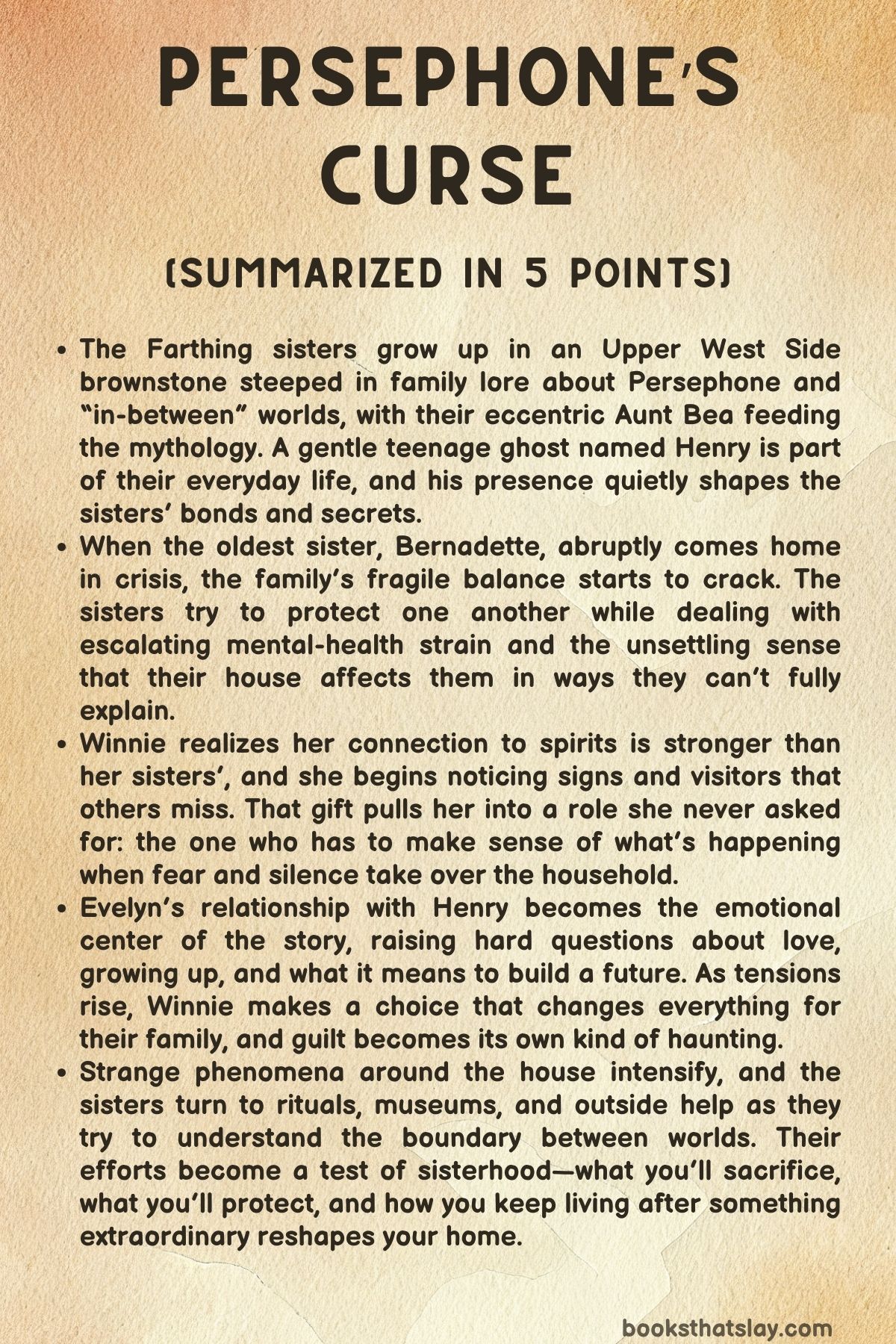
The Farthing sisters—Bernadette, Evelyn, Winnie, and Clara—grow up in their family’s Upper West Side brownstone surrounded by strange rules and stranger stories. Their Aunt Bea treats the family history like something sacred, insisting the Farthing girls come from Persephone’s bloodline and belong between worlds.
The house itself feels alive with memory, and one of those memories has a name: Henry, a gentle ghost who lives in a small bedroom on the fourth floor. The girls learn about him early, and while he rarely causes fear, his presence becomes part of their childhood the way creaky stairs or old wallpaper might.
When Winnie is nine, she’s slapped by Bernadette after wandering into her room. Winnie runs crying to Evelyn, and Henry appears—quiet, kind, and oddly practical.
He comforts Winnie, tells her to apologize first, and jokes that he’ll put worms in Bernadette’s bed if Bernadette doesn’t apologize back. He fades as he leaves, leaving behind a lingering jasmine scent.
Winnie realizes then that Henry is not just a story. He is real, and he pays attention.
Years pass, and the sisters grow into their own personalities. Bernadette becomes intense and volatile, Evelyn becomes careful and private, Winnie becomes observant and emotionally tuned-in, and Clara—much younger—seems sensitive in a way that doesn’t always have words.
Henry stays in the background like a shadow the family has learned to live with.
Everything shifts when Bernadette suddenly returns home late at night during a storm. She arrives frantic, exhausted, and determined not to go back to college.
The sisters gather in the living room, and Bernadette begs them not to wake their parents—then remembers their parents are away for the weekend. In the kitchen, she admits she can’t keep doing school or work, and that she’s done pretending she can.
Winnie cries as Bernadette holds her. That night, all four sisters sleep together upstairs on the fourth floor, and Evelyn quietly acknowledges Henry’s presence nearby, making their group feel complete: girl, girl, girl, girl, ghost.
The next day, the sisters go to Todd’s diner. Winnie notices Bernadette has a black eye.
Bernadette claims it came from a volleyball, even though she doesn’t play volleyball. She becomes defensive when they ask what happened, then breaks down sobbing.
Clara, worried, secretly calls their parents. When the parents arrive early, Bernadette shows their father a video that supposedly proves the volleyball story, but she also insists that the injury isn’t the real reason she came home.
Trying to escape the pressure, Bernadette drags Winnie out, first claiming they’ll go to a museum. On the walk, Bernadette has a panicked episode and refuses to explain what’s wrong.
She fixates on small things—like Winnie wearing Bernadette’s college sweatshirt—and demands it be taken off because she can’t stand seeing it. Instead of the museum, Bernadette impulsively cuts her hair into a short pixie.
Back home, the family reacts with shock. Bernadette cries again, Evelyn is furious, and Clara tries to minimize it as “just hair.” Henry appears briefly in the attic, avoiding questions, then disappears.
Not long after, Winnie realizes she can see more than just Henry. While walking alone, she spots another ghost—a faint Farthing woman—something her sisters don’t seem to notice.
That discovery makes Winnie feel both special and frightened, as if she’s been chosen for something she never asked for.
At dinner, Evelyn is tense and stormy. Winnie follows her and pushes until Evelyn finally confesses the real reason she’s upset: she’s terrified of leaving the house because she doesn’t want to leave Henry behind.
Winnie realizes with shock that Evelyn is in love with him. Evelyn begs Winnie not to tell anyone.
Winnie agrees, but the secret changes everything.
Evelyn’s attachment to Henry becomes clearer as time passes. She detours on walks because Henry once sat by the reservoir when he was alive.
She speaks about death with an intensity that makes Winnie uneasy. Evelyn reveals that their relationship became real on her seventeenth birthday, when Henry—stuck forever at seventeen—couldn’t bear the thought of her growing older without him.
They admitted their love, and Evelyn began living as if the house and Henry were her whole future.
Meanwhile, Bernadette’s instability worsens. Clara paints obsessively after nightmares that seem to predict harm.
The family goes to the Cloisters, where Evelyn gives Clara their grandmother’s watch in an emotional moment that feels like preparation for something. At home, Bernadette drops a wineglass while washing dishes and suddenly screams, collapsing into a violent breakdown.
Their father restrains her and brings her upstairs. The sisters try to cover the sound with a board game while fear spreads through the house.
As autumn deepens, Bernadette disappears overnight. Her room is unnaturally neat.
The family reveals she has been taken to Aunt Bea’s farmhouse in Vermont. No one will explain much.
The house feels hollow without her.
One night, Winnie returns home and catches her mother sneaking out with an overnight bag to drive to Vermont. Winnie insists on coming.
During the late-night drive, Winnie thinks about Aunt Bea—an eccentric artist who treats the family’s Persephone story like truth. Winnie’s mother tells her that Winnie has a gift for showing up when she’s needed, and for caring in a way that changes things.
At Aunt Bea’s, Winnie sees another ghost: Esme, a six-year-old girl who died in the house and still lingers. Esme dances by the fire as if she’s alone in her own world.
In the morning, Bernadette wakes Winnie affectionately and seems calmer. She admits she got into a fight at college and that her anger has been growing.
She says the Farthing house “pulls” at her even when she’s away. She confesses she’s been diagnosed with bipolar II disorder and is starting treatment—therapy, medication, and a psychiatrist.
She connects her experience bitterly to the myth of Melinoë, Persephone’s daughter associated with madness and ghosts.
While spending the day together in Burlington, Winnie accidentally reveals Evelyn’s secret love for Henry. Bernadette says she and Clara already suspected, but they didn’t realize how serious it was.
Winnie fears Evelyn will never leave the house or build a life. Bernadette agrees it’s dangerous and promises to think.
Back in New York, Winnie finds Henry in Evelyn’s room. A surge of anger rises in her—something she doesn’t fully recognize as her own.
She confronts Henry and demands he stop appearing to Evelyn. Henry refuses.
He says he loves Evelyn and won’t abandon her. Winnie argues that his love will trap Evelyn forever.
In a desperate moment, Winnie tells Henry that none of them want him there anymore, and she commands him to go away.
Henry reacts as if he’s heard something beyond her words. He says “Oh,” and vanishes.
Afterward, Winnie is overwhelmed by guilt. She senses her command didn’t just hurt Henry’s feelings—it changed the rules.
The next day, Evelyn confronts Winnie in panic, screaming Henry’s name, knocking on doors, desperate for the jasmine scent that won’t return. Winnie lies, pretending she doesn’t know.
Evelyn becomes hollow and obsessive, knocking until her knuckles bleed.
Bernadette and Clara force Winnie to admit what she did. Clara is horrified.
Bernadette, pragmatic and furious, insists they can’t bring Henry back and must never tell Evelyn. They decide to keep Evelyn busy with outings and distractions until the heartbreak dulls.
For a while, it works. Evelyn begins to laugh again.
She stops knocking. But Winnie deteriorates under the weight of what she’s done.
During Thanksgiving and into early December, guilt eats at her. Then, during a family outing, Winnie blurts something that gives her away.
Evelyn understands immediately. She doesn’t scream.
She simply knows.
A week later, Evelyn disappears.
Desperate, Winnie goes searching for answers from the dead. She visits a graveyard at night and begs Henry to tell her if Evelyn is okay.
A priest finds her and, though confused by her plan, lets her stay. Winnie later visits an occult shop called Dark Magic, where a bored clerk suggests scrying with water.
Winnie tries it at home. At first nothing happens—until a ghost appears in her kitchen.
Winnie whispers “Evelyn?” The ghost nods yes, then disappears. Winnie is shaken, refusing to accept that Evelyn is dead.
Winnie tries the Metropolitan Museum’s Temple of Dendur, hoping ancient stone might help her call Henry. Nothing happens.
She returns to Trinity Churchyard and convinces the same priest to bring her into the crypts by claiming family ties. Underground, Winnie begs Henry again, pressing her hands into the gravel in helpless frustration.
Clara suddenly appears, having tracked Winnie using an app she secretly installed after Evelyn vanished. Clara shows Winnie her finished painting: their backyard in winter, a black slash in the sky, and Evelyn sitting on a bench beneath it.
Clara insists the painting is “today.”
The sisters rush home. The back door is open.
The house is cold. In the backyard, Evelyn sits exactly like the painting, pale and altered, wearing different clothes and looking like someone who has been away too long.
Evelyn says she went to find Henry. She says she went to the Underworld.
Evelyn collapses from weakness. Later, she explains she was gone three nights—but experienced three years.
Cameras never caught her leaving. She believes she traveled through the house itself, through thin places she calls Persephone’s footsteps.
She describes an Underworld that resembles their world but darker, filled with strange music and dancing. Henry was with her, but he didn’t make it back.
Soon, the sisters see a massive black tear in the sky above their house. It shimmers, grows, and cannot be captured on camera.
The air inside the brownstone becomes heavy and cold. Clara senses something emerging from the tear.
Winnie returns to Dark Magic and meets Maybe, a medium. Maybe agrees to perform a séance.
In the attic, Maybe has them cleanse the space, light candles, and use a crystal for yes/no answers. The séance confirms Henry is present and safe.
It also suggests he may be stuck. When asked if he can come back, the answer is uncertain.
Evelyn admits she already tried to return to the doorway and couldn’t. Tensions explode.
The séance ends abruptly, leaving them with more fear than comfort.
As the tear grows, the house begins to steal things from the living. Clara can’t paint—her brush won’t leave color.
Evelyn can’t play the piano—keys move under her fingers, but no sound comes. Their mother becomes vacant and headache-prone, while their father tries to act normal.
Winnie realizes that leaving the house makes her feel lighter, but returning feels like being dragged under.
One day, Winnie walks to the frozen reservoir and Henry appears beside her—outside the house, which should be impossible. He finally tells her his story.
He was born in 1901 and died in 1918 during the flu pandemic. His doctor father brought the illness home.
Henry’s parents and three sisters died. The Farthings took him in and hid him in the attic while he was sick.
When he died, they buried him in the backyard by jasmine bushes so he wouldn’t be thrown into a mass grave. That is why he smells like jasmine.
Henry explains the danger: the tear is drawn to the house and the land because of the family’s connection to Persephone. If the tear reaches the house fully, the Overworld and Underworld will merge, trapping the Farthings in a looping, impossible space.
Henry says he can fix it by using his spirit to seal the tear—sacrificing himself.
Christmas arrives under deep snow. The tear fills the sky.
Evelyn gives her sisters matching gold necklaces engraved with their initials. When the adults leave for a neighbor’s party, the sisters finally confront the truth together.
Henry tells them what closing the tear will cost.
Before sealing the tear, they decide to close the original doorway Evelyn once opened, so no Farthing can repeat the mistake. In the attic, Bernadette sacrifices a cherished journal from Vermont to locate and seal it.
The journal vanishes, and they hear a sound like an invisible lock clicking shut.
Then they go into the backyard. Snow becomes falling jasmine flowers.
The tear presses down like a ceiling. Henry says goodbye to each sister.
When he reaches Winnie, Winnie understands the final piece: her ability to see ghosts is also a tether. If she releases that part of herself, she will release all the ghosts bound to the house—including Henry, Esme, and every Farthing spirit lingering there.
Winnie finds the inner door and lets go.
A burst of golden light spreads across the city for seconds—bright enough to become headlines. The tear seals, leaving a faint gold seam in the sky only the sisters can see.
The ghosts are gone. The house feels emptier, but also lighter.
Their mother even says she feels relief without knowing why.
The sisters grieve in private ways. Clara struggles to paint again.
Bernadette reads obsessively. Evelyn breaks down when no one can hear her.
But time moves forward. Bernadette returns to school in Vermont.
Evelyn leaves for a conservatory in Boston. Winnie stays, still able to see the gold seam sometimes and still catching the scent of jasmine on certain days, missing Henry even as she knows she set him free.
On Winnie’s eighteenth birthday, the family gathers. Maybe gives Winnie a bracelet meant to strengthen communication with the unseen.
Clara, finally able to paint again, gives Winnie a picture of their backyard: jasmine falling, the gold seam in the sky, and four hands below—girl, girl, girl, girl, ghost—showing that Henry, in the way that matters most, is still holding their world together.
Characters
Winnie Farthing
Winnie is the emotional and moral center of Persephone’s Curse, serving as the narrator through whose perceptions the story unfolds. She is observant, empathetic, and deeply tied to the unseen world, gradually realizing that her ability to see and command ghosts is not accidental but inherited and powerful.
Winnie’s defining struggle is between care and control: her love for her sisters drives her to make devastating choices, particularly when she banishes Henry in an attempt to protect Evelyn’s future. Her arc is shaped by guilt, responsibility, and sacrifice, culminating in her willingness to give up her supernatural connection entirely so that both worlds can be restored.
Winnie embodies Melinoë’s legacy not as madness, but as stewardship of grief, memory, and release.
Evelyn Farthing
Evelyn is intense, inward, and emotionally absolute, experiencing love and loss without moderation. Her bond with Henry is sincere and consuming, offering her understanding, companionship, and a sense of belonging that the living world does not fully provide.
Evelyn’s refusal to let go of Henry reflects her fear of change, adulthood, and separation, which makes her particularly vulnerable to the pull of the in-between world. Her journey to the Underworld marks a turning point, leaving her altered, quieter, and more fragile, as if part of her remains elsewhere.
Evelyn’s arc explores the danger of romanticizing stasis and the cost of choosing the past over the living present.
Bernadette Farthing
Bernadette is volatile, fiercely protective, and painfully self-aware. Her struggle with bipolar II disorder is portrayed with nuance, showing both her sharp intelligence and her destructive spirals.
She resents being seen as fragile yet recognizes her own instability, which fuels her defensiveness and secrecy. Bernadette often assumes the role of the realist among the sisters, making harsh but pragmatic decisions, such as insisting Henry cannot be brought back and pushing the family forward even when it hurts.
Her sacrifice of the Vermont journal symbolizes her willingness to lose pieces of herself to protect her sisters, and her eventual return to school suggests a hard-won commitment to survival and growth.
Clara Farthing
Clara is the youngest and most intuitively sensitive of the sisters, expressing her understanding of the world through art rather than words. Her paintings function as premonitions, capturing emotional and supernatural truths before anyone else can articulate them.
Clara’s quiet fear, especially of repeating past breakdowns and losses, makes her observant and cautious, yet she is not passive; she tracks Winnie, confronts hard truths, and runs toward Evelyn when she returns from the Underworld. Clara represents the cost of living alongside trauma from a young age, and her eventual ability to paint again signals healing without forgetting.
Henry
Henry is a gentle, restrained presence whose politeness and kindness contrast sharply with the devastation his existence causes. Frozen at seventeen, he represents unresolved grief, interrupted life, and the lingering aftermath of historical catastrophe, particularly the 1918 flu pandemic that took his family.
His love for Evelyn is genuine but inherently unequal, rooted in stillness while she continues to grow. Henry’s ultimate role is not as a romantic figure but as a guardian and repairer, choosing self-erasure to prevent the collapse of both worlds.
His transformation into the golden seam that seals the tear reframes him as a force of restoration rather than haunting.
Aunt Bea
Aunt Bea is the family’s bridge between myth and modern life, embodying inherited knowledge without fear or denial. Artistic, eccentric, and grounded, she accepts the Farthing lineage as something to be lived with rather than explained away.
Bea provides refuge, especially for Bernadette, and models an adulthood that integrates the strange and the painful without being consumed by it. Her reverence for Persephone and quiet guidance position her as a keeper of tradition who trusts the younger generation to find their own way through it.
Esme
Esme, the ghost of a young girl at Aunt Bea’s farmhouse, serves as a quiet mirror to Winnie. Like Winnie, Esme could see ghosts while alive, and her continued presence is gentle rather than frightening.
Esme’s insistence that sisters always help each other reinforces the novel’s central ethic of familial responsibility. Her eventual release alongside the other ghosts affirms that lingering is not the same as living, even when it feels safe.
Maybe
Maybe, the medium from Dark Magic, occupies the boundary between authenticity and uncertainty. She is perceptive, practical, and respectful of forces she cannot fully control, refusing melodrama or false certainty.
Maybe’s inability to see the tear while still sensing its wrongness reinforces the idea that belief alone does not grant access; lineage and sacrifice do. She functions as a reminder that not all spiritual work is heroic, and that limits must be acknowledged.
Melinoë and Zagreus
Melinoë and Zagreus function as mythic archetypes rather than active figures, framing the sisters’ experiences within a larger cosmology. Melinoë’s association with madness and ghosts resonates most strongly with Winnie and Bernadette, recontextualizing mental illness and spectral sensitivity as inherited burdens rather than personal failures.
Zagreus, tied to rebirth, reflects the possibility of renewal that follows sacrifice, underscoring the novel’s insistence that endings are not annihilations but transformations.
Themes
Inheritance as a living force
The Farthing sisters grow up in a house where family history is not a set of anecdotes but a pressure that shapes daily life, choices, and even perception. Aunt Bea’s insistence that they descend from Persephone is more than a romantic story; it becomes a framework that explains why the house feels charged, why the sisters seem pulled toward certain roles, and why the boundary between the living and the dead is unusually thin.
In Persephone’s Curse, inheritance works like gravity: Bernadette describes the brownstone as something that “pulls” at her even when she is away, and that phrasing captures how legacy behaves in this family. It is not an optional identity they can accept or reject; it follows them, calling them back, affecting mood, health, and the sense of safety.
Even the details of the house—the fourth floor where Henry stays, the backyard jasmine, the attic piano—operate like inherited objects that carry consequences. The sisters’ identities form in response to this force: Evelyn becomes the one who romanticizes what the house offers, Winnie becomes the one who can witness what others cannot, Clara becomes the one who translates fear into art, and Bernadette becomes the one whose mind and body react most violently to the pressure.
The story treats inheritance as something complicated and active: it offers connection, meaning, and a private language between sisters, yet it also creates obligations. The “in-between” idea makes adolescence feel intensified, because the normal struggle to separate from family is paired with a supernatural tether that resists separation.
The final outcome does not deny inheritance; it sets boundaries on it. The sisters cannot erase their lineage, but they can choose what they will no longer permit it to demand from them, even if the cost is grief and a quieter house.
Home as sanctuary and trap
The Upper West Side brownstone is a childhood landmark that holds routines, shared meals, and sisterly closeness, yet it is also a structure that resists change and makes leaving feel like betrayal. The house contains Henry as if it has decided to keep him, and later it produces the black tear that threatens to collapse the distinction between worlds.
This turns the idea of “home” into something unstable: the same place that shelters the sisters also watches them, remembers them, and seems to respond to their emotions. The family uses familiar rituals—board games, diner breakfasts, museum trips—as if normalcy can be placed on top of the house’s unease like a blanket, but the building keeps asserting itself.
When Bernadette returns in a storm and the sisters sleep together on the fourth floor, the moment is tender and frightening at once; comfort requires closeness to the haunting. The story also shows how home can encourage secrecy.
Because the haunting is private, the family tries to manage it privately, and that isolation makes it easier for pain to echo. Evelyn’s refusal to imagine a life beyond the brownstone is not only romance; it is a symptom of how the house turns attachment into permanence.
The tear escalates this idea into a literal threat: leaving does not solve it, because the family feels pulled back, as though the home has become a magnet. The resolution is not a triumphant reclaiming of the house but a hard redefinition of what home should be.
The sisters do not burn the place down or abandon it; they strip it of the features that keep them stuck. When the ghosts are released, the house becomes emptier, and the emptiness is painful, yet it is also honest.
It becomes a place where life can continue without constant negotiation with the dead. The theme lands on a mature truth: some homes protect you, some homes consume you, and often it is the same home doing both.
Love that can’t be lived in the ordinary world
Evelyn’s love for Henry is portrayed with real tenderness, not as a joke or a simple danger sign. She finds in him attention without judgment, a companion who feels constant in a life where everyone else grows up and moves on.
For a teenager, that kind of devotion can feel like safety. Yet the relationship contains an unavoidable imbalance: Henry is fixed at seventeen, while Evelyn’s life is meant to expand.
The story makes this contrast emotionally sharp. Evelyn’s detours to the reservoir, her fixation on where Henry used to read, and her fear of leaving him behind show love turning into a life plan that excludes everything else.
It is not only romantic; it becomes ideological. Evelyn grows intense about death and ancient beliefs, as if the relationship requires a new worldview to justify itself.
Winnie’s horror is not rooted in disgust but in the recognition that love can sometimes narrow a person until the rest of their possibilities go dim. Henry’s own love is complicated too.
He refuses to leave Evelyn when asked, which can read as devotion, but it also keeps her tied to the house and the haunting. His history—losing his family to the 1918 flu and being hidden away—explains why he clings to connection, and why the house becoming “his” feels meaningful.
Still, the story does not let love excuse harm. Evelyn’s disappearance into the Underworld shows how far devotion can push someone when grief overrides caution.
When she returns changed, exhausted, and determined to go back, love has become something like compulsion. The final act forces a redefinition: love can be real and still need an ending.
Henry’s decision to patch the tear with his spirit is not framed as romantic destiny; it is an act that acknowledges limits. Evelyn’s future only becomes possible after loss, and that truth hurts.
The theme argues that some loves, even sincere ones, cannot be made into a sustainable life. They can be honored, mourned, and carried forward, but not necessarily continued.
Power, consent, and the danger of acting “for someone’s good”
Winnie’s ability to see ghosts first looks like an unusual sensitivity, then becomes something far more serious when her words function like commands. The moment she tells Henry that none of them want him there anymore is framed as an emotional outburst, yet the consequence is immediate and irreversible.
That shift forces an uncomfortable question: if someone has power, what counts as consent when they use it? Winnie did not ask Henry to leave as part of a fair conversation; she expelled him in anger, driven by fear for Evelyn’s future.
Even if her motive is protective, the action overrides another being’s choice. The story refuses to treat this as a clean rescue.
Winnie’s guilt becomes a sustained psychological weight, not a brief pang, and that guilt is shown as earned. Bernadette’s response is equally complex: she insists Henry cannot be called back and that Evelyn must never know.
Her reasoning is practical—there is no shared future for Evelyn and Henry—but it also reveals how quickly people justify coercion once they believe they are preventing catastrophe. The sisters’ later strategy of distractions continues the theme in a softer form.
They manage Evelyn’s grief by scheduling her life, curating her mood, and substituting activities for truth. It helps in the short term, and the book gives that approach its due; sometimes survival is about getting through the day.
Yet the cost is trust. When Evelyn finally understands Winnie’s role, the betrayal is not just about Henry; it is about the realization that her sisters decided what she was allowed to know.
This theme also extends to the tear itself. The world between worlds is a space where ordinary rules of agency falter—doors open without cameras, time passes unevenly, and a song can become a key.
In that environment, power becomes especially dangerous because the usual safeguards are missing. The ending provides a form of ethical repair: the sisters stop acting in secret and act together, with shared knowledge and shared cost.
Winnie’s final letting-go is not another act of control; it is an act of release, giving the dead what they want rather than keeping them for comfort. The theme lands on a clear moral pressure: good intentions are not enough when you have the ability to force outcomes, and love becomes more trustworthy when it is willing to relinquish control.
Grief, release, and choosing an ending
The story’s haunting is saturated with grief from the beginning: Henry is a boy who lost his entire family to the 1918 flu, died isolated, and remained close to the jasmine bushes where he was buried. Esme is a child who never got to grow up and still dances by the fire as if time is stuck.
The sisters carry their own grief in smaller, more human ways—fear of losing each other, the ache of watching a sibling suffer, the terror of a future that feels closed. What makes the grief in Persephone’s Curse distinctive is that it is not only emotional; it has rules and consequences.
The dead can be spoken to, loved, argued with, and even expelled, which makes grief feel tempting to manage rather than endure. Evelyn’s refusal to leave Henry behind is a refusal to accept the kind of grief that demands absence.
Winnie’s guilt after banishing him is grief created by her own agency, which is one of the hardest kinds to live with because it constantly replays as a choice. The expanding tear amplifies this into a crisis where the past threatens to swallow the present.
If the Overworld and Underworld fold into each other, nothing truly ends; everyone is trapped in a looping in-between. The solution therefore requires a decision that many people avoid in real life: allowing an ending to be final.
Henry’s plan to patch the tear costs him his individual presence. Winnie’s role costs her the ability to hold the ghosts close, the very gift that once made her feel special and connected.
This is grief framed as release rather than punishment. Letting the dead go is portrayed as both heartbreaking and correct, because keeping them would be another form of captivity.
The aftermath matters: the house feels emptier, the sisters grieve in private ways, and life continues with scars that do not vanish. Yet the continuation is the point.
Bernadette returns to school, Evelyn chooses a conservatory, and Winnie remains aware of the gold seam and the lingering scent of jasmine. The theme argues that love can survive an ending as memory, as responsibility, and as the quieter courage to move forward without demanding that what is gone return exactly as it was.