Secrets Like Ours Summary, Characters and Themes
Secrets Like Ours by S T Ashman is a psychological mystery about memory, marriage, and the quiet ways a childhood can keep shaping an adult life. Emily, in her early thirties, lives with a neck scar she can’t explain and nightmares that feel less like dreams and more like missing footage from her past.
When she meets Daniel Winthrop, a wealthy man with his own carefully guarded history, she believes she’s finally found safety. But therapy, violence, and a trip to Daniel’s isolated family estate force Emily to confront what her mind has been hiding—and what the people closest to her may have hidden, too.
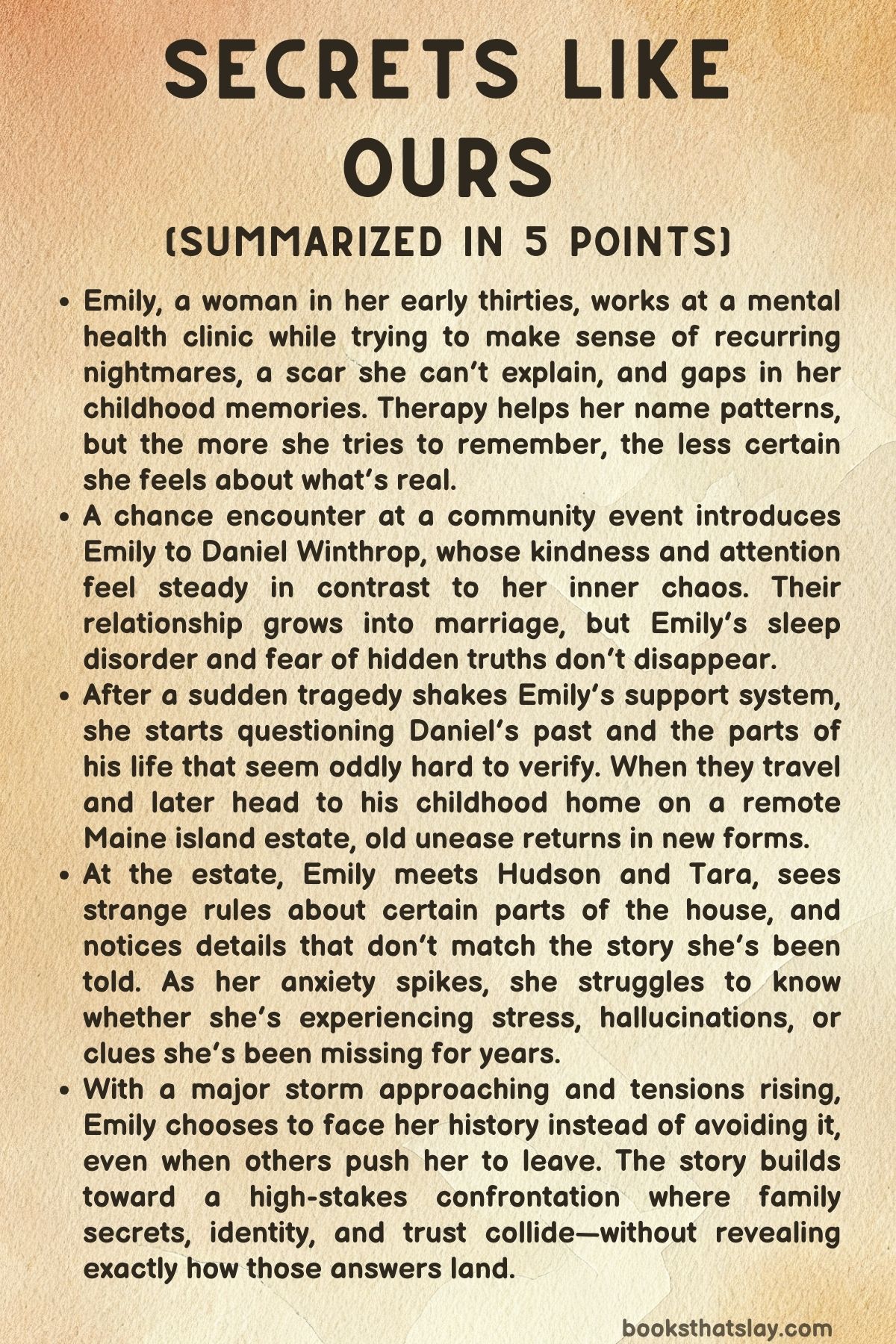
Summary
Emily is in therapy because her sleep is haunted by the same terrifying scene: screaming, a rush of blood, and the sense that she witnessed something violent as a child. She wakes in panic, checking her body, unsettled by a long scar on her neck that she cannot place.
Her therapist, Cynthia, encourages her to stay with the memory and consider whether the figures involved are her parents. Emily resists.
Her childhood recollections are already heavy: a father who drank and exploded in rage, a mother who stayed quiet, and a teenage night when her uncle entered her room and she fought him off—only to be blamed for it afterward. Emily leaves therapy carrying the familiar mix of anger and shame, and returns to her steady job at a community mental health clinic.
The next day she heads toward Boston to volunteer at a Mental Health Awareness 5K. On the way, traffic freezes when two massive mastiffs run loose across the road.
People honk and watch, but no one moves. Emily gets out, approaches slowly, and manages to secure one dog and guide both to safety just as the frantic owner arrives.
Shaken but proud she acted, she continues to the event, where she works the registration table.
There she meets Daniel Winthrop, a young man among a circle of wealthy donors. He’s charming without pushing too hard, and he takes an interest in Emily’s work and in who she is.
When she declines his invitation for coffee because she’s volunteering, he returns with drinks and food anyway, making sure she has what she needs. He also mentions seeing her earlier with the mastiffs, praising her calm under pressure.
Emily admits she has no family “around,” clarifying that her parents are alive but distant. Daniel says his parents died when he was young, and he understands what it’s like to feel alone.
He asks for her number, and Emily assumes he won’t follow through.
Three years later, Emily is married to Daniel and living with him in a sleek Seaport penthouse. From the outside, her life looks settled and privileged, but her nights are getting worse.
She begins sleepwalking during nightmares, reliving a small-child version of herself creeping down a hallway toward muffled screams. Daniel wakes her, and even their parrot, Mochi, repeats “Wake up,” as if the house itself is trying to pull her back to the present.
A neurologist has diagnosed Emily with a non-REM parasomnia tied to nightmares, and Daniel uses grounding strategies to calm her—recordings of his voice, familiar routines, reassurance that he’s real when she fears she’s trapped in an illusion. Daniel is devoted, tender, and certain that Emily’s scar came from saving someone, a story she can’t confirm but sometimes clings to because it sounds better than the truth she suspects.
Emily returns to therapy, and Cynthia presses her to admit what Emily has been minimizing: the nightmares have been intensifying for months. Cynthia points out a pattern Emily doesn’t want to see—her symptoms returned after she met Daniel and escalated after they moved in together.
Cynthia suggests bringing Daniel into a session and urges Emily to learn more about his past. Emily refuses, protective of her marriage and embarrassed by her own fears.
Then Cynthia admits something she did without permission: she asked her police-officer brother to look into Daniel, because he’s strangely difficult to trace. Cynthia says she found nothing outright criminal, but one detail stands out—Daniel grew up at an estate called the Breakers, on a private island off the Maine coast, not in Boston as he claimed.
Before Cynthia can explain more, a furious former client, Malcolm, storms into the office with a gun. He blames Cynthia for a CPS call and, despite her attempts to calm him, shoots her in the head.
Emily collapses beside Cynthia, covered in blood. By the time help arrives, Cynthia is dead.
Emily moves through the aftermath in shock. Daniel takes her home, washes the blood from her skin, and tries to keep her anchored.
He encourages leave from work and suggests travel as a reset. When Emily mentions the Breakers—Cynthia’s last clue—Daniel reacts sharply, dropping his mug and insisting the estate is a bad idea.
He finally admits it was his childhood home, but warns about storms and says it isn’t safe. Emily backs off, and they go to Italy instead.
In Venice, Emily’s nerves remain raw. Fireworks trigger her panic; she bolts, collides with a shop display, and ends up clutching a small pig statue in a moment of confusion.
Daniel smooths things over and protects her from the crowd, and the shopkeeper, touched by her distress, lets her keep the pig. The incident pushes Emily to confront Daniel about his shifting story.
Daniel eventually says his parents died during a storm when a wave swept their car off an ocean road near the Breakers. Afterward, relatives fought over the estate.
He says the only person left from that life is Hudson, the estate manager who helped raise him. Daniel asks Emily to meet Hudson, hoping it will settle things between them.
Emily agrees.
They arrive at the Breakers: an enormous renovated mansion on an island connected by a narrow stone road over the sea. Hudson and his partner Tara welcome them warmly, surrounded by rescued dogs.
The place looks pristine and curated, like it’s prepared for guests more than lived in. Hudson gives warnings that feel oddly specific: avoid certain areas at night, don’t go near a locked basement door marked by a yellow entrance, and stay away from the west wing.
Emily notices a bedroom that seems used by someone else—makeup on the vanity, photos of glamorous women—yet no one explains it. She also discovers Daniel and Hudson share a private bond built around Daniel’s childhood model trains, a hidden hobby he once used as an escape from a harsh father.
Soon after, they take a boat out on the bay. A small elderly rescue dog, Rascal, appears on dangerous rocks by the cliffs and jumps into the sea.
Hudson dives in after him, and the current slams them into the boat. Hudson is injured, and later they realize Rascal has a deep gash on his belly.
Back at the house, Mochi starts repeating alarming phrases—“Woman. In the basement”—and worse, as if echoing something he heard.
Emily grows unsettled, especially when she finds the basement doors open despite being told they are always locked.
Emily’s unease spikes when she wanders into a bedroom preserved like a shrine to Daniel’s parents and sees pig figurines that look identical to the ones Cynthia kept in her office. A woman’s voice speaks behind her, calling her “silly.” Emily turns and sees an older, unkempt woman in the mirror’s reflection.
Emily collapses, waking later to Tara’s concerned care and a rash on her hands that suggests she’s been around dogs despite an allergy. Emily lies to keep Daniel from worrying and quietly schedules urgent telehealth care.
When she tells Daniel she saw a woman in the basement and even called the police, he is alarmed—but the police search finds nothing. The passage she swore existed appears to end in solid rock, and Emily is treated as if she’s in crisis.
Emily starts new therapy with Anna and is put on antipsychotic medication. The drugs quiet the hallucinations and reduce the nightmares, but Emily fears they are also numbing the memories she needs.
She stays at the Breakers anyway, convinced the estate is pulling the truth closer. Daniel begs her to leave, saying the house “takes” people, and his fear grows sharper.
Emily notices she is rarely alone; Hudson and Tara seem to monitor her.
One night, Emily skips her medication and returns to the basement to test reality. The locks are strangely undone, and she hears glass breaking and a scream deeper inside.
She finds the hidden living space again and speaks to the older woman, who claims there is a “monster” in the house who harms women and that the police always protect him. When Emily asks her name, the woman says “Cynthia,” a name that hits Emily like a blow.
The woman also reveals a secret escape route built into the estate: a concealed passage behind a shelf that leads up to the pantry. Emily follows it and emerges into the kitchen, where Hudson catches her.
She lies her way out, but her suspicion hardens.
As a major storm approaches, Emily overhears Hudson urging Daniel to remove her “by whatever means necessary,” implying they can use her mental health history against her. Emily decides she needs answers from her past and calls her mother in Florida, only to learn her father died two years earlier.
Her mother denies the abuse, minimizes everything, and offers Emily no acknowledgment. Emily hangs up knowing closure will not come from her.
With the storm intensifying, Emily tells Daniel she needs him to come to the basement—either there is truly a woman hidden there, or Emily is far sicker than she wants to admit and could have harmed Rascal. Daniel agrees, but Hudson panics, insisting there is no one and that the key is missing.
Emily reveals the pantry corridor, and Daniel’s and Hudson’s reactions confirm there is more truth here than they’ve admitted. Then the power fails, the dogs howl, and chaos erupts.
Daniel barricades Emily in a bedroom and tells her, if needed, to kill the basement woman. Emily is attacked, blacks out, and wakes chained underground among old equipment.
In the darkness, the “Cynthia” figure appears, frantic, insisting the monster did this. Emily is strangled, and a flood of buried memory breaks open.
Emily relives the 1990s: a violent man connected to the Winthrops accuses her of contacting police about “Michael Winthrop.” He terrorizes a young boy, drags Emily across the floor, and her neck catches on a nail, tearing skin and bone—the origin of her scar. A gunshot drops him.
The woman in the memory, younger and desperate, is also being beaten. Emily understands with horror that the woman she has been seeing is her mother, and that “Cynthia” was never just a therapist’s name.
Emily frees herself, restrains her mother, and discovers the hidden truth: a shrine-like room containing a headless skeleton carefully arranged, a body preserved and hidden for years.
Emily fights her way back up through the secret corridor and searches the house for Daniel and Hudson. She finds Hudson bleeding in his cabin, with the dogs circling anxiously, and Mochi safe in his cage.
Emily tries to cross the flooded stone road to the mainland for help. Waves smash her against rocks and finally pull her into the ocean.
As she begins to drown, another memory arrives: as a little girl, she hid with a boy in a dresser while adults screamed nearby. The boy gave her a pig figurine for her collection.
Emily recognizes the boy as Daniel—the one person who protected her in that house.
Emily wakes alive at the Breakers, bandaged, with the power restored. Daniel explains he saw Emily and her mother swept into the sea and pulled them out using a life ring.
Hudson was taken by ambulance. Daniel admits he heard his mother crying underground and barricaded access while he focused on saving lives.
Then he tells Emily the full history: Michael H. Winthrop, Daniel’s father, was violent and powerful. Emily’s mother married him after arriving at the Breakers with Emily as a child.
Daniel and Emily were close as children, hiding together from escalating abuse. Daniel once tried to contact police, but the letter returned to Michael, who confronted them during a storm.
Michael attacked Emily, causing the scar. Emily’s mother shot and killed Michael.
With Hudson’s help, they covered it up, staged a drowning story, and Emily vanished into the storm, later found in Boston with no memory and raised in foster care. Daniel later recognized her as an adult, had her traced, and kept the truth hidden even as he fell in love with her.
They return to the basement and confirm the remains are Michael’s. Daniel, furious, decides to end the secret and sinks the bones into the sea.
Emily leaves the Breakers with Mochi and drives away, overwhelmed by what she now knows.
Weeks later, a DNA connection leads Emily to her paternal grandmother, Kelly Summers, who recognizes her as “Annie,” her birth name. Kelly shares family history, photos, and pig figurines that explain Emily’s attachment to them.
Emily also learns that her mother knew the Winthrops earlier than she ever admitted. Daniel then calls with new tragedy: Emily’s mother has died by suicide.
In spring, Emily returns to the Breakers to collect her mother’s ashes. She and Daniel scatter them at sea.
Daniel gives Emily a final letter addressed to “Annie,” full of guarded hints about betrayal, a past boating incident, and the Winthrop fortune. The letter urges Emily to keep certain truths buried so she can move forward.
Emily drops the letter into the ocean, tells Daniel only what he can bear, and chooses to stay with him—carrying the knowledge of what happened, and the choice of which secrets end with her.
Characters
Emily Summers (Annie)
Emily, who later learns her birth name is Annie, is the story’s emotional center in Secrets Like Ours—a woman whose body has been keeping a record of violence that her mind refuses to hold. Her recurring nightmares, sleepwalking, and fixation on the raised neck scar show how trauma can split memory into fragments that surface as sensation, terror, and compulsion rather than coherent narrative.
She moves through the world with competence and empathy—working in mental health, rescuing the mastiffs, trying to do the “right” thing—yet her inner life is ruled by dread and self-doubt, making her unusually easy to gaslight by both circumstance and people who benefit from her uncertainty. What makes Emily compelling is that her courage is not loud; it appears in the moments where she keeps going anyway—continuing therapy, returning to the questions she fears, breaking into the basement despite humiliation, and refusing to flee once she realizes the Breakers is pulling her memories back.
By the end, she becomes a person who can survive the truth without being consumed by it, but her final choice—to lie about Cynthia’s letter and keep the darkest details buried—shows that healing in this world is not pure disclosure. For Emily, survival includes choosing what to carry, what to set down, and what to protect, even if that protection comes at the cost of absolute honesty.
Daniel Winthrop
Daniel initially reads like a rescuer figure in Secrets Like Ours—kind, attentive, and almost improbably supportive, the man who notices Emily’s bravery and later grounds her during parasomnia episodes with learned therapeutic tools. That surface gentleness is real, but it is also incomplete, because Daniel’s love is tangled with secrecy, control, and fear.
He is a person shaped by a childhood where power and violence lived inside wealth, and where the adults’ conflicts weren’t just interpersonal but legal, reputational, and deadly. His instinct is always containment: contain Emily’s panic, contain the house’s history, contain Cynthia in the basement, contain the narrative that the Winthrops drowned.
Even his tenderness—kissing Emily’s scar and insisting it came from saving someone—functions as narrative control, a way to rewrite what she cannot remember into something safer and more flattering, even when it is false. As the pressure rises, Daniel’s protective instincts mutate into coercion, and his panic turns him volatile, culminating in directives that reveal the frightening edge of his character: he can imagine violence as a solution if it preserves the boundary between “inside” and “outside.” Yet Daniel is not simply an antagonist; he is also a damaged child still trying to outpace the storm that took his family and the guilt of surviving it.
His final acts—saving Emily in the sea, facing his father’s remains, and letting them sink—suggest a man attempting, perhaps for the first time, to stop managing appearances and start accepting reality. His tragedy is that he loves deeply, but he learned love in a place where love and danger were never separable.
Cynthia (Therapist Cynthia)
Therapist Cynthia functions as the first “safe witness”, a professional who takes Emily seriously and pushes gently but persistently toward the truth. She represents the story’s early structure of care: a room where terrifying fragments can be spoken aloud without punishment.
Her methods—inviting the parents, encouraging exploration of patterns, suggesting Daniel join a session—are practical, but what really defines her is her willingness to believe that Emily’s symptoms are meaningful rather than random. She also introduces the theme that institutions can be both helpful and vulnerable; her choice to involve her police-officer brother is protective, but it highlights how Emily’s life is already entangled with systems that can validate or dismiss her.
Cynthia’s murder is not just a plot shock; it is the violent removal of Emily’s stabilizing anchor, a trauma that echoes the earlier, hidden trauma and coats Emily in literal blood, intensifying her fear that she is living inside an unreal or unsafe world. Even after death, Cynthia remains present through the pig figurines and through the name that returns later in a terrifying new form, making her character feel like a hinge between legitimate healing and the story’s more gothic descent.
Malcolm
Malcolm is the embodiment of unpredictable external threat, a reminder that danger is not confined to memory or to old houses. As a former client who storms in with a gun, he represents the volatile intersection of mental illness, fear of authority, and perceived betrayal, and his action detonates Emily’s fragile sense that therapy is a protected space.
Malcolm’s role is brief but consequential because he transforms Emily’s search for the past into a present-tense survival narrative; after Cynthia is killed, Emily no longer has the same structured support or professional containment, and she becomes more reliant on Daniel, which deepens the power imbalance in their marriage. Malcolm is less a fully explored person than a catastrophe with a motive, but that is also the point: he is the kind of chaos that trauma survivors often fear most—an event that arrives without warning and rewrites reality in a second.
Hudson
Hudson appears as warmth and steadiness—an estate manager who feels more like family than staff—but he is also one of the story’s most morally complicated figures. He provides the Breakers with its “normal,” hosting lunches, maintaining the grounds, rescuing dogs, and sharing tender memories of Daniel’s childhood trains, all of which makes him feel like a caretaker in the best sense.
Yet Hudson is also a gatekeeper of secrets, a man whose loyalty has long been aimed at the Winthrop legacy and Daniel’s safety, even when that loyalty requires deception, surveillance, and the willingness to frame Emily as unstable if it gets her out of the house. His reluctance to say certain things, his knowledge of the basement’s true nature, and his quick shift into crisis management during the storm reveal a life spent cleaning up after the powerful.
The dog-rescue tenderness complicates him further, because it proves he is capable of genuine compassion, making his complicity harder to dismiss as simple cruelty. Hudson ultimately reads as a man who has rationalized wrongdoing as protection for so long that he cannot easily distinguish between saving someone and controlling them.
Tara
Tara brings domestic energy and surface normalcy to the Breakers, and she initially feels like the promise of the family Emily has been aching for. She cooks, chats, tends to injuries, bonds with Mochi, and seems genuinely pleased to welcome Emily into the home, which makes her presence soothing and disarming.
At the same time, Tara participates—wittingly or not—in the house’s culture of gentle containment, where Emily is rarely alone and where explanations are offered quickly to smooth over anything unsettling. Her confusion about how the dogs reached the cliffs and her reactions to the oddities of the house suggest she may not know everything, but she knows enough to follow Hudson’s and Daniel’s lead, prioritizing household stability over Emily’s autonomy.
Tara’s character highlights how control does not always arrive as menace; sometimes it arrives as tea, lunch, and a calm voice telling you not to worry.
Mochi
Mochi, Emily’s parrot, functions like an uncanny chorus, repeating fragments that cut through denial and polite explanations. On the surface, he is comic and affectionate, a pet who echoes phrases, bonds with Tara’s offerings, and punctuates scenes with mimicry.
But his repeated lines—especially the disturbing basement warnings—turn him into an externalized symptom detector, a creature who “hears” what humans won’t say and blurts it without social filtering. Mochi’s presence also matters psychologically: he is one of the few constants that belongs to Emily alone, a portable piece of home and identity that travels with her into Daniel’s world.
In a story obsessed with whether Emily can trust her own perceptions, Mochi becomes a strange form of corroboration, not because a parrot is inherently reliable, but because his repetitions feel like the environment leaking truth through an innocent mouth.
Cynthia (Basement Cynthia, revealed as Emily’s mother)
The basement Cynthia is the story’s most haunting character because she is simultaneously victim, perpetrator, protector, and liar, all housed inside a person whose mind has been eroded by years of terror and isolation. At first she appears as a classic “woman in the walls,” warning of a monster and speaking in riddles, which makes it easy for others to frame Emily’s experience as hallucination.
When it is revealed she is Emily’s mother, Cynthia’s earlier contradictions become psychologically coherent: she can be warm one moment and contemptuous the next because her identity has splintered around survival. Her insistence on “the monster” also reads as both literal and defensive; she cannot name what she did, what she saw, or what she enabled without collapsing, so she displaces evil into a single figure while simultaneously wearing the skull mask and inhabiting the dead man’s suit, as if the violence has become costume and prison.
Cynthia’s backstory reshapes the entire narrative: she was trapped in a violent marriage to Michael, she killed him, she hid, and she let the world believe a cleaner story, which bought her freedom from punishment but condemned her to a life underground. Her final letter and her suicide complete her tragedy.
Even at the end, she cannot fully confess; she can only gesture, warn, and ask her daughter to keep secrets, revealing a woman who never learned how to live in truth because truth, in her life, always came with consequences she couldn’t survive.
Michael H. Winthrop
Michael is the central source of corruption, a man whose wealth and authority create an ecosystem where cruelty is not only possible but protected. He is violent in the intimate ways that define domestic terror—hitting, threatening, humiliating, turning a child into a scapegoat—and he is violent in the systemic way as well, using influence so that even a letter to police becomes a weapon that returns to him.
His hatred of Emily as a reminder of Cynthia’s earlier life shows how he treats people as symbols rather than humans, punishing them for what they represent to his ego. The basement’s architecture—the hidden tunnels, muffled walls, secret routes—becomes an extension of his character, a physical manifestation of predation built into the house itself.
Even in death, Michael remains a controlling force: his skeleton shrine, the staged rooms, the inherited fear, and Daniel’s panic all demonstrate how abusers can continue to dominate a family long after they are gone. Michael is not complex in the sense of being redeemable; his complexity lies in how thoroughly the world around him learned to accommodate him.
Emily’s Mother in Florida (the “public” mother before the reveal)
Before the revelation that Cynthia is Emily’s mother, the Florida mother functions as the familiar figure of denial—someone who survived by minimizing and reframing, and who demands that her daughter do the same. Her dismissive responses, defense of Emily’s father, and minimizing of Uncle Ben’s violation show a woman committed to preserving a narrative rather than protecting a child.
She is a portrait of how families maintain abuse: not necessarily through active violence, but through silence, scolding the victim, and treating truth as “drama.” After the later revelation, this figure becomes even more unsettling, because it underscores how thoroughly Emily’s sense of “mother” has been scrambled by secrecy, disappearance, and replacement stories. Whether this mother is adoptive, guardianship-linked, or simply the person Emily believed was her mother, the emotional function is the same: she is the closed door that forces Emily to seek closure elsewhere.
Emily’s Father (abusive father figure)
Emily’s father is defined by rage, alcoholism, and the kind of everyday brutality that becomes normalized inside a frightened household. His violence is not abstract; it is written onto Emily’s body through the neck and chest injury and encoded into her nervous system through nightmares and parasomnias.
He also represents the particular cruelty of adults who harm children and then teach them to doubt their own reality, because Emily grows up unable to remember the scar’s origin even as she lives with it. His death, revealed during Emily’s confrontation call, denies her the confrontation she imagined, which reinforces one of the book’s bleakest truths: accountability is often unavailable, and survivors must build closure without it.
He matters less as a fully rendered person and more as the origin point of Emily’s fractured self-trust.
Uncle Ben
Uncle Ben’s role is to show how violation can be both explicit and socially erased. His creeping into Emily’s room at fifteen and the visceral detail of Emily biting him hard enough to tear flesh establish the scene as a clear act of threat and boundary-crossing.
What defines Ben, however, is not only the act but the aftermath: the way an adult can offer an excuse and have it accepted, while the girl who defended herself is scolded. Ben is a symbol of how predation often hides in plain sight, relying on family dynamics that prioritize comfort, reputation, or denial over a child’s safety.
His presence deepens Emily’s belief that adults will not protect her, which later makes her more vulnerable to the Breakers’ culture of secrecy.
Kelly Summers
Kelly Summers arrives late, but she provides something no one else in the story can offer: a non-coercive connection to origin. She recognizes Emily as Annie and grieves her as real, not as a problem to be managed or a narrative to be controlled.
Through Kelly, Emily receives photographs, context, and a lineage that is not built on power and cover-ups, and that shift is profoundly stabilizing. Kelly’s recounting of Cynthia and Richard’s past reframes Emily’s story from one of pure horror to one that also contains love, youth, and ordinary heartbreak before everything turned.
She becomes a quiet counterweight to the Winthrop world—less glamorous, less influential, but emotionally truthful—offering Emily the possibility that family can exist without manipulation.
Richard Summers
Richard Summers is a shadow presence, but his significance is thematic: he represents inherited vulnerability and the ways addiction and incarceration ripple through families. As Emily’s biological father, he complicates her identity without offering direct comfort, because he is absent in the way that leaves questions but few usable answers.
The detail that he died of an overdose in prison emphasizes the story’s contrast between different kinds of power: the Winthrops can bury bodies and rewrite storms, while someone like Richard is crushed publicly by institutions. His existence also clarifies why Emily’s life could be so easily rerouted into foster care and forgotten—she had no stable, protected “story” in a world that values stories almost as much as people.
Themes
Trauma, Memory, and the Body as Evidence
Nightmares function less like symbolic dreams and more like sensory fragments that refuse to stay buried. Emily’s terror is anchored in physical reality: she wakes checking for blood, and the raised scar on her neck sits on her body as proof that something happened even when her mind cannot name it.
The story keeps returning to how trauma can sever narrative memory while preserving sensation—sounds of screaming, a burst of blood, the feeling of danger in a hallway, the panic when fireworks crack overhead. These experiences don’t arrive as neat recollections; they arrive as interruptions that hijack her nervous system.
Therapy initially offers a structure for meaning-making, but Cynthia’s death destroys that container and leaves Emily with grief layered onto unprocessed childhood fear. What makes the theme sharper is how often Emily is pressured to doubt her own perceptions: the missing room in the basement, the police officer’s assumption that she is in crisis, the sudden disappearance of evidence in the parents’ bedroom.
The result is an ongoing battle between what her body insists is true and what the environment tries to deny. Even medication becomes part of this conflict—relief from hallucinations and nightmares comes at the cost of emotional heaviness and the fear that treatment might also block access to the memories she needs in order to understand herself.
By making the scar’s origin a turning point, Secrets Like Ours shows how the body can hold the timeline when the mind cannot, and how recovery is not simply remembering but surviving the act of remembering. The final revelations confirm that Emily’s childhood injuries were never isolated incidents; they were produced by a violent household that trained everyone inside it to keep quiet, normalize harm, and treat a child’s terror as an inconvenience.
Control Through Doubt, Denial, and “Concern”
Emily is surrounded by people who frame control as care. Her mother’s minimization of abuse is the earliest version of this: scolding the teenager who defended herself, accepting the abuser’s excuse, and later dismissing the scar’s origin as “drama.” That same pattern repeats at the Breakers in a more polished form.
Hudson and Daniel rarely issue direct threats at first; instead they create boundaries “for safety,” hover so Emily is seldom alone, and prepare a narrative in which her mental health history can be used to discredit her if she resists. Even Daniel’s tenderness has an edge: the recorded grounding message is supportive, yet the intimacy around the scar becomes a place where a false story is repeated until it feels like truth.
The dynamic intensifies when Emily calls the police and the environment conspires against her—no room, no woman, no proof—leaving her humiliated and easy to label. The story examines how institutions can unintentionally assist this process.
A responding officer’s risk checklist is meant to protect, but it also reduces Emily to a set of symptoms and makes it easier for powerful people around her to suggest she is unreliable. What’s unsettling is that Daniel’s protectiveness is not purely performative; he believes he is saving her from the house, from storms, from herself.
Yet his desperation leads him to choices that mirror the very coercion Emily is trying to escape: pressuring her to leave, barricading her, telling her to kill the basement woman if necessary, and allowing secrecy to stand in for consent. The theme lands in the moments where “I’m trying to help” becomes indistinguishable from “I need you to comply.” Secrets Like Ours treats doubt as a weapon that can be delivered softly: with reassurances, with locked doors, with medication, with a spouse’s insistence that he knows what is real.
Wealth, Legacy, and the Protection of Predators
The Breakers is not just a setting; it is a machine that preserves a family’s reputation and assets by absorbing harm and making it disappear. Daniel’s inheritance and the estate’s isolation create a world where events can be contained, managed, and rewritten.
The story suggests that violence thrives when a powerful family can control information: relatives fight over money after a death, the police “always protect” the wrong person according to Cynthia, and a cover story is staged by dumping a car into the ocean to support a narrative of accidental drowning. The estate’s architecture reinforces this theme.
Hidden corridors, thick walls, and private tunnels turn the house into an instrument for secrecy, built for exploitation long before Emily arrives. Cynthia’s account of the first Winthrop using the basement to assault women positions predation as a legacy, not an anomaly, and makes the present-day horrors feel like an extension of old permission structures.
When the truth finally surfaces, it is not presented as a simple mystery solved; it is presented as a system working as designed. Hudson’s role is especially revealing: he appears kind, domestic, even paternal, yet he also helps “clean,” “cover,” and keep the story intact.
His loyalty is tied to the estate itself, not to justice. Daniel inherits that moral knot—he funds discreet psychiatrists, hides Cynthia’s existence, and uses wealth to keep consequences away from the family’s front door.
Even well-intended actions become compromised when money can buy silence and when status makes outsiders hesitate to challenge the narrative. In Secrets Like Ours, the danger is not only the violent man at the center of the past; it is the surrounding structure that makes it possible for that man to operate, and then to be erased, while the survivors are left to carry the damage as “mental illness,” “confusion,” or “a storm tragedy.”
Family as Hunger, Refuge, and Trap
Emily’s loneliness is not incidental; it is the opening that makes Daniel’s attention feel like rescue. When he offers coffee, food, and persistent kindness, it meets a need created by years of estrangement and a childhood where love was unreliable.
Later, the Breakers briefly offers the illusion of a home she can finally belong to: shared meals, Tara’s warmth, Hudson’s welcome, rescue dogs, even Mochi’s presence as comic relief and warning system. That hunger for family makes Emily vulnerable to accepting what she is told, and it also makes her determined to stay when she senses answers nearby.
The story does not treat family as automatically healing; it shows how the idea of family can be used to keep someone in place. Daniel’s longing for connection is real—his parents are “gone,” his upbringing was cold, and Hudson raised him in the emotional gaps—yet his version of family still contains secrecy, hierarchy, and control.
Cynthia embodies the theme’s darkest contradiction: she is both the mother Emily yearns for and the person who failed her, endangered her, and later becomes a frightening figure in the basement. The eventual recognition that Cynthia is her mother does not deliver catharsis; it delivers complexity.
Cynthia can be a victim of Michael’s violence and also an agent of denial and harm. Daniel can be a childhood protector and also an adult who orchestrates concealment.
This is why Emily’s final choices carry weight: she seeks her grandmother, learns her birth name, and builds a thread of kinship that isn’t rooted in terror. The family she moves toward is imperfect but not constructed around intimidation.
Secrets Like Ours argues that belonging cannot be bought by a penthouse or performed through dinners at a grand estate; it has to be built where truth is allowed to exist without punishment. The tragedy is that the closest thing Emily had to unconditional love was present all along, but buried under generations of secrets that turned “home” into a place where people disappear.
Truth, Secrecy, and the Ethics of What Gets Buried
The narrative repeatedly asks what truth is for: is it for justice, for healing, for survival, or for control? Emily’s pursuit of memory is a fight to reclaim authorship over her own life.
Daniel’s secrecy is framed as protection—he hides the past, hides Cynthia, hides the investigator’s work, and tries to steer Emily away from the Breakers—yet the protection comes at the cost of Emily’s autonomy. The story makes secrecy feel contagious: Cynthia hides in the basement to avoid punishment; Hudson helps maintain the cover story; Daniel continues the concealment into marriage; Emily ultimately inherits the burden and becomes the final keeper.
The moral pressure peaks with Cynthia’s last letter and the hint of betrayal tied to wealth and a life ring. That letter offers a fork in the road.
Emily could expose everything and risk destroying the fragile stability Daniel has left, or she could contain the truth and try to build a future that isn’t defined by courtrooms, headlines, and inherited shame. Her choice to lie to Daniel about the letter is not treated like a triumphant resolution; it reads as a complicated survival decision shaped by everything she has learned about what truth costs in a family like this.
Importantly, the story does not suggest that burying secrets makes them disappear. Cynthia’s death, the shrine, the scar, and the recurring nightmares show that concealed violence keeps resurfacing in other forms.
Yet the ending also acknowledges a pragmatic reality: truth can be weaponized, and sometimes revealing it does not guarantee safety or repair. In Secrets Like Ours, the ethical dilemma is not “tell the truth or don’t.” It is “who pays for the truth, and who gets protected either way?”
Emily’s final act—letting the letter go into the ocean—signals both release and repetition: she refuses to be consumed by the darkest details, but she also accepts the role of gatekeeper, carrying forward the same secret-keeping that shaped her childhood, now under the banner of love and caretaking.