Snake-Eater Summary, Characters and Themes
Snake-Eater by T. Kingfisher is a quiet desert ghost story with sharp humor, strange local rules, and a steady, practical heart. Selena arrives in the tiny town of Quartz Creek trying to disappear from a controlling life she left behind, and she adopts an older black Lab along the way—Copper, her calm anchor.
With nowhere else to go, Selena stays in her late aunt’s empty adobe house on the edge of the scrublands. The town is friendly in an odd, self-sufficient way, but the desert has its own residents too—spirits, hungers, and bargains that notice when a new person crosses an old threshold.
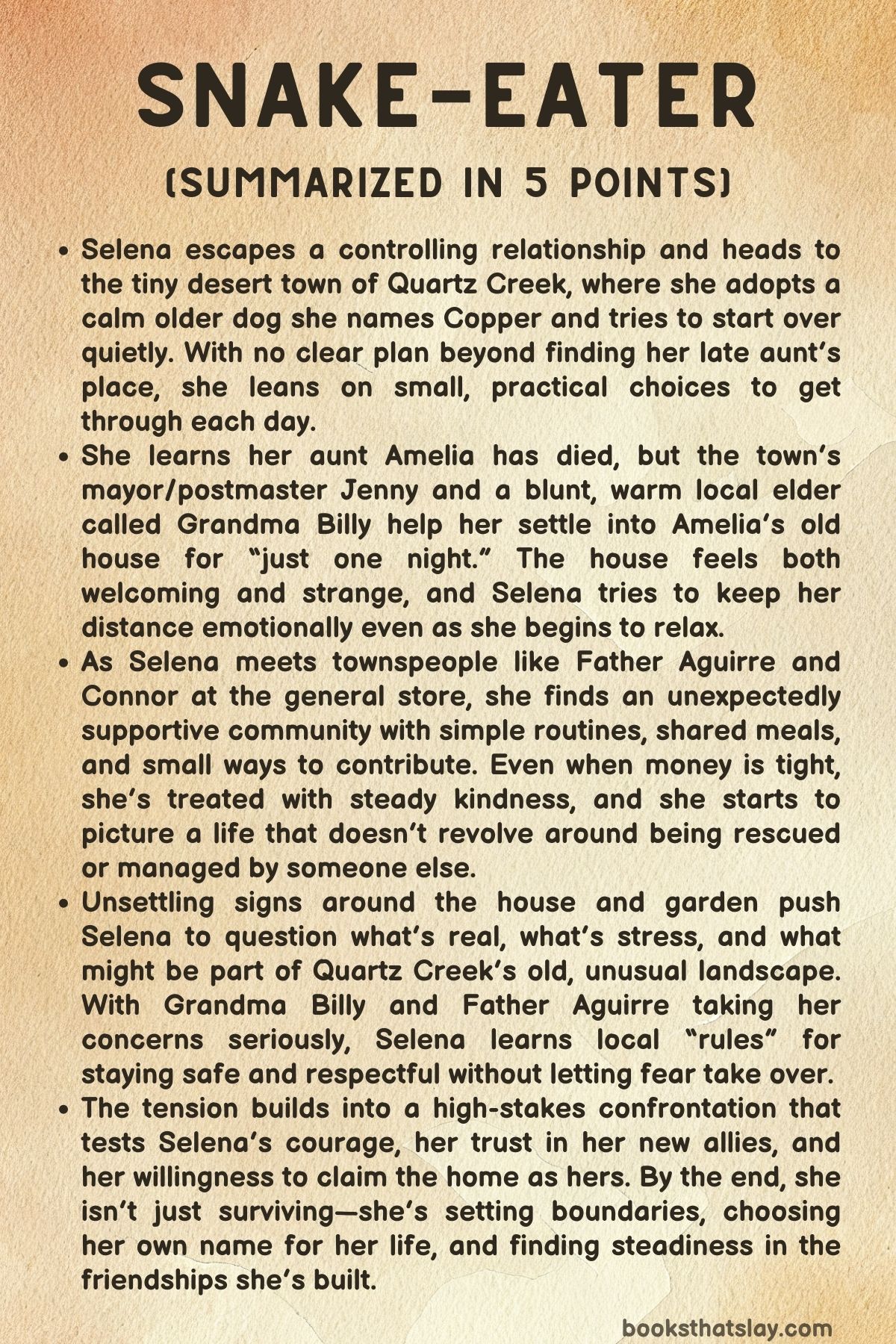
Summary
Selena picks Quartz Creek almost by accident, guided less by logic than by the sight of a black dog lying on a train-station porch. The dog is older, polite, and steady in a way Selena desperately needs.
She names her Copper, fits her with copper-colored tags, and spends the long train ride worrying that someone will object to the dog or to Selena’s own uncertain plan. Nothing happens.
Copper sleeps under the seat, accepts bits of sandwich, and behaves like she has always belonged beside Selena.
Quartz Creek turns out to be barely a stop: no taxis, no gates, no easy way forward. Selena refuses to turn on her phone because a tracker her ex-partner Walter once set up could reveal her location.
With no ride and only a dirt road stretching toward a scatter of houses under a hard blue sky, she drags her suitcase into the desert heat while Copper trots ahead. A battered pickup offers her a lift.
The driver is kind, the town feels small enough that everyone seems to know everyone, and Selena clings to that sense of being seen without being trapped.
At the post office, Selena presents a postcard addressed to “Amelia Walker, Quartz Creek,” expecting to find her aunt. The woman behind the counter—Jenny—recognizes the name immediately and delivers the news without cruelty: Amelia died about a year ago, and no next of kin were found.
Selena bolts outside before she can break apart in public, pressing her face into Copper’s fur while the dog licks her cheek as if she has done this job before. Jenny follows, offers sympathy, and explains there isn’t a motel, there isn’t a hostel, and the train won’t return until tomorrow.
Amelia’s house, however, is still there and still unclaimed. If Selena needs a place for the night, she can stay.
Jenny mentions, almost casually, that she is also the mayor, the fire marshal, and the police chief, which tells Selena a lot about the size of the town.
Walking toward the house, Selena notices Quartz Creek does things differently. Houses have name plaques instead of numbers.
Desert noises make her jump until she identifies them: cicadas, birds, wind in scrub. She meets Grandma Billy, an elderly woman with a sharp tongue and a practical kindness, who offers sweet tea and water and treats Selena’s arrival the way the desert treats weather—something to respect, not panic about.
Grandma Billy warns about snakes under the stove and checks for spiders with the calm skill of someone who has lived a long time in a place that bites.
Jackrabbit Hole House is a small adobe with a sagging porch and dust-softened furniture. It feels abandoned but not dead.
The solar power still works, the water runs clear after a long sputter, and Selena eats her last granola bars while Copper settles in as if the porch was built for her. In a wall niche, Selena notices an ugly carved figure that looks like a doll and makes her skin prickle for reasons she can’t explain.
She sleeps anyway, too tired to run.
Grandma Billy returns with blankets, cookware, eggs, cornbread, and a no-nonsense attitude about survival. During her sweep of the house she finds a scorpion in the fireplace.
Selena asks to spare it, and Grandma Billy, after a moment of surprise, scoops it up and sends Selena outside to release it. When Grandma sees the carved figure, her tone changes.
She calls it Snake-Eater, links it to roadrunners that kill rattlesnakes, and says it is tied to a kind of “people” she doesn’t like. Her advice is plain: don’t get in Snake-Eater’s way.
Selena tries to treat her stay as temporary, but Quartz Creek has a way of giving her just enough footing to remain. Amelia left credit at the general store—hundreds of dollars—meant for supplies and dog food.
Selena could demand the cash and flee, but she can’t make herself do it. She accepts the credit as a gift meant for Copper and for the person Amelia assumed would need help.
Selena begins attending the church community meals, where she can contribute without having to perform. She peels potatoes, washes dishes, carries leftovers home, and discovers she can exist around people without collapsing afterward.
Then the house starts to feel watched. Selena senses attention from the carved statue and turns it toward the wall, which eases the pressure.
A green, masked figure appears at the far edge of her garden and vanishes when she looks twice. Grandma Billy treats this like normal, calling it a local spirit drawn by a “thin spot” in the land and by Selena’s growing garden.
Father Aguirre, the town’s priest, also takes the idea seriously. He speaks about spirits the way some people speak about weather systems: you don’t have to fully understand them to know they’re real, and politeness can be a form of safety.
When Father Aguirre leads Selena to Amelia’s resting place, Selena finds a wooden cross marked with words carved into it: “WHERE IS SHE?” No one admits to carving them. Father Aguirre explains Amelia’s final months were marked by worsening exhaustion and fear, as if something had latched onto her and would not let go.
Selena reads Amelia’s journals and later finds references to a relationship with someone identified only as “S,” full of affection at first, then shifting into unease, clinginess, and the kind of attention that becomes a cage. The pages end blank.
Selena recognizes the pattern, and grief becomes anger.
The first direct attack comes at night. Selena and Grandma Billy face a robed figure with an owl-like face that fires a gun.
Grandma shoots back without hesitation, and the “creature” collapses into empty cloth. Inside are barn owl skins stitched into masks—fetches, constructs made to frighten and follow orders.
Grandma insists they take the skins to Father Aguirre to burn safely, because doing it wrong might invite something worse. On the way, something heavy and snorting moves in the brush beside them—present, watchful, and oddly protective.
At the rectory, Father Aguirre confirms the fetches are real and likely meant as intimidation. The question becomes who sent them and why.
Grandma names a likely culprit: Snake-Eater, a roadrunner spirit tied to the statue and to the land around Jackrabbit Hole. Selena apologizes aloud at her house, introducing herself as Amelia’s niece and asking what amends are required.
A roadrunner appears on the wall, bows, and disappears. For a time, things calm.
Selena builds a routine, earns small money by making sachets and helping where she can, and learns to shoot a rifle from Grandma Billy. She begins to believe she can stay.
But Snake-Eater’s courtship turns dangerous. The spirit leaves dead rattlesnakes as “gifts.” Selena thanks it and buries them, trying to follow rules she doesn’t fully understand.
Still, the pressure increases until a trip into the desert becomes a trap. Grandma Billy vanishes after stepping away from their camp.
Father Aguirre reveals a secret that reframes everything: he can change into a massive javelina-like creature, a gift from his spirit lineage, and he uses that form to track Grandma. He believes Snake-Eater has pulled her into the spirit world and intends Selena to witness harm.
They rush toward Jackrabbit Hole, Snake-Eater’s strongest ground. A force hits like a breaking wave, and Selena is separated from Father Aguirre and Grandma Billy.
She wakes in a strange desert under unfamiliar stars, nearly losing herself until the bite of pain at her wrist—Copper’s leash—brings her back. Copper finds her, along with a friendly yellow dog that speaks like a casual stranger and calls itself a dog god.
It guides Selena toward a gathering of spirits around a fire: beings shaped by animals, places, and old stories.
There, Selena is judged in the blunt language of spirit law. Snake-Eater appears in a powerful human-like form and claims Selena accepted gifts and then revealed she was already “mated,” violating its rules.
Selena argues the truth: she was escaping, grieving, and barely holding herself together. Other spirits weigh in.
A small pale spirit named Scorpion offers help because Selena spared scorpions instead of killing them. DJ Raven, the late-night radio host Selena listens to, is revealed as a spirit too, and openly mocks Snake-Eater’s sense of entitlement.
A fight breaks out among spirits and allies, and Snake-Eater is chased off and weakened.
Selena returns to the real desert at the bottom of Jackrabbit Hole and finds Grandma Billy battered but alive. Copper is injured defending them.
Father Aguirre, in javelina form, tackles Snake-Eater long enough for Selena to act. With Grandma’s shotgun in her hands and a clear choice in front of her, Selena fires.
It doesn’t destroy the spirit, but it drives it away, shredding its presence into feathers and oily residue that sinks into the sand. They escape before sunrise, when Snake-Eater could regain strength, and limp back to town for medical help.
Rosa patches them up: Father Aguirre’s ribs, Grandma’s bruises, Copper’s stitches.
In the aftermath, Yellow Dog warns Selena that the name “Jackrabbit Hole House” created a link to Snake-Eater’s territory. Selena understands that names in Quartz Creek are not decorations; they are anchors.
With friends gathered, she renames her home Copper Dog House, making the new name official and changing the shape of the connection.
Months pass. Selena works through tourist season, helps at the café and community projects, and begins to feel less like a fugitive and more like a resident.
Then Walter arrives, demanding she return, insisting she is unstable and needs him. Selena refuses.
This time, she is not alone. Grandma Billy confronts him; Lupé, Gordon, Father Aguirre, and Mayor Jenny stand beside Selena.
Jenny, in her role as police chief, escorts Walter out of town. He leaves.
Afterward, they gather at the rectory, talking and eating like people who know how to keep going. Selena worries she has taken too much, but the others remind her she has given plenty—work, care, presence, and the willingness to stay and be part of the place.
When a hungry traveler appears asking about a community meal, Father Aguirre welcomes him in. Selena stays behind to greet the newcomer, recognizing herself in the question, and realizing she has become one of the people who can say, simply and truthfully: you can eat here.
You can rest. You can be safe for tonight.
Characters
Selena
Selena begins Snake-Eater as someone running more than traveling: she arrives in Quartz Creek with a practiced instinct for avoiding visibility, shaped by Walter’s control and the lingering fear of being found. Her inner life is dominated by hypervigilance—counting risks, rehearsing social scripts, scanning sounds in the desert, measuring every choice by how easily it could be turned against her later.
Yet the same sensitivity that makes her anxious also makes her unusually attentive and ethical; she refuses to exploit Amelia’s store credit for a quick escape, spares a scorpion on impulse, and tries to understand local customs rather than mock them. Over time, Selena’s growth is less about becoming fearless and more about learning what safety feels like when it’s real: she accepts help without feeling indebted, contributes in ways that match her strengths (quiet labor, steadiness, care), and slowly replaces the idea of being “a burden” with the evidence of mutual belonging.
Her turning point is not simply defeating Snake-Eater, but claiming a life—renaming her home, formalizing her place in the historic zone, and finally confronting Walter with the support of a community that reflects her own worth back to her.
Copper
Copper is introduced as calm, older, and self-contained, and that steadiness becomes the emotional spine of Snake-Eater. She functions as Selena’s anchor in unfamiliar spaces: a constant body beside Selena’s body, a reassuring routine of needs (food, water, walking) that gives Selena something practical to do when her mind spirals.
Copper also quietly rewrites Selena’s expectations of loyalty—this is not devotion that demands performance, but companionship that simply stays. As the story turns supernatural, Copper shifts from comfort object to active protector, sensing danger, yanking Selena away at a critical moment, charging into spirit conflict, and paying the physical cost when Snake-Eater kicks her into a rock.
Even then, Copper’s role never becomes sentimentalized into a symbol only; she remains a dog with pain, stitches, and limits, which keeps the story grounded and makes Selena’s care for her feel reciprocal rather than decorative. The renaming of the house to “Copper Dog House” is ultimately a recognition that Copper did more than accompany Selena—she helped make the new life possible.
Walter
Walter is the clearest human antagonist in Snake-Eater, not because he twirls villainy, but because he embodies a familiar kind of coercion that hides behind concern. His location tracking, his inevitable framing of Selena’s choices as “episodes,” and his expectation that he should retrieve her all reveal a worldview where Selena is not an equal person but an extension of his authority.
What makes Walter chilling is that he can plausibly narrate himself as the rescuer while behaving as the captor; Selena anticipates his script so well that she polices herself even in his absence, which shows how deeply his control has gotten into her nervous system. When he arrives in Quartz Creek, his tactics remain the same—public pressure, medicalized language, insistence on returning “home”—but the context has changed: Selena is no longer isolated, and the town refuses his premise.
His final defeat is social and moral rather than violent: he is exposed, outnumbered by witnesses who believe Selena, and forced to leave without the reward of her compliance.
Amelia Walker
Amelia exists mostly through absence—through what she left behind, what she failed to leave behind, and what others remember—yet she shapes nearly every relationship in Snake-Eater. She is remembered as someone who took in “strays,” and that reputation is both tenderness and warning: it suggests a generous spirit that made the town protective of her legacy, but it also hints at a pattern of involvement that could draw trouble.
Amelia’s journals reveal that she, too, got entangled with a clingy presence (“S”) that drained her and turned frightening, which mirrors Selena’s history with Walter and creates an unsettling sense that the house itself attracts certain dynamics of possession. Her practical preparation—like leaving credit at the store—shows a caretaking impulse that extends beyond death, while the fact that her house remained unclaimed suggests loneliness, disconnection from family, or the quiet tragedy of being hard to trace.
Amelia’s role becomes almost mythic: she is the reason Selena arrives, the reason Selena is tolerated, and the reason Snake-Eater fixates, making Amelia both shelter and catalyst.
Mayor Jenny
Jenny is a stabilizing civic force in Snake-Eater, presented with humor—postmaster, mayor, fire marshal, police chief—but the comedy masks real competence. She reads situations quickly, offers help without interrogation, and understands that Selena’s fragility is not a reason to deny her agency.
Jenny’s greatest strength is her calm practicality: she gives Selena options (a house, time, directions to supplies), doesn’t demand emotional performance, and treats staying as a decision Selena can make rather than a favor Selena must beg for. When the conflict becomes supernatural, Jenny doesn’t take center stage, but she keeps the town’s human reality intact, which matters just as much: she normalizes belief without hysteria and provides the legal framework that lets Selena belong.
Her decisive moment arrives with Walter, when Jenny uses institutional authority not to control Selena, but to protect Selena’s autonomy—an inversion of everything Walter represents.
Grandma Billy
Grandma Billy is one of the richest characters in Snake-Eater because she refuses to fit into a single role: she is protector, busybody, prankster, elder, and gun-toting realist who treats the supernatural as another kind of weather to prepare for. Her bluntness can read abrasive, but it is often a form of care that doesn’t require Selena to be “easy” to love; Grandma Billy provides blankets, food, cups, gardening help, and hard truths with the same unsentimental consistency.
She is also the character most comfortable with boundaries and consequences—she warns Selena about Snake-Eater, insists on safe handling of fetches, and teaches Selena to shoot not because violence is glamorous, but because survival sometimes needs tools. Her transgender identity is not presented as a twist for spectacle; it’s folded into the texture of her long life and her refusal to be defined by other people’s expectations, which quietly models for Selena what self-possession looks like.
When she is taken into the spirit world, the event lands as both danger and insult—Snake-Eater trying to punish Selena through her—because Grandma Billy has become Selena’s first experience of fierce, chosen-family protection.
Father Aguirre
Father Aguirre functions as bridge in Snake-Eater—between town and outsider, Catholic language and local spirit logic, human vulnerability and nonhuman power. His kindness is practical: he walks with Selena, invites her to meals, offers context without condescension, and takes her fear seriously even when it sounds strange.
What complicates him—in a way that deepens the book’s themes—is that his faith doesn’t narrow his world; he can bless a house and discuss “kachina” carvings without needing to declare one realm fake. His secret ability to transform into a javelina-like creature adds mythic weight, but it also exposes an intimacy with the desert that Selena lacks at first, making him both spiritual guide and literal tracker when Grandma Billy disappears.
He carries responsibility lightly yet consistently, and his willingness to stand against Snake-Eater implies an ethic of pastoral care that extends beyond humans. By the time Walter arrives, Aguirre’s presence in the confrontation signals that Selena’s support system is not merely friendly—it is principled, organized, and willing to defend her dignity.
Connor
Connor is a quietly important figure in Snake-Eater because he represents the town’s everyday economy and its unspoken moral code. He doesn’t dramatize Selena’s arrival, but he notices her, provides information, and—most significantly—refuses to let her pay for dog food because Amelia left credit for her.
That moment tests Selena’s character and establishes Connor as someone who honors Amelia’s intent without turning it into leverage. He also becomes part of Selena’s path to self-sufficiency through small-scale commerce, such as buying or enabling the sale of local goods, which matters because Selena’s independence is built on ordinary transactions as much as supernatural victories.
Connor’s steadiness reinforces the book’s sense that Quartz Creek’s power is not only in its spirits, but in its people who keep things fair.
Lupé
Lupé contributes to the communal warmth and embodies the town’s habit of taking care of people through food, work, and matter-of-fact inclusion. At dinners and gatherings, she pushes leftovers into Selena’s hands not as charity but as normal practice, which helps Selena stop interpreting every gift as a debt.
Lupé’s café becomes a social anchor, and the “crucifixion party” reveals the town’s ability to turn tradition into livelihood without losing its humor. Lupé’s presence in the Walter confrontation is telling: she is not “family” by blood, but she stands like family by choice, demonstrating how Selena’s belonging becomes real.
Gordon
Gordon is sketched as practical and work-minded, the sort of person who measures newcomers by skills because skills keep a small town alive. His question about sheep is not mere small talk; it’s an instinct to find where Selena might fit into the local labor web.
Even when Selena can’t offer what he asks for, the interaction still matters because it frames her as a potential contributor rather than a curiosity. Gordon’s later presence among those who back Selena against Walter signals that the town’s solidarity isn’t limited to the most emotionally expressive people; it includes the pragmatic ones too.
Rosa
Rosa’s role highlights the town’s informal but effective care structures. She is the person people trust for injuries, the one who stitches Copper, treats broken ribs, and turns the aftermath of a supernatural fight into a manageable medical reality.
In a story where spirits and magic can feel abstract, Rosa brings consequences back into the body—blood, bruises, recovery—and that grounding is crucial for Selena’s arc, because healing becomes both literal and metaphorical. Rosa’s competence also reinforces the book’s theme that survival is communal; nobody “toughs it out” alone here.
DJ Raven
DJ Raven starts as a distant voice on the radio—comforting background noise that makes the desert quiet less oppressive—but Snake-Eater later reveals that this voice belongs to something more than human. This reveal retroactively reframes the radio: it isn’t only entertainment, it’s a kind of local presence, a thread connecting isolated homes across the scrub.
DJ Raven’s tone—eclectic, slightly theatrical, amused—fits the spirit world’s logic, where narration and performance are part of power. When DJ Raven mocks Snake-Eater, it’s not mere sass; it signals allegiance, social hierarchy among spirits, and a refusal to let Snake-Eater control the story.
For Selena, DJ Raven represents a strange but genuine form of companionship: even when alone, she is not unheard.
Yellow Dog
Yellow Dog, the “dog god,” serves as an unexpected moral hinge because his help is offered in a realm where help usually has a price. He is friendly without being naïve, and his guidance feels rooted in a worldview where kindness can be earned through patterns of behavior—Selena sparing creatures, treating the land with respect—rather than through bargaining her identity away.
Yellow Dog also reinforces the book’s insistence that not all power is predatory; there are forces in this world that protect without possessing. His warning about the house name reveals how language shapes reality in the story’s cosmology, and his presence legitimizes Selena’s bond with Copper as something potent enough to matter in the spirit world, not merely in the emotional one.
Scorpion
Scorpion appears briefly but meaningfully as a spirit whose allegiance is motivated by remembered mercy. Selena’s choice to spare a scorpion earlier—an act that seemed small, almost incidental—returns as social capital in the spirit world, suggesting that compassion is not only virtue but also a kind of currency.
Scorpion’s help reinforces a pattern in the book: power does not exclusively belong to the loud or the violent; even small beings have agency, memory, and the ability to tip a conflict. For Selena, Scorpion’s presence is a quiet reassurance that her instincts toward gentleness are not weaknesses.
Merv
Merv the peacock might seem like comic color at first, but in Snake-Eater he becomes an indicator of the town’s odd, living texture and later a marker of real stakes when Selena believes Snake-Eater has killed him. The peacock’s loudness and nuisance energy contrast with Selena’s tendency to minimize herself, which makes Merv’s presence feel like Quartz Creek’s personality made feathered.
If his death is linked to Snake-Eater, it also shows how the spirit’s cruelty spills beyond Selena into collateral harm, turning harassment into something more openly violent. Merv’s role, small as it is, helps the book move from quirky desert strangeness to genuine danger without losing the sense that these creatures are part of a shared world, not props.
Themes
Leaving Control Behind and Reclaiming Agency
Selena’s arrival in Quartz Creek is driven less by adventure than by a practical need to get out from under someone else’s thumb. Walter’s tracker and her refusal to turn on her phone show how power can be exercised through ordinary technology, turning even a simple act like asking for a ride into a risk calculation.
The story treats escape as messy rather than triumphant: Selena is anxious, socially careful, and constantly measuring what might pull her back. Her choices are shaped by the fear of being forced into a familiar role—“the foolish one” who needs rescuing—because that role keeps Walter important and keeps her dependent.
Quartz Creek offers a counter-model of autonomy that isn’t glamorous: dragging a suitcase over dirt, drinking water after rusty pipes clear, learning how to live without quick solutions. Even the credit Amelia left at the store becomes a test of selfhood.
Selena could convert it into cash and run, but she refuses because taking it would feel like sliding back into an old pattern where survival demands moral compromise or manipulation. She starts building a different kind of agency: asking for help without surrendering control, accepting gifts without owing herself away, and making decisions based on her own long-term stability rather than immediate relief.
That shift becomes clearest when Walter shows up and tries to rewrite her story as an “episode.” Selena’s refusal is not only romantic separation; it is a refusal to let someone else define reality for her. By the end, agency looks like community-backed boundaries: she can say “no” because she has a place, a plan, and people who will stand in the doorway with her.
The theme insists that freedom is not a single dramatic exit, but a series of small, exhausting decisions that slowly create a life where coercion can’t easily get purchase again.
Community as Safety, Not Charity
Quartz Creek doesn’t “save” Selena through inspirational speeches or official programs; it helps her through ordinary, sometimes awkward, human logistics. Jenny’s pile-up of roles—postmaster, mayor, fire marshal, police chief—signals a town where governance is personal, improvised, and built on relationships.
Help arrives in practical forms that preserve dignity: a house key in effect, food in a wheelbarrow, dog food charged to Amelia’s account, a seat at a church meal where Selena can contribute by washing dishes instead of performing gratitude. That matters because Selena’s past includes being treated as a problem to manage.
Here, the town’s support doesn’t require her to present herself as helpless. Grandma Billy’s style is blunt and occasionally bossy, but it is also protective in a way that expects Selena to learn rather than remain dependent.
The community meal is a turning point because Selena discovers a social space with clear, manageable roles: wrap potatoes, wash dishes, carry leftovers. The story pays attention to how safety can be built from predictable routines and shared tasks, especially for someone who finds social interaction draining.
Even the supernatural conflict reinforces this theme. When fetches appear and the threat escalates, the response is collective: bring the evidence to Father Aguirre, burn it safely, sleep at the rectory, return together to the house.
No one tells Selena to toughen up alone, and no one takes over her life “for her own good.” They offer knowledge, weapons training, medical care, and presence, while still treating her as someone who gets a vote. The final confrontation with Walter shows the same community pattern in a realistic key: multiple people show up, not as a mob but as witnesses and backup, making it impossible for him to isolate her.
In Snake-Eater, community is not sentiment; it is infrastructure made of people. It is the steady practice of feeding strangers, sharing tools, noticing who is tired, and stepping forward when someone tries to pull another person back into a cage.
Home, Naming, and the Right to Belong
Quartz Creek operates on names rather than addresses, and that detail becomes a quiet argument about what “home” is. An address is administrative; a house name is personal and story-based.
Selena’s relationship with Jackrabbit Hole House begins with caution—“only overnight”—because she is afraid of attachment and of losing what she starts to love. The house itself feels like a test: the brown water that clears, the dust, the missing sheets, the strange doll-like figure, the heat that pushes her to collapse.
Yet the house also responds: solar power still works, air moves through vents, the porch holds her and Copper as they eat, and Grandma Billy insists the house needs to “know” she’s moving in, as if belonging is a negotiated relationship rather than a legal status. The theme becomes sharper when the name of the house creates a link to Snake-Eater’s territory.
That twist turns naming into something with weight: words don’t just label; they establish connections and expectations. Selena’s later choice to rename her home Copper Dog House is both spiritual strategy and personal declaration.
It says the home is not an extension of Amelia’s past or Snake-Eater’s claim; it is a place shaped by Selena’s present life and by the creature who arrived with her and kept her tethered to herself in the spirit world. The renaming ceremony also shows belonging as communal recognition, not merely private intention.
Selena doesn’t rename it in secret; she does it with people who understand why names matter. This theme also ties to the historic zone paperwork: Jenny grants her the right to stay because she is family, but the story makes clear that legal permission is only one layer.
Selena earns belonging through participation—gardening, making sachets, helping during illness, showing up to meals, taking on the risks of the place. By the end, “home” isn’t the absence of danger.
It is a place where her presence makes sense, where the name on the plaque matches the life inside, and where she is not a temporary guest waiting to be sent back.
Negotiating With the Nonhuman World
The desert in Quartz Creek is not a backdrop; it has its own rules, sounds, and inhabitants that demand respect. Selena’s first days are filled with small recognitions—cicadas instead of ominous buzzing, jackrabbits that look like rocks until they move, scorpions that can be relocated rather than smashed.
Those moments matter because they train her out of panic and into observation. The supernatural elements expand this learning rather than replacing it.
Spirits here operate like another part of local ecology: they have habits, territories, sensitivities, and a sense of exchange. Selena’s first major mistake is not cruelty but ignorance—turning Snake-Eater’s statue to the wall, dismissing the “watched” feeling without understanding what the figure represents, underestimating how her grief and fragility might attract attention.
The story is careful about consent and boundaries in these nonhuman interactions. Father Aguirre’s warning about names and prices in the spirit world treats communication as risky and structured; you cannot simply accept help because help can create debt.
Selena survives partly because she follows a pattern she’s been practicing since arrival: politeness without surrender. She offers cornmeal, apologizes for startling the green spirit, thanks Snake-Eater for gifts even when those gifts are unsettling, and asks directly how to make amends.
This is not submission; it’s conflict management with an entity that does not share human assumptions. Even the town’s religious stance supports the theme: Father Aguirre can be a priest and still take local spirits seriously, because the story frames faith as compatible with respect for realities that exceed one doctrine.
When violence happens, it has limits: guns can drive off a spirit but not end it, so the real solution is a shift in relationship and in the map of meanings—binding, renaming, changing what the house is connected to. Snake-Eater treats the nonhuman world as something you live beside, not something you dominate, and it suggests that learning its boundaries can be part of healing for someone whose human boundaries were repeatedly violated.
Grief, Inheritance, and the Echo of Amelia’s Life
Selena comes to Quartz Creek looking for Amelia and finds a death she wasn’t prepared to face. That shock becomes a new kind of abandonment—one not caused by cruelty but by time and distance—and it forces Selena to reckon with what it means to inherit a life rather than receive comfort from the living person.
Amelia’s absence is everywhere: in the credit at the store, in the wheelbarrow of supplies, in the journals, in the fact that the town knows her as someone who collected “strays.” Selena’s relationship with that legacy is complicated because she needs the help but resists feeling like a replacement. The town’s stories about Amelia create a moral pressure: if Amelia took in strays, what does it mean for Selena to leave after “only overnight”?
At the same time, Amelia’s journals reveal a cautionary pattern that mirrors Selena’s own history. Amelia’s relationship with “S” begins with companionship and ends with exhaustion, clinginess, and fear—an emotional drain that reads uncomfortably close to what Selena experienced with Walter, even if the details differ.
The blank pages at the end of the journals are a powerful form of silence: not a tidy explanation, but the record of a life that became too heavy to narrate. Selena’s grief is therefore not only sadness; it is recognition and dread.
She sees a possible future where escape comes too late, where attachment becomes suffocation, where the body simply runs out. Visiting Amelia’s grave brings this into the open, especially when the cross is vandalized with “WHERE IS SHE?” and later torn out.
Those acts turn mourning into conflict: something or someone refuses closure, insists on possession, or demands answers no human can provide. Selena’s decision to reset the marker and speak aloud about wanting to stay reframes inheritance as choice.
She is not merely squatting in Amelia’s space; she is taking responsibility for what Amelia left behind, including unfinished relationships and spiritual consequences. The theme argues that inheritance is not only property and money.
It is a trail of connections—human and nonhuman—that a survivor must either untangle or accept. Selena’s eventual stability comes partly from recognizing that Amelia’s care for strays can continue without Selena erasing herself.
She can honor the legacy by becoming a person who offers shelter, rather than a person who disappears.
Identity, Neurodivergence, and the Relief of Being Seen Clearly
Selena’s inner life is marked by social strain, sensory overload, and the constant effort of “performing” competence. The narrative repeatedly shows her rehearsing lines, feeling drained after interactions, and experiencing anxiety spikes from unfamiliar sounds.
These details aren’t just character flavor; they shape the kind of safety she needs. Quartz Creek works for her because it is low on performative expectations and high on concrete roles.
People notice what she can do—wash dishes, plant beans, sell sachets—and they accept quiet participation as participation. That acceptance becomes especially meaningful when the supernatural incidents blur the boundary between anxiety, trauma responses, and genuine external threats.
Selena worries she is hallucinating, and the story treats that fear respectfully: she seeks confirmation, tests her perceptions, and still gets help without being mocked. Walter’s later attempt to label her as having an “episode” is therefore not an isolated insult; it is the worst version of a pattern she already fears, where her reality is dismissed and her autonomy is removed “for her own good.” The town refuses that framing by treating Selena as credible.
Grandma Billy’s gender history strengthens this theme by offering a model of a life built through self-definition and persistence. Her disclosure isn’t used as shock; it is a moment of trust and an illustration that Quartz Creek is a place where people can live outside mainstream scrutiny.
Father Aguirre’s mixed identity—priest and desert shapeshifter—adds another layer: the community contains contradictions without demanding that everyone fit one clean category. Selena’s growth is not about becoming louder or more socially smooth; it is about finding environments and relationships that don’t punish her for how her mind and body respond to stress.
Learning to shoot, negotiating with spirits, and setting boundaries with Walter are all parts of the same movement toward self-trust. In Snake-Eater, healing looks like being believed, being useful, and being allowed to exist without constant correction.
The final scene, where Selena stays behind to greet a hungry traveler and make him feel included, shows her stepping into Amelia’s old role in her own way: not as a savior, but as someone who knows what it costs to arrive fragile and need a place that doesn’t demand you earn your right to be real.