The Christmas Trap Summary, Characters and Themes
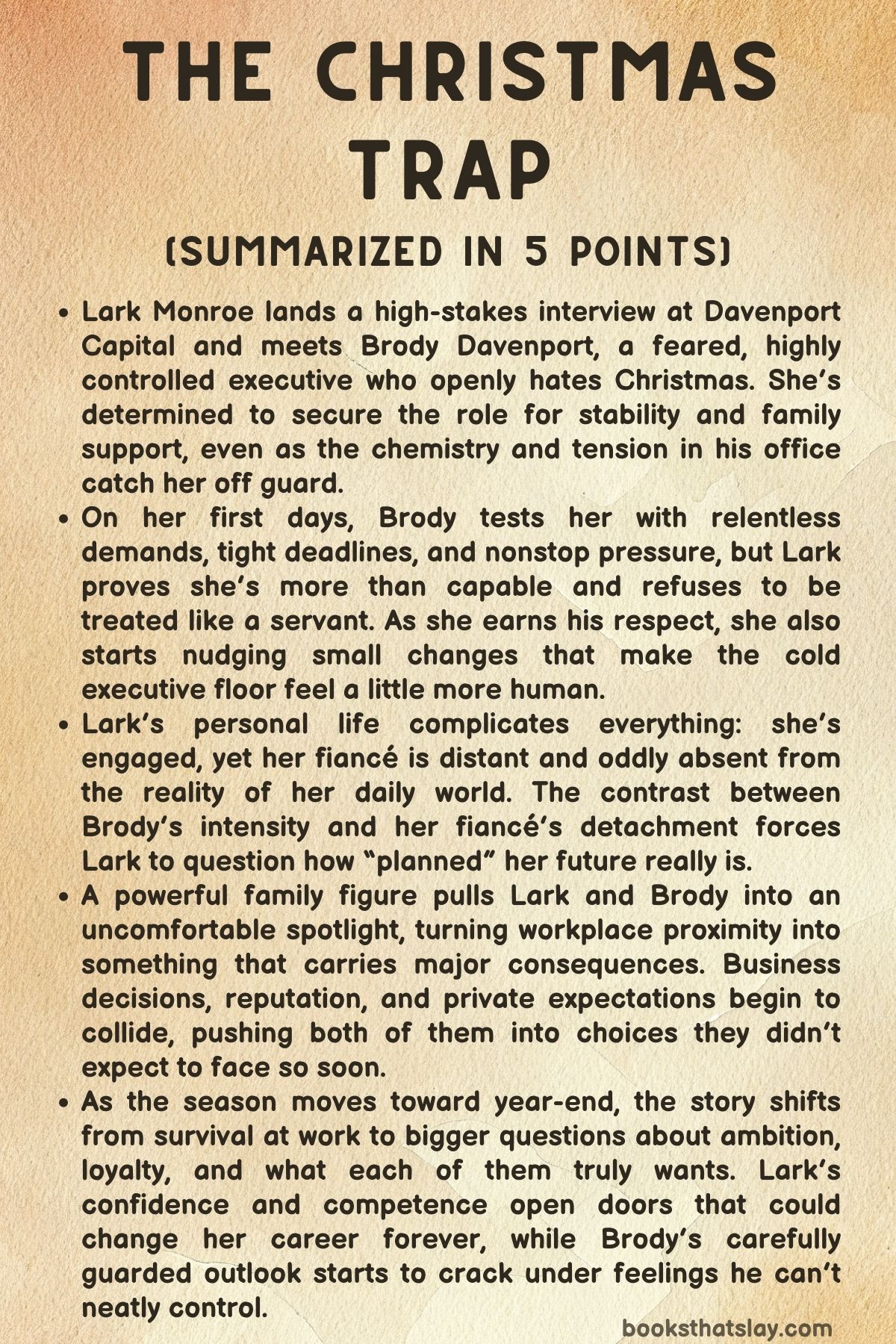
The Christmas Trap by L Steele is a contemporary office romance set in London’s high-finance world, where ambition and emotional guardrails collide right before the holidays. Lark Monroe is a capable, goal-driven woman with a plan: secure a prestigious role at Davenport Capital, stabilize her family’s finances, and marry her long-distance fiancé.
Brody Davenport, the firm’s intimidating leader, has no patience for small talk—or Christmas. When Lark’s competence earns his attention and a family ultimatum forces Brody toward marriage, a practical solution turns personal fast. What begins as a career move becomes a high-stakes relationship that reshapes both their futures. It’s the 7th book in The Davenports series.
Summary
Lark Monroe arrives at Davenport Capital for a ten a.m. interview to become the executive assistant to Brody Davenport, the firm’s powerful and notoriously demanding head.
Even before she meets him, she senses the company’s executive floor is built around discipline and pressure: glass offices, hushed intensity, and not a hint of holiday warmth. In reception, she helps the sick-looking receptionist, Evelyn Rainer, by offering ibuprofen, a small act that shows how Lark’s instincts run toward problem-solving and care.
Left to wait inside Brody’s office, she takes in the sharp, minimalist space and notices details that feel personal—his distinctive scent, the immaculate desk, and an unusual rope knotted with precision.
Brody arrives late with his Great Dane, Tiny, and the first thing he does is criticize Lark’s Christmas jumper. He states, without apology, that he hates Christmas.
Lark, who loves the season, is thrown off but refuses to be rattled. The interview turns into a stress test.
Brody challenges her to explain why she deserves the job in a single minute. Lark drops the polished corporate phrases and speaks plainly: she is resilient, she has worked hard while earning an MBA, she can handle pressure, and she intends to rise—eventually—to the top.
Her ambition catches Brody’s attention. He remains controlled, but he’s clearly more engaged than he expected to be.
Lark gets the job and starts immediately. Outside the building, she calls her sister Raya, who teases her about Brody’s cold personality and obvious appeal.
Lark insists she is focused on the paycheck and the opportunity, but the conversation reveals a quiet truth: she’s been carrying most responsibilities alone for a long time, and she needs this role to change her family’s situation. That evening, Tiny appears again in a park and drags Brody toward Lark as if determined to reunite them.
Brody is irritated, but the moment highlights an odd dynamic—Tiny responds to Lark naturally, and Brody notices.
On her first day, Lark faces an early obstacle when tube delays slow her down, and she stays to help a pregnant woman who faints until paramedics arrive. She reaches the office exactly on time, but Brody expected her early and reacts with anger.
He immediately unloads a mountain of tasks—urgent numbers, rescheduling meetings, drafting communications, solving a minor IT problem, and chasing details across departments—then demands she complete it all at a punishing pace. Lark refuses to be intimidated.
She pushes back on tasks that waste executive bandwidth, suggesting an intern handle errands and low-level work. Brody, surprised by her boundaries, agrees and instructs her to hire an intern who reports to her.
Lark proves her value quickly. She manages the board fallout from postponed meetings and begins untangling Brody’s overloaded inbox.
A board member, Kingly Whittington, tries to charm her into sharing information and asks her out. Lark declines and mentions her fiancé, Keith, reinforcing her commitment to her planned life.
Brody steps in with a curt interruption, redirects Kingly, and pulls Lark into a high-level call. Afterward, Brody asks for her thoughts on the Tokyo expansion.
Lark delivers a clear assessment: the projections are aggressive, and risk planning needs attention. Instead of dismissing her, Brody listens—and then shocks her by assigning her to lead key parts of the project, making it clear he’s testing whether her confidence is real.
As Lark settles into the role, she notices something else: the office feels emotionally sterile. There are no decorations, no seasonal gestures, nothing that signals people are allowed to breathe.
She tries to change that. Brody refuses her proposals for a tree, Secret Santa, and a party, calling it distraction.
Lark argues morale matters and that a happier staff performs better. He shuts it down—until he sees evidence of Lark’s private life intruding into the workspace.
Keith sends holiday-themed flowers as an apology for his absence, and Brody reacts sharply, demanding to know who sent them. Lark pushes back, insisting her personal calls and life don’t belong to Brody’s control.
During the confrontation, Brody notices a small unicorn plush she keeps as a comfort object, and the moment cracks his rigid posture. He relents slightly: she can decorate, but there will be rules—no Christmas tree, and no party.
Brody brings Lark to meet his grandfather Arthur Davenport, the company’s chairman and majority shareholder. Arthur’s home is lavish and overflowing with Christmas décor, a stark contrast to Brody’s executive floor.
There, they meet James Hamilton, a famous chef and friend connected to Lark’s circle. Arthur watches Lark closely, then warms to her when she meets his bluntness with humor and steadiness.
The meeting takes a sharp turn when Arthur reveals a condition tied to Brody’s inheritance: Brody must marry before year-end. Arthur then implies he has chosen Lark as the bride.
Lark is stunned. She refuses immediately, stating she’s engaged.
Brody is furious—at Arthur, at the manipulation, and at the sudden exposure of how trapped he is by his family’s demands. On the drive back, tension builds between Brody and Lark.
She questions why he allows Arthur to control his life. Brody admits he doesn’t believe in love and sees marriage as a practical tool, though he wants children someday.
Lark, meanwhile, begins noticing uncomfortable cracks in her own engagement: Keith’s absence, his lack of involvement, and even the way he doesn’t publicly include her in his life. She messages him about wedding details and gets little in return, and the flowers begin to feel less romantic and more transactional.
As the deadline looms, Brody endures a string of dates arranged to find a suitable wife, but he finds them dull and compares them—unfairly, but inevitably—to Lark. Lark senses it and reacts with jealousy she doesn’t want to name.
Their attraction keeps flaring in close moments at work, but Brody repeatedly reins himself in, aware of both the power imbalance and her claimed engagement. Lark confesses how overwhelmed she feels planning a wedding largely alone.
Brody, unusually honest, tells her if she were his, he would show up for her. Lark reminds him she isn’t.
Then Lark faces the boardroom in a major meeting and proves she can lead under pressure. Board members challenge her, interrupt her, and test her authority.
Lark holds her ground, answers cleanly, and earns their respect. Even the small holiday touches she added to the room soften the atmosphere and make the meeting feel less hostile.
Brody arrives midstream, watches her performance, and afterwards blocks Kingly from flirting with her again. In private, Brody congratulates Lark with physical closeness that nearly crosses a line, then pulls back.
He invites her to stay and work with him over dinner, signaling that their professional partnership is becoming something harder to contain.
Arthur later speaks to Brody with unexpected honesty, admitting he mishandled grief after Brody’s parents died and used control and achievement as substitutes for emotional care. He expresses regret and tells Brody not to repeat his mistakes.
The confession lands heavily, and it pushes Brody toward a decision: stop treating his life like a negotiation and start choosing what he actually wants.
In the aftermath, Brody and Lark end up married—an outcome shaped by family pressure, public expectations, and their own messy motivations. Yet the marriage doesn’t feel like a victory lap.
Lark is shaken by Brody’s sudden withdrawal right after the ceremony, and Brody admits he panicked because he can’t keep pretending this is only practical. Being near her makes him lose control of the emotional distance he relies on.
Lark initially interprets his conflict as rejection, but Brody stops her from leaving and admits he can’t stop thinking about her. They reconcile and leave immediately for a private honeymoon, escaping the family spectacle.
They travel to a secluded Davenport property in the countryside as a winter storm closes in. The setting is deliberately cozy—fires lit, supplies stocked, the outside world muffled by snow—and the isolation forces honesty.
Lark admits she agreed to marriage partly to protect her pride after past disappointment and to avoid public embarrassment. Brody admits the inheritance pressure mattered, but also confesses that the idea of waking up beside Lark feels right in a way he didn’t expect.
Over the following days, their bond deepens through intimacy, conversation, and the simple reality of being together without an audience.
Brody then makes another life-altering offer: he wants Lark to become CEO of Davenport Capital. Lark is stunned.
Brody explains that running the company no longer excites him, and he wants to focus on work that feels meaningful, including investment projects connected to veterans. He believes Lark has already proven she can do the job, and Arthur will support her publicly to reduce resistance.
Lark doesn’t immediately accept, but she agrees to consider it seriously, recognizing the scale of what he’s placing in her hands.
As New Year’s approaches, their relationship shifts again—less like an arrangement and more like a partnership with intensity, trust, and ambition on both sides. At Arthur’s New Year’s Eve party, Brody gives Lark a custom chain that echoes the rope motif from his office, framing it as a personal symbol of commitment.
He tells her he loves her and stops hiding behind control. Lark returns his feelings, and they face the coming year as a united front: Lark stepping into public leadership, Brody choosing a different path, and both of them learning how to build something real from a start that was never simple.
In the final turn, attention briefly shifts to James Hamilton and his volatile professional dynamic with Harper, his sous chef. After a public clash goes viral and threatens his business, James decides on a drastic solution to calm investors and protect the restaurant: he tells Harper she can keep her job, but only if they get married—setting up the next story thread beyond Lark and Brody’s ending.
Characters
Lark Monroe (Lark Davenport)
Lark begins The Christmas Trap as a woman who believes in structure as survival: she has a plan for her career, her finances, and even her emotions, and she treats the executive assistant job as a strategic step toward long-term security and upward mobility. Her competency is not theoretical; it’s proven in the way she absorbs Brody’s impossible workload, triages crises, and still finds room to notice the human details others ignore—helping a pregnant stranger on the tube, easing Evelyn’s discomfort without fanfare, and soothing Serene when the child is upset.
That empathy is not softness in Lark; it’s a kind of power that steadies rooms and people, and it becomes the quiet counterweight to Brody’s intensity. At the same time, Lark’s inner conflict is constant: she wants to be seen as capable and ambitious, yet she’s also conditioned by family expectations that praise her “settling down” more than her achievements.
Her engagement to Keith represents the safe, socially legible future she thought she wanted, but the longer she operates in Brody’s world, the more she recognizes how much of her old certainty was built on appearances and obligation. By the time she’s maneuvered into a marriage arrangement and later elevated toward CEO, Lark’s arc becomes less about being “chosen” and more about choosing herself—owning her intelligence, accepting desire without self-erasure, and stepping into leadership even when it rewrites the life she once carefully scheduled.
Brody Davenport
Brody is introduced as control made human—precise, intimidating, and emotionally compartmentalized to the point where even Christmas feels like a threat to productivity. His authority is real, but it’s also defensive: he weaponizes standards, speed, and emotional distance because he learned early that vulnerability is dangerous and grief is something to outwork.
His relationship to love is stated as disbelief, yet his actions contradict him; he becomes preoccupied with Lark’s presence, protective when other men encroach, and quietly moved by the warmth she injects into his sterile environment. The knots of rope on his desk and the later “braided” chain he gifts her are not random details—they reflect a psyche that equates devotion with restraint, possession, and ritualized symbolism rather than open tenderness.
Brody’s most important tension is that he wants a life that is fully engineered, but Lark makes him feel something he can’t schedule. His growth is not a complete transformation into softness; he remains dominant, decisive, and highly driven.
What changes is that he stops pretending emotion is irrelevant and begins treating connection as something worth risking control for—first in choosing her beyond Arthur’s interference, then in publicly affirming her as his partner, and finally in trying to reimagine his own purpose beyond the CEO role.
Tiny
Tiny, the Great Dane, functions as more than a pet; he is an emotional lie detector and a narrative pressure valve. He responds to Lark immediately and listens to her calm authority, which exposes that her steadiness is not just professional performance—it’s an innate presence others gravitate toward, even an animal.
Tiny also punctures Brody’s carefully maintained image: he literally drags Brody toward the person Brody claims he doesn’t need, forcing proximity and revealing attachment before Brody can admit it. Tiny’s repeated appearances create a softer, almost domestic frame around a relationship rooted in corporate intensity and power, nudging both characters toward something that feels like home rather than strategy.
Evelyn Rainer
Evelyn, the receptionist, appears briefly but meaningfully as the first temperature check of Davenport Capital’s culture. Her illness and quiet admission of discomfort contrast with the executive floor’s polished severity, and her concerned “good luck” signals that Brody’s environment is not neutral—it’s intimidating enough that people warn newcomers.
Evelyn’s interaction with Lark highlights Lark’s instinctive care and preparedness, and it also shows how small acts of kindness can matter in a workplace built on hardness. Even without extensive page time, Evelyn helps establish the social ecosystem Lark walks into: one where warmth is rare, and therefore powerful when it appears.
Raya
Raya serves as Lark’s reality anchor and emotional mirror. Through teasing and blunt observations, she points out what Lark tries to deny—how charged Lark’s reactions to Brody are, and how absent Keith has been at a moment that should feel shared.
Raya’s presence underscores that Lark is not naive; she has people in her life who can see the cracks, even if Lark keeps patching them with responsibility. Raya also represents a key part of Lark’s motivation: Lark’s desire for financial stability is not purely personal ambition, but tied to family support and a sense of duty that Raya understands and, at times, benefits from.
Keith
Keith is written as the kind of partner who is easy to plan around because he isn’t truly present. His long silences, his distance during wedding planning, and the way he attempts to repair disconnection with grand gestures—like sending elaborate flowers—frame him as someone who treats commitment as an outcome rather than a daily practice.
Keith’s biggest narrative function is contrast: next to Brody’s intensity (flawed, controlling, but undeniably engaged), Keith’s absence becomes a form of quiet neglect. Even when Keith claims his work is for their future, the emotional math never balances, because what Lark needs is partnership, not promises.
His lack of visible integration of Lark into his public life and the repeated delays in communication plant the suspicion that Lark’s “safe” future may have been built on a relationship that is safe largely because it is hollow.
Arthur Davenport
Arthur is the architect of the story’s central trap, but he is not a one-note villain. He embodies old-world power—wealth, legacy, and entitlement to direct other people’s lives—and he uses inheritance as leverage because he believes outcomes justify methods.
Yet The Christmas Trap also gives Arthur a late-layered regret: he acknowledges how grief and ambition made him emotionally neglectful, and he admits that his obsession with building an empire damaged his family. His apology to Brody is significant because it reveals a man who understands the cost of his control but struggles to relinquish it; he can speak love and still pivot back into command.
Arthur’s complexity is that his meddling comes from both selfish legacy-preservation and a distorted desire to “fix” what he broke—pushing marriage as a cure for loneliness, emotional detachment, and lineage anxiety, even though he is proof that marriage alone cannot solve those wounds.
Kingly Whittington
Kingly represents a specific kind of corporate entitlement: the board member who believes charm grants access and that a woman’s role is negotiable if he smiles the right way. His flirtation with Lark and his attempt to extract information test her boundaries early, and the fact that Brody intervenes signals that Kingly is not merely annoying—he’s a real threat to professional respect and autonomy in that environment.
Kingly’s function is to spotlight Lark’s self-advocacy: she corrects the “secretary” label, refuses the dinner invitation, and holds the line without collapsing into appeasement. He also sharpens Brody’s possessive instincts, drawing out protective behavior that Brody might otherwise mask as “business.”
Ursula Dalton
Ursula is positioned as an intellectual gatekeeper in the boardroom—sharp, skeptical, and willing to challenge projections and authority. She symbolizes the institutional resistance Lark must overcome to be taken seriously, especially when Lark’s rise is rapid and her relationship to Brody complicates perceptions.
Ursula’s questioning is important because it legitimizes Lark’s competence when Lark answers under pressure; the respect Lark earns isn’t handed to her, it’s won in a space designed to test and diminish. Ursula helps frame the board as a crucible that measures leadership, not just loyalty.
James Hamilton
James operates as a parallel male lead with his own control obsession, and his presence expands the story’s theme beyond finance into craftsmanship and reputation. As a celebrated cook, he is intense about standards, legacy, and authority, and his background as a Marine informs a worldview where discipline and hierarchy feel protective.
Yet his temper and perfectionism have a cost: they create fear, resentment, and the viral spectacle that threatens his business. James is also a bridge character—connected to Arthur’s social circle and to Harper’s working world—and he becomes a lens for examining how public image can force private decisions.
His reluctant admission that Harper occupies his thoughts reveals a vulnerability he tries to bury under professionalism, making him feel like a man who confuses control with safety until emotion corners him.
Harper
Harper is defined by pressure: financial strain, responsibility for her niece, and the exhausting reality of working under a genius who confuses critique with domination. Her confrontation with James is not merely a workplace outburst; it is a moment of self-defense against a system that demands obedience while offering little humanity.
Harper’s argument that control can stifle creativity is also a thematic critique of James—and by extension, of Brody and Arthur—because it frames perfectionism as a cage rather than a virtue. Harper’s accidental lock-in at the walk-in fridge is symbolically rich: she is trapped by the job, by the power imbalance, and by the way conflict can freeze you into helplessness.
When James proposes marriage as damage control for investors, Harper becomes the next “trap” center—her story suggesting that high-power worlds repeatedly convert personal relationships into corporate solutions, forcing women to negotiate dignity inside someone else’s crisis.
Imelda
Imelda appears within the Davenport family orbit and the wedding-day logistics, functioning as part of the machinery that keeps the family’s public image smooth. Her role signals how curated and managed the Davenports’ world is—people are positioned, sent upstairs, redirected, and deployed to handle social flow.
Imelda’s presence reinforces that Lark has married into a system, not just a man, and that intimacy in this family often happens under watchful structure.
Otis
Otis is another figure of institutional steadiness—someone who greets, organizes, and maintains the household’s rhythm during the New Year’s gathering. He represents how wealth becomes operational: power is supported by staff who make celebration, privacy, and spectacle possible.
Characters like Otis also heighten the contrast between public elegance and the private intensity of Brody and Lark’s relationship, reminding the reader that even personal milestones unfold in an environment designed for display.
Summer
Summer’s compliments and social warmth contribute to the sense of a wider Davenport circle that is curious, teasing, and invested in the couple’s narrative. She helps create the atmosphere of family commentary—where relationships are not only lived but also observed.
Summer’s function is to normalize Lark’s new role in the group while also underlining how quickly Lark’s life has been absorbed into a high-visibility social ecosystem.
Sinclair
Sinclair, like Summer, works as part of the family-and-friends chorus that frames Brody and Lark’s relationship within a communal setting. In The Christmas Trap, such characters emphasize that Brody’s transformation cannot stay private; it becomes legible to the people around him, which increases both pressure and legitimacy.
Sinclair’s presence adds texture to the world Brody comes from—a world where lineage and social networks matter.
Nathan
Nathan’s connection to James through military service quietly deepens James’s characterization, anchoring his intensity in a past shaped by discipline and high-stakes environments. Nathan’s comments help show that James’s rigidity is not purely ego; it is also identity and coping strategy.
Nathan also reinforces a recurring motif in the story: powerful men seeking purpose beyond their core careers—Brody with veterans’ ventures, James with legacy-building—suggesting that ambition often masks deeper longing.
Margot
Margot, James’s grandmother, arrives with the unsettling weight of history and expectation. Her presence visibly affects James, indicating unresolved family dynamics and perhaps another layer of pressure shaping his choices.
Margot functions as a reminder that control and legacy are inherited patterns; James is not only reacting to investors and virality, but also to family influence that can feel as commanding as Arthur’s. She hints that James’s storyline, like Brody’s, is entangled with older generations who believe they have a right to steer the future.
Tyler
Tyler appears in relation to the wedding setting and family context, and his importance lies in what his presence signifies: the Davenport world includes siblings/cousins with families, children, and established roles that create comparison pressure. Tyler’s inclusion helps frame marriage and parenthood as a normalized expectation in this circle, intensifying the sense that Brody’s “inheritance marriage” demand is part of a broader family culture.
Serene
Serene, Tyler’s young daughter, has a small but emotionally strategic role. When Lark comforts her after the child falls, it shows Lark’s instinctive nurturing and steadiness under stress, reinforcing that Lark’s leadership style is relational as well as analytical.
Serene also softens the wedding-day tension and places Lark in a maternal-adjacent moment that echoes the story’s repeated conversation about children—highlighting how Lark can be caring without being reduced to a single life script.
Themes
Control, Autonomy, and the Cost of Power
From the first interview, control is treated like a currency: Brody’s office is spare, his rules are rigid, his expectations are timed to the minute, and even the absence of holiday décor signals that he decides what emotions are acceptable in that space. Lark walks into that environment believing she can succeed by being prepared, efficient, and agreeable, but she quickly learns that competence alone is not the same as autonomy.
The early conflict over coffee runs is revealing because it is not about coffee; it is about what her role is allowed to be. When she refuses to be reduced to errands and argues for higher-value work, she forces a renegotiation of status inside a workplace that quietly relies on people accepting small humiliations.
Brody’s willingness to let her hire an intern is not generosity so much as a test: he grants autonomy in exchange for results, reinforcing the idea that freedom must be earned and can be revoked. That same logic extends beyond the office into family and romance.
Arthur tries to control Brody through inheritance conditions, and then tries to control Lark by drafting her into a marriage that benefits the Davenport line. In response, Lark’s repeated insistence on having a fiancé becomes a shield—imperfect, possibly performative, but still a claim to self-determination.
Brody’s own arc complicates this further: he thinks he can keep life contained inside arrangements and deadlines, yet his attraction to Lark exposes how fragile that approach is. The story keeps returning to a hard question: when someone has money, authority, and social leverage, what does consent and choice look like for the people around them?
Even moments framed as romantic carry that tension, because devotion is sometimes spoken in the language of possession and protection, which can feel loving while still narrowing the other person’s space. The theme doesn’t resolve by eliminating power; it resolves by demanding accountability for how power is used, and by showing that control without emotional honesty produces loneliness, resentment, and constant brinkmanship.
Ambition, Professional Identity, and Respect Earned the Hard Way
Lark’s ambition is not treated as a cute personality detail; it is the engine of her decisions and the lens through which she measures dignity. She arrives with a life plan that includes financial stability, family support, and a wedding, and the job is positioned as the keystone that makes all of that possible.
What changes is not her drive, but the level of seriousness with which others are forced to take it. In the interview, Brody dismisses generic answers and pressures her to distill her value into one minute, turning professional aspiration into a performance under stress.
Lark’s response—naming her resilience, her MBA, her capacity for pressure, and her CEO goal—marks a refusal to stay small. The narrative repeatedly contrasts how Lark sees herself (a future leader) with how others label her (“secretary,” decorative assistant, someone whose personal life is fair game).
The board member’s flirting is not merely unwanted attention; it is a workplace maneuver that attempts to reposition her as available, pliable, and therefore less authoritative. Lark’s refusal is a defense of professional identity as much as personal boundaries.
Her competence also becomes a mirror that reflects the organization’s culture. She walks into a system that expects assistants to absorb chaos silently, then proceeds to organize it, negotiate with angry stakeholders, and offer risk analysis on expansion plans.
When Brody asks for her opinion and then assigns her to lead a high-stakes project, the story highlights a specific kind of respect: not warmth, not praise, but responsibility. The board meeting later becomes a proving ground where she wins credibility in a space designed to doubt her.
Importantly, her success is shown as labor—long hours, tight deadlines, strategic thinking—rather than as a magical promotion. Even the eventual CEO conversation carries a double edge: it recognizes her capability, but it also risks turning her achievement into a gift from Brody and Arthur rather than an earned outcome.
The theme stays alive in that tension: ambition can lift someone into rooms where decisions happen, but it can also make them vulnerable to being used as a symbol, a solution, or a pawn. The book asks what it takes for a woman to be seen as a leader in environments that default to underestimating her, and it answers by showing relentless preparation, clear boundaries, and the ability to translate performance into authority.
Marriage as Strategy, Love as Risk, and the Pressure of Appearances
Marriage functions less like a private vow and more like a public instrument used by families, boards, investors, and social expectations. Lark begins with an engagement that looks stable from the outside yet feels increasingly hollow: Keith’s absence, his lack of participation, and the transactional apology flowers suggest a relationship that is maintained through optics rather than presence.
Lark’s unease grows as she notices how little evidence of their partnership exists in his public life, and how her own needs are repeatedly postponed in the name of his work goals. That sets up a sharp contrast with the Davenport family’s approach, where marriage is treated openly as a condition, a lever, and a deadline.
Arthur’s insistence that Brody marry to access inheritance turns commitment into a corporate milestone, and his attempt to assign Lark as the bride reveals how easily a person can be framed as a solution to someone else’s problem.
Brody initially accepts the framework because it matches his worldview: feelings are inconvenient, and marriage can be reduced to outcomes—heirs, inheritance security, stability. Yet the story challenges that logic by making genuine attachment the one variable that refuses to be managed.
The closer Brody and Lark become, the more the “arrangement” language fails. His abrupt exit after vows shows the panic that comes from realizing he is not in charge of his own emotional responses.
Lark’s reaction is equally telling: she interprets distance as rejection because she has been conditioned by her earlier relationship to expect withdrawal when she asks for real partnership. The book repeatedly highlights how public narratives shape private decisions.
Lark admits motives tied to proving something and saving face; Brody admits motives tied to inheritance; later, the restaurant subplot pushes this theme into a new arena where investors demand a story that reassures them, even if it requires turning conflict into romance for consumption. That escalation shows how institutions treat marriage as brand management.
The emotional core of the theme is the risk involved in choosing love when strategy would be safer. Love demands honesty, patience, and vulnerability—costs that neither Brody nor Lark can pay without rewriting how they’ve learned to survive.
The story’s tension comes from watching them decide whether they want a partnership built for appearances or one built for the everyday work of showing up.
The Holiday Setting as a Test of Warmth, Belonging, and Emotional Permission
The book uses Christmas less as decoration and more as a social argument about what a workplace and a relationship are allowed to feel like. The executive floor’s sterile atmosphere—no lights, no tree, no party—signals a culture that treats warmth as inefficiency.
Lark’s immediate notice of the missing seasonal cues matters because it reveals her value system: celebration is not frivolous to her; it is community-building and morale. Her push for decorations becomes a push for emotional permission, a challenge to the idea that seriousness must look cold.
When Brody refuses, he is defending a belief that feelings create mess and distraction. When he later relents on limited décor, it is a crack in his posture, a grudging admission that humans are not machines and that a company runs on motivation as well as discipline.
The holiday elements also expose character through contrast. Lark’s festive jumper and her habit of carrying ibuprofen make her practical care visible—she anticipates needs in intimate, everyday ways.
Brody’s resistance makes his loneliness visible—he rejects a season that emphasizes family and memory because those are painful territories for him. Arthur’s heavily decorated home shows another angle: Christmas can be performative, a display of tradition and abundance that still coexists with manipulation.
In that sense, the holiday setting becomes a test: is warmth offered to control others, or to welcome them? The board meeting scene underscores this when small festive touches soften tension and even earn praise; the narrative suggests that warmth can coexist with rigor and may even improve outcomes.
As the plot moves toward the secluded property during the storm, the holiday setting becomes enforced closeness, a space where routine defenses have fewer exits. The chalet’s coziness functions like a reset button—less noise from the office, fewer witnesses, more honesty.
That can be healing, but it can also intensify attachment quickly, raising questions about whether the bond is chosen freely or accelerated by circumstance. The theme ultimately treats the holidays as a measure of belonging: who gets welcomed, who gets excluded, who is allowed to need comfort, and who is expected to perform competence without tenderness.
By insisting that celebration and care have value, the story argues for a version of success that includes human warmth, not just polished surfaces and quarterly wins.
Desire, Boundaries, and the Language of Possession in Romance
Attraction in this story is not portrayed as gentle or neutral; it is disruptive, competitive, and tied to questions of power. From the first meeting, Lark is affected by Brody’s presence and the sensory markers of his world, while Brody reacts strongly to signs of her personal life, such as flowers from her fiancé.
That possessiveness is framed as jealousy, but it also reveals an assumption that proximity entitles scrutiny. Lark repeatedly pushes back: she refuses to share personal details, claims her right to brief personal calls, and defines her role as executive partner rather than subordinate errand-runner.
Those moments matter because they establish a pattern: desire is not allowed to override respect without consequences.
At the same time, the romance uses a vocabulary that blends love with ownership—claims, marks, public signals—which can feel intense and affirming while also raising the question of whose identity is being centered. The chain gift is a powerful example because it is presented as emotionally meaningful, yet the framing emphasizes possession and public display.
Lark’s reaction suggests she experiences it as intimacy and recognition, especially compared to a wedding ring that has become socially conventional. That contrast illustrates a complicated dynamic: people can crave proof of devotion precisely because they have been neglected or treated as replaceable before.
Lark’s earlier relationship makes her sensitive to absence and half-effort, so Brody’s focus can feel like safety. But the theme does not let intensity substitute for mutuality.
Brody’s promise to protect and please her can be romantic, yet protection can become control if it limits her choices or treats her ambition as secondary. The most meaningful boundary moments are the ones where Brody stops himself, steps back, or admits fear—because they show an attempt to build restraint rather than consume the connection.
This theme also echoes in the restaurant subplot, where public conflict becomes a viral spectacle and then a forced marriage proposal to satisfy investors. That storyline makes the underlying point stark: when desire, reputation, and power collide, boundaries are easily compromised in the name of stability.
Across both romances, the book keeps asking what it means for intimacy to be chosen rather than engineered. The healthiest moments are not the loudest declarations, but the scenes where characters negotiate: professional respect, emotional honesty, and the right to say no even when attraction is strong.