To Bleed a Crystal Bloom Summary, Characters and Themes
To Bleed a Crystal Bloom by Sarah A. Parker is a dark romantic fantasy about survival, secrecy, desire, and the damage caused by protection that becomes control. The story follows Orlaith, a young woman kept inside Castle Noir under the watch of Rhordyn, a dangerous guardian who saved her as a child but has built her life around locked doors, hidden truths, and fear.
As Orlaith begins to question her past, her body, her blood, and the world beyond her Safety Line, the novel reveals a larger conflict involving monsters, lost species, political bargains, and a painful bond that neither she nor Rhordyn can escape.
Summary
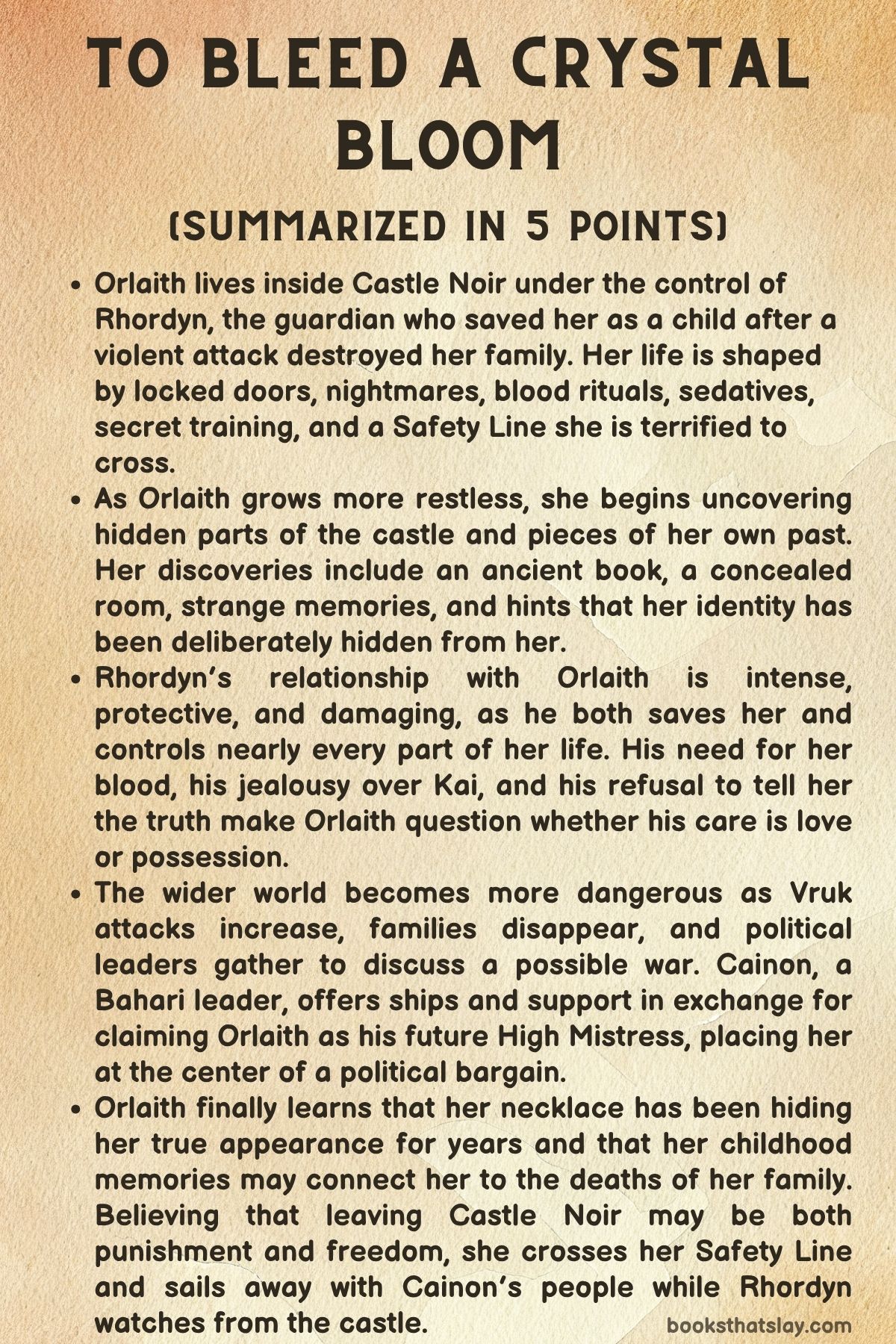
Rhordyn returns to a safe house in Vateshram Forest after years away and finds it burned, surrounded by bodies, and marked by signs of Shulák violence. Among the dead is Aravyn, a woman he had promised to protect.
She is mortally wounded, and before dying, she gives him a necklace and begs him to save her daughter. Rhordyn kills her at her request, then finds a very young child protected inside a crystal-like dome.
The child has a vine-shaped mark associated with death and prophecy. Rhordyn briefly considers killing her, but after tasting her blood, he cannot do it.
Instead, he takes her away, knowing his choice is driven by selfishness rather than mercy.
Years later, that child is Orlaith, now twenty, living in a tower called Stony Stem within Castle Noir. Her life is shaped by rules, secrecy, fear, and dependence.
Each night, she pricks her finger and leaves blood-tinted water in a small door called The Safe for Rhordyn, her guardian. He takes it without speaking.
Orlaith rarely leaves her protected area and refuses to cross the boundary she calls her Safety Line. She suffers from nightmares and uses caspun, a sedative, to sleep.
She also secretly uses Exothryl, a stimulant, to fight the aftereffects. Her closest companion in the castle is Baze, her guard and trainer, who knows much more about her life than he admits.
Orlaith trains with Baze using wooden swords, but the sound and weight of the weapons often trigger old trauma. She hides her injuries and frustrations from Rhordyn, though he sees far more than she realizes.
Rhordyn is stern, controlling, and emotionally distant, yet he watches her constantly and reacts strongly to any sign of danger. He announces that he will host a ball and a Conclave, forcing Orlaith to appear before others to quiet rumors about her isolation.
This terrifies her because her life has been built around avoidance, secrecy, and controlled surroundings.
Inside Castle Noir, Orlaith explores hidden passages known as The Tangle and a secret corridor she calls Whispers, where she builds a mural from painted stones. She also discovers a lost girl named Anika from the forbidden Keep, but is prevented from seeing what lies inside.
Her curiosity grows as the castle’s closed doors and hidden rooms suggest that her life has been shaped by deliberate concealment. She later finds a hidden storage room containing a wardrobe, a bassinet, gems, a family painting, and an ancient book.
The discovery unsettles her because it feels connected to a past she has never been allowed to know.
Beyond the castle, Orlaith’s closest friend is Kai, an Ocean Drake who lives in the sea below Castle Noir. Kai is playful, loyal, and openly affectionate in ways Rhordyn is not.
Orlaith gives him a painted rock of his lost island, and he gives her a conch charm that can summon him. He also reveals pieces of the world’s history, including stories about Ocean Drakes, Irilaks, Aeshlians, and Vruks.
Kai understands that Orlaith knows dangerously little about the world and grows concerned when he learns she has used ingredients from him to make Exothryl. His friendship offers her tenderness, but it also sharpens her awareness of how little freedom she has.
Rhordyn begins taking a more direct role in Orlaith’s training and confiscates her Exothryl. He is harsh, impatient, and unwilling to explain himself, but his concern becomes clear when Orlaith suffers withdrawal from caspun.
He holds her through fever and nightmares, giving her the last of her supply and promising to ration it. These moments confuse Orlaith because Rhordyn can shift from coldness to care without warning.
She wants comfort and answers from him, but he gives her neither consistently.
The arrival of Zali, High Mistress of the East, stirs Orlaith’s jealousy. Rhordyn appears comfortable with Zali in a way that wounds Orlaith, and he tells her he is considering giving Zali his cupla, a betrothal token.
His rejection of romantic ideals devastates Orlaith, who has built much of her private longing around stories and imagination. At dinner, Orlaith behaves defiantly in front of Zali, yet Zali responds with surprising humor and ease.
Rhordyn’s responses remain difficult to read: he seems amused, possessive, and pained all at once.
Orlaith’s nightly blood ritual becomes a battleground between them. When she refuses to give Rhordyn her blood, he storms into her room, enraged by the denial.
He nearly bites her neck and then forces the ritual himself by pricking her finger. He admits that she is not ready to know why he locks her door, but his need for her blood is clearly powerful and dangerous.
Orlaith realizes that the ritual is not simply a habit. It is tied to Rhordyn’s nature, his control, and the secrets he keeps from her.
Soon after, Orlaith experiences her first heat. The physical and emotional intensity overwhelms her, and Rhordyn orders her confined to her tower.
Her desire and fever make her desperate to escape, and Rhordyn blocks her when she tries to leave. When her suffering becomes unbearable, he helps relieve her once, then withdraws coldly and tells her he will not do it again.
Orlaith feels ashamed and rejected, especially because Rhordyn’s care is always followed by distance. Kai later comforts her and kisses her, telling her that someone who loves her should kiss her differently from the way Rhordyn treats her.
Rhordyn reacts with violent jealousy and threatens Kai, proving that his restraint does not mean indifference.
Outside the castle, the threat of Vruks grows. Villages are attacked, families vanish, and the political leaders gather to discuss the danger.
At the Conclave, Zali presents evidence that the Vruks may come from the frozen northern territory of Fryst, possibly controlled or bred by High Master Vadon. The leaders fear a wider war.
Orlaith attends and is forced to witness the reality Rhordyn faces as ruler: fear, military planning, missing children, and the possibility of mass violence. Cainon, a Bahari leader from the South, refuses to pledge support unless Rhordyn allows him to offer Orlaith his cupla.
He argues that a political match with her could secure ships and save lives.
Orlaith learns of Cainon’s bargain and feels guilty that innocent people might suffer because of Rhordyn’s refusal. Rhordyn tries to keep her from the ball, but she escapes her locked tower by crossing a dangerous beam high above the courtyard.
At the ball, she arrives in a revealing red gown and draws the attention of everyone in the room. Rhordyn’s possessiveness is obvious, but he still announces his betrothal to Zali as both a love match and a political alliance.
Orlaith is devastated. In response, she dances with Cainon and allows him to kiss her publicly.
During the kiss, he fastens his cupla on her wrist and announces her as the future High Mistress of the South.
After the ball, Orlaith’s life begins to fracture. Rhordyn reveals one of his greatest secrets: the necklace she has worn for years is a glamour that hides her true appearance.
Without it, she sees herself as a luminous, otherworldly woman with pointed ears, crystalline eyes, star-like freckles, and a black vine-like mark. Rhordyn explains that he promised her dying mother he would keep her safe, but Orlaith recognizes the cost of that promise.
Her body, history, and identity have been hidden from her for almost her entire life. She also realizes that the boy from her nightmares resembles her true form and may be connected to the violent event that destroyed her childhood.
Cainon prepares to take Orlaith south, while Baze tries to stop her from leaving. Orlaith removes Baze’s glamour ring and discovers that he is also Aeshlian, with white hair, pointed ears, and scars suggesting torture.
His betrayal hurts deeply because he knew the truth and never told her. Meanwhile, Orlaith completes the mural in Whispers and understands that it depicts deaths she has seen in nightmares.
The final image of the boy confirms that her dreams are not ordinary fears but fragments of memory or prophecy.
A brutal reminder of the outside world arrives when Mishka, a pregnant woman who once asked permission to move south, reaches the castle fatally wounded by a Vruk. Orlaith stays with her as she dies, while Rhordyn ends her suffering with a mercy killing.
The scene convinces Orlaith that leaving may be necessary, not only for herself but for others endangered by the political deadlock. Rhordyn tries to stop her again.
In The Den, he destroys Cainon’s gifted gown, kisses Orlaith with intense desire, then locks her in his room and leaves to hunt a Vruk. Orlaith feels used, abandoned, and more determined than ever to escape.
She finds a way out through the thermal spring connected to the bathing cavern. While nearly drowning, she recovers buried memories of the attack on her family.
She remembers intruders, her brother’s death, her mother’s pleading, and a terrible black power she released as a toddler that killed everyone nearby. Vruks came afterward to feed on the bodies.
Orlaith concludes that she caused the slaughter and that her Safety Line may have been designed to contain her. Guilt pushes her toward Cainon, whom she sees as a form of punishment and atonement.
At the bay, Baze confronts her one last time. Orlaith defeats him in a fight and uses his stolen glamour ring to prevent him from following.
She boards the Bahari ship and crosses her Safety Line, leaving Castle Noir behind. As the ship pulls away, she looks for Kai and apologizes through the conch.
Rhordyn watches from her balcony, fixed on her departure. Orlaith’s escape marks the end of her life as a hidden ward and the beginning of a dangerous journey into truth, guilt, power, and a world that has been waiting for her.
Characters
Orlaith
Orlaith is the emotional center of the book, a young woman whose life has been built around protection, fear, and withheld knowledge. She begins as someone trapped in a tower, dependent on sedatives, secret stimulants, rituals, and carefully controlled spaces to survive each day.
Her Safety Line is both a physical boundary and a symbol of the mental cage she has accepted because she believes the outside world will destroy her. Yet Orlaith is not passive.
She trains, explores hidden corridors, paints, steals forbidden books, questions Rhordyn’s rules, feeds Shay, visits Kai, and repeatedly tests the limits placed around her. Her recklessness often comes from pain, jealousy, loneliness, and a desperate need to feel real in a life where nearly everyone has lied to her.
Her character becomes more complex as her body and identity begin to change. The heat, her strange blood, her true appearance, and her buried memories all suggest that she has never been allowed to understand herself.
The revelation that her face, species, and history have been hidden beneath a glamour is devastating because it turns her own reflection into another lie. Orlaith’s decision to leave Castle Noir is not simple freedom.
It is shaped by grief, guilt, anger, political pressure, and the belief that she may be dangerous. In To Bleed a Crystal Bloom, she is a character struggling to separate protection from possession and love from control.
Rhordyn
Rhordyn is one of the most powerful and morally difficult figures in the story. He saves Orlaith as a child, but his rescue becomes the foundation of a life ruled by secrecy, control, and emotional deprivation.
He is a guardian, ruler, warrior, and possible monster, and the book presents him as someone who has endured violence for so long that tenderness comes out twisted. His care for Orlaith is undeniable, but so is the harm he causes.
He locks doors, withholds truth, manipulates her movement, threatens those close to her, and uses silence as punishment. His need for her blood adds a disturbing layer to their relationship because it makes his protection feel both intimate and predatory.
Rhordyn’s actions are often driven by fear of what Orlaith is and what others might do to her if they knew the truth. He believes concealment is safety, but the cost is Orlaith’s autonomy.
His love is possessive, intense, and self-condemning; he repeatedly insists there can be no happy ending, as if denying hope can excuse the cruelty of his choices. At the same time, his mercy killings, war planning, and reactions to Vruk attacks show that he carries enormous responsibility beyond Orlaith.
Rhordyn is not written as a simple villain or hero. He is a man whose devotion has become dangerous because he cannot release the person he claims to protect.
Baze
Baze functions as Orlaith’s guard, trainer, friend, and one of the most painful sources of betrayal in the book. He has an easy, familiar relationship with her at first, teasing her, sharing drinks, comforting her through nightmares, and training her in secret.
His rough methods often seem harsh, but they are also meant to prepare her for danger. He understands her fears, her addictions, and her habits better than almost anyone.
This closeness makes his secrecy more damaging when Orlaith learns that he has known the truth about her identity all along.
Baze’s concealed Aeshlian nature changes the meaning of his role. His glamour ring, white hair, pointed ears, and scars suggest that he has survived terrible suffering and that his loyalty to Rhordyn may be tied to shared trauma, debt, or protection.
He is not merely a guard obeying orders; he is also someone hiding from the world. His betrayal is painful because he let Orlaith believe she was alone in her difference when he knew otherwise.
Still, his attempts to stop her from leaving show that his care is real, even if compromised by obedience and fear. Baze represents the damage done when loyalty to a protector conflicts with honesty toward the person being protected.
Kai
Kai brings warmth, playfulness, and emotional openness into Orlaith’s restricted life. As an Ocean Drake, he belongs to a fading species and carries his own grief, especially through the loss of Asha and the corruption of his homeland.
Unlike Rhordyn, Kai usually meets Orlaith with affection rather than command. He gives her gifts, heals her wound, answers questions about the world, and challenges the way she has been kept ignorant.
His bond with his inner drako, Zykanth, adds wildness and tension to his character, showing that he also has powerful instincts he must control.
Kai’s love for Orlaith is protective without being as openly possessive as Rhordyn’s. His kiss after her heat is important because he frames love as something that should offer tenderness, not shame.
He also becomes a symbol of the life Orlaith could have if care were rooted in choice rather than confinement. Yet Kai is not free from conflict.
His anger toward Rhordyn over Asha’s death and the decline of the Ocean Drakes shows that he carries resentment and sorrow beneath his charm. His relationship with Orlaith gives her comfort, but it also complicates her already unstable bond with Rhordyn.
Cainon
Cainon enters the story as a political challenger and possible escape route for Orlaith. He is attractive, controlled, strategic, and fully aware of the value Orlaith may hold.
His offer to provide ships in exchange for the right to give her his cupla makes him appear opportunistic, especially because he uses a crisis to bargain for her future. Yet he also names a truth Rhordyn avoids: Orlaith’s confinement is not freedom, and a public alliance could take her out of Castle Noir.
Cainon’s role is therefore uneasy. He may offer rescue, but that rescue comes with possession of another kind.
His public claim at the ball is both daring and manipulative. By fastening the cupla during a kiss, he gives Orlaith a way to strike back at Rhordyn, but he also marks her before she fully understands the consequences.
His gift of the blue gown later suggests that he sees her as a future mate and political symbol, not simply as a person in pain. Still, Cainon is not shown as careless or shallow.
He responds to Orlaith’s art, sees her Bahari traits, and recognizes her importance. He represents the wider world waiting beyond Castle Noir: seductive, dangerous, political, and not necessarily kinder.
Zali
Zali, High Mistress of the East, is introduced through Orlaith’s jealousy, but she quickly becomes more than a romantic rival. She is composed, capable, and battle-hardened, with a direct understanding of the Vruk threat.
Her account of killing and displaying Vruks shows that she is ruthless when required, yet her behavior toward Orlaith is unexpectedly generous. At dinner, she does not humiliate Orlaith for her rude performance.
Instead, she responds with humor and even quiet solidarity, suggesting that she understands more than she reveals.
Zali’s betrothal to Rhordyn appears to serve political necessity as much as personal connection. Whether or not the relationship is emotionally genuine, she is part of a strategy to unite territories against a growing danger.
Her presence forces Orlaith to confront jealousy, insecurity, and the possibility that Rhordyn’s life includes duties beyond her. Zali also contrasts with Orlaith’s sheltered existence.
She has seen war, made hard choices, and commands respect in public spaces where Orlaith feels exposed. In that sense, Zali becomes a model of adult authority and a reminder of the power Orlaith has not yet learned to claim.
Shay
Shay is a wild Irilak shadow creature, and his connection with Orlaith adds mystery to the story’s treatment of fear, danger, and misunderstood beings. Orlaith feeds him small animals and treats him with a strange kind of trust, even after learning from Kai that Irilaks feed on fear and lure children to death.
This contrast raises questions about whether Shay is truly different, whether Orlaith’s nature affects him, or whether her loneliness makes her willing to befriend something dangerous.
Shay’s reactions reveal a surprising emotional range. He becomes upset when he destroys the bluebells Orlaith wants, shrieks when she is in pain, and reacts strongly to the idea that she may leave.
His forced word, “No,” makes him feel less like a simple monster and more like a being attached to her. At the same time, his growth and agitation make him unsettling.
Shay represents the parts of Orlaith’s world that have been labeled monstrous but may be tied to her in ways no one has explained. His presence near the Safety Line also makes that boundary feel alive with meaning.
Tanith
Tanith serves as Orlaith’s handmaiden and is often positioned at the edge of Orlaith’s private life. She changes sheets, helps manage Orlaith’s heat, delivers clothing, and observes details that others might miss.
Her role may seem practical at first, but she is part of the system that maintains Orlaith’s confinement. She knows enough to follow Rhordyn’s instructions and keep daily life moving around Orlaith’s fears, yet she does not break the silence surrounding Orlaith’s true identity.
Tanith’s interactions also reveal the deeply bodily nature of Orlaith’s imprisonment. During the heat, Tanith manages scent, blood, bedding, and shame, turning Orlaith’s private suffering into another controlled routine.
She is not cruel, but she is not liberating either. Her character shows how confinement is sustained not only by powerful men like Rhordyn but also by ordinary caretaking structures.
Tanith helps Orlaith survive the day-to-day effects of her condition, while also helping maintain the rules that keep Orlaith dependent.
Aravyn
Aravyn appears briefly, but her death shapes the entire book. As Orlaith’s mother, she is the origin of Rhordyn’s promise and the reason Orlaith is taken from the ruins of the safe house.
Her final act is not to explain everything, fight longer, or save herself, but to entrust her daughter to a man she believes can protect her. That choice carries enormous consequences.
Rhordyn builds Orlaith’s life around the promise, and Orlaith later has to live with the damage caused by a vow made before she could understand it.
Aravyn’s role is also tragic because Orlaith’s recovered memories suggest a more complicated truth about the massacre. If Orlaith’s power killed those around her, then Aravyn’s death is tied not only to outside attackers but also to the terrifying force inside her child.
Aravyn becomes a symbol of maternal love, sacrifice, and the unbearable burden of secrets passed from one generation to another.
Mishka
Mishka’s role is small but deeply significant because she gives human weight to the political crisis. When she first appears, she is pregnant and asking permission to move south to be with the man whose cupla she has accepted.
Her request is practical and emotional: she wants safety, family, and a future away from Vruk attacks and rumors of disappearing children. Through her, the danger outside Castle Noir becomes personal rather than abstract.
Her later return, fatally wounded, changes Orlaith’s understanding of Rhordyn and the world. Mishka’s death forces Orlaith to witness the suffering that rulers and warriors face beyond castle walls.
Rhordyn’s mercy killing is brutal but compassionate in context, and Orlaith’s refusal to look away marks a change in her character. Mishka becomes the proof that innocence is already being consumed by the larger conflict.
Her death pushes Orlaith toward leaving, not only out of pain but from a growing belief that her choices carry consequences for others.
Anika
Anika represents the hidden life of the Keep, one of the castle’s most guarded mysteries. As a shivering lost child in The Tangle, she appears vulnerable and confused, prompting Orlaith’s protective instincts.
Her question about Orlaith’s voice creates a brief moment of innocent connection, but her return to the Keep immediately restores the sense of secrecy. Vestele’s harsh reaction and Jasken’s refusal to let Orlaith enter suggest that children, families, or prisoners may exist behind the castle’s locked sections.
Anika’s importance lies in what she reveals about Orlaith’s ignorance. Orlaith lives inside Castle Noir yet does not know what happens in major parts of it.
The encounter shows that her confinement is not only about keeping her inside a tower; it is also about keeping information away from her. Anika widens the mystery of the castle and hints that Orlaith is not the only vulnerable person being controlled.
Vestele
Vestele appears as a stern figure connected to the Keep. Her harsh treatment of Anika immediately makes her seem severe and perhaps cruel, but the limited information around her leaves room for uncertainty.
She may be enforcing necessary rules, hiding something dangerous, or participating in the same culture of secrecy that defines Castle Noir. Her sharp reaction to Anika’s appearance outside the Keep suggests that order in that part of the castle is maintained through fear and control.
As a minor character, Vestele helps build the atmosphere of restriction surrounding Orlaith. She is one of the people who closes doors rather than opens them.
Her presence tells the reader that Rhordyn’s control is not isolated; the entire castle runs on guarded thresholds, withheld explanations, and people who know more than they say.
Jasken
Jasken is the massive guard at the entrance to the Keep, and his function is clear: he is a physical barrier between Orlaith and forbidden knowledge. When Orlaith tries to follow Anika, he blocks her path without explanation.
His size and silence make him part of the castle’s architecture of control, almost like another locked door.
Though he does not receive much emotional development, Jasken matters because he shows how Orlaith’s world is guarded at every level. It is not enough that she fears the forest or obeys Rhordyn; the castle itself is staffed by people whose job is to stop her from seeing too much.
In To Bleed a Crystal Bloom, characters like Jasken make confinement feel organized and deliberate rather than accidental.
Hovard and Dolcie
Hovard and Dolcie appear during Orlaith’s gown fitting, and their scene exposes how others view her body, her future, and her place in court society. Dolcie’s insistence on a revealing neckline and her comments about attracting suitors reduce Orlaith to marriageability and appearance.
This is especially uncomfortable because Orlaith has so little control over her own life already. The fitting becomes another moment where her wishes are overruled until Rhordyn intervenes.
Their role also shows the contradiction in Rhordyn’s control. He restricts Orlaith constantly, yet reacts sharply when others disregard her comfort.
His defense of her against Dolcie is protective, but it does not erase his larger pattern of denying her choice. Hovard and Dolcie’s scene therefore highlights how Orlaith is handled, dressed, displayed, and managed by others before she has had the chance to define herself.
Greywin
Greywin, the deaf master blacksmith, is connected to preparation, war, and Rhordyn’s hidden planning. His forge beneath the castle gives the story a sense of deeper machinery at work below Orlaith’s sheltered life.
Through him, Rhordyn obtains heavier Ebonwood swords for Orlaith’s training, despite Baze’s concern that they will worsen her trauma. Greywin’s work is practical, but it supports Rhordyn’s urgent belief that Orlaith must be readied quickly.
His presence also reflects the seriousness of the threat beyond the castle. Weapons are being made, contingencies are being stored, and Rhordyn is preparing for outcomes Orlaith does not understand.
Greywin is not central emotionally, but he belongs to the network of people helping Rhordyn plan for violence, defense, and possibly catastrophe.
Cook and Lex
Cook and Lex offer glimpses of warmth and ordinary routine inside Castle Noir. Cook notices Orlaith’s moods through food, especially her request for apple-pastry rolls when she feels low.
Lex helps signal whether strangers are present, making the kitchen feel like one of the few spaces where Orlaith can move with some comfort. Their presence softens the castle’s harshness and shows that Orlaith has built small systems of trust.
At the same time, even these kinder figures exist within a controlled environment. Their care does not free Orlaith, but it helps her endure.
They represent the domestic life she is leaving behind: familiar smells, secret routes, small kindnesses, and people who know her habits without knowing the whole truth.
Themes
Protection and Possession
Protection in the story is rarely clean or innocent. Rhordyn saves Orlaith as a child, hides her true appearance, guards her from political enemies, monsters, and possibly from her own power.
Yet the same protection becomes a form of ownership. He locks her door, controls her movement, decides what she is allowed to know, interrupts her relationships, and turns her blood into a private ritual she does not understand.
The book keeps returning to the question of when care becomes captivity. Rhordyn’s intentions may be rooted in fear and devotion, but intention does not erase harm.
Orlaith is kept alive, but she is also kept ignorant, dependent, and emotionally starved. Cainon’s offer complicates this theme because leaving Rhordyn does not automatically mean freedom.
Cainon also wants to claim her through a cupla and use her for political advantage. Orlaith’s struggle is therefore not simply to escape one man, but to find a version of safety that does not demand the surrender of her body, choices, or identity.
The story treats protection as dangerous when it refuses consent.
Identity, Secrecy, and the Stolen Self
Orlaith’s deepest crisis is not only that others have lied to her, but that those lies have separated her from herself. Her face, species, history, memories, and even her reflection have been altered or hidden.
The glamour necklace is one of the clearest symbols of this theft: it protects her from outside danger while denying her the right to know what she is. Her discovery of her true form is painful because it makes her own body feel unfamiliar.
The painted mural, the hidden room, the ancient book, and the recurring dreams all act as pieces of a self that has been scattered throughout the castle. Every secret Orlaith uncovers changes the meaning of her life.
Her nightmares are not random fears, her blood is not ordinary, her Safety Line is not merely anxiety, and her guardian is not simply stern. In To Bleed a Crystal Bloom, identity is treated as something a person must be allowed to face, even when the truth is frightening.
Without truth, Orlaith can survive, but she cannot fully live.
Trauma, Addiction, and Control of the Body
Orlaith’s body carries memory before her mind can explain it. Metallic sounds, blades, darkness, blood, and certain smells trigger reactions she cannot reason away.
Her dependence on caspun and Exothryl shows how she has learned to manage unbearable fear through substances, even when doing so damages her health. The story does not present her addiction as a simple weakness.
It grows from isolation, nightmares, untreated trauma, and the lack of honest support around her. Her heat intensifies this theme because it turns her body into another place where control is stripped away.
She is confined, watched, cooled, scented, and managed while experiencing desire and pain she cannot stop. Rhordyn’s response adds further damage because he offers relief and then withdraws it, leaving her ashamed of need itself.
Throughout the story, Orlaith keeps trying to regain control through training, painting, secret passages, rituals, defiance, and eventually escape. Her battle is not only against outside monsters but against the ways fear has colonized her body.
Healing cannot begin while everyone around her treats control as a substitute for truth.
Guilt, Survival, and the Cost of Leaving
Survival in the story comes with a heavy burden. Orlaith survives the massacre as a child, but the recovered memory suggests that her own power may have killed the people she loved.
This possibility transforms her understanding of herself. She no longer sees her confinement only as Rhordyn’s cruelty; she wonders whether the Safety Line was created to prevent another disaster.
That guilt makes Cainon’s claim more powerful because leaving begins to feel like punishment, duty, and atonement all at once. Mishka’s death adds another layer.
Orlaith witnesses the real cost of the Vruk threat and understands that political choices can decide whether ordinary people live or die. Her departure from Castle Noir is therefore not a simple act of rebellion.
It is charged with grief for Kai, anger at Baze, betrayal by Rhordyn, fear of Cainon, and shame over her past. The story treats leaving as both necessary and painful.
Orlaith steps beyond her Safety Line not because she is suddenly healed, but because remaining would mean accepting a life built by other people’s fear.