When the Fireflies Dance Summary, Characters and Themes
When the Fireflies Dance by Aisha Hassan is a contemporary novel set in Lahore that follows Lalloo, a young man trying to survive two worlds at once: the brutal reality of a debt-trapped brick kiln on the city’s edge, and the polished homes of the rich where he works as a driver and servant. The story moves between present pressure and past wounds, showing how one family’s grief after a son’s death turns into a fight for the living.
It’s a book about class power, loyalty, shame, first love, and the steep price of freedom when the system is built to keep you in place.
Summary
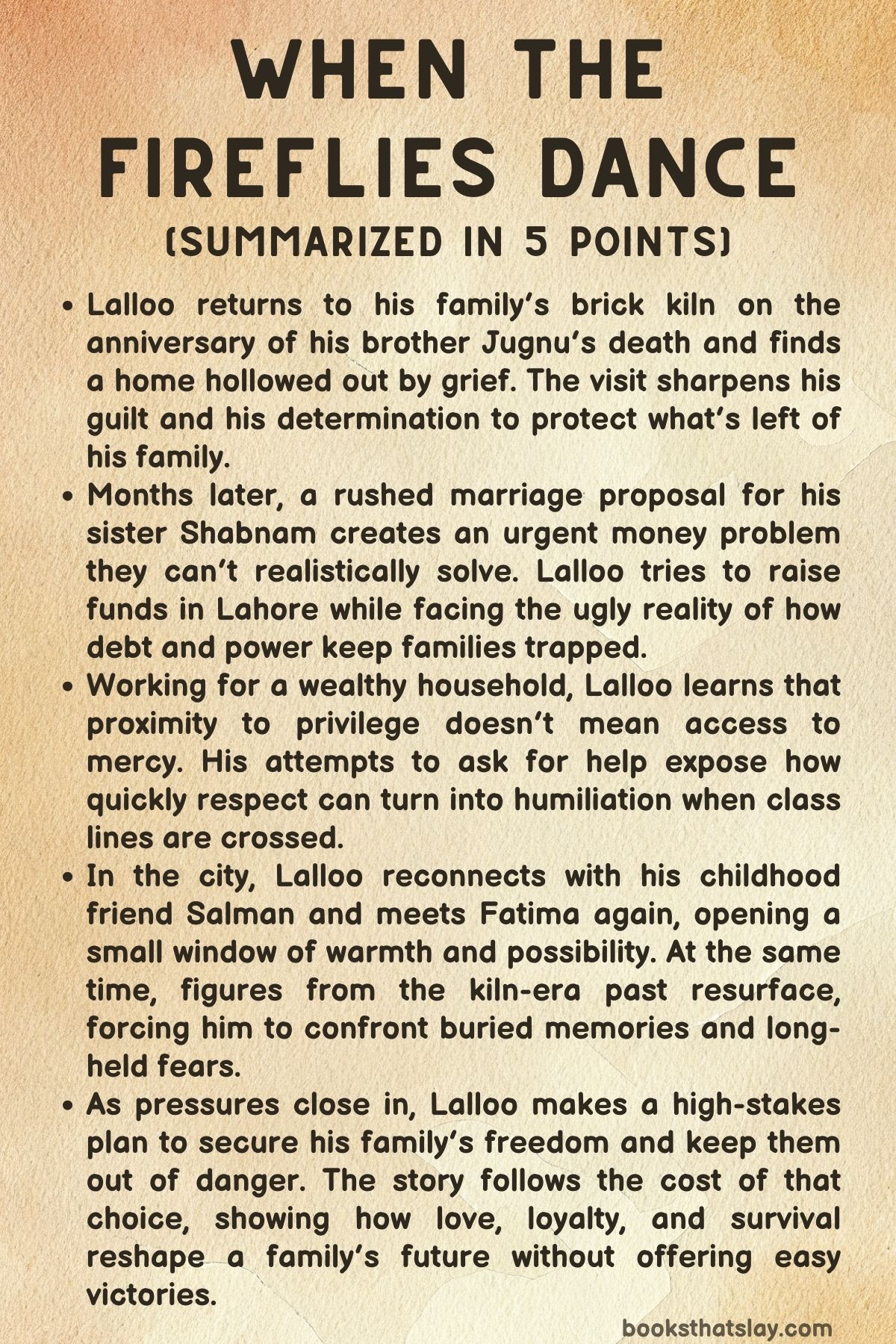
Lalloo travels from central Lahore to the outskirts to visit his family at the brick kiln where they are bound by debt. The kiln is a harsh place of smoke, dust, and endless labor, marked by a towering chimney and rows of drying bricks.
Inside their cramped hut, he finds his mother stuck in raw grief, rocking and striking her head against the wall while his sisters—Shabnam and young Pinky—sit nearby, helpless. Outside, his father Abu, shaken and furious with himself, kills a sparrow with a shovel as the call to prayer rises, muttering that his son’s blood is on his hands.
The family still goes to the cemetery because it is the anniversary of Jugnu’s death. At the grave, there is no proper marker—only an uneven mound and a leaning stick.
Their mother collapses again, and Lalloo feels how Jugnu’s absence has altered everything. That night, unable to sleep, Lalloo buries the dead sparrow himself, as if trying to return one small thing to the earth with care when life has become so careless.
Months later, Lalloo is summoned again. Abu has arranged a marriage proposal for Shabnam.
Lalloo is alarmed; the wedding and dowry are beyond their means, and any new loan will deepen the family’s bondage to Heera, the kiln’s owner. Their mother has become distant since Jugnu’s death, barely speaking, as if she has stepped away from the world.
Abu insists Shabnam must marry now and argues that at least one child must escape the kiln. Lalloo promises he will find the money, even though he has no clear way to do it.
When the groom’s family visits, Lalloo watches his parents stretch a small meal into a show of hospitality. The visitors ask uneasy questions about the family’s debt and mention rumors about “trouble” caused by a young man who asked questions.
The phrase lands like a blow because it points directly to Jugnu and the history the family tries not to say aloud. Abu denies knowing anything, pushing the conversation forward.
The guests want the wedding quickly. Abu agrees to a date only weeks away, leaving Lalloo trapped between a promise he made and a reality he cannot control.
On the bus back to Lahore, Lalloo remembers the night he was sent away as a child after Jugnu’s death. His mother screamed at Abu to take Lalloo away, as if losing one son had made the rest unbearable.
Abu delivered seven-year-old Lalloo to Rizwan, a mechanic, begging him to keep the boy. Lalloo was left with only Jugnu’s cricket ball.
His early life at the workshop is lonely and rough: he sleeps among wrecked cars, gets bullied, and waits for someone to return for him. Over time he meets Salman, a sharp, streetwise boy who becomes his closest friend, and Fatima, a gentle girl who crosses his path during those formative years.
In the present, Lalloo works for the wealthy Alam family as a driver and household help. With the wedding deadline closing in, he turns to Yasmin Alam, the daughter who once helped him get hired.
Yasmin casually agrees to help, planning to get money from her father by pretending it’s for a designer purchase. But Omer Alam surprises her by gifting her the exact expensive handbag instead of cash, leaving Yasmin unable to provide the loan.
Lalloo, humiliated, tries asking Asima Alam privately for an advance. For a moment she seems to consider it, but Omer appears, mocks Lalloo, and shuts the request down.
Lalloo runs into Salman again and learns Fatima has returned to their old neighborhood. Soon he sees her when her grandmother, Chachi Jeera, falls in the bazaar and injures her ankle.
Lalloo and Fatima help her up and gather scattered fruit. In a brief private exchange, Fatima tells Lalloo she remembers him.
The small warmth between them lifts him, even as the crisis over Shabnam’s wedding money grows heavier.
On a Sunday in the bazaar, Lalloo meets Salman, but their day turns ugly when Taari shows up—an old figure tied to the kiln and to Lalloo’s deepest fear. Taari and his men corner the boys, taunting Lalloo about Jugnu and threatening to make him “dance” the way they claim Jugnu once did.
Lalloo snaps and grabs a cricket bat, but Taari strikes him hard, humiliating him in front of a crowd. Salman tries to calm things down, dragging Lalloo away.
As Lalloo escapes, he sees Fatima among the onlookers, shocked. The public beating leaves him sick with shame and flooded with memories of kiln labor, threats, and the night violence broke his family apart.
Not long after, Asima sends Lalloo on an errand into the old city and then, in a secretive move, visits a guarded place to obtain a silver amulet from a spiritual healer. Back at home, Lalloo overhears arguments about the amulet and about what Asima believes is wrong with her daughter’s mind.
Then Asima makes Lalloo an offer: follow Omer, find where he goes and with whom, and bring proof. In return, she will pay him the money he needs.
Lalloo recruits Salman’s help to tail Omer. At the same time, Lalloo grows closer to Fatima.
One evening he speaks with her on a rooftop, notices her medical studies, and feels the distance between their lives—but Fatima meets him with teasing courage rather than pity. He invites her to the cinema; she agrees, and she writes her number on his arm when his phone dies.
With Abu coughing badly at the kiln and Shabnam terrified of what marriage will cost them, Lalloo pushes forward with the surveillance job as if it is the only bridge left.
Lalloo captures photos of Omer meeting a woman named Tania. When he brings them to Asima, her first reaction is triumph, but it quickly turns into panic when she recognizes Tania as someone who will make the scandal far more dangerous than she expected.
She orders Lalloo to delete the photos and refuses to pay immediately. Lalloo refuses, desperate, and threatens to reveal the affair—especially to Yasmin.
Asima, frightened of her daughter learning the truth, agrees to pay later. Lalloo sends the photos to Salman as backup.
The next day, the household erupts: Omer’s watch is “missing.” Asima lines up the servants and forces a degrading search. A gold Rolex is produced from Lalloo’s bag, and he is accused of theft.
Lalloo realizes he has been framed. Omer beats him and smashes his phone.
With nothing left to lose, Lalloo exposes the affair in front of Yasmin, naming Tania. Yasmin is shattered.
Lalloo is thrown out, jobless and bloodied, knowing Omer’s influence can erase his future.
Hunted by police after Omer files a report, Lalloo hides with Salman. Cornered and furious, he decides to take what he believes he is owed.
He steals Omer’s briefcase from the family car at a petrol pump and escapes through narrow lanes. Inside the case is cash—enough to fund Shabnam’s wedding and possibly buy his family out of kiln debt.
Lalloo rushes to the kiln, gives money to his mother, and promises medical care for Abu. Shabnam demands the truth, terrified that Lalloo will be killed like Jugnu, but Lalloo avoids explaining.
Heera names a debt amount in “lakhs” and tells Lalloo to return in two days, while his men watch closely.
Soon after, Lalloo lands in a hospital, and Salman brings him a legal document: Omer Alam has owned the brick kiln for years. The revelation lands like a second tragedy.
The man who beat him, framed him, and used the police also controlled the place where Jugnu died and where Lalloo’s family has been trapped. Lalloo understands that power in Lahore is not scattered—it is connected, and it reaches everywhere.
Realizing Omer’s men will come to kill him, Lalloo forms an extreme plan. He persuades a nurse, Sister Billo, to help him fake his death so he can disappear and move his family.
Billo refuses at first, then changes her mind when she learns Yasmin may never walk again and Omer’s rage is escalating. Billo demands half the money and promises a staged death and a quick burial under “standard procedure” for poor patients.
Lalloo visits Yasmin in her private ward. Injured and barely awake, she warns him that her father will not stop.
Lalloo then calls Fatima and cruelly ends their relationship to protect her, forcing her away so she won’t follow him into danger. Late at night, the fake death plan goes forward.
Lalloo wakes in agony elsewhere, bandaged and weak, and discovers Billo has taken a kidney and shorted him on money. Even betrayed, he keeps moving.
He collects Shabnam, his mother, Abu, and Pinky from an agreed hiding place and disguises them for travel. They take a train toward Karachi, and Lalloo stays alert at every stop, fearing recognition.
He throws away his phone and deletes contacts, committing to being “dead.” In Karachi, his condition worsens—fever, bleeding, exhaustion. They reach a shabby safe house, then move again and again until they find a small place near a rubbish dump.
Slowly, life changes shape: Pinky starts school and learns to play, their mother begins speaking more, and Abu sits in the winter sun, breathing a little easier.
Abu’s health is beyond repair; years of brick dust have destroyed his lungs. Before he dies, he finally tells the truth about Hasnat, the boy whose death was used to smear Jugnu.
Jugnu helped Hasnat’s parents try to escape. When guards arrived, Hasnat ran and drowned in a canal, and Jugnu searched the freezing water but could not find him.
The kiln bosses turned the drowning into a weapon, using it to crush Jugnu and warn everyone else. Lalloo feels a surge of relief that Jugnu was not a killer, only a boy who tried to help.
Abu dies quietly in his sleep. The family mourns together, but Shabnam tells Lalloo he gave their father something they never had at the kiln: peaceful final months.
Later, a letter from Billo confirms she used another corpse to fool Omer and secure a quick burial, and she says Omer has been broken by Yasmin’s injuries. The letter also reveals Salman and Fatima were told Lalloo died.
In Karachi, Lalloo lives carefully, working to support his mother and sisters, dreaming of opening a mechanic’s shop, and holding onto the hope that one day—when it is safe—he might find Salman again and reclaim the parts of his life he had to leave behind.
Characters
Lalloo
Lalloo is the emotional and moral center of When the Fireflies Dance. Shaped by poverty, dislocation, and survivor’s guilt, he moves through the story carrying two burdens at once: the practical obligation to keep his family alive and the private belief that he somehow failed Jugnu.
His adulthood in Lahore, working inside the Alam household, teaches him the humiliating mechanics of class power—how quickly kindness becomes conditional and how easily the wealthy can rewrite the truth. Yet Lalloo is not only reactive; he is intensely strategic, improvising solutions under pressure, reading people fast, and taking risks that reveal both courage and desperation.
His moral line keeps shifting as circumstances tighten: he begins by trying to borrow and bargain, then escalates to blackmail, and ultimately theft, but each step is framed by his conviction that the world has already stolen from him first. What makes him compelling is the way tenderness survives inside him despite constant threat—his gentleness toward Pinky, his protective loyalty to Shabnam, his devotion to Salman, and the careful, almost reverent way he approaches love with Fatima.
Even when he tries to sever ties to protect others, it is the same instinct that drives him: to absorb danger himself so the people he loves can remain untouched. By the end, his “death” is less an escape than a rebirth into a life defined by vigilance, sacrifice, and a quiet, stubborn hope that safety can be built from ruins.
Jugnu
Jugnu exists in the narrative as both memory and moral compass, a figure whose absence restructures everyone’s life. He is remembered as unusually kind and protective within the violence of the bhatti, the sort of older brother who finishes bricks so younger siblings can rest and who can turn a terrifying moment—like Lalloo falling into a sewer—into a story that makes a child laugh.
That warmth is precisely why his death becomes catastrophic: it is not only grief but the loss of the family’s internal shield. Jugnu also represents defiance, even if it is expressed through small acts—helping others, asking questions, nudging against the rules of bondage.
The later truth about Hasnat reframes Jugnu completely: not a reckless boy who caused death, but someone who tried to help an imprisoned family escape and was punished through scapegoating. In that sense, Jugnu becomes a symbol of how systems survive by destroying the person who refuses to accept their logic.
For Lalloo especially, Jugnu is the haunting “what should have been,” the life of courage that demands a response from the living—either surrender or continuation.
Abu
Abu is a tragic portrait of a father trapped in impossible choices, with love expressed through damage. His grief is raw and physical—smashing the sparrow, shaking with guilt—yet his decisions often deepen the family’s harm, especially when he arranges Shabnam’s rishta through more debt even as debt is the chain around their throats.
He carries the quiet shame of having brought his family into bondage and the complicated belief that a daughter’s marriage is a doorway out, even if the price is crushing. Abu’s most defining contradiction is that he both abandons and protects: he once delivers young Lalloo to Rizwan in an act that feels like rejection, but is also a brutal attempt to keep one child “free” from the kiln’s gravity.
His later visit to the workshop, apologizing and insisting Lalloo stay away, reveals the core of his character—he measures love in survival math, sacrificing closeness to preserve a chance. When his lungs fail, the story turns his body into evidence of exploitation, brick dust becoming a slow execution.
His final months in Karachi restore something dignity-like: he gets sun, breath, family presence, and eventually the truth about Hasnat is spoken aloud, as if he can finally put down the secrets the bhatti demanded. Abu’s death lands quietly because his life has been a long, exhausting erosion, but it also marks a small victory: he dies free.
Ami
Ami’s character is built from the psychology of grief under captivity. After Jugnu’s death she becomes almost spectral—rocking, striking her head against the wall, dropping plates, speaking less and less—her mind choosing numbness as the only survivable response.
She embodies how trauma can hollow a person out without killing the body, and how poverty offers no space to mourn properly: even devastation must fit inside work, hunger, and debt. Yet Ami is not only broken; she is a mother whose love keeps leaking through the cracks.
Her brief scolding about the Lux soap, her food sent with Abu to Lalloo years earlier, and her gradual return to speech in Karachi show that she still exists beneath the collapse. Ami’s movement from catatonia to partial recovery tracks the family’s shift from bondage to fragile autonomy: when the threat environment changes, her interior life begins to reassemble.
She is also the story’s reminder that heroism is not always dramatic—sometimes it is simply surviving long enough to become present again.
Shabnam
Shabnam is the family’s pressure point: the one whose marriage becomes the immediate crisis and whose future is treated as a transaction by others. She is outwardly dutiful—scattering rose petals at Jugnu’s grave, smoothing social humiliations when guests arrive, absorbing fear so the household can keep functioning—but her inner strength sharpens as the story progresses.
The rishta is not just a wedding plotline; it reveals how girls in bonded families are pushed into “solutions” that preserve male honor while protecting the system’s economics. Shabnam’s courage is most visible when she confronts Lalloo after he brings money: she refuses comfort purchased with mystery, because she has already seen how a brother can be killed for challenging power.
Her insistence on truth is not defiance for its own sake; it is survival intelligence learned from Jugnu’s fate. Later, when they flee, Shabnam becomes operationally brave—moving through Karachi in disguise, finding food, negotiating rentals—quiet competencies that keep the family alive.
By the end she is not merely someone rescued by Lalloo; she is a co-survivor who helps convert escape into a livable life.
Pinky
Pinky functions as innocence shaped inside captivity, a child whose world has been narrowed so completely that the bhatti feels like the full map of life. Her age makes her the starkest indicator of what is at stake: without intervention, she will inherit bondage as normality.
Pinky’s presence also changes the emotional temperature of scenes—she amplifies the cruelty of the donkey chained and starving, the rows of bricks, the smog—because the reader is forced to see the environment through the lens of what a child is learning to accept. When the family reaches Karachi and Pinky begins to play and attend school, her transformation becomes the story’s most tangible proof that escape is real.
She is the living argument against fatalism: if one child can be moved from kiln dust to classrooms, then the system’s “this is all you are” narrative can be broken.
Salman
Salman is Lalloo’s chosen family, the friend who gives him belonging when his biological family fractures under grief and necessity. Street-smart, teasing, and pragmatic, Salman offers Lalloo a social identity beyond “the abandoned worker boy,” pulling him into routines like Sunday bazaar meetups and into dreams like a future car business.
His loyalty is repeatedly tested, especially when Lalloo’s trauma makes him withdraw or lash out, but Salman stays—sometimes with humor, sometimes with frustration, always with an underlying steadiness. The asthma episodes and the childhood rescue by Lalloo create a mutual indebtedness that is emotional rather than transactional; they have saved each other in ways that matter.
Salman’s greatest role is moral anchoring: he is the voice that fears consequences, urges caution, and understands the street-level realities of police and power. Yet he also takes risks—hiding Lalloo, providing a phone, offering to sacrifice his wrecked car for money—showing that his practicality does not cancel his devotion.
In the end, his separation from Lalloo is one of the story’s sharpest wounds because it is not caused by betrayal but by the logic of survival, and the hope of finding him again becomes part of Lalloo’s reason to keep building a future.
Fatima
Fatima represents possibility, but not in a simplistic “love saves” way; she is possibility grounded in empathy, education, and a different social trajectory. She carries her own grief—her mother’s death in a car accident—so she meets Lalloo not with pity but with recognition.
From their early childhood encounter during Eid to their adult reconnection, Fatima consistently shows a calm competence: finding Salman’s inhaler during an attack, speaking plainly about the illegality of bhatti exploitation, and offering emotional steadiness when Lalloo is unraveling. Her medical textbook becomes a quiet symbol of distance between them, yet the story refuses to turn that distance into contempt; instead, it becomes a tension they both acknowledge without letting it erase intimacy.
Fatima’s warmth is paired with agency—agreeing to the cinema, giving her number, choosing Lalloo even when he is broke and hunted—suggesting a love that is decision, not fantasy. When Lalloo ends the relationship harshly, it is a sacrifice shaped by danger, but Fatima’s earlier refusal to treat him as lesser remains important: she gives him a glimpse of being valued as a person rather than used as labor.
Chachi Jeera
Chachi Jeera is both obstacle and protector, embodying the harsh vigilance of an older woman who believes survival requires control. Her insults and suspicion—calling boys street urchins, policing Fatima’s movements—are cruel on the surface, but they also read as fear translated into dominance: in a society where girls can be harmed through association, she clamps down hard.
She is not written as a villain so much as a person whose care has curdled into severity, whose authority is her only tool. Her presence forces private tenderness into secrecy, which intensifies the intimacy between Lalloo and Fatima while also showing how social surveillance operates at the neighborhood level, not only through wealthy households and police.
Rizwan
Rizwan is a rough guardian figure who provides shelter without warmth, a man who takes Lalloo in more as labor than as a child needing care. The workshop environment—sleeping among wrecked cars, enduring bullying—turns Lalloo’s abandonment into a daily reality, and Rizwan’s emotional distance reinforces the lesson that survival must be earned.
Yet Rizwan’s existence also complicates Abu’s decision: there is at least a place where Lalloo can remain outside the bhatti’s chains, even if the cost is loneliness. Rizwan represents the limited options available to the poor: rescue often arrives as another form of exploitation, just less permanent than debt bondage.
Mumtaz
Mumtaz appears as a gatekeeper of rejection, refusing Lalloo contact with his parents and reinforcing his isolation during moments when he is most vulnerable, like Eid. Her coldness is not extensively explained, which makes her function more symbolic than psychological: she is the domestic force that decides who belongs and who does not.
In a story crowded with overt violence, Mumtaz shows the quieter violence of exclusion—how a child can be erased from family life without being physically struck.
Omer Alam
Omer is the story’s central antagonist not because he is constantly present, but because his power reaches everywhere. In the Alam household he performs casual cruelty—mocking Lalloo’s request, humiliating servants, beating Lalloo, smashing his phone—demonstrating how wealth turns other people’s dignity into a toy.
The revelation that he has owned the bhatti for decades makes him more than a bad employer; it makes him the hidden architecture behind the family’s suffering, the man who profits both from elite domestic labor and from rural-industrial bondage. He weaponizes institutions easily: filing police reports, leveraging influence, treating the law as something that exists for him rather than over him.
Even his family is not safe from his dominance; Yasmin’s injury becomes another site of control, and Asima’s desperation shows that intimacy under such power becomes fear. Omer’s character exposes a system where the same person can host lavish lives in one neighborhood and crush rebellion in another, with no contradiction—only a seamless flow of money and impunity.
Asima Alam
Asima is a study in panic beneath privilege, a woman who benefits from power but is also trapped by the image that power must maintain. Her turn toward the pir and the taaweez reveals a mind seeking control through superstition when reality becomes intolerable, suggesting how fear corrodes reason even in wealthy spaces.
She recruits Lalloo to surveil Omer, which is an inversion of household hierarchy—until she reasserts dominance by refusing to pay, ordering deletion, and then orchestrating his framing with the “missing” watch. Asima’s cruelty feels different from Omer’s: it is defensive, frantic, and self-preserving, driven by terror of scandal and of Yasmin learning the truth.
Her most damning trait is her willingness to destroy a poorer person to protect her status, proving that victimhood inside patriarchy does not automatically translate into solidarity across class. She shows how privilege can coexist with fear, and how fear, when paired with privilege, becomes dangerous.
Yasmin Alam
Yasmin begins as a small opening in an otherwise closed world, someone who once helped Lalloo get hired and who casually agrees to help with Shabnam’s wedding money. That casualness matters: it shows how the wealthy can treat life-changing sums as minor inconveniences, yet it also shows Yasmin’s instinct to help.
Her later shock when the affair is revealed, and her injury that may leave her unable to walk, turn her into a figure of consequence—proof that Omer’s moral rot poisons even his own family. Yasmin is also a mirror for Lalloo’s risk: when he blurts out the truth in front of her, it is both vengeance and an appeal to the last remaining witness inside that household who might still have a conscience.
Her warning to Lalloo in the hospital, urging him to run and promising to try to stop her father, suggests she is not fully swallowed by the family’s culture of denial. In the end she remains ambiguous—both beneficiary and casualty of Omer’s power—illustrating how even privileged children can be broken by patriarchal control, though never in the same way the poor are.
Tania
Tania is less a fully drawn person than a catalyst that detonates the Alam household’s fragile stability. Her identity matters chiefly because of what she represents to Asima—someone recognizable enough to trigger shock and panic—and because her relationship with Omer becomes the leverage Lalloo briefly holds.
Through Tania, the story shows how infidelity in elite spaces is not simply personal betrayal but a threat to social capital, reputation, and control, the kinds of stakes that push Asima into extreme retaliation.
Heera
Heera is the face of institutional bondage at the bhatti, the man who translates exploitation into “accounts,” “loans,” and “interest” until imprisonment looks like paperwork. He polices time, movement, and debt, and his power is enforced by men who watch, threaten, and punish.
Heera’s insistence on cash and his casual mention of “consulting the boss” reveal a hierarchy where cruelty is managed like a business. He is not the ultimate power—Omer is—but Heera is the mechanism, the local administrator who makes the system real every day.
He embodies how slavery modernizes itself: not through chains alone, but through contracts no one can escape.
Taari
Taari is the story’s embodiment of sadism and social humiliation, a man who enjoys the theatrical aspect of dominance—crowds, taunts, bats swung close to the body. His obsession with Jugnu and his threats to make Lalloo “dance” suggest that violence for him is not only enforcement but entertainment, a performance of masculinity built on breaking others.
Taari’s ability to trigger Lalloo’s memories shows that trauma is not locked in the past; it lives in the body and can be reopened in public, under sunlight, with strangers watching. He also functions as proof that the system recruits enforcers from within the same social strata as the oppressed, turning men like Taari into extensions of the owners’ will by rewarding cruelty with proximity to power.
Hasnat
Hasnat is a haunting absence, the child whose suffering reveals the community’s desperation and the owners’ brutality. Rumors of possession and the talk of jinn show how powerless people explain unbearable conditions when medical help and legal protection are inaccessible.
The truth of his death—drowning during an attempted escape—turns him into a symbol of how captivity kills not only through beatings but through the terror of flight. Hasnat’s story also redeems Jugnu, shifting blame from individual wrongdoing to structural violence, and it exposes how owners manufacture narratives to justify punishment.
Sister Billo
Sister Billo is one of the story’s most morally complex figures, operating in the gray economy of survival inside a hospital. She bends rules for money, understands exactly how the poor are processed through “standard procedure,” and is willing to manipulate death itself as a service.
Her decision to help Lalloo is not altruism; it is transactional and opportunistic, and her theft of his kidney is a brutal reminder that even rescue can be predatory. Yet she is also frighteningly competent, capable of outsmarting Omer with a substitute body and a quick burial, suggesting that institutions can be hacked by those who know their weak points.
Billo represents a world where ethics are luxuries, and where the poor often face a choice between being exploited by the powerful or exploiting one another to survive. Her final letter blends confession, brag, and justification, leaving her as a figure who both saves and violates, impossible to categorize neatly.
Abdul
Abdul functions as a small island of dignity in the labor world—someone who fixes cars, provides practical help, and offers Lalloo a space where work feels like skill rather than servitude. His workshop becomes a setting where Lalloo and Salman can still dream of building something of their own, and that dream is important because it is not abstract: it is made of tools, grease, wrecks, and patience.
Abdul’s presence reinforces the theme that craft can be a pathway to autonomy, even if autonomy is constantly threatened by the rich and by police.
Kaka
Kaka, the landlord, is a minor character but a sharp illustration of poverty’s constant squeeze. His pounding on the door and threats to dump Lalloo’s belongings show how quickly “home” becomes unstable when money disappears.
He is not uniquely evil; he is part of a chain where everyone below the wealthy extracts what they can from whoever is weaker. Through Kaka, the story shows that after elite violence knocks you down, ordinary economic pressure finishes the job unless you find protection.
Saif
Saif appears as the voice of caution and social boundary, warning Lalloo to stay away after the childhood incident. He represents the adult fear that association with a poor, abandoned boy could bring trouble, and his reaction shows how communities enforce class separation even among the non-elite.
Yet his presence also highlights Salman’s defiance: Salman continues the friendship anyway, implying that loyalty is a choice that can resist social instruction.
Themes
Grief that refuses to behave
Grief in When the Fireflies Dance is not presented as a clean emotional arc that moves from sorrow to acceptance. It arrives as a force that changes people’s bodies, habits, and ability to speak, and it often shows up as repetition rather than release.
Ami’s head hitting the wall is not simply a sign of sadness; it is grief becoming a daily rhythm, a physical action when language no longer works. Abu’s act of killing the sparrow carries the same logic: when a person cannot repair what has been lost, they reach for something small they can destroy, as if punishment could balance the scale.
Lalloo carries grief differently, but it is just as consuming. He keeps returning to the bhatti, keeps replaying the night he was left at the workshop, keeps measuring every choice against Jugnu’s absence.
The story makes clear that grief is not only about missing someone; it becomes a system for interpreting the world. After Jugnu’s death, everything feels reversed to Lalloo—what used to be safe becomes dangerous, what used to be normal becomes unbearable, and what used to be possible becomes a constant calculation.
Even moments that look like relief, such as Fatima’s smile or Salman’s jokes, do not erase grief; they sit beside it, briefly making it easier to breathe. Later, when Abu finally tells the truth about Hasnat, it does not erase loss either, but it changes the shape of grief by removing a poisonous lie.
The book keeps returning to the idea that grief can trap a family in silence and ritual, but it can also push someone into motion, because standing still hurts too much. Lalloo’s decisions, including the harsh ones, are driven by a refusal to let Jugnu’s death be the final story of the family, even when that refusal costs him his safety, his body, and his future.
Debt as captivity, and the illusion of choice
The bhatti is not only a workplace in When the Fireflies Dance; it is a structure designed to make leaving feel impossible. Debt is the tool that turns time into a prison sentence without an end date.
Abu talks about loans the way someone talks about weather—something that arrives, damages everything, and cannot be argued with—yet the story shows that this “weather” is controlled by people with names, power, and protection. The family’s smallest decisions are shaped by money they do not have: Shabnam’s rishta is not treated as celebration but as a financial emergency; food is served to guests with careful calculation; even soap becomes a charged object because it exposes how little dignity is available.
Lalloo’s life in the city seems at first like an escape, but his freedom is thin. He sleeps in a rented room, fears eviction, and learns that a wealthy household can erase him with a slap, a false accusation, and a police report.
The book exposes how poverty is policed: when a servant asks for an advance, it is treated as shameless; when a rich man lies, it becomes official truth. What makes the theme more brutal is the way “choice” is offered as a trap.
Abu insists the marriage must happen now, as if urgency is virtue, but urgency is created by the debt system itself. Later, Asima offers Lalloo money in exchange for spying, turning survival into a transaction that demands moral compromise.
Even Lalloo’s decision to steal is framed as a distorted form of wages—he takes what he believes was extracted from his family for years, yet the state and the social order will only ever label him criminal. The discovery that Omer owns the bhatti collapses any remaining fantasy that different worlds exist.
The rich house and the kiln are connected parts of the same machine. The theme lands with particular weight because it shows captivity not as chains alone but as paperwork, interest, “rishta” negotiations, and the constant fear that any attempt to step out will be punished.
Power that hides behind respectability
Power in When the Fireflies Dance rarely announces itself as violence at first. It presents itself as respectability, family honor, legal paperwork, and social connections, and only later shows the violence that makes those things enforceable.
Omer is the clearest example: in public, he is the employer, the man with a polished home, the figure whose authority is assumed. In private, he is the one who mocks, humiliates, hits, and then uses the police to extend his reach beyond his own gate.
The theme is sharpened by how easily institutions bend toward him. A false accusation becomes a threat of arrest; a servant’s denial is treated as meaningless; and even the hospital becomes a place where Omer can search for Lalloo, press staff, and coordinate harm.
The book also shows how power recruits ordinary people. Heera’s men enforce the kiln’s control, Taari becomes a local instrument of intimidation, and even Sister Billo turns survival into exploitation by taking Lalloo’s kidney and money.
None of these characters need to be the “big boss” to cause damage; they only need a reason to believe the powerful will protect them or pay them. Respectability is shown as a costume that allows cruelty to operate without consequence.
The pir visit is another angle on this theme: for Asima, wealth does not remove fear; it just gives fear different outlets. She seeks a charm to manage anxiety and control within her family, while her household’s real harm is already being done through intimidation and secrecy.
The story also highlights how power reshapes truth. Jugnu is turned into a convenient villain through rumor and scapegoating, and the drowning of Hasnat is used to justify punishment and keep others obedient.
Only when Abu speaks near the end does the family recover a piece of reality that was stolen from them. The theme suggests that power’s greatest victory is not only physical control but control over narrative—who is believed, who is erased, and whose suffering counts as “normal.”
Survival that requires moral compromise
Lalloo’s path forces the reader to sit with an uncomfortable truth: survival under unjust systems often demands choices that would look unacceptable in safer circumstances. He begins with attempts that still respect the rules—asking for help, requesting an advance, trusting Yasmin’s casual promise, hoping Asima’s sympathy will translate into money.
Each of those attempts ends with humiliation, not because he asks wrongly, but because the rules were never designed to protect him. When he agrees to follow Omer for Asima, the work itself marks a shift: he becomes a tool in a war between rich adults, even though his stakes are life-changing and theirs are about image and marriage.
When Asima refuses payment and then frames him with the watch, the book makes clear that “playing along” does not grant safety; it only delays harm. The theft of the briefcase is the most obvious moral break, yet it is written as the moment when Lalloo stops asking permission to live.
The story does not pretend this is heroic purity. It shows fear, risk, and the way desperation narrows thinking.
Salman’s reaction matters because it represents the human cost of compromise: friendship becomes strained by danger, loyalty becomes a question of how far someone will go, and survival becomes something that can infect everyone nearby. The “fake death” plan takes compromise into a different, darker territory.
Lalloo tries to disappear to protect his family, but the method demands a literal cutting away of his body, leaving him weaker and betrayed. What is striking is that even this sacrifice does not feel fully chosen; it is forced by the threat of being killed and by the knowledge that hiding in place is not an option.
The theme reaches its most painful point when Lalloo ends things with Fatima to protect her. He uses cruelty as a shield, because tenderness would pull her into danger.
Survival, here, is not just staying alive; it is the constant management of other people’s exposure to harm, even when it means losing love, reputation, and identity. By the time the family reaches Karachi, survival looks quieter—school for Pinky, winter sun for Abu—but it is still built on concealment, caution, and the long shadow of what it cost to get there.
Family duty as both anchor and burden
Family obligation in When the Fireflies Dance is not portrayed as a simple virtue. It is an anchor that keeps people human, and a burden that can crush them when resources are absent.
Lalloo’s life is defined by being sent away “to be free,” yet that freedom is never emotionally real because it was purchased with separation and guilt. Abu’s decision to leave him with Rizwan is framed as both abandonment and sacrifice: he cannot protect Lalloo at the bhatti, but he also cannot bear the shame and grief inside the hut after Jugnu’s death.
This complexity prevents any easy judgment. Lalloo grows up carrying a double responsibility—he must survive alone, and he must become the person who can later rescue those who stayed behind.
That expectation becomes explicit when Abu decides Shabnam must marry and looks to Lalloo to solve the impossible. Shabnam, too, is trapped by duty: she is pressured toward marriage as escape, yet she also becomes the one who steadies Ami, protects Pinky, and later searches for housing in Karachi while Lalloo bleeds and shakes with fever.
The theme also shows how family duty can distort communication. Lalloo lies repeatedly about where money comes from, not because deception is his nature, but because honesty would cause panic or put them at risk.
Shabnam’s demand for truth becomes a demand for safety: she has already seen what happens when a brother fights back. Even love is filtered through duty.
Lalloo’s relationship with Fatima carries warmth and possibility, but he measures it against danger, poverty, and the fear of becoming another death that someone must mourn. When Abu dies, the family’s grief is finally shared rather than isolated, suggesting that duty can also be a form of care when it is mutual rather than demanded.
Abu’s quiet end, after a few months outside the kiln, becomes the book’s harsh proof that duty is not only about survival; it is also about dignity. Lalloo cannot give his father a long life, but he can give him a different final season—air that is not full of brick dust, a child going to school, and a home that is not owned by Heera.
Love and friendship as refuge, not rescue
The relationships in When the Fireflies Dance do not function as magical solutions. They are refuges—brief spaces where fear loosens its grip—yet they do not have the power to cancel poverty or violence.
Salman’s friendship is built through shared hunger, humiliation, and small acts of rescue that create trust over years. He is the person who helps Lalloo survive the early workshop days, who jokes to keep him upright, and who later offers to sell his wrecked car, essentially offering his dream as collateral for Lalloo’s crisis.
That offer shows a version of love rooted in sacrifice, but the book also shows its limits: Salman cannot protect Lalloo from Omer’s reach, and even his shop becomes a temporary shelter rather than a stable solution. Fatima represents another kind of refuge—tenderness mixed with aspiration.
Her medical textbooks and her confidence highlight the gap between their worlds, yet she does not use that gap to shame him. The rooftop conversations and the number written on Lalloo’s arm show how intimacy can exist in small stolen minutes, especially in spaces watched by family and community.
Her kiss after Lalloo loses his job is not romantic decoration; it is a refusal to reduce him to his economic condition. Still, love cannot make the police report vanish, cannot stop Omer’s men, and cannot keep Lalloo safe enough to stay.
That is why Lalloo ends the relationship in a way that feels brutal. The theme here is that affection can steady a person, but it can also become a risk if it draws attention.
Even Yasmin fits into this pattern: her early kindness helps Lalloo get hired, and later she tries to warn him from her hospital bed, but she is still trapped inside her father’s control and injury. No relationship in the book is strong enough to defeat the system alone, yet each one proves something important: people can choose care even when the world rewards cruelty.
The lasting effect is that refuge becomes a reason to keep going. Lalloo’s hope of finding Salman again is not sentimental; it is the desire to reconnect with the part of himself that existed before fear and hiding became his default.
Love and friendship do not rescue him, but they keep him from turning into someone who cannot feel, and that emotional survival is shown as its own kind of victory.
Identity shaped by humiliation and resistance
Lalloo’s identity forms under constant reminders that society ranks him as disposable, and the book tracks how that ranking enters his mind and body. He learns early that people can leave him behind without explanation, that adults can treat him as a problem to be moved elsewhere, and that hunger can make dignity feel like a luxury.
At the workshop, his sleeping place among wrecked cars becomes a symbol of how his childhood is treated as leftover space. Later, working for the Alam family, he is trained into invisibility—useful but not equal, present but not permitted to have needs.
The moment he asks for money exposes how fragile his position is: the request is not heard as a human problem but as an offense. Humiliation becomes a repeated tool used against him, from Omer’s mocking to the servants’ public search.
The bazaar beating by Taari adds another layer. It is not just violence; it is performance violence, designed for an audience, designed to remind Lalloo that he can be made to “dance” through fear.
His reaction—grabbing the bat, refusing to shrink—shows a struggle over identity. He wants to be more than what they call him, but resistance triggers consequences because the world punishes poor defiance quickly.
The later discovery that Omer owns the bhatti turns Lalloo’s understanding of himself into a political realization: his suffering was never random, and his family’s story was always connected to a larger structure of control. From that point, his identity shifts from worker trying to survive to a person trying to break an inherited sentence.
Even the act of becoming “dead” is an identity decision as much as a survival tactic. He chooses a new kind of invisibility, one that he controls rather than one imposed on him.
Yet the betrayal by Billo—taking his kidney—shows how hard it is to fully control identity when others can still treat your body as currency. By the end, Lalloo’s identity rests on a quiet, stubborn commitment: he will be the person who keeps the family moving forward, even if he must live cautiously and hide his name.
The plan to open a mechanic’s workshop is not just economic ambition; it is a claim to a life shaped by skill and choice rather than by ownership and debt.