Why Do I Keep Doing This Summary and Analysis
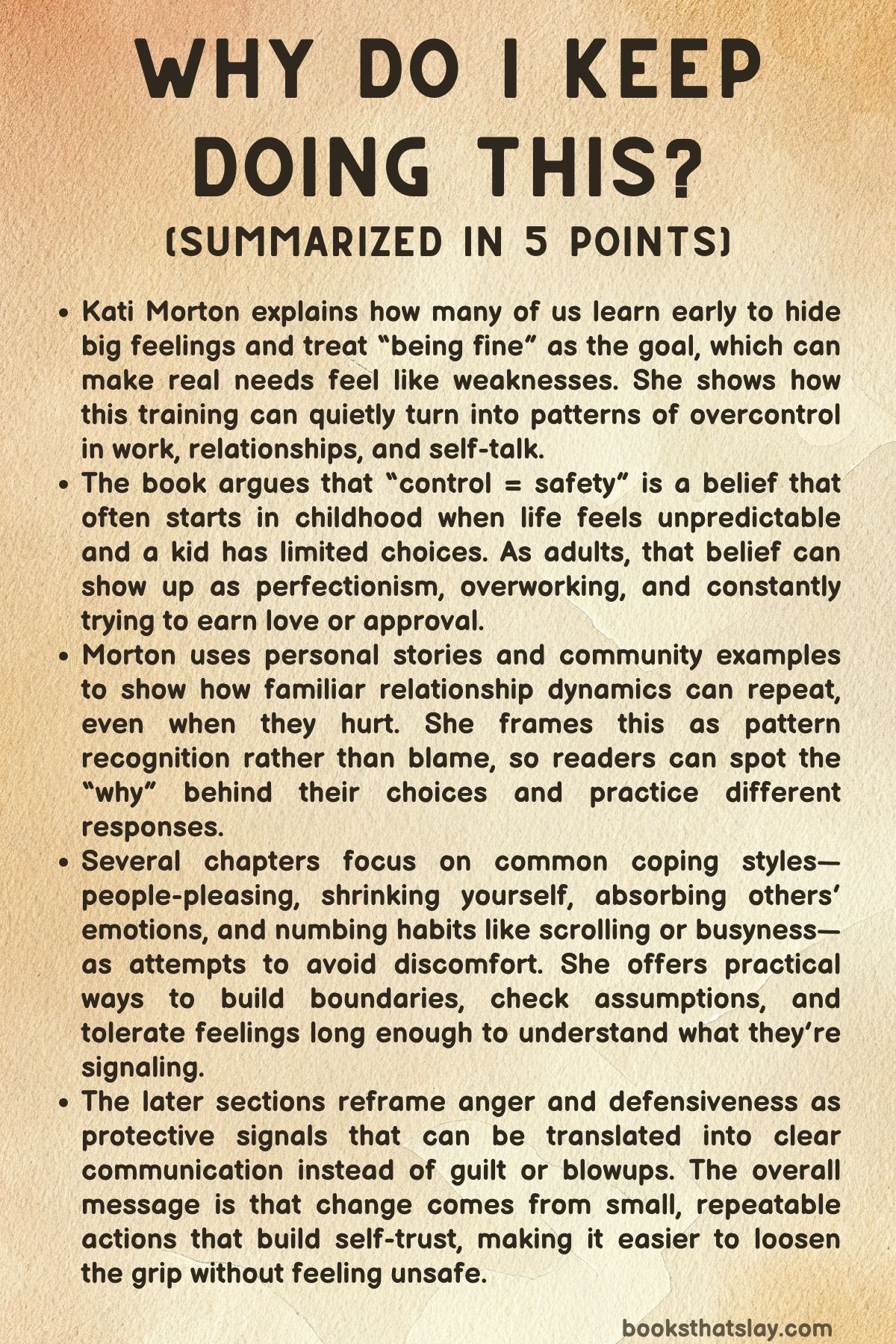
Why Do I Keep Doing This by Kati Morton is a self-help book that reads like a guided conversation with a therapist who has also wrestled with the same patterns she treats in others. Morton explores why people overwork, chase perfection, people-please, shut down emotions, or rely on numbing habits even when they know those behaviors are hurting them.
Using personal stories, client examples, and practical exercises, she argues that many “bad habits” are really protection strategies built in childhood. The goal isn’t to shame yourself into changing—it’s to understand what your nervous system learned, identify the belief underneath, and practice safer, healthier ways to cope and connect.
Summary
In Why Do I Keep Doing This, Kati Morton starts with a familiar lesson many people absorb early: keep your feelings under control, don’t make a scene, and act like you’re fine. Over time, that message becomes a rule for survival.
Big emotions get labeled as “too much,” and needing help gets treated like weakness. Morton points out a strange contradiction in how control is viewed: self-control is praised, but trying to control other people is criticized.
Yet the training to stay “composed” often leads people to manage not only their own inner world but also the moods, reactions, and expectations of everyone around them. The result can look like success on the outside and quiet panic on the inside.
Morton shares her own long-standing need for things to be “just right.” As a child, she believed that anticipating others, making no mistakes, and performing perfectly could keep life stable. She didn’t see it as control at the time.
It felt like being responsible and good. Looking back, she recognizes it as a strategy for safety: if she could manage everything, she could avoid chaos, rejection, or pain.
That strategy eventually breaks down. In 2023, after sustained overwork, she reaches a point where doing more no longer brings satisfaction.
Rest feels dangerous, like falling behind, like failing. Her exhaustion begins turning into irritation and resentment—even toward the people and routines she normally loves.
She snaps at her husband over something minor, feels annoyed at her dog needing a walk, and then turns the anger inward for having those reactions. She tells herself to “get it together,” but guilt and fear keep her trapped in the same pace.
When she finally sits down to journal, she sees the pattern clearly: she has been trying to control everything—her schedule, her emotions, her relationships—and the tighter she holds on, the less free she feels. The book becomes her effort to explain why these patterns happen, how they form, and how to loosen them without feeling like you’re losing your footing.
Morton begins by tracing the urge to control back to childhood. Kids live with limited power in a world run by adults, and unpredictability can feel threatening.
When life feels uncertain—through conflict, inconsistency, or emotional unavailability—children often respond by controlling what they can. They may try to control performance, behavior, routines, or even food.
Over time, the family environment becomes a “blueprint” for how relationships work. If love felt inconsistent, if needs were dismissed, or if emotions were punished, a person may grow up not knowing how to seek comfort directly.
Instead, they may repeat what is familiar, even when it hurts, because familiar can feel more predictable than healthy.
She gives an example from her own therapy: a therapist notices she repeatedly dates men who put her second. One boyfriend expects her to adapt to him and never meets her halfway.
Morton realizes she was choosing emotionally unavailable partners who created the same uncertainty she felt with her father. The point isn’t to blame parents; it’s to name the pattern so it can change.
Morton then expands through stories from her community. One person learns that attention arrives only when she achieves, so she becomes a perfectionist adult who chases achievement and struggles with relationships where care is steady and freely given.
Consistent love feels unfamiliar, and “earning” affection feels normal. Another person grows up with sudden family upheaval and broken promises, then later dates people who need rescuing.
Being needed feels like security, but it can slide into relationships where she does too much, builds resentment, and feels trapped.
A major theme is the temptation of “external fixes”—the belief that you can’t heal until someone else changes, apologizes, or finally understands. Morton acknowledges that supportive relationships calm the nervous system, but she also warns that making your wellbeing dependent on someone else keeps you stuck.
Her alternative is recalibration: tracing a behavior back to its origin and the belief driving it. She offers a method of asking yourself, again and again, “If that’s true, what would it mean?” until the core belief surfaces—often something like “I’m not enough,” “I’m unsafe,” or “I will be abandoned.” With that belief identified, change becomes less about willpower and more about building new responses in small, realistic steps—like noticing when you overapologize, or asking clarifying questions instead of assuming the worst.
From there, Morton explores perfectionism as a control strategy tied to worth. She connects her own competitiveness to a childhood interpretation: her father traveled for work, and she assumed his absence meant she didn’t matter enough.
So she tried to become impossible to ignore through grades and achievements. Therapy helps her shift away from obsessing over outcomes and toward understanding the need underneath—validation and reassurance that she matters.
She explains how trauma or long-term insecurity can create “never enough” thinking: even when you succeed, your mind moves the goalpost. You can also sabotage yourself because part of you doesn’t believe you deserve care or success.
To interrupt that spiral, she suggests practical tools: imagine the worst-case, best-case, and most-likely outcome, and then choose your response with intention rather than fear. She also emphasizes learning to ask for support and stating needs directly—skills perfectionists often avoid because needing anything can feel like failure.
Next, Morton looks at people-pleasing and anxiety. In chaotic homes, staying agreeable can become a safety strategy.
Some people learn that keeping others calm is the best way to avoid criticism, conflict, or emotional fallout. Morton discusses “fawning” as a stress response: appeasing others to reduce threat.
This can merge with codependency and enmeshment, where boundaries blur and someone feels responsible for other people’s emotions. She shares examples of people who become dependable caretakers but feel quietly resentful, passive-aggressive, or unsure what they even want because they’ve spent so long focusing outward.
Morton also admits something uncomfortable: people-pleasing can be a kind of control. If you over-give and over-adapt, you may be trying to manage the risk of rejection.
But over time, this can create relationships where you do all the work and secretly expect others to read your mind. When they don’t, you feel unseen.
Her solution centers on boundaries—both external ones (saying no, asking for time, stating limits) and internal ones (keeping promises to yourself, not abandoning your needs). She notes that some relationships fade when you stop overfunctioning.
That loss can hurt, but it also clears space for more balanced connections.
Morton then explores what it means to “take up space”—not just physically, but emotionally and psychologically. Many people feel uncertain about how much they’re allowed to need, speak, want, or feel.
If someone grew up hearing “not now,” being called dramatic, or being rewarded for being “easy,” they may learn that emotions and needs are a burden. Shrinking becomes protection: if you’re quiet and low-maintenance, you might avoid conflict or rejection.
Morton discusses several roots of shrinking, including intense empathy, parentification (when a child takes on adult responsibilities or emotional caretaking), trauma, and neglect. She also describes how the urge to disappear can show up through disordered eating—trying to become smaller in the hope of becoming more acceptable—only to discover that no amount of physical change fixes the belief underneath.
To help readers understand inner conflict, Morton introduces parts work through Internal Family Systems. She describes imagining different “parts” inside: a responsible manager, a competitive achiever, a distractor who chases fun to avoid pain, a peacekeeper who avoids conflict, and a younger part carrying anger or sadness that was never safe to express.
By listening to these parts, she finds that many “bad habits” are attempts to protect vulnerable feelings. Change, then, involves meeting those protectors with curiosity, not force, and learning how to meet needs in healthier ways.
Empathy becomes the next focus. Morton describes different types of empathy and explains how high empathy can be both a strength and a risk.
Without solid boundaries, empathy can become “toxic” in the sense that you absorb everyone else’s emotions, dismiss your own needs because others “have it worse,” and end up drained. She describes how someone can start the day feeling fine and then take on a partner’s anger as if it were their own.
Her tools include identifying where an emotion came from and using “check the facts” to separate reality from assumptions or emotional contagion. She emphasizes a key idea: boundaries are actions you take, not rules you demand others follow.
She also pushes readers to practice receiving care—accepting compliments, letting others help, sharing struggles—while learning to tolerate the guilt that sometimes comes with not being the strong one.
Morton then addresses numbing and disconnection: drinking, shopping, scrolling, binge-watching, overworking, excessive exercise, drugs, disordered eating, self-injury, daydreaming, and dissociation. These behaviors can bring short-term relief and chemical comfort, but they can create cycles that worsen anxiety, depression, finances, health, and relationships.
She explains why people keep doing it: the brain is built to seek immediate relief. But unprocessed emotions don’t vanish; they gather pressure and eventually leak out through blowups, shutdowns, or symptoms in the body.
Morton argues that emotions are signals meant to guide action, not enemies to defeat. She offers ways to “tap in,” such as naming emotions, noticing bodily sensations, and tracking the behavior you use to avoid feeling.
She also discusses the “ninety-second rule,” explaining that the body’s initial chemical surge is brief, while ongoing intensity is often fueled by replaying the trigger in your mind.
From there, Morton reframes anger. Rather than treating it as inherently bad, she describes anger as a protective alarm: it signals crossed boundaries, disrespect, hurt, or unfairness.
Anger can energize action. Problems arise when anger turns outward through aggression or turns inward through self-criticism, rumination, withdrawal, or self-harm.
She distinguishes anger from assertion: assertion is using anger’s message to speak clearly and set limits without attacking. She recommends learning triggers, identifying patterns, and noticing misplaced anger—like snapping at a partner over something small when the real source is work stress.
She also stresses basic resilience practices, like checking hunger, loneliness, and exhaustion, because low resilience makes emotional reactions more intense.
Morton then moves into protection and pushing people away. She describes defensiveness, hypersensitivity to critique, and a habit of ending relationships instead of having uncomfortable conversations.
She names “toxic independence”: refusing help to avoid disappointment, becoming overwhelmed, and then resenting others for not helping even though you never asked. She lists common defense mechanisms and explains that they exist for a reason: they once helped you survive.
The goal is not to shame them away, but to notice them, understand the fear underneath, and choose a different response when possible. She shares a moment of practicing direct vulnerability—admitting hurt instead of becoming passive-aggressive—and seeing how honesty can create closeness rather than danger.
Belonging and identity come next. Morton describes efforts to fit in, hide differences, and shape yourself into what seems acceptable.
Belonging is framed as a survival need, which is why rejection feels so intense. But constant fitting-in can cost you your sense of self.
Morton explains how she changed herself most in romantic relationships, building connection on a version of herself that wasn’t fully real, and eventually realizing she needed time to rediscover who she was. She offers practical ways to reconnect with identity: taking yourself on “dates,” trying activities alone, leaving early if something isn’t working, and using those experiences to learn what you actually enjoy.
She also emphasizes clarifying values—narrowing down what truly matters, separating genuine values from “should” values adopted for approval, and making choices that match what you say you care about.
In the later part of the book, Morton addresses depression and the feeling of being stuck. She explains that change is rarely smooth because the brain prefers familiar patterns, even painful ones.
Feeling stuck can be physical, emotional, or personal. She describes a middle phase of change where the old coping strategies no longer work, but the new ones aren’t natural yet.
That in-between can feel exhausting and scary. Morton introduces the idea that you don’t need perfect motivation; sometimes it’s enough to know your current life isn’t working anymore.
She encourages patience, naming fears (like losing relationships), and treating setbacks as part of progress rather than proof of failure.
Finally, Morton returns to the central issue: letting go. She admits she once equated letting go with giving up, not caring, or being abandoned.
She reframes it as releasing the need to control outcomes while still caring deeply. Letting go means trusting you can handle what happens, even if you don’t get the result you want.
Progress, she says, is often subtle and imperfect—small choices repeated over time. Through self-trust practices like journaling, quiet walks, and time alone, people can build the confidence to loosen control without panicking.
The conclusion reinforces the book’s message: control is limited, change is not linear, and freedom grows through repeated small acts of honesty, boundaries, and self-connection.
Key People
Kati Morton (Narrator/Author)
In Why Do I Keep Doing This, Kati is both the storyteller and the central “case study,” using her own lived experience to translate psychological concepts into something emotionally recognizable. She’s defined by a lifelong drive to make life feel safe through “being good”: anticipating needs, avoiding mistakes, striving for perfection, and staying productive even when her body is signaling collapse.
What makes her compelling as a character is the tension between insight and entanglement—she’s a therapist who understands patterns intellectually, yet still gets pulled into them under stress, which becomes the book’s emotional engine. Across the narrative she shifts from treating control as virtue (responsibility, excellence, reliability) to recognizing it as a survival strategy that has outlived its usefulness, and her arc becomes less about “fixing” herself and more about learning to tolerate uncertainty without self-erasing or self-punishing.
Ruby
Ruby represents the achievement-conditioned child who learns that love arrives through performance, and who later becomes the adult who cannot tolerate “being cared for” without earning it. Her story captures how praise and attention that only show up for accomplishments can wire the nervous system to equate worth with output, making rest feel dangerous and relationships feel like stages where you must continually prove you deserve a place.
As an adult, Ruby’s discomfort with consistent availability reveals an often-missed consequence of conditional affection: steady love can feel unfamiliar and therefore suspicious, while striving feels safe because it’s predictable. In Why Do I Keep Doing This, Ruby is the clearest illustration of perfectionism as a relationship strategy, not just a work habit.
Tara
Tara’s arc highlights a different survival response to unpredictability: instead of pursuing perfection, she pursues indispensability. After being blindsided by divorce and broken promises, she gravitates toward partners who need her, because being needed feels like a form of insurance against abandonment.
Her relationships become organized around caretaking, which initially creates purpose and security but eventually corrodes into resentment when her needs remain secondary. Tara embodies how codependency can masquerade as love, and how control can look like self-sacrifice—choosing dynamics where your role is clear and your value is constantly demonstrated through what you provide.
Her story underscores a central point of the story : familiar pain can feel safer than unfamiliar stability, even when it keeps you trapped.
Yvette
Yvette represents the dependable caretaker whose identity is built around being useful, agreeable, and emotionally steady for everyone else. Her struggle isn’t a lack of compassion; it’s the chronic erasure of self that happens when expressing needs feels risky, selfish, or pointless.
Over time, the unspoken cost emerges as passive-aggression, feeling lost, and not knowing what she actually wants because she has practiced not wanting for so long. In the book’s framework, Yvette shows how people-pleasing can become a form of indirect control—managing the environment by managing yourself—until it becomes unsustainable.
Her character makes visible the grief that often follows boundaries: when you stop overfunctioning, some relationships fade, revealing which connections were built on mutual care and which were built on your compliance.
Gabby
Gabby’s role is to complicate the myth that closeness is always healthy. She comes from a family environment that looks connected, but where connection is fused with guilt, obligation, and pressure—so independence feels like betrayal rather than growth.
Her conflict illustrates enmeshment: boundaries are blurred enough that her choices don’t fully belong to her, and emotional consequences are used to keep her aligned with the group. Gabby shows how the urge to control can appear as shrinking—holding back opinions, delaying life steps, or staying small—because taking up space threatens the bond that once ensured safety.
Themes
Emotional suppression and the performance of “having it together”
From early on, the book’s emotional landscape is shaped by the message that big feelings are inconvenient, embarrassing, or proof of weakness. When someone is repeatedly taught to look composed no matter what is happening inside, they learn to treat emotions as problems to eliminate rather than signals to understand.
That training doesn’t just mute sadness or fear; it also blunts joy, curiosity, and spontaneity, because any strong internal movement starts to feel risky. Over time, the body still experiences emotion, but the mind becomes practiced at disowning it—labeling reactions as “too much,” second-guessing instincts, and replacing honest expression with a socially acceptable mask.
What looks like maturity from the outside can be a carefully maintained role: calm, competent, agreeable, and productive, even when the nervous system is flooded.
In Why Do I Keep Doing This, the pressure to stay composed turns inward and becomes self-policing. The narrator’s reflex to tell herself to “get it together” after snapping at a loved one shows how quickly emotion becomes moralized: feeling irritated is treated as a personal failure, not a sign of overload.
That moral layer matters because it adds shame to the original feeling, creating a secondary emotional wound. Instead of recognizing a need—rest, support, limits—she experiences guilt for having needs at all.
The result is a loop: the more she tries to silence emotions, the more they demand attention, often bursting out sideways through resentment, irritability, or harsh self-criticism.
This theme also highlights the social contradiction around control. Being “in control” is praised as virtue, yet attempting to manage other people is criticized as manipulation.
The book reveals how these are connected: when someone is trained to fear their own feelings, they may start managing environments, schedules, and relationships so fewer emotions get triggered. Emotional suppression becomes a relationship strategy, not just an internal habit, and genuine closeness gets replaced by peacekeeping.
The cost is steep: less authenticity, less intimacy, and a life built around avoiding emotional messiness rather than learning how to carry it.
Childhood blueprints, attachment patterns, and repeating what is familiar
The book repeatedly returns to the idea that early relationships teach the nervous system what love feels like. When care is inconsistent or needs are punished, the child doesn’t conclude “my environment is unstable”; the child concludes “I am the problem.” That conclusion becomes a core belief—often something like “I’m not enough”—and it quietly directs adult choices.
The book’s examples of choosing emotionally unavailable partners demonstrate how repetition can masquerade as preference. Familiar dynamics can feel oddly calming because they match what the body already knows how to survive, even if they produce pain.
Predictability is mistaken for compatibility.
In Why Do I Keep Doing This, the narrator’s recognition of dating patterns is important because it shows how the past gets reenacted without conscious intent. Choosing partners who require chasing, overgiving, or self-abandonment keeps the old story alive: love must be earned, attention must be competed for, and security is always one mistake away from disappearing.
The book is careful not to frame this as blame toward parents; instead, it treats origins as information. Seeing the origin isn’t about building a case against anyone—it’s about understanding why certain behavior feels compulsory.
The theme becomes richer through the contrast between Ruby and Tara. Ruby learns that celebration arrives only after achievement, so her adult life becomes an endless audition.
Tara experiences betrayal and broken promises, so she chooses relationships where she is needed, because being needed feels like a guarantee of staying. Both are trying to solve childhood uncertainty, but they choose different strategies: one earns love through performance; the other secures love through rescuing.
The shared result is that genuine mutuality becomes unfamiliar. Consistent care can even feel suspicious or boring because it doesn’t match the emotional “weather” the body expects.
The book also challenges the fantasy of the “external fix,” where healing depends on someone else finally apologizing or changing. That hope can keep a person stuck, because it puts the locus of safety outside the self.
Connection remains valuable, but the book pushes toward reclaiming agency: identifying the belief beneath the behavior, naming the pattern, and experimenting with small shifts that teach the nervous system a new kind of safety—one rooted in self-support, clear boundaries, and choosing relationships that do not require self-erasure to maintain.
Perfectionism, overworking, and the “never enough” loop
The narrator’s relationship with achievement shows how perfectionism is less about loving excellence and more about fearing the consequences of imperfection. When a child interprets absence, inconsistency, or criticism as proof that they are not worthy, performance becomes an attempt to become un-rejectable.
The pursuit of flawless outcomes then becomes a stand-in for stable love. The tragedy is that perfectionism is structured to fail: even when goals are met, relief is brief, and the next standard arrives immediately.
Accomplishment becomes a moving target because the emotional need underneath—being valued without conditions—has not been addressed.
In Why Do I Keep Doing This, burnout is portrayed as the logical endpoint of the “never enough” system. The narrator keeps working because work promises identity: productive means good, useful means lovable, busy means safe.
Rest threatens that identity, and the mind reacts as if slowing down would remove protection. The emotional consequence is not only exhaustion but a corrosion of meaning.
Things once loved become burdens. The irritation at small needs—walking the dog, ordinary requests, a tiny conflict with a spouse—shows how the system runs out of capacity.
When someone’s life is organized around earning worth, every demand feels like another test, and every moment of downtime feels like a risk of failing the test.
The book also highlights the hidden emotional pattern of self-sabotage within perfectionism. If love feels undeserved, receiving it can create anxiety rather than comfort.
The mind may unconsciously create chaos, pick fights, or quit first as a way to avoid being rejected later. That behavior looks irrational until it is seen as a protective attempt: if I end it, I won’t be left.
The practical exercises—imagining worst-case, best-case, and most-likely outcomes—serve as a way to calm catastrophic thinking and make room for deliberate choice. But the deeper point is relational: perfectionism often blocks asking for support.
If worth depends on being capable, needing help becomes shameful. The book pushes toward a different model of strength: communicating needs, tolerating “good enough,” and building a life where value is not constantly on trial.
Numbing, avoidance, and learning to relate differently to strong emotions
The book treats numbing behaviors as understandable attempts to escape discomfort, not as moral failures. Scrolling, shopping, drinking, overworking, excessive exercise, disordered eating, dissociation, and self-injury are presented as different costumes for the same function: reducing immediate emotional pain.
The brain is designed to seek relief, so these strategies can feel effective in the moment, sometimes delivering dopamine, endorphins, or simple distraction. The problem is that the emotion being avoided does not disappear; it accumulates and often returns with greater force, or it leaks into life as irritability, indecision, physical symptoms, or a hollow sense of disconnection.
In Why Do I Keep Doing This, the narrator’s experience of snapping at loved ones after chronic overwork demonstrates how avoidance can delay emotion rather than resolve it. When feelings are ignored, they tend to show up in places that feel “irrational,” which then increases shame and doubles the urge to numb again.
The book’s emphasis that emotions are signals—meant to motivate action—repositions discomfort as information rather than threat. The metaphor about feelings needing guidance instead of imprisonment underscores a balanced approach: emotions are not meant to run life, but they also cannot be treated as enemies without consequences.
The “entry point” idea is practical and psychologically sharp: start with the behavior, then trace backward to the feeling. If someone reaches for the phone, the drink, the shopping cart, or the extra work, the question becomes “what feeling is this trying to avoid?” That approach respects the reality that many people do not know what they feel because they have practiced not knowing.
The ninety-second concept is also useful because it separates the body’s initial emotional surge from the mental replay that keeps the emotion burning. This helps people see where choice can return: not in preventing the first wave, but in reducing the fuel that keeps it going.
Sitting with discomfort for a few minutes is framed as training, not punishment. The book builds the idea that resilience grows through repeated experiences of surviving feelings without escaping them immediately.
Over time, the nervous system learns a new lesson: emotion is intense, but it is temporary, and it can be carried without losing the self.