With Friends Like These Summary, Characters and Themes
With Friends Like These by Alissa Lee is a thought-provoking exploration of friendship, guilt, and the complexity of human relationships. The story focuses on a group of Harvard graduates who have maintained a dark tradition called “The Circus”—a high-stakes, competitive game in which they secretly “kill” each other.
What begins as a college prank has evolved into a dangerous and destructive yearly event. The protagonist, Sara, who is now married and leading a complicated life, faces a moral crisis as she confronts the game’s toxic impact on her friendships and personal well-being. The story grapples with themes of loyalty, betrayal, and the long-lasting consequences of their actions.
Summary
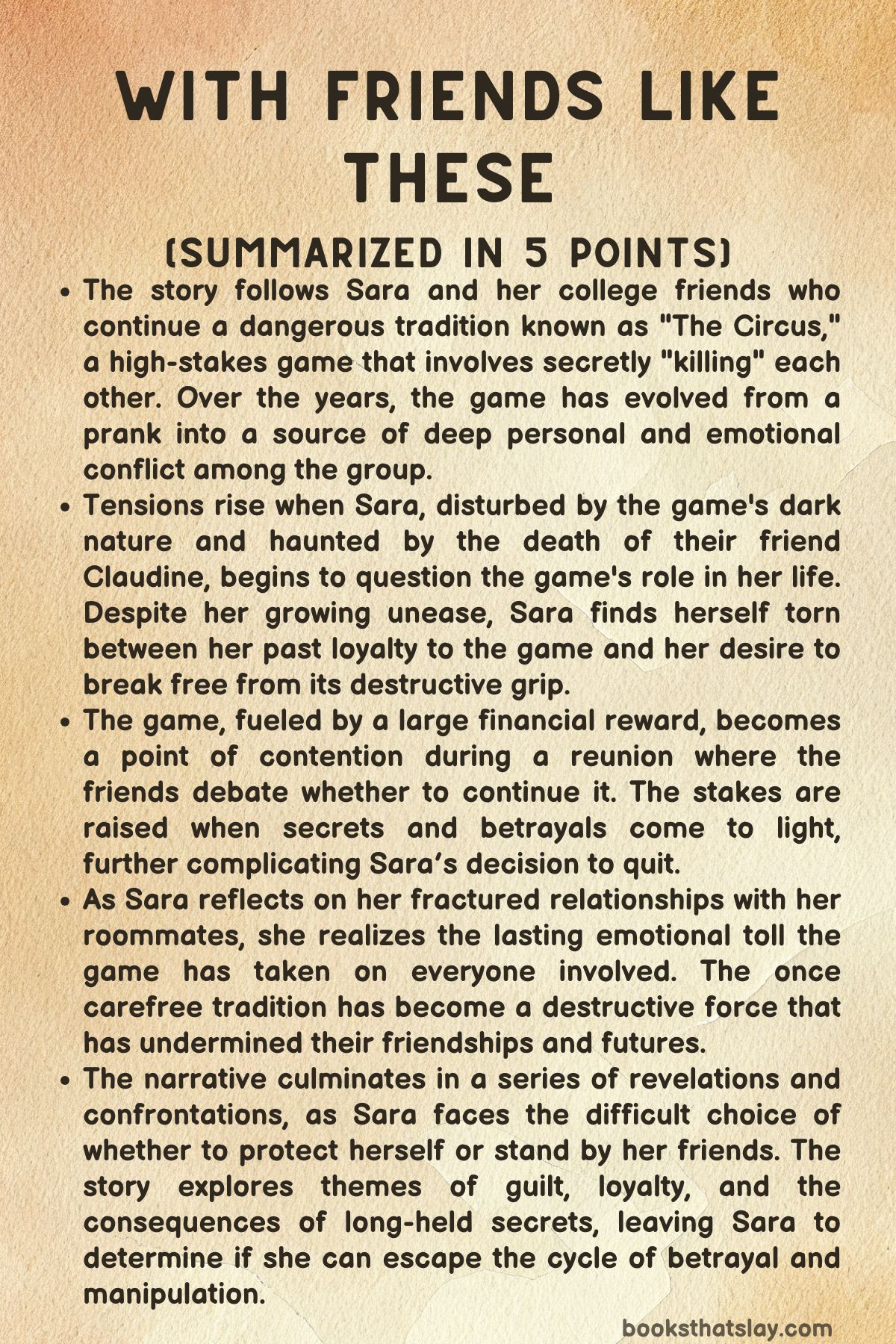
With Friends Like These follows the lives of a group of college roommates who continue their twisted tradition of playing a game called “The Circus” long after graduation. This game, which began as a harmless prank during their sophomore year, has grown into an annual event that spans over two decades.
The rules of the game are simple yet cruel: the players secretly “kill” each other, and the last one standing wins a substantial prize that has accumulated over the years. As time passes, the game becomes darker, and the bonds of friendship begin to erode.
At the center of the story is Sara, who has been deeply involved in the game for years but now begins to feel the weight of its consequences. Sara is married to Coulter, a man she feels increasingly disconnected from as she grapples with the guilt of her past actions.
The story kicks off when the group of friends reunites for the twentieth round of the Circus. Tensions are high, and the group is still haunted by the death of their friend Claudine, whose passing is shrouded in mystery and guilt.
Sara, uneasy about the game’s escalating nature, reflects on whether this should be the final year of the Circus. Her doubts grow stronger when she believes she sees an apparition of Claudine, whom they all assumed had died years ago.
This encounter sends Sara into a spiral of guilt and confusion, making her question everything she has been part of. Her discomfort is heightened as she begins to feel emotionally distant from Coulter, who is focused on running his restaurant but is increasingly strained by financial pressures.
The story explores the various characters within Sara’s circle of friends. Dina, a philosopher, is struggling with balancing her career ambitions and the loyalty she feels toward the game.
Bee, who works as the Manhattan DA, and Allie, who has a family, are also caught up in their own dilemmas. Each character is wrestling with their attachment to the Circus and the ways it has affected their lives.
As Sara decides she wants to quit the game, Bee and Wesley, the most enthusiastic players, argue passionately to continue.
The story builds to a tense dinner meeting where the group gathers to discuss the future of the Circus. The stakes are high, as the prize money for the game is now nearing one million dollars.
As Sara contemplates whether or not to walk away from the game, she is forced to face the impact it has had on her friendships. The financial reward becomes a key point of contention, and the group begins to fracture under the weight of their individual motivations and desires.
Sara’s unease grows as a shocking revelation occurs: Allie has secretly moved away with her family, possibly as a strategy to win the game. This betrayal sends shockwaves through the group, leaving Sara feeling isolated and distrustful.
She realizes that the Circus, once a symbol of youthful freedom and camaraderie, has now turned into a toxic cycle of manipulation and destruction. The group’s relationships are tested to their limits, and Sara must decide whether to break free or continue participating in the toxic game.
As the story progresses, Sara’s paranoia intensifies. She becomes increasingly aware of how far the game has gone, and the stakes become personal.
Sara reflects on her role in the group and the damaging effects of their collective actions. She is caught in a web of loyalty and guilt, torn between her desire to escape and her fear of losing her friends altogether.
The game that once brought them together has now driven them apart, and Sara must confront the truth of what the Circus has cost them.
The tension reaches its peak when Bee is seriously injured in what seems like a subway accident, but Sara suspects foul play. The group begins to wonder if the fall was an attempt to eliminate Bee from the game, and they start looking at each other with suspicion.
The investigation into Bee’s accident intensifies, and the friends are forced to confront the possibility that their actions have led to dangerous consequences.
As the story unfolds, the characters’ individual crises become more apparent. Bee’s political aspirations and Dina’s struggles with her career add layers of complexity to the narrative.
Allie’s mysterious behavior and Wesley’s unstable financial situation further complicate the already strained dynamics between the friends. The game, which initially seemed like a way to stay connected, has become a destructive force that threatens to unravel everything they once held dear.
In the end, the group’s fractured relationships and the looming investigation into Claudine’s death come to a head. The final twist reveals that Allie’s disappearance was part of a strategy to manipulate the outcome of the game, leaving Sara feeling deeply betrayed.
As Sara reflects on everything that has transpired, she realizes that the Circus has no place in their lives anymore. The game that once symbolized their youth has become a destructive force, and Sara must decide if she can break free from the cycle of guilt, competition, and betrayal that has defined her friendships.
The conclusion is bittersweet, as Sara confronts the reality of their fractured relationships. The group’s bonds, once so strong, have been irreparably damaged by the game.
Sara is left with the painful decision of whether to continue in the game or walk away, but either choice will require her to come to terms with the consequences of her past actions. The story ends with Sara reflecting on the complexity of friendship and the ongoing process of healing, suggesting that closure is not always a simple or immediate process.
Characters
Sara
Sara is the central character in With Friends Like These and serves as a lens through which the reader experiences the unraveling of a once-close group of friends. She is deeply reflective and burdened by the guilt of the role she played in the death of Claudine, a friend whose death has haunted the group for years.
Sara’s personal life is complicated, as she is married to Coulter, a man she feels increasingly distanced from. Her marriage, once a source of comfort, has become strained under the weight of her emotional turmoil.
She is the character who begins to question the moral implications of the “Circus” game, a high-stakes tradition among the friends that has slowly morphed from playful competition into something much darker. Her unease grows as she sees an apparition of Claudine, leading her to reconsider whether the game, and by extension, her friendships, should continue.
Sara’s internal conflict and her search for redemption form the emotional core of the novel, highlighting themes of guilt, loyalty, and the consequences of past actions.
Bee
Bee is one of Sara’s roommates and an important figure in the group’s dynamics. As the Manhattan District Attorney, she is used to navigating complex legal and moral landscapes, which makes her especially adept at manipulating situations to her advantage.
Bee’s character is marked by a sense of pragmatic detachment, and she often seems more concerned with the larger game at hand—both the literal “Circus” game and her career—than with personal connections. Despite this, her accident, where she falls onto subway tracks under mysterious circumstances, becomes a turning point in the narrative, revealing the depths of her entanglement in the group’s web of secrets.
Bee’s involvement in the Circus is driven by a mixture of ambition, the need for control, and her struggle to maintain power. Her injuries and the subsequent investigation force her to confront her own vulnerability, and it becomes clear that her long-standing allegiance to the game may have compromised her morality.
Dina
Dina, a philosopher by profession, is another of the group’s roommates whose character is marked by intellectual depth and emotional withdrawal. Throughout the story, she grapples with the tension between her career aspirations and her loyalty to the group.
Her professional struggles, particularly related to a failed tenure case, weigh heavily on her, and these personal challenges add layers to her character, making her a complex figure who is both rational and emotionally distant. Dina’s reluctance to completely sever ties with the Circus, despite its negative impact on her life, reflects her internal battle between intellectual reasoning and emotional attachment.
Her motivations become clearer as she is drawn deeper into the game’s destructive spiral, which pits her personal desires against the darker forces at play within the group.
Wesley
Wesley is one of the more intense characters in With Friends Like These, embodying the competitive and manipulative spirit that defines the “Circus” game. He is fiercely invested in winning the game, and his obsession with the prize money becomes a key part of his character arc.
Wesley’s aggressive nature, revealed through his confrontations with other members of the group, serves to heighten the stakes of the story. As the narrative progresses, Wesley’s desperation becomes more apparent, especially as he faces the threat of exposure and betrayal.
His willingness to go to extreme lengths, including pulling a gun on Sara in a tense moment, highlights his deteriorating mental state and the toxic influence of the game on his psyche. Wesley’s character, while deeply flawed, provides insight into the darker impulses that drive the characters’ actions and the irreversible consequences of their participation in the Circus.
Allie
Allie is a character whose motivations are shrouded in mystery for much of the story. A member of the original group of friends, she has distanced herself from the Circus game in recent years.
However, her sudden reappearance and the revelation that she has secretly moved away with her family to further her own chances in the game, raise suspicions among the group. Allie’s actions highlight her pragmatic, yet self-serving nature.
While she once shared a close bond with the others, her increasing detachment and the secretive way in which she operates suggest a character who is willing to manipulate situations for personal gain. Her ultimate decision to confess her role in the game marks a pivotal moment in the narrative, forcing the group to confront the long-lasting effects of their collective choices.
Coulter
Coulter, Sara’s husband, plays a more peripheral role in With Friends Like These, yet his presence is felt throughout the novel. His relationship with Sara is fraught with tension, as he becomes more consumed by the pressures of running a restaurant and the financial instability that threatens their life together.
Coulter’s character serves as a reminder of the personal stakes involved in the Circus game, with his resentment toward his family business and his growing emotional distance from Sara reflecting the larger disintegration of trust and connection within the group. Coulter’s strained relationship with Sara, coupled with his involvement in the events surrounding Claudine’s death and the manipulations tied to the game, adds a layer of complexity to the story.
His ultimate role in the unraveling of the group is one of betrayal, as his secretive actions heighten the tension and force Sara to question everything she thought she knew about her life and relationships.
Claudine
Though Claudine’s physical presence is absent in the story, her impact on the group remains profound. Her death, shrouded in mystery and guilt, serves as a central point around which the group’s relationships and the game revolve.
The guilt surrounding Claudine’s death is a constant undercurrent throughout the narrative, with each character grappling with their role in her demise. Claudine’s tragic fate becomes a symbol of the dangers of their high-stakes game, and her memory acts as a catalyst for Sara’s introspection and eventual decision to break free from the toxic cycle of the Circus.
Through flashbacks and the characters’ reflections, Claudine’s life and death continue to haunt the group, ultimately leading to a confrontation with their past actions.
Marcella
Marcella is Coulter’s mother, and her character adds a layer of familial tension to the story. Her relationship with Coulter is strained, and the pressure she places on him to ensure the financial success of his restaurant highlights the disconnect between the two.
Marcella represents the traditional values of control and success, contrasting with Coulter’s more rebellious attitude toward the family business. Her role in the narrative, while secondary to the main plot, serves as a reminder of the external pressures that each character faces, and her interactions with the protagonist emphasize the generational and familial conflicts that run parallel to the emotional and moral struggles at the heart of the story.
Clementine
Clementine, Claudine’s half-sister, emerges as a key figure in the final stages of the story. Her presence becomes increasingly important as the protagonist uncovers the tangled web of secrets surrounding Claudine’s death.
Clementine’s desire for justice and her connection to Claudine’s memory propel her character into the spotlight as she seeks to understand her sister’s death. Her involvement adds a layer of mystery and intrigue, culminating in the revelation that her actions are motivated by a quest for retribution.
Clementine’s character symbolizes the unresolved grief and the lengths to which the characters go to seek closure, no matter the cost. Through her, the story explores themes of justice, vengeance, and the impact of unaddressed trauma on the characters’ futures.
Themes
The Consequences of Tradition and Ritual
The game known as “The Circus” initially started as a harmless prank during the characters’ college years, but over the course of the narrative, it reveals itself to be a destructive force that has taken a significant toll on the group of friends. What began as an innocent tradition meant to solidify their bond soon became a ritual that bred competition, manipulation, and secrecy, deeply affecting their relationships.
The game’s high-stakes nature—both emotionally and financially—forces the participants into morally ambiguous situations. As the years pass, the players become increasingly desensitized to the harm it causes, even as their bonds grow strained and fractured.
Sara, the protagonist, begins to recognize the true cost of participating in the game, not only to herself but to her friends as well. The game’s rules—centered around a secretive and violent premise—reflect a gradual erosion of their sense of loyalty and camaraderie.
Sara’s growing unease about the game signifies a larger commentary on how rituals and traditions, when left unchecked, can morph into toxic practices that bind people together for all the wrong reasons. As the tension escalates, especially following the death of their friend Claudine, it becomes clear that “The Circus” is no longer just a game but a symbol of the damage caused by blind adherence to tradition.
Sara’s desire to break free from this toxic cycle speaks to the difficulty of untangling oneself from a long-standing but destructive group dynamic.
Guilt and Responsibility
The theme of guilt plays a central role in shaping the emotional landscape of With Friends Like These. Every character grapples with a sense of guilt, whether it is directly related to the death of Claudine or to their participation in the increasingly dangerous game.
Sara, in particular, struggles with her role in the group and her complicity in the events that led to Claudine’s death. Her internal conflict grows as she feels responsible not only for the physical harm inflicted during the game but also for the emotional damage done to her friends.
This sense of guilt is further complicated by the characters’ denial and reluctance to confront the truth. They all continue to play the game despite the growing harm it causes because confronting the reality of their actions would require them to acknowledge their role in perpetuating it.
Sara’s reflection on her own guilt becomes the lens through which the reader sees the impact of the game on each character’s life. This theme of responsibility is amplified when Sara, upon seeing the apparition of Claudine, is confronted by the ghost of their past choices.
It forces her to question whether their collective guilt can ever truly be absolved, and whether the relationships formed under the shadow of the game can survive the weight of their shared remorse.
Betrayal and Trust
Betrayal weaves throughout the narrative, with characters constantly facing situations where their trust in each other is tested. The game’s foundation—secretive, manipulative, and underhanded—is a breeding ground for betrayal, and the story amplifies this theme through the various relationships in the group.
Sara’s growing disillusionment with her friends mirrors the way each of them has gradually betrayed their own moral compass in order to win the game or to hold onto power within the group.
The relationship between Sara and her husband, Coulter, further explores the theme of betrayal. While their marriage is strained, Coulter’s actions—particularly his manipulative behavior around the game—deepen the mistrust between them.
This extends to the rest of the group, where each person’s motives become increasingly questionable. The tension surrounding Bee’s possible fall and Allie’s departure from the group only serves to heighten suspicions and reveal the deep fractures in their trust.
Betrayal doesn’t just occur between friends; it also manifests in Sara’s relationship with Coulter, showing how the toxicity of the game bleeds into other aspects of their lives. The ultimate sense of betrayal is felt by all when the true nature of their collective actions comes to light—forcing each character to reckon with the trust they’ve lost, both in themselves and in each other.
The Impact of Power and Money
The stakes of the game aren’t just personal but deeply financial, with nearly a million dollars accumulated over the years, adding a layer of greed and competition to the already strained relationships. Power dynamics shift with each round of “The Circus,” as the potential for monetary gain heightens the lengths to which characters are willing to go to win.
Money, in this context, acts as both a motivator and a corrupting influence, deepening the animosity between friends and warping their priorities.
As the group grows more desperate and paranoid, their obsession with the game and its monetary rewards exacerbates their fractures. Sara’s internal conflict becomes tied not only to the emotional and psychological toll the game takes but also to the financial stakes involved.
The narrative reveals how the pursuit of wealth, when attached to a game steeped in secrecy and manipulation, leads to moral decay. The climactic moments in the book, especially when Bee reveals the prize money, underscore how the once simple tradition has evolved into a destructive force, one that has reshaped their friendships and personalities.
The game becomes a symbol of the toxic influence that the pursuit of power and money can have on human relationships, causing individuals to lose sight of their integrity in the face of material temptation.
The Corruption of Youthful Rebellion
At the heart of the story lies the idea of youthful rebellion, which initially manifested as a harmless game among college friends but morphed into something far darker. The protagonists, once idealistic and full of potential, find themselves ensnared in a web of manipulation, guilt, and deceit, which stands in stark contrast to the carefree days of their youth.
The game, which began as an act of defiance against authority and convention, becomes the very thing that holds them back from personal growth and healing.
This theme highlights the dangers of perpetuating a rebellious act without ever questioning its consequences. The characters, despite their education and experiences, remain trapped in a cycle of immaturity and denial, unable to break free from the game’s toxic grip.
The notion of rebellion that once seemed liberating ultimately results in personal destruction, as their youthful energy is channeled into an activity that erodes their relationships and sense of self. As the characters struggle with the wreckage left by their past actions, the story critiques the idea of rebelliousness that lacks self-awareness, showing that without growth or introspection, youthful defiance can lead to irreversible damage.
The Search for Redemption
As the story unfolds, Sara is left to grapple with her search for redemption. Her reflections on the past and the roles she and her friends have played in the Circus offer her a chance to reconsider their choices, seeking to move beyond the toxic cycle they’ve created.
The theme of redemption is closely tied to the idea of personal transformation. Sara’s decision to confront the past, particularly her feelings of guilt and her complicity in the events that led to Claudine’s death, is her first step toward breaking free from the destructive pattern set by the game.
The need for redemption is also seen in the evolution of the other characters, each of whom comes to terms with their actions in different ways. Some, like Bee and Wesley, struggle to reconcile their past behavior with the people they want to be, while others, like Dina, seem to have already distanced themselves from the game.
Ultimately, the theme of redemption highlights the possibility of growth, but it also acknowledges that not all wounds can be healed. The characters are left with the harsh reality that redemption, if it comes, will be a long and difficult journey—one that may not necessarily result in a full restoration of what was lost.