A Million Kisses in Your Lifetime Summary, Characters and Themes
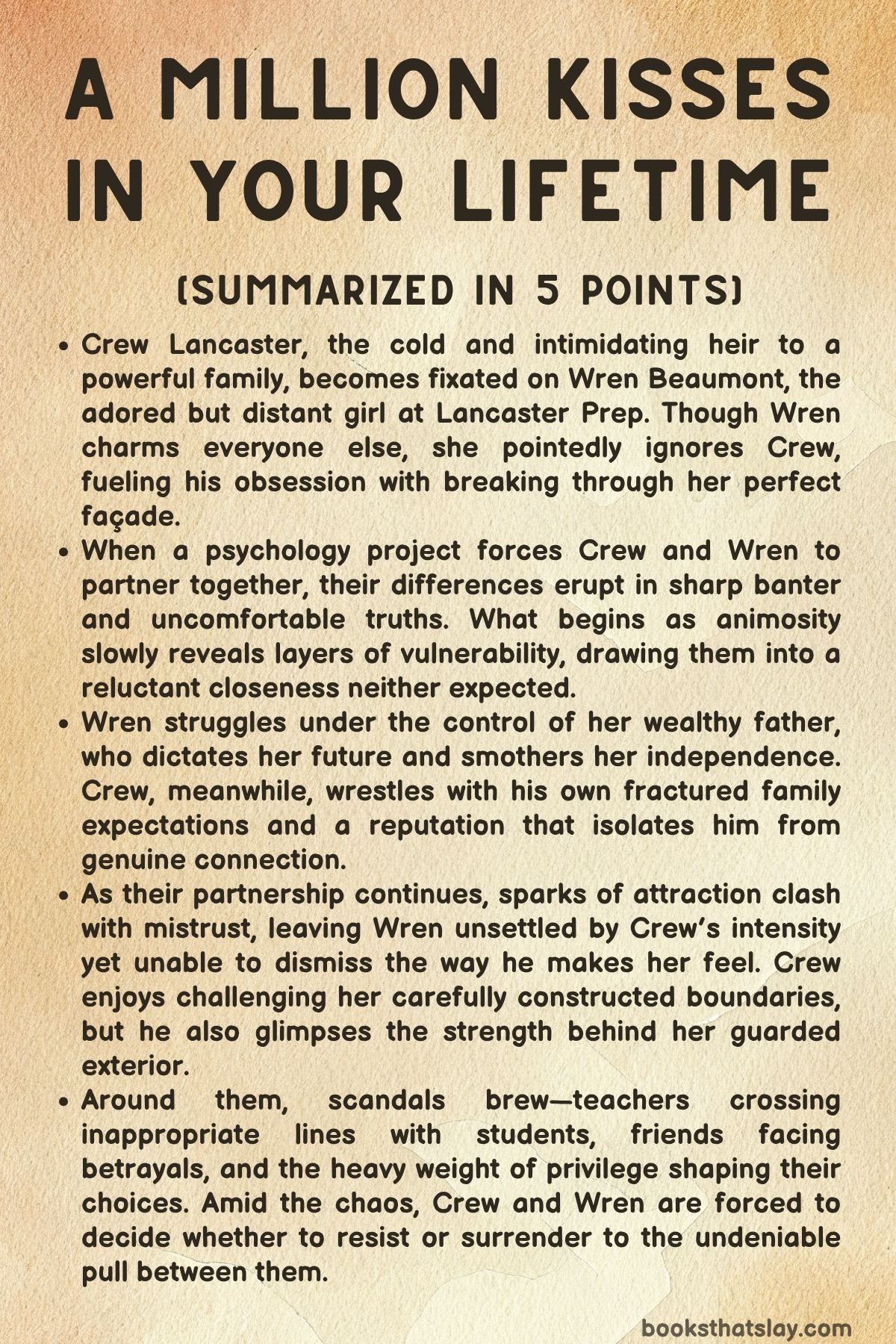
A Million Kisses in Your Lifetime by Monica Murphy is a contemporary romance set against the backdrop of an elite prep school, Lancaster Prep, where power, reputation, and appearances dictate everything. At the center of the story are two very different characters: Crew Lancaster, the arrogant, wealthy heir to the Lancaster empire, and Wren Beaumont, the beautiful, admired “good girl” who seems untouchable.
When they are forced together for a school project, their worlds collide in ways neither expects. What begins as tension and mockery evolves into intimacy, vulnerability, and ultimately love, while secrets, scandals, and family pressures test their bond at every turn.
Summary
Crew Lancaster is the embodiment of power and privilege at Lancaster Prep, known for his cold, intimidating presence and his status as heir to the Lancaster family empire. Despite being admired—or feared—by most, Wren Beaumont, the school’s golden girl, never acknowledges him.
Wren is adored by classmates for her grace and charm, but beneath her perfect image lies the weight of her father’s control and the pressure to conform. Crew becomes obsessed with her, determined to break through her carefully maintained distance.
His fascination grows when he learns he is not invited to her upcoming eighteenth birthday party, and he vows to change that.
Wren’s world is shaped by her billionaire father’s demands and her mother’s silence, leaving her with little control over her own life. Though she dreams of becoming a nurse, her father pushes her toward a path he has chosen, including admission to Columbia secured through his influence.
At school, her instincts tell her something is off when she notices her teacher, Mr. Figueroa (known as Fig), acting inappropriately with her friend Maggie.
This suspicion lingers, particularly when he dismisses Maggie as his teaching assistant in favor of Wren, under the guise of professionalism but with unsettling undertones.
The turning point comes when Ms. Skov, the psychology teacher, pairs Wren with Crew for a semester-long project.
Wren protests, but Ms. Skov insists they need the challenge of working with someone unfamiliar.
Their initial interactions are filled with hostility. Crew mocks her chastity and her perfect image, while Wren tries to dismiss him as crude and arrogant.
Yet their banter begins to reveal layers of vulnerability: her struggle against her father’s dominance, and his resentment of his own family’s expectations.
Their connection intensifies when Crew’s teasing pushes Wren to confront sides of herself she has kept hidden. He calls her “Birdy,” a nickname that both infuriates and unsettles her.
Their exchanges blur the line between disdain and attraction, and soon, curiosity leads them into moments of real intimacy. Crew’s boldness contrasts with Wren’s hesitancy, but he is surprisingly patient, giving her choices even as he challenges her limits.
Their first physical encounter, fueled by Crew’s mischievous use of a lollipop, is a turning point that shakes Wren’s carefully controlled life.
Amid their growing relationship, Fig looms as a threat. Rumors about his involvement with students prove true when Crew sees him dropping off Natalie, another classmate, late at night.
Fig manipulates students, hides behind his authority, and preys on vulnerabilities. When Crew confronts him, the tension between them escalates into a dangerous rivalry, with Wren caught in the middle.
Crew warns Wren about Fig, while Fig tries to discredit Crew and keep her close under the guise of mentorship. The scandal grows when Natalie lies to protect Fig, claiming she was with Crew during a curfew violation.
This forces Crew and Wren to work together to uncover the truth and protect Maggie, who has also been victimized by Fig.
Through it all, Crew’s pursuit of Wren evolves from a game into genuine devotion. He demonstrates his feelings by secretly acquiring a rare and meaningful artwork—“A Million Kisses in Your Lifetime”—that Wren has always adored.
This gesture reveals the depth of his care, showing he wants to give her not only affection but also pieces of herself that her father has denied her. For Wren, this becomes the proof she needs to trust in his love, even when others doubt him.
As their romance unfolds, they navigate the challenges of family expectations. Wren’s father remains controlling, dismissing her dreams and trying to dictate her future.
Crew’s own family, while wealthy, is fractured by neglect and scandal. Against these pressures, the two find solace in each other, creating a bond built on honesty and choice.
Their relationship culminates in open declarations of love, first during intimate moments alone, and later in front of both their families during the holidays. Crew surprises Wren with thoughtful gifts, including a pink Chanel bag filled with every lipstick shade, symbolizing the “million kisses” he promises her.
Their journey continues beyond high school, as seen in the epilogue. Two years later, Crew and Wren have chosen to travel the world together rather than attend college, building their own lives on their own terms.
Wren begins collecting art, echoing the independence she long sought, while coping with her parents’ divorce. Crew, ready to take the next step, proposes to her during a family Christmas dinner, presenting a simple diamond ring mounted on a Blow Pop stick—a private nod to their first moments of intimacy.
Wren accepts, their love cemented by shared defiance of their families’ expectations and the creation of a future they choose together.
In the end, A Million Kisses in Your Lifetime is a story of transformation. Wren moves from being a symbol of untouchable perfection to someone who claims her own desires and choices.
Crew evolves from a reckless playboy into a man capable of deep love and devotion. Their relationship is messy, passionate, and at times scandalous, but it gives both of them the freedom to redefine who they are and who they want to become.
Characters
Crew Lancaster
Crew Lancaster emerges as a complex figure whose life is dictated by both privilege and burden. As the heir to the powerful Lancaster family, his identity is deeply tied to expectations of legacy, control, and status.
Outwardly, he cultivates an intimidating reputation—cold, arrogant, and untouchable. His peers both fear and respect him, which reinforces the idea that his authority is heavy and rooted in duty rather than charm.
Yet beneath that exterior lies someone fractured by neglect and dysfunction: a father who is emotionally absent, siblings who are constrained by the family name, and a cousin whose scandal haunts the family’s image. Crew’s fixation on Wren begins as an obsession, a challenge to conquer her innocence and composure, but gradually evolves into genuine care and love.
His willingness to defy his own cynicism, to buy her art at an astronomical price, and to embrace vulnerability with her shows his transformation from a detached playboy into a man who can prioritize love over duty. His growth is anchored in his recognition that Wren is not just an object of desire but a person who changes him profoundly.
Wren Beaumont
Wren Beaumont stands as the moral and emotional heart of A Million Kisses in Your Lifetime. Seen as the untouchable center of admiration at Lancaster Prep, she carries the burden of perfection thrust upon her by both peers and her controlling father.
Her image—a girl of virtue symbolized by her promise ring—makes her a beacon for imitation, but inwardly she struggles with suffocating pressure. Wren’s greatest conflict lies between the life scripted for her by her father, Harvey, and the one she quietly yearns for: independence, compassion, and a career in nursing rather than being a trophy of wealth and influence.
Her relationship with Crew forces her to confront vulnerability, desire, and agency. Initially resistant to his arrogance, she learns to navigate his provocations, allowing herself to be both shaken and empowered by him.
By the novel’s end, Wren evolves from a girl defined by external control into a woman capable of love, independence, and bold choices, symbolized by her embrace of art and her acceptance of Crew’s proposal.
Harvey Beaumont
Wren’s father, Harvey, serves as a representation of authoritarian control and patriarchal dominance. A billionaire who manipulates opportunities—such as Wren’s admission to Columbia through his connections—he symbolizes the suffocating influence of wealth and power on individuality.
Harvey’s control extends into Wren’s personal dreams, steering her away from nursing, dismissing her autonomy, and treating her as a pawn in his image-driven life. His absenteeism and infidelity exacerbate Wren’s distrust of men, making him a shadowy antagonist in her journey toward freedom.
His absence on Christmas, which prompts Wren’s mother to decide on divorce, reveals his hollowness as both a husband and father, contrasting sharply with Crew’s eventual devotion to Wren.
Cecily Beaumont
Cecily Beaumont, Wren’s mother, is portrayed as a quiet but pivotal figure who embodies endurance and eventual liberation. Trapped in an unfaithful marriage with Harvey, she provides Wren with subtle encouragement while struggling with her own disillusionment.
Her decision to file for divorce becomes a turning point, both for herself and Wren, as it signals the possibility of breaking free from Harvey’s control. Cecily’s bond with her daughter offers Wren a model of resilience, and her encouragement during moments of uncertainty contributes to Wren’s growth.
Though not as dominant in the narrative, her role underscores the theme of women reclaiming autonomy within oppressive structures.
Mr. Figueroa
Mr. Figueroa, or Fig, functions as a disturbing counterpoint to Crew.
While Crew’s pursuit of Wren evolves into genuine love, Fig’s interactions with students reveal predation disguised as mentorship. His relationship with Maggie, his manipulative overtures toward Wren, and his late-night rendezvous with Natalie expose a pattern of exploitation.
He thrives on power imbalances, cloaking his predatory behavior in authority and false concern. Unlike Crew, who provokes Wren but respects her boundaries when it matters, Fig crosses ethical lines without hesitation.
His presence adds tension to the story, making him not only a foil to Crew but also a symbol of the danger lurking beneath institutional respectability.
Maggie Gipson
Maggie Gipson represents vulnerability and the dangers of misplaced trust. Her entanglement with Fig leaves her emotionally fragile, anxious, and struggling with possible pregnancy fears.
Maggie embodies the collateral damage of predatory figures like Fig, highlighting the dangers faced by young women within environments that exploit power imbalances. Despite her pain, she maintains her connection with Wren, whose loyalty and concern underscore themes of friendship and support.
Maggie’s storyline acts as a stark reminder of the stakes involved in Wren’s world, where control and predation are constant threats.
Ezra and Malcolm
Crew’s friends, Ezra and Malcolm, serve as both foils and enablers. They amplify Crew’s early persona of arrogance and entitlement, often making crude jokes and mocking Wren’s chastity.
Malcolm, in particular, represents the most callous and predatory aspects of male privilege, while Ezra tends to play the role of amused observer. Their presence highlights the toxic culture of Lancaster Prep, where wealth and power breed carelessness and cruelty.
At the same time, their interactions with Crew reveal how he diverges from their path—his fascination with Wren eventually separates him from their shallow pursuits.
Themes
Power and Control
Throughout A Million Kisses in Your Lifetime, the tension between personal freedom and external control shapes the trajectory of both Wren and Crew. Wren is raised under the heavy shadow of her father’s wealth and authority, which dictates not only her education but also her future.
Her acceptance into Columbia becomes less a personal triumph than a reminder of her father’s manipulation, as he secures her admission without her genuine consent. This constant intrusion creates in her a quiet rebellion, reflected in her longing for a career path like nursing that her father disapproves of.
Crew, on the other hand, grapples with the suffocating expectations of the Lancaster legacy. His role as heir is less a privilege than a burden, one that strips away his individuality and reduces him to the family’s image.
Both characters’ journeys are marked by the ways they resist, navigate, and occasionally succumb to the control others attempt to exert over them. Their relationship emerges as an act of reclaiming autonomy, offering them both a chance to define their lives on their own terms rather than those imposed by authority figures.
Reputation and Identity
Identity in the novel is closely tied to reputation, especially in the insular world of Lancaster Prep. Wren carries the reputation of being untouchable, virtuous, and admired, symbolized most clearly by her promise ring.
Yet behind this carefully curated image lies a girl suffocated by perfection, yearning for authenticity but fearful of losing the pedestal she has been placed upon. Crew, by contrast, is defined by his notoriety—his cold demeanor, intimidating aura, and the weight of gossip surrounding him.
While he cultivates that reputation as armor, it obscures his loneliness and craving for connection. Their project forces both to strip away those façades, allowing vulnerability to emerge in unexpected ways.
Reputation thus becomes not only a burden but also a barrier to self-discovery, with love acting as the catalyst that helps them reshape how they are perceived and how they perceive themselves.
Corruption and Innocence
The juxtaposition of innocence and corruption runs like an undercurrent through the narrative. Wren, with her purity, discipline, and restraint, becomes a figure of fascination for Crew, who thrives on testing boundaries and defying norms.
His initial desire to “claim her firsts” frames their relationship within the language of corruption, yet the story complicates that binary. Wren is not simply a passive figure to be corrupted; she actively makes choices about intimacy, testing her own boundaries and finding empowerment in her vulnerability.
Meanwhile, the presence of characters like Figueroa highlights a darker, predatory form of corruption that contrasts with Crew’s provocative teasing. The theme underscores the complexity of innocence—not as something fragile to be preserved, but as a state that can evolve into agency and strength when faced with temptation, risk, and trust.
Love as Transformation
At its core, A Million Kisses in Your Lifetime positions love as a transformative force, reshaping both Crew and Wren from the inside out. Crew, who initially avoids relationships and treats intimacy as a game, finds himself profoundly altered by his growing devotion to Wren.
His elaborate gestures, from the million-dollar artwork to the surprise party, reveal a depth of feeling that contradicts his reputation as cold and indifferent. Wren, too, discovers in Crew a source of courage, learning to assert her desires and question the authority of her father.
Love becomes not a distraction but a vehicle for growth, granting both characters the strength to imagine futures defined by their choices rather than the expectations imposed upon them. By the epilogue, love has not only bound them together but also liberated them, proving itself to be both a rebellion against control and an affirmation of personal freedom.
The Burden of Family Legacy
Family legacy weighs heavily on both protagonists, though in different ways. Crew’s every action is framed by the looming presence of the Lancaster empire, where scandal is feared and image is everything.
His siblings and cousins serve as cautionary tales of what happens when one fails to uphold the family’s expectations, instilling in him a mix of resentment and reluctant loyalty. Wren faces a different but equally oppressive legacy in her father’s dominance and her parents’ fractured marriage.
Her father’s unfaithfulness and manipulation erode her trust in men, making her hesitant to embrace Crew’s affection even when it proves genuine. The two find common ground in their struggle against these legacies, forming a partnership rooted in defiance.
The burden of family name and duty remains, but their love offers a counterbalance—a chosen bond that supersedes the weight of inherited obligations.