Does It Hurt Summary, Characters and Themes
Does It Hurt by H.D. Carlton is a dark romance that balances survival, obsession, and redemption against a backdrop of danger both emotional and physical. The novel follows Sawyer Bennett, a young woman fleeing her past, haunted by trauma inflicted by her abusive twin brother, Kevin.
Constantly running, she creates new identities while struggling with paranoia, guilt, and despair. Her life collides with Enzo Vitale, a dangerous yet magnetic man whose work with sharks mirrors his volatile nature. Their connection spirals from desire to destruction as fate strands them together on a mysterious island. What follows is a brutal test of trust, resilience, and the human will to survive love and violence alike.
Summary
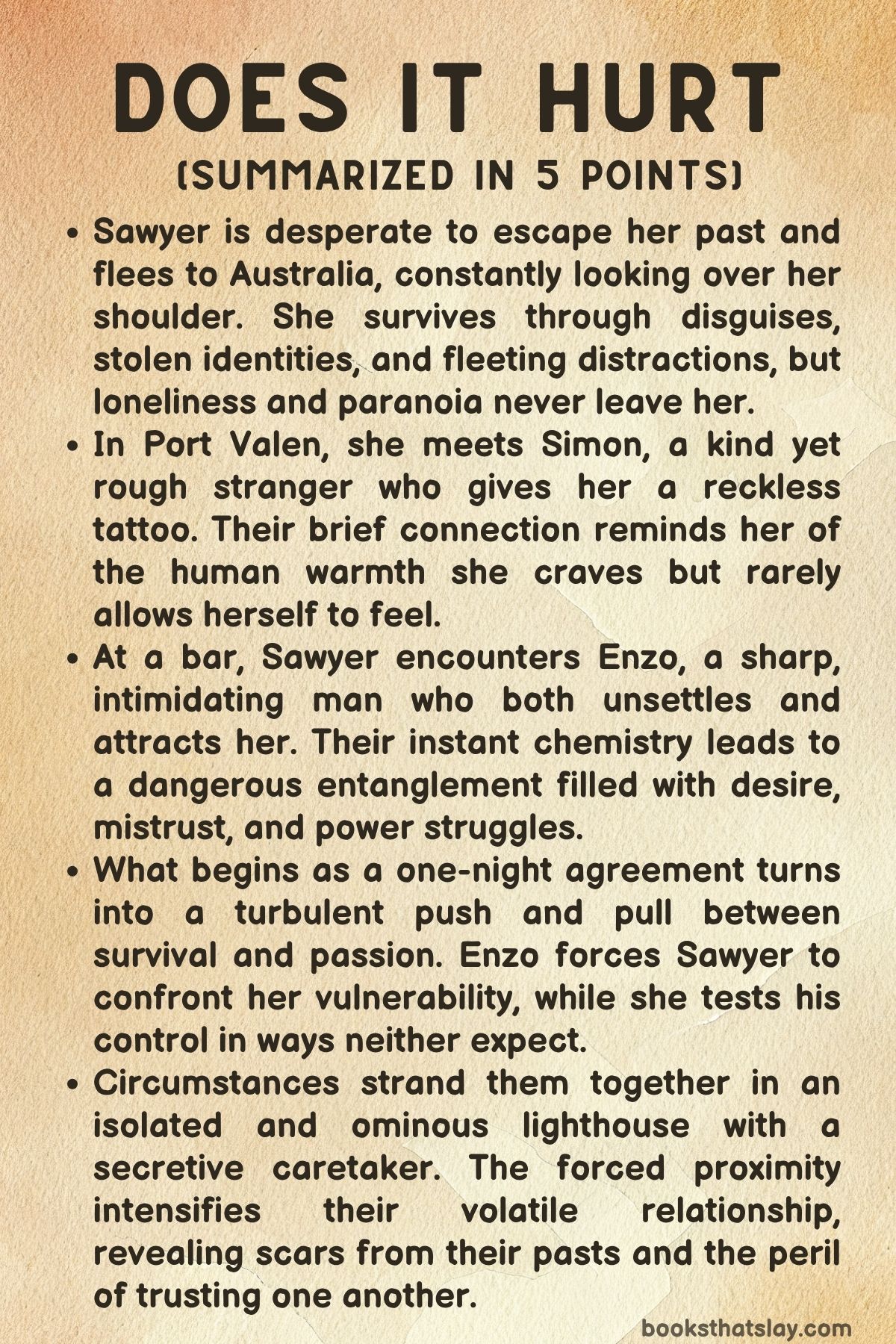
Sawyer Bennett begins her journey in an airport, desperate to escape her past. Spotting a distant relative who threatens to expose her, she abandons her original flight and buys a last-minute ticket to Australia.
With limited resources, she makes her way to Port Valen, a seaside town where she hopes to blend in. Despite the beauty of her surroundings, Sawyer never feels safe.
She smokes excessively, contemplates pregnancy from a recent fling, and struggles with the crushing weight of loneliness and paranoia. Even simple survival becomes a burden as she burns through her dwindling funds.
At a bus stop, she meets Simon, an older man who shows her unexpected kindness. Sharing cigarettes and conversation, he tattoos crude words on her thigh with makeshift tools in exchange for her pack.
The reckless act, though dangerous, brings Sawyer a rare sense of exhilaration. She leaves with bittersweet gratitude, dreading the isolation that returns once Simon is gone.
Sawyer later assumes a false identity, Jamie Harris, and visits a bar. There, she encounters Enzo Vitale, a man who is both intimidating and captivating.
Their conversations brim with tension, sarcasm, and attraction. Enzo reveals his work with sharks, drawing Sawyer in with his intensity and passion.
Despite warnings that their connection can only last one night, they end up together at a secluded waterfall. Their encounter is raw and consuming, built on power struggles and unspoken vulnerabilities.
Enzo refuses to kiss her, insisting she beg for what she wants, while Sawyer experiences overwhelming intimacy she’s never known. Their union leaves both shaken but unable to sever the bond.
The next morning, Sawyer secretly photographs Enzo’s documents and steals his identity, creating a fraudulent credit card. While she wrestles with guilt and memories of Kevin, Enzo discovers the theft and becomes furious.
Yet his anger is complicated by an unwillingness to let her go. When he later spots her on the beach, he masks his rage with charm, luring her onto his shark-diving boat.
The outing quickly turns sinister as he confronts her about the theft. During sex, he chokes and bites her, terrifying her with both physical dominance and the threat of circling sharks.
He forces her to confess her real name—Sawyer Bennett—and nearly drowns her before a storm capsizes their boat.
They awaken on a desolate island, where they meet Sylvester, an eccentric lighthouse caretaker with unsettling rules. Though Sylvester offers shelter, his strict curfews and suspicious behavior suggest hidden malice.
Trapped together, Enzo and Sawyer share a tense coexistence marked by resentment, attraction, and trauma. Enzo’s volatility clashes with Sawyer’s fear and survival instincts, yet their connection deepens.
She reveals Kevin’s abuse and the disbelief of her parents, while Enzo confesses his anger toward his estranged mother. Their conversations swing between cruelty and tenderness, binding them in a destructive intimacy.
When Sawyer explores a cave and is injured, Enzo panics and rushes to save her, realizing she had dragged his unconscious body to the island after the wreck. This revelation shifts his view of her, forcing him to see her resilience.
Their bond strengthens, though it remains volatile, as they oscillate between hate, vulnerability, and desire. Their encounters blur the line between violence and affection, leaving Sawyer torn between craving freedom and clinging to Enzo’s obsession.
Sylvester’s presence grows more ominous. He admits his daughter committed suicide in the lighthouse and seems to suggest Sawyer is destined to replace her.
Enzo grows suspicious of the caretaker’s intentions. Meanwhile, Sawyer contemplates staying on the island permanently, seeing it as a way to stop running.
Enzo insists it is only another prison. In a rare moment of humility, Enzo apologizes for the cruelty he inflicted since the shipwreck, kneeling before her in contrition.
Though Sawyer withholds full forgiveness, their connection grows deeper, balancing raw honesty and unresolved tension.
Eventually, violence erupts. Enzo and Sawyer confront Sylvester and his ally Kacey, leaving both men dead in the lighthouse.
Now surrounded by bodies, they must prepare for the inevitable arrival of authorities. Enzo refuses to let Sawyer return to America, where her past could condemn her.
Instead, he devises a plan to “kill” Sawyer Bennett’s identity. She will assume the role of Trinity, Sylvester’s imaginary daughter raised in captivity, while Sawyer Bennett will be considered a shipwreck victim who died years ago.
The ruse is supported by a fabricated suicide letter and Sylvester’s hidden cellar of skeletal remains. Though torn, Sawyer agrees, determined to claim freedom with Enzo.
When the coast guard arrives, the plan works. At the police station, Sawyer—now Trinity—navigates questioning by Officer Bancroft, who believes the letter confirms Sawyer Bennett’s suicide.
Reluctantly, the authorities release her and Enzo. Enzo surprises her with her old Volkswagen van, a symbolic anchor to her past life.
Slowly, they begin to build a future. Sawyer visits Simon for another tattoo—a cactus symbolizing resilience—while Enzo joins her by getting a shark tattoo, a silent act of solidarity.
Together, they create new rituals to ground themselves in a life outside of fear.
Two years later, Sawyer and Enzo are married. On their boat, they dive among great whites, reveling in the adrenaline that once terrified her.
Their love, once destructive, has transformed into playful intimacy built on trust and survival. Sawyer reflects on her journey—from running, stealing, and fearing—to finally claiming freedom as Sawyer Vitale.
No longer escaping the past, she runs forward, laughing, toward the life she has chosen.
Characters
Sawyer Bennett
Sawyer is the fractured, restless center of Does It Hurt, a woman shaped by trauma and consumed by her need to survive at any cost. From the outset, she embodies both fragility and resilience, constantly fleeing her past and inventing new identities to stay ahead of danger.
Haunted by the abuse of her twin brother Kevin, she carries deep scars of betrayal and abandonment, made worse by the disbelief of her family and authorities. Her compulsive smoking and reckless choices—whether it is stealing identities, numbing herself with alcohol, or engaging in destructive encounters—highlight her desperation to both feel and escape.
Yet Sawyer is not merely a victim; she has an instinctive will to endure. Her relationship with Enzo amplifies this complexity.
With him, she vacillates between distrust and desire, attraction and fear. In his presence, she is pushed into moments of vulnerability that reveal her yearning for connection, even as she convinces herself she destroys everything she touches.
Ultimately, Sawyer evolves into someone who no longer runs only to survive but begins to run toward a life she chooses—flawed, dangerous, but undeniably her own.
Enzo Vitale
Enzo is the volatile storm that collides with Sawyer’s world, embodying both her deepest fears and her unspoken desires. A man of contradictions, he is as ruthless as he is protective, capable of cruelty that borders on sadism but also of moments of startling tenderness.
His passion for the ocean and his work with sharks reflects his own nature—dangerous, predatory, and yet awe-inspiring. Enzo thrives on power struggles, both in his professional life and in his relationship with Sawyer, often pushing her to the brink of fear before pulling her back with unexpected care.
His obsession with control stems from a fractured past, particularly his strained relationship with his mother, whose misery he despises. Yet Sawyer forces him to confront vulnerability, unraveling the armor he hides behind.
With her, he swings between destruction and devotion, eventually finding in her the only tether to life he values. Enzo’s journey is less about redemption and more about surrendering to the fact that love and ruin coexist within him, and Sawyer embodies both.
Simon
Simon is the quiet, unassuming presence who offers Sawyer fleeting comfort in her turbulent life. An older man marked by simplicity and kindness, he represents the rare human connection she encounters without manipulation or danger.
Their interaction at the bus stop, where he tattoos her with crude equipment, is both reckless and strangely tender, granting Sawyer a rare moment of joy and release. Simon’s role, though limited, underscores the importance of small acts of compassion in Sawyer’s survival.
Later, his reappearance when Sawyer seeks a symbol of resilience cements his position as a grounding figure. Unlike Enzo’s chaotic intensity, Simon provides understated stability, reminding Sawyer of the value of gentleness in a world that has offered her little of it.
Kevin Bennett
Kevin, Sawyer’s twin brother, is the dark shadow that defines much of her existence. As an abusive cop, he embodies corruption, manipulation, and betrayal on both personal and systemic levels.
His abuse of Sawyer is not just physical but deeply psychological, robbing her of trust in family, love, and authority. Kevin’s actions haunt Sawyer long after she kills him, leaving her with guilt and paranoia that permeate every decision she makes.
His presence in the story, even after death, is a reminder of the lingering grip abusers can hold over survivors, shaping their identities and fears. Kevin’s role is less as a character who evolves and more as a symbol of the monstrous forces Sawyer must overcome to reclaim herself.
Sylvester
Sylvester is the eerie caretaker of the lighthouse, a man whose presence blurs the line between protector and predator. At first, he appears to be a harmless eccentric, offering shelter and rules that feel odd but manageable.
However, inconsistencies in his story and the oppressive control he wields reveal a darker undercurrent. His backstory—of abandonment, grief, and the loss of his daughter Trinity—paints him as a man consumed by loneliness and obsession.
His strict rules and unsettling comments mirror Sawyer’s fears of captivity and echo the controlling figures from her past. Sylvester’s presence in Does It Hurt forces Sawyer and Enzo into a precarious alliance, and his eventual death becomes a turning point in Sawyer’s transformation from fugitive to reborn survivor.
Troy
Troy, Enzo’s best friend and professional partner, serves as a foil to Enzo’s intensity. Where Enzo is volatile and domineering, Troy provides grounded pragmatism and blunt honesty.
His presence at the oceanic research facility represents stability and camaraderie in Enzo’s life, a reminder that Enzo is capable of loyalty beyond obsession. Though Troy is not deeply fleshed out compared to others, his role is important in highlighting the contrast between Enzo’s dangerous entanglement with Sawyer and the more balanced connections he is capable of.
Troy’s presence also roots Enzo in the world outside of his turbulent relationship, reminding readers that despite his obsession, he remains part of something larger.
Themes
Survival and Identity
In Does It Hurt, survival is not just about enduring physical dangers but also about maintaining, discarding, and reinventing identities. Sawyer’s constant need to escape—whether from her abusive past, the threat of discovery, or the destructive tendencies she carries within herself—forces her into a cycle of reinvention.
She abandons her given name, assumes false identities, and even considers erasing “Sawyer Bennett” altogether. Yet each new persona does not truly liberate her but instead becomes another mask to wear while she continues to run.
This theme illustrates the tension between survival and authenticity: Sawyer must lie and steal to live, but each act strips away pieces of her true self. Her eventual rebirth as “Sawyer Vitale” symbolizes a reconciliation of survival with identity—she does not erase Sawyer entirely but carries the name forward into a new life, one that acknowledges her past while refusing to be imprisoned by it.
The novel suggests that survival is not only about clinging to life but about constructing a self that can withstand the weight of trauma, shame, and violence. It is in this balance of reinvention and remembrance that Sawyer finds a fragile form of freedom.
Trauma and Abuse
The scars of abuse linger throughout Sawyer’s journey, shaping her relationships and decisions. Her twin brother Kevin’s manipulation, violence, and betrayal haunt her every step, not only because of the physical and emotional damage he inflicted, but also because of society’s failure to protect her.
The disbelief of her parents and the indifference of authorities deepen her wounds, teaching her that the world cannot be trusted to safeguard victims. Trauma becomes both her motivator and her prison—fueling her instinct to run, to steal, to manipulate, and to distrust anyone who shows her kindness.
This theme also examines the insidious way trauma distorts intimacy; Sawyer often conflates pain with affection, finding herself drawn to Enzo’s brutality because it mirrors the twisted dynamics she grew up with. Yet as her bond with Enzo evolves, there emerges the possibility of rewriting what intimacy means, transforming suffering into a path toward resilience and self-worth.
The novel portrays trauma not as something to be erased but as an ever-present force that shapes, challenges, and sometimes strengthens the human spirit.
Power, Control, and Desire
Power dynamics permeate Sawyer’s interactions, especially with Enzo. Their relationship oscillates between violent domination and vulnerable intimacy, making the theme of control central to their story.
Enzo’s refusal to kiss Sawyer unless she begs, his manipulations during their shark dive, and his unpredictable mixture of cruelty and tenderness demonstrate how power can both endanger and allure. For Sawyer, who has lived under Kevin’s suffocating abuse, Enzo’s dominance is both a reminder of her past and a potential redefinition of it.
The moments when she asserts herself—such as demanding an apology—mark turning points in her reclamation of agency. This theme underscores the paradox of desire: Sawyer and Enzo’s connection thrives on danger, but it is also what transforms them.
Their passion is born not from safety but from risk, forcing both to confront how much control they are willing to surrender and how much they must seize back. Ultimately, power in the novel is less about dominance over another person and more about the struggle to reclaim control over one’s own narrative, body, and future.
Love as Transformation
While survival and trauma shape Sawyer’s path, love acts as the catalyst for transformation. Her relationship with Enzo begins with hostility, suspicion, and raw lust, but it evolves into something that destabilizes both of them in profound ways.
Enzo, consumed by obsession, finds in Sawyer not just a lover but a mirror of his own brokenness. Sawyer, accustomed to using relationships as tools of escape, experiences with Enzo a connection that forces her to feel, to risk, and to hope.
Their love is not gentle or conventional—it is chaotic, violent, and often destructive—but it is also healing in its intensity. It gives Sawyer the courage to imagine a life beyond running, beyond pain, beyond the shadow of Kevin.
By the time she becomes Sawyer Vitale, love has not erased her wounds but has transformed them into scars she can live with. The theme suggests that love, even when born in darkness, has the power to redefine existence—not by fixing what is broken, but by making survival meaningful.
Freedom and Entrapment
Freedom is always shadowed by entrapment in Sawyer’s story. She flees from one prison only to land in another: the oppressive gaze of Kevin, the suffocating isolation of the lighthouse, and even the dangerous allure of Enzo.
Each setting becomes both a space of potential liberation and a cage. The lighthouse, in particular, symbolizes this paradox—a place of supposed refuge that is instead marked by Sylvester’s rules, secrecy, and the lingering ghost of his daughter.
Sawyer’s inner life mirrors this external entrapment, as her paranoia, shame, and self-destructive impulses keep her captive even when no one is physically holding her. Yet freedom gradually takes shape in her choices, whether in saving Enzo from drowning, in confronting her past through the fabricated “death” of Sawyer Bennett, or in deciding to live openly as Sawyer Vitale.
Freedom here is not absolute but earned through suffering, honesty, and the refusal to be defined solely by victimhood. The novel ultimately argues that true freedom is not the absence of restraint but the courage to claim life on one’s own terms, no matter the risks.