Eyes on Me Summary, Characters and Themes
Eyes on Me by Sara Cate is an intense, emotionally charged contemporary romance that explores the complicated dynamics between Garrett, a man who works at a high-end, voyeuristic club, and Mia, his younger stepsister. The book delves into themes of attraction, obsession, and the complicated boundaries between family and desire.
Garrett is drawn to Mia in ways he can’t fully understand, and their complicated relationship unfolds amid the high-stakes environment of the club they both find themselves entangled in. As they struggle with their feelings for each other, the story explores deep emotional conflicts, self-discovery, and navigating difficult personal relationships.
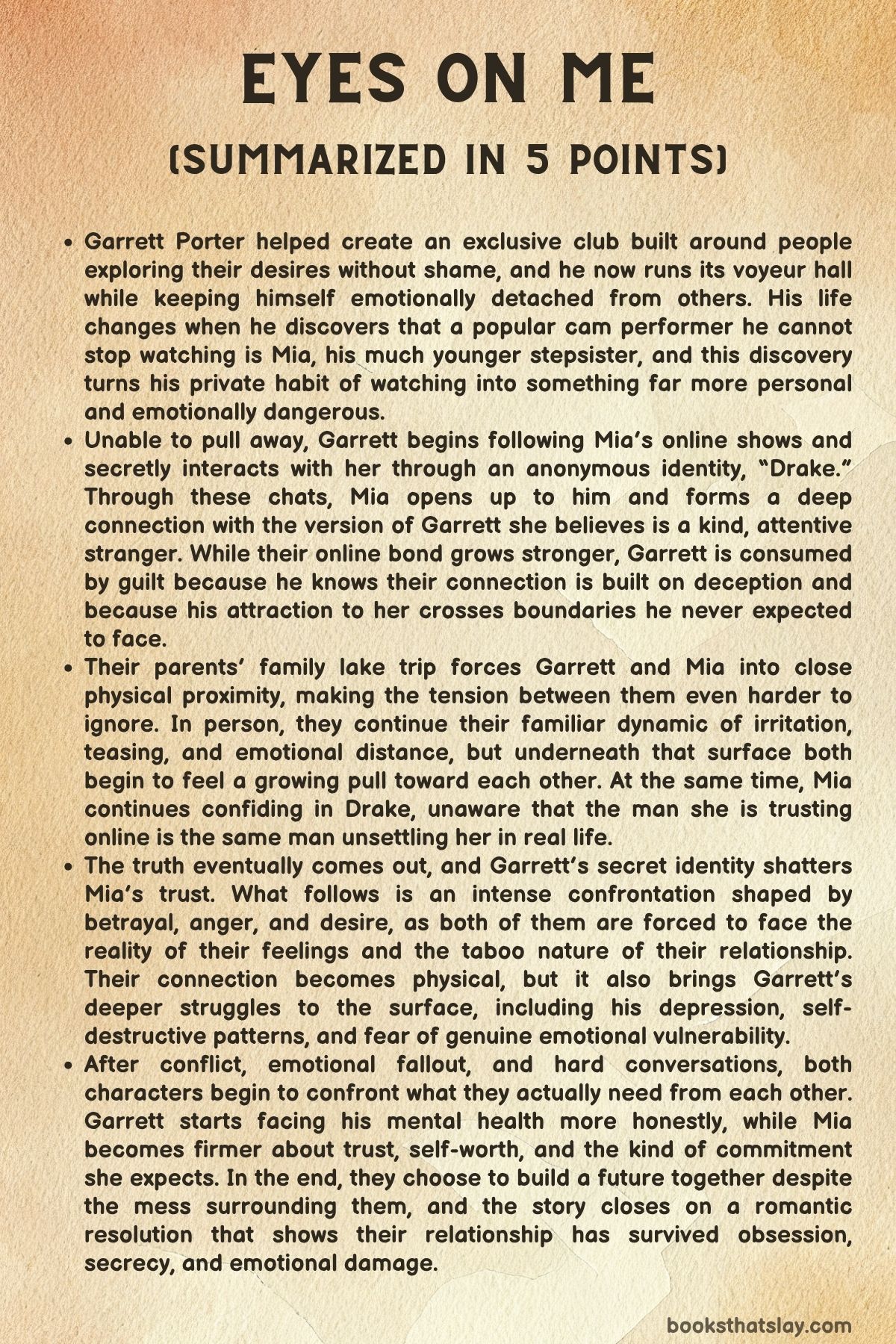
Summary
The story opens with a flashback seven years earlier. Garrett Porter, then in his late twenties, is at a low point—struggling with motivation, a failing career, and emotional numbness.
During a night out with his three close friends (including Emerson Grant), they vent about unsatisfying sexual experiences. Garrett openly admits he is a voyeur: he derives pleasure from watching others engage in consensual sexual acts rather than participating himself.
This conversation sparks an idea from Emerson to create a business that matches people based on their specific kinks without judgment. What begins as a dating app concept evolves into the exclusive, high-end Salacious Players’ Club—a discreet venue in Briar Point where members explore fantasies in a safe, luxurious environment.
In the present day, the club has been open for several months and is thriving. Now thirty-six, Garrett manages the voyeur hall, curating private viewing experiences where couples perform behind glass for spectators.
He remains detached and prefers working alone on the sidelines, comfortable in his role as observer rather than participant. His friends have begun finding their own romantic and sexual connections (as seen in Book 1 with Emerson and Charlotte), which subtly deepens Garrett’s sense of isolation despite the club’s success.
One evening, while casually browsing a cam-girl app (research or personal indulgence), Garrett stumbles upon a performer whose face and blond hair are unmistakably familiar: Mia Harris, his younger stepsister (early twenties). Their parents married when Mia was young, but Garrett—already older and somewhat independent—never developed a close sibling bond with her.
Over the years, their interactions have been marked by tension, teasing, pranks, and mutual irritation. Mia has long felt that Garrett disliked or resented her presence in the family.
Shocked and conflicted, Garrett knows he should stop watching immediately. Yet he is instantly hooked.
He tunes in to her streams, where Mia confidently performs, flirts, and engages with viewers. She finds empowerment and validation in camming, though it remains a secret from her family.
Garrett begins tipping generously and chatting anonymously under the username “Drake”—a charming, attentive persona he crafts. Mia is drawn to this mystery man online, enjoying their increasingly intimate and personal conversations.
She starts falling for “Drake,” unaware that he is actually her stepbrother.
Garrett wrestles with intense guilt and arousal. The attraction feels deeply inappropriate, yet he cannot look away.
This secret obsession awakens long-dormant desires in him and forces him to confront emotions he has avoided for years.
Their parents invite the family to the lake house for a summer getaway. Garrett, who has avoided these family trips in recent years due to the awkwardness with Mia, decides to go—partly for a break from the club and partly because of his growing fixation.
Under the same roof, the physical proximity amplifies the tension. In person, Mia and Garrett maintain their usual dynamic: she is sassy, distant, and sometimes bratty toward him; he appears cool, teasing, and emotionally unavailable.
Meanwhile, their anonymous online relationship deepens. “Drake” and Mia share vulnerable moments, sexual fantasies, and genuine connection.
Garrett experiences a rare sense of openness through the screen, something he has long resisted in real life. The duality torments him: he is falling for Mia while she falls for the version of him she doesn’t know is real.
The forbidden nature of it all—familial ties, the age gap, and the deception—only heightens the intensity.
At the lake house, small moments of forced proximity (conversations, shared spaces, lingering glances) build unbearable sexual tension. Garrett struggles to reconcile his protective instincts, jealousy (when other men show interest in Mia, even online), and overwhelming desire.
Mia, for her part, feels confused by the shift in her feelings toward her stepbrother, even as she continues chatting with the kind, attentive “Drake.”
The story explores dual perspectives: Garrett’s internal battle with his voyeuristic kink turning into something far more personal and obsessive, and Mia’s journey of self-empowerment through her camming career alongside her growing emotional confusion.
The tension peaks through a combination of in-person encounters and continued anonymous interactions. Garrett’s protectiveness surfaces, especially regarding Mia’s safety and choices.
Eventually, the deception cannot hold. The truth about “Drake” comes out, leading to a explosive confrontation filled with anger, hurt, betrayal, and raw desire.
Their first physical encounters are charged with years of pent-up tension, blending voyeuristic/exhibitionist elements (fitting the club’s world) with intense passion. The relationship is messy—marked by power struggles, vulnerability, and the moral weight of their step-sibling bond.
Garrett’s deeper emotional arc comes to the forefront here. He has long battled mental health issues, including severe depression and past struggles with anxiety and self-destructive tendencies (including a referenced overdose incident years earlier).
He has avoided therapy and genuine connection, preferring emotional detachment. As feelings for Mia intensify, these issues resurface, leading to moments of withdrawal and self-sabotage.
Mia, meanwhile, grapples with her own identity, career choices, and the societal/taboo implications of their attraction.
Supporting characters provide grounding and contrast:
Emerson (and Charlotte from Book 1) offer friendship and perspective, with Emerson pushing Garrett toward accountability and help.
Other club owners (Hunter, etc.) appear in the background, highlighting the professional vs. personal divide in Garrett’s life.
The club itself serves as a backdrop rather than a central crisis—its voyeur rooms and fantasy spaces mirror the themes of watching, performing, and hidden desires.
The couple now must navigate the fallout: family reactions (strained but ultimately addressed), Garrett’s reluctance to be fully vulnerable, and Mia’s need for honesty and commitment. Garrett confronts his mental health, seeking help and learning to open up rather than hide behind observation or detachment.
Mia grows more assertive and self-assured, balancing her independence with her feelings for Garrett.
After intense conflict, honest conversations, and passionate reconciliation (including memorable scenes that blend their kinks—voyeurism and exhibitionism), they choose each other. The story emphasizes healing, acceptance of “the mess,” and building something real beyond the initial obsession.
The book closes with a happy ending. Garrett proposes, and they commit to a future together.
A later epilogue (set about two years on) shows them married or deeply settled, celebrating their anniversary with passion and reflection on how far they’ve come. Garrett has made progress with his mental health, and their relationship has strengthened both characters.
Characters
Garrett Porter
Garrett is defined by distance. He has built a life around watching rather than participating, and that habit shapes both his sexuality and his emotional survival.
As the manager of the voyeur hall, he controls intimacy from the edges, making sure everything is orderly, safe, and contained while keeping his own feelings locked down. That position suits a man who has spent years avoiding direct vulnerability.
His voyeurism is not only a kink; it also reflects how he moves through life. He is more comfortable observing desire, pain, and connection in other people than admitting his own need for any of it.
This makes him compelling because his conflict is not simply about forbidden attraction. It is about a man who has organized his identity around detachment being forced into emotional exposure.
His attraction to Mia unsettles him because it breaks the boundaries he relies on to stay in control. He cannot reduce her to a distant fantasy or a safe performance.
She is tied to his family history, his guilt, and his unresolved sense of self. His anonymous persona as Drake shows how badly he wants intimacy while still fearing the consequences of honesty.
Through that mask, he becomes attentive, expressive, and emotionally available in ways Garrett himself avoids. The contrast between the online version of him and the guarded man in person reveals how fractured he is.
He is capable of tenderness and real connection, but he does not believe he can offer those things openly without being judged or rejected.
His depression deepens the character beyond the central romance. He is not written as moody for dramatic effect; his emotional numbness, avoidance, and self-sabotage suggest a man who has lived with despair long enough to mistake it for personality.
The references to past crises, including the overdose, make clear that he has spent years surviving rather than healing. That history explains why he clings to controlled environments and why he resists therapy and emotional dependence.
He does not simply fear scandal or rejection; he fears what happens when his defenses fail. Mia becomes important because she forces him to confront the gap between the life he has built and the life he actually wants.
By the end, Garrett’s development depends on accountability. He cannot earn a future through desire alone.
He has to face the damage caused by deception, accept responsibility for the emotional risk he imposed on Mia, and admit that love requires directness rather than observation. His growth is convincing because it does not erase his darker traits.
He remains intense, possessive, and deeply complicated, but he learns to stop hiding behind those qualities. The emotional resolution works because he does not become a different man; he becomes one who is finally willing to be seen.
Mia Harris
Mia begins as someone frequently misread by the people around her. Her sass, confidence, and occasional provocation can make her seem merely rebellious, but those traits are part of a larger struggle for agency.
She is trying to define herself outside family expectations and outside the assumptions others make about her youth. Her camming is central to that effort.
It is not presented only as sexual performance or shock value. For her, it becomes a space where she controls the terms of attention, receives validation without apology, and experiments with a version of herself that feels powerful instead of dismissed.
That choice gives her complexity because it places self-expression, economic independence, and emotional risk in the same space.
Her relationship with Garrett is shaped by years of misunderstanding. She has long carried the impression that he dislikes her, which leaves her defensive and alert around him.
That history matters because it turns their later connection into more than sudden forbidden attraction. She is responding not only to present tension but also to a long emotional record of distance, teasing, and uncertainty.
When she connects with Drake, she experiences a version of intimacy that feels safer because it is free from that family history. She is drawn to his attentiveness and emotional presence, which suggests that beneath her bold exterior she wants to be known seriously, not simply watched or judged.
Mia’s emotional arc is driven by the tension between empowerment and vulnerability. She is capable of taking risks and claiming her desires, yet she is also the one placed in a position of betrayal when the truth about Drake emerges.
That revelation tests whether her confidence can survive humiliation, anger, and the collapse of trust. Her response is important because she does not exist merely to forgive or redeem Garrett.
She has to decide what kind of honesty she requires, what boundaries matter to her, and whether desire is enough when deception has shaped the relationship. That gives her moral and emotional weight beyond the role of love interest.
Her later strength comes from discernment rather than hardness. She grows more assertive not because she becomes less emotional, but because she learns to connect her feelings to standards.
She can love Garrett without excusing everything he has done. That balance makes her one of the steadier presences in Eyes on Me.
She is adventurous and sexually confident, but she is also someone who insists that intimacy must include truth. Her ending feels earned because she chooses the relationship from a position of knowledge, not fantasy.
Emerson Grant
Emerson functions as both catalyst and mirror. In the early flashback, he helps turn sexual frustration and private confessions into a business model that eventually becomes the club.
That origin point matters because it shows him as someone who does not shame desire but instead sees its possibilities clearly and practically. He is entrepreneurial, socially perceptive, and willing to create structures where taboo fantasies can be explored safely.
This gives him a stabilizing role in the broader world of the story. He represents an organized, outward-facing response to kink, whereas Garrett represents a private and emotionally tangled one.
As Garrett’s friend, Emerson serves an important ethical function. He is close enough to recognize Garrett’s patterns and blunt enough to challenge them.
His presence prevents the central relationship from existing in a vacuum of unchecked intensity. Rather than simply cheering on forbidden attraction, he pushes toward accountability, mental health support, and honest reckoning.
That makes him valuable because he is not just comic relief or background support. He becomes one of the few people capable of confronting Garrett without being dismissed.
Their friendship suggests a long history built on loyalty, shared secrets, and enough trust to survive difficult truths.
Emerson also highlights the contrast between sexual openness and emotional maturity. The club itself is a place built around consent, communication, and negotiated fantasy, and Emerson understands those principles well.
By comparison, Garrett’s deception with Mia violates the values that supposedly underlie the world they helped create. Emerson’s reactions therefore sharpen the story’s moral tension.
He reminds both Garrett and the reader that transgressive desire does not excuse dishonesty. In that sense, he anchors the narrative in a standard larger than chemistry.
His role also broadens the emotional landscape by showing what it looks like when a character embraces intimacy without retreating from it. Since his own romantic arc has already moved toward connection, he stands as evidence that Garrett’s isolation is not inevitable.
Emerson is what Garrett might look like if he stopped mistaking control for safety. That contrast gives Emerson more significance than a typical supporting friend; he becomes part of the argument the story makes about vulnerability.
Charlotte
Charlotte’s role is quieter, but she contributes emotional perspective by standing near the club world without being consumed by its darker tensions. Through her connection with Emerson, she represents the possibility that unconventional desire and genuine tenderness can coexist without constant damage.
That matters in a story dominated by secrecy, guilt, and emotional confusion. Her presence offers a contrast to the central couple’s chaos and helps frame the difference between fantasy explored through communication and fantasy complicated by deception and family boundaries.
She also contributes to the social environment around Garrett and Mia by softening what might otherwise become an entirely male-controlled or male-interpreted space. In a setting where desire can easily be filtered through spectatorship and performance, Charlotte’s presence reminds the story that women within this world are not simply objects of fantasy.
They are participants, decision-makers, and emotional centers in their own right. Even when she is not driving the primary conflict, she helps keep the narrative from reducing the club’s culture to male desire alone.
In relation to Garrett, Charlotte’s significance lies in what she indirectly exposes. Her relationship with Emerson reflects an emotional clarity Garrett lacks.
Where Emerson has moved toward a partnership built on openness, Garrett remains stuck in secrecy and self-protection. Charlotte’s existence within that contrast makes Garrett’s stunted emotional life more visible.
She is part of the world he could belong to if he chose honesty, but he remains at a distance from it for much of the story.
She also contributes tonal balance. Without characters like Charlotte, the narrative could become emotionally claustrophobic.
Her calmer relational energy creates room for reflection and comparison. She helps show that intimacy in this universe does not have to be destructive in order to be intense, which makes the main couple’s turmoil feel like a result of specific choices and wounds rather than a built-in feature of desire itself.
Hunter
Hunter represents the professional structure surrounding the club and helps define the difference between private impulse and public responsibility. As one of the owners moving in the background of the narrative, he is part of the world Garrett helped build, but his function is larger than operational support.
He helps show that the club is not just a fantasy setting. It is a carefully maintained space with expectations, boundaries, and a code of conduct.
That matters because it sharpens the tension between the club’s outward emphasis on consent and Garrett’s deeply personal deception.
His presence adds to the sense that Garrett is part of a larger community even while feeling emotionally isolated inside it. Hunter and the other owners demonstrate shared purpose, competence, and investment in the club’s success, yet Garrett still experiences himself as separate.
This makes his loneliness more striking. He is not alone in any literal sense; he is surrounded by colleagues, friendship, and a thriving business.
His isolation is internal, which makes it harder to solve through external success.
Hunter also helps reinforce the divide between Garrett’s professional identity and personal unraveling. At work, Garrett is skilled, composed, and respected.
He can manage desire when it belongs to other people and unfolds within agreed rules. The more his private feelings for Mia intensify, the more unstable that separation becomes.
Hunter’s steady connection to the club’s practical side therefore throws Garrett’s emotional disorder into stronger relief.
As a supporting figure, Hunter helps maintain the realism of the club world. He suggests that this setting is sustained by more than erotic spectacle; it is built by people who understand systems, trust, and responsibility.
That context matters because it prevents the story from becoming emotionally abstract. Garrett’s crisis unfolds within a world that is structured and functional, which makes his personal loss of control stand out even more sharply.
Garrett and Mia’s Parents
The parents are crucial not because they dominate the page, but because they embody the social and emotional framework the central relationship threatens. Their marriage created the step-sibling bond that turns desire into a taboo with real personal consequences.
They therefore represent the family structure against which Garrett and Mia define themselves, resist each other, and eventually risk open conflict. Even when they are not central in a given scene, their existence shapes the stakes of nearly every major choice.
They also represent the ordinary domestic world standing beside the more secretive and sexually charged spaces of the club and online performance. The lake house scenes are especially important in this regard because they place Garrett and Mia inside a family environment that should signal safety, routine, and relational clarity.
Instead, that setting becomes charged with repression, misread signals, and escalating tension. The parents’ presence intensifies this contrast.
They stand for the conventional order the protagonists cannot fully inhabit.
At an emotional level, the parents also help explain the long-standing misunderstandings between Garrett and Mia. Their blended family did not create genuine sibling closeness, and that emotional gap was apparently never resolved into clear intimacy or clear separation.
As a result, Garrett and Mia grew up inside an ambiguous relational space where obligation existed without deep familial bonding. The parents may not have intended that ambiguity, but it becomes one of the conditions that allows the later attraction to emerge with such force and confusion.
Their importance in the later fallout lies in the fact that the relationship cannot remain a purely private issue. Family reaction matters because it forces the couple to move from fantasy and secrecy into social reality.
The parents therefore function as a test of whether the relationship can survive being seen by others. They embody judgment, disappointment, and the possibility of eventual acceptance, making them structurally essential to the ending.
Themes
Watching as Control and Exposure
Watching operates as both sexual expression and emotional defense. Garrett’s voyeurism initially gives him a way to stay close to desire without risking the vulnerability that comes with participation.
He can manage what he feels by keeping himself at one remove, turning intimacy into something framed, contained, and observed. The club reflects this idea in literal form, especially through private viewing spaces where performance and distance are carefully controlled.
But the story keeps showing that observation is never neutral. The watcher is changed by what he sees, and the act of looking creates attachment, jealousy, and responsibility.
Once Garrett begins watching Mia online, the separation he depends on starts to collapse. He is no longer witnessing anonymous fantasy; he is becoming emotionally entangled in a life he affects directly.
At the same time, Mia’s camming turns visibility into a form of agency, showing that being seen can feel empowering rather than diminishing. The tension between those two meanings gives the theme its depth.
Watching can shield a person from exposure, but it can also become the path through which buried desires, fears, and truths are forced into the open.
Desire and Moral Discomfort
The central relationship refuses easy separation between emotional authenticity and ethical unease. Attraction in this story is not treated as automatically pure simply because it feels intense.
The step-sibling bond, the age difference, and the hidden online identity create a situation where real connection exists alongside genuine moral discomfort. That discomfort is not a surface obstacle added for drama; it shapes how the characters understand themselves.
Garrett’s desire is sharpened by guilt, but the narrative also shows that guilt alone does not make desire disappear or settle what should happen next. Mia’s feelings are equally complicated because they are formed through both real interaction and deception.
This creates a situation where wanting someone is inseparable from questioning what that wanting means. The theme works because it does not flatten the issue into either celebration or condemnation.
Instead, it focuses on the emotional cost of crossing lines that matter socially and personally. The result is a study of how people try to justify, resist, or survive feelings that cannot be made comfortable simply by being sincere about them.
Identity Through Performance
Performance shapes nearly every major relationship in the novel. Mia performs online, Garrett performs detachment in person, and Drake becomes a crafted identity through which Garrett says things he cannot admit under his own name.
These forms of performance are not just masks hiding truth; they are also ways of revealing parts of the self that ordinary life suppresses. Mia’s cam persona allows her to express confidence, sensuality, and control that may be harder to claim in her family life.
Garrett’s online persona becomes the version of him capable of emotional fluency, patience, and tenderness. The problem is that performance can reveal truth without offering accountability.
A person may express something genuine while still hiding the context that gives it ethical meaning. That tension drives much of the emotional damage in Eyes on Me.
The story suggests that identity is not fixed or singular; people often become most honest when they are pretending to be someone else. But it also argues that honesty of feeling is not enough on its own.
A relationship cannot be built securely on expressions that are emotionally real but structurally false. Performance can uncover desire, but it cannot replace trust.
Healing Requires Honesty, Not Just Passion
The emotional resolution depends on the idea that intense chemistry cannot repair deeper wounds by itself. Garrett and Mia share strong desire, and their connection is charged from the start, but that intensity repeatedly runs into the limits of secrecy, avoidance, and untreated pain.
Garrett’s depression, emotional withdrawal, and habit of self-sabotage cannot be solved by finally admitting what he wants. In the same way, Mia’s confidence and sexual openness do not erase the need for trust.
The story therefore links healing to honesty in several forms: telling the truth about identity, acknowledging harm, admitting emotional need, and seeking real help for mental health struggles. This is especially important in Garrett’s arc.
He has spent years turning survival into isolation, assuming that control is safer than connection. His progress begins only when he stops treating vulnerability as weakness and accepts that love requires visibility.
The romantic ending feels earned because it is tied to change in behavior, not merely continued attraction. Passion remains important, but the relationship can last only once both characters insist that desire must be matched by truth, responsibility, and the willingness to live without disguise.