Gallant by V.E. Schwab Summary, Characters and Themes
Gallant by V.E. Schwab is a dark, atmospheric novel about a young girl named Olivia Prior who has spent her entire life in isolation at a strict, orphanage-like school called Merilance. Born mute and burdened with the legacy of a broken family, Olivia receives a letter inviting her to come live with a man she’s never met—her uncle Arthur Prior—at a mysterious estate called Gallant.
But upon arriving, Olivia learns that her uncle is dead, and the estate harbors more secrets than she could have imagined. As Olivia navigates her newfound life, she begins to unravel the truth about her family, the house, and her connection to a haunting legacy. The novel explores themes of belonging, family, and the supernatural, blending mystery with ghostly elements.
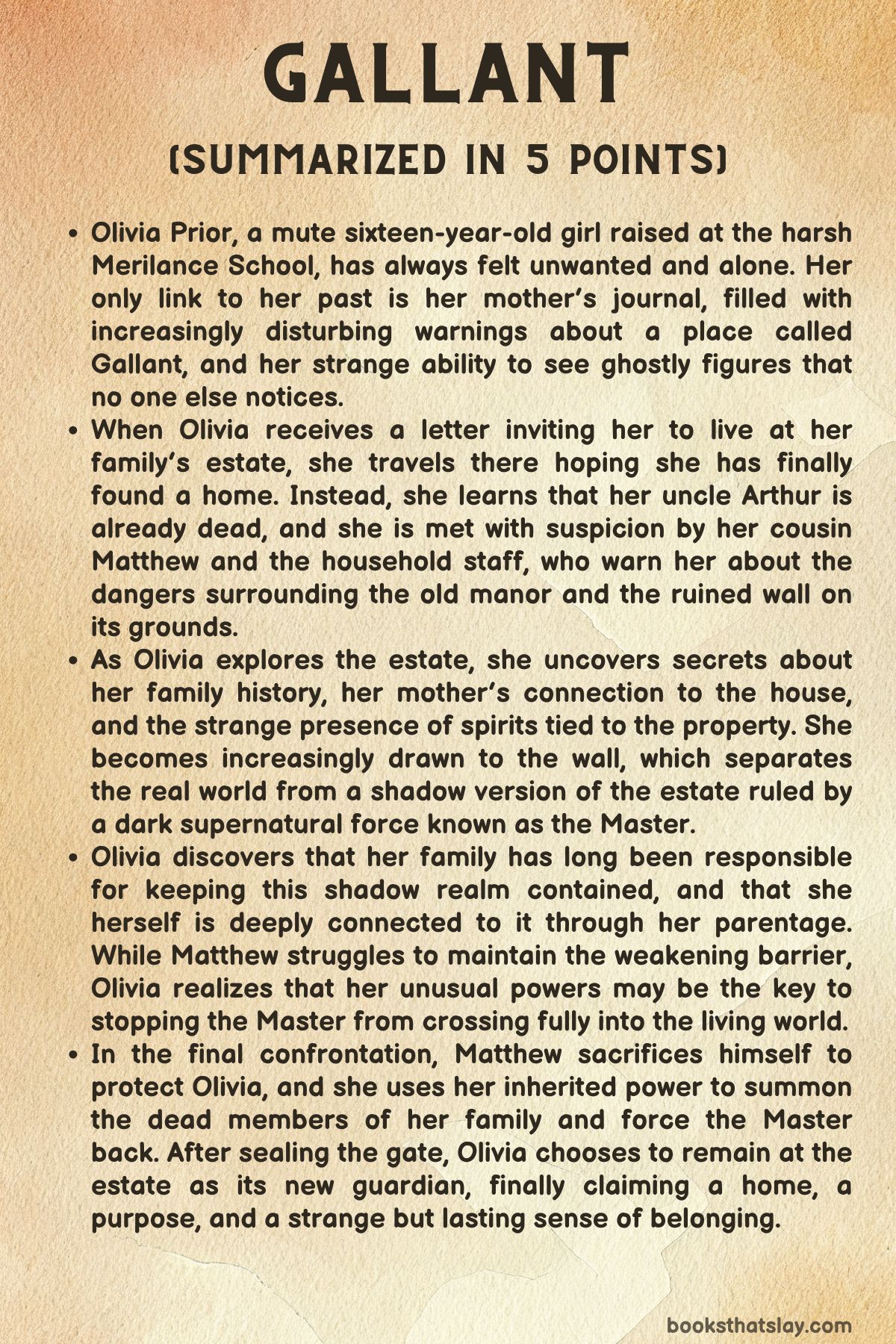
Summary
Olivia Prior is a sixteen-year-old mute girl who has spent her life at Merilance School for Independent Girls, a grim, orphanage-like institution that trains unwanted or orphaned girls in domestic skills. She has no voice—never has—and feels profoundly isolated.
The other girls bully her, and the matrons offer little warmth. Olivia’s only comforts are her sketchbook and a battered green journal that belonged to her mother, Grace.
The journal’s entries begin coherently but spiral into cryptic warnings, madness, and fragments like “he is watching he wants you back” and a final plea for Olivia to stay away from Gallant. Olivia also sees ghouls—half-formed, decaying gray figures that no one else notices.
These spectral remnants of the dead linger at the edges of her vision, both unsettling and oddly familiar.
One day, the headmistress summons Olivia and hands her an old letter from Arthur Prior, her uncle. It invites her to leave Merilance and come live at the family estate, Gallant, promising a true home.
Eager for any sense of belonging, Olivia is sent away immediately. She travels through the English countryside and arrives at the sprawling, ivy-covered manor.
The house is beautiful yet eerie, with vast gardens, endless rooms, and an atmosphere thick with unspoken history.
Hannah and Edgar, the elderly housekeeper and groundskeeper (or butler), greet her with shock. They were not expecting anyone.
When Olivia shows them the letter, they reveal that Arthur Prior—her uncle—died over a year ago. The only other resident is Matthew Prior, Arthur’s son and Olivia’s cousin, a gaunt, exhausted young man a few years older than her.
Matthew is immediately hostile. He insists there is no place for Olivia at Gallant and demands she leave.
Hannah and Edgar, however, refuse to send her away after dark, citing the dangers outside the estate. Reluctantly, Matthew allows her to stay temporarily, but he sets two strict rules: never go out after dusk, and never cross to the wrong side of the ruined wall that runs along the western edge of the property.
Despite the cold welcome, Olivia feels an inexplicable pull toward Gallant. It is the first place that has ever felt like it could be home.
She begins to explore the house, discovering old portraits of the Prior family and rooms filled with the echoes of past lives. She sees more ghouls here—faded, decaying figures that drift through the halls.
Unlike at Merilance, these ghouls seem connected to the estate. Olivia also finds her mother’s old belongings and pieces together that Grace grew up at Gallant but fled in fear, taking baby Olivia with her before eventually leaving her at Merilance.
The journal’s warnings grow clearer: something at Gallant is dangerous, something that “wants” them back.
Matthew remains distant and irritable, often disappearing at night and returning drained. He suffers from nightmares and carries the heavy burden of the Prior legacy.
Hannah and Edgar are kind but guarded; they know the family’s secrets but reveal them slowly. Olivia’s curiosity leads her deeper into the house and gardens.
She learns that the Priors have guarded Gallant for generations. The key to the mystery is the ruined wall in the western garden—a crumbling barrier between the living world and a parallel shadow realm, a decaying mirror version of Gallant.
One evening, at just the right moment when the light shifts, Olivia crosses the wall (or finds a gate in it) and steps into the shadow side. Here, the manor is crumbling and overgrown, the gardens are twisted, and the ghouls are solid, more corporeal.
A mysterious, powerful figure known as the Master (sometimes called Death or the Lord of Shadows) rules this realm. He is a dark, charismatic entity who has been trying to break through the barrier into the human world for centuries.
The Priors’ ancestral duty is to keep the gate sealed and prevent the Master and his shadows from escaping and consuming the living world.
In the shadow Gallant, Olivia uncovers devastating truths about her family. The ghouls are the lingering remnants of deceased Priors, bound to the estate.
Her mother Grace’s ghoul appears among them—tragic and silent. Most shocking is the revelation about Olivia’s father.
He was not a normal man but a construct created by the Master from a fragment of his own bone and ash—a “soldier” or shadow being sent to the human side. Grace fell in love with him (or was drawn to him), and together they had Olivia.
This makes Olivia half-shadow, granting her unique abilities: she can see ghouls clearly, and more importantly, she can command or give temporary life to the dead. Her blood, like that of all Priors, can seal or open the gate.
Olivia’s presence stirs the Master’s interest. He has been watching and waiting, using dreams, lures, and tricks to draw Priors back.
He creates illusions and even a lifelike shadow version of Matthew’s lost younger brother Thomas to manipulate her. As Olivia crosses between the two sides, the tension escalates.
The Master grows stronger, exploiting weaknesses in the seal. Matthew, who has been single-handedly (with Hannah and Edgar’s help) maintaining the barrier through blood rituals and vigilance, grows weaker.
The climax builds as the Master finds a technicality to breach the gate partially. Shadows begin to spill into the real world.
In a desperate confrontation, Matthew sacrifices himself to protect Olivia from a fatal attack. As he dies, Olivia—drawing on her inherited power—summons the ghouls of the Prior ancestors.
She commands them to drive the Master back through the gate. With Matthew’s blood and her own, she marks the iron door/gate, sealing it permanently and trapping the Master and his forces on the shadow side once more.
In the aftermath, Olivia chooses to stay at Gallant as its new guardian. She is no longer alone; the ghouls, including Matthew’s own emerging ghoul and her mother’s, remain with her as silent companions.
The estate is quiet but no longer feels like a prison. Olivia has found belonging not by escaping her legacy but by embracing it.
She sits at the piano with Matthew’s ghoul, learning notes, and reflects that home is sometimes a place of shadows and duty—but it is hers. The Master is contained for now, though the threat lingers as a generational burden.
Olivia faces an uncertain future, but for the first time, she has roots, purpose, and a haunted kind of family.
Gallant is a atmospheric gothic fantasy that blends mystery, family secrets, and supernatural horror with themes of isolation, belonging, the weight of legacy, and the search for home. The slow-burn pacing emphasizes mood and discovery over fast action, culminating in a bittersweet resolution where Olivia actively claims her place rather than fleeing the darkness.
The novel rewards readers who appreciate subtle dread, beautiful prose, and a protagonist who finds strength in silence and observation.
Characters
Olivia Prior
Olivia is the emotional and imaginative center of Gallant, and her character is shaped by silence, abandonment, and an intense inner life. Because she is mute, she is often underestimated by the people around her, yet the novel presents her silence as a form of perception rather than lack.
She watches closely, absorbs tension others ignore, and develops a sharp understanding of people and places through gesture, atmosphere, and instinct. Her sketchbook and her mother’s journal become extensions of her inner voice, showing that expression for her is never absent, only transformed.
This makes her an especially compelling protagonist because her strength does not come from outward force or social power, but from patience, observation, and emotional endurance.
Her longing for home defines much of her movement through the story. At Merilance, she is unwanted; at the estate, she is met with suspicion; even her family history appears fractured and dangerous.
Yet Olivia continues to move toward belonging rather than away from it. What makes her journey powerful is that she does not find comfort in a simple or welcoming family structure.
Instead, she must claim a place shaped by grief, duty, and supernatural danger. Her development lies in learning that belonging is not given to her by others but made through her own choice and courage.
By the end, she no longer seeks permission to exist within the family legacy; she becomes its living center.
Olivia also represents the crossing of boundaries. She exists between childhood and adulthood, life and death, human and shadow, exclusion and inheritance.
Her mixed origin gives her special abilities, but it also creates an identity crisis. She is tied to the living world through her mother and to the shadow realm through her father, and this dual inheritance makes her uniquely capable of understanding both sides.
Rather than presenting her as corrupted by that ambiguity, the story makes her complexity a source of power. She becomes proof that identity does not need to be pure or simple to be meaningful.
Her unusual lineage does not doom her; it equips her to face what others cannot.
What makes Olivia memorable is her refusal to become passive despite a life that has encouraged passivity. She has been controlled by institutions, abandoned by family, and haunted by forces she does not fully understand, yet she keeps moving toward truth.
Her bravery is never loud. It appears in small acts: staying, observing, crossing, asking, protecting.
This restraint suits the novel’s tone and makes her final role as guardian feel earned. She does not defeat darkness by becoming less haunted; she defeats it by accepting that the haunted parts of her life are also the source of her purpose.
Matthew Prior
Matthew begins as cold, defensive, and unwelcoming, but his harshness is deeply tied to exhaustion and inherited fear. He has been carrying the family responsibility almost alone, and that burden has reduced him to someone who survives rather than lives.
His hostility toward Olivia is not simple cruelty. It comes from the belief that closeness leads to danger and that bringing another Prior into the estate’s curse will only repeat old tragedies.
Because of this, he appears emotionally closed off, but the distance is really a form of desperate protection. He has been shaped by duty so completely that he no longer knows how to relate to another person without suspicion or warning.
His character embodies the cost of legacy. Unlike Olivia, who arrives searching for identity, Matthew has been trapped inside identity for too long.
He does not have the freedom to imagine another life because his sense of self has been consumed by the need to guard the boundary and preserve the estate. This makes him a tragic contrast to Olivia.
She is drawn toward home as possibility, while he experiences home as burden. Their tension comes from this difference: she wants to understand and belong, while he wants to contain and survive.
Over time, however, the novel reveals that beneath his bitterness is vulnerability, grief, and a powerful capacity for care.
Matthew’s relationship with loss is central to his characterization. The absence of family members, the memory of his younger brother, and the constant threat from the other side have left him emotionally starved.
He is haunted not only by literal supernatural forces but also by the repetition of grief across generations. That grief has made him brittle, and yet it also gives his actions moral seriousness.
He continues the work not because he is hopeful, but because he knows what happens if he fails. In this sense, he is admirable in a worn, painful way.
He does what is required even as it drains him of youth, energy, and tenderness.
His sacrifice in the climax completes his arc with tragic dignity. It reveals the truth that was always hidden beneath his rough exterior: he is deeply committed to protecting others, especially once Olivia becomes part of his emotional world.
His death is moving because it is both heroic and inevitable. He belongs to a line of guardians who are consumed by the work they inherit.
Yet his bond with Olivia changes the meaning of that sacrifice. He does not die as the last isolated keeper of a failing house; he dies passing on a legacy to someone capable of carrying it differently.
His presence remains important even after death because he becomes part of the silent family Olivia finally gains.
Grace Prior
Grace is one of the most haunting figures in the story because her presence is built through fragments, warnings, and emotional aftermath rather than sustained direct action. Through her journal, she appears first as a frightened and increasingly unstable voice, someone whose language breaks under the pressure of knowledge and terror.
The journal gives insight into a woman who understood the danger of her family history but could not fully escape its reach. Her fear is not abstract.
It comes from intimate contact with something monstrous and from the realization that love, family, and danger have become fatally entangled in her life. As a result, she becomes both a tragic mother and a warning figure.
Grace’s maternal role is morally complex. She does try to protect Olivia, and the repeated warnings to stay away show genuine desperation.
At the same time, she leaves her daughter in an institution, which creates a lasting wound of abandonment. The novel does not allow her to remain a simple idealized mother or a simple failure.
Instead, she is portrayed as someone broken by circumstances larger than herself, forced into choices that cause harm even when motivated by love. This complexity makes her emotionally convincing.
She loved Olivia, but love alone was not enough to create safety, stability, or clarity.
Her relationship to the estate also reveals an important contrast between generations. Grace fled, while Olivia returns.
Grace represents a prior attempt to break from inherited duty, but her escape does not truly free her or her child. This suggests that family history cannot be outrun by physical distance alone.
Her tragedy lies partly in the fact that she recognized the danger but could not transform it. She could warn the next generation, but she could not resolve what had already shaped her life.
That failure is not personal weakness so much as evidence of how powerful the family curse has become.
As a spectral presence, Grace remains emotionally significant because she bridges memory and revelation. She is one of the clearest examples of how the dead continue to shape the living.
Even after death, she influences Olivia’s choices, fears, and understanding of self. Her silence as a ghoul mirrors Olivia’s muteness in a painful way, connecting mother and daughter through forms of expression that remain incomplete.
Grace’s character leaves behind sorrow more than resolution, and that sorrow gives the family history much of its emotional depth.
Hannah
Hannah serves as one of the novel’s quiet moral anchors. At first, she appears to be a practical household figure, someone who manages order and routine within the old estate, but her importance grows because she offers Olivia the first sustained experience of care that is neither institutional nor manipulative.
She is guarded, and she does not immediately reveal everything she knows, yet her restraint comes from caution rather than indifference. She understands the danger surrounding the house and recognizes that truth, if delivered too quickly, can overwhelm rather than protect.
This makes her a maternal figure of a very different kind from Grace: less emotionally intimate perhaps, but more stable in the present.
Her role is deeply connected to continuity. While the Prior family is fragmented by death and trauma, Hannah keeps daily life functioning.
In a story concerned with supernatural threat and generational burden, her domestic steadiness matters. She cooks, watches, remembers, and maintains the rhythms that make the estate feel inhabited rather than abandoned.
This work might seem ordinary beside the larger conflict, but it gives the house human structure. Without figures like Hannah, the estate would become only a symbol of decay.
Through her, it remains a place where life can still be organized and sustained.
Hannah also represents loyal knowledge. She knows much more than she initially says, and this gives her character a measured seriousness.
She is not withholding information for power; she is protecting a fragile balance. Her care for Matthew shows how long she has witnessed suffering without being able to end it, and her willingness to accept Olivia marks an important shift in the household.
She sees not only danger in Olivia’s arrival but also possibility. That intuition helps open the emotional space in which Olivia can begin to belong.
What makes Hannah especially effective as a supporting character is that she embodies affection without sentimentality. She does not speak in grand declarations, and she does not erase the darkness around them.
Instead, she offers reliability. In a story full of uncertain boundaries and broken inheritance, that reliability becomes a form of grace.
Edgar
Edgar is another stabilizing presence, but where Hannah is associated with domestic care, Edgar is more closely linked to protection, memory, and the physical boundaries of the estate. He belongs to the land as much as to the house, and this connection gives him a grounded authority.
He knows the property, respects its dangers, and treats its history with seriousness rather than curiosity. His presence suggests a long relationship not only with the Prior family but with the burden they carry.
He is not simply a servant figure; he is part of the structure that has allowed the estate to endure through repeated loss.
Edgar’s value lies in his steadiness. He is not emotionally expansive, but he is dependable, and that dependability is crucial in a setting where fear can distort judgment.
He helps maintain the protective order around the house, and his actions support Matthew in practical ways that reveal loyalty deeper than obligation. Like Hannah, he participates in the preservation of a fragile world, but his role feels more visibly tied to defense and endurance.
He is one of the people who understands that survival often depends not on dramatic gestures but on the repeated maintenance of boundaries.
He also contributes to the atmosphere of inherited secrecy. Because he knows more than he first explains, he helps create the sense that the estate is full of half-spoken truths.
Yet his silence is not sinister. It reflects the reality that some knowledge has become ritualized, passed down through caution and habit rather than open conversation.
This makes him an important representative of the older order that Olivia must learn to understand before she can reshape it.
As a character, Edgar shows how devotion can exist outside bloodline. He is not a Prior, yet he is bound to the family’s fate through service, memory, and shared danger.
That loyalty broadens the idea of family within the novel. It suggests that belonging can be built not only through birth but through constancy, labor, and chosen commitment.
The Master
The Master functions as the primary antagonist, but he is more effective than a simple embodiment of evil because he represents desire without moral limit. He wants entry, expansion, possession, and return, and his power lies not only in force but in manipulation.
He studies weakness, uses memory, creates emotional traps, and exploits longing. This makes him especially dangerous in a story where the characters are already vulnerable through grief and isolation.
He does not merely attack bodies; he presses on loneliness, guilt, and hope. His charisma matters because it shows that darkness in this novel is seductive as well as destructive.
He also operates as the threatening opposite of home. The estate in the living world is eerie but potentially habitable; the shadow side ruled by the Master is a distorted reflection where decay dominates and control replaces belonging.
In this sense, he is not just a villain but the logic of corruption itself. He takes familiar structures and empties them of warmth, turning lineage into imprisonment and return into capture.
That symbolic role gives him weight beyond the plot. He becomes the force that turns inheritance into predation.
The revelation that Olivia’s father was made from the Master’s own substance intensifies his meaning. Through that connection, he becomes entangled with the family not as an outside invader alone, but as something that has already crossed into their bloodline.
This makes the conflict more intimate and unsettling. Olivia cannot oppose him as a completely separate enemy because part of her origin is tied to his realm.
The struggle therefore becomes one of self-definition as much as external resistance.
What makes the Master compelling is that he is ancient, patient, and deeply aware of human vulnerability, yet he ultimately cannot understand the kind of belonging Olivia chooses. He understands hunger, not loyalty; possession, not care.
That failure is what limits him. He can tempt, threaten, and imitate, but he cannot create the mutual bond that finally allows resistance to hold.
Arthur Prior
Arthur is absent for most of the narrative, yet his absence carries significant narrative force. The letter that brings Olivia to the estate creates the first major turn in her life, and because he is already dead, he immediately becomes a figure of mystery.
His role is shaped by the gap between invitation and reality. Olivia imagines possible rescue, kinship, and welcome through him, only to discover that what he offers is posthumous and incomplete.
This gap reflects the larger instability of family in the novel: even when connection appears, it comes delayed, damaged, or mediated through death.
As a former guardian of the estate, Arthur represents the previous generation’s struggle to maintain control over the inheritance of the Priors. Although he is not present to speak for himself at length, his influence lingers through the household, through Matthew’s burden, and through the fact that the responsibility has passed on without resolution.
He belongs to the line of men consumed by the task of holding back the shadow realm. That inherited labor helps explain why the family is marked less by ordinary domestic continuity than by attrition and sacrifice.
Arthur also contributes to the emotional irony of Olivia’s arrival. She comes because she believes someone has finally chosen her, and although the invitation is real, the chooser is gone.
This creates a poignant tension between desire and reality. Arthur did, in some sense, open the way for Olivia to return, but he cannot protect her or welcome her personally.
His gesture matters, yet it is marked by lateness. That lateness is part of the novel’s sadness.
Even as a mostly indirect figure, Arthur helps define the estate as a place shaped by incomplete transmissions from one generation to the next. He leaves a threshold rather than an answer, and Olivia must do the work of turning that threshold into a future.
Thomas Prior
Thomas occupies a smaller direct role, but he has major symbolic importance because he represents innocence lost and grief preserved. His absence affects Matthew deeply, and the use of his image or memory by the dark force reveals how vulnerable love makes people in this world.
Thomas is important not because of extensive characterization on the page, but because of what he means to those who remain. He is the child who should have had a future but instead becomes part of the emotional wound the house carries.
His significance lies in the way memory can be weaponized. The shadow realm does not merely threaten through physical invasion; it uses remembered affection and unresolved mourning.
Thomas becomes part of that mechanism. His image reminds readers that grief is not passive in this story.
It can be manipulated, revived, and turned against the living. This gives his character a haunting power far beyond his limited direct presence.
Thomas also sharpens the tragedy of Matthew’s life. Through him, readers understand that Matthew’s severity is not simply personality but a response to real loss.
The household has already paid heavily, and Thomas’s fate helps explain why fear has become built into daily existence. The dead do not stay neatly in the past here, and Thomas is one of the clearest examples of how absence continues to act.
In emotional terms, Thomas stands for the family life that might have been possible without the curse. He is the sign of tenderness interrupted, and because of that, his memory deepens the human cost of the supernatural conflict.
Olivia’s Father
Olivia’s father is one of the most unsettling figures in the novel because he is tied to love, creation, and monstrosity at once. As a being made from the Master’s substance, he exists at the edge of personhood and instrumentality.
He was created for purpose, likely as an extension of shadow power, yet his relationship with Grace suggests the possibility of feeling, attachment, or at least a disruption of the order that produced him. This ambiguity makes him difficult to categorize.
He is neither fully human nor merely a monster, and that uncertainty is central to what he represents.
Through him, the novel complicates ideas of bloodline and inheritance. Olivia’s identity is not built from a pure family line but from an impossible union between human and shadow.
Her father’s existence makes the family curse more intimate because the threat is not only outside the wall; it has already entered the genealogy of the household. At the same time, his legacy is not only destructive.
Through him, Olivia gains the power that eventually allows her to act where others could only endure. This means his significance is dual: he is evidence of breach, but also the source of the capability that makes resistance possible.
His obscurity matters. He is not fully knowable, and that lack of clarity reinforces the novel’s interest in partial truths and inherited mystery.
He remains more force than fully developed social character, but that is appropriate to his role. He exists as the troubling answer to questions about origin, identity, and what can happen when boundaries between worlds fail.
The Prior Ancestors and the Ghouls
The ghouls and ancestral dead function as more than atmospheric details; they are the visible form of memory, lineage, and unfinished duty. For Olivia, seeing them has always set her apart, but at the estate they become part of a larger family history.
Their presence suggests that death does not erase responsibility or attachment. The Priors remain bound to the place they were meant to guard, which turns ancestry into something physically near and emotionally active.
This gives the family legacy unusual weight because it is not merely remembered through stories or portraits; it continues to move through the house.
These figures also reshape the idea of companionship. Olivia, who has been isolated for most of her life, discovers among the dead a strange form of closeness.
They do not offer conventional conversation or comfort, but they provide continuity and presence. This is especially important because the living family is fragmented and often emotionally inaccessible.
The dead become part of the home she is building, which gives the novel’s ending its bittersweet quality. Belonging comes, but not in ordinary terms.
The ghouls further reinforce the novel’s refusal to separate horror from intimacy. They are eerie, decayed, and unsettling, yet they are also family.
That tension captures the emotional logic of the story as a whole: what is frightening is often also what is most deeply connected to identity. By the end, the ancestral dead are not simply signs of haunting; they are participants in the preservation of the house and the continuation of family purpose.
Their final importance lies in collective action. When Olivia calls upon them, they become the gathered force of inherited resistance.
Generations that once seemed trapped in silence are finally mobilized through her. In that moment, ancestry stops being only burden and becomes strength.
Themes
Belonging and the Search for Home
Home in Gallant is not presented as comfort, warmth, or uncomplicated acceptance. Instead, it appears as something uncertain, frightening, and deeply desired.
Olivia arrives at the estate because she has spent her life without stable affection or family identity, and her hunger for belonging shapes nearly every decision she makes. What gives this theme depth is that the place she longs for is filled with secrecy, grief, and danger.
The story does not reward her with a perfect home; it asks whether home can still matter when it is haunted, morally difficult, and bound to painful inheritance. By making belonging inseparable from risk, the novel rejects sentimental ideas of family and place.
This theme also develops through contrast. Merilance is organized and familiar, yet emotionally deadening.
The estate is unsettling and unstable, yet it offers Olivia the first real sense that her existence has roots. Belonging therefore becomes less about safety and more about recognition.
She is drawn to the house because something in it acknowledges her history, her strangeness, and her loneliness. In the end, home is not where she is protected from darkness, but where she chooses to remain despite it.
That choice transforms belonging from passive longing into active commitment.
Silence, Voice, and Forms of Expression
Olivia’s muteness shapes the novel’s understanding of communication by showing that voice is larger than speech. She cannot speak in the conventional sense, but she is never without expression.
Her observations, sketches, reactions, and persistence create a powerful interior presence. The story treats silence not as emptiness but as a different mode of relation to the world, one that often allows deeper perception than ordinary conversation.
Because Olivia is forced to navigate life without spoken language, she becomes highly attentive to gesture, atmosphere, and the emotional charge of spaces. This expands the idea of what it means to know or be known.
The theme becomes richer through the presence of other incomplete or fractured forms of communication. Grace’s journal breaks down into warning and fear.
The dead appear but cannot fully explain themselves. The house itself seems to speak through mood, memory, and repetition rather than direct statement.
Across the story, language is unstable, partial, and often insufficient before trauma. Yet meaning still travels.
People fail to say things plainly, but truth gathers through fragments. Olivia’s journey shows that silence can contain resilience, attention, and authority.
By the conclusion, she does not become powerful by gaining a normal voice. She becomes powerful by learning that her existing way of perceiving and responding has always been a form of strength.
Legacy, Inheritance, and the Weight of Family History
Family history in this novel is not a source of pride or continuity alone; it is a burden that shapes identity before characters fully understand it. The Priors inherit not only land and name, but a responsibility that consumes generations.
This turns legacy into something exhausting and dangerous. Matthew’s life demonstrates the personal cost of that burden, while Olivia’s arrival shows how inheritance can return even when one generation tries to flee it.
The past does not remain behind them. It organizes the present, structures fear, and determines what kinds of choices seem possible.
What makes this theme especially effective is that inheritance is both destructive and enabling. Olivia receives trauma, confusion, and supernatural danger through her family line, yet she also receives the capacity to confront what others cannot.
The same bloodline that binds her to darkness also gives her the means to resist it. This prevents legacy from becoming a single negative force.
It is heavy, but it also carries knowledge, responsibility, and latent power. The story therefore suggests that family history cannot be escaped through denial alone.
It must be interpreted, accepted, and transformed. Olivia’s final role shows a shift from inherited suffering to chosen stewardship, giving the burden of legacy a more active and meaningful shape.
Life, Death, and the Persistence of the Past
The boundary between life and death is unstable throughout the story, and that instability shapes both the supernatural atmosphere and the emotional experience of the characters. The dead remain near, not only as frightening presences but as ongoing witnesses to family history.
This makes death feel less like disappearance and more like altered continuation. The estate is filled with reminders that the past does not stay fixed or silent.
Memory walks the halls, grief takes visible form, and ancestral duty survives beyond individual lives. As a result, the characters do not simply remember the dead; they live beside them.
This theme matters because it changes the meaning of haunting. The supernatural is not only a threat from outside but also a sign that what has happened cannot be neatly contained.
Loss persists, and so do obligation, love, and unfinished struggle. The dead can be unsettling, but they can also become sources of protection and connection.
That duality gives the novel much of its emotional complexity. Death is frightening because it marks rupture, yet it does not erase relationship.
Olivia’s eventual acceptance of the dead as part of her world shows that maturity in this story involves learning to live with continuities that are strange, painful, and real. The past remains active, and survival depends on acknowledging that presence rather than pretending it is gone.