Give Me More Summary, Characters and Themes
Give Me More (Salacious Players Club #3) by Sara Cate is a daring exploration of complex emotions, love, and sexual dynamics. The story revolves around Hunter, Isabel, and Drake, who are entwined in an unconventional love triangle that challenges their boundaries, desires, and personal identities.
As the characters navigate the complexities of their feelings for one another, they grapple with societal expectations, jealousy, and the freedom to explore their sexuality. This book dives deep into the struggles of self-discovery, emotional turmoil, and how relationships can evolve when tested by the intensity of both passion and personal growth.
Summary
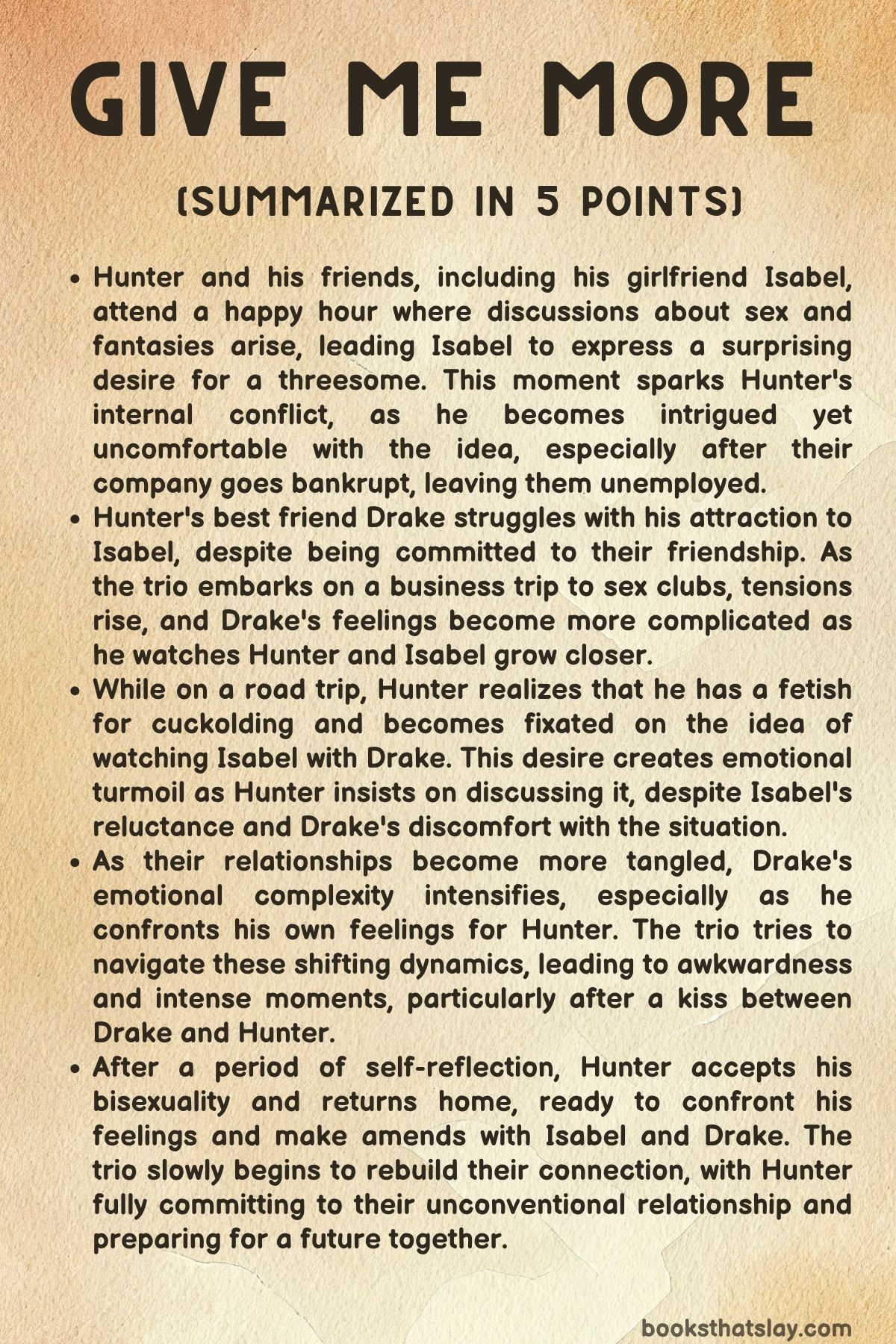
Hunter and Drake have been inseparable since childhood. Hunter, who overcame a troubled past involving family issues and a criminal record, has built a stable life. He co-owns the exclusive Salacious Players’ Club (SPC), an upscale kink club in Briar Point, California, alongside other characters from the series.
Isabel, Hunter’s wife, works with him and is fully supportive of the club’s lifestyle. Drake, a charismatic contractor and self-described playboy (or “scoundrel”), handles construction and renovations for Salacious.
He frequently acts as the charming third wheel in Hunter and Isabel’s marriage, joining them socially without crossing romantic lines—though he has quietly harbored long-suppressed feelings for Isabel.
The trio’s journey begins when Hunter decides to expand and improve Salacious by touring other kink clubs across the country for inspiration. Drake joins as the construction expert, and Isabel comes along for the ride. What starts as a professional road trip quickly becomes the catalyst for profound personal and relational changes.
Early in the trip, while visiting a club in Phoenix (or a similar stop), Drake and Isabel are mistakenly identified as a couple and pulled onstage for a Shibari (Japanese rope bondage) demonstration.
Drake expertly ties and restrains Isabel in intricate, artistic, and sensual rope work, often involving leverage for intimate positioning. Hunter walks in midway and witnesses the scene. Instead of jealousy or anger, he experiences an intense, unexpected arousal—specifically a voyeuristic kink centered on watching Isabel with someone else, particularly his trusted best friend.
This moment plants an obsession in Hunter. He cannot stop replaying the image of Drake’s hands on Isabel and the chemistry between them. Though Hunter has worked in the kink scene for years and considers himself open-minded, this specific desire (a form of hotwifing/voyeurism with cuckold undertones) catches him off guard. It also stirs deeper, previously unacknowledged feelings toward Drake.
As the road trip continues, the underlying tension builds during stops at various sex clubs. Hunter eventually voices his fantasy over breakfast one morning (during a stop in Austin or a similar city).
He confesses to Isabel and Drake that he wants to watch Drake have sex with Isabel—while Hunter observes. Isabel is shocked and hesitant, worried about complicating their marriage and friendship. Drake laughs it off at first, masking his internal conflict: he has wanted Isabel for years but respects Hunter deeply and fears destroying their bond.
Secretly, Drake also harbors complicated attractions that extend beyond Isabel.
The three attempt to process the request while continuing the trip. They set ground rules to protect their relationships, but proximity (including Drake eventually moving in with Hunter and Isabel due to living circumstances) intensifies everything. Hunter’s fixation grows; he becomes consumed by the idea, pushing boundaries in subtle and not-so-subtle ways.
Isabel tries to navigate her husband’s desires while exploring her own attraction to Drake, whom she has always liked but never acted on. Drake feels torn between loyalty to his best friend, his long-held desire for Isabel, and emerging feelings for Hunter.
Emotional strain mounts through jealousy, insecurity, and miscommunication. Hunter grapples with insecurity about whether Isabel prefers Drake’s more carefree personality.
Drake battles guilt over potentially betraying Hunter and fears losing both people he cares about most. Isabel often serves as the emotional anchor—more mature and communicative than the two men—but she also questions motives and worries about the fragility of their triangle.
Throughout the journey (including stops that take them toward Las Vegas and other locations), the group attends kink workshops and experiences charged moments.
One notable scene involves Drake and Isabel sharing a passionate kiss in a club setting while knowing Hunter is watching, which heightens the erotic tension without immediately crossing into full intimacy.
Hunter’s desires evolve further. He begins to confront not just voyeurism but his own bisexuality. Long-buried attractions to Drake surface, complicated by internalized homophobia, fear of societal judgment, and past family trauma that made him suppress any non-heteronormative feelings.
Drake, who is openly bisexual and experienced with both men and women, also wrestles with his growing emotional and physical pull toward Hunter.
Their friendship, once straightforward, becomes laced with unspoken longing, accidental boundary-crossing (including a charged kiss between the two men), and moments of confusion or perceived abandonment.
The road trip forces constant proximity, amplifying every emotion. Rules are established and sometimes bent. The trio experiences highs of exploration and lows of doubt, arguments, and emotional distance.
Isabel encourages openness between Hunter and Drake, even as she manages her position between the two men she loves in different (yet overlapping) ways.
The emotional weight eventually becomes overwhelming. Hunter’s obsession and the group’s inability to fully reconcile their feelings lead to a breaking point. Hunter takes a temporary break or steps away to process his identity, insecurities, and bisexuality in solitude.
This period of reflection is crucial: away from the intensity, he confronts his fears, internalized homophobia, and the depth of his love for both Isabel and Drake.
Upon his return, difficult, honest conversations occur. Hunter admits his bisexuality and his romantic feelings for Drake, not just sexual ones. Drake opens up about his long-standing attractions and fears.
Isabel facilitates much of this growth, expressing her love for both men and her willingness to build something new. The three work through jealousy, guilt, and loyalty issues with raw vulnerability. What began as a sexual fantasy transforms into a committed emotional bond—a throuple or poly triad where all three are equals in love and partnership.
The story culminates in acceptance and a hopeful HEA. The trio embraces their unconventional relationship with clearer communication, trust, and mutual consent. They return to Briar Point and integrate their new dynamic into daily life, including their work at Salacious.
In the final chapter or epilogue, Isabel is pregnant with twins. The paternity is revealed (or implied) to be Drake’s for the twins, with the understanding that Hunter will be the biological father for future children.
This detail symbolizes their balanced, forward-looking commitment: they are building a family together without traditional boundaries. The ending emphasizes unity, growth, and breaking generational cycles of emotional suppression. Hunter especially finds peace in authenticity, no longer hiding parts of himself.
Characters
Hunter
Hunter is a man caught between his past, his desires, and his internal conflicts. At the start of Give Me More, Hunter appears as a committed partner to his wife, Isabel, and a friend who values his relationship with his best friend, Drake.
However, as the narrative progresses, Hunter’s discomfort with certain aspects of his life becomes apparent, particularly as he grapples with his attraction to both Isabel and Drake. His journey is one of self-discovery, as he begins to confront his bisexuality, which has long been suppressed due to societal expectations and his own internalized homophobia.
Hunter’s emotional complexity deepens as he navigates his feelings for Isabel and Drake, both of whom he loves in different ways, leading him to question the boundaries of his relationships. Despite the emotional turmoil, Hunter shows growth through introspection, finally embracing his feelings for both individuals.
His coming to terms with his identity and his desire to live an authentic life forms the core of his character’s evolution. Hunter’s relationship with Isabel and Drake, though unconventional, becomes more stable as he accepts his feelings and commits to their bond.
Drake
Drake’s character is one of emotional conflict and sexual exploration. He initially appears as the carefree best friend of Hunter, who avoids commitment and relishes in his own freedom.
However, Drake’s internal struggle becomes increasingly evident as he develops feelings for Isabel and simultaneously grapples with his attraction to Hunter. Drake’s complexity grows as he tries to navigate his emotions while maintaining his loyalty to Hunter.
Despite his promiscuous nature, he is deeply affected by the emotional weight of his feelings for Isabel and Hunter. His personal struggle becomes more pronounced when he inadvertently crosses boundaries with Hunter, leading to confusion and feelings of abandonment when Hunter kisses him.
Drake’s emotional journey involves confronting his feelings of desire and attachment, especially when Isabel encourages him to explore his connection with Hunter further. His role in the dynamic between the three becomes more intricate, as he seeks clarity and resolution while dealing with the jealousy, guilt, and emotional uncertainty that accompanies their non-traditional relationship.
Ultimately, Drake’s growth is about accepting his own desires, as well as the emotional consequences of his attraction to both Isabel and Hunter.
Isabel
Isabel is the emotional anchor in the complex triangle formed between herself, Hunter, and Drake. She is a woman who is deeply in love with her husband, Hunter, but is also open to exploring her sexuality in ways that challenge conventional norms.
Isabel’s initial revelation about her desire for a threesome sets the tone for the exploration of her character’s boundaries and desires. As the story progresses, Isabel becomes increasingly torn between her love for both men and the emotional complexities of their relationships.
She is the only one who seems to have a clearer understanding of the emotional consequences of their actions, often trying to navigate the situation with a level of maturity that contrasts with the internal confusion of Hunter and Drake. Isabel also plays a pivotal role in encouraging Hunter and Drake to confront their feelings for each other, even as she grapples with her own conflicting emotions.
Throughout the book, Isabel’s character evolves from a woman who seeks to explore her sexuality freely to someone who must reconcile her desires with the realities of her evolving relationships. By the end, Isabel finds herself facing the challenge of balancing her love for both men, and she plays a key role in helping them navigate their shared feelings, pushing them to confront their identities and the future of their unconventional relationship.
Themes
Sexual Identity and Self-Acceptance
Throughout the narrative, Give Me More explores the complexities of sexual identity, particularly in the context of non-traditional relationships. Hunter’s journey toward self-acceptance is fraught with internal struggles and confusion.
His initial discomfort with his desires, particularly surrounding his attraction to his best friend, Drake, and his willingness to share his wife Isabel with him, points to the deep-seated fear of rejection and his internalized homophobia. Hunter’s hesitancy to embrace his bisexuality reflects a broader societal discomfort with non-binary sexual identities.
As the story unfolds, Hunter starts to confront these feelings, culminating in a period of self-reflection. It is only through distancing himself from Isabel and Drake that he begins to understand and accept his desires.
His eventual coming out to his colleagues at work marks a pivotal moment in his emotional growth. The narrative reveals that self-acceptance is not only about understanding one’s desires but also about finding the courage to express them without fear of judgment.
For Hunter, this is a gradual process of embracing his sexuality, free from the constraints of societal norms.
Jealousy, Insecurity, and Emotional Conflict
The book also delves into the emotional complexities that arise in unconventional relationships, particularly focusing on jealousy and insecurity. While the trio of Hunter, Isabel, and Drake explores their desires openly, the emotional tension between them grows, often in the form of unspoken desires and suppressed feelings.
Hunter’s jealousy manifests when he observes Isabel and Drake’s growing chemistry, which he initially misinterprets as a threat to his relationship with Isabel. This jealousy is not just about possessiveness but is deeply tied to Hunter’s insecurities about his place in Isabel’s heart and his fear of being replaced by someone who is more emotionally available.
Similarly, Drake’s emotional conflict becomes more pronounced as he develops feelings for both Isabel and Hunter, unable to reconcile his desires with his fear of damaging his friendships. These emotional struggles highlight the vulnerability that comes with navigating complex romantic and sexual dynamics, where love and desire often collide with fear and uncertainty.
The tension within the trio illustrates the fragility of emotional boundaries and how jealousy can be both a catalyst for growth and a source of pain.
Friendship and Loyalty
At its core, Give Me More is a story about friendship and the bonds that tie people together, even in the face of complex emotional and sexual dynamics. Hunter and Drake’s long-standing friendship is tested in a way neither anticipated when their desires for Isabel begin to complicate their relationship.
Throughout the book, both men grapple with loyalty to each other while dealing with their own personal desires. Drake’s internal struggle is particularly poignant as he tries to balance his respect for Hunter and his growing attraction to Isabel.
His feelings of guilt and confusion are a direct result of his loyalty to Hunter, which creates a turbulent emotional landscape. Hunter, on the other hand, feels torn between his love for Isabel and his attraction to Drake.
Despite the tension, their friendship endures, showcasing that deep connections can survive even the most challenging circumstances. The book emphasizes that loyalty doesn’t mean suppressing one’s desires but rather navigating them in a way that respects the integrity of the relationships that matter most.
The Evolution of Non-Traditional Relationships
The dynamic between Hunter, Isabel, and Drake serves as an exploration of how non-traditional relationships evolve over time. The trio begins their journey with an exploration of their sexual boundaries, but the emotional complexities they face reveal that such relationships are not without their challenges.
The narrative highlights that while non-traditional relationships can offer a sense of freedom and exploration, they also require a significant amount of communication, trust, and emotional vulnerability. The growing closeness between Hunter and Isabel, while exploring their desires with Drake, shifts the nature of their relationship from one rooted in traditional monogamy to one that is more fluid and open.
As the characters navigate their feelings for each other, they must contend with new definitions of love and commitment. The progression of their relationship reflects the evolving nature of human connection, where the boundaries of what is considered “normal” in relationships are increasingly blurred.
In the end, the trio learns that love and commitment are not confined to traditional structures but can be cultivated in various forms, as long as honesty and consent are prioritized.
The Impact of Societal Expectations on Personal Relationships
The book also touches on the impact of societal expectations on personal relationships, particularly regarding traditional gender roles and norms about sexuality. Hunter’s initial discomfort with his feelings for Drake reflects how societal expectations shape one’s perception of what is acceptable in relationships.
The societal pressures that insist on binary sexual identities or fixed relationship models create significant internal conflict for characters who do not neatly fit into these categories. Hunter’s reluctance to accept his bisexuality is partly due to his fear of being judged or rejected by society and his peers.
Similarly, the tension between Drake’s desires and his loyalty to Hunter illustrates the complexity of navigating relationships outside the traditional norms of friendship and love. The book critiques the way societal pressures influence individuals’ ability to express their true selves, whether in terms of sexual identity or the structure of their romantic relationships.
Ultimately, Give Me More advocates for breaking free from these societal constraints and embracing a more authentic, self-determined path in relationships.