Glow by Raven Kennedy Summary, Characters and Themes
Glow by Raven Kennedy is the fourth book in the Plated Prisoner series, a dark romantic fantasy that picks up immediately after the explosive events of Gleam. The novel continues the story of Auren, once King Midas’s gilded “favorite” or pet, who has broken free from years of manipulation and abuse.
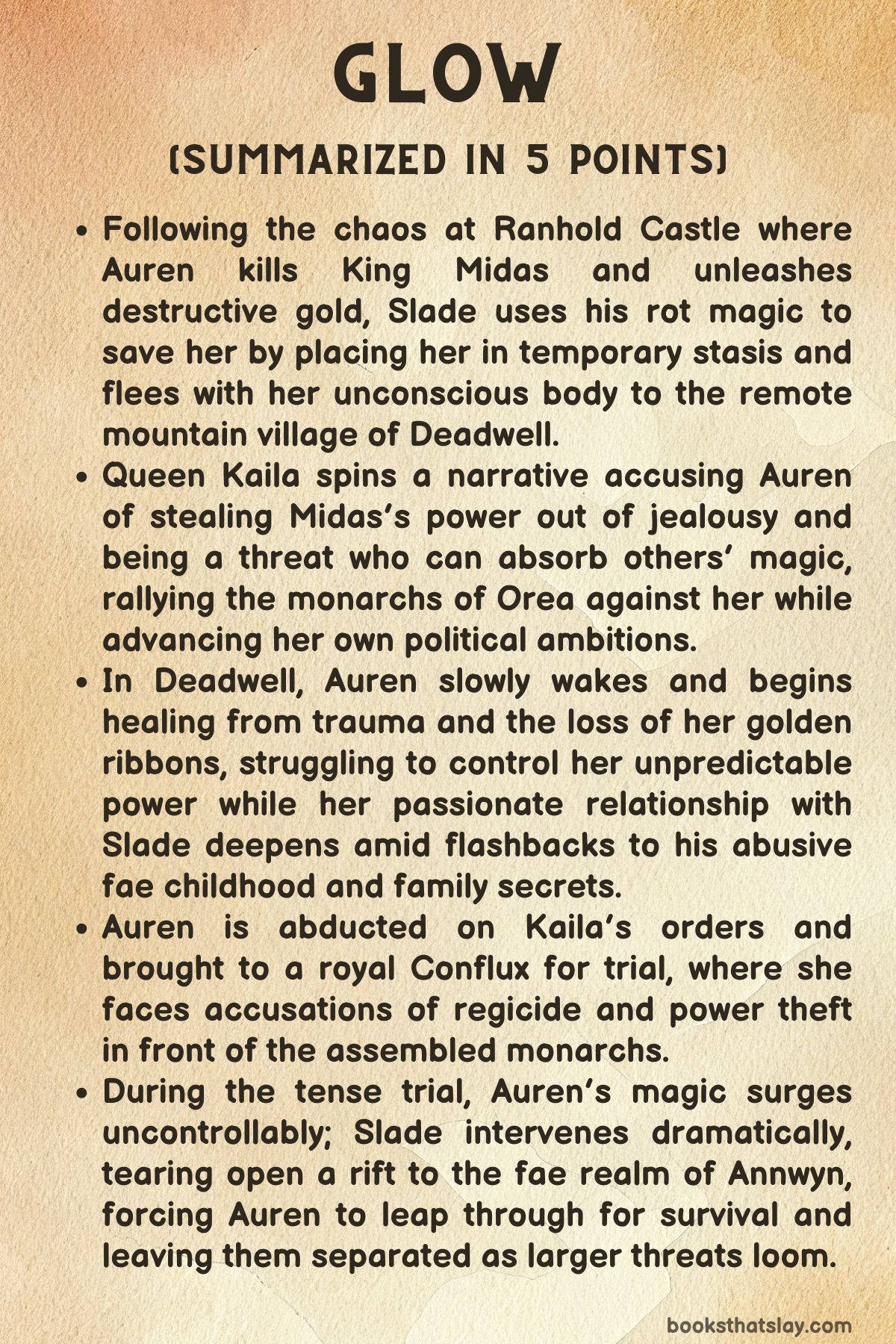
After unleashing uncontrolled gold power at Ranhold Castle in the Fifth Kingdom—killing Midas and flooding the fortress with destructive liquid gold—Auren collapses. King Slade (also known as the Rot King or Commander Rip) uses his deadly rot magic to save her life by placing her in a temporary stasis, then flees with her unconscious form on his timberwing, Argo.
Summary
The story unfolds across multiple perspectives, primarily Auren’s and Slade’s first-person narration, with additional chapters from Queen Kaila, Queen Malina, and members of Slade’s Wrath (such as Osrik and Rissa). It balances intense character healing and romance with political intrigue, heavy backstory revelations, and world-building around the kingdoms of Orea and the distant fae realm of Annwyn.
The novel opens in the immediate aftermath of the Ranhold disaster. Queen Kaila of the Third Kingdom, who had been poised to marry the newly widowed (or so she thought) King Midas to expand her influence, barely escapes the castle with her brother Manu and his husband Keon.
Liquid gold pours from the structure, solidifying and killing many inside. Midas is found dead, encased in his own gold.
Rumors quickly spread that his former favorite, the gold-touched Lady Auren, went mad with jealousy over Kaila’s impending marriage, seduced and killed Midas, and stole his legendary gold-touch power.
Kaila, a calculating and ambitious ruler, sees opportunity in the chaos. She spins a self-serving narrative portraying Auren as a dangerous power-stealer who can absorb others’ magic.
This frames Auren not just as a regicide but as a threat to every monarch in Orea. Kaila’s goal is to turn the other kingdoms against Auren (and by extension Slade) while positioning herself to claim influence over the now-leaderless Sixth Kingdom and beyond.
She orchestrates a royal Conflux—a summit of monarchs—to put Auren on trial. Her brother Manu plays a key role in the political maneuvering, including arranging Auren’s eventual abduction and transport to the trial.
Meanwhile, Slade races through harsh weather with the unconscious Auren. He reaches Deadwell (also called Drollard in some contexts), a remote mountain village in the Fourth Kingdom that he had previously negotiated from Midas.
This isolated community holds deep personal significance: it is where Slade, his brother Ryatt, their mother Elore, and a group of former servants settled after fleeing Annwyn years earlier. Slade struggles desperately to remove the lingering kernel of his rot from Auren’s body so she can wake safely.
A small piece stubbornly remains, keeping her fragile and in partial stasis for days, heightening the tension among Slade’s loyal Wrath soldiers.
When Auren finally wakes, she is overwhelmed by guilt and trauma. She grapples with the memories of losing control at Ranhold, the violence she unleashed, and the lingering effects of Midas’s long-term abuse—including the golden ribbons that once bound her power and body.
Her magic now feels both familiar and terrifying; she fears hurting those around her and initially struggles to access or control it without the ribbons that once defined her.
Much of the middle section of Glow is introspective. Auren begins the slow process of reclaiming her identity and agency.
She trains physically, confronts her emotions about Midas and her past, and explores intimacy with Slade. Their relationship deepens into a passionate, supportive romance marked by mutual vulnerability, spicy scenes, and emotional healing.
Slade refuses to let Auren define herself by guilt or use their connection as punishment for her actions. Auren also interacts with the people of Deadwell, learning about the community’s unique history and the burdens Slade carries.
Interwoven with present events are extensive flashbacks to Slade’s childhood in Annwyn. Born to a human (Orean) mother, Elore, with divination abilities, and a powerful fae father, Stanton (known as the Breaker), Slade grew up in a toxic environment.
His father, a brutal and ambitious figure who helped the fae king destroy the original Bridge of Lemuria (separating the fae realm of Annwyn from the human kingdoms of Orea), only valued Slade once his destructive “rot” or breaking power manifested.
The flashbacks depict harsh, abusive training sessions bordering on torture, Slade’s fear of his own abilities, family violence, and the moment of crisis when a magical clash with his father accidentally tore a rift between worlds. This rift transported Slade, Ryatt, Elore, and their servants to Orea—specifically to the area that became Deadwell.
Elore was left mute and traumatized by the events. Slade has carried profound guilt ever since, feeling responsible for stranding his people in a foreign realm where leaving the rift’s vicinity could kill them.
His black spikes (manifestations of his power) and the nickname “Rip” stem from this history. These revelations explain Slade’s isolation, his careful control over his rot, and his reluctance to wage full-scale war despite the threats to Auren.
Ryatt, Slade’s brother (who once served as the public face of “Commander Rip” while Slade operated in shadows), provides a grounded counterpoint. Their relationship is strained by shared trauma but rooted in loyalty.
Other Wrath members like Osrik add layers to the political and military tensions.
While Slade and Auren grow closer and address village issues (including resource strains), Queen Kaila’s schemes advance. Auren is eventually abducted on Kaila’s orders (via Manu) and taken to the royal Conflux.
There, monarchs from across Orea gather to judge her for Midas’s murder and alleged power theft. Kaila testifies dramatically, painting Auren as a seductive thief who stole Midas’s gold and is now targeting Slade’s rot.
Auren is forced to stand on draining runes that suppress her magic, heightening the danger.
During the tense trial, accusations fly, and political alliances shift. Auren’s power begins to leak uncontrollably—gold and traces of rot—seemingly confirming the worst fears.
Slade arrives in a fury to intervene, rotting guards and the environment in his rage. Unable to fully break through protective magic, his overwhelming power tears open a massive new rift directly to Annwyn, the fae realm.
In the chaos, with Auren on the verge of being executed or drained to death by her own surging magic, Slade holds the rift open. Auren makes the agonizing choice to leap through to safety, separating herself from Slade and Orea.
The rift closes, leaving Slade magically exhausted and devastated. He and Ryatt later return to Deadwell only to discover the original rift gone and the villagers missing—likely affected by the larger magical shifts.
Characters
Auren
Auren stands at the center of the story as a character forced to confront freedom after surviving years of control. Her greatest complexity comes from the fact that escape does not instantly bring peace.
She is no longer confined by Midas in a literal sense, yet his influence still shapes her thoughts, fears, and understanding of herself. The aftermath of Ranhold leaves her carrying guilt, horror, and uncertainty about her own power.
That emotional state makes her compelling because her struggle is not simply against outside enemies; it is against the damage left inside her. She has to learn how to exist without the structure of abuse that once defined her days, and that adjustment is painful, disorienting, and slow.
Her power also mirrors her emotional condition. Gold, which once marked her as an ornament and possession, becomes something unstable and frightening in her own hands.
This change gives her arc a strong psychological depth, because magic is not presented as a gift she can easily celebrate. Instead, it becomes tied to shame, grief, and fear of harming others.
She does not only fear what others think of her; she fears that their accusations may contain some truth. That self-doubt creates tension in nearly every important decision she makes, especially when she is forced to measure her own intentions against the destruction already associated with her name.
Her relationship with Slade is important because it gives her a space where she is not treated as an object, symbol, or political weapon. What makes that bond meaningful is not only desire, but the way it allows her to rebuild trust in her own choices.
She is learning what intimacy looks like without coercion, what care looks like without ownership, and what agency feels like when it is finally hers. That process turns her from someone who was acted upon into someone who begins to act for herself, even when those choices are difficult.
By the end, Auren emerges as a figure defined by transformation rather than innocence. She is not written as untouched by violence or grief.
Instead, she becomes more powerful because she has been broken, frightened, and forced to rebuild. Her final choice carries enormous emotional weight because it proves that she is no longer only reacting to circumstances.
She is deciding, even through fear, what she must do to survive. In Glow, that shift makes her less a rescued heroine and more a woman actively reclaiming herself.
Slade
Slade is constructed as a man whose outward danger hides a deeply controlled and burdened interior life. His reputation as the Rot King suggests ruthless strength, but the narrative gradually reveals that restraint is the more defining feature of his character.
He is terrifying because he possesses enormous destructive ability, yet he is compelling because he spends so much of his life trying not to unleash it. That internal tension gives him moral and emotional weight.
He is not simply dark and powerful; he is someone who has been shaped by fear of what he can do, by memory of what power has already cost him, and by the need to live with consequences that began in childhood.
The flashbacks to Annwyn deepen his characterization by showing that his hardness is rooted in trauma rather than coldness. His father’s brutality, the pressure placed on his magic, and the catastrophic event that tore his family from their world all contribute to his identity.
He has grown up with the belief that his power destroys, isolates, and corrupts whatever it touches. That belief explains his reserve, his guilt, and the intense protectiveness he shows toward those under his care.
Even his leadership carries this complexity: he is not driven merely by conquest, but by obligation toward the people who depend on him and by shame over the way their lives were shaped by his past.
His love for Auren is central to his arc because it challenges his long-held understanding of himself. With her, he is not only guardian or weapon; he is also vulnerable, patient, and willing to be emotionally exposed.
The relationship matters because it does not erase his darkness. Instead, it shows that tenderness can exist alongside rage and power.
He does not become softer by losing intensity. He becomes fuller by allowing devotion and fear to coexist.
That makes him more than a romantic protector figure. He becomes a man trying to believe that his touch can save as well as destroy.
Slade’s role in the climax reinforces the scale of his character. His rage is immense, but it is also tied to desperation, helplessness, and love.
Opening the rift is not just an act of force; it is the physical expression of everything he has tried to contain for years. He is a character defined by containment until the moment containment fails.
That collapse is tragic because it reveals both the magnitude of his power and the cost of carrying it alone for so long.
Queen Kaila
Queen Kaila functions as one of the clearest examples of ambition shaped into political intelligence. She is not dangerous because she possesses overwhelming magic or brute force, but because she understands perception, narrative, and opportunity.
After the fall of Ranhold, she immediately recognizes that truth matters less than the version of events she can make other rulers believe. Her strength lies in interpretation.
She takes chaos and turns it into a usable story, one that places Auren in the role of seductress, murderer, and magical threat. This makes Kaila a formidable antagonist because she does not need the facts on her side to become powerful.
She needs only enough influence to make her version of events useful.
Her motives are deeply tied to power, status, and expansion. The failed marriage to Midas is not merely a personal disappointment; it is a political setback, and she adapts quickly by converting that failure into another route toward authority.
That adaptability shows how pragmatic she is. She is not driven by wounded emotion in a simple sense, though pride and self-interest certainly matter.
More importantly, she sees crisis as a ladder. Every death, rumor, and public fear becomes something she can arrange to strengthen her own position.
This makes her calculating rather than chaotic, and that quality gives her presence a chilling steadiness.
Kaila also represents the cruelty of social and political respectability. She can appear composed, royal, and rational while spreading distortion and weaponizing institutions.
The planned trial is especially revealing because it allows her to turn public judgment into a performance of legitimacy. She does not simply want Auren punished; she wants that punishment sanctioned, witnessed, and framed as justice.
That desire exposes how thoroughly she understands the symbolic side of rule. She knows that power becomes more durable when it wears the mask of order.
What makes her especially effective as a character is that she embodies a world ready to believe the worst about a woman like Auren. Kaila succeeds not only because she is clever, but because the political system around her is eager for a scapegoat.
She thrives in that atmosphere and manipulates it expertly, making her less an isolated villain and more a sharp expression of the broader corruption within the kingdoms.
King Midas
Although Midas dies early, his presence continues to dominate the emotional and political landscape. He operates as more than a dead ruler or former abuser; he remains an internal force within Auren’s mind and a public force in the stories others tell about her.
That lingering influence is crucial to understanding his role. He shaped Auren’s sense of self so thoroughly that even in death he still affects how she interprets guilt, desire, and identity.
His absence is not freedom in any simple way because the damage he caused remains active long after his body is gone.
Midas is defined by possession. His treatment of Auren shows a man who confuses ownership with affection and control with devotion.
He values beauty, status, and spectacle because they reflect his own ego back to him. That makes him emblematic of a kind of power that turns living people into ornaments for self-glorification.
His gold is therefore more than magical wealth; it becomes an extension of his worldview. He covers, claims, and hardens.
Everything associated with him is about display, domination, and the denial of another person’s independent selfhood.
His death is symbolically fitting because he is encased in the very substance through which he exercised control and projected grandeur. That image strips him of majesty and exposes the emptiness of his authority.
Yet the narrative wisely refuses to let his death solve everything. Abuse does not end neatly with the abuser’s removal, and his continuing impact on Auren demonstrates that.
In that sense, Midas remains one of the most important characters precisely because the story understands how long his shadow lasts.
Politically, his death also reveals the instability of rule built on spectacle. Once he is gone, there is no stable legacy, only rumor, opportunism, and panic.
The kingdoms react not with mourning rooted in loyalty, but with scrambling calculation. That response exposes the fragility beneath his image of power and confirms that what he built was founded less on trust than fear and performance.
Ryatt
Ryatt provides an important counterbalance to Slade by revealing another way trauma can shape a survivor. Where Slade often appears burdened by silence, secrecy, and dangerous restraint, Ryatt feels more grounded in practicality.
His role as the public face of Commander Rip in the past suggests that he has long functioned as both shield and stabilizer within their fractured world. That position speaks to a personality built around endurance.
He is not untouched by pain, but he seems better able to convert pain into function, which makes him essential to the structure of Wrath and to Slade’s ability to lead.
His relationship with Slade carries emotional depth because it is shaped by shared history rather than idealized brotherhood. Their bond includes loyalty, but also strain, memory, and the burden of surviving the same violence differently.
Ryatt understands Slade in ways others cannot, yet that understanding does not erase tension between them. This creates realism in their connection.
They are not written as perfectly aligned brothers; they are men carrying the same damage in different forms. Ryatt’s presence helps expose Slade’s vulnerabilities because he stands close enough to the past to recognize where those wounds still govern present choices.
Ryatt’s importance also lies in how he helps preserve continuity between personal pain and political reality. He is part of the mechanism that keeps their world operating.
Through him, the narrative shows that survival requires systems, roles, and people willing to bear unglamorous responsibility. He is not framed as the most dramatic figure, but his steadiness gives the story necessary balance.
Without characters like Ryatt, larger-than-life power would dominate the emotional landscape too completely.
As a character, he represents the kind of loyalty that is not sentimental but tested. He remains near Slade not because that path is easy, but because their history has forged obligation and care into something durable.
His value comes from being believable, competent, and emotionally significant without needing to dominate the page.
Elore
Elore is one of the most quietly tragic figures because her life reflects the aftermath of violence in a deeply embodied way. Her muteness and trauma are not treated as passing background details; they stand as lasting evidence of what was taken from her.
Through her, the story shows that catastrophe does not only alter political structures or magical boundaries. It permanently changes individual lives, bodies, and capacities for expression.
She becomes a living reminder of the cost of male ambition, fae brutality, and magical conflict.
As Slade and Ryatt’s mother, Elore also holds immense symbolic importance. She connects the human and fae worlds through family, but that connection is not romanticized.
Instead, it becomes the site of exploitation, pain, and displacement. Her divination abilities suggest insight and sensitivity, yet those gifts do not protect her from suffering.
This contrast makes her especially poignant. She is not powerless in essence, but she is made vulnerable by the structures around her, particularly by Stanton’s cruelty and by the larger forces that reduce family bonds to instruments of domination.
Her impact on Slade’s character is profound. His guilt over what happened to his family is inseparable from his memory of her suffering.
She is one of the clearest reasons he cannot think of the past as a distant event. Her condition keeps it present.
At the same time, her existence gives emotional context to Deadwell as more than a refuge. It is also a place built out of loss, where survival has required adaptation rather than healing in any complete sense.
Elore’s role may not be the most outwardly active, but her significance is substantial. She carries the emotional residue of another world and another life, and through her the story preserves the human cost of events that might otherwise be understood only in terms of lore or plot.
Manu
Manu is a politically useful and morally revealing figure because he demonstrates how complicity often works through proximity to power rather than through direct domination. As Kaila’s brother, he exists within her orbit of ambition and helps translate her plans into action.
His participation in the abduction and trial machinery shows that he is not merely adjacent to her schemes; he is an active contributor to them. This matters because it broadens the scope of responsibility in the story.
Harm is not produced only by rulers making speeches. It is sustained by those willing to carry out the quieter, practical parts of cruelty.
At the same time, Manu’s position invites attention because he is not presented as the central architect of events. That relative secondary status makes him interesting.
He reflects a kind of political personality that thrives by attaching itself to stronger, more openly ambitious figures. His significance lies in enforcement, coordination, and service to a larger agenda.
Such characters often expose the machinery behind power more clearly than monarchs themselves, because they show how influence becomes action.
His relationship with Kaila also suggests the importance of family networks in political consolidation. He is not just a sibling; he is part of her strategy.
That dynamic reveals how monarchy and kinship combine to create systems of mutual reinforcement. Personal loyalty becomes politically consequential, and private allegiance becomes public harm.
Manu’s participation therefore cannot be dismissed as minor.
What makes him effective within the narrative is that he is recognizable as the sort of person who helps injustice appear orderly. He is not the loudest voice in the room, but he helps build the room in which that voice can dominate.
That makes him an important supporting character in understanding the larger structure of threat around Auren.
Osrik
Osrik helps give shape to Wrath as more than a military extension of Slade’s will. Through characters like him, the group gains texture, loyalty, and internal humanity.
His value lies partly in showing that the forces surrounding Slade are made up of individuals with their own perceptions and emotional investments, not faceless soldiers orbiting a powerful leader. This matters because it reinforces the idea that Slade’s authority is relational.
He is followed not only out of fear, but because bonds, trust, and history exist among the people around him.
Osrik’s perspective contributes to the story’s broader political and emotional framing. Through supporting members of Wrath, the narrative can widen beyond the central romance and reveal how tension spreads through communities, ranks, and loyalties.
He becomes part of the social atmosphere around Deadwell and around Slade’s leadership, helping the reader understand how moments of uncertainty affect more than just the main pair. In this way, even when he is not the dominant focus, he supports the sense that every personal crisis has communal implications.
He also helps reinforce themes of chosen allegiance. The people around Slade remain with him despite the danger attached to his name and power, and that loyalty says something important about the kind of leader Slade actually is.
Osrik’s presence therefore indirectly develops Slade’s character while still carrying his own importance as a witness to unfolding events.
Supporting figures like him are essential in fantasy narratives because they prevent the world from shrinking into only the concerns of rulers and lovers. Osrik helps maintain the reality of a broader lived world, one in which protection, duty, and fear circulate among many people at once.
Rissa
Rissa’s importance comes from how she strengthens the sense of community around Wrath and complicates the emotional environment of the story. Characters like her prevent the world from feeling shaped only by male command structures or royal conflict.
She contributes another angle on loyalty, survival, and the intimate dynamics within a dangerous political setting. Even in a supporting role, she adds social depth by showing that the group surrounding Slade includes bonds and perspectives not reducible to warfare or hierarchy.
Her presence also matters because she participates in the collective tension generated by Auren’s arrival, Slade’s emotional investment, and the uncertainty surrounding external threats. Through figures like Rissa, the narrative can register concern, skepticism, protectiveness, or solidarity in ways that broaden the emotional field.
The central relationship is therefore not sealed off from the world around it. It is observed, interpreted, and felt by others who have stakes in what happens.
Rissa helps express the idea that survival communities are built not only by leaders and fighters, but by networks of everyday trust. In a story shaped by trauma and political danger, that kind of background strength is significant.
It reminds the reader that endurance depends on more than singular heroism. It depends on people who remain present, attentive, and committed within the shared life of a fragile community.
As a character, she may not dominate the dramatic turns, but she contributes to the emotional realism of the setting. Her role helps sustain the sense that Deadwell and Wrath are inhabited by people whose lives continue around the central crisis, which makes the world feel fuller and more believable.
Stanton
Stanton, the Breaker, represents inherited violence in its most destructive form. He is significant not only as Slade’s father but as the origin point for many of the fears, scars, and beliefs that govern Slade’s adult life.
His cruelty is not random; it is bound to power, entitlement, and the expectation that strength justifies domination. He values Slade only when Slade’s destructive ability manifests, which reveals the conditional and corrupt foundation of his fatherhood.
Love, in his hands, is replaced by usefulness. That distortion gives his role lasting psychological force.
He also embodies the worst possibilities of fae power. Through him, authority appears as something brutal, extractive, and hungry for control.
His influence extends beyond the household because his actions are linked to the larger rupture between worlds. He therefore functions on both a personal and mythic level: he is an abusive father, but also part of the larger machinery that has shaped the geography, politics, and trauma of the setting.
What makes Stanton especially effective as a character is that he is not important because of how much page time he occupies in the present. He is important because the narrative repeatedly returns to the structures he created.
Slade’s fear of himself, Elore’s suffering, Ryatt’s history, and the exile of their people all trace back to him. His impact is therefore diffuse and persistent.
He serves as a dark mirror for all questions of power in the novel. Where Slade fears destruction and tries to restrain it, Stanton embraces destruction as proof of worth.
That contrast helps clarify the moral difference between power used in service of control and power carried with conscience, no matter how frightening its effects may be.
Themes
Trauma, Recovery, and the Difficulty of Freedom
Freedom is presented not as a triumphant endpoint, but as an unstable condition that demands painful adjustment. Auren’s escape from Midas does not release her from fear, shame, or learned patterns of self-erasure.
She has survived, but survival leaves behind habits of thought that continue to govern how she sees her body, desires, and power. The emotional force of the novel comes from recognizing that liberation can feel frightening when control has shaped a person for so long.
Recovery, therefore, is not clean or linear. It involves confusion, relapse into self-blame, and the slow effort to imagine a self not defined by violation.
This theme extends beyond Auren. Slade’s history shows another form of survival marked by repression, guilt, and isolation.
Elore’s silence and the fractured lives in Deadwell reinforce the idea that trauma alters families, communities, and futures. The story does not reduce pain to backstory.
It treats trauma as an active force shaping present relationships and choices. That is why tenderness matters so much here.
Care becomes meaningful not because it erases damage, but because it creates conditions under which damaged people can begin to live without being ruled entirely by what hurt them.
Power, Possession, and Control
Power is repeatedly linked to the desire to own, define, and manipulate others. Midas represents the clearest version of this pattern, treating affection as entitlement and reducing Auren to an extension of his status.
Yet the theme is larger than one man’s abuse. Political rulers also seek control through narrative, law, and fear, turning individual lives into instruments of strategy.
Kaila’s response to the collapse at Ranhold demonstrates that authority often depends less on truth than on who gets to frame events convincingly. Power becomes the ability to decide what story will govern public judgment.
Magic intensifies this theme because supernatural abilities are never simply neutral tools. Gold, rot, and draining runes all become expressions of how bodies and wills can be dominated.
Auren’s fear of her own magic is partly a fear that power itself may corrupt or consume her. Slade’s restraint suggests a different possibility, where strength is measured not by how much one can destroy, but by how carefully one chooses not to.
In Glow, control is shown as both the great temptation and the great danger of power, whether in romance, monarchy, or magic.
Identity Beyond What Others Have Named
A central struggle in the narrative is the attempt to live outside labels imposed by others. Auren has been named favorite, pet, ornament, seductress, murderer, and threat.
Each title carries a social judgment that tries to define her before she can define herself. Her development depends on resisting those identities without pretending they have not affected her.
The challenge is not merely rejecting false names; it is discovering who she is when the external scripts fall away. That makes identity an active process of rebuilding rather than a hidden essence waiting to be uncovered.
Slade faces a parallel problem. He is burdened by titles tied to fear and destruction, and his own self-concept has been shaped by what others wanted his power to mean.
The past has taught him to see himself as dangerous first and human second. Their relationship gains importance partly because both characters are learning how to be seen without being reduced.
Recognition becomes restorative when it allows complexity instead of confinement.
This theme also operates politically. Public identity can be manufactured, and once created it becomes difficult to escape.
The trial setting shows how institutions reinforce imposed meanings. Against that pressure, the novel argues that selfhood must be claimed repeatedly, especially in worlds eager to turn people into symbols.
Love as Trust Rather Than Ownership
The romantic core gains significance because it sharply contrasts two models of attachment. One is possessive, performative, and rooted in domination.
The other is built through patience, consent, and emotional honesty. The difference matters because the story refuses to treat desire as automatically healing.
Love becomes meaningful only when it leaves room for fear, choice, and vulnerability. Auren’s growing connection with Slade matters because she is not being remade into another version of someone’s prized possession.
She is being met as a person whose hurt, uncertainty, and will all have to be respected.
This theme also changes how strength is understood. Slade’s care for Auren is powerful not because he can kill for her, but because he does not demand that she become less complicated to be loved.
He allows space for guilt, confusion, and anger without reducing her to those states. That kind of trust stands against every relationship model based on obedience, spectacle, or exchange.
It suggests that intimacy requires the courage to let another person remain fully themselves.
The theme becomes especially resonant because the surrounding world is so saturated with coercion. Against political manipulation, inherited violence, and social judgment, genuine care appears almost radical.
Love is valuable here not as escape from conflict, but as a way of resisting the logic of possession that defines so much of the wider world.