Good Girl Complex Summary, Characters and Themes
Good Girl Complex by Elle Kennedy is a contemporary romance set in the seaside town of Avalon Bay, where privilege and rebellion collide. The novel follows Mackenzie Cabot, a wealthy and ambitious young woman caught between family expectations, a long-term boyfriend, and her own entrepreneurial drive.
Opposite her is Cooper Hartley, a local with a chip on his shoulder against the spoiled students of Garnet College. What begins as a revenge scheme quickly evolves into something more complicated, as Mackenzie and Cooper’s connection challenges their loyalty, independence, and trust. Kennedy explores love, identity, and defiance against societal roles in a vibrant coastal backdrop.
Summary
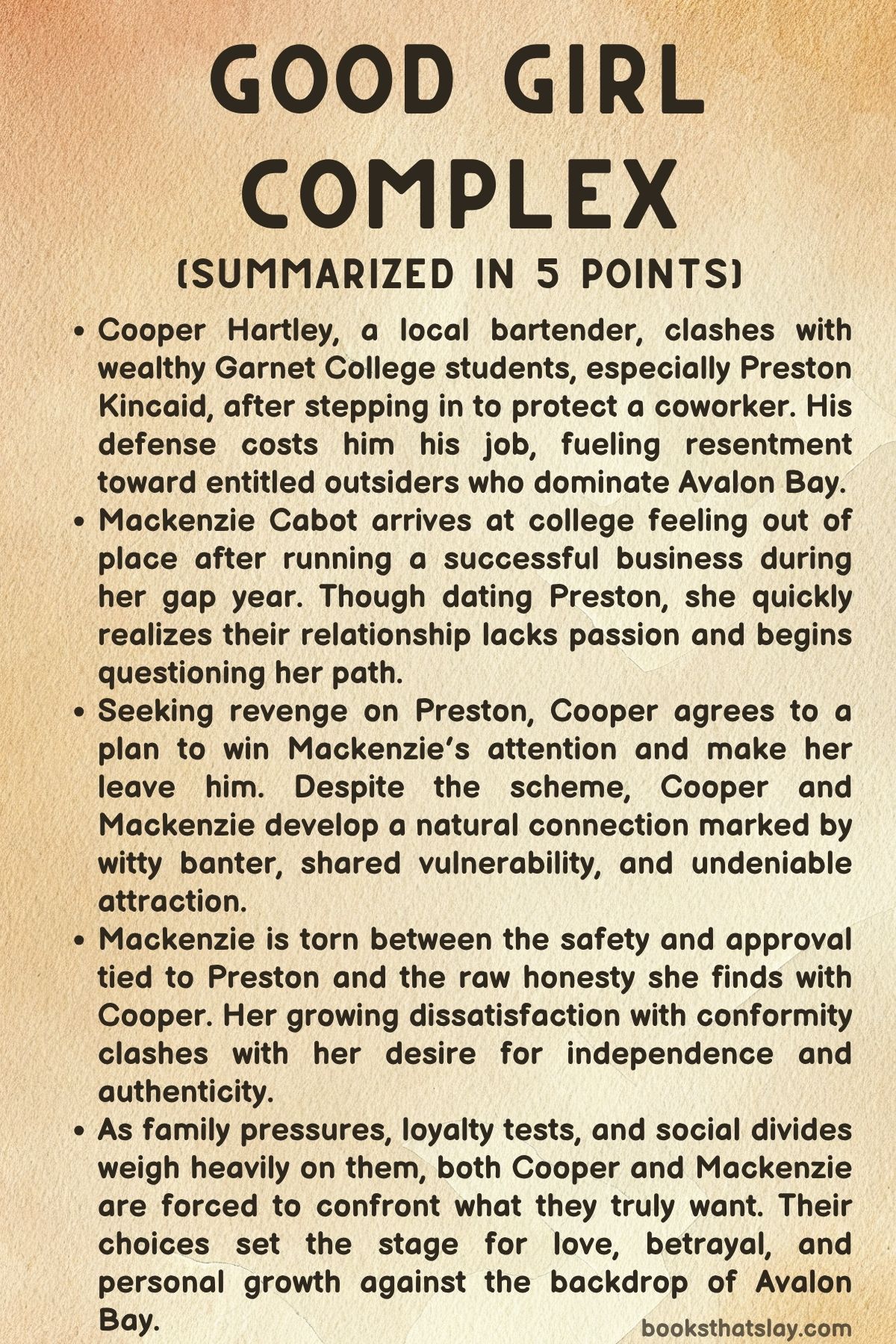
Cooper Hartley works at Joe’s Beachfront Bar, where his resentment toward the wealthy students of Garnet College grows stronger each night. When Preston Kincaid, a privileged student, harasses Cooper’s coworker Steph, Cooper intervenes and punches him.
The fallout leads to Cooper being fired, further fueling his dislike of outsiders like Preston. Meanwhile, Preston’s girlfriend, Mackenzie Cabot, arrives at Garnet College after a year spent building her successful websites.
Though she comes from wealth, Mackenzie is restless under the weight of expectations from her parents and the predictability of her relationship with Preston.
At a locals’ bonfire, Cooper and his twin brother Evan learn that Preston is dating Mackenzie. Seeking revenge, they plot for Cooper to seduce her and push her away from Preston without lying or forcing intimacy.
Mackenzie and Cooper meet unexpectedly during a night out, and despite her attempts to resist, Mackenzie feels intrigued by his boldness. Their banter, humor, and undeniable chemistry begin to chip away at her defenses, and soon she is drawn into a tentative friendship with him.
Though she reminds herself of her loyalty to Preston, she continues to answer Cooper’s messages, setting up an emotional tug-of-war.
As classes begin, Mackenzie finds her coursework uninspiring compared to her business ventures. Her relationship with Preston feels increasingly hollow, especially as his wealth and privilege remind her of how little he truly understands her desires.
Her encounters with Cooper, however, are filled with energy and spontaneity. They argue, laugh, and save a stranded puppy together, which deepens their bond.
Despite her warnings to herself, Mackenzie keeps returning to Cooper, curious about his world and his raw honesty. The dog, eventually named Daisy, becomes a symbol of their growing connection.
Mackenzie’s dissatisfaction with Preston grows, particularly when she observes his circle of wealthy friends casually discussing infidelity as an accepted part of relationships. Preston’s dismissive attitude about loyalty and his plans for their future without consulting her widen the cracks in their relationship.
Meanwhile, Cooper shows her his woodworking projects, revealing his hidden talents and ambitions. Their vulnerability around each other intensifies their closeness, and Mackenzie begins to question what she truly wants from life and love.
The tension reaches a breaking point when Mackenzie accuses Preston of cheating. At dinner with her parents and Preston, she feels suffocated by his arrogance and her father’s domineering presence.
When Preston announces future plans for her without her input, Mackenzie finally ends their relationship. Her confrontation confirms her doubts, and she walks away from the life mapped out for her.
Soon after, she and Cooper surrender to their attraction, beginning a secret romance full of passion but shadowed by their differences.
Though their connection deepens, Mackenzie struggles to be accepted by Cooper’s friends, many of whom resent her wealth and status. Evan, especially, is hostile toward her.
Tensions flare when Evan makes a crude remark, prompting a violent fight with Cooper. Over time, however, Mackenzie begins to earn some respect by proving her resilience, even risking herself to help friends during a storm.
Still, her relationship with Cooper is marked by frequent clashes, as both struggle to balance their independence with their desire for one another.
Meanwhile, Cooper deals with his own family struggles. His mother, Shelley, resurfaces only to steal his savings, forcing him to confront painful truths and cut ties.
Supported by his uncle Levi, Cooper finds new purpose when Levi makes him and Evan partners in his construction company, offering them stability and a future. Mackenzie, too, continues pursuing her independence by working on hotel restoration projects and running her websites, determined to build her own path apart from her parents’ control.
Their fragile happiness shatters at a joint birthday party when Mackenzie overhears Heidi and Alana, Cooper’s friends, discussing how Cooper originally pursued her as part of a revenge plan against Preston. Devastated, she confronts him publicly and leaves, unable to accept his betrayal.
She moves in temporarily with Steph and Alana, vowing to focus on her career and independence instead of love. Cooper, regretful and desperate to win her back, pours his energy into his woodworking business, which thrives thanks to Mackenzie’s earlier help.
Despite their separation, his feelings for her only deepen.
Levi encourages Cooper to fight for Mackenzie in a meaningful way. Inspired, Cooper writes a confession post on Mackenzie’s website, BoyfriendFails, admitting the truth about the revenge plan, declaring his love, and asking her to meet him at the beach where they found Daisy.
Hesitant but moved, Mackenzie arrives. Cooper apologizes without excuses, showing her a vision of the future they could share.
He sets out rocking chairs on the hotel porch, symbolizing her dream of guests watching the waves, and tells her he wants to build a life with her. Though wary, Mackenzie agrees to try again, on the condition that he respect her independence.
In the end, Mackenzie and Cooper commit to one another honestly, determined to rebuild their relationship on trust and equality. They acknowledge the challenges of their different worlds but choose to face them together, bound by love, growth, and a shared vision of the future.
Good Girl Complex closes on a hopeful note, with Mackenzie reclaiming her autonomy and Cooper redefining his place in Avalon Bay, both ready to carve out a life built on choice rather than expectation.
Characters
Cooper Hartley
Cooper Hartley is the quintessential bad boy of Good Girl Complex, yet his character holds far more depth than his initial portrayal suggests. As a working-class local of Avalon Bay, he embodies resentment toward the wealthy Garnet College students who invade his hometown each year.
His bitterness stems not only from economic disparity but also from deeply personal wounds—his absent and reckless mother, his father’s death, and a sense of abandonment that fuels his distrust of privilege. Despite his rough edges and impulsive temper, Cooper shows a strong protective instinct, particularly when defending Steph from Preston’s harassment.
This same instinct becomes complicated in his relationship with Mackenzie, where his initial plan of revenge evolves into genuine love and vulnerability. His honesty, blunt humor, and underlying tenderness make him a conflicted but magnetic figure.
Cooper’s growth lies in learning to balance his anger at the world with his capacity for love, ultimately discovering that vulnerability is not weakness but strength.
Mackenzie Cabot
Mackenzie, often called Mac, is the moral center and emotional heart of the novel. She arrives at Garnet College with wealth, privilege, and parental expectations weighing heavily on her shoulders, yet she feels profoundly dissatisfied with the life carved out for her.
Despite her family’s political influence and her long-term relationship with Preston, she craves independence and authenticity. Her entrepreneurial success with websites like BoyfriendFails and GirlfriendFails showcases her intelligence, resourcefulness, and drive to create something of her own.
Mackenzie’s relationship with Cooper forces her to confront the gap between her safe, predictable life and her yearning for passion and self-definition. She is fearless in moments of crisis—whether diving into the ocean to rescue a dog or standing up to controlling men in her life—but struggles with the vulnerability that comes from love.
Her arc charts a journey from constraint and conformity to freedom and self-assertion, making her one of the most dynamic figures in Good Girl Complex.
Preston Kincaid
Preston represents the entitled, wealthy Garnet College student archetype, yet beneath his charm lies manipulation and deceit. As Mackenzie’s long-term boyfriend, he embodies the safe and family-approved relationship, but one built more on appearances than genuine connection.
His arrogance is clear from the very start—flashing money at bars, harassing women, and hiding behind his family’s power when confronted. For Mackenzie, he symbolizes the future she is expected to embrace: polished, politically advantageous, and suffocating.
His casual acceptance of infidelity and his unilateral decisions about their shared future expose him as self-centered and controlling. Preston’s downfall is inevitable, as his inability to treat Mackenzie with respect or passion contrasts sharply with Cooper’s raw authenticity.
Evan Hartley
Evan, Cooper’s twin brother, provides a foil to Cooper’s fiery nature. He shares his brother’s resentment toward the wealthy college students, but his bitterness runs deeper, often spilling into hostility and recklessness.
Where Cooper begins to soften through his relationship with Mackenzie, Evan initially resists, mocking her and resenting her intrusion into their lives. Yet Evan is not without complexity.
His moments of vulnerability—particularly when Mackenzie helps him after a fight—reveal loneliness and a fragile core masked by bravado. His loyalty to Cooper is fierce, though it sometimes manifests as destructive protectiveness.
Evan’s gradual softening toward Mackenzie marks his own subtle growth, showing that even the most hardened characters can find redemption through connection and honesty.
Bonnie May Beauchamp
Bonnie, Mackenzie’s roommate, brings levity and vibrancy to the story. Her free-spirited, uninhibited Southern charm contrasts sharply with Mackenzie’s cautious and reserved nature, helping to loosen Mackenzie’s grip on routine and propriety.
Bonnie is adventurous, outspoken, and often the catalyst for Mackenzie’s exposure to Avalon Bay’s locals, including Cooper and Evan. Despite her flamboyance, she proves to be a loyal friend who supports Mackenzie through her romantic turmoil.
Her openness and zest for life highlight the theme of breaking free from societal expectations, a path Mackenzie herself comes to embrace.
Steph
Steph, Cooper’s coworker and friend, represents the vulnerability of women navigating male entitlement in Avalon Bay. From the beginning, she is subjected to Preston’s harassment, which sparks the pivotal confrontation that alters Cooper’s life.
Steph is resilient and kind, offering Mackenzie support when others judge her. She becomes a bridge between Mackenzie and the often-hostile local circle, providing a space of acceptance.
Her character, though secondary, underscores the dangers of unchecked privilege and the strength of female solidarity.
Heidi
Heidi embodies jealousy and unresolved feelings, serving as a source of tension in Cooper and Mackenzie’s relationship. As Cooper’s friend with lingering romantic attachment to him, she reacts with coldness and hostility toward Mackenzie, reinforcing the social barriers between locals and wealthy students.
However, Heidi’s eventual reconciliation with Cooper demonstrates her own growth and ability to let go of past wounds. While she never fully embraces Mackenzie, her journey from bitterness to acceptance highlights the messy, imperfect nature of friendship and desire.
Levi Hartley
Levi, Cooper and Evan’s uncle, is the stabilizing force in the Hartley brothers’ lives. Unlike their absent mother, Levi provides consistency, guidance, and unconditional support.
His quiet strength is shown in moments of crisis, whether helping Cooper confront Shelley or restructuring his business to empower the twins. Levi represents the possibility of a different kind of family—one built not on obligation or pretense, but on loyalty and love.
His wisdom and generosity anchor the brothers, reminding them of their worth and potential.
Shelley Hartley
Shelley, the Hartley brothers’ mother, is a destructive force defined by selfishness and betrayal. Her repeated abandonments and theft of Cooper’s savings embody the instability and neglect that haunt the twins.
Shelley’s manipulative nature and refusal to take responsibility contrast sharply with Levi’s dependable presence, forcing Cooper to confront painful truths about family. His ultimate decision to cut ties with her is a defining moment of growth, symbolizing his commitment to building a healthier, more stable future with Mackenzie.
Themes
Class Divide and Social Hierarchies
In Good Girl Complex, one of the most striking themes is the divide between the wealthy college students and the working-class locals of Avalon Bay. This conflict plays out not only in personal relationships but also in community dynamics, where the wealthy families hold power and influence over businesses, jobs, and opportunities, while locals like Cooper are left to struggle for stability.
Preston embodies entitlement, flaunting his money and wielding his father’s influence as a weapon, while Cooper embodies resentment, shaped by years of watching outsiders exploit and belittle his community. The bar fight that costs Cooper his job is emblematic of this imbalance: he is punished for defending Steph because the bar owner fears the economic repercussions of angering Preston’s father.
This pattern of power imbalance runs through the novel, showing how privilege shields certain individuals from consequences while burdening others with constant vulnerability. Mackenzie’s arrival complicates this theme further.
Although she comes from wealth, her inner conflict about fitting into that world while also feeling drawn to Cooper highlights how social divides are not always clear-cut. Her attraction to Cooper is as much about resisting the scripted path laid out by her family and boyfriend as it is about genuine chemistry.
The class divide thus becomes more than a backdrop; it shapes the characters’ choices, relationships, and perceptions of one another, creating an ongoing tension between worlds of entitlement and survival.
Identity and Independence
Mackenzie’s journey is deeply rooted in her struggle for independence and self-definition. Her background paints her as the “good girl,” always obedient to family expectations, molded by her parents’ ambitions and her boyfriend’s plans.
Yet beneath the polished surface lies a restless young woman who has already proven her ability to build something meaningful on her own through her successful websites. Her frustration with college courses she finds irrelevant underscores her yearning to shape her own life, rather than following predetermined steps.
This theme develops further as she questions her relationship with Preston, realizing that her attachment is born more out of expectation and routine than true connection. Her bond with Cooper becomes the catalyst for exploring parts of herself she has long suppressed: spontaneity, courage, defiance, and emotional vulnerability.
Saving the dog, facing down storms, and even confronting Cooper when he treats her dismissively are all moments where Mackenzie asserts her strength and rejects being infantilized. Through these choices, she begins to define herself not as the daughter of a congressman or the girlfriend of a wealthy heir, but as a woman capable of making bold decisions.
Independence here is not only about leaving Preston but about refusing to let anyone, including Cooper, dictate her worth or path. This exploration of selfhood reveals the tension between external identity and internal authenticity, with Mackenzie constantly negotiating the balance.
Love, Betrayal, and Trust
Romantic entanglements in Good Girl Complex are fraught with complications, and the theme of love interwoven with betrayal underscores much of the narrative. The central romance between Cooper and Mackenzie begins under false pretenses, as Cooper initially pursues her out of revenge against Preston.
This deception hangs over their growing connection, raising the question of whether love can survive when its foundation is compromised. Their relationship oscillates between moments of pure passion and moments of destructive conflict, with Mackenzie repeatedly questioning whether she can trust Cooper and whether his feelings are genuine.
Betrayal is not limited to their romance; it echoes in Preston’s casual treatment of fidelity and his manipulation of Mackenzie’s future, as well as in Cooper’s strained relationship with his mother, who robs him of his savings. Each betrayal chips away at the characters’ ability to believe in others, forcing them to grapple with vulnerability.
Yet the story also shows that trust is built not in grand declarations but in actions: Cooper refusing to push Mackenzie into intimacy, Mackenzie risking herself to save Cooper’s brother, or Cooper ultimately confessing publicly to his initial scheme. Trust becomes a fragile yet vital thread that the characters must nurture to move forward.
Love, then, is depicted not as a simple or safe choice, but as something forged in the messy, painful work of honesty and forgiveness.
Family Expectations and Dysfunction
Family plays a powerful role in shaping both Cooper and Mackenzie, though from opposite directions. Mackenzie’s parents embody rigid ambition and control, using her as a prop in her father’s political image and expecting her to fit neatly into a marriage that aligns with social and financial prestige.
Their plans leave Mackenzie suffocated, forced to rebel in small but significant ways, from starting her own websites to secretly spending time with Cooper. For Cooper, family dysfunction is starkly different yet equally formative.
Abandoned by his mother and scarred by her selfish choices, he and his brother were left to rely on their uncle Levi, who became the closest thing to stability in their lives. Shelley’s betrayal in stealing Cooper’s savings represents not just financial loss but the shattering of hope that she might ever change.
Both Mackenzie and Cooper thus grapple with parents who fail them in fundamental ways: one through overbearing control, the other through abandonment and exploitation. These family dynamics fuel their insecurities and choices, yet also highlight their resilience.
When Levi entrusts the brothers with his construction business, it becomes a symbolic act of familial healing and empowerment. Similarly, Mackenzie’s gradual confrontation with her parents signals her refusal to let their expectations define her.
Family in the novel serves both as a source of damage and as a space for redefinition, showing how cycles of dysfunction can be challenged and reshaped.
Power, Control, and Autonomy
The theme of power and control stretches beyond family and class into intimate relationships. Preston embodies control in subtle and overt ways: deciding Mackenzie’s future without her consent, hiding his infidelities, and assuming her loyalty is guaranteed.
Cooper, too, struggles with power in relationships, sometimes lapsing into condescension when frustrated by Mackenzie’s choices, such as when he scolds her for risking her safety. These moments reveal the challenge of balancing care with respect, and Mackenzie’s sharp resistance ensures that she does not fall into passivity.
The recurring pattern is Mackenzie fighting to assert her autonomy against men who try, whether intentionally or unconsciously, to control her narrative. At the same time, Cooper must learn to let go of control in his relationship with Mackenzie, recognizing that trust means allowing her agency rather than protecting her to the point of suffocation.
Autonomy also surfaces in the larger community dynamic, where locals resist the economic dominance of wealthy outsiders. For Mackenzie, true love and partnership come only when she establishes her independence, making choices on her own terms rather than bending to others’ desires.
The novel portrays autonomy as a hard-won achievement, one that requires not just defiance but also self-knowledge and courage to claim a life outside imposed structures.