If You Could See the Sun Summary, Characters and Themes
If You Could See the Sun by Ann Liang is a genre-bending young adult novel that blends magical realism, dark academia, thriller elements, and rivals-to-lovers romance. Set at the elite Airington International Boarding School in Beijing, it follows Alice Sun, a high-achieving Chinese American scholarship student who feels metaphorically invisible among her ultra-wealthy classmates.
When financial pressures and a sudden, uncontrollable ability to turn physically invisible collide, Alice embarks on a morally slippery path that forces her to confront ambition, class disparity, family duty, ethics, and self-worth.
Summary
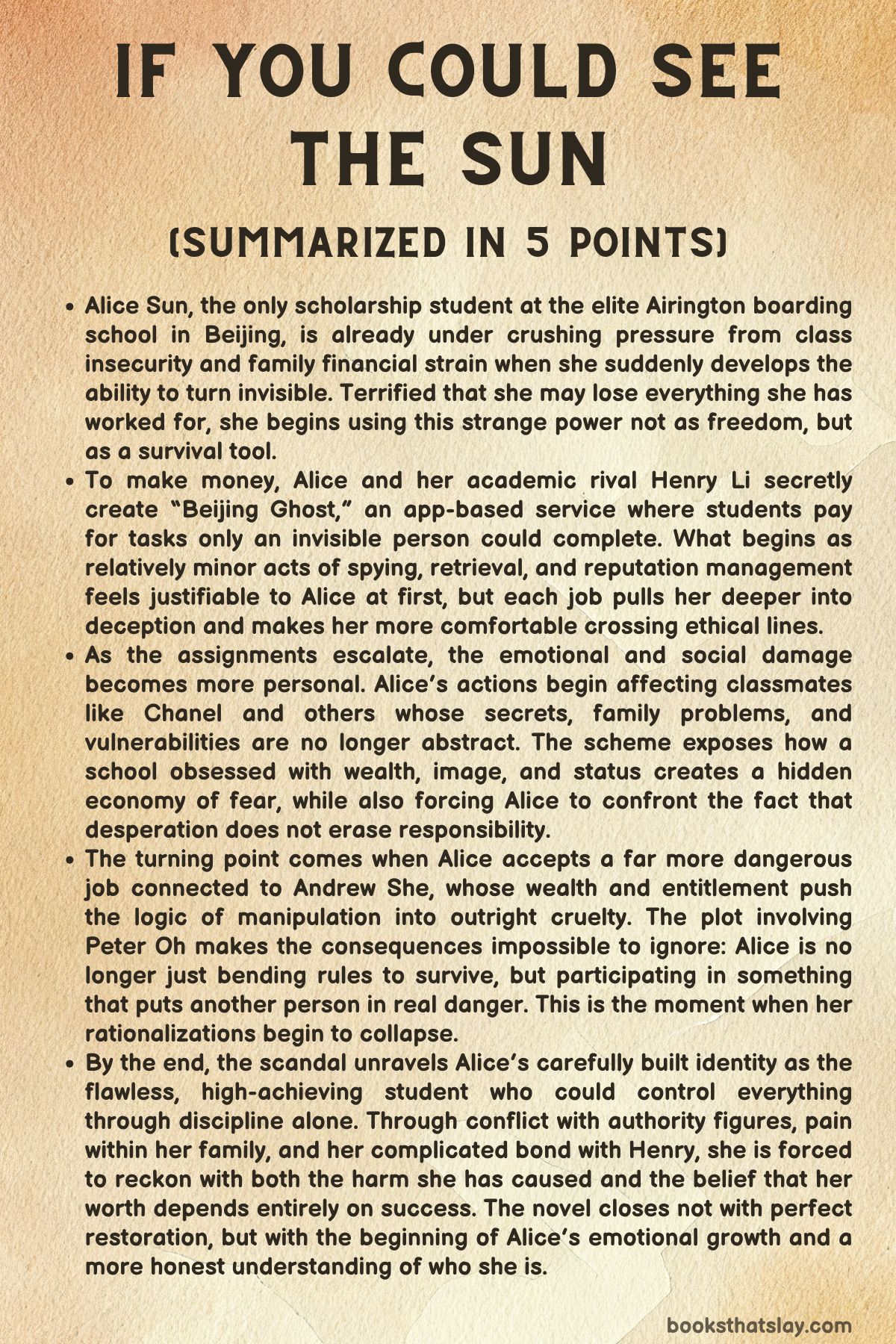
Alice Sun has always been the “study machine”—relentlessly driven to excel academically at Airington, the only scholarship student in a sea of privilege. She competes fiercely with Henry Li, the seemingly perfect, wealthy rival who consistently edges her out in rankings.
Her life feels precarious: she is hyper-aware of her outsider status, both as a scholarship kid and as someone navigating her Chinese American identity in Beijing after her family’s struggles in California.
The story opens with devastating news from her parents during a tense brunch. Rising tuition costs mean they can no longer afford even their portion of the fees (despite the partial scholarship).
Alice faces the prospect of transferring to a public school in Maine or a local Chinese school—options that shatter her carefully built plans for a prestigious future. The pressure intensifies her existing insecurities and sense of isolation.
Shortly afterward, during or right after a school awards ceremony, Alice suddenly turns invisible. At first, she panics, believing it’s stress-induced hallucination or a temporary glitch.
She soon discovers the power is real but unpredictable: it activates (and deactivates) at inconvenient moments, often tied to heightened emotion or stress, and she has no reliable control over it. The invisibility is complete—no one can see, hear, or touch her—making her feel even more disconnected from the world.
Desperate to stay at Airington and ease her family’s burden, Alice decides to monetize her ability. She enlists the reluctant help of Henry Li to build an anonymous app called Beijing Ghost.
Users post requests (and payments); Alice completes shady tasks invisibly, with Henry handling the tech side and sometimes acting as a decoy. Profits are split, though Alice does the dangerous fieldwork.
The business starts small but escalates quickly. Early jobs include spying on a cheating father (which inadvertently shatters her roommate Chanel Cao’s family), deleting compromising photos from phones (such as those held by Jake Nguyen), and other petty scandals.
Alice earns significant money, enough to chip away at tuition worries, but each success deepens her guilt and ethical discomfort. She rationalizes the actions as necessary for survival and family, yet the moral compromises weigh on her.
Her relationship with Henry evolves from pure rivalry and animosity to reluctant partnership and genuine closeness. Henry’s calm logic balances Alice’s impulsiveness; he warns her about risks and ethics but participates anyway, revealing his own vulnerabilities beneath the perfect exterior.
Their banter turns flirtatious, and subtle moments (like Alice discovering an old photo of them in his room) hint at deeper feelings. The rivals-to-lovers dynamic develops naturally through shared secrets and late-night planning sessions.
As tasks grow riskier—including helping with cheating and other crimes—Alice crosses further lines. The tipping point arrives when a wealthy classmate, Andrew She, posts a high-stakes request: help kidnap Peter Oh (a kind, less privileged student) during the upcoming school trip to Suzhou.
The motive is leverage in a family business rivalry; Andrew offers an enormous sum (one million RMB) and promises no real harm. Alice accepts, driven by desperation, but guilt consumes her.
On the trip, in a hotel, Alice is supposed to lure Peter to a specific room where Andrew’s hired men will hold him. Her invisibility falters at critical moments, forcing improvisation.
She ultimately cannot go through with it fully. When Peter is seized, Alice (turning invisible again) sneaks in, tries to free him, and a chaotic struggle ensues.
Peter sustains a mild head injury (concussion after hitting a wall). Alice helps him escape or mitigates the worst, but the incident spirals.
She is seen leaving the scene, and security footage creates suspicion.
Back at school, chaos erupts. Mr. Murphy, Alice’s history teacher and a figure of authority, confronts her.
Evidence is circumstantial but damning in context. Alice faces interrogation-like questioning; her parents are called in, and her father’s public disappointment and anger add humiliation.
The scandal exposes cracks in her double life. She is not fully expelled or criminally charged—thanks in part to influence from Henry, Chanel, and strategic framing that highlights school inequities—but she is suspended and must leave Airington after the current semester.
In the aftermath, Alice grapples with profound guilt, the collapse of her ambitions, and the realization that her pursuit of success “at any cost” nearly destroyed her. She and Henry work together to contain the damage: they repurpose or disguise Beijing Ghost (transforming it into a fake study app while erasing most traces, keeping only Andrew’s incriminating request as potential leverage).
Alice confronts the consequences of her actions without a clean escape—some accountability sticks, even if privilege and connections soften the blow for her and Henry.
The novel ends on a bittersweet but hopeful note rather than a perfectly tidy resolution. Alice reconciles with her parents, who reveal their sacrifices stemmed from love and a desire to give her opportunities, not to burden her with debt or impossible expectations.
She begins to see her worth beyond grades, rankings, or external validation. With support from Henry (whose feelings become clearer) and mentors like Mr. Murphy, Alice embraces a path toward self-acceptance.
Hints of new directions—possibly involving journalism or leveraging her unique perspective—emerge, suggesting growth without erasing the past. Her invisibility power remains unexplained and may or may not fully resolve, mirroring her journey from feeling unseen to claiming her identity.
Characters
Alice Sun
Alice is defined by contradiction: she is brilliant, disciplined, and deeply ambitious, yet also fragile in the way she measures her worth almost entirely through achievement. As the only scholarship student at an elite school shaped by wealth and social ease, she has trained herself to survive through perfection.
That survival strategy gives her purpose, but it also traps her. She believes excellence can protect her from humiliation, financial instability, and exclusion, so when the possibility of losing her place at school appears, her entire sense of identity begins to crack.
Her invisibility power works as an external expression of a feeling she has lived with for years. She already felt unseen as a person, valued mainly for performance, and the magical ability makes that emotional truth physical.
What makes Alice compelling is that her moral decline is understandable without being excusable. She does not become unethical because she is cruel by nature, but because desperation allows her to rationalize one compromise after another.
Each job she accepts reflects a painful mix of fear, pride, and self-justification. She keeps telling herself that the goal is survival and family duty, yet the choices gradually expose how much she has tied love to sacrifice and success to self-erasure.
Her arc is powerful because she is forced to face not only the consequences of what she has done, but the belief system that made those choices seem necessary.
Her relationship with Henry is essential to her development because he sees through the image she has built. Around him, she cannot fully hide behind academic competition or controlled composure.
He challenges her, frustrates her, and gradually becomes one of the few people before whom she is emotionally legible. By the end, her growth lies not in becoming flawless again, but in beginning to understand that her value cannot depend entirely on grades, rank, or proving that she deserves to occupy space.
In If You Could See the Sun, Alice becomes most interesting when the illusion of control falls apart and she has to decide who she is without it.
Henry Li
Henry begins as the polished rival who appears to embody everything Alice resents and fears: wealth, confidence, ease, and effortless excellence. He seems like the perfect representative of the world that excludes her, which makes him an effective foil early on.
Yet his strength as a character comes from how the narrative complicates that impression. Beneath his composure is someone far more observant, emotionally intelligent, and vulnerable than Alice initially allows herself to see.
He understands performance as well, though his version of it is shaped by privilege rather than scarcity. This makes him more than a romantic interest or academic opponent.
He becomes a mirror who reflects Alice’s assumptions back at her and forces her to examine the judgments she makes about wealth, class, and emotional sincerity.
Henry’s role in the Beijing Ghost scheme is morally significant because he is neither innocent nor reckless. He repeatedly recognizes the danger and the ethical drift of what they are doing, but he still participates.
That choice makes him more believable. He is not simply the wise voice warning Alice from the sidelines.
He is implicated, and that shared implication deepens their bond while preserving moral complexity. His intelligence is not just technical or academic; it is social and emotional.
He often sees the shape of consequences before Alice does, yet he also chooses closeness over clean distance, which reveals affection as well as weakness.
As a romantic figure, Henry is effective because his care is expressed through attention rather than grand declarations. He notices details, creates space for Alice’s contradictions, and does not reduce her to either victim or villain.
Their dynamic works because he meets her with both challenge and tenderness. He does not erase the imbalance between them, but he helps her imagine a form of connection not based on competition alone.
His presence softens the story’s harsher edges without removing its tension.
Chanel Cao
Chanel initially appears to belong comfortably within the world of privilege that leaves Alice feeling shut out, yet her character becomes important because she reveals how wealth does not prevent emotional vulnerability or family fracture. As Alice’s roommate, she occupies intimate space in Alice’s life even before genuine emotional trust exists between them.
That closeness gives Chanel a special function in the narrative: she is one of the people most directly harmed by Alice’s actions, even when Alice tells herself that the jobs are abstract or necessary. The scandal involving Chanel’s family turns the supposed distance of the app’s assignments into something painfully personal, showing that hidden actions always ripple outward.
Chanel also represents the social world Alice both envies and distrusts. She is connected to status, appearance, and elite expectations, but she is not merely shallow or decorative.
Her emotional reality complicates Alice’s tendency to divide people too neatly into privileged insiders and struggling outsiders. Through Chanel, the novel shows that the rich are not all identical, even if class still shapes access, protection, and consequences.
That nuance matters because it keeps the social critique from becoming simplistic.
Her relationship with Alice is especially meaningful because it is marked by proximity without complete understanding. They share space, but not initially honesty.
When the truth begins to surface, Chanel becomes part of the moral reckoning that Alice cannot avoid. She stands for the fact that Alice’s desperation does not excuse the betrayals built into her choices.
Even in a supporting role, Chanel adds emotional consequence to the story by making the damage intimate rather than abstract.
Peter Oh
Peter functions as one of the clearest moral reference points in the novel. He is not idealized into perfection, but he is marked by decency, relative vulnerability, and a position outside the most aggressive forms of elite entitlement.
That makes him especially important in the kidnapping plot. He is the person whose safety exposes how far Alice has drifted from the ethical standards she once believed defined her.
Accepting a job that places Peter in danger is not just another questionable task; it is the moment when survival logic becomes impossible to defend convincingly. His presence forces the scheme’s ugliness into full view.
Peter’s significance is also tied to class. He is less protected than the wealthiest students, which makes him easier to target and easier to treat as expendable by those with more power.
Through him, the story shows how privilege often turns other people into tools within larger struggles, including conflicts that have little to do with them personally. That is why the kidnapping plot feels so disturbing.
Peter is caught inside a system where money and influence allow cruelty to masquerade as strategic action.
As a character, he matters because he brings moral clarity without becoming preachy. The harm done to him cannot be explained away as harmless school drama.
His injury and fear make the consequences real. He helps define the emotional and ethical line Alice crosses, and that makes him central to understanding the seriousness of her transformation.
He is less about spectacle than about consequence, and that restraint gives him weight.
Andrew She
Andrew represents the coldest expression of elite entitlement in the story. He is dangerous not because he is emotionally explosive, but because he treats power as something naturally available for use.
Money, status, and family influence have taught him that other people’s lives can be maneuvered for advantage, which is why his kidnapping request feels both shocking and perfectly consistent with the world around him. He does not need to be melodramatic to be threatening.
His casual willingness to instrumentalize Peter reveals a mindset shaped by immunity and strategic cruelty.
What makes Andrew effective as a character is that he exposes the endpoint of the logic already present elsewhere in milder forms. The school environment encourages competition, secrecy, image management, and transactional thinking.
Andrew simply pushes those tendencies into more openly violent territory. In that sense, he is not an isolated evil but an extreme example of what happens when privilege operates without moral restraint.
He believes problems can be solved through leverage because that belief has likely been rewarded throughout his life.
His role in the plot also intensifies Alice’s moral crisis. He offers the kind of money that seems capable of solving everything, and that temptation reveals how desperation can make even a terrible choice appear negotiable.
Andrew does not create Alice’s internal conflict, but he sharpens it. He is the figure who forces her compromises into their ugliest form.
Through him, the novel shows how systems of wealth do not just create inequality; they also create people who assume they have the right to arrange others’ suffering.
Mr. Murphy
Mr. Murphy serves as an authority figure whose importance lies in the balance he represents between institutional judgment and genuine concern. In a school environment dominated by rank, performance, and reputation, he stands out because he engages with Alice as more than a transcript or disciplinary case.
When suspicion closes in around her, he becomes part of the machinery of accountability, but he is not reduced to cold punishment. That complexity makes him significant.
He reflects the fact that adults in positions of power can still be constrained by systems even when they wish to respond with fairness or nuance.
His confrontations with Alice carry emotional force because they strip away her ability to hide behind competence. She has spent so long constructing herself as the student who always delivers that being seen as morally compromised is deeply destabilizing.
Mr. Murphy becomes one of the people before whom her carefully managed image collapses. Yet he is not written as vindictive.
His role suggests disappointment, concern, and the painful necessity of naming what has gone wrong. That makes him an important part of Alice’s reckoning.
He also contributes to the novel’s exploration of mentorship. Rather than offering easy rescue, he represents the harder form of guidance that comes through truth and consequence.
His presence matters because it prevents the story’s ending from feeling emotionally empty or purely punitive. He helps create the possibility that Alice’s future may still contain growth, even after real damage has been done.
Alice’s Parents
Alice’s parents are central to the emotional foundation of her story because they embody the burden of love under financial strain. Their sacrifices, fears, and expectations shape nearly every major decision she makes, even when they are not physically present.
Alice interprets their struggle through the lens of obligation, and that interpretation becomes one of the engines of her desperation. She does not simply want success for herself.
She wants to justify everything her parents have endured and prove that their sacrifices were worth it. This turns family love into a heavy moral pressure, especially because she feels that failure would not be private but collective.
Their importance lies in the gap between intention and impact. They love her deeply, but the reality of money problems, migration history, and educational aspiration has created an atmosphere where Alice experiences that love as pressure as much as comfort.
This is especially painful because no one is acting out of malice. The conflict emerges from care strained by circumstance.
That nuance gives the family dynamic emotional credibility.
Her father’s public disappointment during the fallout is particularly significant because it captures the collapse of the future Alice has been trying to build for all of them. Yet the later reconciliation matters just as much.
It reveals that their love is not meant to imprison her inside achievement, even if that is how she has internalized it. They help bring the novel toward a more generous understanding of worth, one not based solely on performance or repayment.
Jake Nguyen
Jake plays a smaller but still meaningful role in exposing the culture of secrecy, image control, and social vulnerability that surrounds the main plot. Requests involving his phone and compromising material reinforce the fact that students at Airington are living inside a world where privacy is fragile and reputation is constantly at risk.
He helps show how the app thrives not just because Alice has a supernatural advantage, but because the school itself is full of concealed anxieties, scandals, and transactions. In that sense, Jake contributes to the atmosphere that makes Beijing Ghost possible.
His involvement also reminds the reader that many of Alice’s early choices feel less alarming precisely because they are tied to social embarrassment rather than overt violence. Characters like Jake occupy that gray zone where wrongdoing can be disguised as minor interference, gossip management, or personal damage control.
This matters because it shows how Alice’s moral descent begins in places that seem manageable. The path toward larger harm is built through smaller invasions first.
Jake therefore helps the novel chart escalation. He is part of the network of classmates whose secrets create demand for invisible intervention.
Even without dominating the emotional center of the story, he supports one of its key ideas: a culture obsessed with appearances will always generate hidden economies built on fear, leverage, and exposure. His role adds texture to the school’s social ecosystem and strengthens the critique of elite performance culture.
Themes
Class Anxiety and the Violence of Unequal Worlds
Class is not treated as a background condition but as something that shapes identity, ambition, humiliation, and moral choice at every level. Alice’s status as the lone scholarship student means she experiences school as a place she has earned and yet never fully gets to inhabit with ease.
Wealth surrounds her as confidence, social fluency, and safety, while she moves through the same space with constant awareness that one financial collapse could remove her entirely. That insecurity gives class a bodily presence in the novel.
It affects how she speaks, competes, judges others, and judges herself.
The story is especially sharp in showing that inequality does not only produce envy or exclusion. It also produces distorted ethics.
Once money becomes the difference between staying and losing everything she has built, choices that once seemed impossible begin to look necessary. Privilege, meanwhile, often softens consequences for those already protected.
The novel uses Airington to show how elite institutions praise merit while still being structured by inherited advantage, family influence, and economic insulation. That tension gives the story much of its urgency and bitterness.
Visibility, Invisibility, and the Need to Be Seen Correctly
Alice’s supernatural invisibility turns an emotional condition into a literal one. Long before her body disappears, she already feels unseen in the ways that matter most.
Her labor is visible, her grades are visible, and her usefulness is visible, but her inner life remains largely unrecognized. The magic gives form to the loneliness of being valued for output while feeling personally erased.
It also creates a cruel paradox: the more literally invisible she becomes, the more powerful she seems, yet the further she drifts from genuine connection and moral clarity.
The theme gains force because invisibility is not presented as simple liberation. It allows access, secrecy, and temporary control, but it also deepens alienation.
Alice can move through other people’s lives unnoticed, but doing so often means abandoning the mutual recognition that makes ethical life possible. She begins to see others without fully being accountable to being seen by them, and that imbalance encourages harmful choices.
At the same time, the novel asks what it would mean to be seen truthfully. Henry’s growing understanding of Alice matters because he sees more than her academic persona.
The emotional resolution depends not on becoming spectacularly visible, but on rejecting the belief that worth must be earned through flawless performance before one deserves recognition.
Ambition, Ethics, and the Cost of Survival Logic
Ambition in If You Could See the Sun is not treated as shallow vanity. For Alice, ambition is tied to security, family loyalty, migration history, and the hope of building a stable future.
That is what makes her moral decline so compelling. She is not chasing luxury for its own sake.
She is trying to preserve the life she has fought to reach. Yet the novel insists that noble motives do not prevent ethical collapse.
Once success becomes something that must be protected at any cost, the logic of survival begins to justify nearly anything.
This theme is developed through escalation. Small invasions lead to more serious violations, and each compromise becomes easier to explain in the moment than to defend afterward.
The narrative shows how wrongdoing often grows gradually, shaped by rationalization rather than sudden transformation. Alice keeps telling herself that one more task will solve the problem, but the problem keeps changing because the real danger is not only financial.
It is the belief that her future matters enough to override other people’s dignity and safety.
The novel therefore offers a sharp critique of achievement culture. It asks what happens when excellence stops being a form of aspiration and becomes a form of fear.
In that space, ambition ceases to be empowering and becomes corrosive.
Love, Rivalry, and Self-Worth Beyond Performance
The relationship between Alice and Henry matters because it develops inside a world where identity is organized through comparison. They begin as rivals who measure each other through rank, intellect, and controlled displays of competence.
Attraction grows not by erasing rivalry, but by exposing the vulnerability hidden beneath it. This gives the romance emotional weight.
It is not simply about opposites drawn together, but about two people learning how much of themselves has been shaped by performance and expectation.
Their connection becomes meaningful because it offers Alice a different model of value. Henry does not admire her only when she is winning, composed, or morally uncomplicated.
He responds to her sharpness, fear, pride, and damage together. That does not excuse what she does, but it creates a space in which she can exist as more than a résumé or scandal.
The emotional force of the romance lies in that shift from evaluation to recognition.
More broadly, the novel uses romance to question how self-worth is built. Alice has long treated love, approval, and belonging as things earned through achievement.
Her growing closeness with Henry pushes against that belief. The story suggests that intimacy becomes possible only when a person is willing to be known outside the structures that once guaranteed admiration.