Kingdom of the Feared Summary, Characters and Themes
Kingdom of the Feared by Kerri Maniscalco is the steamy, intrigue-packed conclusion to the Kingdom of the Wicked trilogy. It blends dark fantasy, romance, political maneuvering among demon princes, and revelations about curses, identity, and ancient power.
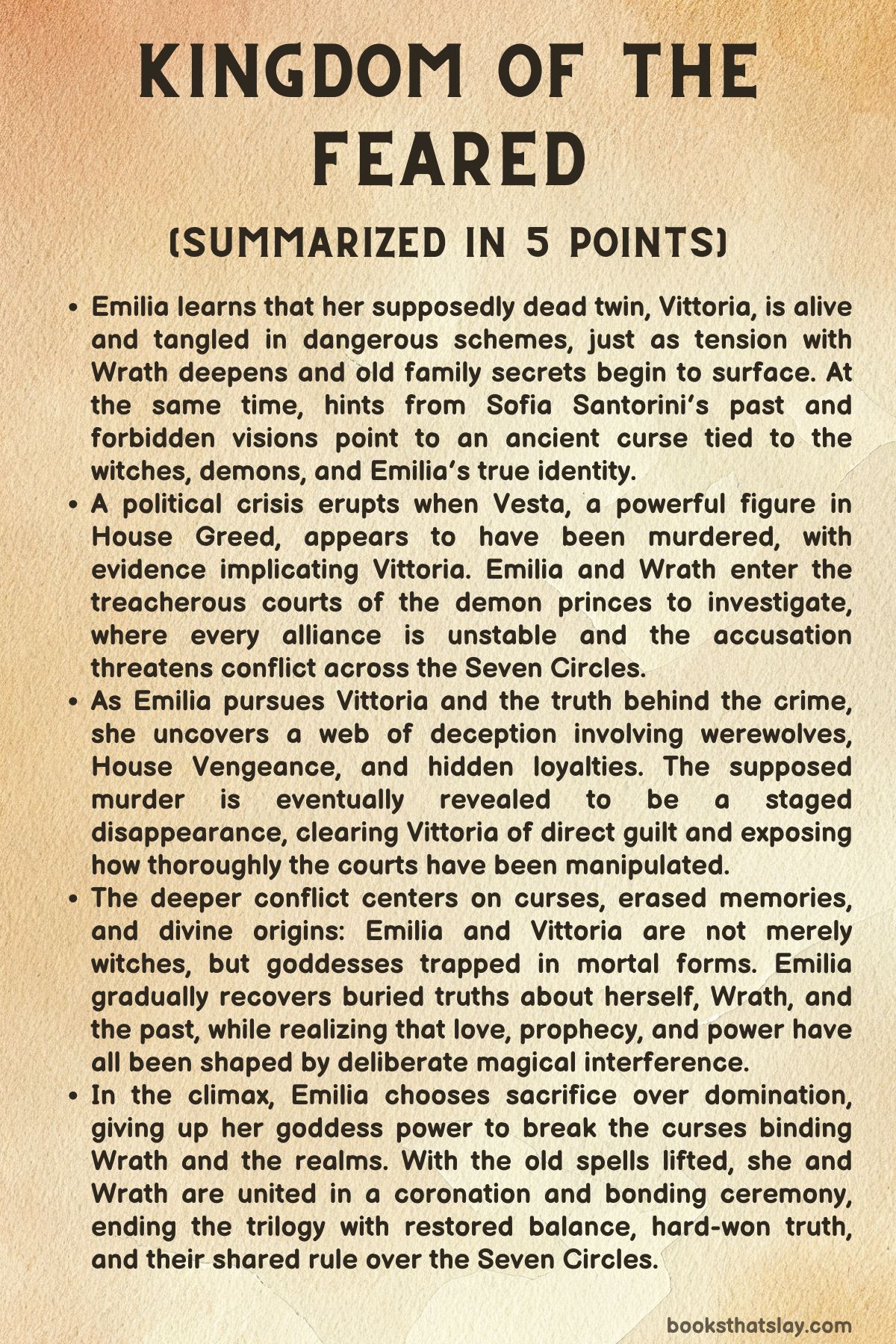
The story picks up immediately after the events of Kingdom of the Cursed, centering on Emilia Santorini, a witch whose world has been upended by the discovery that her twin sister Vittoria—believed murdered in the first book—is alive and deeply entangled in dangerous schemes.
Summary
The novel opens with a haunting prologue set twenty years earlier. Sofia Santorini, a gifted seer in a strict witch coven, defies sacred laws to protect her people from a prophesied curse.
Forbidden from summoning the devil or using black mirrors for scrying, she steals a forbidden grimoire of dark magic and performs a risky ritual in Death’s temple. Using her blood and human skulls, she peers into the future and receives disturbing visions: glimpses of a demon realm, the origins of the First Witch’s curse, and cryptic connections hinting at hidden truths about her coven’s past.
Her efforts are violently interrupted by another witch, who curses her and shatters her mind. Sofia’s final words—“As above, so below”—echo as a mysterious clue to larger cosmic forces at play.
This prologue foreshadows the themes of forbidden knowledge, fractured identities, and the high cost of seeking truth that will define Emilia’s journey.
In the present, Emilia struggles with emotional whiplash. She has just learned Vittoria survived and has been operating in shadows, possibly tied to House Vengeance and manipulative alliances.
Before fully confronting her sister’s betrayal and the family secrets it unearths, Emilia craves intimacy with Wrath, the Prince of Wrath (revealed as the true Devil/King of the Seven Circles). Their relationship is passionate and charged with tension: Emilia desires not only his body but his heart and soul, yet Wrath’s enigmatic nature and lingering curses make full emotional vulnerability difficult.
Early scenes emphasize their physical and emotional bond, with steamy moments underscoring their deepening commitment amid chaos.
The central plot ignites when a high-ranking member of House Greed—Vesta, Greed’s third-in-command—is found “assassinated.” Damning evidence, including signs of a werewolf attack, points squarely at Vittoria, who is quickly declared an enemy of the Seven Circles. This accusation threatens war or blood retribution among the demon houses.
Greed, driven by vengeance and a need to assert dominance, demands justice and presses Emilia and Wrath for answers (or Vittoria’s head).
Emilia and Wrath travel to House Greed’s opulent, sin-soaked court to investigate. They navigate tense meetings with the other demon princes (including Sloth, who analyzes evidence suggesting werewolf involvement, and Pride).
Emilia fiercely defends her sister, arguing the evidence is circumstantial and possibly fabricated, while Wrath remains strategically calm, weighing political ramifications. The investigation involves deception, scandals (such as staging events at Greed’s gaming halls), and uncovering Vesta’s personal life—including rumored affairs (e.g., with Pride).
Emilia’s magic, still affected by prior curses and spell-locks, begins to flare unpredictably, manifesting in bursts of power tied to her rising emotions.
Parallel to this, Emilia confronts Vittoria directly. She journeys to the Shifting Isles (linked to shadow realms and werewolf territories), where her sister reveals shocking truths.
Vittoria’s actions, while manipulative and seemingly cruel, stem from deeper motives tied to protecting Emilia and reclaiming their true heritage. Their sisterly bond is strained—full of betrayal, cryptic half-truths, and lingering love—but Vittoria is not the straightforward villain she first appears.
She has ties to werewolves (including Domenico Nucci, who has been courting her) and House Vengeance, and her “involvement” in events often serves larger purposes.
As layers peel back, it emerges that Vesta’s “murder” is not what it seems: it is ultimately revealed as a staged escape. Vesta is actually a hybrid (with demon and werewolf elements, sometimes referred to as Marcella in context), and her disappearance was orchestrated with Vittoria and Domenico’s help.
This clears Vittoria of direct guilt in that crime and highlights misdirection in the demon courts. The subplot underscores themes of hidden identities and fragile alliances between demons, witches, shape-shifters, and other factions.
Running beneath the murder mystery are two interconnected curses and one ancient prophecy. Emilia and Vittoria are far more than mortal witches: they are goddesses (Emilia as the Goddess of Fury, Vittoria as the Goddess of Death), bound into mortal forms long ago.
Their “Nonna” (grandmother) used dark magic and sacrifice to trap them in human bodies as part of a larger scheme involving the witches’ covens and the First Witch (Sursea, also called La Prima). Sursea, a powerful and mocking antagonist, arrives with political players like the vampire emissary Blade and stirs conflict between witches and demons.
A key curse on Wrath limits his ability to love freely; anyone he loves is destined to be taken from him, with a ticking clock (referenced as “six years, six months, and six days” in some memory fragments). Memories of past events were partially purged or altered, creating confusion even for powerful figures like Wrath and Sursea.
Emilia experiences visions and memory unlocks, often triggered by intimate moments with Wrath or confrontations with Vittoria. One pivotal scene involves Vittoria removing Emilia’s mortal heart (symbolically or literally) to help restore her full goddess power and memories.
Supporting characters add depth:
Fauna: Emilia’s loyal friend and handmaiden in House Wrath, who provides practical aid and insights.
Blade: The cunning vampire emissary whose hidden agendas and interactions heighten political danger.
Greed: Antagonistic yet calculating, his vendetta drives much of the court tension.
Other princes (Envy, Lust, etc.) pursue their agendas, testing fragile alliances.
Emilia also grapples with artifacts like a hexed blade/knife capable of breaking curses but at great personal cost. There are encounters with werewolves, vampire courts, and the looming threat of “the Feared”—ancient, powerful entities tied to the twins’ past reputations and the reckoning prophecy.
As unrest brews between witches, demons, shape-shifters, and the Feared, Emilia and Wrath play a “sin-fueled game of deception” to uncover the true villains—often closer to home than expected. Emilia’s powers grow dramatically but remain volatile.
The investigation into Vesta resolves with the staged-escape reveal, easing immediate threats of war and allowing focus on the curses.
The emotional and magical climax involves breaking the curses. Emilia makes a profound sacrifice: she trades away the entirety of her goddess magic to free Wrath and the realms from the binding spells.
This includes a painful scene where Wrath must stab her with the hexed dagger, burning away her power in the process. The moment is raw, highlighting themes of love, loyalty, and the cost of power.
Following this, they proceed to Emilia’s coronation and their bonding ceremony (essentially a wedding) in the Sin Corridor and gardens of House Wrath, attended by the princes and others. Wrath shares his power with her through their union, restoring balance so they rule as equals—King and Queen of the Seven Circles.
The ending is satisfying and romantic: curses lifted, truths revealed, and Emilia and Wrath committed to eternity together. Loose threads remain (Vittoria reestablishing House Vengeance, potential reconciliation involving Pride and his lost wife Claudia, who receives a memory stone to choose her path; returning a spellbook to their mother), but the core arc for Emilia and Wrath closes on hope and empowerment.
Characters
Emilia Santorini
Emilia is shaped by conflict between desire, suspicion, grief, and the need for self-definition. At the start, she is no longer simply a grieving witch seeking answers about her sister’s murder.
That earlier identity has fractured, leaving her caught between mortal emotion and a far older, more dangerous truth about who she really is. What makes her compelling is that each revelation expands her power while also destabilizing her sense of self.
She wants clarity, but truth arrives in pieces, often through pain, memory disruption, or betrayal. As a result, her character is defined by emotional intensity and constant reevaluation.
She must judge whether the people closest to her are protecting her, using her, or doing both at once.
Her relationship with power is especially important. Emilia does not experience power as a simple gift that makes her stronger and freer.
Instead, it is tangled with inheritance, curse, prophecy, and sacrifice. Her magic responds to emotion, which gives her arc a volatile quality: the more she feels, the more dangerous she becomes.
This connection between inner state and outward force makes her development psychologically rich. She is learning not only what she can do, but what she is willing to become.
The revelation that she is the Goddess of Fury intensifies this tension because fury is not merely an emotion she experiences; it becomes part of her essence, something ancient and defining that she must learn to contain without denying.
Emilia’s intelligence also deserves attention. She is not passive within court intrigue, even when others withhold information from her.
She questions narratives, challenges accusations, and pushes against manipulative structures whether they come from demon princes, witches, or family secrets. Her refusal to accept convenient explanations makes her effective in a story filled with staged crimes, hidden motives, and masked identities.
At the same time, her impulsiveness keeps her from becoming emotionally distant. She thinks sharply, but she feels just as sharply, and the combination makes her both formidable and vulnerable.
Her final sacrifice reveals the deepest truth of her character. She is powerful, but the narrative insists that her greatness lies not only in magical force but in what she chooses to relinquish for love, balance, and freedom.
She moves from wanting answers and vengeance to making an act of profound agency. That choice transforms her from someone chasing truth into someone defining the future on her own terms.
In Kingdom of the Feared, she emerges as a heroine whose strength is inseparable from risk, devotion, and the courage to lose power without losing herself.
Wrath
Wrath is written as a figure whose authority depends on concealment, discipline, and emotional restraint. He carries the aura of a demon prince and ruler, yet much of his complexity comes from what he cannot easily say or express.
Even when his identity as the true Devil and King of the Seven Circles is fully in view, mystery remains central to his characterization. He is powerful, politically intelligent, and deeply committed, but also shaped by withheld memory, curse, and the burden of leadership.
That combination prevents him from becoming a straightforward romantic hero. He is not defined only by devotion to Emilia, but by the tension between what he feels and what he has been magically or historically prevented from fully enacting.
His curse is one of the most important parts of his characterization because it turns love into a site of danger. He is not someone avoiding emotional vulnerability out of pride alone.
He has genuine reason to fear attachment because love has been structured as loss within his life. This gives his reserve emotional credibility.
His distance is not indifference, and his secrecy is not merely manipulative. Instead, both are linked to a long history of pain, distortion, and political consequence.
That history makes his tenderness toward Emilia more meaningful, because every moment of softness carries risk.
As a ruler, Wrath is consistently strategic. He does not allow emotion to dominate his public conduct in the way Emilia sometimes does, and that difference between them creates balance.
He can navigate competing demon houses, read threats beneath performance, and consider the larger structure of power even in moments of personal crisis. Yet his political control never erases his passion.
The novel keeps returning to the fact that beneath calculation lies intensity. That intensity surfaces in his possessiveness, desire, and protectiveness, but also in the absolute seriousness with which he regards promises and bonds.
What makes Wrath especially effective is that his emotional arc is not about becoming less dark or less powerful. It is about becoming less divided.
He must confront the truth of his own heart, his past, and the forces that have limited his capacity to love openly. By the end, his union with Emilia feels earned because it comes after he has faced both the political and emotional cost of being who he is.
He becomes most complete not when he dominates, but when he finally stands beside someone as an equal rather than above her as an untouchable prince.
Vittoria Santorini
Vittoria is one of the most ambiguous and dynamic figures because she exists at the border between betrayal and protection. Much of her power as a character comes from uncertainty.
Emilia, and by extension the reader, is never allowed to approach her through a single stable interpretation. She can appear manipulative, secretive, cruel, and emotionally distant, yet the narrative repeatedly complicates those impressions by revealing deeper motives behind her actions.
This instability makes her fascinating. She is not written to be easily trusted or easily condemned, and that ambiguity allows her to embody the novel’s concern with hidden identities and fractured loyalties.
Her connection to Emilia is central to both characters. Their bond is shaped by love, resentment, separation, and buried truth.
Vittoria is not merely a missing sister returned to the story; she is a challenge to Emilia’s entire understanding of family, memory, and selfhood. Every interaction between them carries the weight of what was lost and what was concealed.
Because they are twins, their conflict is never only personal. It has symbolic force, with each sister reflecting alternative ways of carrying power, secrecy, and destiny.
Vittoria often seems further along in knowledge and acceptance, but that position also isolates her. She knows more, yet that knowledge has made her harder, more elusive, and more willing to act without permission.
The revelation that she is the Goddess of Death strengthens her characterization rather than reducing it to mythology. Death here is not just destruction.
It is transformation, knowledge of endings, and intimacy with what others fear. Vittoria embodies these qualities through her ability to move through shadows and morally uncertain spaces.
She accepts costs that Emilia resists, and that willingness gives her a dangerous edge. At times she appears almost ruthless, but her ruthlessness is linked to long-term protection and a larger understanding of what is at stake.
Vittoria’s role in the staged disappearance of Vesta further clarifies her complexity. She is willing to deceive courts, manipulate appearances, and unsettle even her sister if it serves a broader purpose.
That does not make her purely noble, but it does make her purposeful. She functions as a reminder that survival in a corrupt world often requires methods that look treacherous from the outside.
Her presence ensures that the story’s moral world remains unstable, forcing both Emilia and the reader to confront the possibility that love can coexist with concealment.
Sofia Santorini
Sofia’s importance begins before the main action fully unfolds because her prologue establishes the emotional and thematic foundation of the story. She is defined by defiance, foresight, and desperation.
As a seer, she possesses access to knowledge that others fear, and her willingness to break sacred laws reveals a character driven by protective urgency rather than passive obedience. She does not challenge her coven out of vanity or reckless rebellion.
She does so because the future she perceives is intolerable, and knowledge becomes a burden she can neither ignore nor safely contain.
Her actions reveal the high cost of seeking truth in a world structured by prohibition. The ritual she performs is transgressive in every sense: spiritually, politically, and personally.
By turning to forbidden magic, she becomes a figure who places communal survival above institutional law. This gives her moral complexity.
She is courageous, but her courage also opens the door to catastrophe. The violence that follows, including the destruction of her mind, shows how punishing the world can be toward women who attempt to see too much and act too boldly.
Sofia also functions as a bridge between generations. Her choices reverberate through Emilia’s story, making her more than a tragic precursor.
She is part of the hidden architecture of the family’s fate. The phrase she leaves behind carries symbolic force because it suggests that what happens in one realm echoes in another, and what is hidden below reflects what appears above.
This makes her a guardian of truth even after she has been silenced. Her brokenness does not erase her significance; it intensifies it.
As a character, Sofia represents the painful paradox of prophecy. To see danger is not necessarily to prevent it, and the attempt to intervene can create new forms of damage.
Yet the narrative treats her with seriousness rather than blame. She becomes a figure of maternal or ancestral sacrifice, someone whose ruin testifies to how fiercely she tried to protect what mattered.
Greed
Greed is a strong political antagonist because he turns injury into leverage and suspicion into pressure. He is not driven by simple rage alone, even when Vesta’s supposed murder gives him reason to seek retaliation.
His fury is always filtered through ambition, status, and the demands of public authority. That makes him dangerous in a specifically courtly way.
He does not merely want revenge; he wants revenge that reinforces his standing and compels others to respond on his terms. In that sense, he represents the way personal grievance becomes political theater.
His court reflects his character. It is luxurious, performative, and morally charged, suggesting a ruler who understands temptation and display as instruments of power.
Greed’s presence sharpens the atmosphere of suspicion because he treats every event as potentially exploitable. Even when his claims appear reasonable, there is often a sense that he is testing boundaries, measuring weakness, and using crisis to consolidate influence.
This gives him narrative usefulness beyond the immediate investigation. He becomes a force that keeps tension high by ensuring that no accusation remains merely private.
Greed is also significant because he embodies the values of his title without being reduced to caricature. His greed is not only for wealth or pleasure.
It extends to control, certainty, and dominance within the hierarchy of the Seven Circles. He wants outcomes that serve him, truths that validate him, and justice that enhances his authority.
That breadth of appetite makes him more compelling than a one-note rival.
His interactions with Emilia and Wrath help reveal both of their strengths. Against Greed’s demands, Emilia’s loyalty becomes more visible and Wrath’s diplomacy more necessary.
He acts as a pressure point within the political structure, forcing the protagonists to respond not just emotionally but strategically. Even when he is not the final source of danger, he remains crucial as a character who shows how unstable alliances can become when power and wounded pride meet.
Vesta
Vesta is an especially interesting character because her apparent role and actual role are so sharply different. At first, she seems to function primarily as a victim whose death triggers political chaos.
Yet as the truth emerges, she becomes something more layered: a figure whose supposed murder is itself a carefully constructed illusion. This shift changes how she should be read.
She is not merely the object around which other characters act. She is part of the machinery of deception, identity concealment, and strategic disappearance that defines the broader plot.
Her hybrid nature is essential to her significance. As someone connected to multiple worlds, she embodies the instability of rigid categories in the novel’s universe.
Demon, werewolf, loyalist, fugitive: none of these identities alone can contain her. Her existence challenges the neat divisions that political systems rely on, and that challenge helps explain why her case becomes so explosive.
She is living evidence that the boundaries between factions are more porous than courts would like to admit.
Vesta’s staged escape also reveals how survival sometimes depends on performance. To disappear successfully, she must first become legible as dead.
That dynamic fits the novel’s broader preoccupation with masks, rumors, and the gap between what courts believe and what is actually true. She matters because she exposes how easily public certainty can be manufactured.
Although she does not dominate the emotional center of the story, her role is far from minor. She becomes a catalyst for conflict and a symbol of concealed reality.
Through her, the narrative emphasizes that hidden truth is often more disruptive than open violence, especially when entire systems are built on appearances.
Fauna
Fauna provides an important grounding presence within a story dominated by large revelations, volatile magic, and dangerous political games. She is loyal, practical, and attentive, and these qualities make her more significant than a simple attendant or companion.
Her role is to stabilize emotional and social space around Emilia, offering a form of support that is not based on prophecy, seduction, or royal power. In a world full of manipulation, that steadiness has real value.
Her presence also helps humanize House Wrath. Courts can easily become abstract settings defined only by intrigue and symbolism, but characters like Fauna make them feel inhabited.
Through her, daily life, personal loyalty, and grounded observation remain visible. She reminds the reader that the realm is not composed only of rulers and rivals; it also depends on the labor, perception, and devotion of those who keep its internal life functioning.
Fauna’s importance lies partly in contrast. Emilia’s world is full of characters who conceal motives, test trust, or speak in half-truths.
Fauna does not operate through grand mystery. That relative directness gives her emotional clarity.
She helps create moments where Emilia can respond as a person rather than as a political symbol or divine figure. This is especially meaningful in a narrative where identity is constantly under pressure.
She also reflects a different kind of strength. Not every important figure needs to command armies or ancient power.
Fauna’s value comes from presence, reliability, and insight into the emotional undercurrents around her. Supporting characters like her keep the narrative from collapsing into spectacle alone by preserving intimacy and interpersonal texture.
Blade
Blade brings a distinct form of menace because he represents diplomatic charm fused with hidden agenda. As a vampire emissary, he enters scenes carrying both outsider status and political relevance.
He is never simply ornamental. His presence suggests that the conflicts of the Seven Circles are being watched, interpreted, and possibly manipulated by powers beyond the immediate demon hierarchy.
This expands the scale of the story and gives Blade significance as a character connected to wider networks of influence.
What makes him effective is the uncertainty surrounding his motives. He is clever, observant, and strategically placed, which means even relatively small interactions with him feel charged.
The narrative uses him to increase paranoia and ambiguity. Readers are invited to suspect that he knows more than he says, wants more than he admits, and may benefit from instability in ways the central characters do not fully perceive.
Blade also contributes to the sensual and dangerous atmosphere of the courtly world. Vampires in this setting carry associations of seduction, appetite, and old power, and he channels those associations without losing political sharpness.
He is not threatening only because he is supernatural. He is threatening because he understands performance and can move within elite spaces while keeping his intentions obscured.
His role reinforces the idea that every alliance in the novel may contain secondary motives. That makes him useful both as an individual character and as a symbol of how diplomacy itself can become a predatory art.
Even when he is not at the center of events, he intensifies the sense that Emilia is navigating a world where appearance is always a tactical weapon.
Sursea
Sursea is one of the most formidable presences in the story because she embodies ancient knowledge, mockery, and manipulative power. As a figure tied to the First Witch and the deeper history of curses, she stands above ordinary court conflict.
Her significance is mythic as well as personal. Whenever she appears, the novel shifts into a larger register, one concerned not just with current schemes but with foundational betrayals, old magic, and the deep structures that have shaped the world.
Her personality matters as much as her power. She is not presented as solemn or abstract.
Instead, she often carries a mocking, unsettling quality that makes her feel intellectually and emotionally dangerous. She does not merely oppose others through force; she destabilizes them through knowledge, insinuation, and contempt.
This makes her an especially effective antagonist because she attacks certainty itself. Around her, characters must confront the possibility that much of what they believe about family, curse, and identity has been engineered.
Sursea also functions as a challenge to inherited narratives. She represents the persistence of the past in its least comforting form.
Through her, the story shows that old wrongs do not stay buried simply because later generations wish them to. She carries continuity with ancient acts of violence and manipulation, making her a living reminder that history can act like a curse when never truly faced.
What makes her memorable is that she is not only a villainous obstacle. She is also an interpretive key.
Through her, the novel exposes how systems of belief, punishment, and identity were constructed. That dual role gives her substantial weight.
She threatens the present while also revealing the architecture beneath it.
Domenico Nucci
Domenico is important because he connects emotional loyalty with factional complexity. His ties to Vittoria and the werewolf world place him at a crucial intersection of romance, alliance, and strategic action.
He is not merely a suitor orbiting a more important character. His involvement in helping orchestrate Vesta’s escape shows that he can act decisively within the larger political game.
This gives him practical significance and prevents him from being read as only decorative.
His connection to Vittoria also helps illuminate her character. Through him, readers see that Vittoria inspires attachment even while remaining elusive and difficult to trust.
Domenico’s willingness to align himself with her suggests both personal feeling and political belief. That combination matters because it reflects the novel’s recurring tension between emotion and strategy.
Relationships are rarely separate from power structures, and Domenico’s role makes that clear.
As a werewolf-associated figure, he broadens the social and supernatural map of the story. He reminds the reader that the central conflict is not confined to witches and demon princes.
Other factions have their own loyalties, desires, and capacity for intervention. His presence therefore enlarges the world and complicates the balance of forces around Emilia and Wrath.
Domenico works best as a character who represents chosen involvement. He is not dragged reluctantly into events.
He participates, assists, and takes risks. That active role gives him narrative value and reinforces the idea that many of the novel’s most important outcomes depend on cooperation across unstable boundaries.
Pride
Pride occupies an intriguing position because he appears as both a member of the ruling hierarchy and a figure marked by his own emotional history. As one of the demon princes, he naturally carries political authority, and even rumors involving him can influence investigations and alliances.
Yet what makes him more than a symbolic embodiment of his title is the sense that there are unresolved personal wounds beneath his power, especially in relation to Claudia.
His pride is expressed less as simple vanity and more as guardedness, status-consciousness, and emotional distance. He belongs to a realm where appearances matter immensely, and he seems shaped by that logic.
This makes him a useful counterpoint to Wrath. Both are powerful princes, but where Wrath’s inner conflict is closely tied to cursed love, Pride’s characterization leans more toward self-protection through control of image and feeling.
The hints of his connection to Claudia give him latent emotional depth. They suggest that even characters who function primarily within political structures are carrying private losses and deferred choices.
This matters because it prevents the demon hierarchy from feeling flat or uniform. Each prince is shaped by his title, but not fully contained by it.
Pride’s value in the narrative lies in suggestion as much as in action. He contributes to the charged atmosphere of the courts and to the sense that every powerful figure has history capable of reshaping present events.
Even when not centrally foregrounded, he helps build the emotional and political density of the world.
Claudia
Claudia, though not always at the forefront, carries substantial symbolic importance because she represents memory, choice, and the possibility of reclaiming one’s own path after long separation from truth. Her connection to Pride introduces an undercurrent of unfinished emotional history, and the memory stone associated with her becomes a powerful object not just of remembrance but of autonomy.
It suggests that memory is not merely something one receives; it can become something one must decide how to live with.
Her role matters because the novel repeatedly treats altered memory as a form of control. In that context, Claudia’s situation reflects a wider concern with who gets to know the truth of their own life.
The possibility of restored knowledge is therefore both hopeful and painful. To remember is not automatically to heal.
It may also force confrontation with grief, betrayal, or lost time.
Claudia contributes to the larger emotional structure by showing that the story’s concerns extend beyond the central couple. Other lives have also been shaped by magical interference and deferred revelation.
This broadens the moral weight of the narrative. The curses and manipulations at work are not isolated incidents; they have touched many relationships across the realm.
As a character, Claudia embodies suspended possibility. She stands at the threshold between past and future, and that threshold gives her quiet but meaningful power.
Through her, the novel affirms that the restoration of truth matters not only for cosmic balance, but for deeply personal acts of choosing who to be next.
Themes
Truth as Forbidden Knowledge
Knowledge in Kingdom of the Feared is never neutral. It is guarded, punished, fragmented, and often accessible only through transgression.
Sofia’s ritual establishes this early by showing that truth must be wrested from systems built to restrict it. The danger is not just that forbidden knowledge can harm the seeker, but that institutions fear what truth might expose about their legitimacy.
Secrets within covens, demon courts, and family histories are maintained because revelation would disrupt inherited power. This makes truth politically destabilizing as much as spiritually dangerous.
The novel also treats knowledge as incomplete and distorted. Emilia receives answers through visions, broken memories, and revelations that arrive without full context.
This forces her into a difficult mode of understanding in which certainty is always provisional. The emotional force of the theme comes from how exhausting that process is.
To learn the truth is not to arrive at peace. It often means losing old identities and relationships that depended on falsehood.
The story therefore presents truth as costly but necessary, a force that threatens order precisely because it allows people to see the structures that have shaped and limited them.
Identity as Inheritance and Choice
Identity in the novel is split between what has been imposed and what must be consciously claimed. Emilia and Vittoria are raised as mortal witches, but that role conceals divine origins, altered memories, and a destiny shaped long before they understood themselves.
The shock of these revelations lies in how thoroughly their lives have been organized by hidden design. Family, magic, and social role all turn out to be less stable than they seemed.
Identity is therefore shown as something vulnerable to manipulation, especially when powerful figures decide which truths may be remembered and which must remain buried.
At the same time, the novel does not suggest that inherited identity is the final word. Emilia’s development depends on choosing how to live with the truths she uncovers.
She cannot control the fact that she is tied to prophecy, curse, and goddesshood, but she can decide what those realities will mean in practice. That distinction gives the theme depth.
The self is shaped by bloodline, memory, and history, yet not fully determined by them. Vittoria offers an alternative model, one more accepting of concealment and strategy, while Emilia moves toward an identity based on conscious commitment.
The contrast between them shows that truth about origin does not erase the need for personal moral choice.
Love Against Possession, Curse, and Fear
The central romance gains thematic power because it is repeatedly tested by forces that turn love into danger. Wrath’s curse means attachment is bound up with inevitable loss, which transforms intimacy into a risk neither emotional openness nor desire can easily overcome.
This prevents love from functioning as mere fantasy fulfillment. It becomes a site of fear, vulnerability, and sacrifice.
Emilia wants not just passion but full mutual devotion, and the difficulty of obtaining that desire gives the relationship emotional substance. Love must survive secrecy, magical interference, and histories neither lover fully controls.
The novel also contrasts love with possession. Many relationships and political structures in the story are shaped by control, hidden agendas, and the urge to use others for larger ends.
Against that, Emilia and Wrath’s bond becomes meaningful because it moves toward reciprocity. Their union matters not because one absorbs the other’s power, but because equality becomes possible through mutual recognition and shared cost.
Even the painful curse-breaking scene emphasizes this. Love is not depicted as soft escape from conflict.
It is something that demands endurance, trust, and willingness to suffer without turning the beloved into an object of ownership. That distinction gives the romance its lasting force.
Power and the Price of Liberation
Power in the novel is consistently attached to cost. Magic can protect, reveal, seduce, or destroy, but it always demands something from the person who wields it.
Emilia’s increasing strength does not make her invulnerable or morally simplified. Instead, greater power exposes her to harder choices.
The story resists the idea that becoming fully powerful is automatically the same as becoming fully free. In fact, power is often shown to be another form of burden, especially when it is linked to prophecy, inherited roles, and political expectation.
This theme reaches its clearest form in Emilia’s final sacrifice. She gives up her goddess magic not because power itself is evil, but because liberation in this story requires breaking the systems that have turned power into imprisonment.
The act is meaningful precisely because it is voluntary. So much of the novel concerns magic imposed on others through curses, hidden rituals, and manipulated memory.
Emilia’s decision reverses that pattern by making choice the center of transformation. Freedom comes not from hoarding every possible strength, but from deciding what must be surrendered so love, balance, and self-directed life can exist.
The novel therefore argues that the highest expression of power may be the willingness to relinquish it for a future no longer governed by old chains.