Painted Scars Summary, Characters and Themes
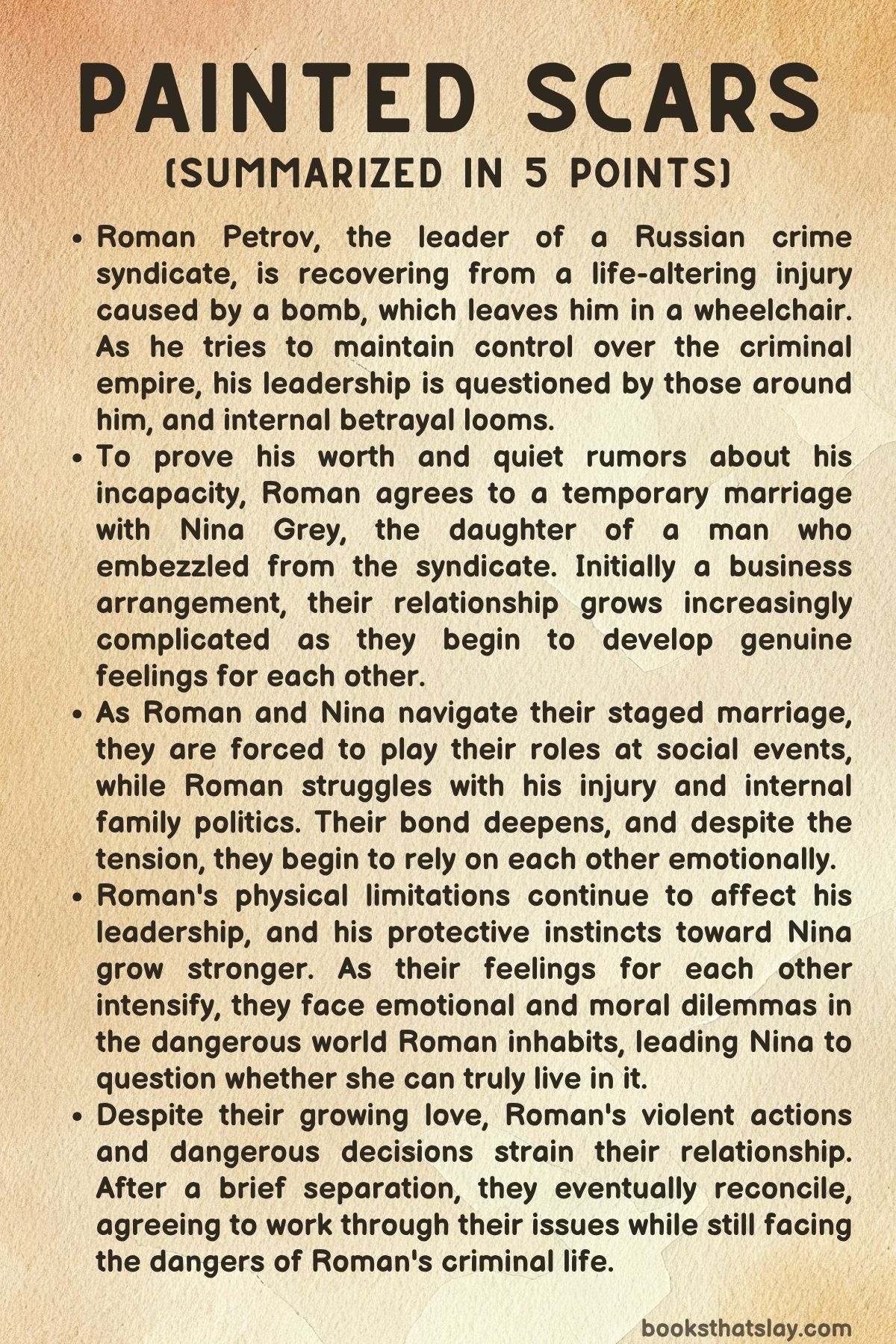
Painted Scars by Neva Altaj is a contemporary dark romance novel set against the backdrop of the dangerous world of Russian organized crime. The story follows Roman Petrov, a powerful crime syndicate leader, who is recovering from a life-threatening injury after a bomb attack.
Struggling with his physical limitations, he navigates the delicate balance between maintaining control of his empire and managing personal conflicts. His unlikely marriage to Nina Grey, the daughter of a man who embezzled money from his syndicate, forms the central plot. Despite their relationship starting as a business arrangement, Roman and Nina develop a deep emotional connection, all while grappling with the violent and treacherous world they inhabit. The book explores themes of power, loyalty, love, and the emotional scars that come with living in such a dangerous environment.
Summary
The explosion leaves him with a severe knee injury that requires a wheelchair for much of the story and forces him to rely on crutches or physical therapy as he recovers. The visible weakness shakes his authority—rumors spread that he is no longer fit to lead, and whispers of betrayal circulate within his own ranks.
Determined to project strength and stability, Roman needs a way to silence the doubts and reassert control.
Enter Nina Grey, a talented, independent artist with a vibrant, grungy style (piercings, colorful hair, combat boots) and no prior ties to the criminal underworld. Her father, Samuel Grey, embezzled a significant sum (around $3 million) from the Bratva and squandered it.
Facing lethal consequences for the debt, Samuel offers his daughter as part of the repayment. Roman’s inner circle, including his loyal second-in-command Maxim, sees an opportunity: a swift, convincing marriage to Nina will portray Roman as a strong family man still fully in command, quelling rumors of his vulnerability.
The arrangement is a straightforward six-month contract marriage of convenience. Nina reluctantly agrees—not out of fear for herself, but to save her father’s life.
Roman, drawn to Nina’s ability to “play a part” and her spirited personality, views her as the perfect temporary solution. He is intrigued by this “perfectly imperfect little manipulator” who can deceive outsiders into believing she is crazy in love with him.
From their first meeting, sparks fly beneath the professional facade. Nina is initially wary of the dangerous world she’s entering and of Roman’s intimidating presence, but she adapts quickly.
Their public appearances as a newlywed couple (complete with a whirlwind-romance backstory) start as pure performance, but private moments reveal growing chemistry. Nina sets up an art studio in Roman’s mansion, clinging to her independence and creativity as an escape.
Roman finds himself unexpectedly vulnerable with her, enjoying quiet, intimate scenes like lying with his head in her lap while she strokes his hair.
As they spend time together, the fake marriage deepens into genuine attraction and emotional connection. Nina sees past Roman’s cold, controlling exterior to the man struggling with pain, recovery, and the constant pressure of leadership.
Roman becomes fiercely protective and even tender, spoiling Nina with clothes, jewelry, and gestures while falling hard for her unique spirit. Their relationship includes plenty of steamy, open-door scenes, and Roman’s disability is portrayed with a mix of realism and romance—he refuses to let it define him, yet it adds layers to his vulnerability and determination.
Behind the scenes, Roman continues investigating the assassination attempt. Betrayal lurks within the syndicate, and he must identify the traitor while maintaining his grip on power.
Nina, meanwhile, grapples with the moral weight of the violent mafia life she’s now part of. A key turning point occurs when Roman tracks down and tortures the man from Nina’s past who caused her trauma.
Though he acts out of fierce protectiveness, Nina is horrified—she had explicitly asked him not to kill the man, not wanting blood on her conscience. This incident highlights the clash between their worlds: Roman’s brutal pragmatism versus Nina’s desire for some moral boundary.
Disturbed by the violence and the nightmares it triggers, Nina reaches her breaking point. She leaves Roman and repeatedly requests a divorce, insisting she wants a normal life away from the danger and bloodshed.
In a dramatic escalation, he declares war on rival factions (including the Italians), seemingly on a reckless, near-suicidal path.
Nina, realizing she never stopped loving him despite everything, returns and begs him to stop the war. In one of the book’s most memorable romantic moments, Roman—still very much the possessive pakhan—looks at her and says, “Marry me, and I’ll stop the war.” It’s not a redo of the original contract but a raw, heartfelt declaration that he has no intention of ever letting her go.
The six-month deal is officially off; their bond is now real and permanent.
The story closes on a HEA (happily ever after), with Roman and Nina committed to each other. Nina has grown stronger and more integrated into his life without fully losing her artistic identity, while Roman finds emotional healing and stability through their relationship.
They face the ongoing dangers of the Bratva world together, but their love—forged in deception, tested by violence and personal scars—proves resilient. Subtle hints of future family (pregnancy in some interpretations of the ending) underscore their fresh start.
Characters
Roman Petrov
Roman Petrov is the central figure in Painted Scars, and his complex character drives much of the narrative. As the pakhan (leader) of a Russian crime syndicate, he embodies power, control, and intimidation, which are essential traits in his line of work.
However, his life takes a dramatic turn when he is severely injured by a bomb attack, leaving him physically impaired and dependent on a wheelchair. This injury shakes his authority, and throughout the novel, Roman struggles with not just his physical limitations but also his internal conflicts as he faces the growing conspiracy against him.
He is initially portrayed as a cold, ruthless leader, but as the story unfolds, his vulnerability becomes more apparent. Roman’s emotional struggles with his injury, his fears of losing his grip on power, and his desire to prove his worth are central to his character.
Despite his hardened exterior, his relationship with Nina reveals a softer side of him. His growing love for Nina challenges his usual emotional detachment, making him more protective and even possessive, especially as their fake marriage turns into something more real.
His violent tendencies, especially when dealing with betrayals and threats, highlight the brutal world he inhabits, yet his emotional turmoil and deep love for Nina create a contrast that makes his character multi-dimensional. As the novel progresses, Roman’s need to maintain control of both his criminal empire and his personal life brings out the tension between his darker impulses and his desire for love and stability.
Nina Grey
Nina Grey’s character is both intriguing and multifaceted in Painted Scars. Initially introduced as an artist, Nina is thrust into the dangerous world of organized crime when her father, Samuel, is forced to offer her up in a marriage of convenience to Roman.
Though she has no prior connection to the criminal underworld, Nina quickly adapts to her new role, playing the part of Roman’s wife to help secure his position in the syndicate. Her resilience and independence are immediately apparent as she begins to navigate the complex dynamics of her arranged marriage.
Despite the farcical nature of their relationship at the beginning, Nina’s connection with Roman deepens over time, turning their marriage from a political arrangement into a genuine emotional bond. Nina’s artistic background is an essential aspect of her identity, and it provides her with a sense of individuality that she fiercely protects throughout her time in the syndicate.
Her role as Roman’s wife is not just a passive one; she takes an active role in managing her own life, setting up a space for her art in the mansion, and maintaining a sense of independence in the midst of her forced marriage. As the story progresses, Nina’s internal conflict becomes more evident, particularly as she begins to grapple with the violence of Roman’s world.
Her love for him grows, but so does her discomfort with his brutal actions, creating a tension between her emotional attachment to him and the moral dilemmas she faces. Nina is forced to reconcile her feelings for Roman with the reality of his criminal lifestyle, making her one of the most complex and compelling characters in the book.
Maxim
Maxim is Roman’s second-in-command and serves as a trusted ally within the Bratva, though his loyalty is not without its complications. He is a pragmatic and calculating character, often acting as the voice of reason when it comes to Roman’s leadership and the internal struggles within the syndicate.
Maxim plays a crucial role in the early stages of the story when he proposes the arranged marriage between Roman and Nina as a way to stabilize Roman’s leadership amidst rumors about his ability to lead while recovering from his injury. Although his suggestion appears self-serving, Maxim is ultimately loyal to Roman, even as he manipulates the situation to secure the future of the syndicate.
His strategic mind and ability to read people make him a valuable asset to Roman, but his motives are not entirely transparent. Maxim is a man of action, not hesitating to do whatever is necessary to maintain the stability of the crime family, even if that means pushing Roman into uncomfortable situations.
However, despite his loyalty, Maxim’s role in the power struggle within the family shows the underlying tensions and the degree to which even the closest allies are driven by self-interest. As the story unfolds, Maxim’s true nature becomes clearer, and his role in the unfolding drama becomes one of both a protector and a potential threat, depending on how the power dynamics shift within the Bratva.
Leonid
Leonid is Roman’s uncle and a key figure in the power struggle that emerges as Roman deals with the aftermath of the bombing. He is a significant character in the book, representing the complex relationships within Roman’s family and the challenges of maintaining control in the criminal world.
Leonid is shown to have his own ambitions, and his animosity toward Roman becomes apparent as the story progresses. His resentment of Roman’s leadership creates a rift between them, and this tension ultimately leads to a dramatic confrontation.
Leonid’s role in the novel highlights the treacherous nature of the world Roman inhabits, where family ties can be just as dangerous as any external threat. His actions ultimately contribute to the instability within the syndicate, and his death serves as a pivotal moment in Roman’s journey, further complicating his emotional and leadership struggles.
Leonid’s character adds depth to the themes of betrayal, loyalty, and power that run throughout Painted Scars, showing the dark and often fatal consequences of internal conflict within a criminal empire.
Varya
Varya is a secondary but important character who adds an element of care and warmth to the otherwise tense environment of Roman’s world. As a member of the household, Varya plays a supporting role, often providing comfort and assistance to Nina and Roman.
Her relationship with both main characters is one of kindness and practicality, and she helps Nina adjust to the complexities of her new life. Varya’s presence in the story serves as a contrast to the violence and ruthlessness of the criminal world.
She provides a sense of stability and normalcy in a world otherwise filled with deceit and danger. While Varya’s role is largely in the background, her interactions with the other characters serve to humanize the world they live in, reminding the reader that even in such a hostile environment, there are moments of warmth and compassion.
Samuel Grey
Samuel Grey is a pivotal character in Painted Scars because of his relationship to Nina and the role he plays in the plot’s development. He is the catalyst for the arrangement between Roman and Nina, offering his daughter as a pawn to save himself from the wrath of the Bratva.
Samuel’s desperation highlights the power dynamics at play in the criminal world, where personal relationships are often sacrificed for survival. While Samuel’s character is not explored in great depth, his actions set the stage for Nina’s involvement in Roman’s life, and his willingness to use Nina to protect himself adds a layer of moral ambiguity to the story.
Samuel’s influence over Nina is also significant, as he is the one who places her in the position of vulnerability within the syndicate’s world, leading to the emotional and moral challenges Nina faces throughout the novel.
Themes
Power and Its Fragility
In Painted Scars, power is a central theme that revolves around Roman Petrov’s struggle to maintain control over both his personal and professional life, despite his physical limitations. Roman, as the leader of a Russian crime syndicate, is used to exerting power over others, making decisions that affect his family and his empire.
However, after the bombing incident, his life is irrevocably changed. His injury leaves him in a wheelchair, and this physical vulnerability shakes his position as the pakhan, the head of the Bratva.
Roman’s ability to command respect and control operations begins to falter, not only because of his injury but also because of the doubts that begin to surface among his closest allies. His physical condition serves as a constant reminder of his fragility, not just as a man but also as a leader.
The fragility of power is depicted through the betrayal within his ranks, where conspirators are trying to frame him and suggest that he is no longer fit to lead. The book illustrates how power, especially in a criminal world, is precarious.
It’s not just about brute strength or dominance; it also relies on perception, loyalty, and fear. Roman’s struggle to maintain authority and to restore his reputation within the syndicate highlights how quickly power can slip away and how hard it is to regain it.
Even in his weakened state, however, Roman’s influence remains significant, showcasing how certain individuals can still wield power despite visible weakness.
Love and Sacrifice
The evolving relationship between Roman and Nina explores the theme of love in the context of sacrifice and personal growth. Initially, their marriage is based on convenience and necessity, a farce meant to preserve Roman’s position within the criminal world.
Nina is coerced into this arrangement, and Roman treats her more as a tool to solidify his power than as a partner. However, as their relationship develops, the lines between obligation and genuine affection blur.
Roman, despite his dangerous nature and involvement in criminal activities, begins to feel real love for Nina. He sacrifices his pride and even his autonomy, as he leans on her for support, especially given his injury.
For Nina, the relationship becomes increasingly complex as her initial fear and resentment give way to a deeper understanding and affection for Roman. She starts to see beyond his violent and controlling exterior, realizing that he is not just the ruthless criminal kingpin but also a man who is vulnerable, emotionally scarred, and in need of care.
The love that grows between them is tempered with sacrifice, as both characters must navigate their roles in a world that demands harsh decisions. Nina sacrifices her independence and personal freedom for Roman’s safety, while Roman sacrifices his sense of control and pride to allow Nina to help him.
Ultimately, their love represents the complex balance between personal desire, emotional vulnerability, and the sacrifices that come with being involved in a dangerous world.
Trust and Betrayal
Trust and betrayal are interwoven throughout Painted Scars, with characters constantly questioning their relationships and the loyalties of those around them. Roman’s life is built on a foundation of loyalty and trust within his crime syndicate, yet his position as leader is constantly under threat.
The betrayal by those closest to him—particularly within his inner circle—casts a shadow over the story. Roman’s uncle Leonid plays a significant role in this theme.
As Roman faces internal and external threats, he realizes that trust is a commodity that can easily be lost. The tension between the need for loyalty and the reality of betrayal is palpable, especially as Roman tries to uncover the traitors within his ranks.
On the other hand, Nina also grapples with trust, particularly as her relationship with Roman grows more intense. She finds herself torn between her own moral compass and her trust in Roman’s intentions.
Despite his violent and unpredictable behavior, she begins to see him as someone worthy of her trust, even as his actions challenge her beliefs. Betrayal, however, isn’t just about Roman’s enemies—it’s also about Nina’s struggle to reconcile her feelings for Roman with the dangers and violence that come with his lifestyle.
Her internal conflict shows how betrayal isn’t just a matter of external acts but also the emotional cost of love, loyalty, and the choices that define relationships in the face of danger.
Identity and Personal Transformation
The theme of identity and personal transformation is central to Nina’s character arc in Painted Scars. At the start of the story, Nina is an artist, independent and unconnected to the world of crime that Roman inhabits.
She is thrust into this dangerous world through her forced marriage to Roman, and this event challenges her understanding of who she is and what she values. Over time, Nina transforms from a passive participant in the arrangement to a key figure in Roman’s life and empire.
She not only adapts to her new role as Roman’s wife but also begins to carve out a space for herself within the constraints of this dangerous world. Nina’s identity is tested as she navigates her feelings for Roman, her relationship with her family, and her growing involvement in the criminal world.
As Roman’s protector, she evolves from a woman who was initially coerced into a marriage of convenience to someone who actively contributes to Roman’s stability and success. This transformation is mirrored by Roman’s own emotional and psychological growth.
Despite his hardened exterior, Roman shows a more vulnerable side, particularly in his interactions with Nina, which causes him to confront his own limitations. Both characters, through their bond, experience significant personal growth, with Nina learning to navigate the complexities of her new world, and Roman coming to terms with his injury, his feelings for Nina, and the increasingly fragile nature of his power.
Violence and Its Consequences
Violence is an omnipresent force in the world of Painted Scars. The story is set in the violent, cutthroat world of Russian organized crime, where power is maintained through intimidation, bloodshed, and brutal retribution.
Roman’s injury, which sparks the conflict at the start of the book, is a direct result of the violence that surrounds him. As Roman struggles with his recovery, he remains immersed in this world of bloodshed, where the consequences of actions are often lethal.
The theme of violence is explored not just through physical confrontations but also through its psychological and emotional toll on the characters. Roman’s violent tendencies, honed by years in the criminal underworld, are both a source of his power and a source of inner conflict.
For Nina, the violence she witnesses challenges her perception of Roman and her place in his world. She is forced to confront the brutal reality of his life, and as she falls deeper in love with him, she grapples with the fear that she might become a victim of that violence.
The consequences of violence extend beyond the immediate injuries it causes; it affects the characters’ relationships, decisions, and emotional states. As the story progresses, the reader sees how violence creates a vicious cycle, with both Roman and Nina making decisions that continue to perpetuate the world of crime, danger, and death.
Ultimately, the book asks whether it is possible to escape the consequences of a violent life, and whether love and sacrifice can heal the emotional scars left by it.