Thank You for Listening Summary, Characters and Themes
Thank You for Listening by Julia Whelan is a heartfelt and nuanced exploration of the intersection between personal growth, love, and professional identity. The story follows Sewanee Chester, an audiobook narrator who has distanced herself from romance novels and the life she once imagined for herself.
While attending BiblioCon in Las Vegas, Sewanee faces the complexities of her past, including the deteriorating health of her grandmother and unresolved issues with her estranged father. As she navigates her career, a blossoming relationship with Nick, and the emotional weight of her personal life, Sewanee must confront her insecurities and embrace the uncertainty of her future. Through humor, pain, and moments of clarity, the novel dives into the messy, beautiful experience of rediscovering oneself.
Summary
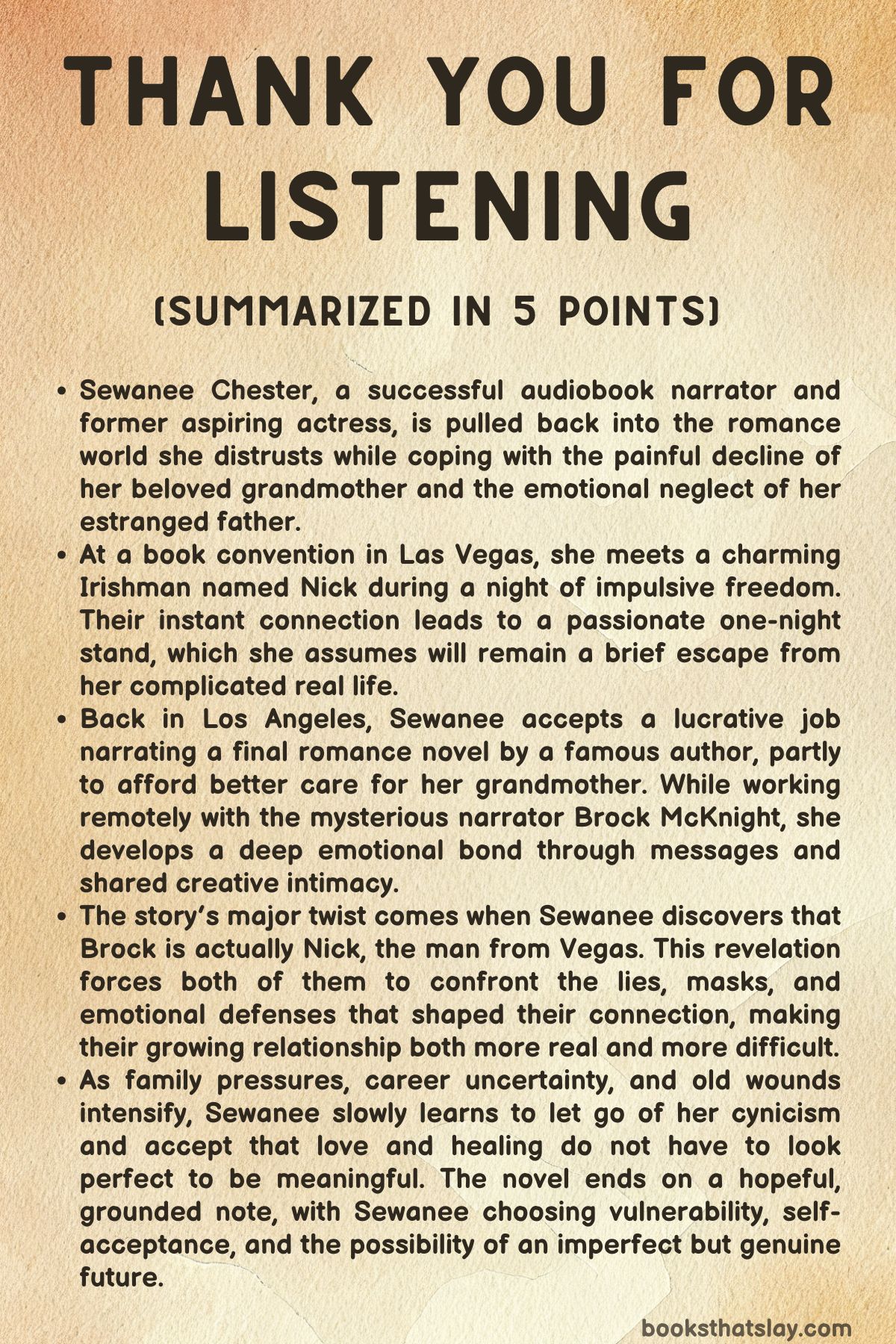
Sewanee Chester—pronounced “Swah-nee” but often called Swan—is a successful audiobook narrator living in Los Angeles. Seven years earlier, she was a Juilliard-trained actress on the cusp of major stardom when a freak on-set accident cost her an eye (she now wears an eyepatch) and damaged her shoulder, abruptly ending her on-camera career.
The trauma left her cynical about happy endings and romance in general. She pivoted to audiobook narration, first gaining fame in the romance genre under the pseudonym Sarah Westholme, but later distanced herself from it, preferring general fiction narrated under her real name.
She finds steady work and satisfaction in the booth, though it feels like a compromise compared to her original dreams. Her income primarily supports the care of her beloved grandmother, Barbara (affectionately nicknamed BlahBlah or Blah from childhood), who is declining with dementia and requires increasingly expensive memory-care support.
Sewanee’s relationship with her father, Henry, is strained; he is emotionally distant, often dismissive of family responsibilities, and reluctant to contribute meaningfully to BlahBlah’s care.
The story opens as Sewanee reluctantly travels to BiblioCon (a major book convention) in Las Vegas. She is filling in at the last minute for her mentor, boss, and landlord Mark to moderate a panel on audiobook production.
She is not fond of the romance-heavy atmosphere at the event. Her best friend, Adaku Obi—a glamorous, successful Hollywood actress whose career is soaring—joins her, sharing a luxurious suite and providing comic relief, emotional support, and gentle pressure for Sewanee to loosen up and enjoy herself.
At the convention, Sewanee feels out of place amid the romance pavilion and the glamorous world that reminds her of the acting life she lost. She grapples with isolation, professional doubts, and the heavy emotional burden of her grandmother’s worsening condition back home.
One evening, after a particularly draining day, Sewanee heads to a bar in the hotel. There she meets a charming Irishman named Nick.
Using her acting skills and embracing the “what happens in Vegas” mindset, she introduces herself as Alice, a book editor with a playful Texan accent. Nick is flirtatious, funny, and easygoing.
Their conversation flows effortlessly; they bond over shared disillusionment with the over-the-top Las Vegas scene. They gamble together at roulette (Sewanee has a small win), share laughter, and experience instant, undeniable chemistry.
A freak snowstorm strands Nick, so Sewanee invites him to stay in the suite. What follows is a passionate, emotionally charged one-night stand.
They part the next morning without exchanging real names, contact information, or professions—both treating it as a perfect, contained fantasy. Sewanee returns to Los Angeles feeling unexpectedly alive but determined to file the night away as a one-off.
Back in her regular life, Sewanee faces mounting pressures. BlahBlah’s condition deteriorates, and the costs of proper care escalate.
Her father continues to avoid serious discussions and pushes for cheaper options. Then comes a significant professional opportunity: the late, beloved romance author June French has left behind one final manuscript, and she specifically requested that Sarah Westholme (Sewanee’s old pseudonym) narrate it as a duet with the industry’s most popular and mysterious male romance narrator, Brock McKnight.
Brock’s real identity is unknown to fans—he guards his privacy fiercely. The payday is substantial enough to secure better care for BlahBlah, so despite her aversion to romance novels and their “unrealistic” happy endings, Sewanee agrees.
She resurrects Sarah Westholme for the project.
As recording begins remotely, Sewanee (as Sarah) and Brock begin corresponding via email and text about the script, production notes, and eventually more personal topics. Their exchanges are professional at first but gradually grow warmer, thoughtful, and emotionally intimate.
Behind the anonymity of their pseudonyms, Sewanee finds herself opening up in ways she hasn’t in years. She starts dreaming again—about connection, vulnerability, and possibilities she had long dismissed.
The slow-burn development of this online relationship forms much of the novel’s heart, blending humor, genuine rapport, and deepening feelings.
Meanwhile, real-life complications mount. Sewanee continues navigating her grandmother’s decline, clashing with her father over decisions and feeling the weight of sole responsibility.
She leans on Adaku for support, and their friendship provides moments of levity and self-reflection, including a memorable makeover scene in Vegas that briefly boosts Sewanee’s confidence. Industry anxieties also surface: discussions with Mark highlight the potential threat of AI technology replacing human narrators, adding uncertainty to Sewanee’s career stability.
The central twist arrives when Sewanee and Brock finally meet in person, often described in reviews as occurring around an awards ceremony or similar event. The revelation is shocking yet inevitable: Brock McKnight is Nick—the charming Irishman from her Vegas one-night stand.
Both had used fake names and personas that night (and in their professional correspondence), never suspecting their paths would cross again in this way. The discovery brings a mix of joy, embarrassment, humor, betrayal, and vulnerability.
Sewanee feels exposed; the anonymity that allowed their connection now complicates it. Nick (Brock) has his own reasons for privacy, tied to the pressures of fame in the audiobook world and a desire to separate personal and professional lives.
As they process the revelation, their relationship moves from virtual to real-world, but it is far from smooth. Sewanee’s deep-seated cynicism about romance and happy-ever-afters clashes with the genuine emotions developing between them.
They confront past traumas—Sewanee’s accident and lost dreams, Nick’s own insecurities and the demands of his hidden identity. Family crises intensify with BlahBlah’s health, forcing Sewanee to make difficult choices and confront her father’s emotional absence.
The novel weaves in meta-commentary on the romance genre itself: characters repeatedly note that real life is messier than fiction, with no guaranteed perfect endings, regrets, failures, and transient feelings. Yet through humor, pain, honest conversations, and moments of clarity, Sewanee begins a journey of self-acceptance, learning to risk vulnerability and embrace desires she had buried.
The book explores themes of identity (professional vs. personal, past dreams vs.
present reality), the complexities of family responsibility, the intimacy of audiobook narration, and the tension between fantasy and real emotional connection. Adaku serves as a foil and catalyst, highlighting Sewanee’s internal conflicts about glamour, success, and self-worth.
BlahBlah remains an emotional anchor, her fading memory underscoring the passage of time and the importance of presence.
By the end, Sewanee and Nick navigate the fallout of secrets, industry pressures, and personal growth. They do not receive a traditional, sweeping romance-novel proposal or flawless happily-ever-after.
Instead, the conclusion offers a hopeful, grounded new beginning: two people who have confronted their vulnerabilities, accepted life’s uncertainties, and chosen to move forward together with authenticity and cautious optimism. Sewanee finds peace with her choices, her career, her family scars, and the possibility of love that doesn’t require perfection.
The novel closes on a note of quiet resilience and self-discovery, affirming that listening—to stories, to others, and to oneself—can lead to unexpected healing and connection.
Whelan, an accomplished audiobook narrator herself, infuses the story with insider authenticity, humor, and heartfelt nuance, creating a meta yet emotionally resonant exploration of love, loss, and rediscovering oneself in the messy beauty of real life.
Characters
Sewanee Chester
Sewanee Chester is a complex and multifaceted character who navigates personal, professional, and emotional challenges throughout Thank You for Listening. She is a talented audiobook narrator who, while skilled in her profession, harbors a strong disinterest in romance novels, the genre that forms the crux of much of her career.
Her discomfort with romance novels is compounded by her unresolved feelings about her career path. Once an aspiring actress, Sewanee’s transition to audiobook narration came after a traumatic event that left her physically injured, marking a significant turning point in her life.
Despite her success in audiobook narration, Sewanee’s internal world is a mixture of self-doubt and emotional turmoil. Her strained relationship with her father, Henry, and the growing decline of her grandmother BlahBlah’s health create a heavy burden that she cannot easily shake off.
Sewanee’s interactions with her best friend, Adaku, reflect her desire for the kind of success and glamour that Adaku enjoys in Hollywood, but they also highlight her own discomfort with the glamorous life. Sewanee’s emotional landscape is marked by isolation, even when surrounded by others, as she grapples with the loss of her old dreams and the realization that her life, while successful, is not necessarily fulfilling.
Through her romantic interactions, particularly with Nick, Sewanee begins to confront her own feelings of vulnerability and emotional complexity. Her initial reluctance to engage fully with Nick turns into a tender exploration of herself and her desires.
The fleeting nature of her relationship with him, especially given the complexities of her own personal life, serves as both a source of solace and confusion for Sewanee. She is a character torn between her responsibilities and her own emotional needs, and the story’s progression showcases her growth as she begins to make peace with her past and embrace the future, despite her uncertainties.
Nick
Nick is a charming and enigmatic character whose relationship with Sewanee forms the heart of the novel’s emotional journey. Initially introduced as a flirtatious, easygoing Irishman, Nick quickly becomes a more significant figure in Sewanee’s life.
His initial appeal lies in his confidence, humor, and the effortless chemistry he shares with Sewanee. However, as the story unfolds, it is revealed that Nick has been keeping a significant secret—he has been communicating with Sewanee online under a false identity, posing as Brock, a man she had been corresponding with.
This deception complicates his character and adds layers of ambiguity to his intentions.
Nick’s actions are motivated by a desire to keep his personal life separate from his professional persona, particularly as an audiobook narrator. His deception, while initially leading to tension and mistrust, is ultimately rooted in his genuine feelings for Sewanee.
Despite the rocky start to their relationship, Nick’s vulnerability becomes evident as he admits his feelings and the complexity of his actions. Over time, his bond with Sewanee deepens, as they navigate not only their personal issues but also the professional challenges they face in the audiobook industry.
Nick’s character is a blend of charm, insecurity, and emotional depth. He grapples with the pressure of living up to the expectations of others while seeking his own fulfillment in his creative work, particularly his involvement in the audio recording of June French’s novels.
His growing connection with Sewanee is reflective of his own personal growth, as he learns to open up and confront his past. By the end of the novel, Nick’s evolution from a mysterious figure to a devoted partner reveals the strength of his commitment to Sewanee, and his emotional honesty paves the way for a deeper, more genuine relationship.
Adaku Obi
Adaku Obi is Sewanee’s best friend and a significant presence in the story, offering a stark contrast to Sewanee’s introspective and more reserved nature. As a famous actress who has achieved success in Hollywood, Adaku embodies the glamorous lifestyle that Sewanee once dreamed of.
Despite her fame, Adaku is presented as down-to-earth and caring, but there is an underlying tension in her relationship with Sewanee. Sewanee admires her friend’s success, yet she is also envious and somewhat disconnected from the lifestyle Adaku has cultivated.
Adaku’s role in the story goes beyond that of a supportive friend. She is a catalyst for Sewanee’s self-discovery, urging her to embrace new aspects of herself, such as when she convinces Sewanee to undergo a makeover in Las Vegas.
This moment of transformation allows Sewanee to experience a different version of herself, sparking a renewed sense of confidence. Through Adaku, Sewanee is reminded of the importance of self-acceptance and the value of genuine, supportive friendships.
Despite their differing career paths, Adaku’s loyalty and affection for Sewanee remain unwavering, even when Sewanee feels lost or uncertain.
While Adaku’s professional success contrasts with Sewanee’s internal struggles, the friendship between them reveals a deep sense of mutual care. Their interactions highlight themes of personal growth, as Sewanee begins to reconcile her own life choices and acknowledge the pressures that come with fame, whether in Hollywood or the world of audiobook narration.
Henry Chester
Henry Chester, Sewanee’s estranged father, plays a pivotal role in the novel, though his presence is often felt through the emotional tension he brings into Sewanee’s life. Their relationship is distant and strained, primarily due to Henry’s lack of emotional involvement in Sewanee’s life, especially as she navigates her grandmother BlahBlah’s declining health.
Henry’s detachment is a source of great frustration for Sewanee, as he fails to offer the support she desperately needs during this time of family crisis.
His indifferent attitude towards BlahBlah’s deteriorating condition exemplifies his inability to engage with Sewanee on an emotional level. This dynamic highlights the dysfunction in their relationship, and Sewanee’s efforts to care for her grandmother are complicated further by her father’s coldness.
Henry’s reluctance to confront their past or offer Sewanee the emotional support she yearns for underscores his role as an obstacle in Sewanee’s journey toward self-understanding. His presence in the narrative, though less physically prominent, contributes to the emotional weight that Sewanee carries throughout the story, forcing her to confront the limitations of her family relationships and the need to find her own path forward, free from the shadow of his neglect.
BlahBlah
BlahBlah, Sewanee’s grandmother, is a central emotional anchor in the novel, representing both the fragility of life and the complexities of family dynamics. BlahBlah’s deteriorating health, particularly her struggles with memory loss, serves as a poignant reminder for Sewanee of the passage of time and the vulnerability of those she loves.
Sewanee’s devotion to her grandmother is evident in her efforts to ensure BlahBlah receives proper care, even though this often brings her into conflict with her father, Henry.
BlahBlah’s condition and the emotional strain it places on Sewanee deepen her sense of responsibility and highlight the gap between her emotional needs and her family’s inability to fulfill them. Despite her fading memory, BlahBlah represents a source of stability and love for Sewanee, offering a grounding force in her life.
The relationship between them is one of unconditional affection, which makes BlahBlah’s decline all the more heartbreaking for Sewanee, reinforcing her emotional journey throughout the novel.
Themes
Identity and Self-Discovery
In Thank You for Listening, Sewanee’s journey is deeply intertwined with the theme of identity and the process of self-discovery. She is at a crossroads in her life, grappling with her career choices, her relationships, and her sense of self.
Early in the story, Sewanee is positioned in a place of internal conflict, questioning her place in the world, particularly as it relates to her work in audiobook narration, a career she didn’t originally set out for. This disconnect between her passions and her profession creates a backdrop of uncertainty that permeates much of her interactions with others.
Sewanee’s discomfort with her role at the BiblioCon, especially in the romance genre, highlights her struggle to reconcile her public persona with her private feelings. This issue is further compounded by her past as an aspiring actress, which reflects a life she might have had if it weren’t for a traumatic event that changed the course of her future.
As she spends more time with others at the convention, particularly Adaku, Sewanee becomes increasingly aware of the differences between her own life and the glamorous world her best friend inhabits. The contrast between their paths forces Sewanee to confront her own choices and what she might have given up in the pursuit of security and stability.
Her interactions with Nick provide an additional layer of exploration, where her attraction to him begins to blur the lines between personal connection and professional identity. The unfolding of her feelings for him mirrors her growing recognition of her own desires and the potential for change in her life.
By the end of the story, Sewanee begins to accept her multifaceted identity, understanding that her worth isn’t tied to a single role or expectation, but rather to the person she is becoming through her experiences.
Relationships and Emotional Connections
Throughout the novel, the author explores the complexity of human relationships and the emotional connections that define them. Sewanee’s relationship with her grandmother, BlahBlah, stands as a central emotional anchor, representing both the love and the burdens of family ties.
BlahBlah’s deteriorating health forces Sewanee to confront the fragility of life and her responsibility to care for those she loves, despite the emotional strain it causes her. Her relationship with her father, Henry, further complicates her emotional landscape, as she feels abandoned and unsupported in her caregiving efforts, only to face his indifference regarding BlahBlah’s health and financial concerns.
This strained family dynamic highlights the deeper emotional rift between them, and Sewanee’s internal battle is amplified by her father’s inability to offer her the emotional support she craves.
On a more personal level, Sewanee’s interactions with Nick reveal another layer of emotional complexity. Their initially lighthearted and playful connection gradually transforms into something deeper and more significant, though marred by deception when Nick reveals he was pretending to be someone else.
The discovery of his lies creates a moment of betrayal, leaving Sewanee torn between her feelings for him and her need for honesty and trust. However, their emotional connection deepens over time, and despite the turbulence of their relationship, Sewanee begins to see Nick as someone who understands her in ways others do not.
Their relationship evolves from casual flirtation to a deeper bond, underscoring the novel’s exploration of vulnerability, trust, and the willingness to open up despite past hurts.
In contrast to these personal relationships, Sewanee’s professional life also reflects the complexities of emotional connection. Her work as an audiobook narrator offers a different form of intimacy with the characters she brings to life, yet her connection to the genre remains fraught with tension.
Over the course of the story, Sewanee must learn to navigate her emotions in both her personal and professional spheres, recognizing that the strength of her relationships—whether with family, friends, or romantic partners—requires honesty, emotional availability, and a willingness to confront the painful truths that lie beneath the surface.
The Impact of Career and Ambition
Sewanee’s career plays a pivotal role in her emotional development and sense of identity. As an audiobook narrator, she has built a life that offers stability but also limits her creative expression, leaving her with feelings of dissatisfaction.
Early on, she’s depicted as someone who took this path out of necessity after a traumatic event, but the novel gradually exposes her inner conflict as she struggles with her growing resentment of the romance genre, which she is now deeply embedded in. Her work is tied to a sense of compromise, where her personal tastes are sidelined in favor of financial stability and professional reputation.
This internal conflict becomes more apparent as Sewanee is offered an opportunity to narrate a June French romance novel, a decision that comes with both the promise of financial security and a sense of failure for returning to a genre she’d left behind. The tension between her desire for independence and her responsibility to take care of her grandmother’s needs forces Sewanee to confront the role her career plays in her life.
She feels a profound disconnection from the world of romance novels, yet she continues to narrate them because of the pressure it places on her financially. This dilemma reflects a broader theme about the nature of work—how it shapes and sometimes confines individuals, forcing them to compromise their passions in pursuit of a more secure, predictable life.
In addition to Sewanee’s internal struggle with her career, the novel also touches upon the external changes impacting the industry. Mark’s discussion about the future of audiobook production, particularly with the advent of AI-generated voices, adds a layer of anxiety about the future of her profession.
Sewanee is faced with the unsettling possibility that the career she has worked so hard to build may soon be replaced by technology. This further highlights the theme of ambition and career, as Sewanee must come to terms with the evolving nature of her work and the uncertainty it brings.
Family Dynamics and Responsibility
Family dynamics are crucial to understanding Sewanee’s motivations and struggles. Her relationship with her grandmother, BlahBlah, is the emotional core of the story, with Sewanee’s caregiving duties weighing heavily on her as BlahBlah’s health deteriorates.
Despite the physical and emotional strain, Sewanee remains deeply attached to her grandmother, driven by a sense of responsibility and love. This devotion is tested by the contrasting indifference of her father, Henry, whose lack of support and concern for BlahBlah’s well-being only deepens Sewanee’s sense of isolation.
The strained relationship between Sewanee and Henry reflects a larger theme of family responsibility and the emotional toll it can take on individuals who are forced to carry the burden of others’ apathy.
The weight of responsibility is further complicated by Sewanee’s sense of guilt and resentment. She feels torn between her professional obligations and her familial duties, unsure of how to balance her work with the demands of caregiving.
This tension reveals a broader societal expectation that individuals, particularly women, should shoulder the emotional and caregiving responsibilities of their families, often at the expense of their own well-being. Sewanee’s journey is marked by her struggle to reconcile her own desires with the sense of duty that has been ingrained in her since childhood.
The novel suggests that the emotional complexity of family relationships can be both a source of strength and a heavy burden, as Sewanee’s experiences with BlahBlah and Henry force her to reevaluate her own understanding of love, sacrifice, and family loyalty.