The Lost Metal Summary, Characters and Themes
The Lost Metal is the fourth and final novel in Brandon Sanderson’s Wax and Wayne series (Mistborn Era 2), set six years after The Bands of Mourning. It blends high-stakes political intrigue, a conspiracy thriller, Allomantic action, and deep character work within the expanding Cosmere.
The story centers on Waxillium “Wax” Ladrian, a former Roughs lawman now serving as a senator in Elendel, his irreverent partner Wayne, detective Marasi Colms, and Wax’s pragmatic wife Steris. Together, they confront the shadowy organization known as the Set, political divisions threatening civil war, and a god-level threat involving the Shard Autonomy (manifesting as the mysterious god Trell).
Summary
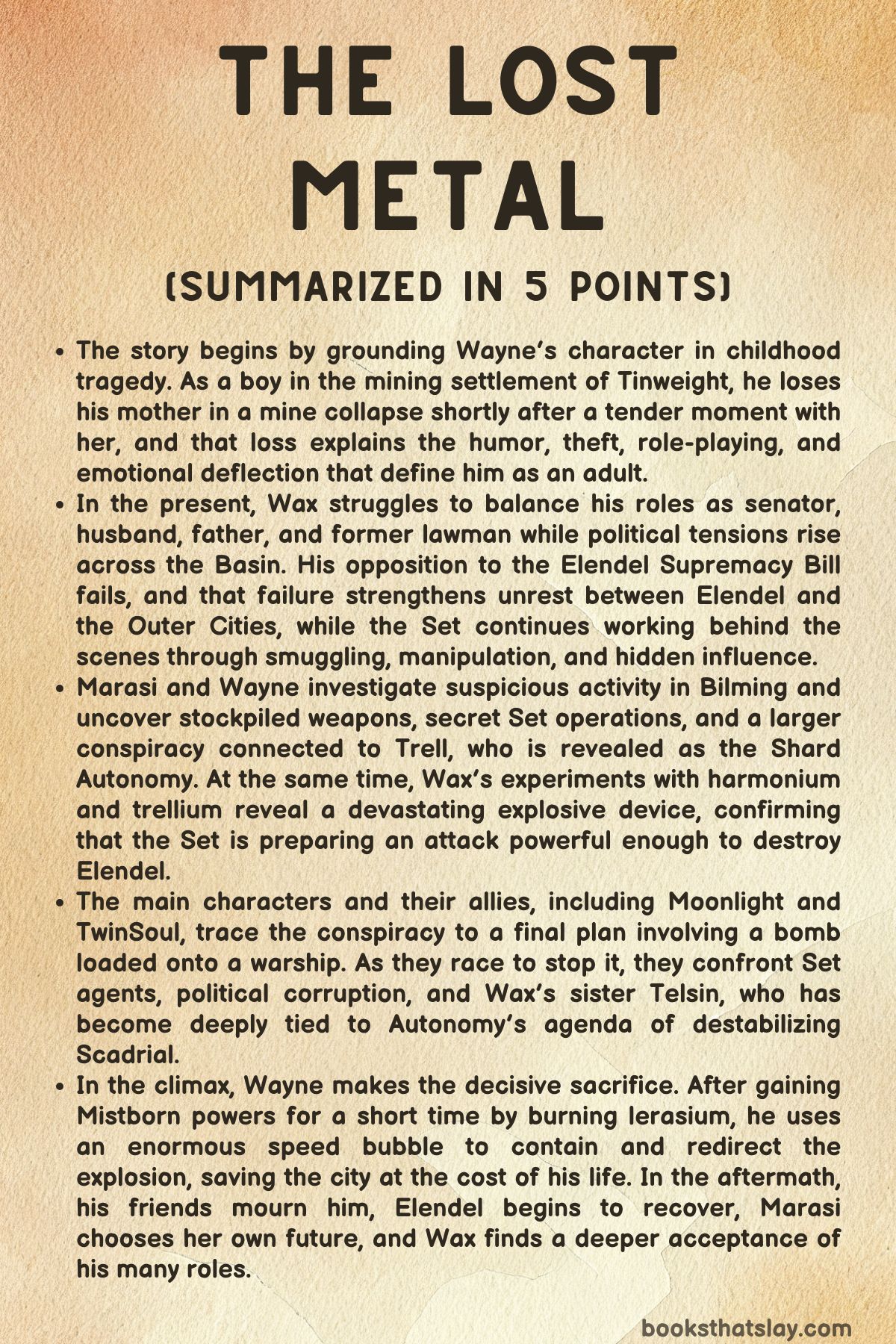
The book opens with a poignant prologue set twenty-nine years earlier. Eleven-year-old Wayne lives in poverty in the mining settlement of Tinweight.
He anxiously awaits his mother’s return from the dangerous mines that already claimed his father and uncle. To cope with fear and hardship, young Wayne steals small items, pretends to be other people, and collects oddities like clothes and playing cards left by miners.
When his mother returns safely one evening, she gently scolds him for theft but comforts him with a bedtime story about the heroic Allomancer Jak defeating bandits from within. The next day, a mine collapse kills her.
This early loss shapes Wayne’s lifelong use of humor, personas, and detachment as shields against grief and vulnerability.
In the present, Wax balances life as a senator, husband, and father to two young children (Maxillium and Tindwyl) with Steris, whose strategic mind and quiet support prove invaluable. Wax opposes the controversial Elendel Supremacy Bill, which would centralize power in Elendel’s governor at the expense of the Outer Cities, risking unrest or civil war.
Despite his efforts—delivering passionate speeches and presenting letters from Outer City leaders—the bill passes, heightening tensions. Wax’s sister Telsin is secretly a high-ranking member of the Set (their late uncle was also involved), adding personal stakes.
Meanwhile, Marasi (now a detective) and her partner Wayne investigate in the industrial port city of Bilming. They discover stockpiled weapons being smuggled, apparently intended to arm Outer Cities against Elendel and inflame divisions.
This ties into the Set’s broader activities, including the long-running kidnappings of Allomancers. Wax’s basement experiments with harmonium (the god metal of Harmony, a blend of atium and lerasium) accidentally reveal a new, catastrophic explosive when combined with trellium (Trell/Autonomy’s god metal).
The metals repel each other violently, suggesting a “nuclear”-style bomb capable of destroying Elendel. Harmony’s power is mysteriously blinded in Bilming, prompting the god to once again ask Wax to serve as his “Sword.”
The protagonists uncover that the Set, under Telsin’s leadership, plans to detonate a harmonium-trellium bomb in or against Elendel. Telsin has become an avatar of Autonomy, seeking to prove herself by destabilizing Scadrial and demonstrating independent strength—Autonomy values those who act decisively on their own.
The Set manipulates public perception, uses Hemalurgy (spiking individuals for enhanced or stolen powers), and exploits political friction. A key antagonist is the Cycle, a Hemalurgically enhanced Feruchemist whom Marasi confronts and defeats by exploiting his spikes and her clever use of time-slowing cadmium grenades and strategic thinking.
Allies include Worldhoppers and Ghostbloods members like Moonlight and TwinSoul, who assist in investigations. Marasi’s arc emphasizes self-worth: she feels her cadmium Allomancy (slowing time in bubbles) is “weaker” than others’ powers, yet her intelligence, determination, and leadership shine as she navigates underworld clashes, sewer explorations, and factory infiltrations tied to smuggling and bomb development.
Steris shines through meticulous planning, organizing evacuations and supporting Wax while challenging him emotionally. Wax grapples with identity—lawman versus senator versus family man—and his strained relationship with Harmony, questioning blind faith while accepting the need to act.
Wayne’s arc is the emotional heart. His impulsiveness and humor mask deep insecurity rooted in his mother’s death and past mistakes (including killing Allriandre’s father years earlier, for which he later atones via posthumous gifts).
He has grown wealthy through shrewd (if eccentric) dealings but feels unworthy. His loyalty to Wax and Marasi drives him, and he experiments with shaping his bendalloy time bubbles more precisely.
Investigations converge in Bilming. Wax, Wayne, Marasi, and allies infiltrate Set operations, confront corrupted officials (including Bilming’s leadership), and piece together the bomb’s location.
The device, loaded onto a warship rigged with dead-man switches and redundancies, is set to sail toward Elendel for detonation. The ship’s controls are booby-trapped; any interference risks immediate explosion.
In the frantic finale aboard the vessel, Wax and Wayne reach the bomb. Harmony communicates with them, confirming the dire stakes.
Wayne devises a desperate plan using his bendalloy (creating speed bubbles) and steel. He urges Wax to safety with a Steelpush.
Before Wax leaves, Wayne takes a vial containing a small amount of lerasium—produced accidentally in Wax’s harmonium-splitting experiments. Burning the lerasium briefly grants Wayne full Mistborn abilities, amplifying his powers dramatically.
He creates an enormous duralumin-enhanced speed bubble to slow time to a near-standstill around the bomb, allowing him to disarm or contain the blast while triggering a controlled, smaller explosion. His body is consumed in the process, but the city is saved.
Wayne dies a hero, finally accepting his own worth and declaring himself the best constable who ever lived.
Wayne’s sacrifice devastates his friends. Wax grapples with profound grief and guilt, wishing he could have said goodbye or found another way.
Steris helps him process that it was Wayne’s choice and that his death carried meaning. Marasi struggles with the loss while transitioning toward greater responsibilities; she meets Kelsier (leader of the Ghostbloods) but declines a full offer to join, prioritizing her own path.
She later takes on diplomatic or ambassadorial roles to help bridge divides between Elendel, the Outer Cities, and the Malwish Consortium from the Southern Continent.
Two years later (with seven epilogues providing closure), Elendel honors Wayne with a statue. The city and Basin begin healing from political wounds.
Wax finds peace, embracing his multifaceted identity as lawman, senator, husband, and father without needing to choose one role. He and Steris reflect on legacy and family.
Broader Cosmere threads emerge: Autonomy withdraws her direct influence for now (after Telsin’s failure and the bomb’s neutralization), but Harmony warns of future threats. Hints of atium/lerasium production, Wax becoming a weak Mistborn himself, and Kelsier’s ongoing schemes set up Era 3.
Allriandre appears symbolically as a recipient of Wayne’s wealth, underscoring his quiet redemptions and lasting impact.
Characters
Waxillium “Wax” Ladrian
Wax stands at the center of the novel’s moral, political, and emotional conflicts because he is pulled between several identities that all demand different versions of him. He is a former lawman shaped by direct action, a senator forced to work through institutions, a husband and father learning responsibility in quieter forms, and Harmony’s chosen instrument in moments of crisis.
What makes him compelling is that none of these roles fully cancels the others. He does not simply move from violence to civilization or from independence to duty.
Instead, he struggles to accept that adulthood requires him to hold conflicting obligations at once. His resistance to the Elendel Supremacy Bill shows his political conscience, but it also exposes his limits, because speeches and reason are not enough to stop large systems from moving toward injustice.
That failure deepens his frustration and reinforces his fear that he is most useful only when acting as a weapon.
His relationship with Harmony sharpens this inner conflict. Wax no longer accepts divine instruction with unquestioning faith, and that tension gives his character unusual weight.
He wants moral clarity, but he lives in a world where even a god is compromised, restricted, or uncertain. This forces him to become more independent in judgment.
He is not simply obeying a higher purpose; he is deciding what kind of man he will be when sacred authority cannot provide complete answers. That change matters because it turns him from an agent into a moral thinker.
His final role in the crisis is therefore not just heroic action, but acceptance that his worth is not limited to being a force of destruction against evil.
His family life also reveals dimensions of him that earlier conflicts could not. Steris and their children anchor him in a future beyond survival, and that domestic role challenges his self-image just as much as politics does.
He often thinks in terms of sacrifice and burden, but family asks him to think in terms of presence, continuity, and care. By the end, his development lies in accepting that being a protector does not only mean hunting threats.
It also means building a life worth protecting. His grief over Wayne’s death completes that understanding, because he must endure loss without reducing it to duty or necessity.
He emerges not as a man who solved every contradiction, but as one who finally recognizes that his fullness lies in carrying all of them honestly.
Wayne
Wayne is the emotional core of the story because his comedy, improvisation, and apparent carelessness conceal the deepest pain. His childhood losses explain the habits that define him: stealing, adopting accents and identities, avoiding sincerity, and turning every tense moment into a performance.
These are not random eccentricities. They are survival mechanisms created by a boy who learned too early that love can vanish suddenly and that grief becomes unbearable when faced directly.
His humor works because it is both genuine and defensive. He truly sees absurdity in the world, but he also uses absurdity to keep despair at a distance.
This gives him a unique emotional texture, since he is neither merely comic relief nor merely tragic. He is a man who built an entire personality to prevent himself from collapsing under memory and guilt.
That guilt is essential to understanding him. His long effort to make indirect restitution to Allriandre reveals a conscience that has never forgotten the harm he caused.
He does not believe he deserves forgiveness, and much of his behavior can be read as an attempt to remain useful because he cannot imagine being clean. Even his generosity has a self-punishing quality, as though he can compensate materially for wounds that cannot truly be repaired.
Yet the novel refuses to leave him trapped in self-hatred. His growth comes through the gradual recognition that remorse is not the same as moral worthlessness.
He can be flawed, responsible for terrible acts, and still capable of goodness that is real rather than compensatory.
His final sacrifice has power because it is not framed as a sudden transformation into heroism. Wayne has always been brave, loyal, and inventive.
What changes is his understanding of himself. When he chooses to stay behind, enhanced by lerasium and acting on the edge of impossible odds, he is not seeking punishment.
He is making a clear, loving, self-aware decision. He finally believes that his life has meaning and that his death, in that moment, is not an escape from guilt but an expression of value.
That is why his ending is devastating. He does not die because he was broken beyond repair.
He dies after discovering, perhaps for the first time, that he was worthy all along.
Marasi Colms
Marasi’s arc is grounded in the movement from self-doubt to self-definition. She begins from a position of comparison, often measuring her cadmium Allomancy against more visibly powerful abilities and feeling that she occupies a secondary place beside larger personalities.
Yet the narrative consistently proves that her real strengths are judgment, patience, intelligence, and the ability to read systems rather than simply react to them. Her investigative work in Bilming makes this clear.
She is not useful despite lacking flashy power; she is useful because she understands motives, institutions, and patterns of behavior with unusual clarity. Her method is deliberate, and in a story full of explosive force, that deliberateness becomes one of the most valuable traits anyone possesses.
Her confrontation with the Set also shows how her growth depends on rejecting inherited assumptions about strength. She learns that usefulness does not require resemblance to Wax’s decisiveness or Wayne’s improvisational brilliance.
Instead, she develops a style of action that is distinctly her own: analytical, ethical, and strategically patient. Her victory against the Cycle is especially revealing because it combines intelligence with composure under pressure.
She studies the enemy, understands the mechanics of his enhancements, and turns her supposedly limited powers into an advantage. That moment confirms what the novel has been building all along.
Marasi is formidable not because she suddenly becomes someone else, but because she stops undervaluing what she already is.
Her relationship to larger organizations such as the Ghostbloods extends this same theme. Meeting powerful people and being offered entry into secret structures could have functioned as a simple reward, but her refusal gives the arc greater integrity.
She does not define success as joining the most mysterious or prestigious group available to her. Instead, she chooses a path consistent with her own sense of purpose.
That decision affirms her independence at the deepest level. She has spent much of her life being adjacent to larger forces, whether family expectations, public events, or more dramatic personalities.
By the end, she is no longer adjacent. She is central to her own future, and her authority comes from the fact that she has chosen it consciously.
Steris Harms
Steris becomes one of the most impressive figures in the story because she turns qualities once dismissed as awkward or excessive into forms of strength that hold entire communities together. Her careful planning, social precision, and habit of preparing for worst-case scenarios are not treated as quirks for amusement.
They become essential responses to a world in political and material crisis. Where others improvise, Steris systematizes.
Where others focus on the immediate threat, she anticipates the second and third consequences. Her competence is especially striking because it is neither glamorous nor loudly celebrated within the world around her.
She performs labor that is often invisible until disaster proves how necessary it was all along.
Her marriage to Wax is one of the novel’s most mature relationships because it is built not on idealized romance but on mutual recognition. Steris understands the fractures in Wax’s personality and does not attempt to simplify him.
Instead, she supports him in ways that are emotionally intelligent without becoming sentimental. She challenges his instincts when necessary, especially when he tries to reduce himself to a sacrificial instrument, and reminds him that duty to family is not a lesser calling than duty to society.
In return, Wax increasingly sees her not as someone who complements him from the margins, but as a person with her own authority and vision. Their bond rests on trust earned through repeated acts of care, not on dramatic declarations.
Steris also embodies a broader moral idea about usefulness and dignity. She is a powerful answer to any worldview that only values charisma, combat, or spontaneity.
Her contribution to evacuation efforts and crisis management shows that order, preparation, and emotional steadiness are forms of courage. She does not seek symbolic heroism, yet she helps save lives on a massive scale by refusing panic and thinking clearly.
Her importance lies in the fact that she represents civilization at its best: not abstract law or political rhetoric, but the patient, practical work of helping people survive uncertainty together.
Telsin Ladrian
Telsin is one of the most unsettling figures because she joins ideological extremity with intimate betrayal. As Wax’s sister, she is not simply an external villain threatening the social order; she is a personal wound made political.
Her allegiance to the Set and eventual role as an avatar of Autonomy reveal how family connections can be hollowed out by ambition, resentment, and belief. She reflects what happens when independence becomes detached from empathy and accountability.
Autonomy’s values appeal to her because they flatter self-assertion, decisiveness, and separation from weakness, but those ideals curdle into cruelty when they are no longer limited by human concern. Telsin therefore embodies a version of freedom that destroys relationship in the name of strength.
Her significance is not only in what she does, but in what she represents for Wax. She forces him to confront the fact that evil can wear familiar faces and can emerge from the same lineage that produced him.
This personal connection prevents the conflict from becoming ideologically simple. He is not opposing an abstract enemy from a safe moral distance.
He is facing someone who shares his blood, history, and social position, yet has chosen domination over responsibility. That contrast sharpens the novel’s interest in choice.
Family background, pain, and pressure matter, but they do not erase agency. Telsin cannot be explained away as a victim of circumstance alone.
As a servant of Autonomy, she also reveals the seduction of certainty. She appears to believe that she is proving strength through decisive action, but what she actually demonstrates is dependence on a destructive ideology that rewards self-separation.
Her downfall carries thematic force because it exposes the emptiness of her model of power. She gains status, influence, and divine backing, yet becomes less human as she rises.
In that sense, she is not merely a villain to be defeated. She is a warning about what happens when the desire to be unconstrained by others turns into a refusal to recognize the humanity of others at all.
Harmony
Harmony occupies one of the most unusual roles in the novel because he is both divine and limited, immensely powerful yet unable to act with full clarity. Rather than providing certainty, he introduces tension about the reliability of higher authority.
His inability to see clearly into Bilming and his struggle against Autonomy complicate the old expectation that gods should resolve disorder from above. He is burdened by the balance of opposing powers within himself, and that internal division shapes the story’s moral atmosphere.
He wants to guide, preserve, and protect, yet his very nature restricts direct action. This makes him a figure of frustration as much as comfort, especially for Wax, who increasingly resists being treated as a weapon in a divine strategy.
What makes Harmony compelling is that he is not depicted as false or malicious, but as compromised by the structure of his own existence. His limits create a serious theological question within the narrative: what does faith look like when the object of faith is real, benevolent, and still not enough?
The answer is not rejection, but maturation. Characters can no longer rely on passive trust.
They must interpret, decide, and sometimes challenge the god they serve. Harmony’s importance therefore lies partly in how he forces human beings into moral adulthood.
He cannot replace their judgment, and perhaps should not.
His relationship with Wax reaches its most meaningful point when obedience gives way to difficult partnership. Harmony still needs a sword, but the sword is no longer willing to remain unthinking.
That shift is crucial because it humanizes both figures. Wax becomes more than an instrument, and Harmony becomes more than an infallible source of command.
In the aftermath of catastrophe, his warnings about future threats reinforce his cosmic significance, yet the emotional truth of his character remains his insufficiency. He is a god who cares deeply and still cannot prevent every loss, which makes his presence both comforting and tragic.
Moonlight
Moonlight brings a wider cosmere perspective into the novel, but she is effective because she is more than a device for exposition. She represents competence rooted in knowledge, adaptability, and concealed history.
Her involvement with the Ghostbloods positions her at the intersection of local crisis and larger interplanetary currents, which gives her an air of authority without making her emotionally inaccessible. She often appears controlled and professional, yet beneath that restraint lies a sharp understanding of how fragile worlds and people can be.
Her presence expands the scale of the conflict while also highlighting how much the main cast still does not know.
She also functions as a contrast to Marasi. Both are intelligent women navigating dangerous structures, but Moonlight is already comfortable operating in secrecy and ambiguity, whereas Marasi remains committed to more transparent forms of justice.
This contrast helps clarify Marasi’s growth. Moonlight shows one possible future path: power through hidden networks, deeper knowledge, and strategic distance.
The fact that Marasi does not simply follow that model gives both characters sharper definition. Moonlight is admirable, but she is not presented as a universal ideal.
Her abilities and poise also reinforce one of the novel’s key ideas about identity. She is someone who can quite literally alter what she appears to be, and that makes her a fitting presence in a story obsessed with masks, roles, and self-construction.
Yet unlike Wayne, whose shifting identities are tied to emotional defense, Moonlight uses transformation as mastery. She suggests that identity can be flexible without being false, as long as the person beneath the change remains intentional and self-aware.
TwinSoul
TwinSoul serves as a stabilizing presence among the offworld allies because he projects physical and moral solidity. His abilities make him impressive, but what defines him more strongly is his sense of groundedness.
He is measured where others are frantic, direct where others are secretive, and quietly principled without becoming rigid. In a narrative full of improvisation, panic, and political distortion, he offers a sense of dependable structure.
That steadiness makes him memorable even when he is not the emotional center of the story.
His interactions with the main cast also help illuminate the scale of the world beyond Scadrial. He is evidence that the crisis is not purely local and that different cultures produce different forms of power, discipline, and responsibility.
Yet he never feels reduced to a piece of lore. His value lies in how he affects the texture of scenes, often making them feel more balanced by introducing perspective and restraint.
He stands as a reminder that strength can be calm rather than theatrical.
TwinSoul’s broader narrative role is to reinforce the idea that cooperation across difference is necessary in a world facing threats larger than any one city or political faction. He does not share the protagonists’ history, religion, or national loyalties, but he still chooses to help.
That choice matters because it counters the logic of separation that defines both the Set and Autonomy. His presence quietly argues that solidarity does not require sameness, and that trustworthy alliance can exist even among people shaped by entirely different worlds.
Themes
Identity as a Burden and a Choice
Identity is treated not as a fixed truth waiting to be discovered, but as something formed through pressure, role, memory, and repeated decisions. Wax is divided between lawman, senator, husband, father, and divine instrument, and his struggle comes from believing these identities compete with one another.
Wayne uses imitation, accents, humor, and theft to avoid a stable self because stability would force him to face grief and guilt directly. Marasi feels trapped by comparison, as though her place has already been decided by the more dramatic abilities and reputations around her.
Across these arcs, the central issue is not confusion alone, but the fear that one’s identity might already be determined by past actions, trauma, or public expectation.
What gives the theme force is that the story rejects both complete freedom and complete determinism. The characters are shaped by history, yet they are not imprisoned by it.
They become themselves through response. This is especially clear in The Lost Metal, where selfhood gains moral meaning only when it is chosen under pressure.
Identity becomes healthiest when it stops being performance for others and starts becoming honest responsibility. The novel suggests that a person is not defined by a single role or by the worst thing they have done, but by what they continue to choose when those facts remain true.
Power, Responsibility, and Moral Limits
Power is never presented as simple capability. It always raises the question of what kind of judgment must govern force before force becomes destruction.
Political authority, divine authority, scientific discovery, and magical ability all carry the same underlying danger: they can be used in ways that exceed the wisdom of the people holding them. The harmonium-trellium bomb is the clearest material example, because it transforms knowledge into civilization-ending possibility.
Yet the theme extends far beyond weapons. Harmony possesses godlike power but cannot act cleanly.
Wax can kill efficiently but cannot solve public division through violence. Telsin gains greater influence as she aligns herself with Autonomy, yet that ascent strips away ethical restraint rather than confirming strength.
The novel’s treatment of responsibility is serious because it refuses the fantasy that good intentions automatically justify dangerous means. Characters must ask whether they are acting out of duty, fear, pride, faith, or desperation.
Steris’s practical competence becomes important here because she models responsible power in its least glamorous form: preparation, organization, and care for vulnerable people. The contrast is sharp.
Catastrophic power seeks spectacle, while responsible power often looks administrative, patient, and restrained. The story argues that power without moral limits becomes domination, but power governed by responsibility can preserve life, dignity, and social order even under extreme threat.
Grief, Guilt, and the Possibility of Redemption
Loss shapes nearly every major emotional decision in the novel. Wayne’s childhood bereavement creates the emotional architecture of his adult personality.
Wax carries grief not only from present danger but from accumulated death, family betrayal, and the repeated burden of being the person asked to act when others cannot. Even the political crisis reflects a collective form of damage, as cities and factions interpret fear through resentment and prepare to answer insecurity with aggression.
Grief therefore does not appear as a private interruption to the plot. It is one of the forces driving the plot, shaping how characters love, hide, speak, and decide.
Guilt intensifies that grief because several characters feel responsible, whether justly or not, for harm that cannot be undone. Wayne’s long attempt to compensate for the death he caused reveals how remorse can become a way of life.
The novel does not dismiss guilt, but it does challenge the idea that self-condemnation is the highest form of moral seriousness. Redemption is shown not as erasure of the past, and not as a single dramatic absolution, but as a continuing willingness to act truthfully in the presence of irreversible wrong.
That is why Wayne’s ending carries such emotional force. He does not become redeemable because he dies.
His final act matters because it comes after he has already begun to accept that redemption means living and choosing differently, not merely paying a price.
Autonomy, Community, and the Danger of Isolation
The conflict around Autonomy gives ideological shape to the novel’s political and personal struggles. Independence sounds admirable at first, especially in a world where cities resent domination, individuals want control over their own lives, and divine guidance is imperfect.
Yet the story distinguishes sharply between self-rule and isolationist pride. Autonomy’s philosophy becomes dangerous because it strips interdependence of value and treats vulnerability as weakness.
Telsin and the Set exploit existing political divisions by encouraging groups to define themselves against one another rather than with one another. The result is not freedom, but fragmentation, suspicion, and the near destruction of the social order.
This theme works because it appears at every scale. Nations distrust cities, cities distrust one another, gods distrust rival powers, and individuals struggle to rely on friends or family without feeling diminished.
Against this, the novel offers a different model of strength: cooperation without surrender of self. Steris organizes people rather than controlling them.
Marasi works with allies while maintaining moral independence. Wax learns that family obligation does not weaken public duty.
Even the help from offworlders suggests that connection across difference is necessary in a threatened world. The theme ultimately argues that autonomy without relationship becomes sterile and violent.
Human flourishing depends not on radical separateness, but on freely chosen bonds of trust, responsibility, and mutual aid.