The Never King Summary, Characters and Themes
The Never King by Nikki St. Crowe is the first book in the Vicious Lost Boys series, a dark, explicit reverse-harem romantasy retelling of Peter Pan. It reimagines Peter Pan as a dangerous, obsessive ruler rather than a boy frozen in innocence.
The story follows Winnie Darling, who grows up under the shadow of a family curse: every Darling woman is taken at eighteen and returned damaged, if she returns at all. When Winnie is taken to Neverland, she enters a world filled with fading magic, brutal desire, old betrayals, and men who are as broken as the island they serve. Combining fantasy, menace, sensuality, and family mystery, the novel turns a familiar myth into something far darker and more adult.
Summary
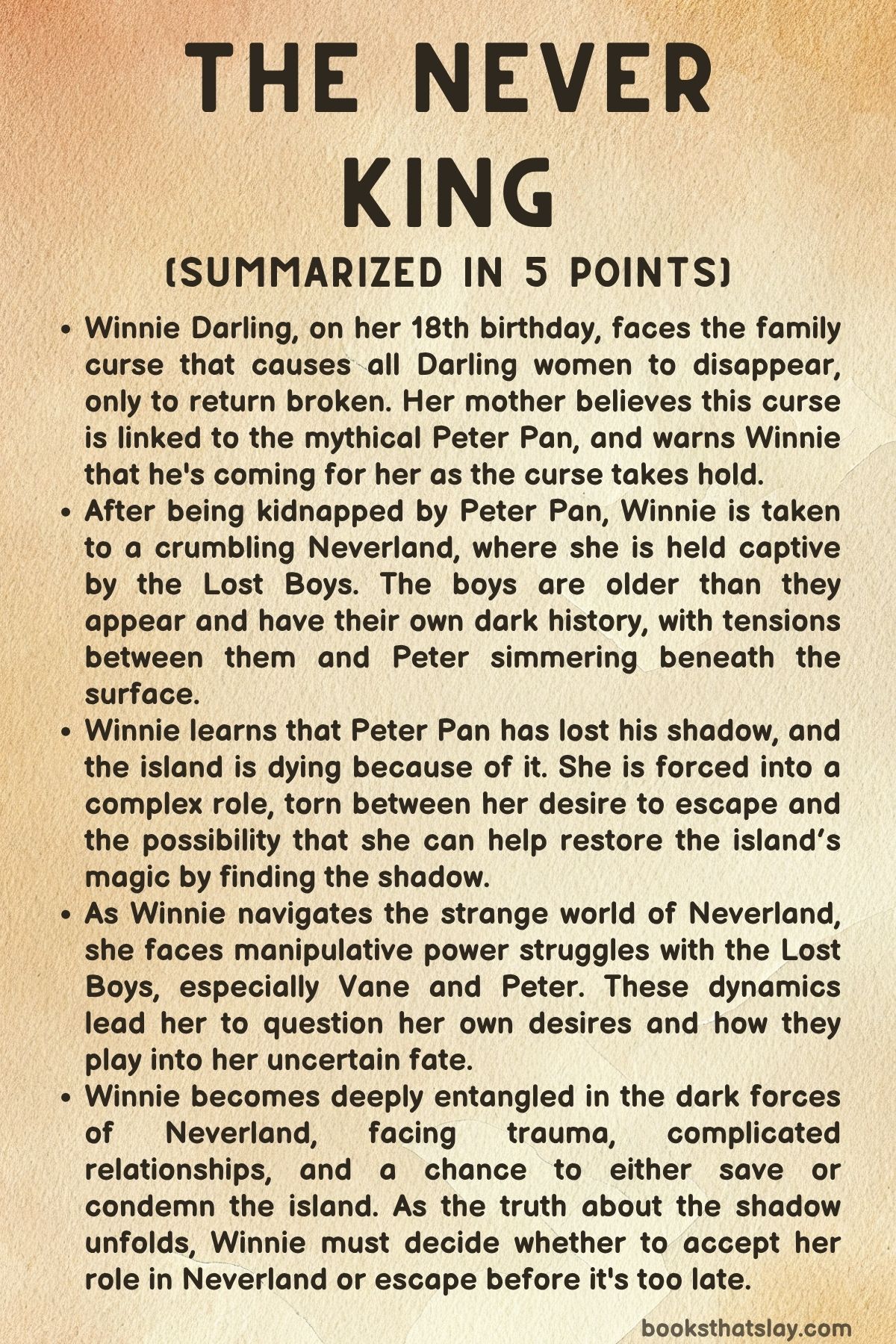
Winnie Darling has spent her life living under the strain of a family terror that no one outside her home takes seriously. Her mother, Meredith, has always warned her that Peter Pan is real and that he comes for Darling women when they turn eighteen.
Meredith is treated as unstable, much like the other women in the family before her, and her fear shapes the whole house. Locks, symbols, rituals, and forbidden rules fill Winnie’s childhood.
Even so, Winnie grows up emotionally distant from her mother’s warnings, not because she fully believes they are false, but because she has learned to survive by shutting herself off from fear.
On the day Winnie turns eighteen, that fear finally becomes impossible to dismiss. Meredith becomes frantic and forces Winnie into a special protected room covered in symbols meant to keep evil away.
For the first time, Meredith gives a fuller explanation. She says Peter takes Darling women to Neverland, a magical island where he believes they can somehow help him.
She describes the place as beautiful but deeply dangerous, and admits she does not know how to stop him. Later that night, Peter appears exactly as Meredith predicted.
He is not the childish fantasy figure of storybooks, but a powerful, dark, frightening man. Meredith begs for Winnie to be spared, but Peter takes her anyway, promising only that he will bring her back.
Winnie wakes in Neverland, a place that is both ruined and enchanting. She finds herself chained to a bed inside a treehouse home near the sea.
Peter leaves her in the care of the Lost Boys, especially the twins Kastian and Sebastian, known as Kas and Bash. They are unsettling but fascinating, and each reveals a different kind of danger.
Kas is softer and more attentive, while Bash is reckless, provocative, and openly sexual. Another Lost Boy, Vane, is even more disturbing.
He possesses a supernatural force that lets him fill Winnie with raw terror, showing her at once that this island is ruled through fear as much as fantasy.
Winnie slowly learns that she was not taken at random. Peter and the island itself are failing.
His magic is weakening, Neverland is decaying, and the Lost Boys believe Winnie may hold the answer. They tell her that the Darling line stole something valuable long ago, something Peter needs to survive.
Cherry, a human girl living among them, expands Winnie’s understanding of the island. She reveals that Neverland is only one of several magical realms, each connected to shadows of life and death.
Peter once held the life shadow of Neverland, but he lost it, and both he and his kingdom have been deteriorating ever since.
Peter’s own condition reinforces how fragile he has become. He can no longer tolerate daylight and spends his days entombed underground.
He wakes at night, armed and volatile, driven by anger, desperation, and possessiveness. When he confronts Winnie, he tells her plainly that she is there to help him recover what her family stole.
Winnie resists him, tries to run, and quickly learns escape is not simple. Neverland is physically and magically separate from her world, and Peter can overpower her with ease.
Recognizing that direct resistance will not protect her, Winnie turns to manipulation. Using sexual confidence as a shield and a weapon, she tries to influence the men around her.
She first tests this strategy on Kas, who is kind to her and briefly lowers his guard, but he stops before things go too far. Bash proves more vulnerable to her provocation, and the tension between them becomes physical.
Peter interrupts their encounter, asserting control over both of them. His reaction reveals something important: Winnie is no longer just a prisoner linked to an old family mystery.
She is becoming personally significant to Peter and to the men around him.
As Winnie spends more time in Neverland, she discovers that its beauty and corruption exist side by side. She is drawn into bonfires, faerie drink, sensual games, and shifting alliances, even while danger remains constant.
At one party she goes too far in Peter’s eyes by kissing another Lost Boy, and Peter responds with shocking brutality, killing the boy in public and making clear that Winnie now exists inside his rules. His possessiveness becomes explicit, and the lines between punishment, desire, and control grow increasingly blurred.
The twins are also deeply tied to her now, torn between loyalty to Peter and their own fascination with her.
Beyond the erotic power struggle, Winnie uncovers the deeper history of the island. Kas and Bash are not ordinary boys but banished fae princes who killed their father and lost their wings.
Cherry comes from Hook’s territory, suggesting that Neverland contains multiple powers beyond Peter’s house. Vane carries a death shadow from another island, which explains both his frightening power and the emotional damage surrounding him.
Each of these figures is marked by exile, violence, or decay, and all of them are trapped in one way or another.
Winnie’s most important discoveries concern the Darling bloodline itself. Peter eventually tells her that one of her ancestors stole his shadow long ago.
Since then, he has taken Darling women at eighteen because he believes memory can be passed through blood. He hopes one of them will remember where the shadow was hidden.
This history casts Meredith and the other Darling women in a tragic new light. They were not simply unstable; they were repeatedly subjected to magical invasion and psychic damage.
Winnie realizes that the madness haunting her family may have been forced upon them.
This danger becomes immediate when Queen Tilly, the fae ruler and sister of Kas and Bash, arrives during the full moon. She has the power to search Winnie’s mind for inherited memories.
The process is agonizing, and Winnie feels as though her inner self is being torn apart. As Tilly pushes further, it becomes increasingly clear that something is wrong.
Rather than helping Peter recover what he lost, she may be using the searches to destroy the Darlings and ensure the secret remains hidden. Vane, who has so often frightened Winnie, is the one who finally stops the attack.
He carries her away, protects her, and offers her a rare moment of care, showing that even the cruelest figure among them is capable of refusing further harm.
After this, Winnie dreams a memory from the past. In it, an earlier Darling hides a box in a secret compartment inside Wendy’s trunk.
Winnie also sees a winged woman similar to Tilly, but not Tilly herself. Peter explains that this woman was Tinker Bell.
Long ago, Tinker Bell loved him and hated the Darling he loved. She stole his shadow and killed that original Darling.
Peter later killed Tinker Bell in return, but the shadow remained hidden. The Brownies and other servants have since worked to keep it out of his hands.
Once Winnie understands that the answer lies in Wendy’s trunk, the story moves back into the human world. Peter, Winnie, Vane, and the twins return to her family home, where they discover Meredith trapped by Brownies loyal to the old conspiracy.
During the confrontation, the Brownie leader tempts Kas and Bash with the possibility of taking the shadow for themselves, but the truth now matters more than ambition. Peter kills the leader, and Winnie finds the hidden box in the secret drawer exactly where the inherited memory showed her it would be.
In the aftermath, Winnie speaks with Meredith in a calmer, more intimate way than ever before. Meredith admits that before her mind was shattered, part of her had wanted to stay in Neverland because of its magic.
This conversation allows Winnie to see her mother not only as a frightened, damaged woman, but as someone who once had desires and choices of her own. Meredith decides to remain in the family house, while Winnie chooses to return to Neverland with Peter and the Lost Boys.
The novel ends on a revelation rather than a resolution. Back in Neverland, Peter opens the box expecting to reclaim his missing shadow and restore himself.
Instead, two shadows emerge. This closing moment changes the mystery once again.
It suggests that the past is even more complicated than Peter believed, that the theft of the shadow involved more than one force, and that the future of Winnie, Peter, and the island is still uncertain. By the end, Winnie has changed from a numb, reluctant victim into someone who actively confronts the truth of her family, the men who claim her, and the dangerous magic binding all of them together.
Characters
Winnie Darling
Winnie begins as emotionally shut down, and that numbness is one of the most important parts of her character. She has spent her life trapped between a normal world that dismisses her mother as insane and a home life shaped by ritual, fear, and prophecy.
Because of this, she meets extraordinary horror with a strange calmness that can look like bravery but is really a survival response. Once she reaches Neverland, that detachment becomes a tool.
She studies the people around her, tests boundaries, and quickly learns that vulnerability has little value in a place ruled by power. Her decision to use seduction as leverage shows both her intelligence and her recklessness.
She is not simply acting out desire; she is trying to claim agency in a situation built to strip it away.
As the story continues, Winnie becomes more complex than either victim or temptress. She is curious, manipulative, frightened, and stubborn all at once.
She does not fit the pattern Peter expects from the Darling women before her, and that difference gives the novel much of its tension. She also carries the emotional weight of inherited trauma.
Her family history is written into her body and mind, and the revelation that the Darling women were repeatedly harmed by magical intrusion gives her role real tragic force. By the end, she has become someone willing to face brutal truths rather than hide from them.
Her choice to return to Neverland shows that she is no longer moving only out of fear. She is choosing her place in a dangerous world that has already marked her.
Peter Pan
Peter is presented not as an eternal child but as a decaying king whose beauty, violence, and desperation exist together. He rules through fear, appetite, and control, yet beneath that dominance is a figure in decline.
His lost shadow is not just a magical object but a symbol of wholeness, identity, and authority. Without it, he is physically weakened, unable to walk in daylight, and increasingly unstable.
That makes his obsession with Winnie more layered than simple possession. He needs her because of what her bloodline may remember, but he is also drawn to her because she resists the roles others have played before her.
She unsettles him, and that loss of control is one of the clearest signs that he is still vulnerable despite all his cruelty.
What makes Peter compelling is that the story does not reduce him to either monster or tragic hero. He is capable of tenderness, honesty, and even a certain rough protectiveness, but these qualities never erase the harm he causes.
His violence is real, and his jealousy is often terrifying. At the same time, his past carries grief, betrayal, and the collapse of a kingdom that was once alive with power.
He is a ruler trying to recover not just his shadow but also the self he was before loss changed him. His connection to Winnie grows from need into fixation, and that shift gives his character emotional danger.
He is not redeemed, but he is revealed as fractured in ways that make his darkness feel personal rather than empty.
Kastian
Kas serves as the gentlest emotional entry point into Neverland’s inner circle. He is still dangerous, but compared with the others he offers warmth, patience, and moments of softness that make him stand out.
His early interactions with Winnie show a capacity for care that the others often bury under threat or lust. He comforts her, shares pieces of the island’s magic, and reveals truths without immediately using them as weapons.
This does not make him harmless. Instead, it shows that he holds his violence further below the surface.
His restraint gives him moral complexity, because he understands what is happening to Winnie and yet remains part of the system holding her there.
Kas is also shaped by exile and guilt. As a banished fae prince who helped kill his father, he carries a history of blood and punishment that prevents him from being merely the kind twin.
His closeness with Bash is central to who he is. Their relationship is protective, intimate, and deeply coded by shared shame and survival.
Kas often acts as the balancing force between Bash’s impulsiveness and Peter’s brutality, but he is never fully outside their orbit. His attraction to Winnie disturbs him because it threatens the emotional lines he has tried to keep intact.
In him, the novel explores what happens when tenderness survives inside a violent world without being strong enough to change it.
Sebastian
Bash is the twin who lives closer to appetite, chaos, and immediate feeling. He is flirtatious, provocative, and more openly physical than Kas, which makes him seem simpler at first, but he is carrying his own wounds.
His attraction to Winnie is immediate because she challenges him and because she actively reaches toward danger rather than shrinking from it. Their connection is one of the most openly charged in the book, but Bash is not only a source of lust.
He also reveals emotional attentiveness in surprising ways, such as remembering Winnie’s favorite food and offering gestures that feel almost domestic. These moments matter because they show that his care is real even when his choices are reckless.
Bash’s inner conflict comes from being both participant in and witness to Peter’s control. He desires Winnie for himself, yet his loyalty to Peter and his bond with Kas trap him inside a hierarchy he cannot escape.
He understands that Peter is dying, that Neverland is failing, and that Winnie may change everything, but he has no clean way to act on that knowledge. His sexuality often looks bold and fearless, yet emotionally he is vulnerable to rejection, jealousy, and shame.
That combination makes him one of the more human figures in the cast. He is impulsive, yes, but he is also capable of affection that feels instinctive rather than strategic.
Vane
Vane is introduced as the most frightening of the Lost Boys because his power operates directly on the mind. He can summon terror in a way that strips people down to their most helpless selves, and his presence is tied to the death shadow he carries.
This makes him feel predatory from the beginning, yet his character gradually opens into something more complicated. His cruelty is not only sadism.
It is also a result of living in close contact with corruption, violence, and emotional ruin. He knows what it means to break someone, and that knowledge gives him a grim self-awareness the others do not always show.
His relationship with Winnie is built on conflict, resistance, and denied desire. She refuses to collapse under his intimidation, which catches his attention precisely because he expects fear.
When she tries to provoke him sexually, his refusal becomes significant. He could use her vulnerability for his own satisfaction, but he pulls back because he does not want to leave her damaged in the way he has seen others become.
Later, when he interrupts Tilly’s psychic assault and protects Winnie, he reveals the clearest moral boundary in his character. Vane may be dangerous, but he is also the one most openly disgusted by cycles of abuse disguised as necessity.
His darkness gives him a harsher kind of conscience.
Meredith Darling
Meredith initially appears as the classic unstable mother figure, the woman whose warnings are too strange for anyone to believe. As the story unfolds, that image is redefined with devastating clarity.
She is not simply irrational; she is a survivor of repeated violation whose damaged mind has been interpreted as madness. Her rituals, symbols, and paranoid behaviors come from lived experience, not fantasy.
This changes how the reader understands her entire role. She has spent years trying to protect Winnie with the only tools left to her, even though language itself often fails her.
Her fragmented speech reflects trauma rather than unreliability.
Meredith also represents the cost of inherited violence. The Darling curse is not abstract in her case; it is visible in her fear, her damaged sense of reality, and her desperate need to keep history from repeating.
Yet she is more than a warning figure. Her final conversations with Winnie restore some of her lost humanity by showing that she once felt wonder as well as fear.
She remembers the magic of Neverland even through the ruin it caused her. That detail makes her especially tragic, because it suggests that what broke her was not only terror but also the destruction of desire and possibility.
She is one of the clearest examples of how women in this story are forced to carry the consequences of old male conflicts.
Cherry
Cherry plays an important supporting role because she offers Winnie a view of Neverland that is neither fully captive nor fully empowered. She is human, but unlike Winnie she came into this world willingly and has adapted to its strange rules.
Through her, the island feels larger and more socially layered. She knows about the seven islands, the political tension between rulers, and the deeper history shaping the men in Peter’s house.
That knowledge makes her useful as an informant, but it also highlights her vulnerability. Her bruises and evasions suggest that survival in this world requires silence as much as loyalty.
Cherry’s character adds perspective on consent, compromise, and belonging. She is not idealized as a free spirit choosing fantasy over reality without consequence.
Instead, she seems like someone who has made peace with a dangerous environment because the alternative may feel worse or because she has learned how to find value within it. Her scenes with Winnie quietly expose how normalized violence has become in this world, especially for women.
At the same time, she is not powerless. She understands more than she says, and her ability to move among the Lost Boys gives her a practical resilience that matters.
Queen Tilly
Tilly embodies cold authority, political calculation, and the seductive face of manipulation. As queen of the fae and sister to Kas and Bash, she arrives with immediate power, and her beauty only sharpens the threat she poses.
Unlike Peter, whose rage is open, Tilly’s danger is controlled and ceremonial. She does not need to shout to dominate a room.
Her authority comes from knowledge, lineage, and strategy. The search she performs on Winnie’s mind is presented as necessary, but the deeper truth is that Tilly has her own ambitions.
She is willing to let Peter fail and appears to have used the Darling women as expendable vessels in a larger plan to keep the shadow from him.
Tilly’s significance lies in how she broadens the story’s idea of power. She is not driven by romance, lust, or wounded attachment in the way others are.
She is driven by rule, inheritance, and advantage. That makes her especially unsettling.
Even her ties to her brothers are shaped by distance rather than tenderness. She reflects a world where cruelty can be elegant, rational, and politically useful.
Through her, the novel shows that women in positions of power are not automatically protectors. Tilly is neither victim nor savior.
She is a ruler who treats pain as an acceptable cost of ambition.
Tinker Bell
Though she appears mostly through backstory and memory, Tinker Bell is one of the most important unseen forces in the novel. She transforms the familiar fairy figure into a jealous, destructive presence whose love becomes possessive hatred.
Her theft of Peter’s shadow and murder of the Darling he loved set the entire plot into motion. Even after death, her choices continue to shape the lives of Winnie, Meredith, Peter, and the Lost Boys.
She functions almost like a ghost haunting the bloodline and the island alike.
What makes Tinker Bell interesting is that she represents desire turned into ruinous control. She is not remembered as innocent or whimsical.
She is remembered as someone who wanted exclusive claim over Peter and chose violence when she could not have it. In that sense, she mirrors Peter while also standing against him.
Both are possessive, both are shaped by obsession, and both leave damage behind them. Her legacy also exposes the long reach of unresolved grief.
The past is not dead in this world; it actively structures the present, and Tinker Bell is one of its clearest examples.
Themes
Inherited Trauma and the Weight of Bloodline
Family history in The Never King is not a matter of memory alone but of damage carried across generations. Winnie’s life is shaped long before she understands why, because the Darling women before her have already suffered the consequences of an old theft and a long campaign of control.
The novel treats inherited trauma as something that lives in the body, the mind, and the home itself. Meredith’s paranoia, the rituals around the house, and Winnie’s emotional numbness all show how deeply the past has already entered the present.
What makes this theme especially powerful is that the so-called madness of the Darling women is revealed to be a response to real violation. Their instability is not proof that they imagined danger; it is proof that the danger was never allowed to end.
Bloodline here is both a curse and an archive. It carries memory, but it also carries pain, making identity inseparable from what earlier generations were forced to endure.
Desire as Power, Weapon, and Vulnerability
Sexuality in the novel is never presented as simple romance or simple pleasure. It operates as negotiation, defiance, possession, and self-defense all at once.
Winnie quickly learns that in Neverland desire can change the balance of a room, redirect attention, and create temporary forms of control. Her use of seduction begins as a survival tactic, a way to keep from being reduced to helplessness.
Yet the story also shows how unstable that tactic is, because desire can never be fully managed once it enters a violent hierarchy. Peter, Bash, Kas, and Vane all respond to Winnie through their own wounds, needs, and fears, which means erotic tension often carries real threat.
At the same time, the novel refuses to make desire purely destructive. Attraction also reveals emotional truth.
It exposes where the men are weakest, where Winnie is most reckless, and where connection and danger become almost impossible to separate.
Decay Behind Fantasy
Neverland is introduced as magical, beautiful, and dreamlike, but that beauty is inseparable from rot. The island is failing because its ruler is failing, and the fantasy space that should represent wonder instead reveals decline, imbalance, and exhaustion.
This gives the setting unusual depth. It is not simply a dark version of a children’s tale; it is a world where enchantment itself has been damaged by loss.
Peter sleeping underground, daylight becoming deadly, and the island’s dependence on a missing shadow all suggest that fantasy can wither just as easily as ordinary life. The result is a setting where beauty becomes unsettling rather than comforting.
Glowing water, fae illusions, and moonlit revelry exist beside cruelty, fear, and physical ruin. That contrast allows the novel to question the appeal of magical escape.
Wonder remains real, but it comes at a cost, and the story keeps asking whether beauty is enough to justify the pain bound up in it.
Control, Captivity, and the Struggle for Choice
Nearly every central relationship in the novel is shaped by unequal power. Winnie is taken against her will, watched, restrained, and used as the key to a problem created long before her birth.
Peter rules through command and threat, Tilly uses mental invasion as a tool, and even the more sympathetic characters remain tied to systems that limit freedom. What makes this theme stand out is that captivity is not always physical.
Meredith is trapped by trauma, Peter by loss, Kas and Bash by exile and loyalty, and Vane by the darkness he carries. Choice therefore becomes one of the most valuable things in the story.
Winnie cannot control the fact of her abduction, but she constantly fights to control her responses, her body, her secrets, and eventually her future. Her final decision to return to Neverland matters because it complicates the idea of freedom.
The novel suggests that agency does not always mean escaping a dangerous place. Sometimes it means claiming the right to decide, even within conditions shaped by violence and desire.