Worst Wingman Ever Summary, Characters and Themes
Worst Wingman Ever by Abby Jimenez is a contemporary romance novella built around timing, grief, and the small accidents that can change a life. At first, it looks like a light story about a misplaced Valentine’s note, but it quickly becomes more than that.
The book pairs humor and tenderness with the very real pain of heartbreak, caregiving, and loss. At its center is Holly, a hospice nurse trying to stay strong while caring for her dying grandmother, and John, a maintenance man still recovering from his own failed relationship. Their connection begins by mistake, then slowly grows through kindness, patience, and the feeling that maybe hope can return when life seems at its hardest. It’s the 1st book of the Valentine’s Day series.
Summary
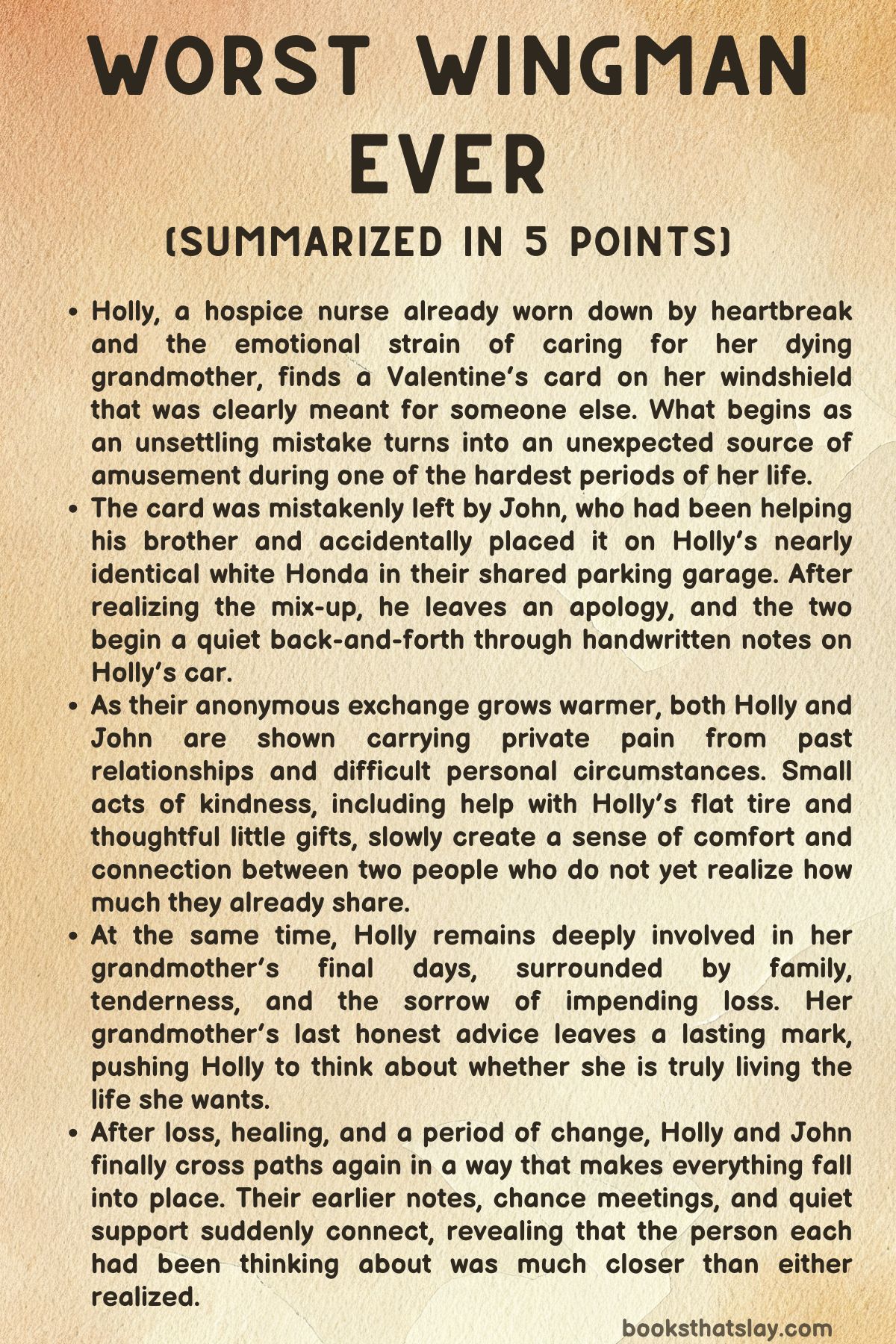
Holly is already carrying more than she can manage when an odd surprise appears on her car. She is working as a hospice nurse and, at the same time, helping care for her grandmother, who is in the final stage of her life.
During a quick errand in the middle of her shift, Holly finds a Valentine’s Day card taped to the windshield of her white Honda. Because the situation feels suspicious, she immediately becomes alarmed.
She locks herself in the car, calls her sister Jillian, and drives somewhere public before checking what it is. When she finally reads it, she discovers that it is not a threat at all but a handwritten romantic note meant for someone named Andrea.
Along with it is a crude coupon for sex, which makes the whole thing feel awkward and ridiculous. Holly realizes someone left it on the wrong car, so she tosses it into her glove compartment and goes back to the much heavier reality of her day.
Her private life is already full of strain. She is still wounded by the end of her relationship with Jeb, who cheated on her, and she is emotionally worn down from watching her grandmother decline.
Holly tries to keep herself steady for everyone else, but she is scared, tired, and grieving even before the loss has fully happened. Her family surrounds her grandmother with warmth, beauty, laughter, and company, because that is what her grandmother wants.
She does not want her final days to feel cold or clinical. Holly helps create that environment while also quietly recognizing the medical signs that death is getting closer.
The story then shifts to John, revealing how the card ended up on Holly’s car in the first place. John had agreed to help his brother Frank by placing the Valentine on Frank’s girlfriend’s white Honda in their shared apartment garage.
Because Holly’s car looks almost identical, John makes the mistake without realizing it. Once he understands what happened, he feels bad about it.
Later, when he spots the same car again, he leaves an apologetic note on the windshield explaining that the card was a mix-up.
Instead of being upset, Holly finds the apology funny. She writes back, returns the original card in a plastic bag, and reassures him that no angry boyfriend was involved.
That small exchange begins a quiet correspondence between two strangers. They keep leaving notes for each other on the car, and the messages slowly become a bright spot in Holly’s difficult days.
John has his own problems. He is still hurting from a breakup with Brenda, who left him for someone else after they had been planning a future together.
He works as a maintenance man in a large apartment complex while also doing repair work for Frank. His days are often unpleasant and messy.
In one especially awful situation, he enters an empty apartment expecting to find a dead body because of the smell, only to discover a neglected puppy trapped in a crate. The dog has been abandoned and barely cared for.
John rescues him, cleans him up, keeps him, and eventually names him Doobie. The rescue shows John’s decency and also gives him companionship during a lonely period.
As the note exchange continues, John notices that Holly’s tire is going flat. Concerned that she may not realize how bad it is, he fills it with air and leaves her a note explaining what he did.
For Holly, this simple act matters more than he knows. She is already stretched thin by grief and responsibility, and a flat tire would have been one more problem she could barely handle.
She gets the tire repaired and leaves him a thank-you note along with a gift card. Their anonymous bond becomes more personal through these small acts of help.
John then buys Holly a nurse bobblehead to place on her dashboard so her car will stand out from all the other white Hondas. Holly loves it.
The gift makes her feel seen and cared for, even though she still does not know exactly who he is. At the same time, life in her grandmother’s apartment keeps moving toward the inevitable end.
Family members visit and say their goodbyes. Jillian, trying to lighten Holly’s mood and gently push her toward the future, jokes that when Holly is ready to date again, she should go to Home Depot and look for a man carrying red tools.
Holly laughs, though she is not ready to think seriously about romance.
Not long after that, Holly notices a handsome man in the building with a dog and a tool belt. She sees him in the elevator and later in the courtyard.
This is John, but neither of them realizes that the stranger standing in front of them is the same person from the notes. In the courtyard, Holly pets Doobie and talks with him.
Their conversation is easy and playful. They joke together, share a natural warmth, and clearly enjoy each other’s company.
Even so, the moment slips away before either one asks the other’s name or makes the connection.
Meanwhile, Holly’s grandmother reaches the final stage of her life. In one of her last clear moments, she shares a shocking secret with Holly.
She reveals that her first husband had been abusive and that she killed him in self-defense, with her sister Lucy helping her hide what happened. She is not telling Holly this out of guilt or to seek forgiveness.
She wants Holly to understand something larger: if she is unhappy with her life, she has to take responsibility for changing it. She cannot stay trapped inside pain, fear, or habit.
The next morning, Holly’s grandmother dies with her family around her.
The death leaves Holly grieving, but it also marks the beginning of a shift. After the funeral, she starts thinking seriously about what it means to move forward instead of only surviving.
John, too, begins to change. Encouraged by Holly’s last anonymous note, which repeats the grandmother’s advice about changing a life you do not love, he starts putting more effort into himself.
He improves his appearance, decorates his apartment, settles more comfortably into his work, and grows more connected to the people around him. Though they are apart, each remains affected by the other.
Both think of the note-writer as someone important they somehow missed.
Their paths finally come together properly when Holly calls maintenance at her apartment because her sliding door is sticking. John is the one who arrives to fix it.
The second they see each other, they recognize the familiar face from the courtyard. As they talk, more details fall into place.
The nurse bobblehead, the white Honda, the hospice work, the notes on the windshield, the small favors, the emotional support from a distance—all of it clicks at once. They realize they are the same two people who have been quietly caring for one another for weeks.
With the mystery solved, John admits that he is the “worst wingman” because his mistake started the whole thing. Then he asks Holly out.
Holly says yes without hesitation. After heartbreak, exhaustion, and loss, she sees clearly that the kindness and connection she had been hoping to find were already right in front of her.
Characters
Holly
Holly is the emotional center of Worst Wingman Ever, and much of the story’s depth comes from the way she carries grief, exhaustion, and hope all at once. She is introduced as someone living under intense pressure.
She is caring for her grandmother during hospice, still hurting from a betrayal by her ex, and trying to function through a period when even simple problems feel too heavy. What makes her compelling is that she does not present herself as dramatic or self-pitying.
Instead, she keeps moving, keeps helping, and keeps protecting other people from the full weight of what she is feeling. That restraint gives her character a quiet strength.
Her role as a hospice nurse also says a great deal about her nature. She is someone who knows how to stand close to pain without turning away.
She values dignity, tenderness, and calm, which shapes the way she handles her grandmother’s final days. Even while she is breaking internally, she focuses on creating comfort and beauty around someone she loves.
This makes her kindness feel active rather than sentimental. It is part of who she is, not just a reaction to the man she eventually meets.
Holly is also cautious for understandable reasons. The note on her windshield does not feel romantic at first; it feels threatening.
Her instinct is to protect herself. That response, along with the history of being cheated on, shows that she has learned not to move carelessly through the world.
Yet she does not become cynical. Once she realizes the mistake behind the card, she allows herself to be amused.
Then, little by little, she opens the door to playfulness. Her note exchanges reveal humor, warmth, and a willingness to respond to goodness when she sees it.
One of the most appealing things about Holly is that she is not waiting to be rescued. Her grandmother’s final advice lands so powerfully because Holly is already someone capable of change.
By the end, when she chooses to move forward and accept connection, it feels earned. She has not been transformed into a new person.
She has simply made room again for a life that includes joy.
John
John is written as an appealing romantic lead because he is defined less by grand gestures and more by steady, thoughtful actions. His first major role in the plot comes from an error: he puts the Valentine on the wrong white Honda.
That mistake launches the story, but it is his response to the mistake that reveals his character. He feels guilty, returns to fix it, and chooses honesty when it would have been easier to let the matter disappear.
This immediately marks him as conscientious and decent.
Like Holly, John is carrying emotional residue from a failed relationship. Brenda left him for someone else after they had been planning a future together, so he begins the story bruised and somewhat adrift.
He is working, helping his brother, and moving through daily responsibilities, but there is a sense that he is not fully settled inside his own life. He does not appear bitter, though.
Instead, he seems disappointed and somewhat disconnected, which makes his gradual reawakening through the note exchange feel believable and satisfying.
John’s personality comes through most clearly in his small acts of care. He fills Holly’s tire with air because he is worried about her safety.
He buys the nurse bobblehead so her car will be easier to identify. He rescues an abandoned puppy and immediately takes responsibility for him.
None of these actions are designed to impress an audience. They come from instinct.
He notices what needs attention and responds. That makes him feel reliable, observant, and emotionally generous.
He also has a gentle sense of humor that keeps him from seeming too polished or too perfect. The story allows him to be a little awkward and self-aware, especially when the truth of the notes is finally revealed and he calls himself the “worst wingman.” That line works because it matches his character: sincere, a little embarrassed, but direct when it matters.
He grows not by becoming someone else, but by becoming more engaged with his own life. Holly’s influence encourages him to take better care of himself and feel more at home in his world, which suggests that he was always capable of emotional partnership.
He just needed a reason to believe in it again.
Grandma
Holly’s grandmother is crucial to the emotional foundation of the story. Even though she is nearing death from the start, she is not treated as a passive figure whose only function is to inspire sadness.
She has a strong presence, clear preferences, and a view of death that shapes the atmosphere around her. She wants beauty, laughter, and companionship rather than a cold, clinical ending.
That preference tells the reader a great deal about the life force she still possesses. She may be dying, but she remains a person with taste, will, and perspective.
Her relationship with Holly is especially important because it reveals both the tenderness and the burden of caregiving. Holly is deeply attached to her, and the grandmother seems to understand Holly well enough to know that her granddaughter is not only grieving but also stuck in a life that no longer fully serves her.
This understanding leads to her final confession and advice, which become the moral hinge of the story. The revelation about her abusive first husband and the act of self-defense adds surprising dimension to her character.
It suggests a hidden past marked by danger, resolve, and the refusal to remain powerless.
What makes this confession so meaningful is that she does not share it to shock or to seek absolution. She uses it to communicate a principle: when life becomes unbearable, action matters.
Do not sit in unhappiness forever. Change something.
That lesson becomes her final gift to Holly. In this way, she functions not just as a beloved family member but as a force of transformation.
Her death is painful, but her voice continues to shape the decisions that come after it.
Jillian
Jillian plays the role of sister, sounding board, and emotional counterweight. From the beginning, her conversations with Holly help bring out how overwhelmed Holly really is.
She is someone Holly can call in a moment of anxiety, which shows trust and emotional closeness. Jillian’s presence suggests a family structure in which support is imperfect but real.
She is there when Holly needs someone practical, familiar, and grounding.
Her personality seems more open and outward-facing than Holly’s at this stage in the story. Where Holly is weighed down by grief and caution, Jillian is able to joke, tease, and imagine a future beyond the present pain.
Her comment about finding a good man in Home Depot is funny, but it also serves a deeper purpose. It reflects her belief that Holly will eventually live beyond mourning and heartbreak.
Jillian is not dismissing Holly’s pain; she is gently reminding her that pain does not have to be permanent.
As a supporting character, Jillian helps reveal Holly’s emotional state while also representing the possibility of normal life continuing around grief. She is affectionate without being overly sentimental, and her encouragement helps keep the story from becoming emotionally closed-in.
She supports Holly not by delivering dramatic wisdom, but by staying present and nudging her toward the future.
Frank
Frank is a minor but structurally important character because his request is what sets the entire plot in motion. He asks John to deliver the Valentine to his girlfriend’s car, and that simple act becomes the source of the mix-up.
In that sense, he is the accidental architect of the central romance. Though he does not dominate the narrative, his presence gives John a family connection and a context beyond the romantic storyline.
Frank also helps frame John as a dependable person. John is doing repair work for him, which suggests a family dynamic where John is someone others count on.
Even before John becomes Holly’s love interest, he is already shown as the sort of person who shows up for people. Frank’s existence reinforces that trait.
Doobie
Doobie, the abandoned puppy John rescues, is more than a cute addition to the story. He reflects John’s character and deepens the emotional texture of the narrative.
The condition in which John finds him immediately creates sympathy, but the real significance lies in John’s response. He does not ignore the dog or hand him off without care.
He rescues him, cleans him up, keeps him, and names him. This makes Doobie a living expression of John’s nurturing side.
Doobie also helps create connection between the two leads. Holly meets John in the courtyard while petting the dog, and the animal softens the encounter, making it easier for warmth and humor to emerge naturally.
In romance stories, pets often function as emotional shortcuts, but here Doobie feels tied to larger themes of rescue, second chances, and unexpected companionship. He enters the story as something neglected and unwanted, then becomes part of a more loving life, which quietly mirrors what both Holly and John are trying to find for themselves.
Lucy
Lucy appears briefly, but her importance is magnified by the secret Holly’s grandmother reveals. As the sister who helped cover up the death of the abusive husband, Lucy belongs to the hidden family history that Holly never knew.
Her role suggests loyalty, decisiveness, and a willingness to protect someone she loved in an extreme situation.
Even with limited page time, Lucy adds depth to the family story. She helps transform the grandmother’s confession from an isolated act into evidence of a bond between sisters who faced violence together and chose survival over submission.
Her presence expands the emotional and historical world of the narrative, showing that the women in this family have been carrying strength in ways not always visible.
Brenda
Brenda never becomes a fully developed on-page presence, but she matters because of what her past relationship with John reveals. She left him for someone else after they had planned a future together, which places her in the same emotional category as Jeb in Holly’s life: a person whose betrayal left damage behind.
Brenda’s role is not to become a villain with her own arc, but to explain John’s wounded starting point. Because of her, he enters the story less confident, less rooted, and less open than he might otherwise be.
Her importance lies in contrast. The relationship with Brenda seems to belong to an old pattern of disappointment and instability, while John’s growing connection with Holly is built on attentiveness, honesty, and mutual kindness.
Brenda helps define what John is moving away from.
Jeb
Jeb serves a similar function in Holly’s life. His cheating has left her hurt, distrustful, and emotionally drained even before the story’s central events unfold.
He is one of the reasons she is in no state to welcome romance at the beginning. Because of him, her caution feels grounded rather than artificial.
She has reason to guard herself.
At the same time, Jeb’s betrayal helps clarify Holly’s standards. By the end, she is able to recognize that what she truly wants is not charm for its own sake, but dependability, thoughtfulness, and care.
Jeb’s role, though indirect, sharpens the contrast between past disappointment and present possibility.
Andrea
Andrea barely appears as a person, yet she has a small symbolic role because she is the intended recipient of the original Valentine. Her name is attached to the misunderstanding that begins everything.
She represents the path the story was supposed to take before chance redirected it. In that sense, she is less a character than a reminder of how accidental beginnings can create meaningful outcomes.
Without Andrea, there is no mistaken card, no first note, and no quiet bridge between Holly and John.
Themes
Love as Quiet, Practical Care
Romance here grows through small, useful acts rather than dramatic declarations. The connection between Holly and John begins with a mistake, but what gives it meaning is the steady pattern of care that follows.
He notices her flat tire and takes care of it before it becomes another burden in her already painful days. She responds with gratitude, humor, and kindness, and their notes slowly create trust.
This idea of love is tied to attention: seeing what another person needs, even when they do not ask out loud. The same pattern appears in Holly’s work as a hospice nurse and in the way she helps her grandmother remain surrounded by warmth and dignity.
Love is shown through presence, labor, and thoughtfulness. By the time Holly and John finally understand who they are to each other, their relationship already has a strong foundation because it has been built through generosity.
The story suggests that real affection is often less about charm and more about reliability, tenderness, and the willingness to make someone’s life easier.
Grief, Mortality, and the Work of Letting Go
Death shapes the emotional world of the story from the beginning. Holly is living in a state of anticipatory grief, knowing her grandmother is near the end while still having to keep functioning from one hour to the next.
That creates a painful tension between daily errands and overwhelming sorrow. The family’s approach to hospice care gives this theme particular depth because they try to make the final days feel human, comforting, and even beautiful instead of cold or medical.
Holly’s heartbreak is not only about losing someone she loves, but also about carrying the quiet responsibility of witnessing decline. Her grandmother’s death becomes a turning point rather than only an ending.
The funeral closes one chapter, but it also forces Holly to think about how she wants to live after loss. Grief is shown as something that isolates, exhausts, and changes a person, yet it also clears away avoidance.
In that sense, mourning becomes part of renewal. The pain of letting go does not disappear, but it opens space for honesty, healing, and a more deliberate future.
Second Chances After Betrayal
Both Holly and John enter the story with emotional damage caused by people they once trusted. Holly is still hurt by Jeb’s cheating, and John is recovering from Brenda leaving him for someone else after they had made serious plans together.
Because of that, neither begins from a place of romantic confidence. Their guardedness gives emotional weight to the slow development between them.
The anonymous notes matter because they allow connection without immediate pressure. What grows first is not desire alone, but evidence that another person can be considerate, funny, and safe.
This makes the story less about sudden attraction and more about the rebuilding of faith after disappointment. The past is not erased, and neither character is magically cured by meeting the other.
Instead, they move toward openness step by step, through repeated proof that care can be sincere. The eventual relationship feels earned because it comes after disillusionment.
The theme suggests that betrayal can leave deep marks, but it does not have to define the rest of a person’s life. Trust can return when kindness is consistent.
Taking Responsibility for One’s Own Life
One of the clearest ideas in the story is that change does not simply happen; it has to be chosen. Holly’s grandmother delivers this theme in its strongest form when she shares the truth about her first marriage and the violence she survived.
Her story is shocking, but its purpose is not just revelation. She wants Holly to understand that remaining trapped in misery is also a decision, and that a person must act if they want a different life.
That message reaches beyond Holly. After loss and reflection, Holly begins to move forward instead of staying frozen in sorrow and old hurt.
John also changes in response to the emotional impact of their exchanges. He improves how he lives, takes more pride in himself, and becomes more engaged with the world around him.
These choices are modest, but they matter because they show inner movement. The theme is not about total reinvention; it is about refusing passivity.
Happiness, dignity, and connection require courage, and both characters finally begin to claim them for themselves.