11.22.63 by Stephen King Summary, Characters and Themes
11.22.63 by Stephen King is a speculative historical novel that blends time travel with mid-twentieth century American history. The story follows Jake Epping, a divorced English teacher who discovers a portal to 1958 in the pantry of a local diner.
Given the chance to alter the course of history, Jake undertakes a long and dangerous mission: to prevent the assassination of President John F. Kennedy. As he lives for years in the past, he forms deep relationships, most notably with a librarian named Sadie Dunhill, and begins to understand that history resists change. The novel explores love, consequence, memory, and the moral cost of trying to reshape the world.
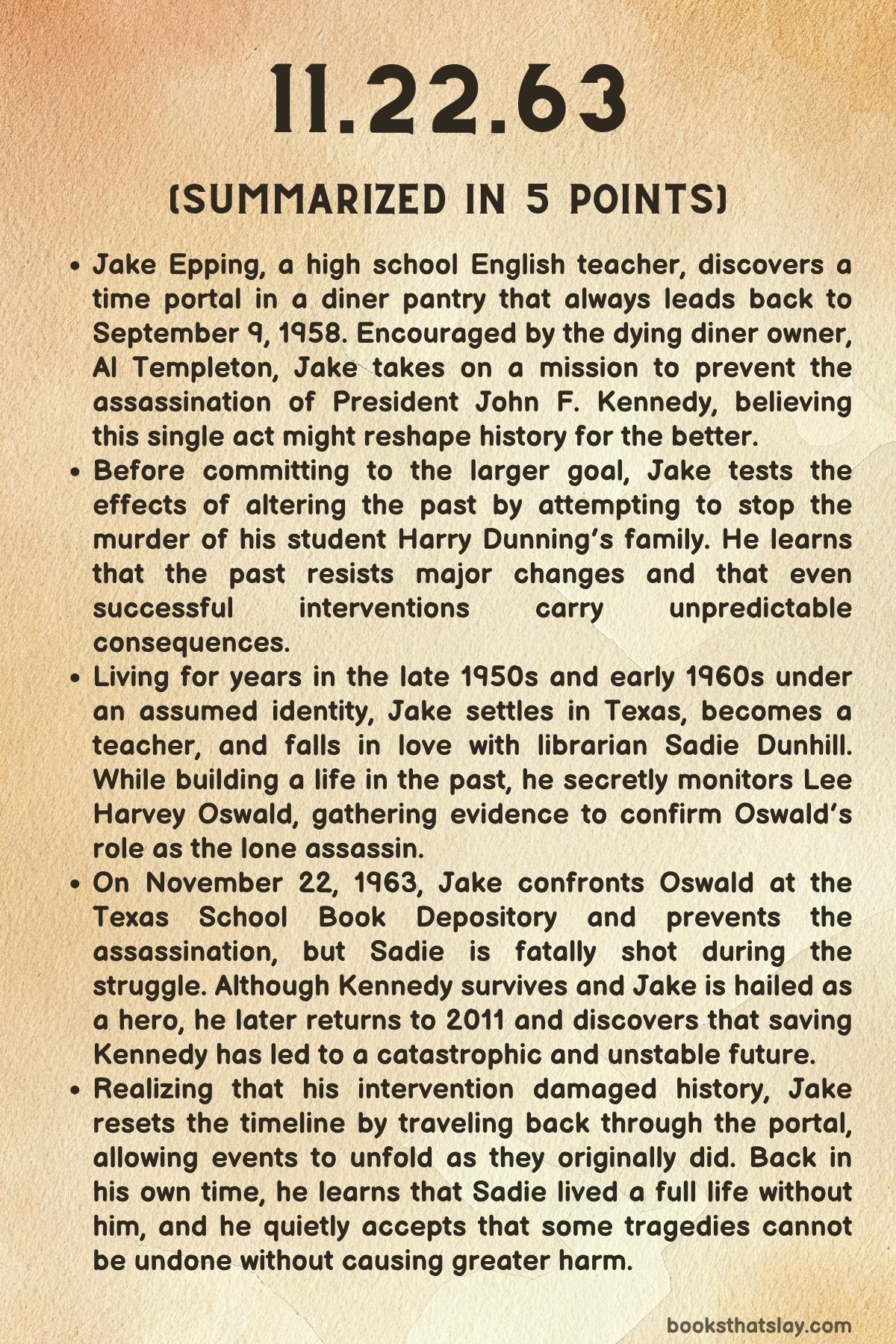
Summary
Jake Epping is a high school English teacher in Maine whose life feels stalled after his divorce. One of the most powerful moments in his teaching career comes when a janitor, Harry Dunning, submits an essay describing the night in 1958 when his drunken father murdered most of his family and permanently injured him.
The story moves Jake deeply, challenging his belief about his own emotional detachment.
Two years later, Jake’s acquaintance Al Templeton, owner of Al’s Diner, reveals a secret hidden in the diner’s pantry. There is a portal to September 9, 1958.
Each time someone steps through, they arrive at the same moment in the past, and no matter how long they remain there, only two minutes pass in the present when they return. Every trip resets previous alterations, wiping away earlier changes.
Al has used the portal for years and now, dying of cancer, wants Jake to complete a mission he can no longer finish: prevent the assassination of President John F. Kennedy on November 22, 1963.
Al explains several rules. The past can be changed, but it resists change, creating obstacles that grow more severe as the intended alteration becomes more significant.
Al attempted to stop Kennedy’s assassination but fell ill before he could act. He also tested smaller interventions, such as preventing an accidental shooting of a young girl, and observed minimal ripple effects.
Still, he worries about unintended consequences. Convinced that Lee Harvey Oswald acted alone, but lacking absolute proof, Al leaves Jake detailed notes about Oswald’s life.
Before committing to the larger mission, Jake decides to test the system by saving Harry Dunning’s family. He returns to 1958, establishes a new identity, and travels to Derry, Maine.
There he observes Frank Dunning, Harry’s father. Jake sees that Frank can be charming and attentive but also violent and unstable when drinking.
Unsure whether to kill him outright or intervene on the night of the crime, Jake chooses to wait until Halloween, when the murders are destined to occur.
The past pushes back. Jake falls ill and faces unexpected complications.
Another man, Bill Turcotte, whose sister was previously married to Frank, also seeks revenge and interferes. The confrontation ends violently.
Frank kills one of his sons before Jake and Bill manage to stop him. Jake is injured but escapes back through the portal.
In 2011, Jake discovers that Harry’s sister Ellen survived and thrived, but Harry himself later died in Vietnam. Al, overwhelmed by illness and fear that Jake might refuse the larger mission, has committed suicide.
Jake resolves to return and carry out the plan to stop Kennedy’s assassination.
On his third trip, Jake ensures Frank Dunning never harms his family by killing him in advance. He then begins the long wait until 1963.
He earns money through carefully placed bets on known sporting events and settles into life in Florida before eventually moving to Texas. In the small town of Jodie, he takes a teaching job and becomes involved in the community, directing school plays and forming friendships.
There he meets Sadie Dunhill, a school librarian. Their relationship begins lightly but deepens over time.
Sadie is intelligent, warm, and carrying trauma from her marriage to Johnny Clayton, a disturbed and controlling man. Jake finds himself torn between his mission and his growing love for her.
Meanwhile, he travels periodically to Dallas and Fort Worth to monitor Oswald’s movements, planting listening devices and tracking his associations, particularly with George de Mohrenschildt.
Jake observes Oswald’s volatile marriage to Marina and becomes convinced that Oswald is unstable and capable of violence. He also confirms that Oswald shot at General Edwin Walker in 1963, strengthening his belief that Oswald alone will kill Kennedy.
As the years pass, Jake’s double life strains his relationship with Sadie. She senses his secrets and eventually learns that he is from the future.
Though skeptical at first, she accepts the truth after Jake proves his knowledge of upcoming events.
Sadie’s estranged husband reenters her life violently. He attacks her, disfiguring her face before taking his own life when confronted by Jake.
Sadie undergoes reconstructive surgery, and Jake promises that medical advances in his original time could fully repair her injuries. Their bond grows stronger, and Sadie becomes determined to help him complete his mission.
As November 1963 approaches, Jake is brutally beaten by criminals who suspect him of cheating at gambling. He suffers a serious head injury and partial memory loss.
With the assassination days away, he struggles to recall crucial details. Sadie supports him, helping him recover his memories, including the location of Al’s notebook containing essential information.
On the morning of November 22, 1963, Jake and Sadie encounter repeated obstacles as they race to Dallas. Mechanical failures and delays reflect the past’s resistance.
They reach the Texas School Book Depository just in time. Jake confronts Oswald on the sixth floor.
During the struggle, Oswald shoots Sadie. Authorities then shoot Oswald.
Kennedy survives, but Sadie dies in Jake’s arms.
Jake becomes a national hero and briefly meets President Kennedy. Yet victory feels hollow.
Returning to 2011, he discovers that preventing the assassination has devastated the future. The world is unstable.
Environmental disasters are frequent, society is fractured, and nuclear weapons have been used in conflicts. Civil rights legislation never passed as it did under Lyndon Johnson, leading to worsening racial tensions and the eventual presidency of George Wallace.
Time itself seems damaged, with reality physically trembling.
A mysterious figure known as the Green Card Man explains that each change creates new strands of time. The cumulative strain of major alterations threatens existence.
Jake must reset everything by traveling back and allowing events to unfold as they originally did.
Faced with the knowledge that saving Kennedy caused immense suffering, Jake makes the painful decision to undo his work. He returns through the portal, resetting the timeline once more.
This erases his years with Sadie and restores the original course of history.
Back in 2011, Jake researches Sadie’s life. She survived Johnny’s attack and lived a full life, though without him.
Eventually, he travels to Texas to see her one last time. She is elderly and celebrated for her contributions to her community.
When they meet, she senses a connection she cannot explain. They share a dance to a familiar song, an echo of their past together.
Jake understands that some moments cannot be reclaimed. He chooses to let history stand as it was, accepting that love and sacrifice can exist even if memory does not.
Characters
Jake Epping
Jake begins as a cautious, somewhat numb man who has convinced himself he is emotionally restrained, partly because of his failed marriage and partly because routine has made him passive. The portal forces him into a life where decisions carry immediate moral weight, and he gradually becomes someone who can act under pressure, lie convincingly, and endure long stretches of isolation.
His defining trait is not fearlessness but persistence: he keeps going even when the past pushes back through illness, bad luck, and violence. Jake’s ethics stay in constant motion—he dislikes killing, yet he chooses it when he believes it will prevent worse harm, and he carries the psychological cost of those choices.
Over time, the mission that starts as an almost academic exercise in “fixing history” becomes personal, shaped by grief, love, and the slow realization that even well-meant heroism can create catastrophic outcomes. By the end, Jake’s maturity shows in his willingness to surrender what he wants most, because he understands that the world he “improved” is far worse than the one he restored.
Al Templeton
Al is the catalyst of the story and a portrait of urgency. He is practical, sharp, and deeply lonely in the way people become when they hold a life-altering secret for too long.
His belief that stopping Kennedy’s assassination will improve history gives him purpose, but his illness turns that purpose into obsession, because time is running out for him in more than one sense. Al’s preparation for Jake—fake identity papers, money, research notes—shows a man who thinks in systems and contingency plans, yet his emotional core is surprisingly vulnerable.
His test-run intervention with Carolyn Poulin is less about curiosity and more about reassurance; he wants proof that what he’s asking Jake to do won’t break the world. His death underscores how heavy the responsibility has become for him: he cannot bear the idea that the chance will be wasted, and his final push is both an act of manipulation and an act of faith in Jake.
Sadie Dunhill
Sadie is the emotional center of the middle and late sections of the novel, not because she exists to “soften” Jake, but because she embodies a life that is real, present, and worth protecting apart from any grand historical goal. She is smart, capable, and socially perceptive, which is why Jake’s half-truths and odd gaps unsettle her so quickly.
Her past marriage leaves her with trauma and anger, yet she refuses to let those experiences define her entire future; she wants a life built on dignity rather than fear. Once she learns Jake’s secret, she responds less like a romantic fantasy figure and more like a grounded partner—shocked, skeptical, then fiercely committed once she understands the stakes.
Her injuries and later choices show resilience without turning her into a symbol; she remains human, sometimes proud to a fault, sometimes frightened, sometimes stubborn. Her death is devastating because it isn’t treated as a heroic necessity—it feels like the brutal price of trying to impose control on history, and her final presence in Jake’s life becomes the clearest reason he struggles to accept the need to undo everything.
Harry Dunning
Harry first appears through his writing, which frames him as a survivor carrying pain so heavy it leaks into every sentence. The power of his essay lies in its plainness—he isn’t performing tragedy, he’s reporting it, and that sincerity is what breaks through Jake’s emotional defenses.
Harry’s later life, altered by Jake’s intervention, becomes the novel’s most personal demonstration that saving someone can still lead to loss. Even in the improved timeline, Harry’s death in Vietnam suggests that history redirects harm rather than eliminating it, and that “fixing” one moment does not guarantee a gentler life overall.
In the ruined future Jake briefly visits, the older Harry becomes a warning figure: living proof of the unintended consequences of large-scale change, and a reminder that survivors often carry the burden of explaining what went wrong to people who arrived too late.
Frank Dunning
Frank Dunning is written as a frightening mix of ordinary and monstrous, which is why Jake’s surveillance of him is so destabilizing. Frank can appear friendly, even tender in public, and he understands how to use charm as camouflage.
Yet his violence is not impulsive in a simple way; it feels stored up, fed by alcohol, resentment, and a need for domination that turns his family into targets. The tension Jake feels—wondering whether he is judging a man on a single testimony—adds complexity, but the eventual brutality confirms Frank as a force of domestic terror rather than a misunderstood figure.
Frank’s role is also structural: his storyline acts as Jake’s moral training ground, forcing him to decide what he is willing to do to prevent a crime, and showing him early that the past will fight back hard when a key event is threatened.
Bill Turcotte
Bill Turcotte functions as both antagonist and tragic mirror. He is driven by grief and rage tied to his sister’s earlier marriage to Frank, and he wants punishment, not mercy.
Unlike Jake, Bill’s focus is narrow: he wants Frank to suffer through the justice system, and he resents any outcome that denies him that reckoning. Yet Bill is not portrayed as evil—he’s a man whose life has been warped by suspicion, loss, and the belief that no one else will deliver justice.
His physical collapse during the confrontation underlines how self-destructive his obsession has become. Bill shows Jake that even when people share an enemy, they may be fighting for entirely different emotional reasons, and those reasons can collide violently.
Zack Lang, the Green Card Man
Zack Lang introduces a cosmic, almost bureaucratic layer to the novel’s time travel rules. He is not a villain in the conventional sense; he is a guardian trying to keep reality stable, and his bluntness reads as impatience born from seeing too many timelines fracture.
Zack’s shifting “card” system reflects psychological strain, suggesting that knowledge of repeated realities erodes sanity. He treats Jake’s actions as dangerously unprecedented, which reframes Jake’s mission: it is no longer a brave attempt to improve history, but an act with existential risk.
Zack’s presence shifts the story from personal consequence to structural consequence, forcing Jake to confront the possibility that the universe has limits, and that crossing them has a cost that goes beyond any single life.
Kyle, the former Yellow Card Man
Kyle is mostly defined through aftermath, but his importance is emotional and thematic. His death signals that the portal has caretakers and that the job damages them.
The image of a man driven to self-destruction by the weight of fractured timelines raises the stakes for Jake and adds dread to every later decision. Kyle also embodies the idea that knowledge itself can be corrosive—seeing too much, knowing too many outcomes, and being unable to fully prevent harm leads not to wisdom but to collapse.
Lee Harvey Oswald
Oswald is portrayed through Jake’s surveillance, which creates a sense of distance that fits the novel’s moral tension: Jake must decide whether to kill a man based largely on observation and prediction. Oswald appears as a volatile, controlling figure, particularly in his marriage, and his cruelty toward Marina makes it easier for Jake to view him as a threat that must be stopped.
At the same time, brief glimpses of his family situation, especially his mother’s behavior, complicate him without excusing him. He is less a charismatic mastermind than an unstable man drawn to grand political fantasies and personal grievance.
This portrayal supports the novel’s focus on how history can hinge on ordinary, damaged individuals rather than theatrical villains. Oswald’s end is abrupt and messy, emphasizing that the story is not interested in giving him a grand stage—only in the terrible consequences of what he is positioned to do.
Marina Oswald
Marina is often seen at the edges of Jake’s mission, but she remains distinct as a woman trapped in a hostile marriage and a foreign environment. Her vulnerability is practical as much as emotional: she navigates language barriers, isolation, and dependence, while trying to protect her children.
The volatility between her and Oswald shows a cycle of intimidation and survival rather than a simple “bad marriage” dynamic. Marina’s connections with people like Ruth Paine also show how small acts of support can alter a person’s options, even when larger forces are closing in.
She represents the collateral lives surrounding major historical events—people who did not choose the spotlight but are pulled into it anyway.
Marguerite Oswald
Marguerite is depicted as harsh, demanding, and emotionally abrasive, especially toward her sons. Her presence adds context to Oswald without turning her into a single-cause explanation for his choices.
She comes across as someone who needs control and affirmation, and who uses criticism as a default language. For Jake, witnessing her treatment of Robert and Lee creates uncomfortable sympathy, because it hints at how emotional deprivation and constant belittlement can shape a person.
Marguerite is important less for plot than for theme: she shows how private family dynamics can echo outward into public catastrophe without any clear point where blame becomes simple.
Robert Oswald
Robert functions as a quiet counterpoint to his brother. He appears responsible, steady, and exhausted by the burden of being related to someone unpredictable.
Through Jake’s eyes, Robert reads as someone who has learned to manage chaos by staying composed, even when embarrassed or hurt. His presence emphasizes that people who share the same upbringing can still diverge dramatically, and it strengthens the sense that Oswald’s path is not inevitable in a purely deterministic way.
Robert is also one of the story’s subtle reminders that historic villains usually leave behind ordinary relatives who must live with the fallout.
George de Mohrenschildt
George de Mohrenschildt brings ambiguity and social power into Jake’s investigation. He operates as a well-connected figure who enjoys influence and the performance of sophistication, and his conversations with Oswald carry the uneasy possibility of encouragement, manipulation, or casual provocation taken too far.
Whether he is actively steering Oswald or simply amused by him, George represents the danger of treating unstable people as entertainment or political toys. Jake’s decision to confront him by posing as a government agent shows Jake’s increasing willingness to deceive and intimidate to reach certainty.
George’s link to Jack Ruby, even indirectly, also underlines how the world around the assassination is filled with overlapping circles rather than clean, isolated actors.
Ruth Paine
Ruth Paine appears as a capable, organized woman whose involvement shows how “help” can become historically significant. She offers Marina support and structure, and her household becomes a key node in the timeline leading to November 1963.
Ruth’s role isn’t framed as conspiratorial; instead, she represents how ordinary kindness and social networks can inadvertently position someone at the center of major events. For Jake, Ruth is part of the puzzle he must navigate carefully—someone he cannot treat as an enemy, yet someone whose choices affect access, timing, and proximity.
Peter Gregory
Peter Gregory is a smaller but meaningful figure because he demonstrates how Oswald and Marina are drawn into wider social circles. By hiring Marina to teach Russian, he opens a door that leads to more influential acquaintances.
He seems polite and ordinary, which reinforces the novel’s theme that huge historical shifts can depend on casual connections rather than dramatic schemes. Gregory’s presence also adds realism to Jake’s surveillance: the Oswalds’ lives are not lived in isolation, which makes Jake’s control over the situation feel even more fragile.
Deke Simmons
Deke is a stabilizing force in Jodie and one of the few people in the past Jake grows to trust. He is decent, practical, and quietly brave, especially during the crisis involving Johnny Clayton.
Deke’s loyalty is grounded in everyday ethics—showing up, helping, keeping calm—not in big speeches. He represents the kind of person Jake meets when he stops treating the past as a backdrop and starts living inside it.
Deke’s steady presence gives Jake a sense of community, which makes the later losses hit harder, because Jake is not only giving up Sadie when he resets time, but also the life and friendships that made him feel whole.
Mimi Corcoran
Mimi begins as a persuasive administrator type but grows into a figure of warmth and sharp perception. She recognizes Jake’s oddities and inconsistencies yet chooses to value what he brings to the school and the students.
Her illness and the way she prepares for death suggest a person who faces reality directly, without romance or denial. Mimi helps anchor Jake in the daily life of Jodie, pulling him into commitments that complicate his mission and deepen his emotional stakes.
Her death reinforces the story’s constant reminder: time moves forward relentlessly, whether you’re trying to change history or simply survive your own life.
Ellie Dockerty
Ellie represents institutional scrutiny and the risk inherent in Jake’s constructed identity. She is intelligent and persistent enough to notice his fabricated background, and she chooses a pragmatic solution rather than immediate destruction.
That choice shows her as principled but not rigid; she cares about the school’s safety and the students’ well-being more than catching a liar for its own sake. Ellie’s presence increases tension in Jake’s personal life because she sees through him in a way Sadie also does, and Jake cannot fully manage either relationship without telling the truth.
She also embodies the limits of Jake’s control: no matter how well he plans, the world contains competent people who will notice when something doesn’t add up.
Mike Coslaw
Mike starts as a big, talented student actor-athlete type but becomes one of the story’s clearest examples of loyalty and generosity. His injury and the community’s response to it show how tightly knit Jodie can be, and his initiative in supporting Sadie’s medical needs shows maturity that surprises Jake.
Mike’s affection for Jake feels genuine, built on respect rather than hero worship. He matters because he is part of the life Jake builds in the past that is not directly tied to Kennedy or Oswald; losing that life when Jake resets time carries the quieter grief of losing students who became family.
Bobbi Jill Allnut
Bobbi Jill represents the way random tragedy touches the community and pulls Jake deeper into local life. Her injury becomes a catalyst for fundraising and shared effort, drawing Jake into a public role that contrasts with his secret mission.
She is not defined only by victimhood; her presence encourages solidarity and forces Jake to commit to something that will matter even if his larger plan fails. In narrative terms, she strengthens the theme that daily acts of care can be as meaningful as headline-making events, and that Jake’s identity in the past is shaped not only by what he tries to prevent, but also by what he chooses to support.
Vince Knowles
Vince is a smaller presence, but his sudden death reinforces the story’s atmosphere of unpredictable loss. The accident that takes him functions like a reminder that danger in the past is not only tied to Jake’s mission.
Vince’s role emphasizes randomness, the kind that makes Jake’s attempts at control feel fragile. His death also raises the emotional stakes for the students and the town, showing how quickly a community can be changed by a single moment.
Johnny Clayton
Johnny is one of the novel’s most chilling human threats because his violence is intimate and personal rather than political. He is controlling, unstable, and driven by humiliation and obsession, which makes him unpredictable.
The “broom” detail from Sadie’s marriage reveals not just sexual dysfunction but a deep need to police boundaries and punish vulnerability. Johnny’s return forces Jake to confront a threat he cannot solve with surveillance and long-term planning; it erupts suddenly and attacks the person Jake loves most.
Johnny’s suicide is not cathartic—if anything, it is infuriating because it denies Sadie and Jake the sense of justice or closure they might have needed. His presence shows that even if Jake could control the political history he’s targeting, private cruelty would still exist, and it can be just as destructive.
Christy Epping
Christy appears mainly through Jake’s memories and serves as a reference point for who Jake was before the portal. Her criticism that Jake cannot feel deeply is partly unfair and partly accurate at the time, because Jake had learned to protect himself through distance.
She isn’t painted as a villain; she represents a relationship that failed through mismatch, disappointment, and emotional fatigue. Christy’s significance grows in hindsight: Jake’s later grief, devotion, and willingness to sacrifice prove that he is capable of love that is intense and enduring.
In that sense, Christy functions as a baseline that makes Jake’s transformation measurable.
Chaz Frati and Frank Frati
The Frati figures connect to the recurring “harmonies” Jake notices, suggesting that time leaves echoes of names, patterns, and relationships. Chaz is a casual, talkative local connection in Derry whose information helps Jake understand Frank Dunning and the town’s undercurrents.
Frank Frati in Dallas appears later in the gambling plotline, and the similarity of the names unsettles Jake, reinforcing his sense that repeated interference leaves residues that surface in odd coincidences. Together, they are less about deep personal arcs and more about the story’s mechanism: reminders that the past keeps receipts, and reality repeats shapes even when details change.
Richie Tozier and Beverly Marsh
Richie and Beverly appear briefly but leave an outsized impression because they make Derry feel haunted and wrong. They are lively, talented kids practicing a dance, yet the atmosphere around them hints at something darker in the town’s background.
Their friendliness toward Jake contrasts with the hostility he encounters elsewhere, and their presence highlights Jake’s instinct to protect children when he can. They also mirror Jake’s later dance with Sadie, linking moments of joy across different parts of the past.
In the larger story, Richie and Beverly are a reminder that Jake is moving through a world that contains other stories and other dangers beyond his chosen mission.
Themes
The Burden of Changing History
In 11.22.63, altering history is not presented as a clean moral opportunity but as a heavy, destabilizing responsibility. Jake begins with a fairly simple assumption: if a terrible event can be prevented, it should be.
The assassination of a president seems like an obvious wrong that ought to be corrected. Yet the novel steadily complicates that belief by showing how even carefully targeted changes produce unpredictable consequences.
The rules governing the portal—especially the reset mechanism and the idea that each intervention leaves residue—suggest that time is not a passive backdrop but an active system with its own balance.
Jake’s early experiment with saving Harry Dunning’s family appears successful on the surface, yet even that smaller act produces mixed outcomes. The later revelation of the dystopian future that results from saving Kennedy reframes the entire mission.
Good intentions are insufficient protection against systemic chaos. The novel suggests that history is not a single broken thread waiting to be repaired but a complex structure in which removing one support can collapse the whole.
The earthquakes and social decay in the altered 2011 symbolize not just political instability but ontological damage, as if reality itself is straining under the weight of manipulation.
The burden, therefore, is not only about guilt or regret; it is about comprehension. Jake must learn that moral action requires humility in the face of complexity.
He cannot see the full chain of cause and effect, and acting without that knowledge risks magnifying suffering rather than reducing it. The theme ultimately questions whether human beings are equipped to redesign large-scale history, even when they believe they are acting for the greater good.
The Obdurate Past
The past in 11.22.63 behaves like an entity with defensive instincts. It resists interference through coincidence, illness, mechanical failure, and sudden violence.
This resistance becomes more intense as Jake approaches larger points of change. What might first seem like bad luck gradually acquires a pattern, suggesting that history contains pressure points and reacts when they are threatened.
This resistance functions on both practical and symbolic levels. Practically, it creates tension and obstacles that make Jake’s mission more dangerous.
Symbolically, it raises questions about determinism. The idea that the past pushes back implies that certain events are embedded deeply in the structure of time.
They are not random occurrences but anchors around which other developments organize themselves. When Jake tries to shift one of those anchors, the system destabilizes.
The resistance also mirrors Jake’s internal conflict. As he grows attached to life in Jodie and to Sadie, the “pushback” becomes emotional as well as physical.
The past seems to test his commitment, forcing him to choose between a personal future and a historical correction. The repeated disruptions—car trouble, illness, memory loss—underline the sense that time itself disapproves of large-scale alteration.
By personifying history as resistant, the novel moves beyond mechanical time travel rules and toward a philosophical stance: some events may be too entangled with the fabric of reality to be cleanly removed. The obdurate past is not evil, but it is protective of its own continuity, and that continuity may be more fragile than it appears.
Love Versus Mission
Jake’s relationship with Sadie introduces a conflict that is more intimate than politics. Living for years in the past forces him to inhabit that world fully rather than treating it as a temporary stage set.
Sadie represents everything that makes that life meaningful beyond the abstract goal of saving Kennedy. She offers companionship, shared struggle, and a sense of belonging that Jake lacks in his original time.
The tension between love and mission intensifies as the assassination date approaches. Jake knows that success might erase his time with Sadie if he resets the timeline, yet failure could cost countless lives.
The novel does not romanticize his choice. Instead, it presents a sustained emotional negotiation.
Jake repeatedly considers abandoning the mission, and Sadie’s eventual involvement complicates matters further. She is no longer a bystander; she becomes a participant who chooses risk.
Sadie’s death at the moment of apparent triumph makes the conflict devastatingly concrete. The world is saved, but the person Jake loves is lost.
When he later learns that his intervention has damaged the future, the sacrifice feels doubly tragic. Resetting time erases their shared life entirely, turning love into something only he remembers.
The theme insists that large moral missions cannot be separated from personal cost. Heroic ambition collides with intimate attachment, and neither can be dismissed as trivial.
In the end, Jake’s most painful decision is not killing Oswald or undoing history; it is accepting a world in which Sadie exists without him.
Moral Ambiguity and Violence
Jake’s transformation from teacher to killer unfolds gradually, forcing him to confront the ethics of preemptive violence. He does not act in the heat of passion; he acts after surveillance, planning, and rationalization.
His first major intervention against Frank Dunning already raises troubling questions. Even if Frank is destined to commit murder, Jake is still choosing to kill a man before the crime occurs in this altered timeline.
The same dilemma applies to Oswald. Jake observes him, gathers evidence, and seeks confirmation that Oswald acted alone in previous events.
This quest for certainty reflects Jake’s need to justify lethal action. Yet the novel never grants absolute moral clarity.
Oswald is cruel and unstable, but he is also shaped by family dysfunction and social alienation. Killing him becomes an act both of prevention and of execution without trial.
Violence in the novel rarely resolves tension cleanly. Johnny Clayton’s suicide denies catharsis.
Frank Dunning’s death saves lives but leaves blood on Jake’s conscience. Sadie’s shooting during the final confrontation underscores how unpredictable violence remains, even when carefully managed.
The theme suggests that moral lines blur when the stakes are amplified by time travel. Acting to prevent harm may require committing harm.
The narrative refuses to frame these choices as simple heroism. Instead, it shows that even justified violence leaves residue—emotional, ethical, and temporal.
Jake cannot emerge from his actions untouched, and neither can the world he attempts to reshape.
Fate, Free Will, and Determinism
The structure of time in 11.22.63 places fate and free will in constant tension. The portal allows intervention, implying that events are not fixed.
Yet the resistance of the past and the catastrophic results of major change suggest that certain outcomes exert gravitational pull. The assassination appears as one such focal point, deeply embedded in the chain of twentieth-century developments.
Jake exercises free will repeatedly. He chooses to return, to kill Frank Dunning, to stay in Jodie, to confront Oswald.
However, his choices are constrained by knowledge of the “original” timeline. He acts not from ignorance but from hindsight, which complicates the notion of freedom.
He is free to choose, but only within the parameters set by events he already knows.
The dystopian future resulting from Kennedy’s survival complicates the question further. It implies that removing one tragic event does not guarantee a better world.
Instead, it suggests that history contains self-correcting or compensatory mechanisms. Free will may exist at the individual level, but collective outcomes arise from vast networks of cause and effect that no single person can fully map.
The theme does not settle on strict determinism or complete freedom. Instead, it portrays history as elastic but resistant, flexible but structured.
Jake’s final decision to restore the original timeline acknowledges that while he can change events, he cannot control the full cascade of consequences. Accepting limits becomes a form of wisdom rather than defeat.
Memory and Identity
Memory functions as both weapon and vulnerability for Jake. His knowledge of the future gives him strategic advantage—winning bets, predicting political crises, proving his origin to Sadie.
Yet memory also isolates him. No one else shares his frame of reference, and he must constantly censor himself to avoid revealing too much.
His identity in the past is partly constructed through lies, which erodes his sense of authenticity.
The head injury that causes partial amnesia near the climax highlights how fragile his mission truly is. If he forgets, the entire enterprise collapses.
The idea that the past might be actively interfering with his memory reinforces the sense that knowledge itself is contested territory. When he recovers his memories by revisiting Al’s notebook, it feels less like a triumph of intellect and more like a reclamation of self.
After resetting the timeline, memory becomes an even heavier burden. Jake alone remembers years of love, friendship, and sacrifice.
Sadie, in the restored present, has no recollection of their shared life. This asymmetry creates a quiet tragedy: identity for Jake now includes experiences that are real to him but nonexistent for everyone else.
The theme emphasizes that memory defines who we are. Jake’s actions matter because he remembers them, even if the world does not.
His identity is shaped not by the official timeline but by the life he lived in an erased strand of time. In that sense, memory becomes the only enduring trace of what was lost.
The Illusion of a Better Past
The late 1950s and early 1960s initially appear inviting to Jake. Gas is cheap, music is lively, communities feel tight-knit, and daily life seems slower.
The contrast with his own era creates a nostalgic glow. Yet this glow fades as he confronts racism, domestic abuse, social repression, and political paranoia.
The world he idealizes contains deep structural problems that nostalgia obscures.
The altered future where Kennedy survives dismantles the fantasy even further. Preventing one iconic tragedy does not produce utopia.
Instead, it generates different crises, including worsened race relations and normalized nuclear warfare. The dream of a single corrective action fixing society collapses.
The novel challenges the belief that earlier decades were inherently simpler or better. It suggests that every era contains its own injustices and vulnerabilities.
Jake’s extended stay forces him to experience the past not as myth but as lived reality, with all its limitations. His affection for the period becomes personal rather than ideological; he loves specific people and moments, not the abstract idea of “the good old days.”
By the end, the theme reframes nostalgia as selective memory. The past is not a golden age waiting to be restored.
It is a complicated landscape shaped by forces that resist simplification. Attempting to perfect it from outside reveals how little control any individual truly has over historical currents.