13 Things Mentally Strong People Don’t Do Summary and Analysis
13 Things Mentally Strong People Don’t Do: Take Back Your Power, Embrace Change, Face Your Fears, and Train Your Brain for Happiness and Success by Amy Morin is a practical guide to building resilience by eliminating destructive mental habits. Drawing from her professional experience as a psychotherapist and her own encounters with profound loss, Morin argues that mental strength is less about adding inspirational routines and more about refusing behaviors that undermine growth.
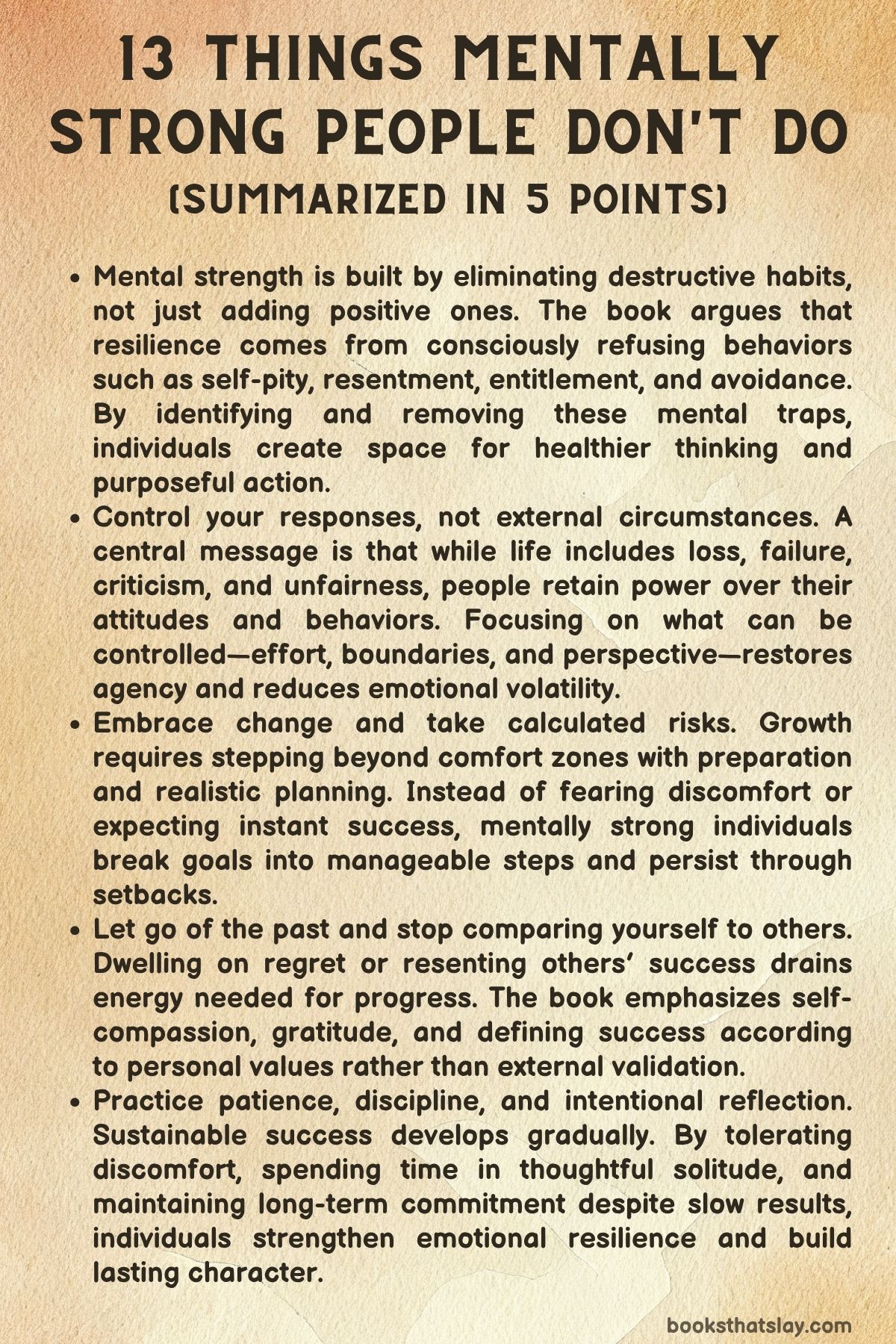
Each chapter identifies a common self-defeating pattern—such as self-pity, resentment, or fear of change—and offers concrete strategies to replace it with healthier thinking. The book combines case studies, psychological research, and actionable advice to help readers build emotional discipline and long-term success.
Summary
The book begins with Amy Morin’s personal account of enduring multiple devastating losses within a few years: the sudden death of her mother, the unexpected passing of her husband, and later, the terminal illness of her father-in-law. Rather than presenting herself as naturally resilient, she describes how grief challenged her identity and emotional stability.
Through both her therapeutic training and lived experience, she came to understand that recovery depends not simply on time passing, but on how one chooses to use that time. From this insight emerged her list of thirteen behaviors mentally strong people avoid.
The first principle is that mentally strong people do not waste time feeling sorry for themselves. Morin illustrates this through the story of a boy who survived a traumatic accident but whose recovery was slowed by his mother’s constant focus on what had been lost.
By shifting the narrative from victimhood to resilience, the family helped the child rebuild confidence. Morin explains that self-pity drains energy, invites passivity, and reinforces helplessness.
Though it can bring temporary comfort or attention, it prevents forward movement. Replacing self-pity with gratitude and action restores a sense of control.
The second principle emphasizes not giving away personal power. Through the example of a woman whose intrusive mother-in-law dominated her thoughts and emotions, Morin shows how resentment and rumination allow others to control one’s internal world.
Mentally strong people recognize that while they cannot dictate others’ behavior, they can control their responses. Setting boundaries, reframing negative self-talk, and refusing to let criticism define self-worth are key strategies in reclaiming authority over one’s emotional state.
The third lesson focuses on embracing change rather than avoiding it. A man newly diagnosed with diabetes attempted to transform his lifestyle overnight, only to relapse into old habits.
Morin explains that sustainable change requires readiness, planning, and incremental steps. Fear of discomfort and uncertainty often blocks progress.
By breaking goals into manageable actions and modifying the environment to support new habits, individuals can move steadily from intention to maintenance.
Next, Morin addresses the tendency to fixate on things beyond one’s control. She recounts the story of a father consumed by a custody battle, obsessed with altering his ex-wife’s behavior while neglecting his own relationship with his daughter.
The concept of locus of control becomes central here. An extreme focus on controlling everything leads to frustration, while total resignation leads to passivity.
Mentally strong people identify what they can influence—their behavior, attitude, and effort—and direct energy there.
The fifth habit involves people-pleasing. Morin describes a woman overwhelmed by constant obligations because she feared disappointing others.
People-pleasing, she argues, is rooted in the desire to manage others’ perceptions. It often leads to resentment and burnout.
Mentally strong individuals clarify their values, tolerate disapproval when necessary, and learn to say no without excessive justification. Healthy relationships are built on authenticity, not constant accommodation.
Risk-taking forms the sixth principle. Through the story of a teacher who cautiously launched a side business after past financial setbacks, Morin distinguishes reckless risk from calculated risk.
Fear often exaggerates danger and suppresses opportunity. By analyzing potential costs and benefits, preparing contingency plans, and gradually exposing oneself to feared situations, individuals can expand their comfort zones responsibly.
The seventh chapter focuses on not dwelling on the past. A mother paralyzed by guilt over earlier parenting mistakes repeatedly enabled her adult daughter’s irresponsibility.
Morin argues that lingering on regret or nostalgia prevents effective present action. While reflection can offer lessons, excessive rumination maintains shame and stagnation.
Accepting the past as unchangeable frees mental space for better decisions now.
Avoiding repeated mistakes is the eighth principle. Morin presents the example of a professional who continued yelling at her children despite knowing it was counterproductive.
Repetition often occurs because individuals fail to analyze triggers or plan alternative responses. Mentally strong people treat mistakes as data.
They examine patterns objectively, create written plans for different behavior, and practice tolerating discomfort as they implement change.
The ninth habit concerns resentment of others’ success. A man consumed by envy of his wealthier neighbors compromised his own financial stability in an attempt to compete.
Morin explains that resentment combines jealousy with hostility and keeps individuals focused on others’ progress rather than their own growth. By defining success according to personal values and practicing appreciation for others’ achievements, mentally strong people redirect energy toward self-improvement.
The tenth principle addresses persistence after failure. Many people interpret early setbacks as proof of inadequacy.
Morin shares the example of a woman who abandoned her dream career after struggling academically. Research on growth mindset supports the idea that abilities develop through effort.
Mentally strong people respond to failure with self-compassion and renewed strategy rather than self-criticism or withdrawal.
The eleventh chapter highlights the importance of alone time. In a culture saturated with noise and digital connection, solitude can feel uncomfortable.
Morin recounts the experience of a professional who avoided silence because it triggered anxiety. Gradually learning to sit with her thoughts improved her sleep and clarity.
Chosen solitude enhances creativity, empathy, and emotional regulation. It differs from forced isolation because it is intentional and restorative.
Entitlement is the twelfth behavior mentally strong people avoid. A young professional expecting immediate promotion without earning it illustrates how entitlement damages relationships and limits growth.
Morin distinguishes between believing one deserves special treatment due to superiority and believing one is owed compensation for past hardship. Both attitudes foster resentment and inhibit collaboration.
Mentally strong individuals focus on contribution, gratitude, and continuous learning instead of demanding recognition.
The final principle concerns unrealistic expectations of immediate results. A woman who repeatedly quit self-improvement efforts when change felt slow demonstrates how impatience sabotages progress.
Morin argues that modern culture reinforces instant gratification, obscuring the sustained effort behind most success stories. Mentally strong people accept that growth is gradual.
They set flexible timelines, celebrate incremental progress, and remain committed despite temporary setbacks.
Throughout the book, Morin reinforces a consistent theme: mental strength is not about suppressing emotion or displaying toughness. It involves acknowledging feelings while choosing behaviors aligned with long-term values.
By identifying and eliminating habits that undermine resilience—self-pity, resentment, avoidance, entitlement, and impatience—individuals regain control over their thoughts and actions.
The book concludes with the reminder that mental strength requires ongoing practice. Just as physical fitness declines without maintenance, emotional discipline must be cultivated daily.
The thirteen principles serve as a framework for evaluating choices, responding to adversity, and building a life defined by intention rather than reaction.
Key People
Amy Morin
Amy Morin functions as both author and central presence in 13 Things Mentally Strong People Don’t Do. Her role is not that of a distant expert but of a practitioner who tests her own principles under extreme emotional strain.
After enduring the deaths of her mother and husband, followed by her father-in-law’s terminal illness, she becomes a living case study in resilience. Her defining trait is disciplined self-awareness: she recognizes her own vulnerability to self-pity, rumination, and avoidance, and consciously counters these tendencies.
Morin’s character embodies applied psychology—she does not claim immunity from pain but demonstrates that strength arises from deliberate choices. Her authority stems from the tension between grief and agency, and her journey frames the book’s philosophy that mental strength is built through eliminating destructive habits rather than cultivating image-based positivity.
Jack
Jack, the young boy injured in a bus accident, represents how narratives shape identity. Physically harmed but capable of recovery, his psychological trajectory is heavily influenced by his mother’s perception of him as fragile and wronged.
Initially, he internalizes a story of victimhood reinforced by repeated retellings of his trauma. When a therapist reframes his experience as survival and resilience, Jack begins to reinterpret himself not as damaged but as strong.
His character illustrates how children absorb adult emotional cues and how empowerment can begin with a change in language. Jack’s development underscores the book’s argument that self-pity, even when rooted in legitimate suffering, can stall growth if it becomes a defining identity.
Jack’s Mother
Jack’s mother embodies the seductive pull of self-pity disguised as protection. Her trauma over her son’s accident manifests as overprotection and repeated recounting of the incident, which reinforces a sense of injustice.
Though motivated by love, she unconsciously limits her son’s recovery by focusing on what was lost rather than what remains possible. Her character demonstrates how caretakers can project their unresolved fear onto children, creating dependency and fragility.
She is not portrayed as malicious but as overwhelmed, illustrating that good intentions can still produce limiting outcomes when filtered through unresolved grief.
Lauren
Lauren represents the experience of relinquishing emotional control to others. Her conflict with her intrusive mother-in-law consumes her mental space far beyond the actual time spent together.
Lauren’s defining characteristic at the outset is resentment paired with passivity. She waits for external behavior to change before allowing herself peace.
Through therapy and boundary-setting, she learns to shift from reaction to intention. Her transformation lies in recognizing that resentment is a form of surrendering control.
Lauren’s arc demonstrates that reclaiming power requires internal decisions before external circumstances shift.
Jackie
Jackie, the overbearing mother-in-law, functions as a catalyst rather than a villain. She is assertive, opinionated, and dismissive of boundaries, yet her power over Lauren exists largely because Lauren permits it.
Jackie’s character reveals how difficult personalities can dominate emotional environments when limits are not clearly defined. She highlights the book’s theme that influence over one’s well-being often depends less on changing others and more on adjusting personal responses and boundaries.
Richard
Richard, newly diagnosed with diabetes, represents resistance to change masked as enthusiasm. His initial attempt to overhaul his life overnight reflects impulsivity and unrealistic expectations.
When he fails, discouragement sets in. Richard’s character demonstrates that motivation without structure often collapses.
Through incremental habit replacement and environmental adjustments, he learns that change is procedural rather than dramatic. He embodies the tension between intention and execution, illustrating that readiness and manageable steps matter more than bursts of willpower.
James
James, the father in a custody battle, symbolizes misplaced control. His obsession with altering court outcomes and his ex-wife’s behavior drains his energy while damaging his relationship with his daughter.
He believes persistence equates to control, yet his focus on external circumstances blinds him to internal opportunities. James’s character illustrates how excessive attempts to dominate uncontrollable situations create chronic frustration.
His growth depends on redirecting attention toward what he can influence: his own parenting during the time he shares with his child.
Carmen
Carmen, James’s ex-wife, is portrayed largely through James’s frustration. She represents the uncontrollable variable in his life.
Her presence reinforces the theme that other people’s decisions cannot be micromanaged. Carmen’s character functions as a mirror reflecting James’s need for dominance and highlights the limits of personal authority within shared responsibilities.
Megan
Megan exemplifies chronic people-pleasing. She appears generous and dependable, yet her inability to refuse requests leaves her exhausted and resentful.
Her core motivation is fear of being perceived as selfish. Megan’s arc reveals that seeking approval can become self-centered because it prioritizes managing others’ impressions over authentic contribution.
Her development occurs when she clarifies her values and tolerates discomfort associated with disappointing others. She shows that strength sometimes requires accepting temporary disapproval.
Dale
Dale, the shop teacher turned entrepreneur, represents calculated risk. Burned by previous financial loss, he initially avoids new ventures out of fear.
His defining quality is caution shaped by past failure. Through structured risk assessment and gradual experimentation, he redefines risk not as recklessness but as informed decision-making.
Dale’s character demonstrates that courage is not the absence of fear but action informed by preparation. His renewed enthusiasm for both business and teaching underscores how growth can revitalize stagnant aspects of life.
Gloria
Gloria is trapped in guilt over earlier parenting mistakes. Her enabling behavior toward her adult daughter stems from a belief that suffering in the present compensates for past shortcomings.
Gloria’s character highlights how unresolved regret can distort current judgment. Her transformation depends on separating accountability from self-punishment.
She learns that clinging to guilt does not repair history but perpetuates dysfunction. Gloria embodies the theme that mental strength requires accepting imperfection without allowing it to dictate present behavior.
Christy
Christy repeatedly loses her temper with her children despite recognizing the damage it causes. She represents habitual reactivity.
Her defining challenge is not ignorance but lack of alternative strategies and emotional regulation. Christy’s journey illustrates that insight alone does not change behavior.
Through identifying triggers and planning substitute responses, she models how discipline and preparation interrupt negative cycles. Her character reinforces the idea that mistakes become lessons only when actively examined.
Dan
Dan struggles with resentment toward wealthier neighbors. His insecurity drives him to maintain a façade of success while accumulating debt.
Dan’s character reflects how comparison erodes self-worth and decision-making. Rather than defining success by personal values, he measures himself against others’ material displays.
His bitterness masks deeper feelings of inadequacy rooted in childhood poverty. Dan’s growth begins when he reframes success as stability and family well-being instead of status competition.
He illustrates how envy can distort priorities until consciously redirected.
Susan
Susan abandons her dream of becoming a teacher after early academic struggles. She internalizes failure as proof of incapacity rather than as feedback for growth.
Susan represents the fixed mindset response to difficulty. Her fear of being exposed as inadequate prevents persistence.
Through developing self-compassion and reframing setbacks as part of learning, she begins to rebuild confidence. Susan’s character demonstrates that resilience is often less about talent and more about interpretation of setbacks.
Vanessa
Vanessa, the real-estate agent uncomfortable with solitude, embodies modern overstimulation. Her constant activity shields her from confronting anxious thoughts.
When quiet moments arise, she experiences racing concerns about productivity and success. Vanessa’s growth occurs when she practices intentional alone time through journaling and meditation.
Her character highlights how avoidance of silence can amplify internal chaos. By learning to tolerate her own thoughts, she gains clarity and emotional balance.
Lucas
Lucas, the recent MBA graduate, exemplifies entitlement rooted in perceived superiority. He believes his credentials merit immediate recognition and advancement.
His impatience and dismissiveness strain workplace relationships. Lucas’s defining flaw is conflating education with earned authority.
Through self-examination, he learns that contribution precedes reward. His character illustrates how entitlement narrows empathy and obstructs collaboration.
Growth emerges when he shifts from demanding status to demonstrating competence.
Sarah Robinson
Sarah Robinson, a young cancer patient who focuses on creating a hospitality house for others, contrasts entitlement with generosity. Facing terminal illness, she chooses contribution over complaint.
Sarah’s character embodies gratitude and purpose under extreme adversity. Her perspective challenges the notion that circumstances determine attitude.
She serves as a moral counterpoint within the book, demonstrating that meaning can arise from service even amid personal suffering.
Marcy
Marcy seeks rapid transformation but repeatedly abandons efforts when change feels slow. She symbolizes impatience shaped by expectations of instant results.
Her dissatisfaction stems from underestimating the time required for growth. Marcy’s character reveals how quitting prematurely reinforces a cycle of stagnation.
Through adjusting her timelines and recognizing incremental progress, she begins to experience genuine development. She demonstrates that endurance is often the dividing line between aspiration and achievement.
Daniel “Rudy” Ruettiger
Rudy Ruettiger appears as a study in persistence and contradiction. His determination to play football at Notre Dame reflects extraordinary patience and commitment.
Yet his later involvement in securities fraud shows that resilience in one domain does not guarantee integrity in another. Rudy’s character illustrates that mental strength is context-dependent and must be applied consistently.
His story underscores the complexity of human behavior, reminding readers that perseverance alone is insufficient without ethical grounding.
Analysis of Themes and Lessons
Personal Responsibility and Agency
Across 13 Things Mentally Strong People Don’t Do, the insistence on personal responsibility functions as the structural backbone of the book’s philosophy. Individuals are repeatedly confronted with moments in which circumstances are painful, unfair, or limiting, yet the decisive factor becomes their response rather than the event itself.
This theme does not deny hardship; instead, it distinguishes between what happens to a person and what a person does next. Whether facing grief, professional setbacks, interpersonal conflict, or health challenges, the text argues that agency begins with recognizing the difference between influence and control.
The stories consistently reveal how surrendering emotional control to others, clinging to resentment, or waiting for external validation leads to stagnation. Agency is framed not as domination over circumstances but as disciplined self-governance.
This reframing pushes against cultural tendencies to externalize blame. However, the theme also raises subtle tensions.
By emphasizing individual responsibility, the book risks underrepresenting structural constraints such as socioeconomic barriers or systemic inequality. Even so, the consistent message is that reclaiming agency—through boundary-setting, reframing thought patterns, and disciplined behavior—restores dignity and momentum.
Responsibility becomes empowering rather than burdensome because it places power back into the individual’s sphere of influence.
Emotional Regulation and Cognitive Discipline
Emotional awareness is presented as necessary but insufficient without regulation. Characters often begin in states of anxiety, guilt, anger, envy, or fear.
The text underscores that emotions are valid signals but unreliable decision-makers when left unchecked. Mental strength is therefore defined as the ability to acknowledge emotion without becoming governed by it.
This reflects principles from cognitive-behavioral psychology, where thoughts, feelings, and behaviors operate in reciprocal cycles.
Several narratives demonstrate how unchecked emotion narrows perception. Resentment fuels competition and debt.
Guilt leads to enabling harmful behavior. Fear exaggerates risk and suppresses opportunity.
Emotional discipline does not imply suppression; rather, it requires examining the thoughts that generate emotional responses. By challenging irrational beliefs and replacing them with balanced interpretations, individuals regain composure.
This disciplined thinking interrupts destructive cycles before they escalate.
The theme also critiques modern environments saturated with stimulation. Constant comparison through digital platforms intensifies envy and impatience, while relentless productivity discourages reflection.
Developing mental strength therefore involves creating intentional pauses—through solitude, journaling, or structured reflection—to recalibrate internal narratives. Emotional regulation becomes a learned skill, not an inherited trait.
Through repeated practice, individuals develop resilience not by eliminating emotion but by responding to it with intention rather than impulse.
Acceptance of Limits and Focus on Controllables
An essential tension throughout the book lies between ambition and acceptance. The narratives repeatedly caution against the illusion that every outcome can be engineered through effort alone.
Attempts to control other people’s decisions, manipulate legal outcomes, or erase past mistakes are portrayed as exhausting and futile. The healthier alternative involves directing attention toward personal behavior, attitude, and effort.
This theme challenges exaggerated self-help claims that promote total personal control over destiny. Instead, the text introduces a balanced perspective that recognizes both personal influence and external unpredictability.
Acceptance is framed as active rather than passive. It does not mean surrendering goals; it means channeling energy efficiently.
By distinguishing between influence and control, individuals prevent frustration from escalating into helplessness.
The emphasis on acceptance also connects to grief and regret. Moving forward requires acknowledging that certain losses and errors cannot be reversed.
Emotional healing begins not when pain disappears but when resistance to reality decreases. In this sense, acceptance becomes a stabilizing force that preserves energy for constructive pursuits.
Through this lens, mental strength is measured not by forceful dominance but by clarity regarding where effort truly matters.
Resilience Through Gradual Growth
Change is consistently portrayed as incremental rather than dramatic. Attempts at sweeping transformation often collapse under their own intensity.
Sustainable growth emerges from small, repeated actions supported by structured planning. This theme critiques cultural narratives of overnight success and rapid reinvention.
The examples highlight how unrealistic expectations fuel discouragement, leading individuals to abandon worthwhile pursuits prematurely.
Patience appears as a central virtue. Delayed gratification is framed as foundational to achievement, echoing research in behavioral psychology regarding impulse control.
Characters who succeed tend to accept that progress may feel invisible in early stages. They prepare for setbacks and anticipate discomfort rather than interpreting these experiences as evidence of failure.
Resilience in this context becomes procedural. It involves planning for triggers, writing replacement behaviors, and building accountability systems.
Growth is not romanticized as spontaneous inspiration but grounded in routine effort. This perspective demystifies achievement, presenting it as accessible through consistent practice.
It also reframes failure as feedback rather than identity. By normalizing slow progress, the text counters impatience and reinforces endurance as a cultivated habit.
The Dangers of Comparison and Entitlement
Comparison functions as a corrosive force throughout the book. Envy and resentment distort personal values, encouraging individuals to measure success against external markers rather than internal standards.
This theme is especially relevant within modern social contexts where curated online identities intensify competitive instincts. When success becomes relative rather than value-based, satisfaction diminishes even in the presence of achievement.
Entitlement emerges as a related distortion. Believing that one deserves special recognition without corresponding contribution undermines collaboration and personal growth.
The text distinguishes between confidence and superiority, arguing that self-worth rooted in effort and integrity is stable, whereas self-worth dependent on status is fragile. Entitlement also appears in more subtle forms, such as believing that hardship guarantees compensation or that effort ensures immediate reward.
By rejecting comparison and entitlement, individuals cultivate humility and gratitude. These qualities foster healthier relationships and realistic expectations.
The theme suggests that contentment arises not from outperforming others but from aligning actions with personal principles. In this framework, mental strength involves maintaining self-respect without demanding exceptional treatment.
Courage and Calculated Risk
Fear is portrayed not as an obstacle to eliminate but as a signal to interpret carefully. Many characters initially avoid opportunities because fear amplifies perceived danger.
The text differentiates between reckless behavior and calculated risk, emphasizing analysis over impulsivity. Courage emerges through preparation rather than denial of vulnerability.
This theme also highlights cognitive distortions that exaggerate unlikely threats while minimizing common risks. By assessing probabilities, preparing contingency plans, and gradually exposing oneself to discomfort, individuals expand their capabilities.
The emphasis on calculated action challenges both paralysis and recklessness.
Risk-taking becomes a vehicle for growth because it confronts stagnation. Comfort zones, while safe, often restrict development.
Through disciplined experimentation, individuals gather evidence that they can survive uncertainty. Courage in this framework is practical rather than dramatic.
It is the repeated willingness to act despite discomfort, supported by planning and reflection. Mental strength therefore includes the capacity to evaluate fear rationally and move forward with informed confidence.
Solitude and Self-Reflection
Intentional solitude is presented as an antidote to emotional reactivity and cognitive overload. Many individuals avoid being alone with their thoughts because silence exposes unresolved concerns.
Yet without reflective space, patterns remain unexamined. The book portrays solitude as a skill that strengthens clarity, creativity, and empathy.
Cultural narratives often equate constant busyness with value. Against this backdrop, choosing solitude becomes countercultural.
By reducing external noise, individuals gain awareness of internal narratives that shape behavior. Journaling, meditation, and quiet reflection allow for recalibration of priorities.
The theme also distinguishes chosen solitude from enforced isolation. Voluntary reflection promotes growth, whereas isolation without agency can damage well-being.
This nuance underscores the importance of intention. Solitude serves as a training ground for emotional regulation and thoughtful decision-making.
Through regular reflection, individuals identify destructive habits and consciously replace them. Mental strength thus depends not only on outward action but also on inward examination.
Integrity and Long-Term Character Formation
Underlying all thirteen principles is a broader concern with character formation over time. Mental strength is not presented as a temporary strategy but as a durable way of living.
Patterns such as self-pity, entitlement, resentment, and impatience erode integrity when repeated. Conversely, disciplined thought, humility, and perseverance build character gradually.
The narratives demonstrate that strength can coexist with vulnerability. Experiencing grief, fear, or failure does not negate resilience; avoidance and stagnation do.
Character is shaped through repeated choices aligned with values rather than impulses. The emphasis on long-term orientation counters cultural pressures for immediate recognition and validation.
Integrity also requires consistency. Perseverance in one area does not compensate for ethical lapses in another.
Mental strength must permeate professional, relational, and personal domains to sustain credibility. Through continuous practice, individuals create internal stability that does not depend on fluctuating external conditions.
This cumulative process reflects the book’s central conviction that disciplined habits determine the quality of one’s life trajectory.