1408 by Stephen King Summary, Characters and Themes
1408 by Stephen King is a compact horror story set almost entirely inside a single hotel room. It follows Mike Enslin, a skeptical writer who makes his living by staying overnight in places rumored to be haunted and then turning the experience into a bestselling book.
He doesn’t believe in ghosts, but he believes in the value of a good scare and the power of a strong anecdote. When he insists on booking room 1408 at the Hotel Dolphin in New York, the manager’s fear and the room’s grim history hint that this assignment won’t behave like the others.
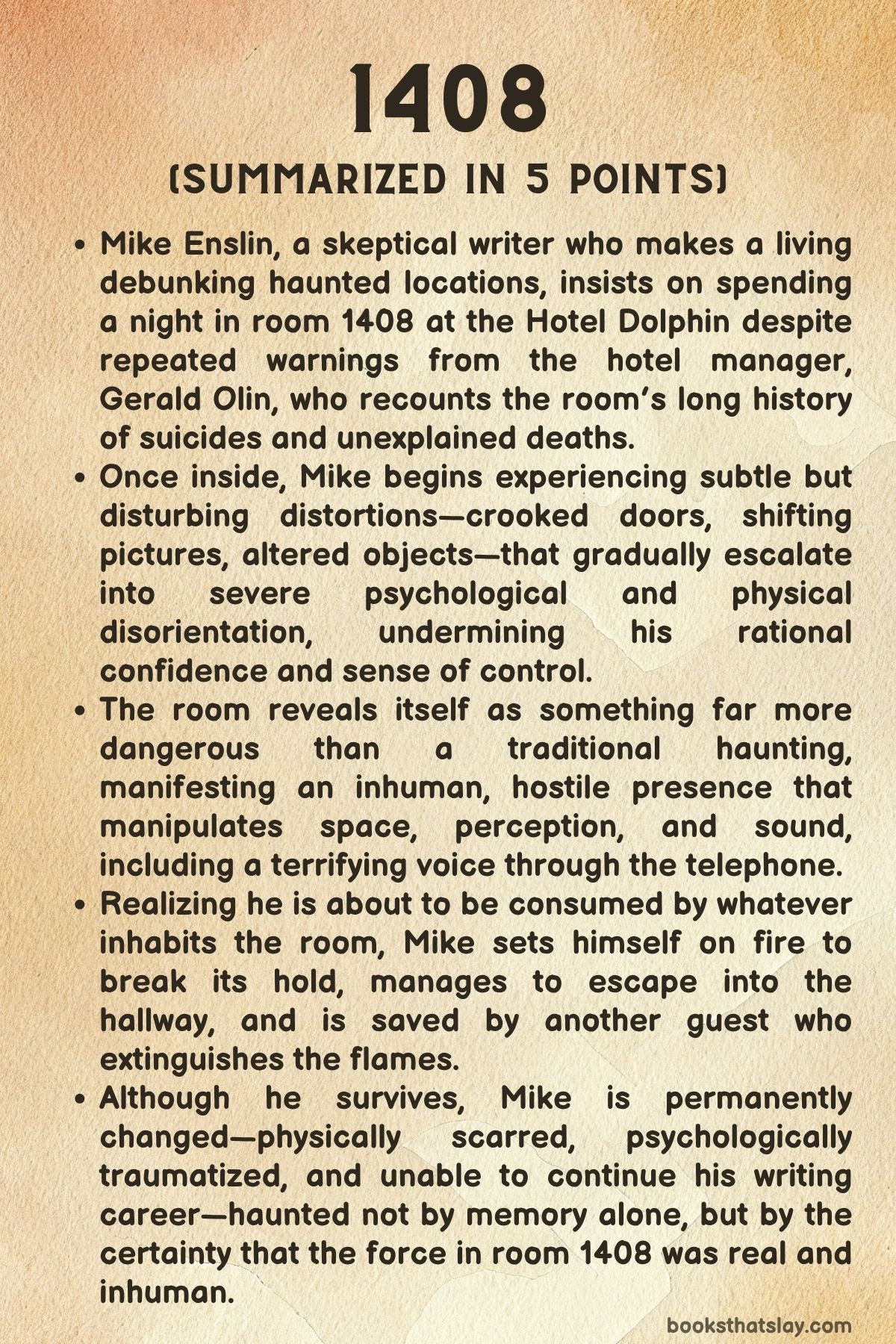
Summary
Mike Enslin arrives at the Hotel Dolphin in Manhattan with a small overnight bag and a well-practiced confidence. He has built a career out of visiting alleged paranormal locations, spending a night there, and writing entertaining accounts that please readers who want a safe thrill.
He treats the whole business as a job: research, show up, endure boredom, and turn it into a lively story. This time, though, the hotel manager, Gerald Olin, is waiting for him in the lobby, and the look on his face signals that the hotel is not eager to cooperate.
Olin asks Mike to come to his office, and the conversation quickly becomes tense. Olin has done his homework on Mike’s books and, instead of mocking him, admits he’s a skilled writer.
The praise doesn’t soften the warning that follows. Olin tries every approach he can think of—polite refusal, legal objections, personal appeals—but Mike has brought a lawyer before, knows the rules, and knows the room is empty.
He wants room 1408 specifically, because it’s the kind of story that will stand out, the kind that can anchor a whole book. Olin’s distress only convinces Mike that he’s found the strongest material yet.
In the office, Olin explains that room 1408 has a long record of deaths, especially suicides. People have jumped from the window, overdosed, cut themselves, or used the closet to end their lives.
Beyond that, Olin claims there have been many other “natural” deaths—heart attacks, strokes, seizures—far more than anyone would expect from coincidence alone. Staff members who enter the room even briefly have suffered breakdowns: sobbing fits, uncontrolled laughter, fainting, and in one case a temporary loss of vision accompanied by disturbing bursts of color.
Olin insists it isn’t a conventional ghost story. He says there is something there, something that behaves like a force rather than a person, and it reacts badly to disbelief.
Mike’s skepticism, Olin argues, won’t protect him; it may make him easier to harm.
Mike listens, argues, and tries to keep the upper hand. He sets up his minicorder, stops it, starts it again, and shifts between sarcasm and irritation.
He sees Olin’s fear as part performance and part superstition, and he refuses to be bullied out of what he sees as a lawful choice and a professional opportunity. Olin offers him a drink and, at last, hands him an old brass key on a paddle marked 1408.
The hotel uses keycards, Olin says, but 1408 is the only door still opened by a physical key, because the room hasn’t been rented to a paying guest in decades. Olin also claims electronics behave unpredictably inside: watches fail or run backward, phones and beepers act on their own, and devices refuse to function when the room “doesn’t want them to.”
After the drink, Olin escorts Mike to the elevator and rides up with him. The building avoids labeling the thirteenth floor, jumping from 12 to 14 on the panel, a small ritual of avoidance that feels childish and yet widely practiced.
At the corridor, Olin stops short and refuses to go closer, giving one final plea. Mike, determined not to retreat, walks down the hall alone toward 1408.
Even before he enters, his perceptions start to slip. The door seems subtly tilted, then straight, then tilted again, producing a wave of nausea like seasickness.
He questions whether this is suggestion, stress, or something staged, but he pushes forward, unlocks the door, and steps inside. At first, the room looks like an ordinary junior suite: standard furniture, a desk, lamps, a bedroom beyond, framed pictures on the walls, and a window fitted with an external grille that would prevent anyone from jumping.
Mike begins recording his impressions, but his commentary comes in fragments. He stops the tape repeatedly, distracted by small details that feel wrong.
The pictures on the walls hang unevenly, and their angles make him queasy. He goes around straightening them, noticing the glass is coated with a greasy dust that feels unpleasant under his fingertips.
He finds a matchbook that looks strangely old and pockets it as a souvenir. He cracks the top half of the window for air, tries to ground himself by listening to the city sounds outside, and makes jokes into the recorder to prove he’s in control.
When he enters the bedroom, the space feels hotter and more oppressive, washed in a sickly yellow-orange tone. The bedspread has the same harsh color, and the room-service menu seems to change when he looks at it: first a foreign language he can’t place, then another, then the text vanishes into images that shouldn’t be there.
Objects appear and disappear—a plastic-looking plum on a dish, then nothing, then a new picture that wasn’t on the wall before, showing that same plum under feverish light. Mike’s confidence breaks.
He backs away from the bed, aware of his pulse and the pressure behind his eyes, and returns to the sitting room hoping the main space will feel safer.
Instead, the room escalates. The pictures are crooked again, but now their content has transformed into explicit threats: the woman in the frame becomes predatory and bloodied; the ship’s deck fills with blank-faced dead, including the room’s first suicide; and one image shows a severed head with a cigarette tucked behind its ear, mirroring Mike’s own habit.
Mike rushes to the door to the hallway, but it won’t open despite the lock appearing free. Panic tightens around him.
The outside sounds of New York fade, as if the room is swallowing them.
He turns to the telephone and dials for help. There is no normal ring.
Instead, a rasping voice erupts from the receiver, barking numbers and threats, announcing impossible messages as though the room itself is speaking through the line. The voice doesn’t sound human, and that realization changes the fear from “haunted hotel” to something colder and stranger.
The architecture of the room begins to deform. Straight lines sag into warped shapes that hurt his eyes, the chandelier droops, and the light intensifies into the same desert-like yellow-orange.
The walls show tears that resemble mouths, and the floor seems to soften under his shoes.
In desperation, Mike reaches for the matchbook he took earlier. He lights multiple matches at once and presses the flare to his shirt, setting himself on fire.
The sudden heat and the sharp sulfur smell clear his head for a moment, and in that brief clarity he understands the simple choice: burn and maybe escape, or stay and die inside whatever the room is becoming. The room’s shapes remain unstable, and something seems to be approaching from behind the walls, but the fire changes the room’s response.
When Mike throws himself at the hallway door again, it opens.
He bursts out into the corridor screaming and burning. A guest named Rufus Dearborn, a sewing machine salesman staying nearby, rushes in with an ice bucket and reacts without thinking.
He knocks Mike down, smothers the flames with his foot and the carpet, and dumps ice over him. Dearborn glimpses a terrifying glow and hears an unnatural buzzing from the open doorway of 1408, and for a moment he is drawn toward it, as if the room is trying to pull him back.
Mike grabs Dearborn’s pant leg and warns him not to go inside. The warning snaps the moment, and the door to 1408 slams shut on its own.
Dearborn runs for the elevators and pulls the fire alarm, bringing staff and emergency response.
Mike survives, but with serious burns and lasting damage. His tape recorder is scorched and partially melted, yet the cassette inside remains intact, preserving a short, broken record of the night.
People who hear the tape find it deeply unsettling, not because it offers a clear explanation, but because it captures a mind losing its grip in real time, surrounded by strange sounds that suggest something more than panic. The hotel manager later confirms he tried to stop Mike and shows no surprise at the outcome.
After recovery and skin grafts, Mike changes. He stops writing and abandons the persona of the fearless investigator.
He carries lingering physical problems and, more importantly, a constant dread that resurfaces in dreams and in ordinary objects. Telephones become intolerable.
Twilight becomes unbearable, because the color of sunset recalls the same oppressive light from the room. He can’t properly remember the details of what happened inside 1408, and he is relieved by that blankness.
What remains is the certainty that the presence in that room was not a human spirit playing out a sad story. It was something else entirely—something that treated him as prey—and the fact that he escaped does not feel like a victory so much as a narrow, scorched exception.
Characters
Mike Enslin
Mike Enslin is the central consciousness of 1408, and the entire story depends on the gradual unraveling of his certainty. At the outset, he is a professional skeptic who has built a lucrative career out of visiting allegedly haunted places and writing entertaining accounts for readers who enjoy fear without believing in it.
He sees himself as rational, disciplined, and immune to superstition. His Hawaiian shirt and the unlit cigarette behind his ear function as small rituals of control, props that reinforce his self-image as someone who can flirt with danger without being consumed by it.
Yet beneath the surface confidence lies a quieter vulnerability: he once aspired to serious literary recognition, and there is an undercurrent of insecurity about the kind of writing he now produces. That tension—between artistic ambition and commercial success—mirrors the deeper tension between his declared disbelief and the fragile boundary of his psyche.
Mike’s skepticism is not purely intellectual; it is defensive. He believes that the absence of ghosts means the absence of a higher order as well, and that belief gives him a bleak sense of control.
If there is no supernatural force, then the universe is random but comprehensible. Room 1408 dismantles this framework by presenting something that does not behave like a ghost and does not conform to any narrative he has previously exploited.
As his perceptions distort—crooked doors, shifting pictures, altered text—his analytical voice begins to fracture. The confident narrator who usually crafts witty observations into publishable anecdotes becomes a man talking to himself in fragments.
His tape recorder, once a tool of mastery, captures his disintegration instead.
The most significant transformation in Mike occurs when he understands that the threat in 1408 is not theatrical. It is not there to frighten him in a conventional way; it is there to consume him.
The decision to set himself on fire is both desperate and lucid. It marks the moment he abandons control as a writer and acts purely as a survivor.
After his escape, he does not emerge triumphant. Instead, he carries the experience as an unresolvable trauma.
His career collapses, his creative impulse dies, and ordinary sensations—especially telephones and sunset light—become triggers. He survives physically, but the identity that once defined him is burned away.
He moves from skeptic to witness, and that shift costs him the certainty that structured his life.
Gerald Olin
Gerald Olin, the manager of the Hotel Dolphin, serves as both gatekeeper and reluctant prophet. At first glance, he appears to be a conventional hotel administrator: polite, well-groomed, and concerned with occupancy rates and corporate expectations.
Yet his anxiety around room 1408 reveals a deeper burden. Olin carries institutional memory.
He has studied the room’s history, tallied its suicides and unexplained deaths, and witnessed the psychological breakdowns of staff members. Unlike Mike, he does not treat the room as a story.
For him, it is a liability, a danger, and a stain on the hotel’s orderly facade.
Olin’s fear is not melodramatic; it is weary. He does not describe 1408 as haunted in romantic terms.
In fact, he rejects the ghost narrative entirely. He insists that what inhabits the room is not a spirit but a presence, something inhuman and hostile.
This distinction is crucial. Olin understands that disbelief offers no protection, and he recognizes in Mike the worst possible candidate to enter the room: a man who has made a living trivializing the supernatural.
Olin’s repeated attempts to dissuade Mike—legal arguments, historical data, appeals to common sense—reflect not superstition but responsibility. He does not want another death on his conscience.
There is also a subtle moral complexity in Olin. He could have concealed the room permanently, fabricated a permanent occupant, or blocked access more aggressively.
Instead, he complies with the law and hands over the key. This act is not cowardice but resignation.
Olin seems to believe that 1408 operates beyond human authority. His role is limited to warning, not preventing.
After Mike’s survival, Olin’s calm insistence that he tried to stop him reinforces his function as a figure who knows the truth but cannot impose it. He embodies the tension between institutional control and the recognition of forces that defy management.
Rufus Dearborn
Rufus Dearborn appears briefly but plays a pivotal role as the agent of rescue. A sewing machine salesman staying on the same floor, he becomes an ironic echo of the room’s first recorded suicide, who was also in the same trade.
This coincidence highlights one of the story’s recurring motifs: patterns that suggest meaning without offering clear explanation. Dearborn’s heroism is instinctive rather than philosophical.
He does not confront the room intellectually or spiritually; he responds to a man on fire in the hallway.
What distinguishes Dearborn’s moment is his near-seduction by the open doorway of 1408. As he extinguishes the flames on Mike’s shirt, he glimpses the unnatural light and hears the strange buzzing emanating from within.
For an instant, he is drawn toward it, as if curiosity or fascination might override caution. This impulse mirrors Mike’s earlier determination to enter.
The difference is that Dearborn is interrupted by Mike’s warning. The word “haunted,” spoken at the threshold, seems to function as a barrier that snaps the trance.
Dearborn retreats and triggers the fire alarm, choosing survival over exploration.
Dearborn does not undergo the psychological collapse that Mike does, largely because he never crosses the room’s boundary. His brush with 1408 suggests that proximity alone is dangerous, but full immersion is catastrophic.
In narrative terms, Dearborn represents the ordinary person who encounters the supernatural only in passing. His life continues, perhaps with lingering unease, but he is not marked in the same irreversible way.
Through him, the story contrasts brief contact with sustained exposure, emphasizing how thin the line is between safety and annihilation.
Sam Farrell
Sam Farrell, Mike’s literary agent, functions as a pragmatic counterpoint to the supernatural ordeal. He views events primarily through the lens of publication, contracts, and market potential.
When he hears the recovered tape from Mike’s recorder, his reaction is not metaphysical horror but professional calculation. He recognizes that the experience could become a major book, possibly surpassing Mike’s previous successes.
In this sense, Farrell represents the commercial engine behind Mike’s career, the force that encourages risk in exchange for profit.
Yet Farrell is not entirely immune to unease. The tape unsettles him.
The fragmented narration and disturbing background sounds create a discomfort he cannot fully dismiss. Even so, he does not interpret them as evidence of an inhuman presence.
His worldview remains anchored in business logic. This contrast highlights the divide between those who have entered 1408 and those who have not.
Farrell’s skepticism resembles Mike’s earlier stance, but it lacks the personal confrontation that would challenge it.
In the aftermath, Farrell becomes a reminder of the life Mike once led. He wants the writer back.
He wants the narrative shaped and sold. Mike’s refusal to continue writing underscores the depth of his trauma.
Where Farrell sees opportunity, Mike sees contamination. Farrell’s character therefore reinforces the cost of the experience: it severs Mike not only from a room but from an entire professional identity.
The Presence in Room 1408
Although not human, the presence in room 1408 functions as the story’s most dominant character. It does not manifest as a ghost with a backstory or motive.
Instead, it operates as an environment that reshapes perception and attacks cognition. Its methods are subtle at first—tilted doors, shifting images, altered text—and then escalate into architectural distortion and direct auditory assault.
The telephone’s voice, the melting geometry, and the intensifying yellow-orange light suggest something that feeds on confusion and fear rather than on narrative closure.
What makes this presence distinct is its inhuman quality. It does not communicate in a coherent way.
The numbers barked through the phone and the warped phrases carry no moral lesson, no plea for justice. Unlike traditional hauntings, there is no tragic history seeking recognition.
The room behaves more like a predator than a memory. It isolates, destabilizes, and overwhelms.
Its hostility toward Mike seems less personal than opportunistic; he is simply the latest occupant to enter its domain.
The presence also undermines language itself. Mike, who depends on words for control, finds his speech fragmenting.
His recorder captures incoherence, and his thoughts lose logical progression. In this sense, the room attacks the very faculty that defines him.
By the end, the presence remains undefeated. It is sealed behind a closed door, but it is neither destroyed nor explained.
It stands as an embodiment of chaos without narrative, a force that exists outside the frameworks Mike once used to interpret the world.
Themes
Skepticism versus the Unknown
Mike Enslin enters the events of 1408 armed with disbelief, and that disbelief functions as both shield and vulnerability. His career has been built on exposing haunted sites as theatrical disappointments.
He does not merely doubt ghosts; he commodifies that doubt. For him, the supernatural is a narrative device, something to be observed, repackaged, and sold.
This intellectual stance gives him a sense of superiority over superstition and allows him to treat fear as material rather than experience. The room challenges this position not by presenting a recognizable ghost but by destabilizing perception itself.
The threat does not argue with his skepticism; it bypasses it. Doors appear crooked, objects change, language shifts, and physical space becomes unreliable.
The battle is not between belief and disbelief in a theological sense but between certainty and cognitive collapse.
What makes this theme powerful is that skepticism is not portrayed as foolish in itself. Mike has good reasons for doubting.
He has spent years in allegedly haunted places without encountering anything genuine. The narrative respects that history.
However, the story insists that the absence of evidence in one context does not guarantee safety in another. When the room begins to alter reality around him, Mike’s analytical tools prove inadequate.
His tape recorder, once an instrument of documentation, captures only fragments and incoherence. The more he tries to narrate the experience, the less stable his language becomes.
Skepticism here is not condemned, but it is shown to be insufficient against forces that operate outside the rules he understands. The room does not demand belief; it enforces confrontation.
By the end, Mike’s survival depends not on argument or reasoning but on a raw, instinctive act of self-destruction through fire. The unknown in this story resists interpretation and remains intact, indifferent to human frameworks.
The Limits of Rational Control
Control defines Mike’s identity long before he reaches the hotel. His rituals—the cigarette behind his ear, the structured way he records observations, the neat professional distance he maintains—create the impression of a man who organizes experience into manageable segments.
He approaches haunted locations as assignments. He gathers data, shapes anecdotes, and produces a coherent narrative.
Even when confronted by Olin’s warnings, he treats them as obstacles to be negotiated rather than existential threats. This confidence rests on the assumption that reality is stable and that events can be interpreted within predictable boundaries.
Room 1408 erodes this assumption step by step. The first distortions are subtle: a door that seems slightly tilted, pictures hanging unevenly, a vague sense of nausea.
Each irregularity could be dismissed as imagination, suggestion, or fatigue. The cumulative effect, however, breaks down the reliability of sensory input.
The room does not attack Mike physically at first; it dismantles the reliability of his perception. Text changes languages.
Objects appear and disappear. The geometry of the room begins to sag and bend.
Rational thought depends on stable surroundings, and once those surroundings shift, the mind loses its footing. Mike’s narration becomes fragmentary because the world he is trying to describe no longer adheres to logic.
This theme extends beyond the immediate horror. Mike’s identity as a writer depends on his ability to shape chaos into story.
Inside 1408, chaos refuses shaping. He cannot impose structure.
Even after he escapes, the loss of control persists. He cannot return to writing because the tools that once allowed him to dominate fear now remind him of his failure.
The story suggests that rational control is not a universal solution but a fragile system sustained by stable conditions. When those conditions collapse, control becomes illusion.
The room does not defeat Mike by arguing with him; it defeats him by denying him a coherent environment in which argument is possible.
Isolation and Psychological Disintegration
The setting intensifies the sense of isolation long before overt horror begins. A hotel room is a transient space, impersonal and detached from community.
Mike enters alone, having rejected the manager’s plea and any external support. His choice to go up without companionship underscores his professional habit of solitary endurance.
The room becomes a sealed environment where the usual social anchors—conversation, shared observation, mutual reassurance—are absent. Once inside, even the sounds of the city begin to fade.
The distant traffic and music that initially provide comfort diminish as the room asserts itself. Isolation becomes both physical and psychological.
As the distortions increase, Mike’s inner monologue replaces external interaction. His tape recorder serves as a substitute for dialogue, but it cannot answer him.
The fragmentation of his recorded speech mirrors his mental fragmentation. He starts and stops sentences, interrupts himself, and fixates on details that would normally seem trivial.
This breakdown is not sudden but progressive. The more the room isolates him from stable reference points, the more his mind turns inward and begins to unravel.
The sense of being alone with something incomprehensible creates a feedback loop: fear amplifies perception, perception amplifies fear.
Isolation persists even after rescue. Mike survives physically, yet the experience separates him from his former life.
He withdraws from writing and avoids telephones and sunset light. The psychological residue of the room lingers, isolating him from ordinary experience.
The story presents horror not only as immediate danger but as enduring estrangement. The most lasting damage is not the burn scars but the inability to reconnect with a stable sense of reality.
Isolation becomes internalized, transforming from a temporary circumstance into a chronic state of guarded distance from the world.
The Inhuman Nature of Evil
Traditional ghost stories often revolve around restless spirits, unresolved grievances, or moral reckonings. The force in 1408 resists such frameworks.
Olin insists that what inhabits the room is not a ghost, and the narrative supports this distinction. The manifestations inside the room—shifting images, distorted architecture, the rasping voice on the telephone—lack personality in any conventional sense.
There is no plea for recognition, no tragic history seeking closure. Instead, the presence behaves like a predator.
It destabilizes, isolates, and advances without explanation. Its speech, when it emerges, consists of numbers and threats that convey hostility but not intention.
This inhuman quality intensifies the horror. Human ghosts can be reasoned with or understood within moral systems.
An impersonal force cannot. Mike’s earlier experiences with allegedly haunted sites always involved the possibility of interpretation.
Even when nothing happened, the idea of a ghost implied some narrative. In 1408, narrative collapses.
The room does not provide a story; it consumes them. The images it projects seem designed to mock and destabilize rather than communicate.
The transformation of the framed pictures into grotesque scenes illustrates this point. The room uses symbols from its history but strips them of meaning beyond shock and menace.
The climax reinforces this theme. The entity appears to recoil from fire not because of moral vulnerability but because a burning body may be unusable to it.
Survival comes not through exorcism or revelation but through disruption. The presence remains intact, sealed behind a door but undefeated.
By presenting evil as something alien rather than human, the story removes the comfort of explanation. The unknown is not a puzzle to solve but a boundary to respect.
Trauma and the Aftermath of Survival
Survival in this story is not triumph but burden. Mike escapes with burns and scars, yet the deeper damage is psychological.
The room leaves him with gaps in memory, recurring nightmares, and an inability to engage with the tools of his former profession. The tape recorder, once a trusted companion, becomes an artifact of terror.
He cannot listen to it without unease. Writing, which defined his identity, now triggers nausea and dread.
Trauma reshapes his daily life. He avoids telephones because the memory of the inhuman voice remains close to the surface of his mind.
He draws curtains at sunset because the color of the light recalls the oppressive glow inside the room.
The narrative treats trauma as lingering contamination rather than a single event. Even without clear recollection of every detail, Mike carries the emotional imprint.
His body bears scars, but his behavior bears more significant changes. He withdraws from his career and accepts a quieter, more restricted existence.
The experience also alters his relationship with skepticism. He no longer argues about ghosts or dismisses them as superstition.
Instead, he chooses silence. This shift indicates that trauma has replaced intellectual certainty with experiential knowledge that cannot easily be shared.
What emerges is a portrait of survival that resists heroic framing. Mike did not defeat the room; he escaped it through desperate means.
The presence continues to exist. His life continues, but in altered form.
The theme underscores that encounters with overwhelming forces do not resolve neatly. They leave marks that shape behavior long after physical danger has passed.
In this way, the horror of 1408 extends beyond the seventy minutes inside the room and settles into the quiet routines of a man who now lives carefully, aware that some doors should never be opened again.