1st to Die by James Patterson Summary, Characters and Themes
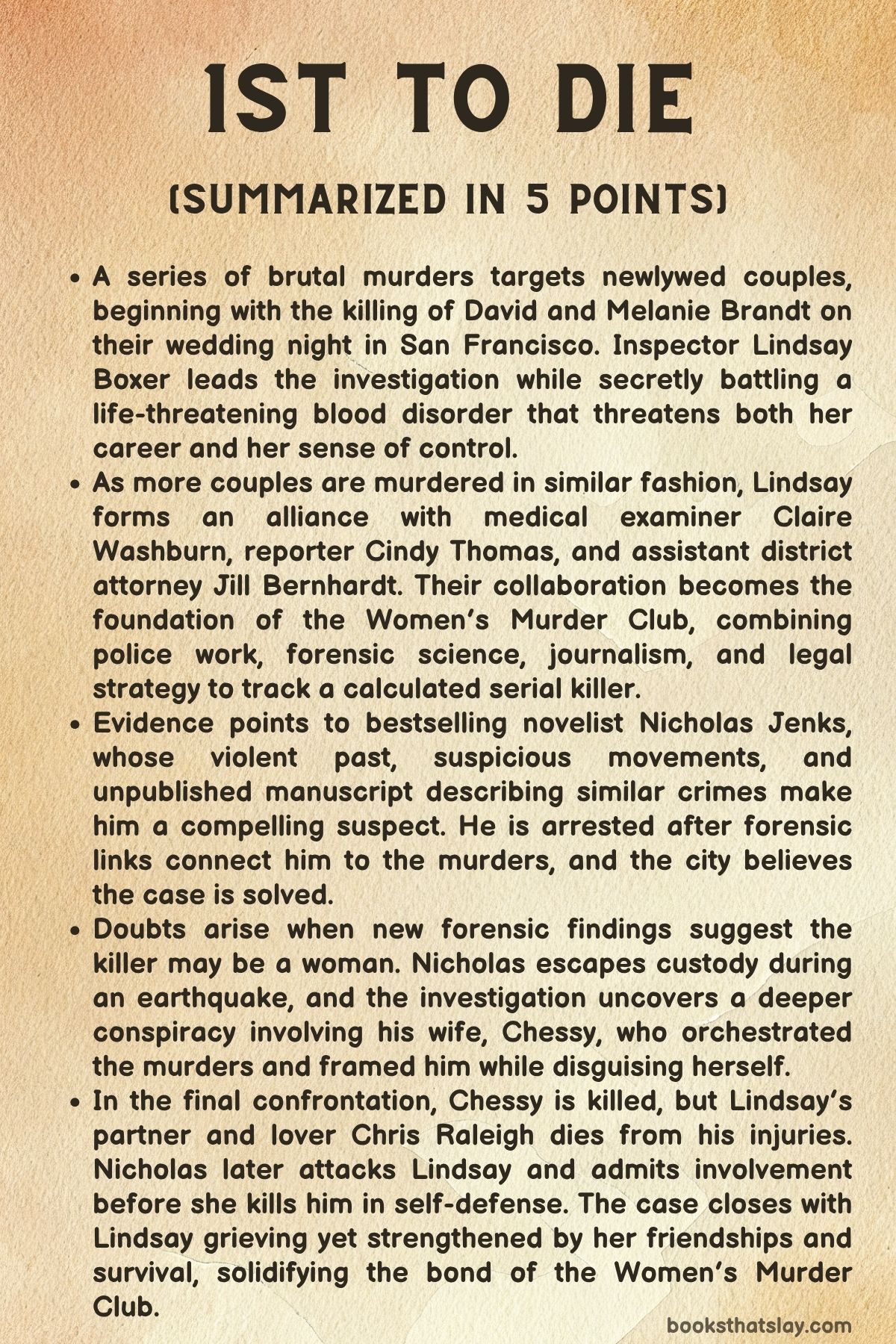
1st to Die by James Patterson is a fast-paced crime novel that introduces Detective Lindsay Boxer of the San Francisco Police Department and the group that becomes known as the Women’s Murder Club. When a bride and groom are murdered on their wedding night, Lindsay leads the investigation while privately battling a life-threatening blood disorder.
As more newlywed couples are killed, the case grows into a high-profile hunt for a serial killer targeting brides and grooms. Alongside a medical examiner, a reporter, and an assistant district attorney, Lindsay forms an alliance that blends friendship with professional resolve. The novel combines police procedure, psychological tension, and personal loss. It’s the 1st book of the Women’s Murder Club series by the author.
Summary
The story opens with Inspector Lindsay Boxer standing on the terrace of her apartment, overwhelmed by despair and holding a gun. The weight of her job and her private struggles have brought her to a breaking point.
The narrative then moves back to the beginning of the case that changed everything.
David and Melanie Brandt are celebrating their wedding night in a luxury hotel suite in San Francisco. Their happiness is interrupted when a man posing as a well-wisher knocks on the door.
He presents a bottle of champagne and then brutally stabs David. When Melanie rushes from the bathroom, she too is murdered.
The killer arranges her body on the bed, leaving a scene that feels staged and deliberate.
Lindsay is called to the crime scene shortly after receiving devastating medical news. Her doctor has diagnosed her with a rare and potentially fatal blood disorder, Negli’s aplastic anemia.
Her body is no longer producing sufficient red blood cells, and she must begin immediate treatment, including frequent blood transfusions. Despite this, she throws herself into the investigation.
At the hotel, Lindsay observes several disturbing details. The groom was stabbed through the heart.
The bride was sexually assaulted and posed on the bed in her wedding dress. A tuxedo jacket at the scene does not belong to the groom, and the couple’s wedding rings are missing.
Lindsay begins to suspect that this is not a crime of passion but something far more calculated.
The case quickly attracts media attention. Cindy Thomas, a determined reporter for the San Francisco Chronicle, manages to get inside the hotel and catch a glimpse of the crime scene.
Though Lindsay initially resents Cindy’s persistence, she recognizes her intelligence and drive.
As the investigation continues, Captain Chris Raleigh is assigned to work the case with Lindsay due to its high profile. Although she is skeptical at first, she gradually develops both professional respect and personal feelings for him.
Meanwhile, Dr. Claire Washburn, the medical examiner and Lindsay’s close friend, provides crucial forensic insights. Claire confirms the brutality of the attack and notes that the killer likely attended the wedding.
The presence of a red beard hair found later becomes an important clue.
A second newlywed couple, Becky and Michael DeGeorge, disappear shortly after their wedding in Napa Valley. They are later found murdered at a winery.
Like the Brandts, their wedding rings are missing. Tire tracks suggest the use of a limousine, and the crimes appear connected.
Public fear intensifies as it becomes clear that someone is targeting brides and grooms.
Lindsay, Claire, and Cindy begin meeting regularly, later joined by assistant district attorney Jill Bernhardt. Their collaboration evolves into the Women’s Murder Club, a partnership built on trust and shared determination.
Each woman contributes her expertise: Lindsay with police work, Claire with forensic analysis, Cindy with investigative reporting, and Jill with legal strategy.
As more evidence emerges, the group learns that both brides purchased their wedding dresses from the same department store, and files containing brides’ information were stolen weeks before the first murder. This suggests the killer carefully selected victims in advance.
The investigation expands when another newlywed couple is killed in Cleveland. Surveillance footage captures a man with a red beard near the scene.
A witness from the Brandt wedding recalls speaking to a red-bearded man who hinted that the couple had been “chosen.” The pattern strengthens the theory of a serial killer with a specific obsession.
Attention turns to Nicholas Jenks, a bestselling novelist with a violent past. He had a prior relationship with one of the victims, Kathy Voskuhl, and was in Cleveland at the time of her murder.
He also owns the same brand of champagne found at the first crime scene and has a history of domestic abuse. Most damning of all, his unpublished early novel describes murders that closely mirror the real crimes, including a character named Phillip Campbell who kills brides and grooms.
Armed with this evidence, Lindsay and her team secure an arrest. Forensic tests match beard hair from Jenks’s razor to the hair found on one of the victims.
Clothing linked to the crime is discovered in his possession. He is taken into custody, and the city breathes a temporary sigh of relief.
During this time, Lindsay’s personal life becomes more complicated. Her illness worsens, leading to fainting spells and severe fatigue.
She finally confides in Chris about her condition, and he supports her without hesitation. Their relationship deepens, offering her moments of comfort amid the chaos.
Despite the mounting evidence, Lindsay begins to question Jenks’s guilt. A forensic detail reveals that the killer was right-handed, while Jenks is left-handed.
Furthermore, his novel includes a plot twist in which the apparent killer is framed. Doubt creeps in.
Before these concerns can be fully addressed, an earthquake causes a prison transport accident, allowing Jenks to escape. Panic spreads as authorities search for him.
At the same time, new forensic analysis of evidence from the original crime scene reveals something shocking: biological traces indicate the killer is a woman.
Suspicion shifts to Joanna Wade, Jenks’s ex-wife, who had motive and physical capability. However, events escalate rapidly.
Jenks contacts Lindsay, claiming he knows the real killer. Soon after, Joanna is found murdered in her apartment.
The final confrontation occurs at the Palace of Fine Arts, where Jenks and his current wife, Chessy, were married. Chessy, disguised to resemble Jenks, is revealed as the true mastermind.
She orchestrated the murders to punish brides and grooms, acting out her anger and resentment. She planted evidence to frame her husband, exploiting his violent reputation.
During a tense standoff, Chessy confesses her crimes and forces Jenks to swallow the stolen wedding rings. Lindsay shoots Chessy to stop her.
In the aftermath, tragedy strikes. Chris is fatally wounded during the confrontation.
Lindsay holds him as he dies, devastated by the loss. His death leaves her grieving yet determined to continue.
Although Chessy’s guilt appears clear, the story delivers one final shock. Nicholas Jenks confronts Lindsay in her apartment, admitting that he and Chessy acted together.
He attacks her, but Lindsay defends herself and shoots him. With that final act, the case truly ends.
The novel closes with Lindsay relying on her friends for strength. The Women’s Murder Club, forged through violence and shared hardship, remains intact.
Though she has endured illness, betrayal, and profound loss, Lindsay survives. The experience reshapes her understanding of trust, justice, and resilience, setting the stage for the future cases that await her.
Characters
Lindsay Boxer
Lindsay Boxer is the emotional and moral center of 1st to Die. A homicide inspector with the San Francisco Police Department, she is driven, disciplined, and deeply committed to justice.
Her professional identity is central to her sense of self, which makes her diagnosis of aplastic anemia particularly destabilizing. The illness introduces vulnerability into a life built on control and strength.
Lindsay refuses to step back from her work, even when her health falters, revealing both courage and a streak of denial. Her leadership in the investigation shows sharp intuition, especially when she begins to question the obvious suspect.
Emotionally, she struggles with intimacy, shaped by a failed marriage and early family losses. Her relationship with Chris Raleigh exposes her fear of burdening others, yet it also demonstrates her capacity for love.
By the end of the novel, Lindsay is marked by grief but strengthened by survival, embodying resilience in both her personal and professional worlds.
Chris Raleigh
Chris Raleigh begins as an outsider assigned to a politically sensitive case, but he grows into a trusted partner and romantic interest for Lindsay. As a captain, he carries authority and polish that initially contrast with Lindsay’s more grounded style.
However, Chris proves himself thoughtful, capable, and steady under pressure. His investigative work, particularly in uncovering Nicholas Jenks’s violent past, demonstrates diligence and intelligence.
Emotionally open and more communicative than Lindsay, he represents stability and warmth. His willingness to support Lindsay after learning about her illness shows depth of character and genuine commitment.
Chris’s death is one of the novel’s most devastating moments, underscoring the personal cost of police work and transforming Lindsay’s journey from professional triumph to profound loss.
Claire Washburn
Dr. Claire Washburn serves as both the medical examiner and one of Lindsay’s closest friends. Highly competent and perceptive, Claire’s forensic expertise is critical in uncovering the truth, especially the biological evidence that reveals the killer’s gender.
She stands out as calm, rational, and compassionate. Claire balances scientific detachment with emotional intelligence, offering Lindsay unwavering support.
Her reactions to Lindsay’s illness show deep concern and loyalty. As a wife and mother, Claire represents a more stable domestic life, which contrasts with Lindsay’s isolation.
Her presence grounds the narrative in logic and empathy, and she plays a key role in forming the Women’s Murder Club, blending professional skill with personal solidarity.
Cindy Thomas
Cindy Thomas is ambitious, resourceful, and determined to prove herself in a competitive newsroom. Initially viewed with suspicion by Lindsay, Cindy earns respect through persistence and sharp investigative instincts.
Her ability to uncover connections, such as Nicholas Jenks’s past relationship with Kathy, becomes vital to the case. Cindy thrives on information and understands the power of narrative, yet she gradually learns to balance journalistic ambition with loyalty to her friends.
Her growth from opportunistic reporter to trusted ally reflects increasing maturity. Cindy adds energy and curiosity to the group dynamic, representing the media’s complicated relationship with law enforcement while also reinforcing the importance of collaboration.
Jill Bernhardt
Assistant District Attorney Jill Bernhardt provides the legal backbone of the investigation. Intelligent and cautious, Jill consistently emphasizes the need for solid evidence, especially when dealing with a high-profile suspect like Nicholas Jenks.
She understands the political and procedural risks involved in prosecution and refuses to act on speculation. While sometimes frustrating to Lindsay, her restraint ensures that the case is built on firm ground.
Jill’s inclusion in the Women’s Murder Club broadens the team’s expertise, and she contributes a pragmatic perspective. Her character highlights the intersection of law and justice, showing that conviction requires more than suspicion.
Nicholas Jenks
Nicholas Jenks is a bestselling novelist whose public persona masks a history of violence and manipulation. Charismatic and self-assured, he embodies the unsettling idea that fame can conceal darkness.
His prior abuse of his ex-wife and his connection to one of the victims position him as a compelling suspect. The discovery of his unpublished manuscript, which mirrors the murders, deepens suspicion and blurs the line between fiction and reality.
Nicholas presents himself as misunderstood and wrongfully accused, often shifting blame and portraying himself as the victim. Even when evidence points elsewhere, his arrogance and emotional cruelty remain evident.
His final confession that he participated in the murders confirms his moral corruption, revealing a man driven by ego and resentment rather than remorse.
Chessy Jenks
Chessy Jenks emerges as the true architect behind the murders. Initially appearing as a supportive spouse, she is revealed to be calculating, vengeful, and capable of elaborate deception.
Her use of disguise to frame Nicholas demonstrates intelligence and theatrical precision. Chessy’s motives stem from bitterness, jealousy, and a desire to punish brides and grooms, possibly reflecting her own disillusionment with marriage.
By planting evidence and manipulating perceptions, she exploits Nicholas’s violent reputation to shield herself. Her final confrontation exposes her need for recognition and control, as she confesses her crimes in a dramatic display.
Chessy represents concealed rage and the destructive power of resentment, challenging assumptions about gender and physical capability in violent crime.
Joanna Wade
Joanna Wade, Nicholas’s ex-wife, functions as both a red herring and a symbol of past trauma. A Tae-Bo instructor with physical strength and a history of financial sacrifice for Nicholas, she appears to have motive for revenge.
Her lawsuits against him and history of domestic abuse add layers of suspicion. However, Joanna ultimately becomes another victim, reinforcing the manipulative scope of Chessy’s plan.
Her character highlights the long-term damage of abusive relationships and the way victims can be re-cast as suspects due to circumstance.
Warren Jacobi
Warren Jacobi, Lindsay’s longtime partner, represents steady loyalty and experience. Though not as central to the emotional arc as Chris, he provides dependable investigative support.
Practical and grounded, Warren assists in tracking leads such as the champagne purchases and guest lists. His partnership with Lindsay reflects mutual trust developed over years of collaboration.
Warren embodies traditional police work, serving as a counterbalance to the political pressures surrounding the case.
Phillip Campbell
Phillip Campbell exists primarily as a fictional creation within Nicholas Jenks’s unpublished novel, yet his presence influences the investigation. As a character who murders brides and grooms, Phillip mirrors the real-life crimes and provides insight into the killer’s psychology.
The parallels between fiction and reality initially incriminate Nicholas, demonstrating how art can reflect or conceal truth. Phillip symbolizes the blurred boundary between imagination and confession, becoming a narrative device that both misleads and ultimately reveals deeper guilt.
Dr. Medved
Dr. Medved, Lindsay’s hematologist, plays a crucial role in the personal dimension of the story. Professional and direct, he outlines the severity of Lindsay’s condition without minimizing its risks.
His updates on her fluctuating blood counts create tension parallel to the murder investigation. While not emotionally close to Lindsay, he represents medical reality and the limits of human endurance.
His eventual news of improvement offers a rare moment of hope amid the surrounding tragedy.
Sweet Martha
Sweet Martha, Lindsay’s dog, may seem peripheral, but she represents comfort and stability in Lindsay’s solitary life. Through daily routines like walks and quiet evenings at home, Sweet Martha anchors Lindsay to normalcy.
In a narrative filled with violence and betrayal, the dog symbolizes unconditional companionship and the small constants that help Lindsay endure overwhelming stress.
Themes
Female Solidarity and Professional Collaboration
In 1st to Die, the formation of the Women’s Murder Club represents a powerful assertion of female solidarity within traditionally male-dominated institutions. Lindsay, Claire, Cindy, and Jill each operate in high-pressure professional environments where their authority is frequently questioned or constrained by hierarchy and politics.
Instead of competing, they choose collaboration. This alliance is not symbolic or sentimental; it is practical and strategic.
Each woman contributes expertise that strengthens the investigation. Lindsay brings investigative instincts and field experience, Claire provides forensic precision, Cindy uncovers hidden connections through journalism, and Jill ensures that legal standards are upheld.
The club becomes a space of trust where professional boundaries soften enough to allow honesty about fear, frustration, and doubt. Their meetings are not merely about evidence but also about survival—emotional, psychological, and even physical.
The murders target brides, women at a culturally celebrated moment of transition into marriage. In response, these women create a different model of commitment, one based on friendship and shared purpose rather than romance.
The club challenges isolation, especially Lindsay’s tendency to carry burdens alone. Through this collective effort, the narrative suggests that cooperation among women is not secondary to institutional power but can rival and even surpass it.
The Women’s Murder Club ultimately becomes both a crime-solving unit and a support system that sustains its members through illness, grief, and trauma.
The Illusion of Marriage and the Violence Beneath Romance
The repeated targeting of newlyweds forces a confrontation with the cultural mythology surrounding marriage. Weddings are portrayed as elaborate celebrations filled with optimism, beauty, and social prestige.
The killer disrupts this ritual at its most symbolic moment, exposing how fragile such ideals can be. Brides in white dresses, luxury venues, and romantic honeymoons become settings for calculated brutality.
This contrast heightens the horror and questions whether marriage is truly a sanctuary or simply another stage for power struggles and hidden resentments.
The character of Chessy Jenks embodies the bitterness that festers beneath the surface of marital appearances. Her rage is directed at couples who seem to embody happiness and social validation.
At the same time, Nicholas’s history of abuse reveals how marriage can conceal cruelty behind public respectability. Even Lindsay’s own failed marriage casts doubt on the promise of lasting romantic security.
The novel does not reject love outright; Lindsay’s relationship with Chris shows genuine connection. However, it refuses to present marriage as inherently redemptive.
Instead, it portrays it as a complex institution shaped by ego, insecurity, betrayal, and longing. By attacking couples at the beginning of their married lives, the story symbolically dismantles the fantasy of flawless union and reveals the volatility that can exist beneath ceremonial perfection.
Appearance Versus Reality
Public identity repeatedly clashes with hidden truth throughout 1st to Die. Nicholas Jenks exemplifies this theme.
As a bestselling novelist and cultural figure, he enjoys admiration and influence. Yet his polished image conceals a history of domestic violence and manipulation.
His fame complicates the investigation, illustrating how reputation can distort justice. Authorities hesitate to act without overwhelming evidence, not simply because of legal caution but because public perception shapes institutional decisions.
Chessy’s elaborate disguises intensify this tension. By presenting herself as Nicholas in certain contexts, she exploits assumptions about gender, appearance, and guilt.
Her ability to move undetected highlights how easily perception can be engineered. Even forensic evidence initially points in misleading directions, reinforcing the idea that surface impressions cannot be trusted.
On a personal level, Lindsay also performs strength while privately battling a life-threatening illness. Her colleagues see competence and resolve, rarely the exhaustion and fear beneath.
This duality underscores the emotional cost of maintaining authority. The theme suggests that truth requires persistence and skepticism, especially when confronted with charisma, status, or carefully constructed personas.
Justice depends not on what appears convincing but on what withstands scrutiny. By revealing how easily appearances deceive, the novel critiques both societal assumptions and institutional blind spots.
Mortality and Human Fragility
Death is constant in the narrative, but it is not confined to murder victims. Lindsay’s diagnosis introduces a quieter yet equally threatening form of mortality.
Her body becomes unpredictable, forcing her to confront vulnerability in a profession that demands physical and emotional endurance. The juxtaposition of her illness with the violent deaths she investigates creates a layered exploration of fragility.
She is not only chasing a killer but also racing against her own failing blood counts.
The randomness of the earthquake that enables Nicholas’s escape further emphasizes how quickly life can change. Chris’s death during the final confrontation reinforces that even the most capable individuals are not protected from sudden loss.
This awareness of mortality shapes Lindsay’s emotional decisions, particularly in her relationship with Chris. Her hesitation to fully commit is tied to fear—fear of loss, fear of burdening someone with her illness, fear of attachment in a dangerous world.
The novel suggests that strength is not the absence of vulnerability but the decision to continue despite it. Lindsay continues working, loving, and fighting even when her physical condition deteriorates.
Mortality does not paralyze her; it sharpens her focus. The theme ultimately reframes fragility as a universal condition rather than a personal weakness.
Everyone, from celebrated authors to decorated police officers, is subject to forces beyond their control.
Justice, Power, and Institutional Pressure
High-profile crime exposes the tension between truth and political expediency. From the outset, the investigation is shaped by media coverage, mayoral oversight, and the involvement of federal authorities.
Decisions are influenced not only by evidence but by public reaction and the reputations of those involved. The assignment of Chris Raleigh reflects institutional desire to manage optics as much as to solve the case.
Jill’s insistence on airtight evidence before arresting Nicholas underscores the legal complexities surrounding justice. Prosecuting a celebrity carries risks that extend beyond the courtroom.
The narrative portrays justice as a process constrained by hierarchy, bureaucracy, and public scrutiny. Even when Lindsay believes she has found the killer, she must navigate procedural hurdles.
The eventual revelation that the wrong suspect was initially arrested complicates any simple understanding of justice. Evidence can mislead, and confidence can be misplaced.
Yet the system also allows for correction. Forensic reexamination and Lindsay’s refusal to ignore inconsistencies lead to the truth.
The theme suggests that justice is neither automatic nor pure; it requires persistence, skepticism, and the courage to challenge assumptions. Power structures may slow progress, but they can also provide frameworks for accountability when used responsibly.
Trauma, Resilience, and Personal Cost
The psychological toll of violence permeates the narrative. Each murder scene leaves emotional residue, especially for Lindsay.
Her early contemplation of suicide signals accumulated stress long before the central case unfolds. Professional exposure to brutality intersects with personal illness, compounding strain.
Chris’s death represents the ultimate personal cost of dedication to duty. Lindsay’s grief is not abstract; it reshapes her identity.
Yet she does not retreat permanently. Instead, she leans on her friends and confronts Nicholas when he attacks her in her own home.
Her survival in that final confrontation is symbolic. She refuses to be defined by victimhood, even when circumstances threaten to reduce her to it.
Resilience in the novel is collective as well as individual. The Women’s Murder Club absorbs shock together.
Shared conversations, shared investigation, and shared mourning create a framework for endurance. Trauma does not disappear, but it becomes survivable when distributed among those who care.
The narrative acknowledges loss without offering easy consolation. Strength emerges not from invincibility but from persistence after devastation.