21 Lessons for the 21st Century Summary and Analysis
21 Lessons for the 21st Century by Yuval Noah Harari is a wide-ranging exploration of the most urgent questions facing humanity today. Drawing on history, science, politics, and philosophy, Harari examines how rapid advances in artificial intelligence and biotechnology are reshaping work, power, freedom, and identity.
He asks what it means to live in a world flooded with information yet starved of clarity, and how societies can respond to rising nationalism, inequality, and technological disruption. Rather than offering easy answers, Harari invites readers to think critically about the present and to take responsibility for the future we are collectively creating.
Summary
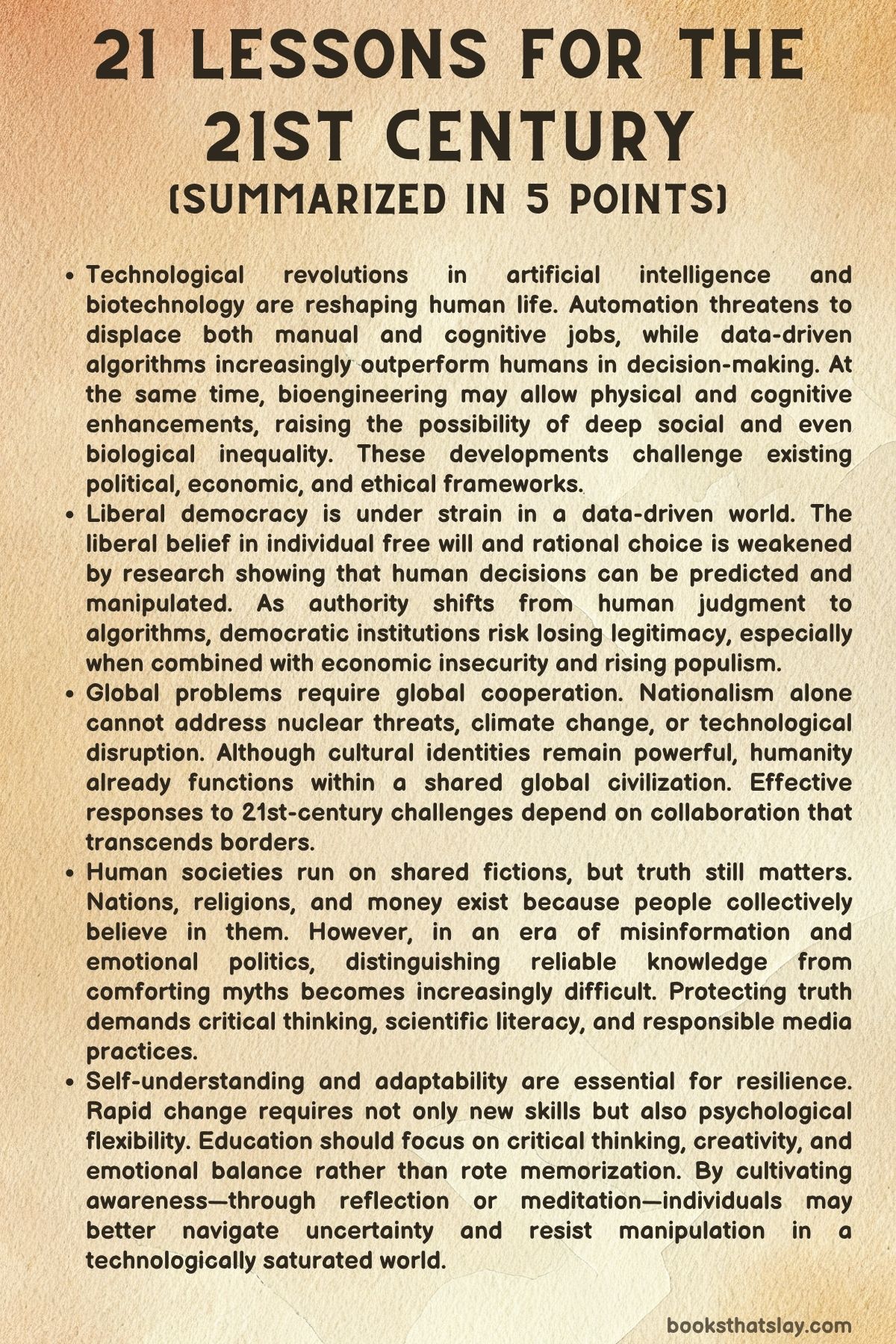
21 Lessons for the 21st Century is organized around a central concern: humanity is entering a period of unprecedented technological and political transformation, yet our intellectual frameworks and political systems are struggling to keep pace. Harari sets out to clarify what is happening in the world today and what it might mean for the future of Homo sapiens.
He begins by examining the crisis of liberal democracy. In the late 20th century, liberalism appeared triumphant after the collapse of fascism and communism.
It promised individual freedom, human rights, and free markets. However, events such as the global financial crisis of 2008, the rise of populist leaders, and Brexit revealed widespread dissatisfaction.
Many people feel economically insecure and politically unheard. According to Harari, liberalism has not yet found convincing answers to the disruptions caused by the digital revolution and the emerging fields of biotechnology and artificial intelligence.
The transformation of work is one of the most immediate challenges. Automation, machine learning, and robotics are changing industries at a pace that few fully understand.
While new jobs may emerge, many traditional roles are disappearing. Even professions that require advanced cognitive skills could eventually be performed by algorithms capable of analyzing emotions and decision-making patterns.
Artificial intelligence has advantages over humans in connectivity and updatability. A human doctor improves slowly through experience; an AI system can instantly update across the globe.
This could produce enormous benefits, such as accessible healthcare, but it could also create mass unemployment or a “useless class” of people whose labor is no longer economically valuable. Harari suggests that societies may need to shift their focus from protecting jobs to protecting people, possibly preparing for a post-work future.
The growing power of data raises further concerns. Liberal democracy rests on the idea that individuals possess free will and that authority flows from personal choices expressed through votes and consumer behavior.
Yet advances in neuroscience and data science challenge the notion of free will. If human decisions are the result of biochemical processes, and if algorithms can learn to predict and manipulate those processes, authority may gradually shift from individuals to data-processing systems.
Governments or corporations that control vast amounts of data could gain unprecedented power. Harari warns that digital dictatorships might emerge if information becomes centralized and citizens are constantly monitored and influenced.
Inequality may intensify in this environment. In the agricultural era, land ownership determined wealth and hierarchy.
In the industrial era, machines and factories played a central role. In the digital era, data becomes the key asset.
Those who own data may control the future. Moreover, biotechnology could enable enhancements to physical and cognitive abilities, potentially dividing humanity into upgraded elites and a marginalized majority.
Regulating data ownership is therefore one of the defining political tasks of the century, yet it is far more complex than regulating land or industry because data is intangible and easily shared.
Harari then turns to political and cultural challenges. He questions whether online social networks can replace the intimate communities that shaped human evolution.
Humans evolved in small groups and still require physical presence and direct interaction. Digital platforms may connect billions, but they can also deepen loneliness and enable large-scale manipulation.
Corporations that rely on maximizing user engagement are unlikely to prioritize genuine social well-being.
Addressing the “clash of civilizations” thesis, Harari argues that humanity already shares a single global civilization. Cultural differences remain significant, but economic systems, scientific knowledge, and political institutions are increasingly interconnected.
Events such as the Olympic Games illustrate a shared global framework of rules and symbols. Conflict is not inevitable between civilizations; rather, it often stems from political narratives.
Nationalism, while capable of fostering solidarity, becomes dangerous when it turns into ultranationalism. The 21st century presents global problems that cannot be solved by individual nations alone: nuclear proliferation, climate change, and technological disruption.
Climate change, in particular, requires coordinated global action to reduce emissions and prevent severe ecological consequences. A retreat into narrow nationalism would weaken humanity’s ability to confront these threats.
Religion, in Harari’s view, offers limited guidance for technical and policy challenges, which are better addressed through scientific inquiry. However, religion remains influential in shaping identity and often reinforces national divisions.
In modern politics, religious traditions frequently serve national agendas rather than transcending them. Immigration debates in Europe highlight tensions between tolerance and cultural preservation.
Beneath these debates lies a deeper question about cultural superiority and whether liberal values can sustain open societies without undermining social cohesion.
Harari also examines fear-driven issues such as terrorism and war. Terrorism relies on provoking overreaction and spreading panic.
Governments and media play crucial roles in preventing hysteria from amplifying the impact of violent acts. Regarding global war, Harari notes that economic and technological changes make large-scale conquest less profitable than in the past.
Knowledge-based economies and nuclear weapons reduce incentives for traditional warfare, though human miscalculation remains a danger.
The book then shifts to themes of humility, morality, and truth. Harari challenges the belief that any nation or religion stands at the center of history.
Moral behavior predates organized religion and has roots in evolutionary biology. He distinguishes between belief in a mysterious cosmic force and belief in a divine lawgiver who dictates specific rules.
Morality, he argues, should focus on reducing suffering rather than obeying ancient commands.
Secularism, built on values such as truth and compassion, also has its flaws. Secular ideologies can harden into rigid dogmas.
Yet their willingness to admit error gives them an advantage in a rapidly changing world shaped by biotechnology and AI.
A major obstacle to informed decision-making is human ignorance. Individuals rely heavily on collective knowledge and often overestimate their own understanding.
In a complex global system, cause-and-effect relationships are difficult to trace. Our sense of justice evolved in small communities and struggles to handle large-scale structural injustices, such as global supply chains or climate impacts.
Simplistic narratives, conspiracy theories, and rigid ideologies offer psychological comfort but obscure reality.
Harari argues that humans are a storytelling species. Shared myths enable large-scale cooperation, whether in religion, nationalism, or economics.
Even money functions because people collectively believe in its value. However, the pursuit of power often takes precedence over the pursuit of truth.
Combating misinformation requires investing time in verifying sources and engaging with credible research.
Science fiction significantly shapes public perceptions of technology. Many narratives focus on conscious robots rebelling against humans, but Harari suggests a more plausible scenario: a small elite empowered by algorithms dominating a disempowered majority.
The danger lies not in sentient machines but in systems that understand and influence human behavior.
Education must adapt to constant change. Instead of memorizing information, students need critical thinking, communication, collaboration, and creativity.
Emotional resilience and flexibility will be essential in a world where careers and identities shift repeatedly.
In exploring meaning, Harari questions the idea that life follows a grand narrative. Humans adopt multiple identities and stories, switching between them as circumstances change.
Clinging to a single all-encompassing story, as in fascism, can have catastrophic consequences. Doubt, once condemned, has become central to intellectual freedom.
The book concludes with a reflection on meditation. Harari distinguishes between the brain as a biological organ and the mind as a stream of subjective experiences.
As algorithms grow more capable of predicting and shaping behavior, understanding one’s own mind becomes urgent. Meditation offers a practical method for observing thoughts and emotions directly.
Harari suggests that much human suffering arises from mental patterns rather than external conditions. By observing these patterns, individuals may reduce suffering and gain clarity.
Throughout 21 Lessons for the 21st Century, Harari calls for intellectual honesty, global cooperation, and self-awareness. He does not claim certainty about the future but insists that humanity must confront its challenges thoughtfully.
The choices made in the coming decades may determine not only political systems but the very nature of human existence.
Key People and Characterizations
Yuval Noah Harari
Harari is the central presence in 21 Lessons for the 21st Century, not as a fictional protagonist but as the guiding intelligence shaping every argument and example. He speaks as a historian who is wary of prediction yet willing to map the forces that make certain futures more likely than others.
His defining trait is an insistence on clarity: he repeatedly returns to the idea that modern life overwhelms people with noise, and that the first task is to see what is actually happening. He balances skepticism about comforting narratives with a practical concern for human suffering, which becomes his moral baseline when he assesses religion, nationalism, technology, and politics.
His voice is also marked by controlled urgency—he treats AI, biotechnology, climate risk, and authoritarian drift as real pressures, but he discourages panic because panic makes people easier to manipulate and less capable of coordinated action.
Harari’s worldview is shaped by a tension he never fully resolves: he doubts free will in the traditional sense and emphasizes biological and social forces that steer human choices, yet he still argues for responsibility, education, and ethical restraint. This makes him less of a preacher and more of a disciplined critic of human self-mythology.
He challenges readers to give up flattering stories about individual autonomy, national uniqueness, or moral superiority, and he replaces them with a demand for humility and self-knowledge. His recurring method is to take a popular assumption—about jobs, liberty, religion, truth, or identity—and test it against history, evolutionary logic, and institutional incentives.
By the end, he comes across as someone who believes that inner training (attention, emotional balance, self-observation) is not separate from politics, because the political future will be determined in part by how predictable, fearful, and distractible human minds become.
The Ordinary Citizen
The “ordinary person” functions as a recurring implied character: a worker, voter, consumer, and social-media user who is trying to live a stable life while the ground shifts under their feet. This figure is defined by vulnerability to forces they neither control nor fully understand—automation, data extraction, global supply chains, and political polarization.
Harari treats this person with a mix of sympathy and bluntness. He acknowledges their anxiety about becoming economically irrelevant and their desire for simple explanations, but he also describes how easily they fall into the knowledge illusion, mistaking collective expertise for personal understanding.
This character’s arc across the book is not a journey toward triumph but a confrontation with limits: limited attention, limited comprehension of complex systems, and limited ability to keep up with constant change without psychological cost.
At the same time, the ordinary citizen is not portrayed as helpless. Harari’s advice repeatedly implies that this person can reclaim some agency by learning how to evaluate information, by resisting fear-based manipulation, and by investing in adaptable skills and emotional resilience.
Yet the character remains caught between ideals and incentives: liberal democracy asks them to make rational choices, but the information environment rewards outrage and group loyalty; markets offer personalization, but personalization can become behavioral control. The citizen becomes a test case for whether democratic societies can remain functional when persuasion technology grows more powerful than the average person’s self-knowledge.
The Algorithm
The algorithm is the book’s most influential nonhuman character, presented less as a single entity and more as an evolving system of decision-making powered by data, connectivity, and constant updates. Harari frames it as a competitor to human judgment: it does not need to be perfect, only reliably better than average humans in predicting choices and optimizing outcomes.
Its defining traits are speed, scale, and the ability to learn across millions of cases. The algorithm’s “personality,” in Harari’s depiction, is not emotional but instrumental: it measures, predicts, nudges, and, when given authority, replaces.
This makes it both a tool and a threat, depending on who owns it and what goals it serves.
What gives the algorithm narrative weight is its capacity to shift the source of authority. In the liberal story, individuals are supposed to know themselves and choose accordingly.
Harari argues that if algorithms know people better than they know themselves, individuals will increasingly outsource decisions—first small ones, then life-shaping ones. The algorithm thus becomes a quiet usurper: it rarely needs violence, because it can achieve control through convenience, accuracy, and personalization.
Harari also highlights a darker possibility: centralized algorithmic power could make authoritarian regimes more efficient than democracies by turning surveillance into prediction and dissent into a solvable technical problem. In that sense, the algorithm is not simply a machine; it is a new kind of political actor whose influence depends on the structure of ownership and governance around data.
The “Useless Class”
This is not an insult in Harari’s framing but a social category: people who may lose economic value because machines outcompete them across both manual and cognitive tasks. As a character, the useless class represents the human cost of a transition where societies protect jobs as a principle, even when jobs vanish faster than people can retrain.
The defining conflict for this group is not only unemployment, but also loss of meaning, status, and social belonging. Harari suggests that emotional stamina may become a dividing line: some will adapt repeatedly, while others will experience continuous disruption as a form of slow social exclusion.
Harari uses this figure to stress that the crisis is not merely economic. When a person’s value is measured by employability, large-scale redundancy threatens social stability and personal dignity.
The useless class also functions as a warning about political consequences: fear, resentment, and susceptibility to nostalgic fantasies can rise when people feel discarded by systems that promise progress. This character therefore embodies both the moral question—what do societies owe people beyond employment—and the political question—what kinds of movements emerge when large populations feel permanently sidelined.
The Superhuman Elite
Opposite the useless class stands the potential upgraded elite: those who own data, control advanced AI, and can afford biotechnological enhancements that extend life or increase cognitive and physical abilities. Harari treats this figure as a plausible outcome of unequal access rather than a guaranteed destiny, but he uses it to show how inequality could become biological rather than merely economic.
The superhuman elite is defined by compounding advantages: better tools to acquire wealth, more power to shape regulation, and, eventually, the possibility of being literally different from the rest of humanity in capability and lifespan.
This character is not necessarily portrayed as evil in intention, but as structurally dangerous. Even benevolent elites can create a world where their interests and experiences diverge so sharply from the majority that shared citizenship becomes fragile.
The elite becomes a driver of political instability because democracy assumes a basic equality among citizens; if the gap turns into a gap of ability, health, and longevity, democratic bargaining may stop feeling meaningful. In Harari’s analysis, the superhuman elite is less a villain than a symbol of what happens when technological progress is guided primarily by market logic and weak governance.
The Data Baron
The data baron is the modern counterpart to the landowner or factory magnate: an individual or corporation whose power flows from controlling information streams and biometric or behavioral data. This character is defined by invisibility and intimacy at the same time—people may not know who holds their data, yet that data may reveal more about them than their friends do.
Harari presents this figure as politically consequential because data concentration can translate into influence over elections, markets, and public opinion. Unlike traditional wealth, data wealth can grow as it is shared and processed, making dominance harder to challenge once established.
The data baron’s key narrative role is to complicate the usual debate between state power and private power. Harari warns that handing data control to governments could create digital dictatorships, while leaving it to corporations can create unaccountable private empires.
The data baron therefore represents a new kind of sovereignty: authority gained not by territory or armies, but by prediction, persuasion, and behavioral design. This character forces the reader to see regulation as a civilizational question rather than a technical policy tweak.
The Digital Dictator
The digital dictator is an updated authoritarian figure who benefits from AI-driven surveillance, centralized databases, and emotion-shaping propaganda. Harari contrasts this with older dictatorships that struggled with information flow and relied on human bureaucracies that were slow, corrupt, or blind.
The digital dictator is defined by administrative competence powered by machines: the ability to monitor citizens continuously, anticipate unrest, and fine-tune incentives and punishments with precision. This makes repression less visibly brutal and more quietly total, because control can be achieved through prediction and manipulation rather than constant overt force.
In Harari’s framing, the danger is not only political oppression but the erosion of inner freedom. If a regime can track stress, anger, desire, and fear through biometric data, it can intervene before dissent becomes action.
The digital dictator thus represents a future where the battleground is not just public speech but private emotion. This character also serves as a critique of complacency in democracies: if democracies fail to manage data power responsibly, authoritarian systems may appear more efficient and therefore more attractive to frightened populations.
Mark Zuckerberg
Zuckerberg appears as a real-world figure used to illustrate the ambition of social platforms to engineer community at scale. In the book’s portrayal, he is less an individual with a personal storyline and more a symbol of corporate social engineering.
Harari treats Zuckerberg’s interest in “building community” as consequential because it positions a private company as a designer of social life, using AI to shape how people connect, argue, and organize. The character is defined by a mismatch between stated aims and business incentives: platforms make money by capturing attention, which often rewards content that provokes, polarizes, or keeps users online rather than content that builds deep offline relationships.
Zuckerberg’s narrative function is to highlight the limits of corporate-led solutions to social fragmentation. Harari suggests that humans need embodied communities and real-world bonds, but the platform model tends to pull people away from physical life.
This tension makes Zuckerberg a case study in how technological optimism can slide into manipulation, especially if the next step becomes immersive augmented realities that blur the line between authentic experience and designed experience.
Samuel P. Huntington
Huntington appears as the intellectual source of the “clash of civilizations” thesis, serving as a representative of a worldview that treats cultural blocs as natural and destined for conflict. Harari engages Huntington not primarily to attack a person but to challenge the explanatory power of the thesis.
Huntington’s character role is that of a grand theorist whose framework is appealing because it simplifies complexity and offers a clear map of enemies and identities.
Through this engagement, Huntington becomes a foil for Harari’s emphasis on shared global civilization and the malleability of cultural narratives. Harari argues that civilizations are not biological species and that cultural identities can merge, shift, and be reinvented.
Huntington’s presence therefore helps Harari show how seductive large narratives can be, and how they can encourage fatalism or justify conflict by treating it as inevitable.
The Terrorist Producer
Harari characterizes terrorists less as battlefield commanders and more as producers of spectacle who aim to trigger fear and provoke overreaction. This character is defined by strategic psychology: the goal is not maximal physical destruction but maximal emotional impact.
The terrorist producer depends on media attention and public imagination. Their success is measured by the scale of the response they elicit from states and societies.
In this depiction, the terrorist producer’s power comes from exploiting a vulnerability in modern legitimacy. States promise public safety, so highly visible attacks can make governments appear weak, pushing them toward excessive retaliation.
Harari’s focus on this character reinforces a broader theme: in the 21st century, perception management can matter as much as material force, and fear can be weaponized to reshape politics.
The Soldier-Statesman of the Past
This is an implied historical character: the 19th- and early 20th-century leader who believed conquest was profitable and war was a reliable tool of national enrichment. Harari contrasts this figure with modern leaders who face a world where knowledge economies, nuclear weapons, and cyber capabilities make large-scale war high-risk and low-reward.
The past soldier-statesman is defined by confidence in military solutions because history once rewarded those solutions.
This character serves to explain why comparisons between different eras can mislead. People may see echoes of past tensions and assume the same outcomes are likely, but the underlying incentives have changed.
The soldier-statesman figure also supports Harari’s warning that even if conditions discourage war, human error and vanity remain constant risks.
The Secular Idealist
The secular idealist represents the ethical code that supports modern science and democracy, oriented around truth, compassion, equality, and responsibility. Harari presents this character as aspirational rather than triumphant.
The secular idealist wants openness and self-correction, but is tempted to harden into dogma under pressure, especially in emergencies when uncertainty feels intolerable.
This character’s significance lies in the willingness to admit mistakes. Harari treats that willingness as a survival trait for civilizations facing transformative technologies.
The secular idealist becomes a defense against authoritarian certainty and against ideological comfort that refuses to learn. Yet the character remains fragile, because institutions built on secular values can still commit atrocities if they prioritize order or power over their stated principles.
The Meditator
The meditator is both a personal and conceptual figure in the book, representing systematic self-observation in an age when external systems increasingly observe and influence us. This character is defined by attention training and a practical interest in the mind as lived experience rather than as abstract theory.
Harari presents meditation as a method for noticing how suffering arises through craving, aversion, and repetitive mental habits.
As a character, the meditator is not a retreat from modern problems but a response to them. If algorithms become better at predicting and steering human behavior, then understanding one’s own mind becomes a form of resistance.
The meditator stands for inner clarity in a world that profits from distraction. This figure also ties the book’s themes together: global politics and personal psychology are linked because societies are built from minds that can be frightened, manipulated, and polarized, or steadied, curious, and self-aware.
Themes
Technological Disruption and the Future of Humanity
Rapid advances in artificial intelligence and biotechnology form the structural backbone of 21 Lessons for the 21st Century. Harari treats these technologies not as distant possibilities but as forces already reshaping economies, political systems, and personal identities.
Automation threatens to replace not only manual labor but also cognitive and emotional tasks once thought uniquely human. Algorithms can diagnose diseases, compose music, and predict preferences with growing accuracy.
The central concern is not simply job loss, but the redistribution of power. When machines outperform humans in decision-making, authority begins to migrate away from individual judgment toward data-driven systems.
Biotechnology deepens this disruption by raising the possibility of altering the human body and mind. Enhancements in cognition, lifespan, and emotional regulation could change what it means to be human.
The combination of AI and bioengineering introduces a scenario in which human beings may no longer be the most capable agents in their own societies. This possibility destabilizes long-standing political ideals built around human autonomy and equality.
Technological disruption thus becomes an existential question: if humans can be upgraded, predicted, or outperformed, the meaning of democracy, work, and moral responsibility must be reconsidered.
Harari does not treat technology as inherently good or evil. Instead, he frames it as a multiplier of existing social structures.
If concentrated in the hands of a few corporations or authoritarian governments, it could lead to unprecedented control. If regulated responsibly and distributed equitably, it might improve healthcare, reduce suffering, and enhance knowledge.
The uncertainty surrounding these outcomes is part of the tension. Humanity is racing forward without a coherent narrative that integrates these powers into a stable political and ethical framework.
Crisis of Liberalism and Political Authority
Liberal democracy, once regarded as the final stage of political evolution, faces mounting challenges. The promise that free markets and individual rights would produce stability and prosperity appears less convincing in an era of financial crises, economic inequality, and cultural polarization.
Harari explores how technological shifts exacerbate this crisis. Liberalism depends on the belief that individuals possess free will and can make rational decisions.
However, behavioral science and data analytics suggest that human choices are often predictable and manipulable.
This tension erodes confidence in the foundations of liberal governance. If algorithms can anticipate voters’ preferences or influence their emotions, the concept of informed consent becomes fragile.
Political campaigns can target individuals with tailored messages, shaping opinions at a granular level. Authority gradually shifts from public deliberation to data-driven persuasion.
In such a context, democracy risks becoming a performance rather than a genuine expression of collective will.
The crisis is intensified by economic insecurity. Automation may displace workers faster than new roles can be created.
Citizens who feel economically irrelevant may lose faith in institutions that once promised upward mobility. Nostalgic nationalism fills the ideological vacuum, offering simple explanations and emotional comfort.
Harari’s analysis suggests that liberalism’s survival depends on its ability to reinvent itself in response to these pressures. Without a new narrative that addresses technological power and global interdependence, liberal democracy may struggle to maintain legitimacy.
Data, Surveillance, and Inequality
Data emerges as the most valuable asset of the digital age. In previous eras, land and machinery determined wealth; now, information about human behavior holds the key to economic and political dominance.
Those who control data can predict preferences, optimize services, and shape decisions. This creates new hierarchies that may surpass earlier forms of inequality.
The gap is not only financial but informational: corporations and governments may know more about individuals than individuals know about themselves.
The concentration of data power raises the specter of digital authoritarianism. Surveillance technologies enable constant monitoring of behavior, emotions, and social interactions.
Predictive analytics can identify dissent before it manifests openly. Such capabilities could strengthen centralized regimes, making them more efficient and less reliant on visible repression.
Even in democratic societies, data monopolies threaten fairness and transparency. Citizens may unknowingly surrender autonomy in exchange for convenience.
Economic inequality may also become biological. If advanced healthcare and cognitive enhancements are available only to the wealthy, humanity could split into stratified groups with differing abilities and lifespans.
This scenario undermines the moral premise of equality on which modern politics rests. Regulating data ownership becomes a defining challenge, yet it is difficult because data is intangible and easily replicated.
Harari emphasizes that decisions made about data governance will shape the balance between freedom and control in the coming decades.
Nationalism, Globalism, and Shared Civilization
National identity remains a powerful emotional force, yet many contemporary problems transcend borders. Climate change, nuclear proliferation, and technological disruption cannot be addressed by isolated states.
Harari challenges the idea that civilizations are inherently locked in conflict. Cultural identities are constructed through shared stories rather than genetic divisions, and these stories can change.
Humanity already participates in a single global system of trade, science, and communication.
Nationalism can foster solidarity and social welfare within states, but when it becomes exclusive or supremacist, it obstructs cooperation. Ultranationalism frames global collaboration as betrayal and treats external threats as defining features of identity.
This mindset may have been functional in earlier periods, but in a tightly interconnected world it becomes self-defeating. Environmental collapse, for instance, ignores political boundaries.
No nation can insulate itself from rising temperatures or ecological degradation.
The tension between national pride and global responsibility is one of the defining dilemmas of the century. Harari does not dismiss attachment to culture or homeland; rather, he questions whether these attachments can coexist with planetary cooperation.
The future depends on constructing narratives that allow multiple identities to coexist without turning difference into hostility. Shared civilization does not erase diversity but requires recognition of interdependence.
Truth, Fiction, and Collective Narratives
Human societies rely on shared stories to organize large-scale cooperation. Money, corporations, nations, and religions function because people collectively believe in their legitimacy.
Harari argues that the capacity to create and sustain fictions has been essential to human success. However, this capacity also enables manipulation and self-deception.
In a world saturated with information, distinguishing reliable knowledge from comforting myth becomes increasingly difficult.
The concept of a “post-truth” era is reframed as a continuation of humanity’s long-standing tendency to prioritize cohesion and power over objective accuracy. False narratives can unify groups and mobilize action, sometimes more effectively than factual accounts.
Digital platforms amplify this dynamic by rewarding emotionally charged content. As a result, misinformation spreads rapidly, shaping political and social outcomes.
Harari emphasizes the responsibility of individuals and institutions to invest effort in verifying sources and engaging with credible research. The pursuit of truth demands humility and patience, qualities often at odds with political urgency.
Without a shared commitment to factual integrity, democratic deliberation weakens. The struggle over truth is therefore not merely epistemological but political, determining whether societies can address real challenges rather than imaginary ones.
Education, Adaptability, and Psychological Resilience
Traditional education systems were designed for a world where information was scarce and relatively stable. Memorization and technical specialization once guaranteed employability.
In a rapidly changing technological environment, such approaches risk obsolescence. Harari suggests that adaptability, critical thinking, communication, and creativity are more durable skills.
Individuals must be prepared to reinvent themselves repeatedly as industries evolve.
This demand for constant reinvention places psychological strain on people. Humans evolved in relatively stable environments; perpetual uncertainty can generate anxiety and disorientation.
Emotional resilience becomes as important as technical competence. Societies must consider how to support citizens facing continuous disruption, not only economically but mentally.
Education also plays a role in defending against manipulation. Understanding how algorithms operate and how information spreads can reduce vulnerability to propaganda.
Self-knowledge becomes a strategic asset. By cultivating awareness of cognitive biases and emotional triggers, individuals may preserve autonomy in a data-driven world.
Adaptability thus encompasses both practical skills and inner stability.
Meaning, Identity, and Self-Understanding
Many individuals seek a narrative that explains their place in the universe. Religious, national, and ideological stories offer frameworks that assign roles and purposes.
Harari questions whether such grand narratives reflect objective reality or human psychological needs. People often maintain multiple identities, shifting between them according to context.
Absolute loyalty to a single narrative can produce intolerance and violence.
The search for meaning becomes more complex in a world where traditional structures lose authority and technological change accelerates. Doubt, once condemned as weakness, becomes essential for intellectual freedom.
Yet constant doubt can also feel destabilizing. Harari suggests that observing suffering directly, rather than clinging to rigid stories, may provide a more grounded path toward understanding.
Meditation appears as a practical response to this crisis of meaning. By observing thoughts and emotions without attachment, individuals can see how narratives form and how craving generates suffering.
This introspective practice connects personal well-being with broader societal resilience. If algorithms aim to predict and shape behavior, then awareness of one’s own mental processes becomes a form of defense.
The theme of meaning ultimately converges with the theme of power: the more clearly people understand themselves, the less easily they are governed by fear, illusion, or external control.