2666 by Roberto Bolaño Summary, Characters and Themes
2666 by Roberto Bolaño is a vast, restless 5 part novel that moves across continents and decades, circling the same set of mysteries from different angles. It begins with comedy and intellectual vanity in the world of literary scholarship, then shifts into family breakdown, political exile, journalism, and a city haunted by relentless violence.
At its center are two linked questions: who is the elusive writer Benno von Archimboldi, and what does it mean when a place becomes known for the steady disappearance and murder of women? The book’s scope is large, but its focus stays sharp: obsession, complicity, and what people choose to ignore.
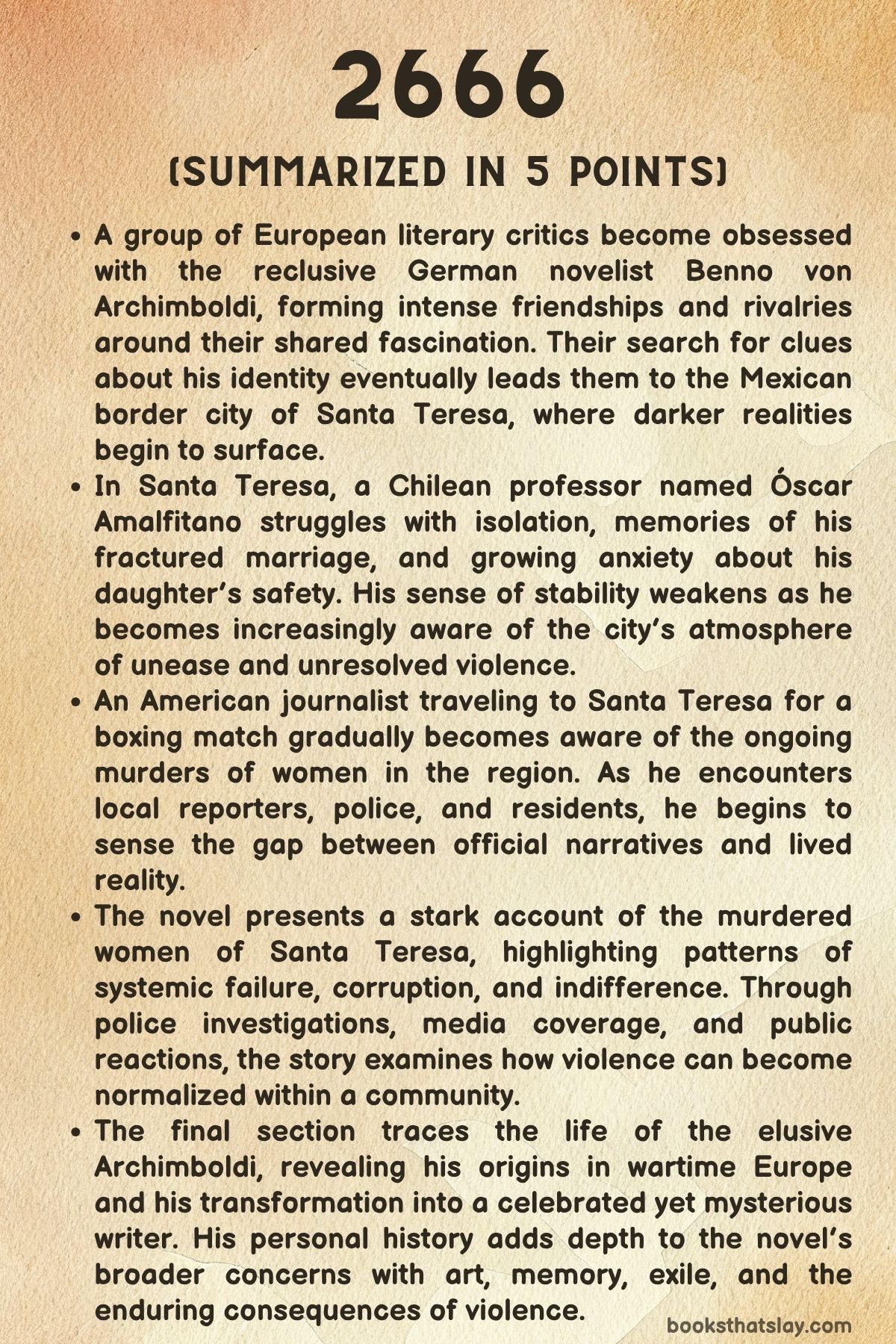
Summary
Four European academics—Jean-Claude Pelletier, Piero Morini, Manuel Espinoza, and Liz Norton—form a tight circle around their shared fixation: the German novelist Benno von Archimboldi, a celebrated writer whose personal life is almost completely unknown. Their careers, reputations, and friendships become organized around conference panels, translations, and gossip about him.
Pelletier, a French professor, builds status as an Archimboldi specialist through scholarship and translation. Morini, an Italian scholar living with multiple sclerosis and using a wheelchair, is equally devoted and well read.
Espinoza, a Spanish academic who once wanted to be a novelist, carries bitterness about his failed ambitions. Norton, younger than the others, is drawn as much by the mystery of Archimboldi’s absence as by the books themselves.
They meet repeatedly at conferences, where rumors flare that Archimboldi will receive the Nobel Prize. The prize never comes, and the writer never appears, but the rumor becomes part of the group’s rhythm.
They trade clues, debate interpretations, and treat the hunt like a competition with other academics. A writer known as the Swabian hints that he once met Archimboldi in South America, and that scrap of information sends the group chasing traces through publishers and intermediaries.
They visit a publisher named Schnell and later meet Mrs. Bubis, who once published Archimboldi’s work. She remembers little beyond his height and presence, offering no direct path to him.
As their search stalls, the group’s private tensions take over. Pelletier and Espinoza both fall for Liz, and their scholarly alliance turns into a romantic contest.
Liz begins sleeping with both men, and the arrangement creates a fragile balance held together by denial and bravado. Morini, increasingly left out, becomes a quieter observer.
He follows news of mass killings of women in northern Mexico, a story that barely registers with the others at first.
Liz’s relationships become unstable. She can’t decide whether she prefers Pelletier or Espinoza, and she also grows tired of the men’s neediness and competitiveness.
Around this time, Morini visits Liz in London after having a disturbing dream. He encounters a threatening stranger in a park, then spends time with her in a gentrified neighborhood whose recent history includes an artist, Edwin Johns, who severed his own hand as part of his art and ended up confined in a Swiss institution.
Morini’s curiosity about Johns leads to a visit to the institution with Pelletier and Espinoza. Morini asks Johns why he cut off his hand, and Johns whispers an answer.
Morini later tells Liz the secret: Johns claims he did it for money, and Morini asks her not to tell the others.
The group’s moral drift becomes clearer after a violent incident in London. In a taxi, their explicit talk irritates the driver, who insults Liz.
Espinoza attacks him brutally. The three flee, frightened of consequences that never arrive.
Afterward, Pelletier and Espinoza sink into shame and agitation, and both begin seeking out sex workers, sometimes together, sometimes alone, as if trying to outrun what they did.
A new lead arrives from Mexico: a young writer claims Archimboldi has been seen in Mexico City, traveling toward the desert city of Santa Teresa. Pelletier, Espinoza, and Liz fly to Mexico, while Morini stays in Italy due to his health.
In Mexico they meet people who tell stories that may be true, may be invented, or may be half true. They chase hotel registers and university contacts, arriving in Santa Teresa, where they find a professor named Óscar Amalfitano, rumored to know something about Archimboldi.
They view Amalfitano as a disappointment, yet he helps them anyway. The city feels tense, and the hotel they stay in produces strange dreams and sleeplessness.
Liz, restless and emotionally raw, has sex with both Pelletier and Espinoza again, but the act settles nothing. Soon she decides to leave Mexico and return to Europe.
Pelletier and Espinoza linger, drinking, reading Archimboldi’s novels, and convincing themselves they are close to the writer. Espinoza begins seeing a young local girl from a market and makes promises he can’t keep.
Liz later sends an email ending her affairs and revealing the truth: she is in love with Morini. Pelletier and Espinoza leave Santa Teresa believing they have been as close to Archimboldi as they will ever get.
Amalfitano’s story begins earlier. A Chilean professor living in exile, he raises his daughter Rosa after his wife, Lola, leaves to chase a poet she once slept with and never stopped longing for.
Lola writes letters describing her search across Spain, her poverty, and her attempt to see the poet in a psychiatric facility. She manages to meet him once, declares her love, and receives almost nothing in return.
Her life becomes a chain of precarious arrangements, including sex with a taxi driver in a cemetery and weeks of hunger and sleeping outdoors. Over time her letters stop.
Years later she writes again from Paris, then reappears briefly in Amalfitano’s life, sick with AIDS and accompanied by a young son, Benoit. She leaves again and vanishes from his world.
Amalfitano takes a job in Santa Teresa and moves there with Rosa. Only after arriving does he understand the city’s reputation: young women are being murdered, and the danger feels both public and ignored.
He begins to experience mental strain—voices in his head, odd dreams, and a compulsion to make diagrams and lists. He hangs a mysterious geometry book on a clothesline as if conducting an experiment on reality itself.
He spends time with colleagues and their families, but connection keeps slipping away. He befriends Marco, the dean’s son, a man who boasts about seeking fights with gay men.
Amalfitano senses madness in the air, in the city, and in himself, and he worries most about Rosa.
A third thread follows Quincy Williams, a journalist from New York who writes under the name Oscar Fate for a Black-focused magazine. After his mother dies and he completes a confused, hurried funeral, he is assigned to cover a boxing match in Mexico because a colleague has been killed.
Fate travels to Santa Teresa and falls in with sports reporters. He becomes more interested in the reports of murdered women than in the fight he is supposed to cover, but his editor refuses to pursue that story.
Fate meets local figures, including a reporter investigating the killings and a group of friends who spend nights drinking and talking. After the match, he meets Rosa Amalfitano, and his attraction to her becomes immediate.
A chaotic night leads to confrontation with men around Rosa, and Fate punches one of them while escaping with her.
Fate’s fear grows when he learns people may be searching for him. He takes Rosa to her father, and Amalfitano quickly understands the risk.
He gives Rosa money and supplies and asks Fate to get her across the border, back toward safety. Before leaving, Fate keeps a promise to accompany a reporter to a prison interview with Klaus Haas, the main suspect in the murders.
Fate and Rosa meet Haas—tall, composed, and imprisoned while the killings continue. Then Fate drives Rosa north and crosses into the United States with her, leaving Santa Teresa behind but not leaving its shadow.
The city’s shadow is shown in stark detail through the record of murdered women from the early 1990s into the end of 1997. Bodies appear in desert lots, dumps, vacant buildings, and shallow graves; many victims are raped, strangled, or mutilated.
Investigations collapse through corruption, indifference, incompetence, and fear. Evidence goes missing.
Confessions are forced. Suspects are used to close cases rather than solve them.
Police officers, journalists, families, activists, and opportunists orbit the crimes, each pulled between outrage and resignation.
Within this landscape, several investigations unfold. An inspector, Juan de Dios Martínez, works cases while beginning a relationship with Elvira Campos, the director of a mental health facility.
Their intimacy exists alongside exhaustion and despair. Another case involves a church vandal known as the Penitent, whose violence seems separate from the murders yet occupies police attention and resources.
A young recruit, Olegario Cura, called Lalo, is drawn from poverty into the orbit of narcotraffickers and police power. He tries to behave professionally in a system that mocks professionalism, learning early that procedure is treated as theater.
Klaus Haas enters as a plausible villain: a German-born American living in Santa Teresa, with prior sex-related offenses on record. He is arrested, beaten, and held for years as his trial stalls.
In prison he becomes dangerous and influential, buying protection, trading contraband, manipulating the spectacle of his own case through press conferences. He claims innocence and offers alternative names, including wealthy men who seem untouchable.
While officials try to frame the murders as the work of one monster, the killings keep coming, sometimes fitting patterns, sometimes not, suggesting a reality too sprawling for a neat solution. Activists protest, rumors of snuff films circulate, reporters disappear, and official assurances keep changing shape to fit the latest public relations need.
Finally, the novel reveals the origin of Archimboldi. He is Hans Reiter, born in Prussia in 1920, a tall boy fascinated by water, shaped by poverty and the approach of war.
He is drafted into the German army and survives the Eastern Front, wounded and temporarily unable to speak. In an abandoned Russian village he finds the hidden writings of a Jewish man, Boris Abramovich Ansky, and becomes obsessed with reading.
These pages—full of biographies, literary references, and desperate notes—introduce him to the painter Arcimboldo, a name that later becomes part of his chosen identity.
After the war Hans is held in a camp, where he meets men haunted by their own crimes. He later admits to killing one such man, a bureaucrat implicated in mass murder, and carries the burden without seeking redemption.
In ruined postwar Cologne he meets Ingeborg Bauer, a woman from his past who insists he remember a promise he made. They become lovers, and she moves into his life.
Hans begins to write seriously, adopting the pseudonym Benno von Archimboldi as he types his first novel on a rented machine. A Jewish publisher, Mr. Bubis, recognizes the manuscript’s strange power and publishes it, then continues publishing Archimboldi’s books even when sales are modest.
Archimboldi’s career grows into cult status, while his personal life narrows around Ingeborg’s illness and death.
As Archimboldi becomes more famous, he also becomes harder to reach, traveling, sending manuscripts from scattered addresses, and staying mostly out of view. The story turns to his sister Lotte, who marries and has a son, Klaus Haas—the same man later accused in Santa Teresa.
When Klaus is arrested in Mexico, Lotte struggles to help him as the legal process drags on. She eventually reads an Archimboldi novel and recognizes scenes from her childhood, realizing the missing writer is her brother.
She contacts Mrs. Bubis, and Archimboldi returns to Germany to see Lotte. Learning what has happened to her son, he decides to go to Mexico to handle it.
He sets off toward Santa Teresa, the place where his shadow has been waiting all along.
Characters
Benno von Archimboldi / Hans Reiter
Hans Reiter, who later adopts the name Benno von Archimboldi, stands at the novel’s center as both absence and origin. As a child in Prussia, he is marked by physical difference—his unusual height—and by a private, almost mystical fascination with water and hidden depths.
That early attraction to what lies beneath the surface mirrors his later life as a writer who conceals himself behind a pseudonym. War shapes him profoundly.
On the Eastern Front he witnesses brutality, survives near death, and encounters the hidden writings of Boris Ansky, which ignite his intellectual awakening. Literature becomes not just vocation but refuge and transformation.
After the war, he chooses anonymity, as if protecting himself from both history and accountability. His admission that he killed a man in a prison camp complicates him morally; he is neither hero nor simple witness but a participant in violence who carries it silently.
As Archimboldi, he becomes an enigmatic author whose work circulates widely while he retreats further from public life. His decision to travel to Mexico at the end suggests a late return to responsibility, drawn by family ties to Klaus Haas and by the unresolved darkness that has followed his name.
Jean-Claude Pelletier
Pelletier embodies intellectual ambition and romantic self-deception. As a French scholar who builds his career around Archimboldi, he treats literature as both calling and ladder.
His devotion to the writer borders on fetishistic, and his scholarly pursuit often masks a hunger for prestige. Emotionally, he reveals insecurity beneath confidence.
His rivalry with Espinoza over Liz Norton exposes his possessiveness and competitiveness, traits that contrast with his cultivated academic persona. The violent incident with the taxi driver in London reveals how thin his civility is; beneath intellectual refinement lies a capacity for cruelty and cowardice.
In Mexico, he clings to the belief that proximity to Santa Teresa brings him closer to Archimboldi, even as the city’s real suffering remains secondary to his obsession. Pelletier’s arc reveals how intellectual life can become insulated from moral urgency.
Manuel Espinoza
Espinoza is driven by resentment as much as by admiration. Once an aspiring writer, he turned to academia after disappointment, and that compromise lingers within him as bitterness.
His fascination with Archimboldi partly expresses admiration but also a displaced longing for literary greatness. In relationships, he is volatile and possessive.
His violence against the taxi driver signals a temper that erupts when pride is wounded. In Santa Teresa, his relationship with a young local girl underscores his moral blindness and exploitative tendencies; he treats the encounter as romantic possibility while ignoring its imbalance of power.
Espinoza’s struggle is not simply romantic or professional but existential—he senses that he is living a diminished version of the life he imagined, and that frustration leaks into his behavior.
Liz Norton
Liz Norton serves as both catalyst and counterpoint to the male critics. Intelligent, independent, and self-aware, she initially appears to move fluidly among her colleagues without being consumed by rivalry.
Yet she is not immune to uncertainty. Her simultaneous relationships with Pelletier and Espinoza reflect experimentation as well as indecision, and she refuses to reduce herself to their expectations.
Her abrupt shifts—ending affairs, joking about a ménage à trois, leaving Mexico—signal a desire for autonomy rather than confusion. Ultimately, her declaration of love for Morini reveals depth beneath her outward composure.
Liz sees more clearly than the others the limits of their obsession, and her withdrawal suggests moral fatigue. She is less interested in chasing Archimboldi than in preserving her own sense of self.
Piero Morini
Morini stands apart from the other critics through physical vulnerability and emotional steadiness. Living with multiple sclerosis, he experiences isolation that sharpens his sensitivity.
His interest in Archimboldi is genuine but less performative than that of Pelletier and Espinoza. He approaches literature contemplatively rather than competitively.
His visit to Edwin Johns in the Swiss institution and his private conversation about self-mutilation suggest a fascination with artistic extremity and authenticity. Morini’s quiet love for Liz and her eventual reciprocation position him as the moral center of the quartet.
He does not participate in the London violence, and he remains distant from the sexual rivalries. His physical limitations contrast with his emotional clarity, emphasizing that strength in the novel often lies in restraint rather than dominance.
Óscar Amalfitano
Amalfitano represents intellectual displacement and creeping psychological fragmentation. A Chilean exile, abandoned by his wife Lola, he carries the weight of failed relationships and political dislocation.
His move to Santa Teresa places him in a city defined by relentless violence against women, and he becomes consumed by anxiety for his daughter Rosa. His strange behaviors—hanging a geometry book on a clothesline, drawing diagrams, hearing voices—reflect both mental strain and philosophical desperation.
He is a thinker trying to impose structure on chaos. The voice he hears, possibly imagined ancestors, connects personal history to inherited prejudice and trauma.
Amalfitano’s fragility underscores the corrosive effect of living amid unacknowledged horror. He senses the city’s curse before he fully understands it.
Rosa Amalfitano
Rosa moves from peripheral figure to embodiment of vulnerability. As Amalfitano’s daughter, she is both cherished and endangered.
Young, curious, and drawn toward risk, she becomes entangled with men linked to crime and drugs. Her attraction to that world suggests a desire to escape the stifling anxiety of her father’s household.
Yet she is not naïve; she recognizes the instability of her relationships. Her night with Fate marks a turning point, as she chooses escape over continued exposure to danger.
Rosa’s presence in Santa Teresa symbolizes the broader peril faced by young women in the city. Her departure across the border becomes a rare instance of survival within a narrative dominated by loss.
Oscar Fate / Quincy Williams
Fate operates as outsider and observer. A journalist from New York assigned to cover a boxing match, he gradually becomes aware of the deeper crisis in Santa Teresa.
His initial detachment gives way to curiosity and moral unease. He wants to pursue the story of the murdered women but is restrained by editorial priorities, revealing the limits of institutional journalism.
His attraction to Rosa adds urgency to his stay; his protective impulse contrasts with the indifference shown by many locals and officials. Fate’s decision to help Rosa escape demonstrates personal courage, though it does not resolve the larger tragedy.
He leaves Santa Teresa changed, aware that the world’s violence cannot be reduced to a single article.
Klaus Haas
Klaus Haas embodies ambiguity and menace. Tall, blond, and foreign in appearance, he becomes the most visible suspect in the Santa Teresa murders.
His prior record and aloof demeanor make him an easy villain. In prison, he proves manipulative and strategic, cultivating alliances with drug traffickers and staging press conferences to assert innocence.
Whether he is responsible for some, all, or none of the murders remains unresolved, which amplifies his symbolic role. He represents the desire for a single monster who can contain collective guilt.
His connection to Archimboldi through family lineage complicates that symbolism, suggesting that violence and mystery run along unexpected lines of inheritance.
Juan de Dios Martínez
Inspector Martínez represents a weary attempt at integrity within a compromised system. He works cases diligently and forms a relationship with Elvira Campos, seeking intimacy amid professional frustration.
He senses inconsistencies in official narratives and doubts the easy closure offered by confessions or scapegoats. Yet he remains limited by bureaucracy and corruption.
Martínez’s desire for emotional connection with Elvira parallels his desire for clarity in investigations—both are partially fulfilled and partially denied. His character reflects the strain of trying to remain ethical in a structure that rewards expediency over truth.
Sergio González
Sergio González, the journalist covering the murders, embodies persistence in the face of indifference. Initially assigned to peripheral stories, he gradually pushes to investigate the killings seriously.
His work exposes resistance from editors and officials who prefer silence. Sergio’s interviews with activists, politicians, and Haas himself show his commitment to assembling fragments of truth.
Yet he also confronts the impossibility of definitive answers. His determination contrasts with the apathy surrounding him, positioning him as one of the few figures attempting to document rather than escape the horror.
Lola
Lola, Amalfitano’s wife, is driven by obsession and restlessness. Her pursuit of a poet she once loved reveals romantic idealism shading into self-destruction.
Her letters chart a life of instability—poverty, fleeting relationships, illness. Her eventual return, sick with AIDS and accompanied by a child, underscores the cost of her choices.
Yet she is not portrayed simply as irresponsible; she is searching for meaning in a world that repeatedly disappoints her. Lola’s trajectory parallels other quests in the novel, including the critics’ hunt for Archimboldi, suggesting that longing often leads not to revelation but to fragmentation.
Boris Ansky
Boris Ansky appears through his hidden writings discovered by Hans Reiter during the war. A Jewish intellectual navigating Soviet politics, Ansky’s life is marked by ideological tension and artistic struggle.
His fragmented notes introduce Hans to broader literary traditions and to the painter Arcimboldo. Though physically absent from much of the narrative, Ansky’s influence is profound.
He represents suppressed voices and lost histories, reminding readers that literature can survive even when its author does not. Through Ansky, the novel links personal awakening to collective catastrophe.
Ingeborg Bauer
Ingeborg is Hans Reiter’s partner and emotional anchor during his postwar transformation into Archimboldi. Their relationship is passionate and marked by intimacy that resists shame.
Ingeborg’s illness and eventual death deepen Hans’s retreat from ordinary life. She encourages his writing and shares in his fragile stability.
Her presence humanizes him, grounding the enigmatic writer in tenderness and vulnerability. After her death, his increasing isolation suggests that she was the last strong tie to his former self.
Lotte Reiter
Lotte, Hans’s younger sister, bridges past and present. Her life in Germany unfolds separately from her brother’s literary ascent, yet their bond remains latent.
As mother to Klaus Haas, she becomes entangled in the Santa Teresa tragedy. Her discovery that Archimboldi is her brother reconnects family and myth.
Lotte’s persistence in supporting her son, despite uncertainty about his guilt, reflects familial loyalty complicated by doubt. Through her, the narrative emphasizes that the consequences of violence ripple outward into ordinary domestic lives.
Themes
Obsession and the Search for Meaning
Across 2666, characters are driven by obsessions that promise clarity but often produce distortion. The European critics dedicate their professional and emotional lives to tracking the elusive writer Archimboldi.
Their pursuit begins as literary admiration but gradually becomes a substitute for intimacy, moral awareness, and even identity. Archimboldi’s absence allows them to project fantasies onto him, turning him into a symbol of ultimate artistic authority.
In chasing him across conferences and continents, they reveal how obsession narrows perception. Even when they arrive in Santa Teresa—a city defined by the systematic murder of women—they remain focused on the possibility that Archimboldi might be nearby.
The search becomes less about literature and more about validation, prestige, and belonging.
This pattern repeats elsewhere. Lola’s fixation on the poet she once loved consumes her life, leading her into poverty, illness, and estrangement from her family.
Amalfitano becomes obsessed with patterns, geometry, and the mysterious voice in his head, as if intellectual structure might protect him from the chaos surrounding his daughter. Even journalists such as Sergio González pursue fragments of truth with a persistence that borders on compulsion, compelled to record what others ignore.
Obsession in the novel is double-edged: it can produce art, insight, and commitment, but it can also serve as escape. The relentless search for meaning—whether in literature, love, or crime—reveals a human desire to impose coherence on a world that resists explanation.
Instead of resolution, most searches end with partial answers or unsettling ambiguity, suggesting that the need to search may matter more than what is found.
Violence, Gender, and Systemic Indifference
The murders in Santa Teresa form the moral core of 2666, exposing violence not as isolated horror but as an ongoing social condition. The detailed cataloging of murdered women refuses to treat them as anonymous statistics, yet the sheer number of victims creates a chilling accumulation.
Patterns appear—young women, often poor, often migrants—yet investigations falter through incompetence, corruption, or deliberate neglect. Officials shift narratives to fit political convenience, sometimes attributing crimes to a single suspect, sometimes to gangs, sometimes to random criminals.
The effect is a system that absorbs violence without addressing its roots.
Gender shapes this violence profoundly. The victims are overwhelmingly female, and their bodies become sites of power, exploitation, and spectacle.
Rumors of snuff films, brothel networks, and parties for wealthy men suggest an economy built on the commodification of women. At the same time, everyday misogyny surfaces in police culture, in casual jokes, and in Marco’s open hostility toward gay men and perceived weakness.
Rosa Amalfitano’s vulnerability underscores the precariousness of simply existing as a young woman in Santa Teresa. The novel refuses to isolate violence within a single monstrous figure; even Klaus Haas, the most obvious suspect, cannot contain the breadth of the crimes.
By showing murders continuing during his imprisonment, the narrative emphasizes systemic failure rather than individual pathology. Violence becomes normalized through repetition, and indifference becomes as dangerous as the killers themselves.
The result is an unsettling portrait of a society where horror coexists with routine life.
Art, Literature, and Moral Responsibility
Art in 2666 is both refuge and problem. Archimboldi’s novels generate devotion among critics who treat literature as sacred.
For them, reading and interpreting become ways of constructing identity and community. Yet their intense focus on art raises uncomfortable questions about detachment.
While they debate textual nuance, real violence unfolds in Santa Teresa. The contrast suggests that aesthetic passion can coexist with moral blindness.
The critics’ intellectualism does not necessarily translate into ethical engagement.
Archimboldi himself embodies this tension. His transformation from Hans Reiter, a soldier shaped by war, into a reclusive author implies that writing can emerge from trauma.
His encounter with Ansky’s hidden manuscripts demonstrates literature’s capacity to survive oppression and inspire change. At the same time, Archimboldi withdraws from public life, avoiding accountability and visibility.
His anonymity grants him freedom but also distance from consequences. Other figures complicate the theme further: Edwin Johns mutilates himself in pursuit of artistic statement; journalists struggle to convince editors that documenting violence matters.
Art appears as both preservation and escape, capable of confronting horror yet also capable of ignoring it. The novel does not offer a simple endorsement or condemnation of literature.
Instead, it presents art as a force that shapes perception and memory, raising the question of whether creating beauty or narrative can meaningfully respond to collective suffering.
Exile, Displacement, and Fragmented Identity
Movement across borders defines the lives of many characters. Amalfitano leaves Chile for Mexico, carrying political exile and personal abandonment with him.
Archimboldi moves from Prussia to the Eastern Front, from prison camps to postwar Germany, then across Europe and eventually toward Mexico. Fate travels from New York to Santa Teresa and back again, never fully belonging in either place.
These migrations create identities built on fracture rather than continuity. Characters rarely experience stable homes; instead, they exist in temporary arrangements shaped by war, economic necessity, or emotional escape.
Displacement also affects perception. Amalfitano’s sense of unreality in Santa Teresa intensifies his mental instability.
The city feels alien and threatening, and his fear for Rosa reflects a father’s anxiety compounded by cultural estrangement. Archimboldi’s pseudonym functions as a form of self-exile, separating Hans Reiter from his past and allowing him to navigate postwar Europe without confronting his full history.
Lotte’s journey to Mexico to support her son confronts her with a landscape far removed from her German upbringing, forcing her to confront the global reach of violence.
Identity in the novel is therefore unstable. Names change, languages shift, allegiances fracture.
Even Santa Teresa, modeled on a real border city, embodies the tension between nations, economies, and cultures. The border itself becomes symbolic—a line that promises safety yet cannot erase trauma.
Through constant movement and fractured belonging, 2666 suggests that modern identity is shaped less by rootedness than by displacement, and that such instability can produce both creativity and profound alienation.