55 Miles to the Gas Pump Summary, Characters and Themes
55 Miles to the Gas Pump by Annie Proulx is a brief yet unsettling short story from her collection Close Range: Wyoming Stories. Set in rural Wyoming, it presents a stark portrait of isolation and its corrosive effects.
In only a few paragraphs, Proulx sketches the life and death of Rancher Croom, a man whose rough eccentricity hides something far darker. The story’s spare structure and dry tone contrast sharply with its shocking revelations. Through vivid imagery and dark irony, Proulx examines loneliness, secrecy, violence, and the grim consequences of lives lived far from scrutiny or connection.
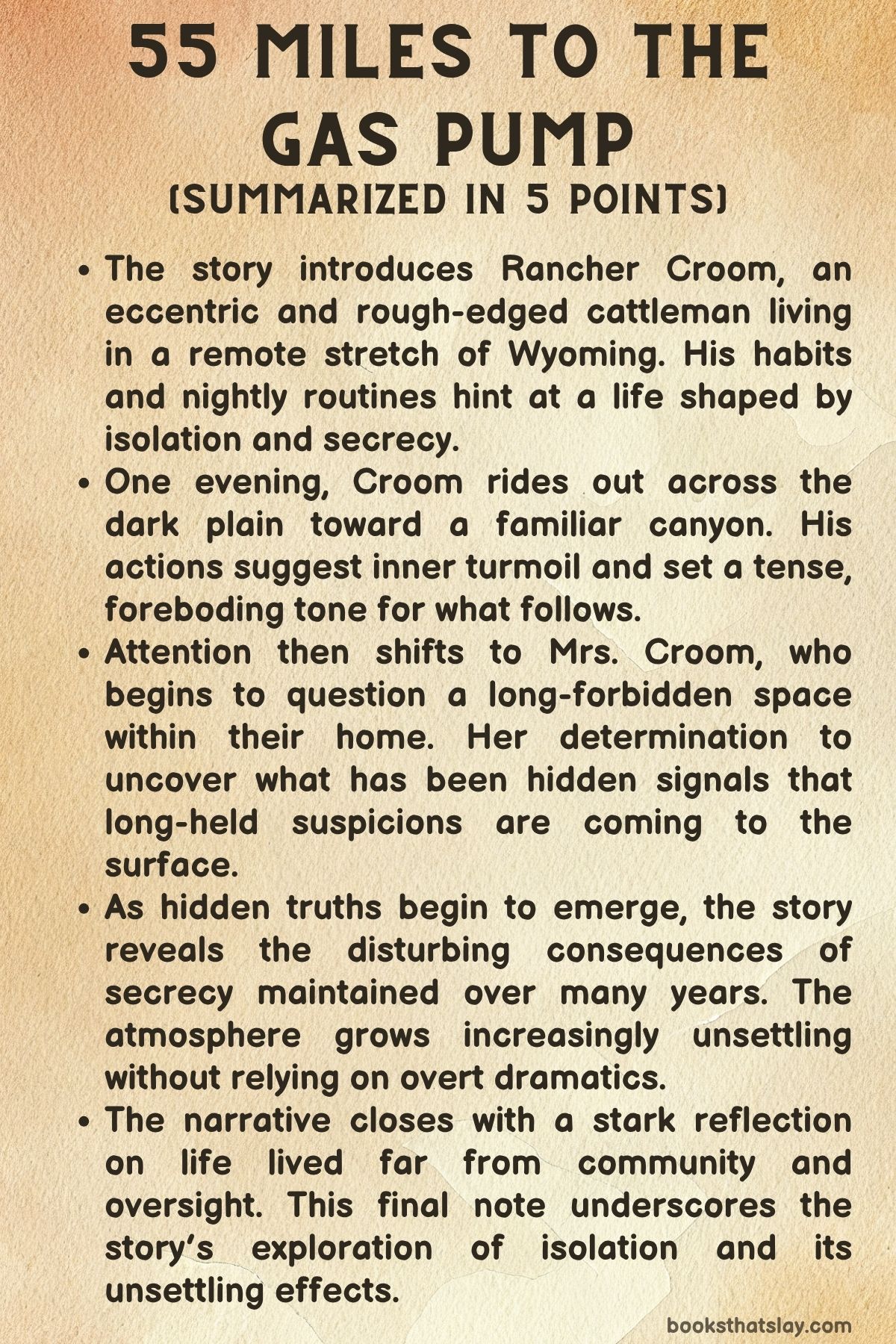
Summary
The story opens with a portrait of Rancher Croom, a disheveled cattleman known for his handmade boots, filthy hat, and wandering eye. He is a strange and restless figure, given to brewing his own cloudy beer that foams over in bottles and to dancing energetically on rough boards or down cellar steps.
Though these details suggest eccentricity and rough vitality, there is an undercurrent of instability in his character. One night, drunk and riding hard across the dark Wyoming plain, Croom turns his horse toward a familiar canyon.
He dismounts at the cliff’s edge and looks down at the broken rocks below. After a pause, he steps off the brink with a roar, arms flailing as he falls.
Yet instead of describing his body striking the ground, the narration offers a surreal image: before he hits, he rises again to the top of the cliff like a cork bobbing in milk. This strange detail interrupts the expected finality of his suicide, suspending the moment between death and return.
The focus then shifts abruptly to Mrs. Croom. She is on the roof of their isolated ranch house, sawing into the attic, a space her husband had kept locked for twelve years.
He had barred her from entering, securing it with padlocks and issuing warnings. Now, after his death, she acts on a long-held suspicion.
Sweating with effort, she exchanges the saw for a chisel and hammer, prying loose a section large enough to peer inside. What she sees confirms what she has apparently suspected for years.
Inside the attic lie the bodies of several women. Mrs. Croom recognizes them from newspaper photographs accompanying missing persons notices.
The women had once been reported as missing, and now their corpses are hidden above her head. The bodies are in varying states of decay.
Some are dried and darkened like jerky; others are moldy from exposure to roof leaks. All bear signs of rough treatment.
There are tarry handprints and the marks of boot heels pressed into their remains. Traces of bright blue paint from old shutters stain some of them.
One corpse is wrapped in newspaper from nipple to knee, a chilling detail that underscores both concealment and violation.
The narrative does not describe Mrs. Croom’s emotional reaction. There is no expression of horror, grief, or shock.
Instead, the story ends with a single detached sentence: “When you live a long way out you make your own fun.” This line casts a grim shadow over everything that precedes it. It suggests that in extreme isolation, ordinary boundaries erode.
Cut off from community, oversight, and meaningful human contact, Croom created his own entertainment in monstrous ways. The statement is blunt and almost casual, intensifying its impact.
By closing on this note, the story frames Croom’s crimes not as sudden madness but as a product of a harsh environment where loneliness, secrecy, and rigid roles can fester unchecked.
Characters
Rancher Croom
Rancher Croom is the central figure in 55 Miles to the Gas Pump, and his character is defined through striking physical detail and shocking revelation. At first glance, he appears as an eccentric, rough-edged Wyoming cattleman—disheveled, walleyed, dressed in handmade boots and a filthy hat.
He brews his own beer, dances with surprising agility, and rides recklessly across the plains at night. These traits create an image of a man who is coarse yet energetic, someone shaped by isolation and hard living.
However, this outward strangeness masks a far more sinister reality. His suicide at the canyon suggests despair, guilt, or an attempt to escape exposure, yet the narrative denies him even the finality of impact, suspending his fall in a surreal image.
This refusal to grant him a straightforward death mirrors the moral distortion of his life.
The discovery of murdered women in his attic redefines everything about him. He is revealed as a serial killer who concealed his crimes for years within his own home.
The physical evidence—boot marks, tarry handprints, paint stains—points to brutality and a sense of ownership over his victims. The attic, locked for twelve years, becomes a symbol of his hidden violence and the secret life he maintained alongside his marriage.
Croom embodies the dangerous consequences of unchecked isolation and rigid masculinity. His need to dominate and control is expressed not only in his crimes but in the authority he exerts over his wife by forbidding her access to the attic.
He is both absurd in his eccentricities and horrifying in his cruelty, a man whose loneliness curdles into predation.
Mrs. Croom
Mrs. Croom occupies far less narrative space, yet her presence is deeply significant. For twelve years she has been barred from entering the attic by her husband’s locks and warnings.
Her eventual act of climbing onto the roof and cutting her way inside suggests long-standing suspicion. The effort she expends—sawing, chiseling, hammering—reflects determination rather than impulsive curiosity.
When she peers inside and sees the corpses, she is not portrayed as shocked or confused. Instead, the narration implies confirmation: she sees exactly what she expected.
This calm recognition suggests that she may have known or at least suspected her husband’s crimes for years but felt powerless to confront them.
Mrs. Croom’s silence is striking. The narrative does not describe her emotional response, leaving readers to infer her internal state.
Her position within the marriage reflects the rigid gender hierarchy of their remote setting. She has lived under her husband’s authority, respecting his padlocks and prohibitions for over a decade.
Only after his death does she act. This delay underscores her limited agency within the confines of her environment and marriage.
At the same time, her methodical entry into the attic reveals strength and resolve. She becomes a witness to the truth, the one who uncovers and confirms the horror hidden above her living space.
Through her, the story highlights how isolation can trap not only perpetrators but also those forced to live alongside them.
The Murdered Women
The murdered women appear only as bodies in the attic, yet they represent the story’s most tragic dimension. Identified through newspaper photographs as missing persons, they once had lives beyond the ranch.
Their reduced state—desiccated, moldy, marked by boot heels and handprints—emphasizes how completely they have been stripped of identity and dignity. The detail that Mrs. Croom recognizes them from missing woman notices suggests that their disappearances were publicly known, yet the vast distances and isolation of the setting allowed the crimes to remain unsolved.
Their varied states of decay reflect the passage of time and the sustained nature of Croom’s violence. One body wrapped in newspaper adds a layer of bitter irony, as the medium that once announced her disappearance becomes part of her concealment.
Though they do not speak or act within the narrative, their presence exposes the depth of Croom’s depravity and the failure of social structures to protect them. They stand as silent evidence of exploitation and vulnerability in a landscape where distance shields wrongdoing.
Through these women, the story confronts the cost of isolation and the way violence can persist unnoticed when communities are fractured and far apart.
Themes
Isolation and Moral Decay
The physical remoteness of rural Wyoming shapes every event in 55 Miles to the Gas Pump, creating conditions where secrecy thrives and accountability weakens. The final line, stating that when one lives a long way out one makes one’s own fun, frames isolation not merely as a backdrop but as a force that distorts moral judgment.
Rancher Croom’s crimes occur in a setting far removed from neighbors, law enforcement, and communal oversight. Distance becomes a shield, allowing violence to remain hidden in plain sight.
The attic, locked and elevated above the domestic space, functions as a symbol of concealed corruption made possible by geographic and emotional separation.
Isolation in the story operates on multiple levels. There is the vast physical distance from town, suggested by the title’s reference to miles needed to reach something as basic as a gas pump.
There is also emotional isolation within the marriage. Mrs. Croom lives under the same roof as her husband yet remains barred from a crucial part of the house for twelve years.
Her exclusion signals a deeper separation between them, one reinforced by secrecy and silence. This estrangement reflects how isolation can exist even in shared spaces.
The environment does not excuse Croom’s actions, but it amplifies them. Without meaningful social bonds or scrutiny, his impulses go unchecked.
The story suggests that prolonged solitude can warp perception, making cruelty seem like private entertainment rather than crime. The casual tone of the closing line underscores the normalization of horror in a context where few witnesses exist.
Through this stark portrayal, the narrative presents isolation as a corrosive force that erodes empathy, encourages domination, and allows violence to persist without interruption.
Violence and Control
Control defines Rancher Croom’s interactions with both his wife and his victims. The locked attic represents more than secrecy; it represents authority.
For twelve years, Mrs. Croom obeys his command not to enter that space. His power within the household mirrors the dominance he exerts over the women he murders.
The physical marks described on the corpses—boot heels, tarry handprints, paint stains—reveal brutality and ownership. These traces show that violence in the story is not random but deliberate and sustained, an assertion of mastery over vulnerable bodies.
The narrative offers no dramatic confrontation or moral reckoning. Instead, it presents violence in a matter-of-fact tone.
This restraint intensifies its impact. By refusing to dramatize or sensationalize the crimes, the story emphasizes how normalized such domination can become in environments structured by rigid hierarchies.
Croom’s identity as a rancher also carries symbolic weight. Ranching involves control over land and animals, and that mindset of possession appears to extend grotesquely into his treatment of women.
His victims are described as “paramours,” a term that falsely softens the reality of assault and murder, suggesting how language itself can obscure brutality.
Mrs. Croom’s delayed action also reflects the pervasive nature of control. She does not challenge her husband during his lifetime, which points to the strength of his authority and perhaps to social norms that discourage confrontation.
Only after his death does she assert physical control over the attic by cutting through it from above. This reversal is quiet but significant.
The theme of violence in the story is not limited to physical harm; it includes psychological dominance, silencing, and confinement. Through these elements, the narrative examines how unchecked authority fosters cruelty and how control, once established, can shape an entire household.
Death and Denial
Death is present from the opening image of Rancher Croom stepping off a cliff. Yet the narration resists depicting the expected impact.
Instead, Croom rises again to the cliff’s edge like a cork. This surreal detail interrupts the natural finality of suicide.
It creates a sense that death cannot fully contain or resolve what he has done. His body does not simply strike the rocks and end the story.
Instead, the image suggests evasion, as if he escapes the consequences of his fall just as he evaded justice during his life.
The attic scene deepens the theme of death by revealing that Croom has turned his home into a hidden grave. The corpses are described in varying states of decay, emphasizing time’s passage and the persistence of mortality.
Some bodies are dried and hardened, others moldy from roof leaks. These details make death tangible and ongoing rather than abstract.
The attic preserves evidence of multiple lives cut short, yet it also preserves Croom’s denial. By locking the space and forbidding access, he attempts to compartmentalize his crimes, keeping death above but separate from daily life.
Mrs. Croom’s reaction, or lack of overt reaction, adds another dimension. The story does not record her grief, horror, or outrage.
This emotional restraint mirrors the suspension in Croom’s fall. Both moments resist conventional expressions of finality.
Death in the story is not cathartic or redemptive. It is unresolved and unsettling.
Even the closing line carries a chilling acceptance, as if death and violence are part of the landscape. The narrative suggests that denial does not erase wrongdoing; it merely postpones its revelation.
Death lingers in the house, in memory, and in the reader’s awareness, refusing to be neatly contained.
The Distortion of Gender Roles
The story reflects a world governed by rigid expectations about masculinity and femininity. Rancher Croom embodies a version of masculinity defined by toughness, independence, and authority.
His identity as a cattleman, his physical roughness, and his command over the household align with traditional images of male dominance in rural settings. Yet this exaggerated masculinity becomes destructive.
His need to control space and bodies reveals how such norms can foster entitlement and aggression.
Mrs. Croom’s role contrasts sharply with her husband’s. She complies with his prohibitions for twelve years, respecting the locked attic and his warnings.
Her obedience reflects social conditioning that discourages challenging male authority. The marriage appears structured around silence and hierarchy rather than partnership.
Only after Croom’s death does she act decisively. Her climb onto the roof and physical effort to breach the attic signify a reclaiming of agency, though it occurs in the aftermath of tragedy rather than as prevention.
The murdered women further illuminate this theme. They are identified primarily through their status as missing women and as victims.
Their individuality has been erased by violence. The term used to describe them implies romantic involvement, yet the evidence of assault contradicts any suggestion of consent.
This discrepancy highlights how language can mask exploitation and how women’s experiences are often reframed to minimize male wrongdoing.
By presenting these dynamics without overt commentary, the narrative exposes how entrenched gender expectations can enable abuse. Authority granted to men without accountability and compliance expected from women without protection create a structure in which violence can flourish.
The remote setting intensifies these patterns, but the underlying critique extends beyond geography. Through its stark portrayal of power and submission, the story reveals how distorted gender roles contribute to secrecy, harm, and silence.